steering VOLVO S80 2016 Owner´s Manual
[x] Cancel search | Manufacturer: VOLVO, Model Year: 2016, Model line: S80, Model: VOLVO S80 2016Pages: 380, PDF Size: 9.45 MB
Page 5 of 380
Contents
* Option/accessory, for more information, see Introduction.3
03
03 Instruments and controls
Instrument overview ................................. 59
Information displays – introduction........... 62
Eco Guide* and Power Meter*.................. 65
Information displays – indicator symbols. 66
Information displays – warning symbols... 68
My Car – introduction............................... 70Information displays – ambient tempera-
ture sensor................................................ 71 Information displays – trip odometer and
clock......................................................... 72
Inserting/removing remote key................. 72
Ignition modes.......................................... 73
Front seats................................................ 74
Front seats – folding backrest*................. 75
Front seats – power seat.......................... 75Key memory – power driver's seat* and
door mirrors.............................................. 77
Rear seats – head restraints..................... 78
Rear seats – folding backrest................... 80
Steering wheel.......................................... 81
Electrically heated* steering wheel........... 82
Lighting panel........................................... 82
High/low beam headlights........................ 83
Active high beams (AHB)*......................... 84
03
Tunnel detection (models with the rain
sensor* only)............................................. 85
Active Bending Lights (ABL)*.................... 85
Auxiliary lights*.......................................... 86
Instrument and "theater" lighting.............. 86
Parking lights............................................ 87
Rear fog lights........................................... 87
Hazard warning flashers........................... 88
Turn signals............................................... 88
Front interior lighting................................. 89
Rear interior lighting.................................. 90
Home safe lighting.................................... 90
Approach lighting...................................... 91
Windshield wipers..................................... 91
Rain sensor*.............................................. 92
Windshield washer.................................... 92
Tailgate wiper/washer............................... 93
Power windows......................................... 94
Sun shades*.............................................. 95
Power door mirrors................................... 96Power door mirrors – automatic tilting/
retraction................................................... 97 Heated windshield*, rear window and
door mirror defrosters............................... 98
03
Interior rearview mirror.............................. 98
Digital compass*....................................... 99
Power moonroof – introduction.............. 100
Power moonroof – operation.................. 101 HomeLink ®
Wireless Control System* –
introduction............................................. 102HomeLink ®
Wireless Control System* –
programming........................................... 103
Volvo Sensus.......................................... 105
Information display – menu controls....... 106
Information display – menu overview..... 107
Information display – messages............. 107
Trip computer – introduction ................. 109Trip computer – functions, analog instru-
ment panel.............................................. 110 Trip computer – functions, digital instru-
ment panel.............................................. 113 Trip computer – Supplementary informa-
tion.......................................................... 115
Trip computer – Trip statistics................ 116
Page 7 of 380
Contents
* Option/accessory, for more information, see Introduction.5
06
Locking/unlocking – trunk....................... 156
Alarm – general information.................... 157
Alarm indicator........................................ 158
Alarm – arming/disarming....................... 158
Alarm signal............................................ 159
Alarm – turning off................................... 159
Alarm-related functions........................... 160
07
07 Driver support
Active chassis* (Four C).......................... 162
Stability system – introduction................ 162
Stability system – operation.................... 163Stability system – symbols and mes-
sages....................................................... 164
Adjustable steering force*....................... 166 Road Sign Information (RSI)* – introduc-
tion.......................................................... 166
Road Sign Information (RSI) – operation 167
Road Sign Information (RSI) – limitations 167
Cruise control (CC) – introduction.......... 168Cruise control (CC) – engaging and set-
ting speed............................................... 168 Toggling between ACC and CC (stand-
ard Cruise Control).................................. 170
Cruise control (CC) – deactivating.......... 170
Adaptive Cruise Control – introduction... 171
Adaptive Cruise Control – function......... 172
Adaptive Cruise Control – engaging....... 174
Adaptive Cruise Control – setting speed 175Adaptive Cruise Control – setting time
interval..................................................... 176
Adaptive Cruise Control – deactivating.. 176Adaptive Cruise Control – passing
another vehicle........................................ 178
07
Adaptive Cruise Control (ACC) – Queue
Assist...................................................... 178
Radar sensor........................................... 180
Adaptive Cruise Control – limitations...... 180Adaptive Cruise Control – symbols and
messages................................................ 182 Adaptive Cruise Control – troubleshoot-
ing........................................................... 184
Distance Alert – introduction................... 185
Distance Alert – operation....................... 185
Distance Alert – limitations...................... 186
Distance Alert – symbols and messages 188
City Safety – introduction........................ 189
City Safety – function.............................. 190
City Safety – operation............................ 191
City Safety – limitations.......................... 191
City Safety – troubleshooting.................. 192
City Safety – symbols and messages..... 194
City Safety – Laser sensor...................... 195
Collision warning – introduction.............. 196
Collision warning* – function................... 198
Collision warning* – operation................ 199
Collision warning* – Cyclist detection..... 200Collision warning* – Pedestrian detec-
tion.......................................................... 201
Page 10 of 380
Contents
8
10
10 Maintenance and servicing
Maintenance – introduction.................... 307
Maintenance – owner maintenance........ 308
Maintenance – hoisting........................... 309
Onboard Diagnostic System................... 310
Booking service and repairs .................. 310
Maintenance – opening/closing hood..... 312
Engine compartment – overview............ 313
Engine compartment – engine oil........... 314
Engine compartment – coolant............... 316
Engine compartment – brake fluid.......... 317Engine compartment – power steering
fluid......................................................... 318
Bulbs – introduction................................ 319
Bulbs – headlight housing....................... 320
Bulbs – cover.......................................... 321
Bulbs – low beam, Halogen.................... 321
Bulbs – high beam, Halogen................... 322
Bulbs – extra high beam......................... 322
Bulbs – front turn signals........................ 323
Bulbs – front side marker lights.............. 324
Bulbs – taillight housing.......................... 324
Bulbs – license plate lighting.................. 325
Bulbs – trunk lighting.............................. 326
Bulbs – vanity mirror lighting.................. 326
10
Bulbs – specifications............................. 326
Wiper blades – service position.............. 327
Wiper blades – windshield...................... 328
Engine compartment – washer fluid....... 329
Battery – symbols................................... 330
Battery – handling................................... 330
Battery – maintenance............................ 331
Battery – changing.................................. 332
Fuses – introduction............................... 333
Fuses – engine compartment................. 335
Fuses – glove compartment................... 339
Fuses – cargo area/trunk........................ 342Fuses – engine compartment cold zone
(Start/Stop only)...................................... 343
Washing the car...................................... 345
Automatic car wash................................ 346
Polishing and waxing.............................. 346
Cleaning the interior................................ 347
Touching up paintwork........................... 349
11
11 Specifications
Label information.................................... 352
Dimensions............................................. 355
Weights................................................... 357
Engine specifications.............................. 358
Oil specifications..................................... 359
Oil volume............................................... 360
Coolant – specification and volume........ 361Transmission oil – specification and vol-
umes....................................................... 361
Brake fluid – specification and volume... 361
Power steering – specification................ 362Fuel tank volume – specification and vol-
ume......................................................... 362 Air conditioning – specification and vol-
ume......................................................... 362
Battery specifications............................. 363
Symbols – general information............... 364
Warning symbols.................................... 364
Indicator symbols.................................... 365
Information symbols............................... 366
Information symbols – ceiling console.... 367
Information symbols – center console.... 367
Page 19 of 380
01 Introduction
01
17
WARNING
If your vehicle is involved in an accident, unseen damage may affect its drivabilityand safety.
WARNING
CALIFORNIA proposition 65 Engine exhaust, some of its constituents, and certain vehicle components contain oremit chemicals known to the state of Cali-fornia to cause cancer, and birth defectsor other reproductive harm. In addition,certain fluids contained in vehicles andcertain products of component wear con-tain or emit chemicals known to the Stateof California to cause cancer, and birthdefects or other reproductive harm.
WARNING
Certain components of this vehicle such as air bag modules, seat belt pretensioners,adaptive steering columns, and button cellbatteries may contain Perchlorate material.Special handling may apply for service orvehicle end of life disposal. See www.dtsc.ca.gov/hazardouswaste/ perchlorate.
ShiftlockWhen your vehicle is parked, the gear selec- tor is locked in the P (Park) position. To
release the selector from this position, the ignition must be in mode
II (p. 73) or the
engine must be running. Depress the brakepedal, press the button on the front side ofthe gear selector and move the selector fromP (Park).
Anti-lock Brake System (ABS)The ABS system performs a brief self-diag-nostic test when the engine has been startedand driver releases the brake pedal. Anotherautomatic test may be performed when thevehicle first reaches a speed of approximately6 mph (10 km/h). The brake pedal will pulsateseveral times and a sound may be audiblefrom the ABS control module. This is normal.
Fuel filler doorPress the button on the light switch panel(see the illustration in Refueling – opening/closing fuel filler door (p. 263)) when the vehi-cle is at a standstill to unlock the fuel fillerdoor. It will relock when closed and there willbe an audible click.
Points to keep in mind
• Do not export your Volvo to another country before investigating that coun-try's applicable safety and exhaust emis-sion requirements. In some cases it maybe difficult or impossible to comply withthese requirements. Modifications to theemission control system(s) may renderyour Volvo not certifiable for legal opera- tion in the U.S., Canada and other coun-tries.
• All information, illustrations and specifica-tions contained in this manual are basedon the latest product information availa-ble at the time of publication. Please notethat some vehicles may be equipped dif-ferently, depending on special legalrequirements. Optional equipment descri-bed in this manual may not be available inall markets.
• Some of the illustrations shown aregeneric and may not depict the exactmodel for which this manual is intended.
• Volvo reserves the right to make modelchanges at any time, or to change speci-fications or design without notice andwithout incurring obligation.
Related information
• Information on the Internet (p. 20)
• Volvo and the environment (p. 22)
• Important warnings (p. 23)
Page 32 of 380
02 Safety
02
30
Seat belt reminder
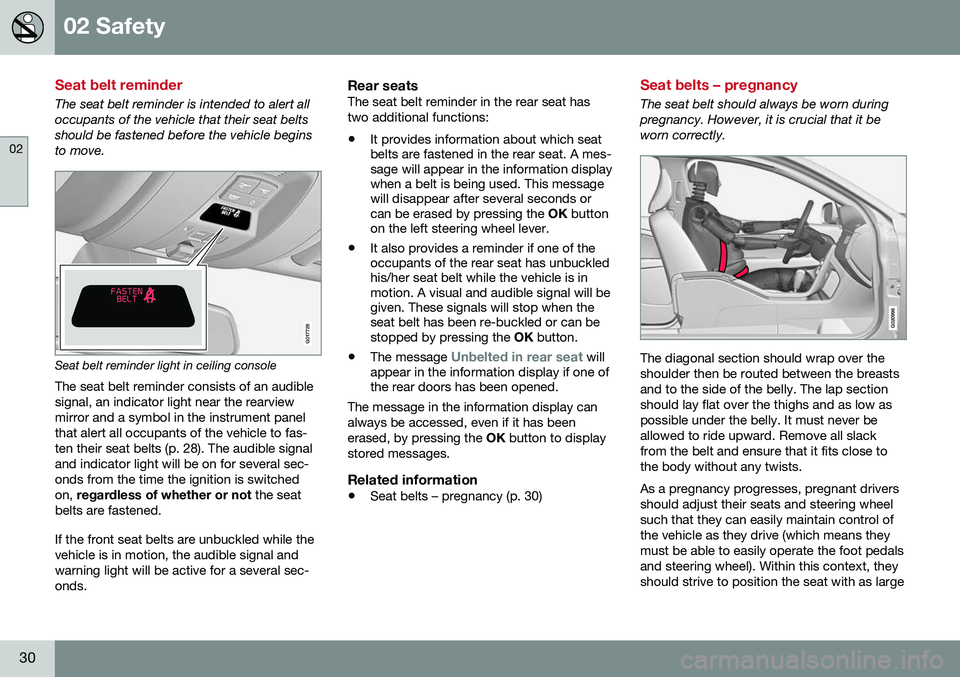
The seat belt reminder is intended to alert all occupants of the vehicle that their seat beltsshould be fastened before the vehicle beginsto move.
G017726
Seat belt reminder light in ceiling consoleThe seat belt reminder consists of an audible signal, an indicator light near the rearviewmirror and a symbol in the instrument panelthat alert all occupants of the vehicle to fas-ten their seat belts (p. 28). The audible signaland indicator light will be on for several sec-onds from the time the ignition is switchedon, regardless of whether or not the seat
belts are fastened. If the front seat belts are unbuckled while the vehicle is in motion, the audible signal andwarning light will be active for a several sec-onds.
Rear seatsThe seat belt reminder in the rear seat hastwo additional functions:
• It provides information about which seat belts are fastened in the rear seat. A mes-sage will appear in the information displaywhen a belt is being used. This messagewill disappear after several seconds orcan be erased by pressing the
OK button
on the left steering wheel lever.
• It also provides a reminder if one of theoccupants of the rear seat has unbuckledhis/her seat belt while the vehicle is inmotion. A visual and audible signal will begiven. These signals will stop when theseat belt has been re-buckled or can bestopped by pressing the
OK button.
• The message
Unbelted in rear seat will
appear in the information display if one of the rear doors has been opened.
The message in the information display can always be accessed, even if it has beenerased, by pressing the OK button to display
stored messages.
Related information
• Seat belts – pregnancy (p. 30)
Seat belts – pregnancy
The seat belt should always be worn during pregnancy. However, it is crucial that it beworn correctly.
G020998
The diagonal section should wrap over the shoulder then be routed between the breastsand to the side of the belly. The lap sectionshould lay flat over the thighs and as low aspossible under the belly. It must never beallowed to ride upward. Remove all slackfrom the belt and ensure that it fits close tothe body without any twists. As a pregnancy progresses, pregnant drivers should adjust their seats and steering wheelsuch that they can easily maintain control ofthe vehicle as they drive (which means theymust be able to easily operate the foot pedalsand steering wheel). Within this context, theyshould strive to position the seat with as large
Page 33 of 380
02 Safety
02
}}
* Option/accessory, for more information, see Introduction.31
a distance as possible between their belly and the steering wheel.
Related information
•
Seat belts – buckling/unbuckling (p. 29)
• Seat belt reminder (p. 30)
• Child restraints (p. 47)
Supplemental Restraint System (SRS)
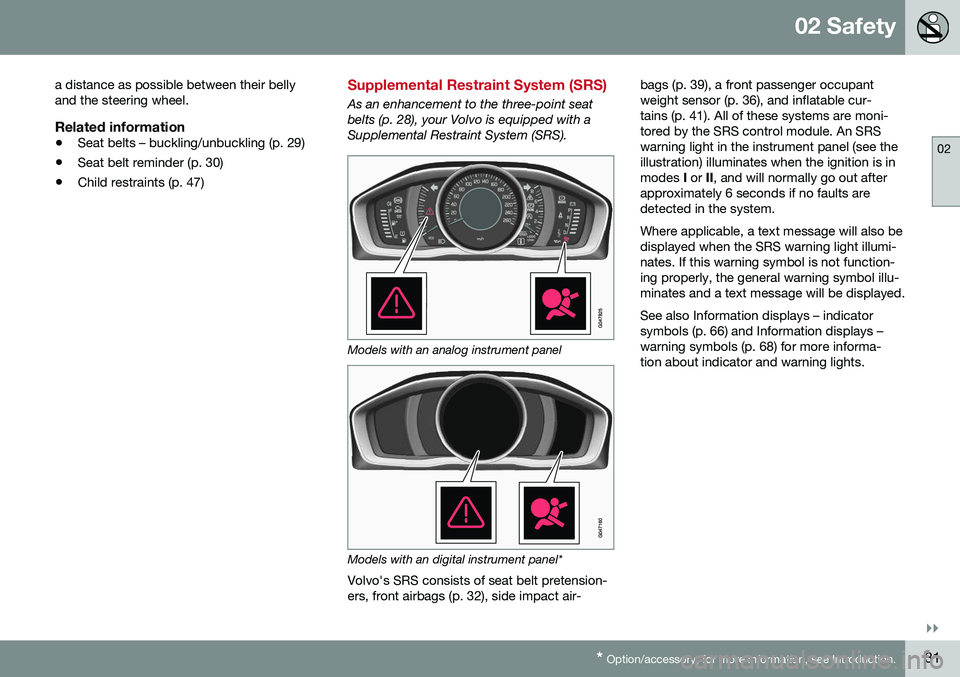
As an enhancement to the three-point seat belts (p. 28), your Volvo is equipped with aSupplemental Restraint System (SRS).
Models with an analog instrument panel
Models with an digital instrument panel*
Volvo's SRS consists of seat belt pretension- ers, front airbags (p. 32), side impact air- bags (p. 39), a front passenger occupantweight sensor (p. 36), and inflatable cur-tains (p. 41). All of these systems are moni-tored by the SRS control module. An SRSwarning light in the instrument panel (see theillustration) illuminates when the ignition is inmodes
I or II, and will normally go out after
approximately 6 seconds if no faults aredetected in the system. Where applicable, a text message will also be displayed when the SRS warning light illumi-nates. If this warning symbol is not function-ing properly, the general warning symbol illu-minates and a text message will be displayed. See also Information displays – indicator symbols (p. 66) and Information displays –warning symbols (p. 68) for more informa-tion about indicator and warning lights.
Page 35 of 380
02 Safety
02
}}
33
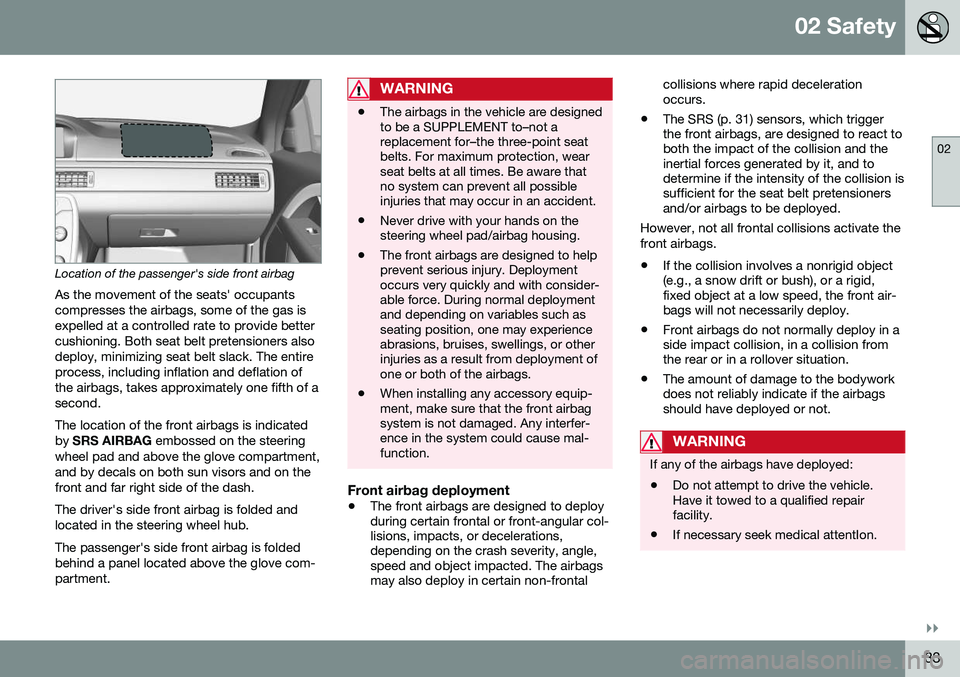
Location of the passenger's side front airbagAs the movement of the seats' occupants compresses the airbags, some of the gas isexpelled at a controlled rate to provide bettercushioning. Both seat belt pretensioners alsodeploy, minimizing seat belt slack. The entireprocess, including inflation and deflation ofthe airbags, takes approximately one fifth of asecond. The location of the front airbags is indicated by SRS AIRBAG embossed on the steering
wheel pad and above the glove compartment,and by decals on both sun visors and on thefront and far right side of the dash. The driver's side front airbag is folded and located in the steering wheel hub. The passenger's side front airbag is folded behind a panel located above the glove com-partment.
WARNING
• The airbags in the vehicle are designed to be a SUPPLEMENT to–not areplacement for–the three-point seatbelts. For maximum protection, wearseat belts at all times. Be aware thatno system can prevent all possibleinjuries that may occur in an accident.
• Never drive with your hands on thesteering wheel pad/airbag housing.
• The front airbags are designed to helpprevent serious injury. Deploymentoccurs very quickly and with consider-able force. During normal deploymentand depending on variables such asseating position, one may experienceabrasions, bruises, swellings, or otherinjuries as a result from deployment ofone or both of the airbags.
• When installing any accessory equip-ment, make sure that the front airbagsystem is not damaged. Any interfer-ence in the system could cause mal-function.
Front airbag deployment
•
The front airbags are designed to deploy during certain frontal or front-angular col-lisions, impacts, or decelerations,depending on the crash severity, angle,speed and object impacted. The airbagsmay also deploy in certain non-frontal collisions where rapid decelerationoccurs.
• The SRS (p. 31) sensors, which triggerthe front airbags, are designed to react toboth the impact of the collision and theinertial forces generated by it, and todetermine if the intensity of the collision issufficient for the seat belt pretensionersand/or airbags to be deployed.
However, not all frontal collisions activate the front airbags.
• If the collision involves a nonrigid object (e.g., a snow drift or bush), or a rigid,fixed object at a low speed, the front air-bags will not necessarily deploy.
• Front airbags do not normally deploy in aside impact collision, in a collision fromthe rear or in a rollover situation.
• The amount of damage to the bodyworkdoes not reliably indicate if the airbagsshould have deployed or not.
WARNING
If any of the airbags have deployed:
• Do not attempt to drive the vehicle. Have it towed to a qualified repairfacility.
• If necessary seek medical attentIon.
Page 36 of 380
||
02 Safety
02
34
WARNING
•Do not use child safety seats or child booster cushions/backrests in thefront passenger's seat. We also rec-ommend that occupants under 4 feet7 inches (140 cm) in height who haveoutgrown these devices sit in the rear seat with the seat belt fastened 1
.
• Never drive with the airbags deployed. The fact that they hang out can impairthe steering of your vehicle. Othersafety systems can also be damaged.
• The smoke and dust formed when theairbags are deployed can cause skinand eye irritation in the event of pro-longed exposure.
Should you have questions about any com- ponent in the SRS system, please contact atrained and qualified Volvo service technicianor Volvo customer support: In the USA Volvo Cars of North America, LLC Customer Care Center1 Volvo DriveP.O. Box 914Rockleigh, New Jersey 076471-800-458-1552 www.volvocars.com/us In Canada Volvo Cars of Canada Corp. National Customer Service9130 Leslie Street, Suite 101Richmond Hill, Ontario L4B 0B91-800-663-8255www.volvocars.com/ca
NOTE
•
Deployment of front airbags occurs only one time during an accident. In acollision where deployment occurs,the airbags and seat belt pretensionersactivate. Some noise occurs and asmall amount of powder is released.The release of the powder may appearas smoke-like matter. This is a normalcharacteristic and does not indicatefire.
• Volvo's front airbags use special sen-sors that are integrated with the frontseat buckles. The point at which theairbag deploys is determined bywhether or not the seat belt is beingused, as well as the severity of the col-lision.
• Collisions can occur where only one ofthe airbags deploys. If the impact isless severe, but severe enough topresent a clear injury risk, the airbagsare triggered at partial capacity. If theimpact is more severe, the airbags aretriggered at full capacity.
1
See also the Occupant Weight Sensor information, (p. 36).
Page 37 of 380
02 Safety
02
35
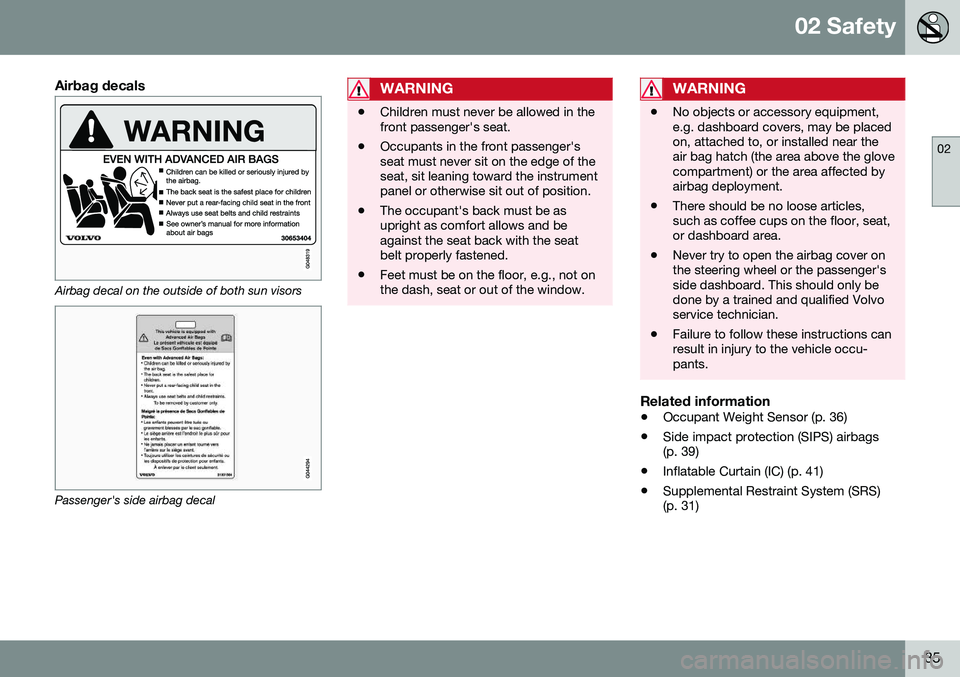
Airbag decals
Airbag decal on the outside of both sun visors
Passenger's side airbag decal
WARNING
•Children must never be allowed in the front passenger's seat.
• Occupants in the front passenger'sseat must never sit on the edge of theseat, sit leaning toward the instrumentpanel or otherwise sit out of position.
• The occupant's back must be asupright as comfort allows and beagainst the seat back with the seatbelt properly fastened.
• Feet must be on the floor, e.g., not onthe dash, seat or out of the window.
WARNING
•
No objects or accessory equipment, e.g. dashboard covers, may be placedon, attached to, or installed near theair bag hatch (the area above the glovecompartment) or the area affected byairbag deployment.
• There should be no loose articles,such as coffee cups on the floor, seat,or dashboard area.
• Never try to open the airbag cover onthe steering wheel or the passenger'sside dashboard. This should only bedone by a trained and qualified Volvoservice technician.
• Failure to follow these instructions canresult in injury to the vehicle occu-pants.
Related information
•
Occupant Weight Sensor (p. 36)
• Side impact protection (SIPS) airbags (p. 39)
• Inflatable Curtain (IC) (p. 41)
• Supplemental Restraint System (SRS)(p. 31)
Page 63 of 380
03 Instruments and controls
03
* Option/accessory, for more information, see Introduction.61
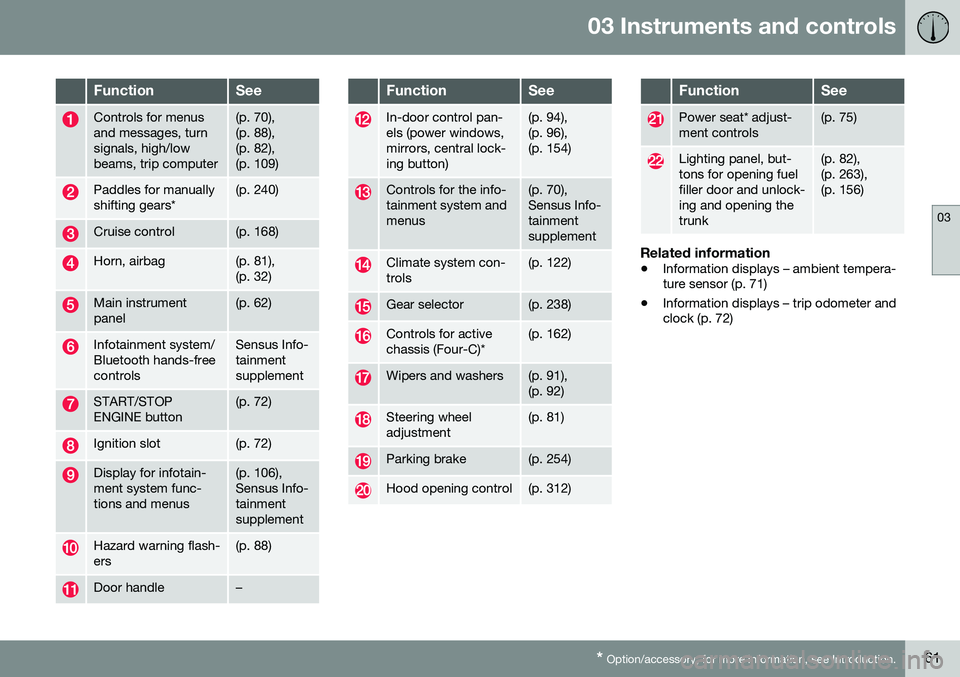
FunctionSee
Controls for menus and messages, turnsignals, high/lowbeams, trip computer(p. 70), (p. 88),(p. 82),(p. 109)
Paddles for manually shifting gears*(p. 240)
Cruise control(p. 168)
Horn, airbag(p. 81), (p. 32)
Main instrument panel(p. 62)
Infotainment system/ Bluetooth hands-freecontrolsSensus Info- tainmentsupplement
START/STOP ENGINE button(p. 72)
Ignition slot(p. 72)
Display for infotain- ment system func-tions and menus(p. 106), Sensus Info-tainmentsupplement
Hazard warning flash- ers(p. 88)
Door handle–
FunctionSee
In-door control pan- els (power windows,mirrors, central lock-ing button)(p. 94), (p. 96),(p. 154)
Controls for the info- tainment system andmenus(p. 70), Sensus Info-tainmentsupplement
Climate system con- trols(p. 122)
Gear selector(p. 238)
Controls for active chassis (Four-C)*(p. 162)
Wipers and washers(p. 91), (p. 92)
Steering wheel adjustment(p. 81)
Parking brake(p. 254)
Hood opening control(p. 312)
FunctionSee
Power seat* adjust- ment controls(p. 75)
Lighting panel, but- tons for opening fuelfiller door and unlock-ing and opening thetrunk(p. 82), (p. 263),(p. 156)
Related information
• Information displays – ambient tempera- ture sensor (p. 71)
• Information displays – trip odometer andclock (p. 72)