brake light VOLVO S90 1998 User Guide
[x] Cancel search | Manufacturer: VOLVO, Model Year: 1998, Model line: S90, Model: VOLVO S90 1998Pages: 175, PDF Size: 4.45 MB
Page 73 of 175
1998 Volvo S90
Chapter 4 (cont)
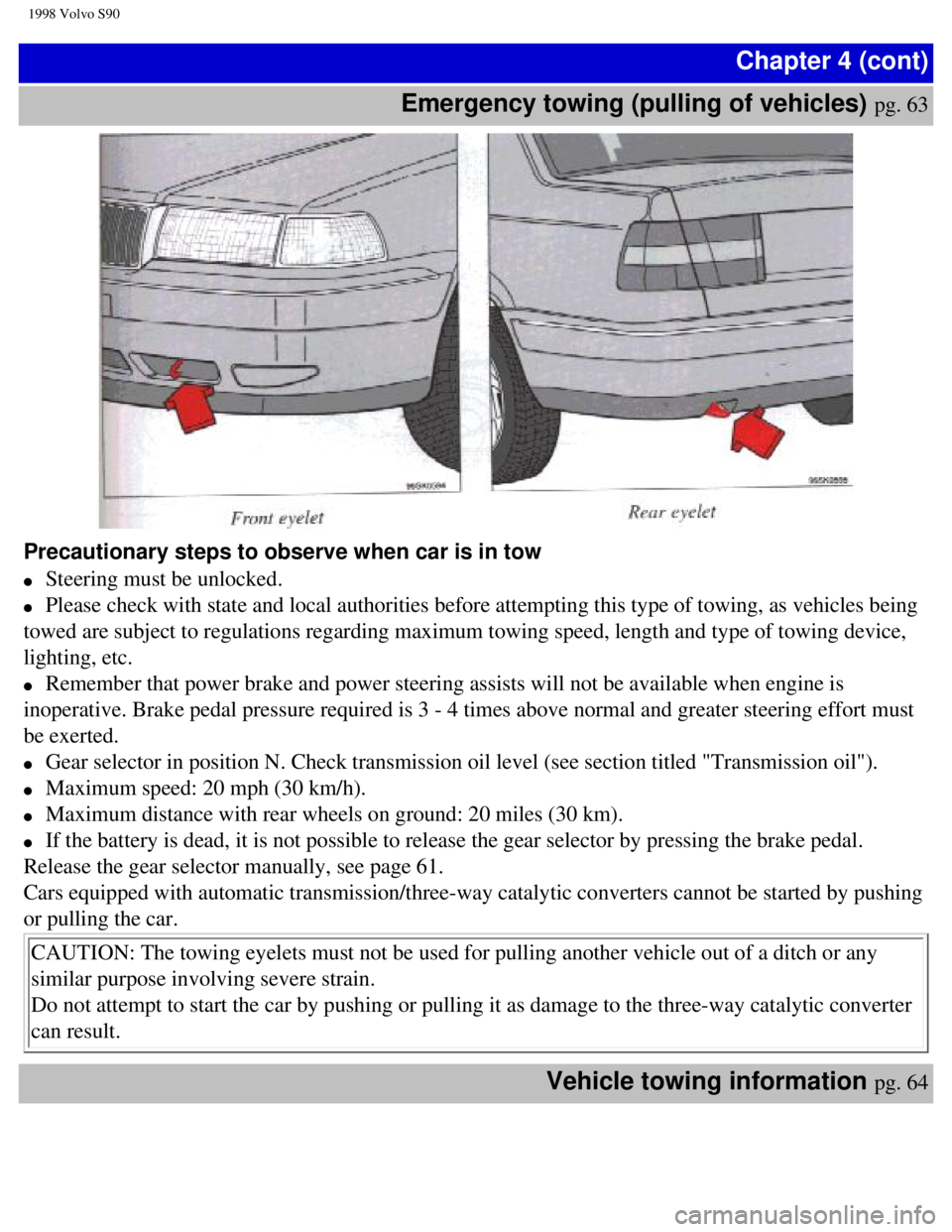
Emergency towing (pulling of vehicles)
pg. 63
Precautionary steps to observe when car is in tow
l Steering must be unlocked.
l Please check with state and local authorities before attempting this typ\
e of towing, as vehicles being
towed are subject to regulations regarding maximum towing speed, length \
and type of towing device,
lighting, etc.
l Remember that power brake and power steering assists will not be availab\
le when engine is
inoperative. Brake pedal pressure required is 3 - 4 times above normal a\
nd greater steering effort must
be exerted.
l Gear selector in position N. Check transmission oil level (see section \
titled "Transmission oil").
l Maximum speed: 20 mph (30 km/h).
l Maximum distance with rear wheels on ground: 20 miles (30 km).
l If the battery is dead, it is not possible to release the gear selector \
by pressing the brake pedal.
Release the gear selector manually, see page 61.
Cars equipped with automatic transmission/three-way catalytic converters\
cannot be started by pushing
or pulling the car.
CAUTION: The towing eyelets must not be used for pulling another vehicle\
out of a ditch or any
similar purpose involving severe strain.
Do not attempt to start the car by pushing or pulling it as damage to th\
e three-way catalytic converter
can result.
Vehicle towing information pg. 64
file:///K|/ownersdocs/1998/1998_SV90/98S90_063.htm (1 of 4)12/30/2006 \
1:52:43 PM
Page 77 of 175
1998 Volvo S90
Chapter 4 (cont)
Brake system
pg. 67
If one of the brake
circuits should
malfunction, the red
warning light will come
on
The pedal stroke increases
slightly, the pedal feels softer
and extra pressure is required for
normal braking.
If the light comes on while
driving or braking, stop
immediately and check the brake
fluid level in the reservoir.
WARNING!
If the fluid level is below the
MIN mark in either section
of the reservoir: DO NOT
DRIVE. Tow the car to a
Volvo retailer and have the
brake system checked and
repaired.
Anti-lock Brake System
– ABS
If the warning lamp lights up
there is a malfunction of the
ABS system (the standard
braking system will however
The system performs a self-
diagnostic test when the vehicle
is started and at 4 mph (6 km/h).
The driver may detect one
pulsation of the brake pedal,
which is normal.
To obtain optimal effect from
the ABS system, constant
pressure should be kept on the
brake pedal while the system
is modulating the brakes. Do
not pump the brake pedal.
The switching of the ABS
modulator will be audible at this
time.
Please be aware that ABS does
not increase the absolute braking
potential of the vehicle.
While control will be enhanced,
ABS will not shorten stopping
distances on slippery surfaces.
Moisture on brake
discs and brake pads
affects braking.
Driving in rain and slush or
passing through an automatic car
wash can cause water to collect
on the brake discs and pads.
This will cause a delay in
braking effect when the pedal is
depressed. To avoid such a delay
when the brakes are needed,
depress the pedal occasionally
when driving through rain, slush
etc. This will remove the water
from the brakes. Check that
Severe strain on the
brake system
The brakes will be subject to
severe strain when driving in
mountains or hilly areas or
towing. The speed is usually low
which means that the cooling of
the brakes is less efficient than
when driving on level roads. To
reduce the strain on the brakes it
is advisable not to use the brakes
excessively. Instead, shift into a
lower gear, position 3 or in some
cases L ,and let the engine help
with the braking.
Do not forget that, if you are
towing a trailer, the brakes will
be subjected to greater load than
is normal.
If the brake power-
assist does not
function
The power assist to the brakes
functions only when the engine
is running. When the car is
moving without the engine
running the brake pedal pressure
required to stop the car is
increased by 3-4 times.
The brake pedal feels stiff and
hard.
file:///K|/ownersdocs/1998/1998_SV90/98S90_067.htm (1 of 5)12/30/2006 \
1:52:43 PM
Page 78 of 175
1998 Volvo S90
function) and the vehicle should
be driven to a Volvo retailer for
inspection.
The Anti-lock Braking System
(ABS) helps to improve vehicle
control (stopping and steering)
during severe braking conditions
by limiting brake lock-up. When
the system "senses" impending
lock-up, braking pressure is
automatically modulated in
order to help prevent lockup,
which could lead to a skid. brake application feels normal.
This should also be done after
washing or starting in very damp
or cold weather.
Trailer towing pg. 68
When preparing for
trailer towing, observe
the following:
l Volvo recommends the use of
Volvo trailer hitches which are
specially designed for the car.
For trailer weights exceeding
2000 lbs. (908 kg), use only a
trailer hitch offered as a
Genuine Volvo accessory.
NOTE: Models with automatic
transmission are equipped with
a transmission oil cooler as
standard equipment. This cooler
helps prevent overheating of the
transmission during times of
increased load, as when towing
a trailer.
l Maximum trailer weight
recommended by Volvo is:
Trailers without brakes: 1100
lbs (500kg)
Trailers with brakes: 2" ball -
3300 lbs (1500 kg), 1 7/8" ball -
2000 lbs (908 kg).
WARNING! Never connect a
trailer's hydraulic brake
system directly to the vehicle
brake system, nor a trailer's
lighting system directly to the
vehicle lighting system.
Consult your nearest
authorized Volvo retailer for
correct installation.
All Volvo models are equipped
with energy-absorbing shock-
mounted bumpers. Trailer hitch
installation should not interfere
with the proper operation of this
bumper system. Trailer towing
does not normally present any
particular problems, but take
into consideration:
l Recommended hitch tongue
load is 110 lbs (50 kgs) for
trailer weights below 2,650 lbs
(1,200 kgs) and 165 lbs (75 kgs)
for trailer weights above 2,650
lbs (1,200 kgs).
l For trailer weights between
2,650-3,300 lbs (1,200-1,500
l Avoid overload and other
abusive operation.
l Hauling a trailer affects
handling, durability, and
economy.
l It is necessary to balance
trailer brakes with the towing
vehicle brakes to provide a safe
stop (check and observe State/
Local regulations).
l Do not connect the trailer's
brake system directly to the
vehicle's brake system.
l More frequent vehicle
maintenance is required.
l Remove the ball and drawbar
assembly when the hitch is not
being used.
l Volvo recommends the use of
synthetic engine oil when towing
a trailer over long distances or in
mountainous areas.
l The trailer hitch tongue load
(110/165 lbs - 50/75 kg) is part
of the vehicle's capacity weight.
It may be necessary to reduce the
trunk/cargo area load when
file:///K|/ownersdocs/1998/1998_SV90/98S90_067.htm (2 of 5)12/30/2006 \
1:52:43 PM
Page 80 of 175
1998 Volvo S90
cold-weather oil for hard driving or in warm
weather. See section "Engine oil" for more
information.
l The load placed on the battery is greater during
the winter since the heater, windshield wipers,
lighting etc. are used more often. Moreover, the
capacity of the battery decreases as the
temperature drops. In very cold weather, a poorly
charged battery can freeze and be damaged. It is
therefore advisable to check the state of charge
more frequently and spray an anti-rust oil on the
battery posts.
l Volvo recommends the use of snow tires on all
four wheels for winter driving - see section
"Wheels and tires".
l To prevent the washer reservoir from freezing,
add washer solvents containing antifreeze. This is
important since dirt is often splashed on the
windshield during winter driving, thus requiring
frequent use of the washers and wipers.
functions when the transmission is in reverse.
Also see "Winter/Wet" mode on page 59.
Winter/Wet mode
Enhanced Vehicle Traction
This mode may be selected for starting/moving
off on slippery roads or to lower downshift speeds
if the transmission is in "L".
Mode W
*In position D, the gearbox starts in third gear and
changes up to fourth gear.
*In position 3, second gear is locked and there is
no change up to third gear. In position L, first gear
is locked.
*These positions always offer the kick-down
feature.
Long distance trip pg. 70
Before a long distance trip
It is always worthwhile to have your car checked at a Volvo retailer
before driving long distances. Your retailer will also be able to supply\
you with bulbs, fuses, spark plugs and wiper blades for your use in the \
event that problems occur.
If you prefer to check the car yourself, please note the following:
l Check that the engine runs smoothly and that fuel consumption is
normal.
l Check engine oil, coolant levels, and for possible fuel leakage.
l Check transmission oil level and rear axle for leakage.
l Check condition of drive belts.
l Check state of charge of battery.
l Examine tires carefully (the spare tire as well), and replace those
that are worn. Check tire pressures.
l The brakes, front wheel alignment, and steering gear should be
checked by your Volvo retailer only.
l Check all lights, including high beams.
file:///K|/ownersdocs/1998/1998_SV90/98S90_067.htm (4 of 5)12/30/2006 \
1:52:43 PM
Page 83 of 175
1998 Volvo S90
When replacing tires, be sure that the new tires
are the same size designation, type (radial) and
preferably from the same manufacturer, on all
four wheels. Otherwise there is a risk of altering
the car's road-holding and handling
characteristics.
NOTE:When storing wheel/tire assemblies (e.g.
winter tires and wheels), either stand the
assemblies upright or suspend them off the
ground. Laying wheel/tire assemblies on their
sides for prolonged periods can cause wheel and/
or tire damage.
Wear indicator
The tires have a so-called "wear indicator" in the
form of a number of narrow strips running across
or parallel to the tread. When approx. 1/16" (1.6
mm) is left on the tread, these strips show up and
indicate that the tire should be replaced.
Tires with less than 1/16" (1.6 mm) tread have a
very poor grip in rain or snow.
All tires become warm during use. After cooling,
when the vehicle is parked, the tires have a
tendency to distort slightly, forming flat spots.
These flat spots can cause vibrations similar to the
vibrations caused by imbalanced wheels.
They do, however, disappear when the tire warms
up. The degree to which the flat spots form
depends on the type of cord used in the tire.
Remember that, in cold weather, it takes longer
for the tire to warm up and consequently longer
for the flat spot to disappear.
Wheels and tires (cont.) pg. 73
Snow chains
Snow tire chains can be used on your Volvo with
the following restrictions:
l Snow chains should be installed on rear wheels
only. Use only Volvo approved snow chains.
l Snow chains can only be used on tires which
are not wider than 195 mm.
l Sufficient clearances between chains and
brakes, suspension and body components must be
maintained.
l Some strap-on type chains will interfere with
brake components and therefore CANNOT be
used.
Consult your Volvo retailer for additional snow
Snow tires, studded tires*
Tires for winter use:
Owners who live in or regularly commute
through areas with sustained periods of snow
or icy driving conditions are strongly advised
to fit suitable winter tires to help retain the
highest degree of traction.
It is important to install winter tires on all four
wheels to help retain traction during cornering,
braking and accelerating. Failure to do so could
reduce traction to an unsafe level or adversely
affect handling. Do not mix tires of different
design as this could also negatively affect overall
tire road grip.
file:///K|/ownersdocs/1998/1998_SV90/98S90_071.htm (2 of 5)12/30/2006 \
1:52:44 PM
Page 93 of 175
1998 Volvo S90
Replacing tail light bulbs (sedan
models)
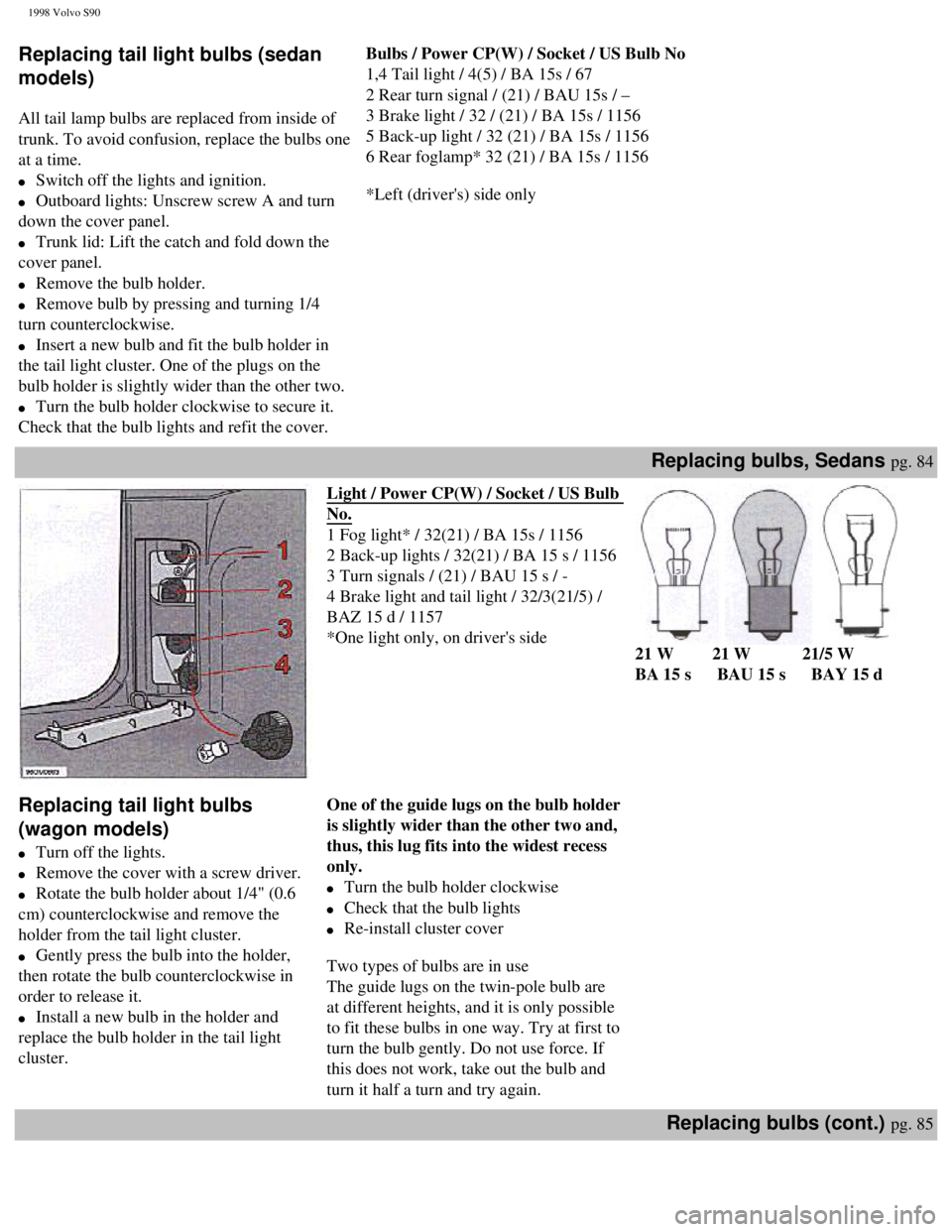
All tail lamp bulbs are replaced from inside of
trunk. To avoid confusion, replace the bulbs one
at a time.
l Switch off the lights and ignition.
l Outboard lights: Unscrew screw A and turn
down the cover panel.
l Trunk lid: Lift the catch and fold down the
cover panel.
l Remove the bulb holder.
l Remove bulb by pressing and turning 1/4
turn counterclockwise.
l Insert a new bulb and fit the bulb holder in
the tail light cluster. One of the plugs on the
bulb holder is slightly wider than the other two.
l Turn the bulb holder clockwise to secure it.
Check that the bulb lights and refit the cover. Bulbs / Power CP(W) / Socket / US Bulb No
1,4 Tail light / 4(5) / BA 15s / 67
2 Rear turn signal / (21) / BAU 15s / –
3 Brake light / 32 / (21) / BA 15s / 1156
5 Back-up light / 32 (21) / BA 15s / 1156
6 Rear foglamp* 32 (21) / BA 15s / 1156
*Left (driver's) side only
Replacing bulbs, Sedans pg. 84
Light / Power CP(W) / Socket / US Bulb
No.
1 Fog light* / 32(21) / BA 15s / 1156
2 Back-up lights / 32(21) / BA 15 s / 1156
3 Turn signals / (21) / BAU 15 s / -
4 Brake light and tail light / 32/3(21/5) /
BAZ 15 d / 1157
*One light only, on driver's side
21 W 21 W 21/5 W
BA 15 s BAU 15 s BAY 15 d
Replacing tail light bulbs
(wagon models)
l Turn off the lights.
l Remove the cover with a screw driver.
l Rotate the bulb holder about 1/4" (0.6
cm) counterclockwise and remove the
holder from the tail light cluster.
l Gently press the bulb into the holder,
then rotate the bulb counterclockwise in
order to release it.
l Install a new bulb in the holder and
replace the bulb holder in the tail light
cluster. One of the guide lugs on the bulb holder
is slightly wider than the other two and,
thus, this lug fits into the widest recess
only.
l Turn the bulb holder clockwise
l Check that the bulb lights
l Re-install cluster cover
Two types of bulbs are in use
The guide lugs on the twin-pole bulb are
at different heights, and it is only possible
to fit these bulbs in one way. Try at first to
turn the bulb gently. Do not use force. If
this does not work, take out the bulb and
turn it half a turn and try again.
Replacing bulbs (cont.) pg. 85
file:///K|/ownersdocs/1998/1998_SV90/98S90_081.htm (3 of 6)12/30/2006 \
1:52:45 PM
Page 95 of 175
1998 Volvo S90
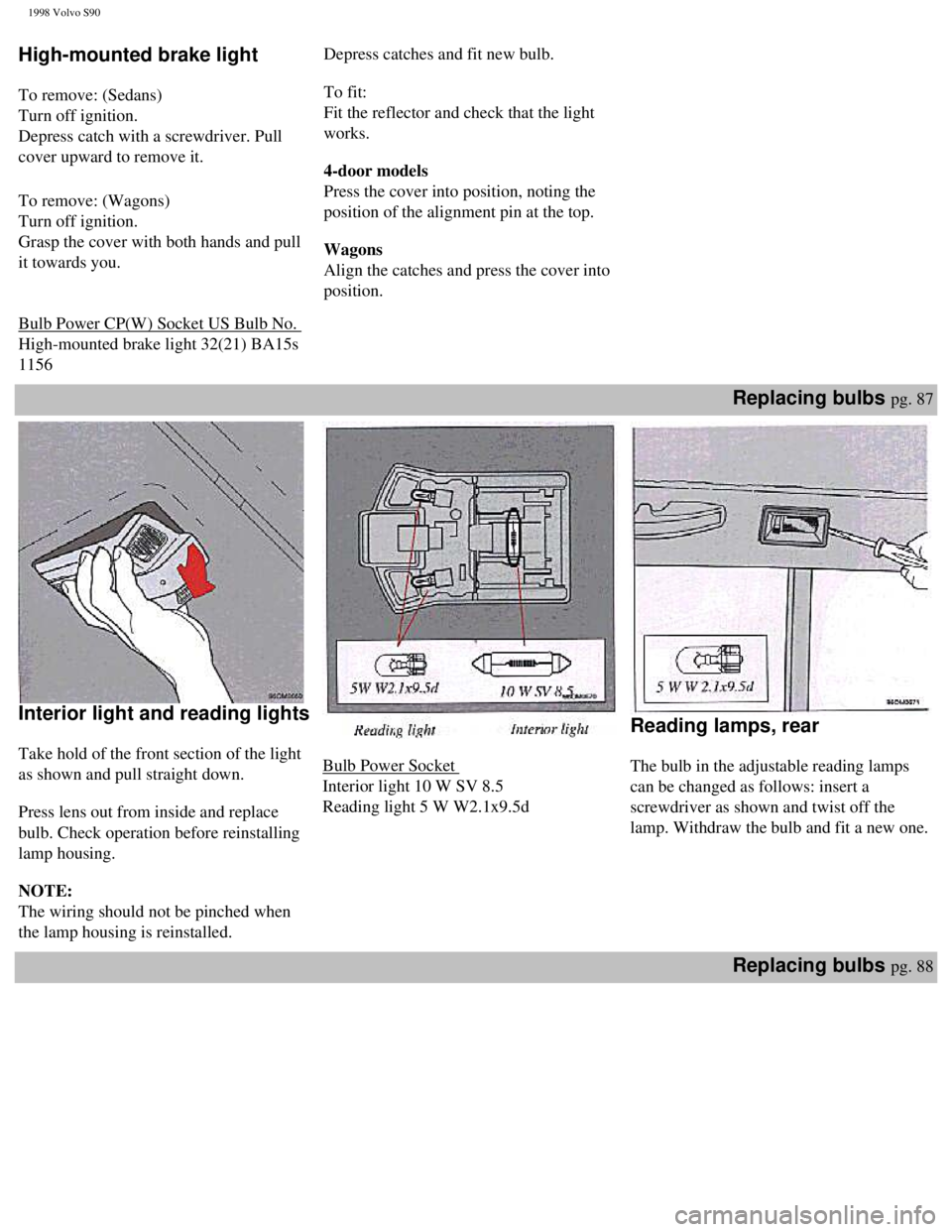
High-mounted brake light
To remove: (Sedans)
Turn off ignition.
Depress catch with a screwdriver. Pull
cover upward to remove it.
To remove: (Wagons)
Turn off ignition.
Grasp the cover with both hands and pull
it towards you.
Bulb Power CP(W) Socket US Bulb No.
High-mounted brake light 32(21) BA15s
1156 Depress catches and fit new bulb.
To fit:
Fit the reflector and check that the light
works.
4-door models
Press the cover into position, noting the
position of the alignment pin at the top.
Wagons
Align the catches and press the cover into
position.
Replacing bulbs pg. 87
Interior light and reading lights
Take hold of the front section of the light
as shown and pull straight down.
Press lens out from inside and replace
bulb. Check operation before reinstalling
lamp housing.
NOTE:
The wiring should not be pinched when
the lamp housing is reinstalled.
Bulb Power Socket
Interior light 10 W SV 8.5
Reading light 5 W W2.1x9.5d
Reading lamps, rear
The bulb in the adjustable reading lamps
can be changed as follows: insert a
screwdriver as shown and twist off the
lamp. Withdraw the bulb and fit a new one.
Replacing bulbs pg. 88
file:///K|/ownersdocs/1998/1998_SV90/98S90_081.htm (5 of 6)12/30/2006 \
1:52:45 PM
Page 99 of 175
1998 Volvo S90
2 Audio, Power seats, Hazard warning flashers,
Compartment Lights,
Power Antenna, Trailer Power, 50
3 Power Supply Relay "A" 50
4 Fuel System Relay, Ignition System Relay 50
5ABS-unit 50
6 Air pump, Starter Solenoid, Horn 50
7 Electric Cooling Fan 50
8 Pos./parking Light Relay, Headlight Relay, Fog light
relay 50
*Some of the equipment/systems listed may be
available on certain models only and/or as optional
items only.
Brake system pg. 91
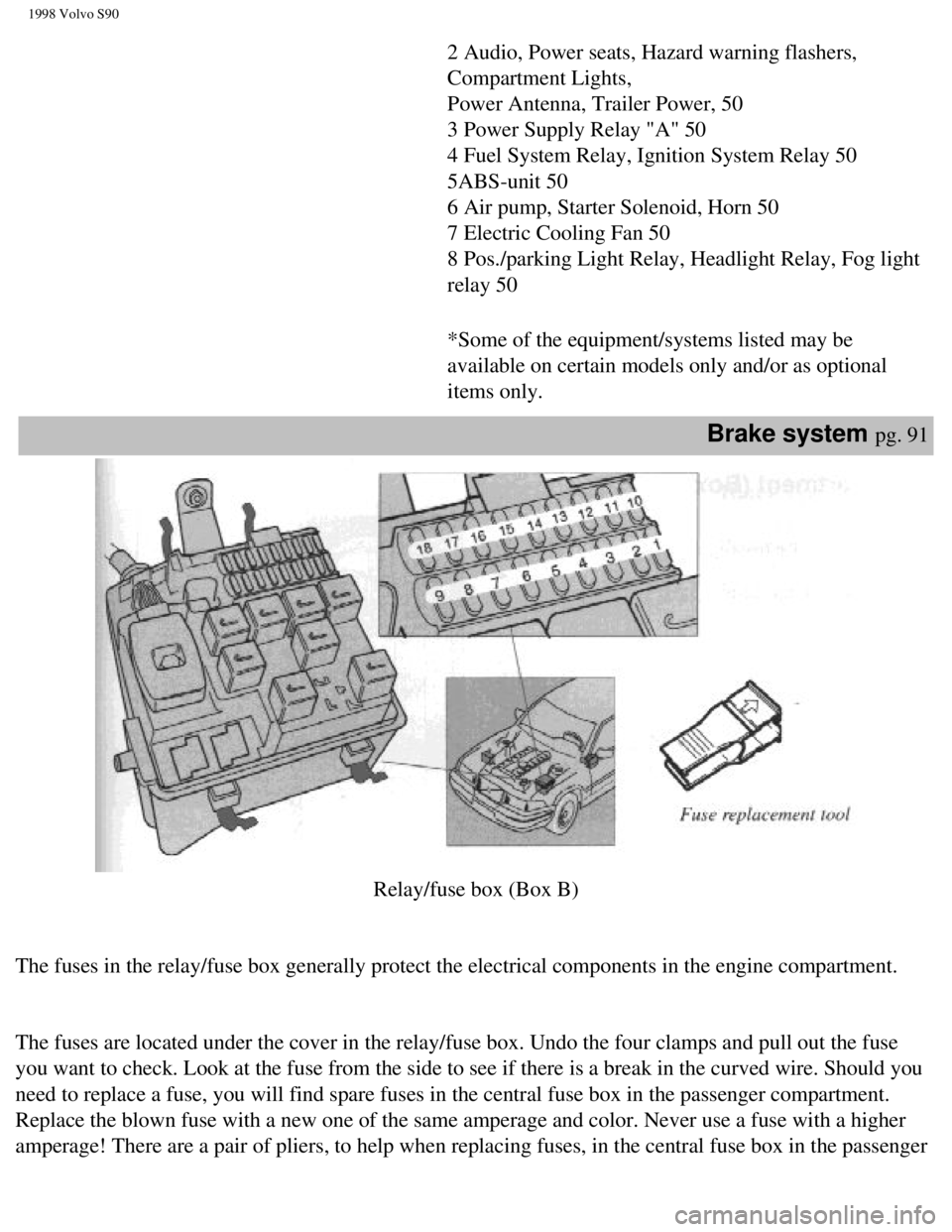
Relay/fuse box (Box B)
The fuses in the relay/fuse box generally protect the electrical compone\
nts in the engine compartment.
The fuses are located under the cover in the relay/fuse box. Undo the fo\
ur clamps and pull out the fuse
you want to check. Look at the fuse from the side to see if there is a b\
reak in the curved wire. Should you
need to replace a fuse, you will find spare fuses in the central fuse bo\
x in the passenger compartment.
Replace the blown fuse with a new one of the same amperage and color. Ne\
ver use a fuse with a higher
amperage! There are a pair of pliers, to help when replacing fuses, in t\
he central fuse box in the passenger
file:///K|/ownersdocs/1998/1998_SV90/98S90_089.htm (3 of 9)12/30/2006 \
1:52:46 PM
Page 101 of 175

1998 Volvo S90
Location ** Amperage
1 Heated rear window 25
2 Central locking 20
3 Brake light, Light switch 15
4 Ignition switch, SRS 10
5 Spare
6 Windshield wiper/washer, Headlight wiper, horn relay 25
7 Climate unit 20
8 Power pass. seat, Power side-view mirrors, Tailgate wiper/washer (wag\
ons)
Instrument lighting, Ambient temp. sensor 15
9 Audio system 15
10 Cigarette lighter/accessory socket 15
11 Transmission mode selector, Gear selector light 5
12 ABS 5
13 Clock, Interior/glove compartment lighting, Door open warning lights,\
Cargo space lighting, Vanity mirror 10
14 Horn 10
Location ** Amperage
15 Power antenna, Headlight flasher, Trailer 20
16 Accessories 20
17 Hazard warning flasher, Direction indicator, Alarm hazard indication \
20
18 Audio/amplifier, CD changer 15
file:///K|/ownersdocs/1998/1998_SV90/98S90_089.htm (5 of 9)12/30/2006 \
1:52:46 PM
Page 118 of 175
 Replace at 100,000 miles (160,000 km).
2) Brake fluid should be changed at owner request every second year (o\
nce a year if the car is driven in
mountainous areas or in areas wi")
1998 Volvo S90
1) Replace at 100,000 miles (160,000 km).
2) Brake fluid should be changed at owner request every second year (o\
nce a year if the car is driven in
mountainous areas or in areas with high humidity).
The following items should be checked weekly by the driver (it takes on\
ly a few minutes):
Engine oil level Windshield wipers
Brake fluid level Level of windshield washer fluid
Radiator coolant level
Tire pressure (all five tires)
Operation of all lights
Horns
The following should also be carried out at regular intervals:
Washing
Polishing
Cleaning
Contents | Top of Page
file:///K|/ownersdocs/1998/1998_SV90/98S90_103.htm (7 of 7)12/30/2006 \
1:52:48 PM