steering VOLVO S90 1998 User Guide
[x] Cancel search | Manufacturer: VOLVO, Model Year: 1998, Model line: S90, Model: VOLVO S90 1998Pages: 175, PDF Size: 4.45 MB
Page 71 of 175
1998 Volvo S90
disconnected, the code must
be re-entered before the radio
will function properly.
Points to remember pg. 62
Weight distribution affects
handling
At the specified curb weight
your car has a tendency to
understeer, which means that the
steering wheel has to be turned
more than might seem
appropriate for the curvature of
a bend. This ensures good
stability and reduces the risk of
rear wheel skid. Remember that
these properties can alter with
the vehicle load. The heavier the
load in the trunk, the less the
tendency to understeer.
Handling, roadholding
Vehicle load, tire design, and
inflation pressure, all affect
vehicle handling. Therefore,
check that the tires are inflated
to the recommended pressure
according to the vehicle load.
See "Tire pressure" section.
Loads should be distributed so
that capacity weight or
maximum permissible axle loads
are not exceeded.
WARNING!
An extra mat on the driver's
floor can cause the
accelerator pedal to catch.
Check that the movement of
the accelerator pedal is not
impeded. Not more than one
protective floor covering may
be used at one time.
CAUTION: Drive slowly and
carefully if going through
standing water (i.e. flooded
roadways, etc.). Damage to
engine could result if excess
water is ingested through the air
intake system. Never drive the
vehicle in water deeper than 1
foot (300 mm). See the flood
warning on page 7.
WARNING! Do not drive
with trunk lid or tailgate
open!
Poisonous exhaust gases may
enter via the trunk lid or
tailgate.
If the trunk lid/tailgate must
be kept open for any reason,
proceed as follows:
l Close the windows.
l Set the ventilation system
Roof rails/racks
Roof rails are standard
equipment on wagon models.
Load bars are available as a
retailer installed option on the
sedan models. Observe the
following points when is use:
l Avoid single-point loads.
Distribute the load evenly.
l Place heavier cargo at bottom
of load.
l Observe that center of gravity
and handling are influenced by
load weight.
l Increasing load size increases
wind resistance and, thus,
adversely affects fuel economy.
l Anchor the cargo correctly
with appropriate tie-down
equipment.
l Drive carefully. Avoid rapid
starts, fast cornering and hard
braking.
l Max. roof load is 220 lbs.
(100 kg) for removable racks.
For permanent roof racks, check
the manufacturers weight
specifications.
file:///K|/ownersdocs/1998/1998_SV90/98S90_058.htm (6 of 7)12/30/2006 \
1:52:42 PM
Page 73 of 175
1998 Volvo S90
Chapter 4 (cont)
Emergency towing (pulling of vehicles)
pg. 63
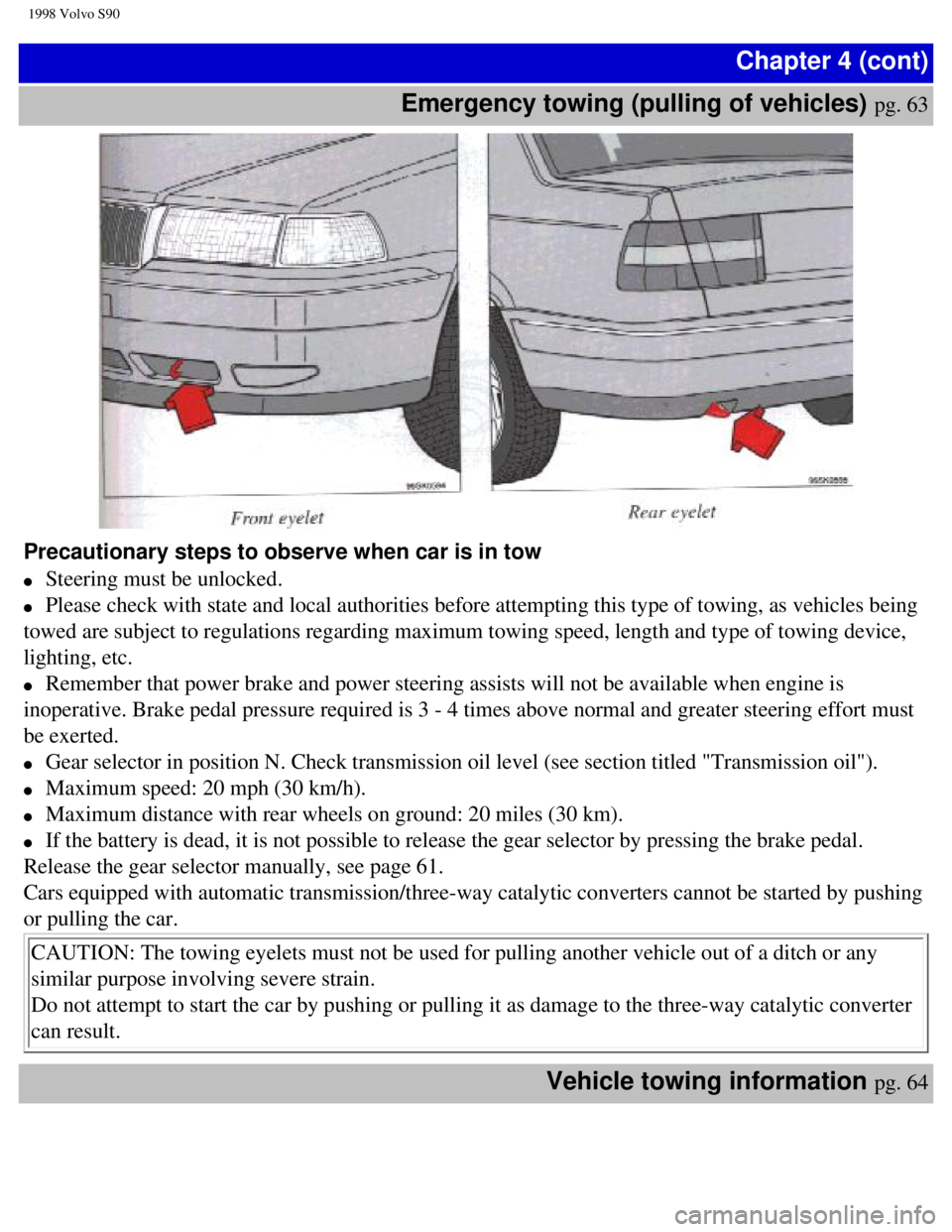
Precautionary steps to observe when car is in tow
l Steering must be unlocked.
l Please check with state and local authorities before attempting this typ\
e of towing, as vehicles being
towed are subject to regulations regarding maximum towing speed, length \
and type of towing device,
lighting, etc.
l Remember that power brake and power steering assists will not be availab\
le when engine is
inoperative. Brake pedal pressure required is 3 - 4 times above normal a\
nd greater steering effort must
be exerted.
l Gear selector in position N. Check transmission oil level (see section \
titled "Transmission oil").
l Maximum speed: 20 mph (30 km/h).
l Maximum distance with rear wheels on ground: 20 miles (30 km).
l If the battery is dead, it is not possible to release the gear selector \
by pressing the brake pedal.
Release the gear selector manually, see page 61.
Cars equipped with automatic transmission/three-way catalytic converters\
cannot be started by pushing
or pulling the car.
CAUTION: The towing eyelets must not be used for pulling another vehicle\
out of a ditch or any
similar purpose involving severe strain.
Do not attempt to start the car by pushing or pulling it as damage to th\
e three-way catalytic converter
can result.
Vehicle towing information pg. 64
file:///K|/ownersdocs/1998/1998_SV90/98S90_063.htm (1 of 4)12/30/2006 \
1:52:43 PM
Page 78 of 175
1998 Volvo S90
function) and the vehicle should
be driven to a Volvo retailer for
inspection.
The Anti-lock Braking System
(ABS) helps to improve vehicle
control (stopping and steering)
during severe braking conditions
by limiting brake lock-up. When
the system "senses" impending
lock-up, braking pressure is
automatically modulated in
order to help prevent lockup,
which could lead to a skid. brake application feels normal.
This should also be done after
washing or starting in very damp
or cold weather.
Trailer towing pg. 68
When preparing for
trailer towing, observe
the following:
l Volvo recommends the use of
Volvo trailer hitches which are
specially designed for the car.
For trailer weights exceeding
2000 lbs. (908 kg), use only a
trailer hitch offered as a
Genuine Volvo accessory.
NOTE: Models with automatic
transmission are equipped with
a transmission oil cooler as
standard equipment. This cooler
helps prevent overheating of the
transmission during times of
increased load, as when towing
a trailer.
l Maximum trailer weight
recommended by Volvo is:
Trailers without brakes: 1100
lbs (500kg)
Trailers with brakes: 2" ball -
3300 lbs (1500 kg), 1 7/8" ball -
2000 lbs (908 kg).
WARNING! Never connect a
trailer's hydraulic brake
system directly to the vehicle
brake system, nor a trailer's
lighting system directly to the
vehicle lighting system.
Consult your nearest
authorized Volvo retailer for
correct installation.
All Volvo models are equipped
with energy-absorbing shock-
mounted bumpers. Trailer hitch
installation should not interfere
with the proper operation of this
bumper system. Trailer towing
does not normally present any
particular problems, but take
into consideration:
l Recommended hitch tongue
load is 110 lbs (50 kgs) for
trailer weights below 2,650 lbs
(1,200 kgs) and 165 lbs (75 kgs)
for trailer weights above 2,650
lbs (1,200 kgs).
l For trailer weights between
2,650-3,300 lbs (1,200-1,500
l Avoid overload and other
abusive operation.
l Hauling a trailer affects
handling, durability, and
economy.
l It is necessary to balance
trailer brakes with the towing
vehicle brakes to provide a safe
stop (check and observe State/
Local regulations).
l Do not connect the trailer's
brake system directly to the
vehicle's brake system.
l More frequent vehicle
maintenance is required.
l Remove the ball and drawbar
assembly when the hitch is not
being used.
l Volvo recommends the use of
synthetic engine oil when towing
a trailer over long distances or in
mountainous areas.
l The trailer hitch tongue load
(110/165 lbs - 50/75 kg) is part
of the vehicle's capacity weight.
It may be necessary to reduce the
trunk/cargo area load when
file:///K|/ownersdocs/1998/1998_SV90/98S90_067.htm (2 of 5)12/30/2006 \
1:52:43 PM
Page 80 of 175
1998 Volvo S90
cold-weather oil for hard driving or in warm
weather. See section "Engine oil" for more
information.
l The load placed on the battery is greater during
the winter since the heater, windshield wipers,
lighting etc. are used more often. Moreover, the
capacity of the battery decreases as the
temperature drops. In very cold weather, a poorly
charged battery can freeze and be damaged. It is
therefore advisable to check the state of charge
more frequently and spray an anti-rust oil on the
battery posts.
l Volvo recommends the use of snow tires on all
four wheels for winter driving - see section
"Wheels and tires".
l To prevent the washer reservoir from freezing,
add washer solvents containing antifreeze. This is
important since dirt is often splashed on the
windshield during winter driving, thus requiring
frequent use of the washers and wipers.
functions when the transmission is in reverse.
Also see "Winter/Wet" mode on page 59.
Winter/Wet mode
Enhanced Vehicle Traction
This mode may be selected for starting/moving
off on slippery roads or to lower downshift speeds
if the transmission is in "L".
Mode W
*In position D, the gearbox starts in third gear and
changes up to fourth gear.
*In position 3, second gear is locked and there is
no change up to third gear. In position L, first gear
is locked.
*These positions always offer the kick-down
feature.
Long distance trip pg. 70
Before a long distance trip
It is always worthwhile to have your car checked at a Volvo retailer
before driving long distances. Your retailer will also be able to supply\
you with bulbs, fuses, spark plugs and wiper blades for your use in the \
event that problems occur.
If you prefer to check the car yourself, please note the following:
l Check that the engine runs smoothly and that fuel consumption is
normal.
l Check engine oil, coolant levels, and for possible fuel leakage.
l Check transmission oil level and rear axle for leakage.
l Check condition of drive belts.
l Check state of charge of battery.
l Examine tires carefully (the spare tire as well), and replace those
that are worn. Check tire pressures.
l The brakes, front wheel alignment, and steering gear should be
checked by your Volvo retailer only.
l Check all lights, including high beams.
file:///K|/ownersdocs/1998/1998_SV90/98S90_067.htm (4 of 5)12/30/2006 \
1:52:43 PM
Page 112 of 175

1998 Volvo S90
Chapter 8 - Volvo Service
pg. 103
Service - an investment
An investment which will pay dividends in the form of improved reliabili\
ty,
durability, and resale value.
Label information pg. 104
Maintenance service, Warranty pg. 105
Maintenance schedule pg. 106
Engine oil pg. 108
Servicing pg. 110
Fuel/emissions systems pg. 112
Engine compartment pg. 114
Lubrication, body pg. 115
Power steering fluid, brake fluid pg. 116
Drive belt pg. 117
Cooling system pg. 118
Washer fluid reservoir/nozzles pg. 119
Label information
pg. 104
1 Vehicle
Identification
Number
(VIN)*
VIN plate is
located on
top left
surface of
dashboard.
The VIN is
also stamped
on the right
hand door
pillar.
2 Vehicle
Emission
file:///K|/ownersdocs/1998/1998_SV90/98S90_103.htm (1 of 7)12/30/2006 \
1:52:48 PM
Page 117 of 175
1998 Volvo S90
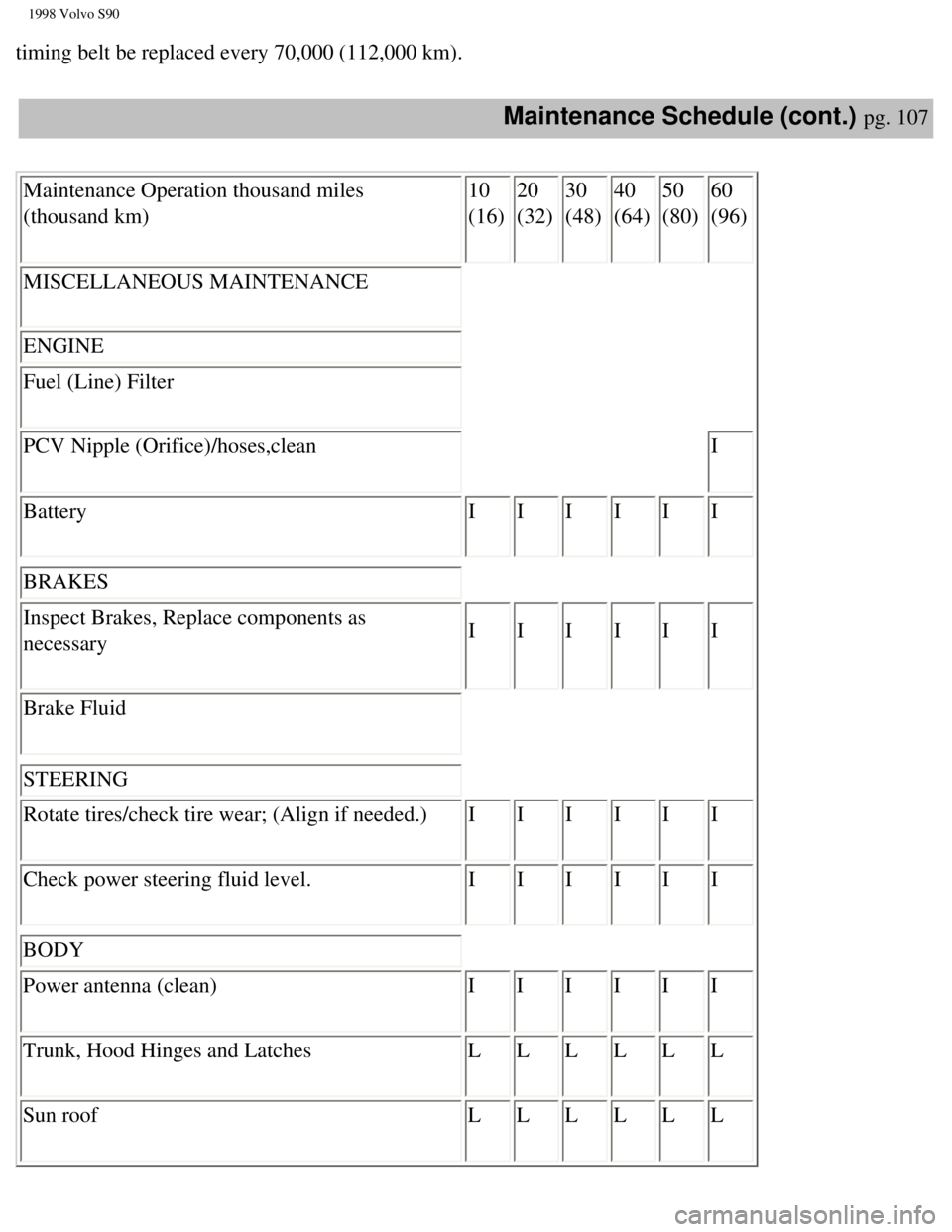
timing belt be replaced every 70,000 (112,000 km).
Maintenance Schedule (cont.) pg. 107
Maintenance Operation thousand miles
(thousand km) 10
(16) 20
(32) 30
(48) 40
(64) 50
(80) 60
(96)
MISCELLANEOUS MAINTENANCE
ENGINE
Fuel (Line) Filter
PCV Nipple (Orifice)/hoses,clean I
Battery I I I I I I
BRAKES
Inspect Brakes, Replace components as
necessary I
I I I I I
Brake Fluid
STEERING
Rotate tires/check tire wear; (Align if needed.) I I I I I I
Check power steering fluid level. I I I I I I
BODY
Power antenna (clean) I I I I I I
Trunk, Hood Hinges and Latches L L L L L L
Sun roof L L L L L L
file:///K|/ownersdocs/1998/1998_SV90/98S90_103.htm (6 of 7)12/30/2006 \
1:52:48 PM
Page 125 of 175
1998 Volvo S90
Chapter 8 - (cont.)
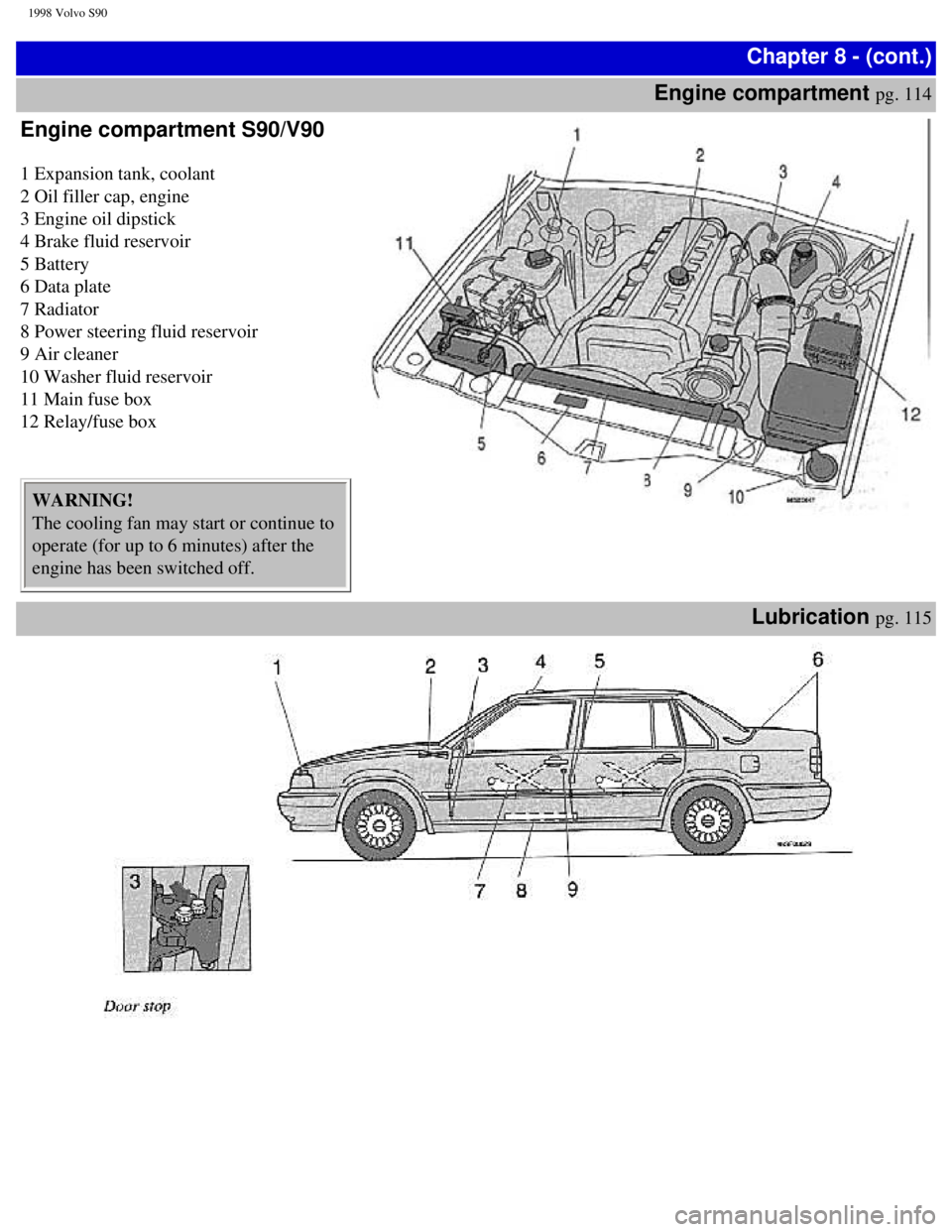
Engine compartment
pg. 114
Engine compartment S90/V90
1 Expansion tank, coolant
2 Oil filler cap, engine
3 Engine oil dipstick
4 Brake fluid reservoir
5 Battery
6 Data plate
7 Radiator
8 Power steering fluid reservoir
9 Air cleaner
10 Washer fluid reservoir
11 Main fuse box
12 Relay/fuse box
WARNING!
The cooling fan may start or continue to
operate (for up to 6 minutes) after the
engine has been switched off.
Lubrication pg. 115
file:///K|/ownersdocs/1998/1998_SV90/98S90_114.htm (1 of 5)12/30/2006 \
1:52:50 PM
Page 126 of 175
1998 Volvo S90
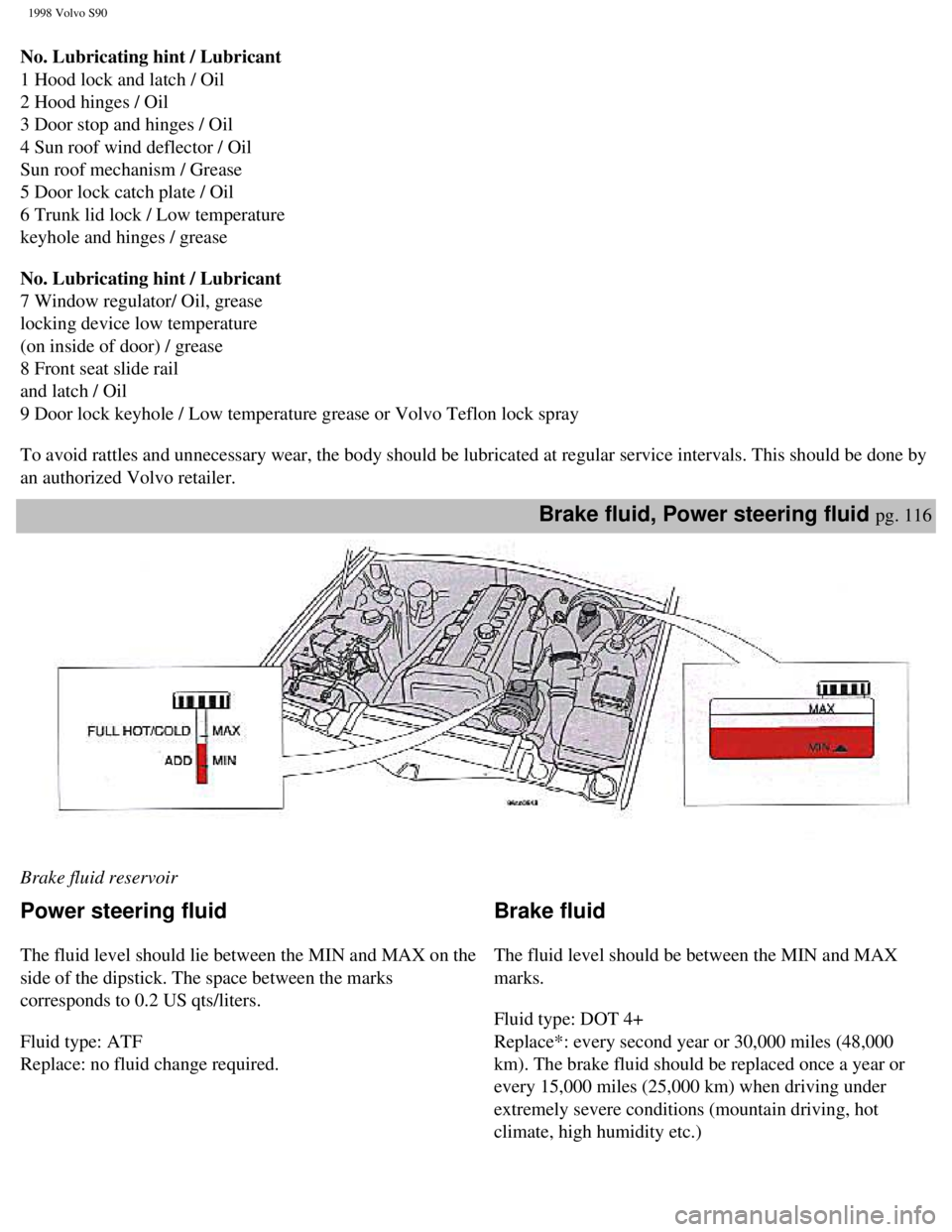
No. Lubricating hint / Lubricant
1 Hood lock and latch / Oil
2 Hood hinges / Oil
3 Door stop and hinges / Oil
4 Sun roof wind deflector / Oil
Sun roof mechanism / Grease
5 Door lock catch plate / Oil
6 Trunk lid lock / Low temperature
keyhole and hinges / grease
No. Lubricating hint / Lubricant
7 Window regulator/ Oil, grease
locking device low temperature
(on inside of door) / grease
8 Front seat slide rail
and latch / Oil
9 Door lock keyhole / Low temperature grease or Volvo Teflon lock spray \
To avoid rattles and unnecessary wear, the body should be lubricated at \
regular service intervals. This should be done by
an authorized Volvo retailer.
Brake fluid, Power steering fluid pg. 116
Brake fluid reservoir
Power steering fluid
The fluid level should lie between the MIN and MAX on the
side of the dipstick. The space between the marks
corresponds to 0.2 US qts/liters.
Fluid type: ATF
Replace: no fluid change required.Brake fluid
The fluid level should be between the MIN and MAX
marks.
Fluid type: DOT 4+
Replace*: every second year or 30,000 miles (48,000
km). The brake fluid should be replaced once a year or
every 15,000 miles (25,000 km) when driving under
extremely severe conditions (mountain driving, hot
climate, high humidity etc.)
file:///K|/ownersdocs/1998/1998_SV90/98S90_114.htm (2 of 5)12/30/2006 \
1:52:50 PM
Page 127 of 175
1998 Volvo S90
Check, without removing the cap, that the level is above
the "MIN" mark of the fluid reservoir.
Always entrust brake fluid changing to an authorized
Volvo retailer.
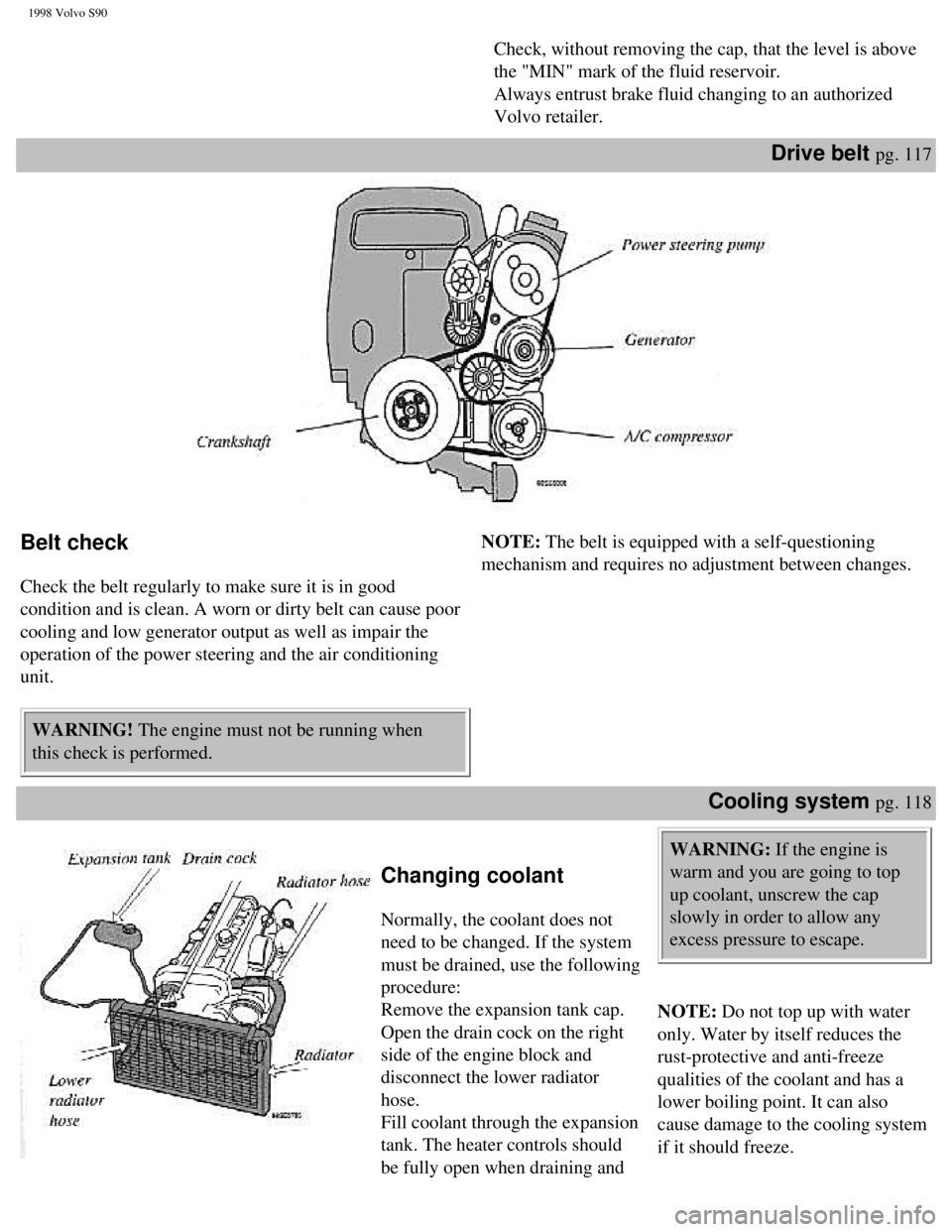
Drive belt pg. 117
Belt check
Check the belt regularly to make sure it is in good
condition and is clean. A worn or dirty belt can cause poor
cooling and low generator output as well as impair the
operation of the power steering and the air conditioning
unit.
WARNING! The engine must not be running when
this check is performed. NOTE: The belt is equipped with a self-questioning
mechanism and requires no adjustment between changes.
Cooling system pg. 118
Changing coolant
Normally, the coolant does not
need to be changed. If the system
must be drained, use the following
procedure:
Remove the expansion tank cap.
Open the drain cock on the right
side of the engine block and
disconnect the lower radiator
hose.
Fill coolant through the expansion
tank. The heater controls should
be fully open when draining and
WARNING: If the engine is
warm and you are going to top
up coolant, unscrew the cap
slowly in order to allow any
excess pressure to escape.
NOTE: Do not top up with water
only. Water by itself reduces the
rust-protective and anti-freeze
qualities of the coolant and has a
lower boiling point. It can also
cause damage to the cooling system
if it should freeze.
file:///K|/ownersdocs/1998/1998_SV90/98S90_114.htm (3 of 5)12/30/2006 \
1:52:50 PM
Page 131 of 175
1998 Volvo S90
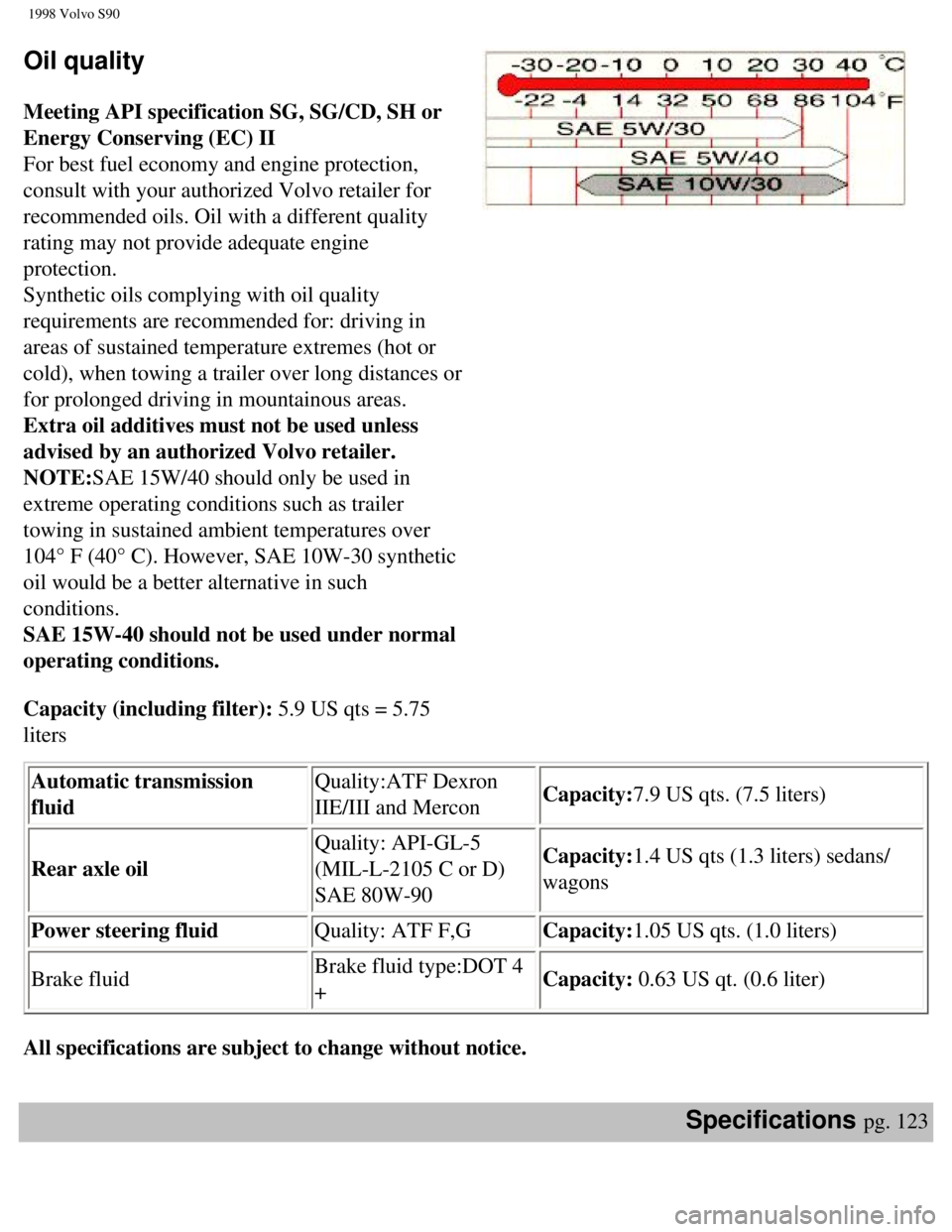
Oil quality
Meeting API specification SG, SG/CD, SH or
Energy Conserving (EC) II
For best fuel economy and engine protection,
consult with your authorized Volvo retailer for
recommended oils. Oil with a different quality
rating may not provide adequate engine
protection.
Synthetic oils complying with oil quality
requirements are recommended for: driving in
areas of sustained temperature extremes (hot or
cold), when towing a trailer over long distances or
for prolonged driving in mountainous areas.
Extra oil additives must not be used unless
advised by an authorized Volvo retailer.
NOTE:SAE 15W/40 should only be used in
extreme operating conditions such as trailer
towing in sustained ambient temperatures over
104° F (40° C). However, SAE 10W-30 synthetic
oil would be a better alternative in such
conditions.
SAE 15W-40 should not be used under normal
operating conditions.
Capacity (including filter): 5.9 US qts = 5.75
liters
Automatic transmission
fluid Quality:ATF Dexron
IIE/III and Mercon
Capacity:7.9 US qts. (7.5 liters)
Rear axle oil Quality: API-GL-5
(MIL-L-2105 C or D)
SAE 80W-90Capacity:1.4 US qts (1.3 liters) sedans/
wagons
Power steering fluid Quality: ATF F,GCapacity:1.05 US qts. (1.0 liters)
Brake fluid Brake fluid type:DOT 4
+Capacity: 0.63 US qt. (0.6 liter)
All specifications are subject to change without notice.
Specifications pg. 123
file:///K|/ownersdocs/1998/1998_SV90/98S90_121.htm (2 of 4)12/30/2006 \
1:52:50 PM