engine overheat VOLVO S90 2018 Owner´s Manual
[x] Cancel search | Manufacturer: VOLVO, Model Year: 2018, Model line: S90, Model: VOLVO S90 2018Pages: 640, PDF Size: 11.37 MB
Page 434 of 640
||
STARTING AND DRIVING
* Option/accessory.
432 the vehicle safely and letting the engine idle for a few minutes to let the transmissioncool.
• If the vehicle begins to overheat, the air con-ditioning may be temporarily switched off.
• After a prolonged period of driving indemanding conditions, do not turn off theengine immediately after stopping.
NOTE
It is normal for the engine's cooling fan to operate for a short time after the engine isswitched off.
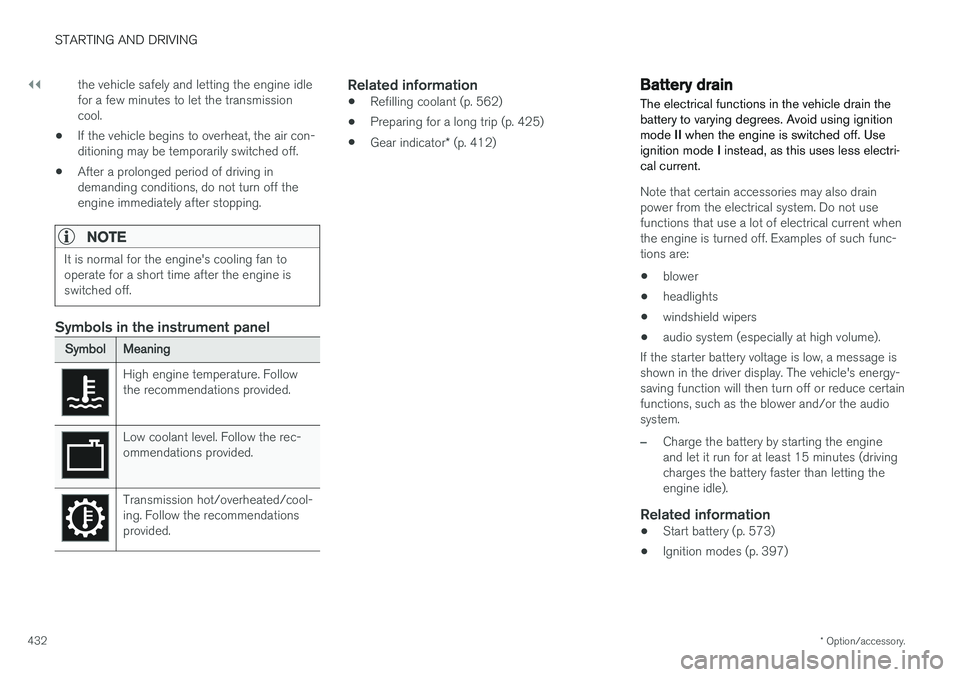
Symbols in the instrument panel
SymbolMeaning
High engine temperature. Follow the recommendations provided.
Low coolant level. Follow the rec- ommendations provided.
Transmission hot/overheated/cool- ing. Follow the recommendationsprovided.
Related information
•Refilling coolant (p. 562)
• Preparing for a long trip (p. 425)
• Gear indicator
* (p. 412)
Battery drain The electrical functions in the vehicle drain the battery to varying degrees. Avoid using ignitionmode II when the engine is switched off. Use
ignition mode I instead, as this uses less electri-
cal current.
Note that certain accessories may also drain power from the electrical system. Do not usefunctions that use a lot of electrical current whenthe engine is turned off. Examples of such func-tions are:
• blower
• headlights
• windshield wipers
• audio system (especially at high volume).
If the starter battery voltage is low, a message isshown in the driver display. The vehicle's energy-saving function will then turn off or reduce certainfunctions, such as the blower and/or the audio system.
–Charge the battery by starting the engine and let it run for at least 15 minutes (drivingcharges the battery faster than letting theengine idle).
Related information
• Start battery (p. 573)
• Ignition modes (p. 397)
Page 535 of 640
WHEELS AND TIRES
}}
533
7. Connect the electrical cable to the nearest
12 V outlet and start the vehicle.
NOTE
Make sure that none of the vehicle's other 12 V sockets are used while the compressoris running.
WARNING
Never leave children unattended in the vehicle while the engine is running. 8. Start the compressor by moving the switch to
the I (On) position.
WARNING
Never stand next to a tire being inflated with the compressor. If cracks, bulges, etc. form onthe tire, switch off the compressor immedi-ately. The vehicle should not be driven. Callroadside assistance to have the vehicle towedto a workshop for inspection/replacement ofthe tire. Volvo recommends an authorizedworkshop.
NOTE
When the compressor first starts, air pressure may temporarily increase up to 6 bar (88 psi)but should decrease again after approxi-mately 30 seconds.
9. Inflate the tire for 7 minutes.
CAUTION
To help avoid overheating, the compressor should never be used for more than10 minutes at a time.
10. Switch off the compressor and check the
inflation pressure using the air pressure gauge. The inflation pressure should bebetween 1.8 bar (22 psi) and 3.5 bar(51 psi). If the inflation pressure is too high,use the air release valve to release air.
WARNING
If the bottle is not removed in the correct order, sealant could spill out.
WARNING
If pressure falls below 1.8 bar (22 psi), the hole in the tire may be too large. The vehicleshould not be driven. Call roadside assistanceto have the vehicle towed to a workshop forinspection/replacement of the tire. Volvo rec-ommends an authorized workshop.
11. Switch off the compressor and remove the electrical cable.
12. Unscrew the hose from the tire's valve and screw the valve cap back on.
13. Put the protective hose cover onto the hose to help prevent leakage of any residual seal- ing compound. Return the equipment to thecargo compartment.
Page 537 of 640
WHEELS AND TIRES
535
Inflate tires with the compressorincluded in the tire sealing system The vehicle's original tires can be inflated using the compressor in the tire sealing system.
1. The compressor must be switched off. Makesure that the switch is in the 0 (Off) position
and take out the electrical cable and the hose.
2. Unscrew the tire's valve cap and screw the hose's valve connector as far as possibleonto the valve. Be sure the air release valve on the com- pressor's hose is completely closed.
3. Connect the electrical cable to the nearest 12 V outlet and start the vehicle.
WARNING
Inhaling exhaust fumes could lead to serious injury. Never leave the engine running in anenclosed space or a space without sufficientventilation.
WARNING
Never leave children unattended in the vehicle while the engine is running.
4. Start the compressor by moving the switch to the I (On) position.
CAUTION
Risk of overheating. The compressor should not be running for longer than 10 minutes ata time.
5. Inflate the tire to the pressure specified on
the tire pressure decal on the driver's side door pillar. If the inflation pressure is toohigh, use the air release valve to release air.
6. Switch off the compressor. Remove the hose and the electrical cable.
7. Screw the valve cap back onto the tire.
NOTE
• After inflating a tire, always replace the valve cap to help prevent valve damagecaused by gravel, dirt, etc.
• Use plastic valve caps only. Metal capscould corrode and become difficult toremove.
NOTE
The compressor is an electric device. Follow local regulations for disposal.
Related information
• Recommended tire pressure (p. 517)
• Using the tire sealing system (p. 531)
• Tire sealing system (p. 530)
Page 628 of 640
INDEX
626Daytime running lights 152 Decals
location of 610
Defrosting 217
Detection of cyclist 328
Dimensions 613
Dipstick, electronic 560
Direction of rotation 510
Disengaging the shiftlock 411
Display lighting 162
Distance Alert 280, 281, 282 limitations 283
DivX ®
470
Door mirrors 171, 173 compass 441
dimming 172
outer 171, 173
power folding 173
resetting 173
Driveline transmission 407
Drive mode 413 changing 415
Driver Alert Control 351 operation 352, 353
Driver Alert Control limitations 353
Driver performance 88, 89
Driver profile 135 edit 137
select 136
Driver support system 262 Driving cooling system 431
Driving economy 424
Driving through standing water 426 driving with a trailer towball load 616
towing capacity 616
E
ECO climate 415
ECO mode 415activate with function button 417
Economical driving 415, 424
Electrical outlet 539 use 540
Electrical system 573
Electric parking brake 401
Electronic immobilizer 242
emergency brake lights 159
Emission inspection readiness 548
Engine overheating 431
start 394
Start/Stop 418
turn off 396
Engine compartment coolant 562
engine oil 559
overview 559
Engine drag control 264
Engine oil 559 filling 560
filter 559
grade and volume 618
Engine shutdown 396
Engine specifications 617 Engine temperature high 431
Environment 27Error messages Adaptive Cruise Control 298
see Messages and symbols 298, 313
Error messages in BLIS 341 Ethanol content max. 10% by volume 428
Exterior dimensions 613
Page 632 of 640
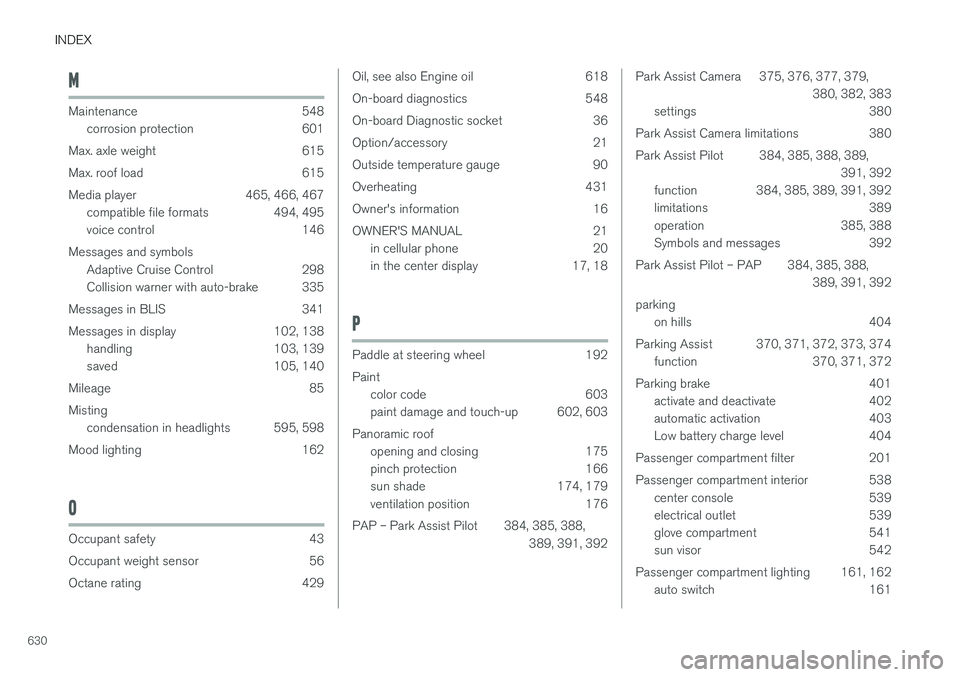
INDEX
630
M
Maintenance 548corrosion protection 601
Max. axle weight 615
Max. roof load 615
Media player 465, 466, 467 compatible file formats 494, 495
voice control 146
Messages and symbols Adaptive Cruise Control 298
Collision warner with auto-brake 335
Messages in BLIS 341
Messages in display 102, 138 handling 103, 139
saved 105, 140
Mileage 85 Misting condensation in headlights 595, 598
Mood lighting 162
O
Occupant safety 43
Occupant weight sensor 56
Octane rating 429
Oil, see also Engine oil 618
On-board diagnostics 548
On-board Diagnostic socket 36
Option/accessory 21
Outside temperature gauge 90
Overheating 431
Owner's information 16
OWNER'S MANUAL 21 in cellular phone 20
in the center display 17, 18
P
Paddle at steering wheel 192 Paint
color code 603
paint damage and touch-up 602, 603
Panoramic roof opening and closing 175
pinch protection 166
sun shade 174, 179
ventilation position 176
PAP – Park Assist Pilot 384, 385, 388, 389, 391, 392
Park Assist Camera 375, 376, 377, 379,
380, 382, 383
settings 380
Park Assist Camera limitations 380
Park Assist Pilot 384, 385, 388, 389, 391, 392
function 384, 385, 389, 391, 392
limitations 389
operation 385, 388
Symbols and messages 392
Park Assist Pilot – PAP 384, 385, 388, 389, 391, 392
parking on hills 404
Parking Assist 370, 371, 372, 373, 374 function 370, 371, 372
Parking brake 401 activate and deactivate 402
automatic activation 403
Low battery charge level 404
Passenger compartment filter 201
Passenger compartment interior 538 center console 539
electrical outlet 539
glove compartment 541
sun visor 542
Passenger compartment lighting 161, 162 auto switch 161