towing VOLVO S90 2018 Owner´s Manual
[x] Cancel search | Manufacturer: VOLVO, Model Year: 2018, Model line: S90, Model: VOLVO S90 2018Pages: 640, PDF Size: 11.37 MB
Page 438 of 640
||
STARTING AND DRIVING
* Option/accessory.
436
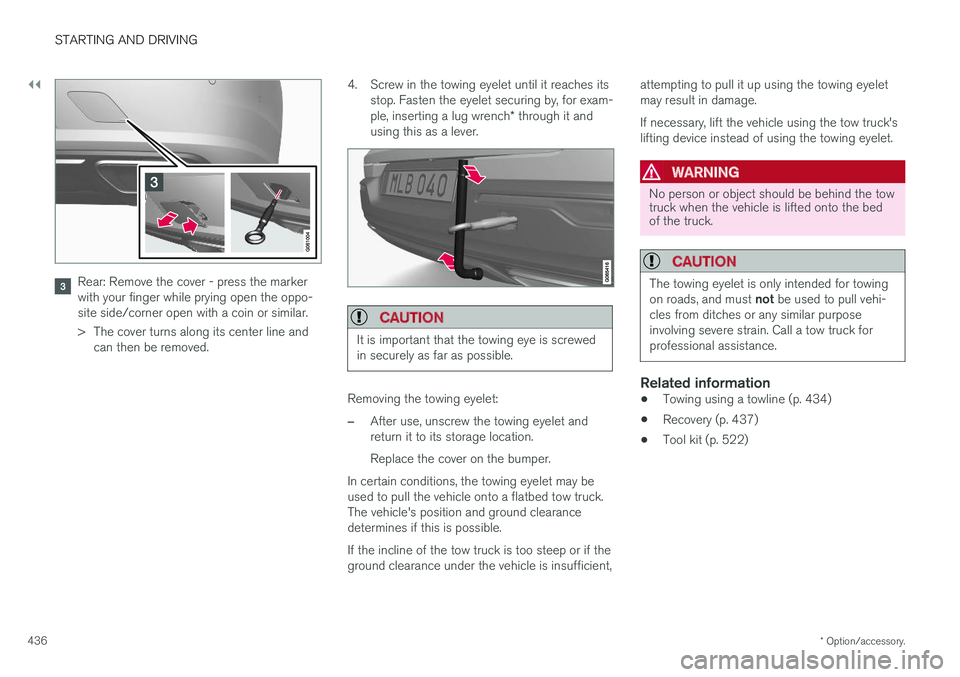
Rear: Remove the cover - press the marker with your finger while prying open the oppo-site side/corner open with a coin or similar.
> The cover turns along its center line and
can then be removed. 4. Screw in the towing eyelet until it reaches its
stop. Fasten the eyelet securing by, for exam- ple, inserting a lug wrench * through it and
using this as a lever.
CAUTION
It is important that the towing eye is screwed in securely as far as possible.
Removing the towing eyelet:
–After use, unscrew the towing eyelet and return it to its storage location. Replace the cover on the bumper.
In certain conditions, the towing eyelet may be used to pull the vehicle onto a flatbed tow truck.The vehicle's position and ground clearancedetermines if this is possible. If the incline of the tow truck is too steep or if the ground clearance under the vehicle is insufficient, attempting to pull it up using the towing eyeletmay result in damage. If necessary, lift the vehicle using the tow truck's lifting device instead of using the towing eyelet.
WARNING
No person or object should be behind the tow truck when the vehicle is lifted onto the bedof the truck.
CAUTION
The towing eyelet is only intended for towing on roads, and must
not be used to pull vehi-
cles from ditches or any similar purpose involving severe strain. Call a tow truck forprofessional assistance.
Related information
• Towing using a towline (p. 434)
• Recovery (p. 437)
• Tool kit (p. 522)
Page 439 of 640
STARTING AND DRIVING
}}
* Option/accessory.437
Recovery
This section refers to transporting the vehicle with a tow truck or similar vehicle.
Call a professional towing service for assistance. In certain conditions, the towing eyelet can be used to pull the vehicle onto a flatbed tow truck. For vehicles equipped with leveling control *:
If the vehicle is equipped with pneumatic suspen- sion, this feature must be turned off before thevehicle is lifted onto a tow truck. Turning off thefunction in the center display. 1. Tap
Settings in the Top view.
2. Tap
My CarParking Brake and
Suspension.
3. Select
Disable Leveling Control.
The vehicle's location and ground clearance determine if it can be lifted onto a tow truck. Ifthe incline of the tow truck is too steep or if theground clearance under the vehicle is insufficient,attempting to pull it up may result in damage. Inthis case, the vehicle should only be lifted withthe tow truck's lifting equipment.
WARNING
No person or object should be behind the tow truck when the vehicle is lifted onto the bedof the truck.
CAUTION
The towing eyelet is only intended for towing on roads, and must not be used to pull vehi-
cles from ditches or any similar purpose involving severe strain. Call a tow truck forprofessional assistance.
CAUTION
Note that the vehicle must always be towed with the wheels rolling forward.
Related information
• Attaching and removing the towing eyelet (p. 435)
HomeLink®
*9
HomeLink ®
10
is a programmable remote control,
integrated in the vehicle electrical system, that can control up to three different devices (e.g.garage door opener, alarm system, outdoor andindoor lighting, etc.) and thereby replace theremote controls for these.
General
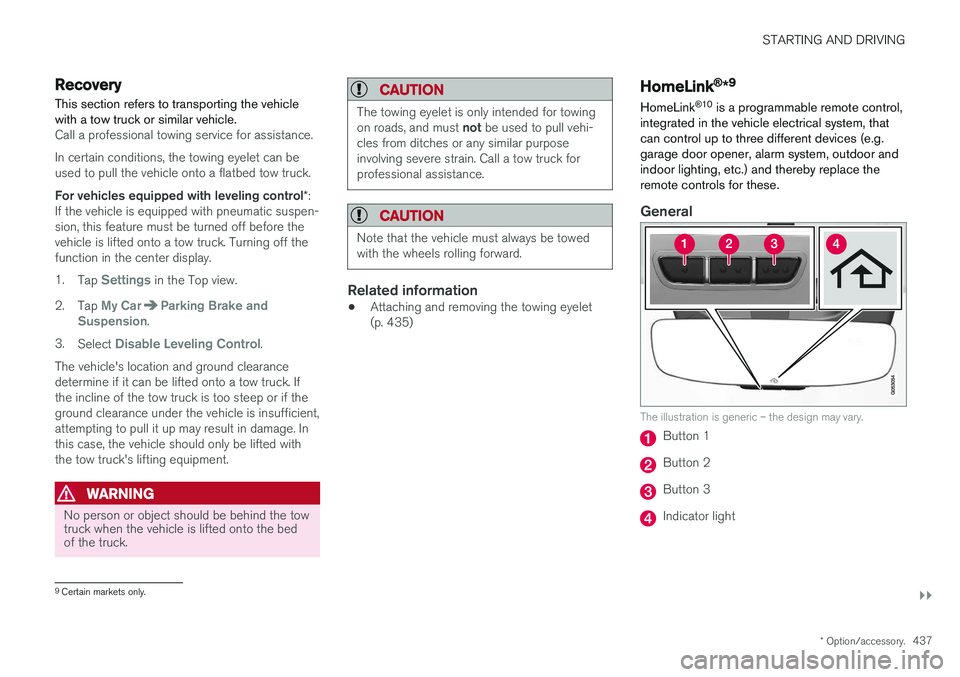
The illustration is generic – the design may vary.
Button 1
Button 2
Button 3
Indicator light
9 Certain markets only.
Page 524 of 640
||
WHEELS AND TIRES
* Option/accessory.
522
Related information
• Recommended tire pressure (p. 517)
• Adjusting tire pressure (p. 516)
• Calibrating the tire pressure monitoring sys- tem
* (p. 519)
• Viewing tire pressure status in the centerdisplay
* (p. 520)
• Tire pressure monitoring system
* (p. 517)
• Inflate tires with the compressor included in the tire sealing system (p. 535)
When changing wheels
The wheels can be changed, e.g. to switch to snow tires or spare tires. Follow the applicableinstructions for removing and installing thewheel.
Changing to tires of another dimensionMake sure that the tire dimension is approved for use on the vehicle. If you change to tires of another dimension, con- tact an authorized Volvo workshop to update thevehicle's software. A software update may benecessary when changing to tires of larger/smaller dimensions or when changing to or fromsnow tires.
Related information
• Removing a wheel (p. 524)
• Installing a wheel (p. 526)
• Tool kit (p. 522)
• Snow tires (p. 529)
• Spare wheel (p. 527)
• Wheel bolts (p. 523)
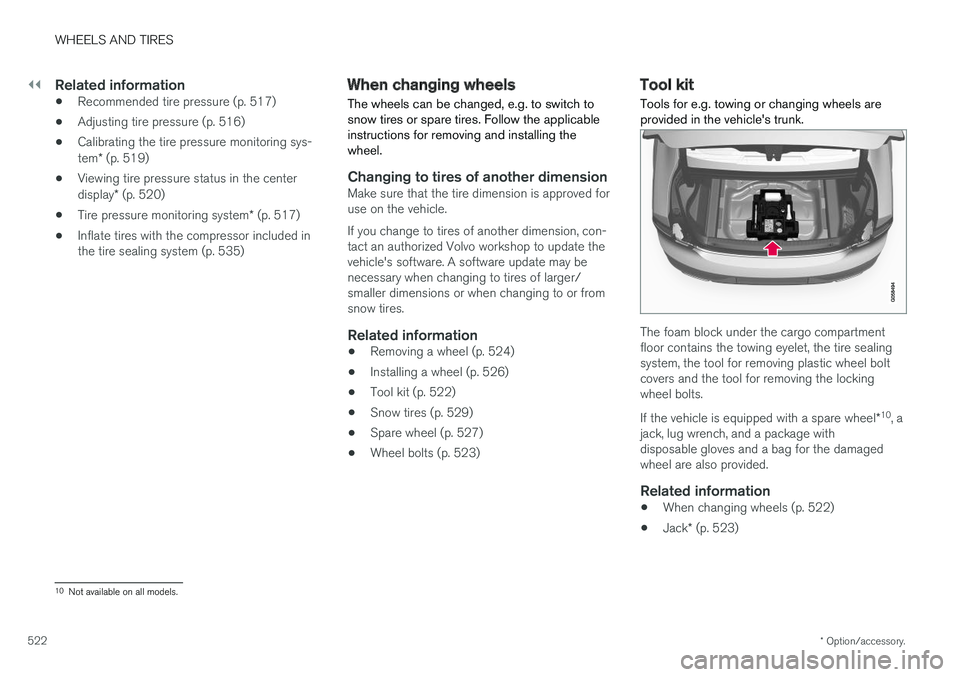
Tool kit Tools for e.g. towing or changing wheels are provided in the vehicle's trunk.
The foam block under the cargo compartment floor contains the towing eyelet, the tire sealingsystem, the tool for removing plastic wheel boltcovers and the tool for removing the lockingwheel bolts. If the vehicle is equipped with a spare wheel
*10
, a
jack, lug wrench, and a package with disposable gloves and a bag for the damagedwheel are also provided.
Related information
• When changing wheels (p. 522)
• Jack
* (p. 523)
10
Not available on all models.
Page 527 of 640
WHEELS AND TIRES
}}
* Option/accessory.525
1. Turn on the vehicle's hazard warning flashers
if a wheel change must be performed in an area with traffic.
2. Apply the parking brake and put the gear selector in P.
For vehicles with
Leveling Control* : If the
vehicle is equipped with pneumatic suspen- sion, this must be switched off before the vehicle is lifted with the jack *.
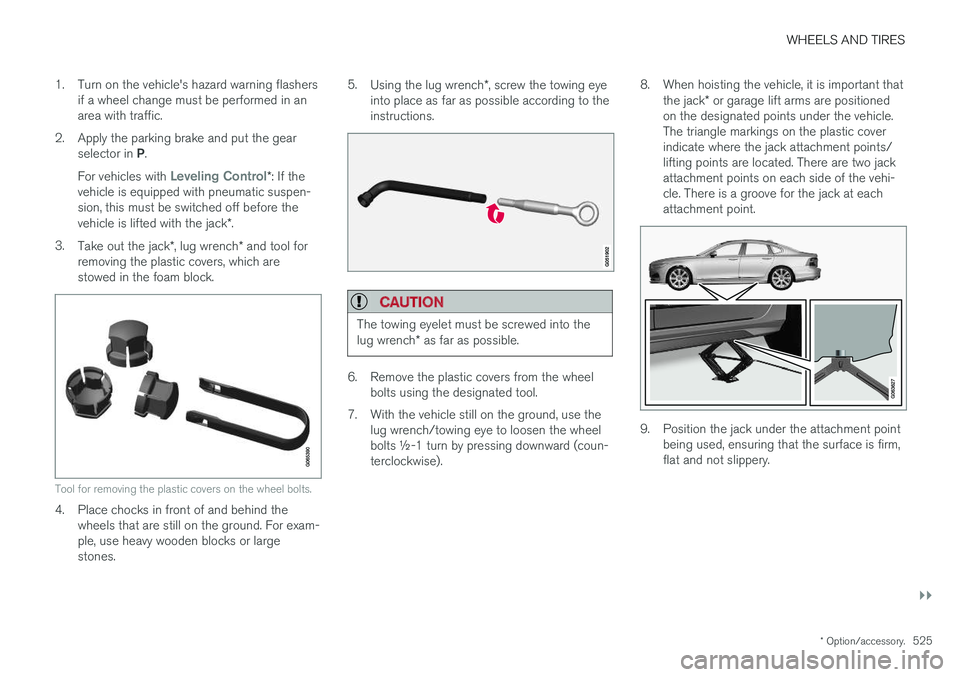
3. Take out the jack *, lug wrench * and tool for
removing the plastic covers, which are stowed in the foam block.
Tool for removing the plastic covers on the wheel bolts.
4. Place chocks in front of and behind the wheels that are still on the ground. For exam- ple, use heavy wooden blocks or largestones. 5.
Using the lug wrench *, screw the towing eye
into place as far as possible according to theinstructions.
CAUTION
The towing eyelet must be screwed into the lug wrench * as far as possible.
6. Remove the plastic covers from the wheel
bolts using the designated tool.
7. With the vehicle still on the ground, use the lug wrench/towing eye to loosen the wheel bolts ½-1 turn by pressing downward (coun-terclockwise). 8. When hoisting the vehicle, it is important that
the jack * or garage lift arms are positioned
on the designated points under the vehicle.The triangle markings on the plastic coverindicate where the jack attachment points/lifting points are located. There are two jackattachment points on each side of the vehi-cle. There is a groove for the jack at eachattachment point.
9. Position the jack under the attachment point being used, ensuring that the surface is firm, flat and not slippery.
Page 530 of 640
||
WHEELS AND TIRES
528
WARNING
•The vehicle must never be driven with more than one "Temporary spare" tiremounted.
• Driving with a spare wheel may alter thedriving characteristics of the vehicle.Replace the spare wheel with a normalwheel as soon as possible.
• The spare wheel is smaller than the nor-mal wheel, which affects the vehicle'sground clearance. Watch for high curbsand do not wash the vehicle in an auto-matic car wash when a spare wheel ismounted.
• Follow the manufacturer's recommendedtire inflation pressure for the spare wheel.
• On all-wheel drive vehicles, the drive onthe rear axle can be disconnected.
• If the spare wheel is mounted on thefront axle, snow chains must not be used.
• The spare wheel must not be repaired.
CAUTION
The vehicle must not be driven with wheels of different dimensions or with a spare tire otherthan the one that came with the vehicle. Theuse of different size wheels can seriouslydamage your vehicle's transmission.
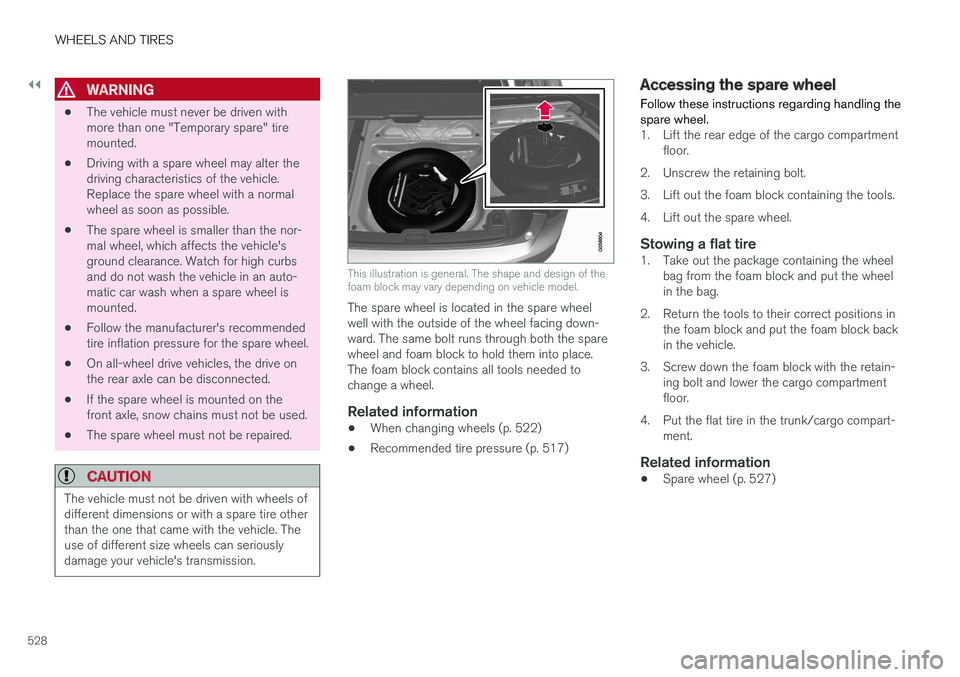
This illustration is general. The shape and design of the foam block may vary depending on vehicle model.
The spare wheel is located in the spare wheel well with the outside of the wheel facing down-ward. The same bolt runs through both the sparewheel and foam block to hold them into place.The foam block contains all tools needed tochange a wheel.
Related information
•When changing wheels (p. 522)
• Recommended tire pressure (p. 517)
Accessing the spare wheel
Follow these instructions regarding handling the spare wheel.
1. Lift the rear edge of the cargo compartment floor.
2. Unscrew the retaining bolt.
3. Lift out the foam block containing the tools.
4. Lift out the spare wheel.
Stowing a flat tire1. Take out the package containing the wheel bag from the foam block and put the wheel in the bag.
2. Return the tools to their correct positions in the foam block and put the foam block backin the vehicle.
3. Screw down the foam block with the retain- ing bolt and lower the cargo compartmentfloor.
4. Put the flat tire in the trunk/cargo compart- ment.
Related information
• Spare wheel (p. 527)
Page 538 of 640
WHEELS AND TIRES
536
Determining the vehicle's permittedweight
Properly loading your vehicle will provide maxi- mum return of vehicle design performance.
Weight designationsBefore loading your vehicle, familiarize yourself with the following terms for determining yourvehicle's weight ratings, with or without a trailer,from the vehicle's Federal/Canadian Motor Vehi-cle Safety Standards (FMVSS/CMVSS) label, andthe vehicle's tire information placard:
Curb weight
The weight of the vehicle including a full tank of fuel and all standard equipment. It does notinclude passengers, cargo, or optional equipment.
Capacity weight
All weight added to the curb weight, including cargo and optional equipment. When towing, tow-bar weight is also part of cargo weight.
Permissible axle weight
The maximum allowable weight that can be car- ried by a single axle (front or rear). These num-bers are shown on the Federal/Canadian MotorVehicle Safety Standards (FMVSS/CMVSS) label.The total load on each axle must never exceed itsmaximum permissible weight.
Gross vehicle weight (GVW)
The vehicle's curb weight + cargo + passengers.
Steps for Determining Correct Load Limit
1. Locate the statement "the combined weight of occupants and cargo should never exceed XXX kg or XXX lbs." on your vehicle's plac-ard.
2. Determine the combined weight of the driver and passengers that will be riding in yourvehicle.
3. Subtract the combined weight of the driver and passengers from XXX kg or XXX lbs.
4. The resulting figure equals the available amount of cargo and luggage load capacity.For example, if the "XXX" amount equals1400 lbs. and there will be five 150 lb. pas-sengers in your vehicle, the amount of availa-ble cargo and luggage load capacity is 650lbs. (1400 - 750 (5 × 150) = 650 lbs.)
5. Determine the combined weight of luggage and cargo being loaded on the vehicle. Thatweight may not safely exceed the availablecargo and luggage load capacity calculatedin Step 4.
6. If your vehicle will be towing a trailer, load from your trailer will be transferred to yourvehicle. Consult this manual to determinehow this reduces the available cargo and lug-gage load capacity of your vehicle.
WARNING
• Exceeding the permissible axle weight, gross vehicle weight, or any other weightrating limits can cause tire overheatingresulting in permanent deformation orcatastrophic failure.
• Do not use replacement tires with lowerload carrying capacities than the tires thatwere original equipment on the vehiclebecause this will lower the vehicle's GVWrating. Use only tires with the correct loadcarrying capacity. Consult your Volvoretailer for information.
Related information
• Loading recommendations (p. 543)
Page 545 of 640
LOADING, STORAGE AND PASSENGER COMPARTMENT
}}
* Option/accessory.543
Cargo compartment Loads can be secured in the trunk to keep them in place while driving.
The folding* rear seat backrests can help
increase the cargo capacity of the trunk. Load anchoring eyelets and grocery bag holders areprovided to help secure objects in place. The towing eyelet and tire sealing system, or the temporary spare tire *, are located under the
cargo compartment floor.
Related information
• Loading recommendations (p. 543)
• Grocery bag holders (p. 544)
• Load anchoring eyelets (p. 545)
Loading recommendations
There are a number of things to consider when carrying loads in or on the vehicle.
Load-carrying capacity is determined by the vehi- cle's curb weight. The total weight of all passen-gers and any installed accessories reduces thevehicle's load-carrying capacity by the corres-ponding amount.
WARNING
The vehicle's driving characteristics change depending on the weight and position of theload.
Loading in the trunk and cargo compartment
• Position objects so they are pressing against the rear seat backrests.
• Distribute the load evenly.
• Heavy objects should be positioned as lowas possible. Avoid placing heavy objects onfolded-down seat backrests.
• Cover sharp corners with a soft cloth or simi-lar to help prevent damage to the upholstery.
• Use the load anchoring eyelets and tension-ing straps or similar to secure all objects.
WARNING
In a head-on collision at a speed of 50 km/h (30 mph), an unsecured object weighing 20kg (44 pounds) can reach a projectile weightequivalent to 1000 kg (2200 pounds).
WARNING
If objects are loaded higher than the upper edge of the side windows, leave a 10 cm (4in.) space between the objects and the win-dow. Objects placed closer to this couldimpede the function of the inflatable curtainconcealed inside the headlining.
WARNING
Always secure the load. Otherwise, it may shift during heavy braking and injure people in thevehicle. Cover sharp edges and sharp corners with something soft. Turn off the engine and apply the parking brake when loading/unloading long objects.Otherwise, it is possible for the load to reachthe gear lever or gear selector and move it toa drive position – which could cause the vehi-cle to begin rolling.
Page 617 of 640
SPECIFICATIONS
615
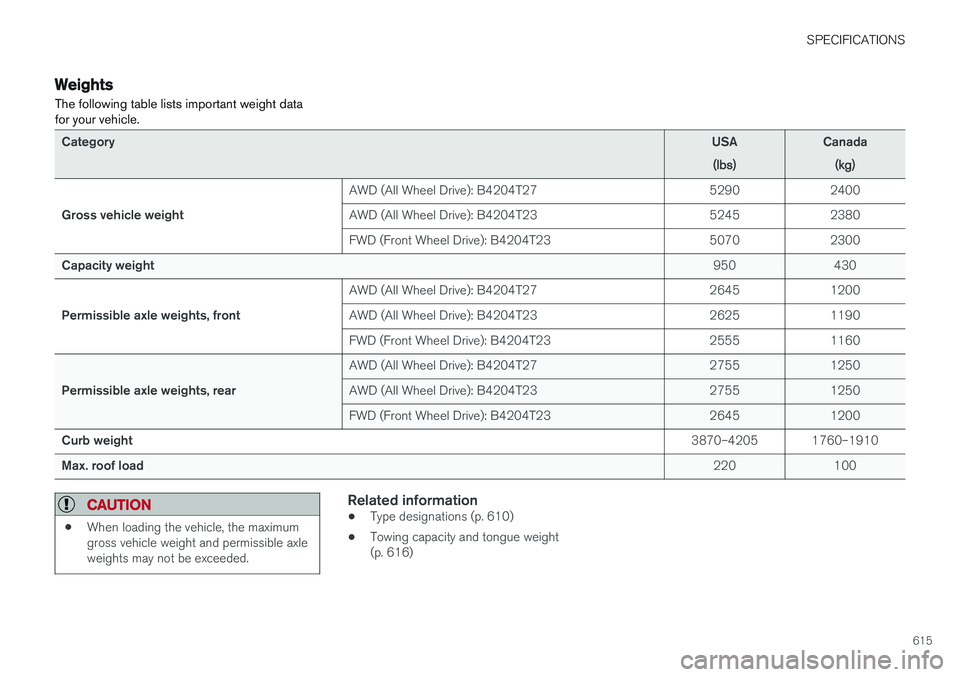
Weights The following table lists important weight data for your vehicle.
CategoryUSA
(lbs)Canada(kg)
Gross vehicle weight AWD (All Wheel Drive): B4204T27 5290 2400
AWD (All Wheel Drive): B4204T23 5245 2380
FWD (Front Wheel Drive): B4204T23 5070 2300
Capacity weight 950 430
Permissible axle weights, front AWD (All Wheel Drive): B4204T27 2645 1200
AWD (All Wheel Drive): B4204T23 2625 1190
FWD (Front Wheel Drive): B4204T23 2555 1160
Permissible axle weights, rear AWD (All Wheel Drive): B4204T27 2755 1250
AWD (All Wheel Drive): B4204T23 2755 1250
FWD (Front Wheel Drive): B4204T23 2645 1200
Curb weight 3870–4205 1760–1910
Max. roof load 220 100
CAUTION
•When loading the vehicle, the maximum gross vehicle weight and permissible axleweights may not be exceeded.
Related information
•Type designations (p. 610)
• Towing capacity and tongue weight (p. 616)
Page 618 of 640
SPECIFICATIONS
616
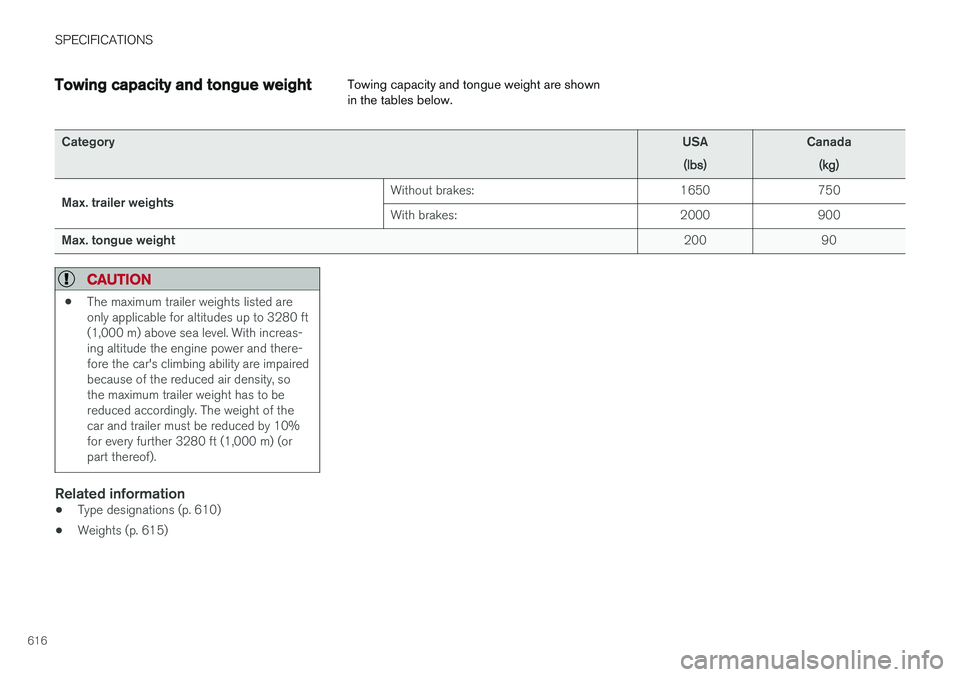
Towing capacity and tongue weightTowing capacity and tongue weight are shown in the tables below.
Category
USA
(lbs)Canada(kg)
Max. trailer weights Without brakes: 1650 750 With brakes:
2000 900
Max. tongue weight 200 90
CAUTION
•The maximum trailer weights listed are only applicable for altitudes up to 3280 ft(1,000 m) above sea level. With increas-ing altitude the engine power and there-fore the car's climbing ability are impairedbecause of the reduced air density, sothe maximum trailer weight has to bereduced accordingly. The weight of thecar and trailer must be reduced by 10%for every further 3280 ft (1,000 m) (orpart thereof).
Related information
•
Type designations (p. 610)
• Weights (p. 615)
Page 628 of 640
INDEX
626Daytime running lights 152 Decals
location of 610
Defrosting 217
Detection of cyclist 328
Dimensions 613
Dipstick, electronic 560
Direction of rotation 510
Disengaging the shiftlock 411
Display lighting 162
Distance Alert 280, 281, 282 limitations 283
DivX ®
470
Door mirrors 171, 173 compass 441
dimming 172
outer 171, 173
power folding 173
resetting 173
Driveline transmission 407
Drive mode 413 changing 415
Driver Alert Control 351 operation 352, 353
Driver Alert Control limitations 353
Driver performance 88, 89
Driver profile 135 edit 137
select 136
Driver support system 262 Driving cooling system 431
Driving economy 424
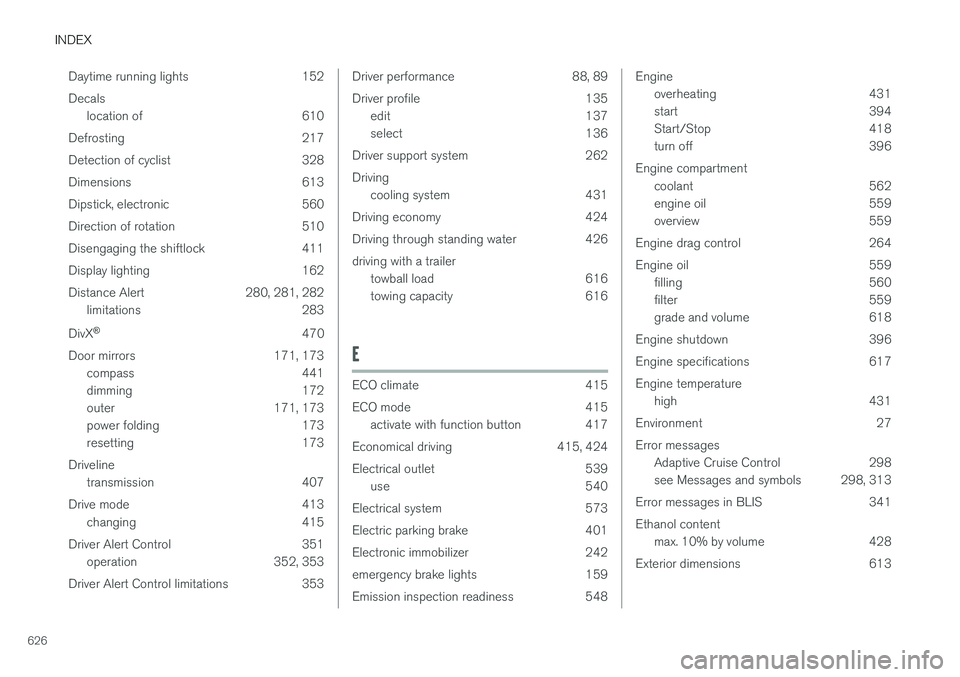
Driving through standing water 426 driving with a trailer towball load 616
towing capacity 616
E
ECO climate 415
ECO mode 415activate with function button 417
Economical driving 415, 424
Electrical outlet 539 use 540
Electrical system 573
Electric parking brake 401
Electronic immobilizer 242
emergency brake lights 159
Emission inspection readiness 548
Engine overheating 431
start 394
Start/Stop 418
turn off 396
Engine compartment coolant 562
engine oil 559
overview 559
Engine drag control 264
Engine oil 559 filling 560
filter 559
grade and volume 618
Engine shutdown 396
Engine specifications 617 Engine temperature high 431
Environment 27Error messages Adaptive Cruise Control 298
see Messages and symbols 298, 313
Error messages in BLIS 341 Ethanol content max. 10% by volume 428
Exterior dimensions 613