lock VOLVO S90 T8 2018 Owner´s Manual
[x] Cancel search | Manufacturer: VOLVO, Model Year: 2018, Model line: S90 T8, Model: VOLVO S90 T8 2018Pages: 166, PDF Size: 4.72 MB
Page 99 of 166
PRACTICAL INFORMATION
}}
97
Snow tires and chains
The use of snow chains and/or winter tires can help improve traction in winter driving conditions.
Snow chains can be used on your Volvo with the following restrictions:
• Snow chains should be installed on frontwheels only. Use only Volvo approved snowchains.
• If accessory, aftermarket or "custom" tiresand wheels are installed and are of a size dif-ferent than the original tires and wheels,chains in some cases CANNOT be used.Sufficient clearances between chains andbrakes, suspension and body componentsmust be maintained.
• Some strap-on type chains will interfere withbrake components and therefore CANNOTbe used.
• All Wheel Drive models
: Snow chains
should only be installed on the front wheels.
• Certain size tires may not allow the assemblyof snow chains/traction devices.
Consult your Volvo retailer for additional snowchain information.
CAUTION
• Snow chains should not be used on wheels larger than 18".
• Always follow the chain manufacturer'sinstallation instructions carefully. Installchains as tightly as possible andretighten periodically.
• Check local regulations regarding the useof snow chains before installing.
• Use single-sided snow chains only.
• Never exceed the chain manufacturer'sspecified maximum speed limit. (Underno circumstances should you exceed31 mph (50 km/h).
• Avoid bumps, holes or sharp turns whendriving with snow chains.
• The handling of the vehicle can beadversely affected when driving withchains. Avoid fast or sharp turns as wellas locked wheel braking.
Checking tire inflation pressure
Correct tire inflation pressure helps improve driv- ing stability, save fuel and increase the servicelife of the tires.
WARNING
• Under-inflation is the most common cause of tire failure and may result insevere tire cracking, tread separation, or"blow-out," with unexpected loss of vehi-cle control and increased risk of injury.
• Under-inflated tires reduce the load car-rying capacity of your vehicle.
Cold tiresInflation pressure should be checked when thetires are cold. The tires are considered to be cold when they have the same temperature as the sur-rounding (ambient) air. This temperature is normally reached after the vehicle has been parked for at least 3 hours. After driving a distance of approximately 1 mile (1.6 km), the tires are considered to be hot. If youhave to drive farther than this distance to pumpyour tire(s), check and record the tire pressurefirst and add the appropriate air pressure whenyou get to the pump. When weather temperature changes occur, tire inflation pressures also change. A 10-degree
Page 101 of 166
PRACTICAL INFORMATION
* Option/accessory.99
NOTE
•If you overfill the tire, release air by push- ing on the metal stem in the center of thevalve. Then recheck the pressure withyour tire gauge.
• Some spare tires require higher inflationpressure than the other tires. Consult thetire inflation pressure table or the inflationpressure placard.
Changing tires
When changing wheels to another dimension, always follow Volvo's instructions.
When changing to tires of another
dimension
If you mount tires with a dimension other thanthe factory-installed tires, contact an authorizedVolvo retailer to update the vehicle's software.This may also be necessary when changing fromsummer to winter tires, or vice versa.
Related information
• Snow tires and chains (p. 97)
• Installing a wheel (p. 102)
• Removing a wheel (p. 101)
Tools
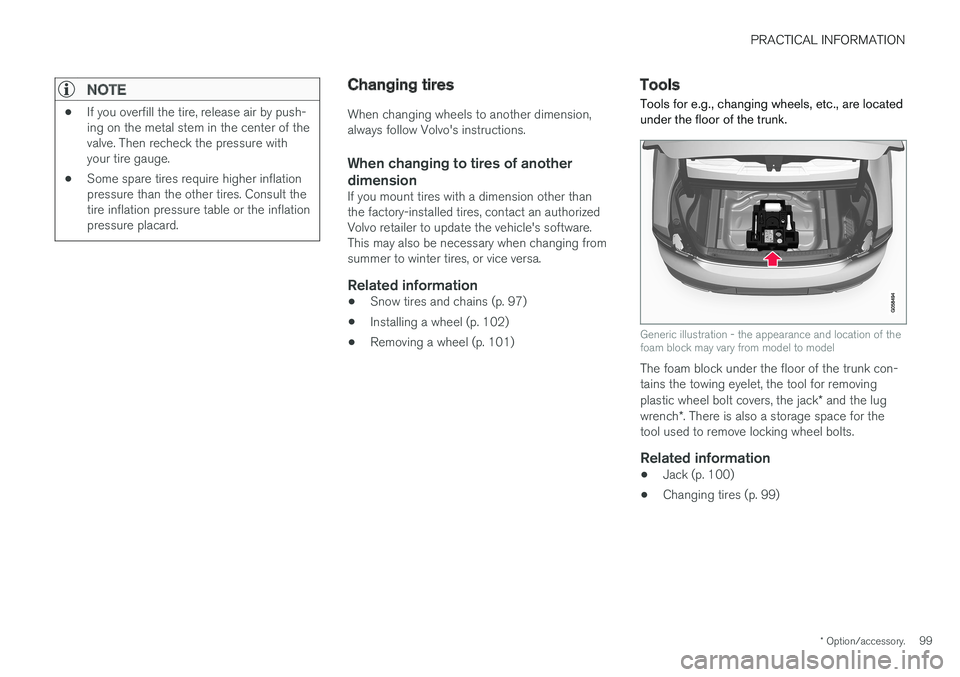
Tools for e.g., changing wheels, etc., are located under the floor of the trunk.
Generic illustration - the appearance and location of the foam block may vary from model to model
The foam block under the floor of the trunk con- tains the towing eyelet, the tool for removing plastic wheel bolt covers, the jack * and the lug
wrench *. There is also a storage space for the
tool used to remove locking wheel bolts.
Related information
• Jack (p. 100)
• Changing tires (p. 99)
Page 102 of 166
PRACTICAL INFORMATION
* Option/accessory.
100
Jack
The jack is used to raise the vehicle, for example when mounting winter wheels, etc.
WARNING
• The jack must correctly engage the jack attachment.
• Be sure the jack is on a firm, level, non-slippery surface.
• Never allow any part of your body to beextended under a vehicle supported by ajack.
• Use the jack intended for the vehiclewhen changing a tire. For any other job,use stands to support the vehicle.
• Apply the parking brake and put the gear selector in the Park (
P) position.
• Block the wheels standing on the ground, use rigid wooden blocks or large stones.
• The jack should be kept well-greased andclean, and should not be damaged.
• No objects should be placed between thebase of jack and the ground, or betweenthe jack and the attachment bar on thevehicle.
CAUTION
•
When not in use, the jack
* should be kept
in its storage compartment under the cargo compartment floor.
• The jack provided with your vehicle isintended to be used only in temporary sit-uations such as changing wheels in theevent of a flat tire. Only the jack thatcame with your particular model shouldbe used to lift the vehicle. If the vehicleneeds to be lifted more frequently or for aprolonged period, using a garage jack orhoist is recommended. Always follow thisdevice
Page 103 of 166
PRACTICAL INFORMATION
}}
* Option/accessory.101
Removing a wheel
Wheel changes should always be carried out correctly.
1. Turn on the hazard warning flashers if the wheel change has to be done near passing traffic.
2. Apply the parking brake and put the gear selector in P.
CAUTION
Models with suspension and level con- trol *:
Turn this function off before raising the vehi- cle. To do so, go to
SettingsVehicleDisable Leveling Control in the center dis-
play's Top view.
WARNING
• The jack must correctly engage the jack attachment.
• Be sure the jack is on a firm, level, non-slippery surface.
• Never allow any part of your body to beextended under a vehicle supported by ajack.
• Use the jack intended for the vehicle whenchanging a tire. For any other job, usestands to support the vehicle.
• Apply the parking brake and put the gear selector in the Park (
P) position.
• Block the wheels standing on the ground, use rigid wooden blocks or large stones.
• The jack should be kept well-greased andclean, and should not be damaged.
• No objects should be placed between thebase of jack and the ground, or betweenthe jack and the attachment bar on thevehicle.
NOTE
The jack provided with your vehicle is intended to be used only in temporary situa-tions such as changing wheels in the event ofa flat tire. Only the jack that came with yourparticular model should be used to lift thevehicle. If the vehicle needs to be lifted morefrequently or for a prolonged period, using agarage jack or hoist is recommended. Alwaysfollow this device
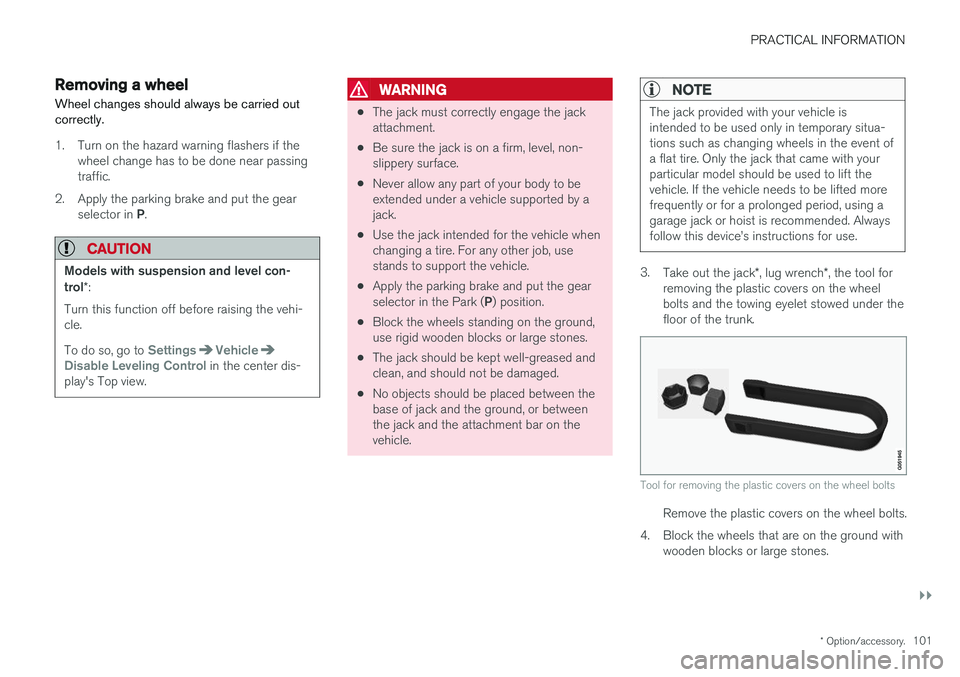
Page 104 of 166
||
PRACTICAL INFORMATION
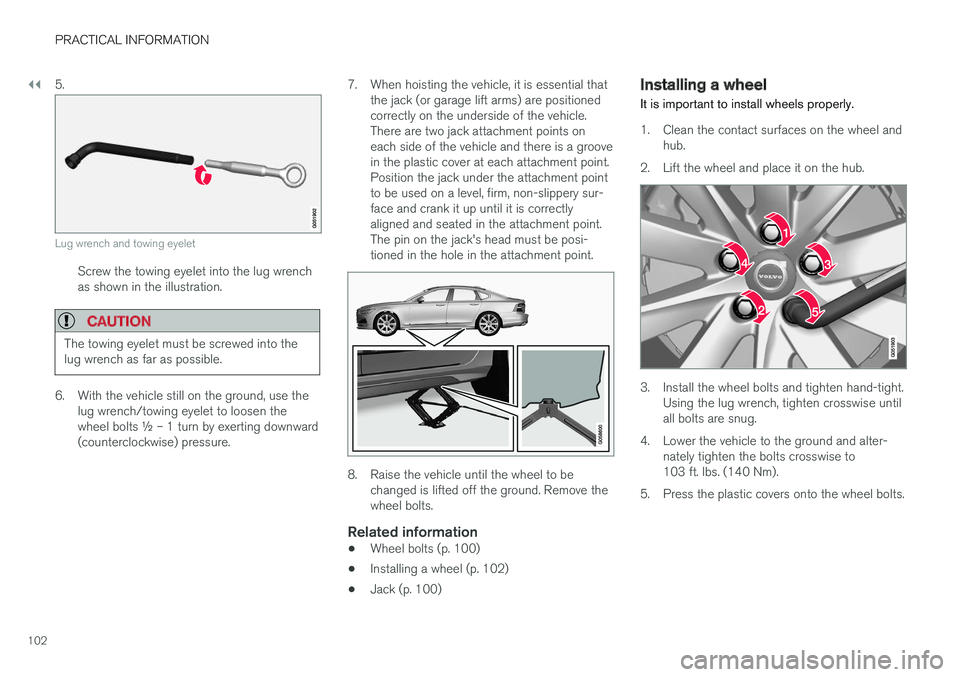
1025.
Lug wrench and towing eyelet
Screw the towing eyelet into the lug wrench as shown in the illustration.
CAUTION
The towing eyelet must be screwed into the lug wrench as far as possible.
6. With the vehicle still on the ground, use the
lug wrench/towing eyelet to loosen the wheel bolts ½ – 1 turn by exerting downward(counterclockwise) pressure. 7. When hoisting the vehicle, it is essential that
the jack (or garage lift arms) are positionedcorrectly on the underside of the vehicle.There are two jack attachment points oneach side of the vehicle and there is a groovein the plastic cover at each attachment point.Position the jack under the attachment pointto be used on a level, firm, non-slippery sur-face and crank it up until it is correctlyaligned and seated in the attachment point.The pin on the jack's head must be posi-tioned in the hole in the attachment point.
8. Raise the vehicle until the wheel to bechanged is lifted off the ground. Remove the wheel bolts.
Related information
• Wheel bolts (p. 100)
• Installing a wheel (p. 102)
• Jack (p. 100)
Installing a wheel
It is important to install wheels properly.
1. Clean the contact surfaces on the wheel and hub.
2. Lift the wheel and place it on the hub.
3. Install the wheel bolts and tighten hand-tight. Using the lug wrench, tighten crosswise until all bolts are snug.
4. Lower the vehicle to the ground and alter- nately tighten the bolts crosswise to103 ft. lbs. (140 Nm).
5. Press the plastic covers onto the wheel bolts.
Page 121 of 166
PRACTICAL INFORMATION
119
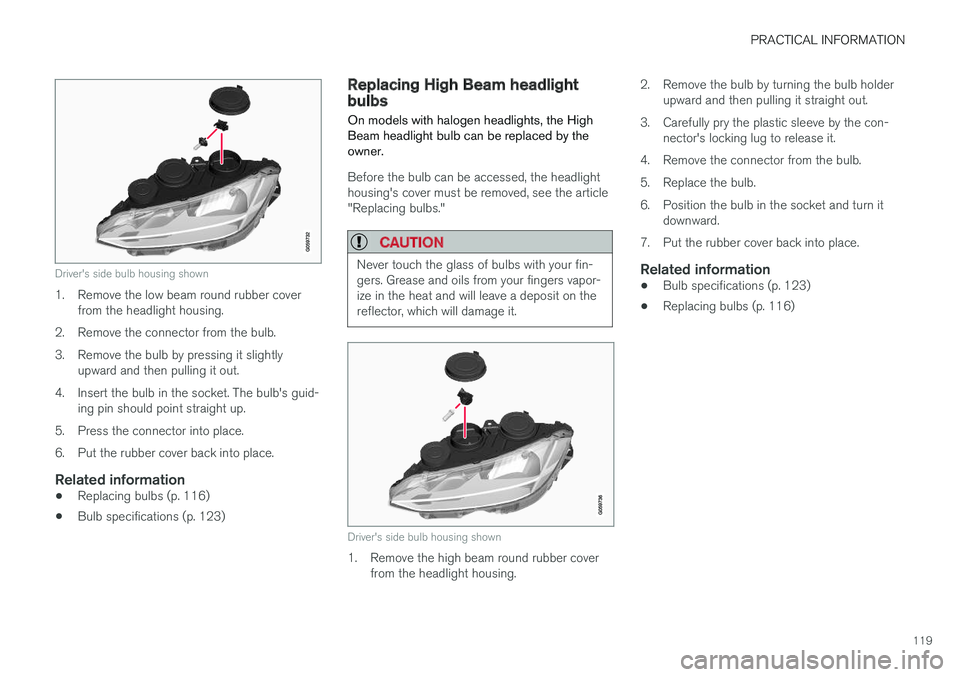
Driver's side bulb housing shown
1. Remove the low beam round rubber coverfrom the headlight housing.
2. Remove the connector from the bulb.
3. Remove the bulb by pressing it slightly upward and then pulling it out.
4. Insert the bulb in the socket. The bulb's guid- ing pin should point straight up.
5. Press the connector into place.
6. Put the rubber cover back into place.
Related information
• Replacing bulbs (p. 116)
• Bulb specifications (p. 123)
Replacing High Beam headlight bulbs
On models with halogen headlights, the High Beam headlight bulb can be replaced by theowner.
Before the bulb can be accessed, the headlight housing's cover must be removed, see the article"Replacing bulbs."
CAUTION
Never touch the glass of bulbs with your fin- gers. Grease and oils from your fingers vapor-ize in the heat and will leave a deposit on thereflector, which will damage it.
Driver's side bulb housing shown
1. Remove the high beam round rubber cover from the headlight housing. 2. Remove the bulb by turning the bulb holder
upward and then pulling it straight out.
3. Carefully pry the plastic sleeve by the con- nector's locking lug to release it.
4. Remove the connector from the bulb.
5. Replace the bulb.
6. Position the bulb in the socket and turn it downward.
7. Put the rubber cover back into place.
Related information
• Bulb specifications (p. 123)
• Replacing bulbs (p. 116)
Page 123 of 166
PRACTICAL INFORMATION
}}
121
Related information
•Replacing bulbs (p. 116)
• Bulb specifications (p. 123)
Replacing the rear fog light The rear fog light bulb is located behind the panel on the inside of the trunk lid on the driver'sside of the vehicle.
NOTE
Rear fog light bulbs should preferably be replaced by a trained and qualified Volvo serv-ice technician.
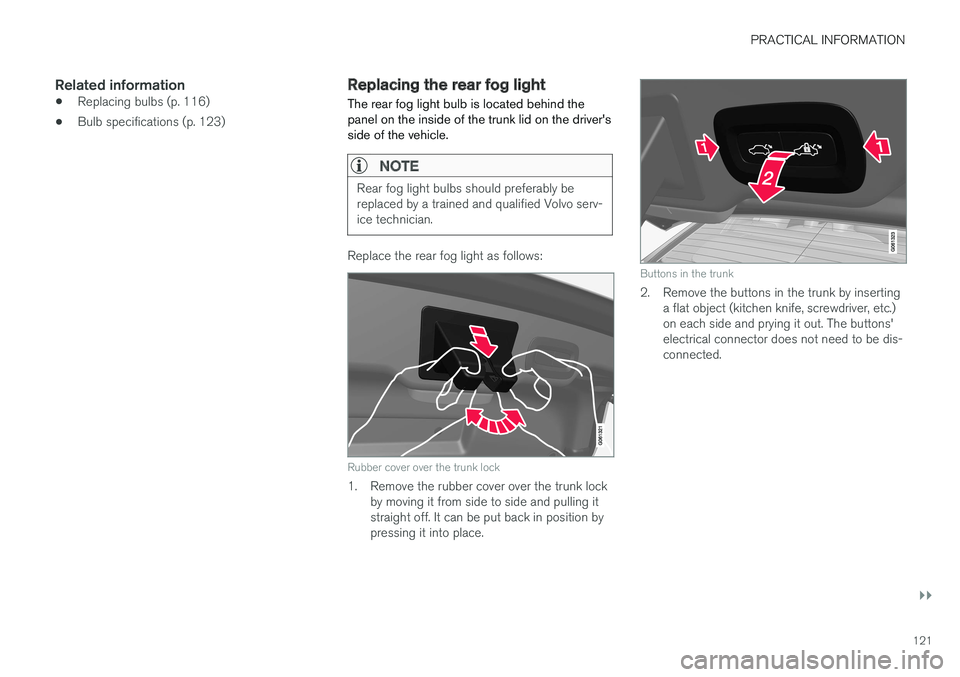
Replace the rear fog light as follows:
Rubber cover over the trunk lock
1. Remove the rubber cover over the trunk lock
by moving it from side to side and pulling it straight off. It can be put back in position bypressing it into place.
Buttons in the trunk
2. Remove the buttons in the trunk by inserting a flat object (kitchen knife, screwdriver, etc.) on each side and prying it out. The buttons'electrical connector does not need to be dis-connected.
Page 124 of 166
||
PRACTICAL INFORMATION
122
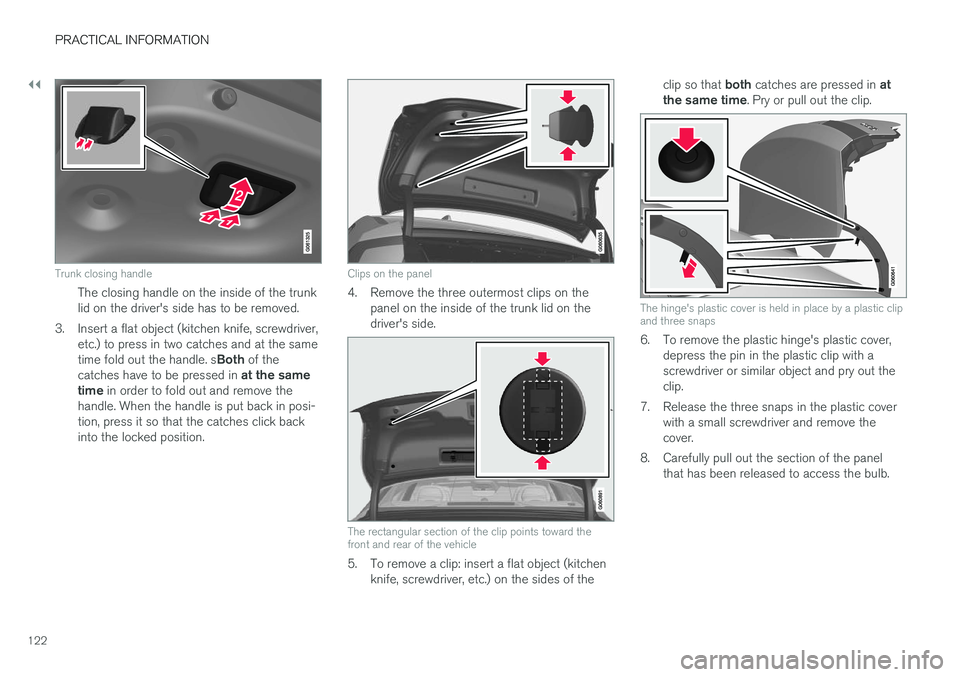
Trunk closing handle
The closing handle on the inside of the trunk lid on the driver's side has to be removed.
3. Insert a flat object (kitchen knife, screwdriver, etc.) to press in two catches and at the same time fold out the handle. s Both of the
catches have to be pressed in at the same
time in order to fold out and remove the
handle. When the handle is put back in posi- tion, press it so that the catches click backinto the locked position.
Clips on the panel
4. Remove the three outermost clips on the panel on the inside of the trunk lid on the driver's side.
The rectangular section of the clip points toward the front and rear of the vehicle
5. To remove a clip: insert a flat object (kitchenknife, screwdriver, etc.) on the sides of the clip so that
both catches are pressed in at
the same time . Pry or pull out the clip.
The hinge's plastic cover is held in place by a plastic clip and three snaps
6. To remove the plastic hinge's plastic cover,
depress the pin in the plastic clip with a screwdriver or similar object and pry out theclip.
7. Release the three snaps in the plastic cover with a small screwdriver and remove thecover.
8. Carefully pull out the section of the panel that has been released to access the bulb.
Page 125 of 166
PRACTICAL INFORMATION
123
NOTE
When putting the plastic cover over the hinge back in place: •The pin in the clip must be pressed back far enough so that it sticks out of the clipbefore the clip is used to reinstall theplastic cover.
• When the hinge's plastic cover is put inposition, press the plastic clip into thehole in the cover.
• Press the pin into the plastic clip until itsend is flush with the surface of the clip.
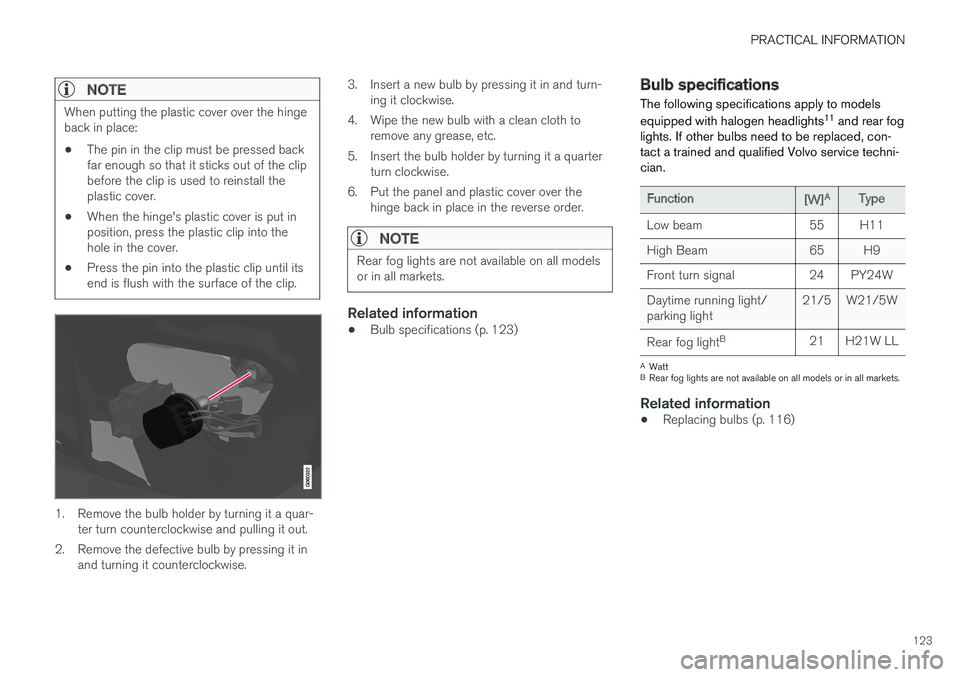
1. Remove the bulb holder by turning it a quar-
ter turn counterclockwise and pulling it out.
2. Remove the defective bulb by pressing it in and turning it counterclockwise. 3. Insert a new bulb by pressing it in and turn-
ing it clockwise.
4. Wipe the new bulb with a clean cloth to remove any grease, etc.
5. Insert the bulb holder by turning it a quarter turn clockwise.
6. Put the panel and plastic cover over the hinge back in place in the reverse order.
NOTE
Rear fog lights are not available on all models or in all markets.
Related information
• Bulb specifications (p. 123)
Bulb specifications The following specifications apply to models equipped with halogen headlights 11
and rear fog
lights. If other bulbs need to be replaced, con- tact a trained and qualified Volvo service techni-cian.
Function [W]A
Type
Low beam 55 H11
High Beam 65 H9
Front turn signal 24 PY24WDaytime running light/ parking light 21/5 W21/5W
Rear fog light B
21 H21W LL
AWatt
B Rear fog lights are not available on all models or in all markets.
Related information
• Replacing bulbs (p. 116)
Page 129 of 166
PRACTICAL INFORMATION
}}
127
Volume:
• 5.8 qts (5.5 liters)
Related information
•
Opening and closing the hood (p. 127)
• Engine compartment overview (p. 81)
Opening and closing the hood The hood is opened by releasing it from the pas- senger compartment and then by using the han-dle under the front edge of the hood.
Opening
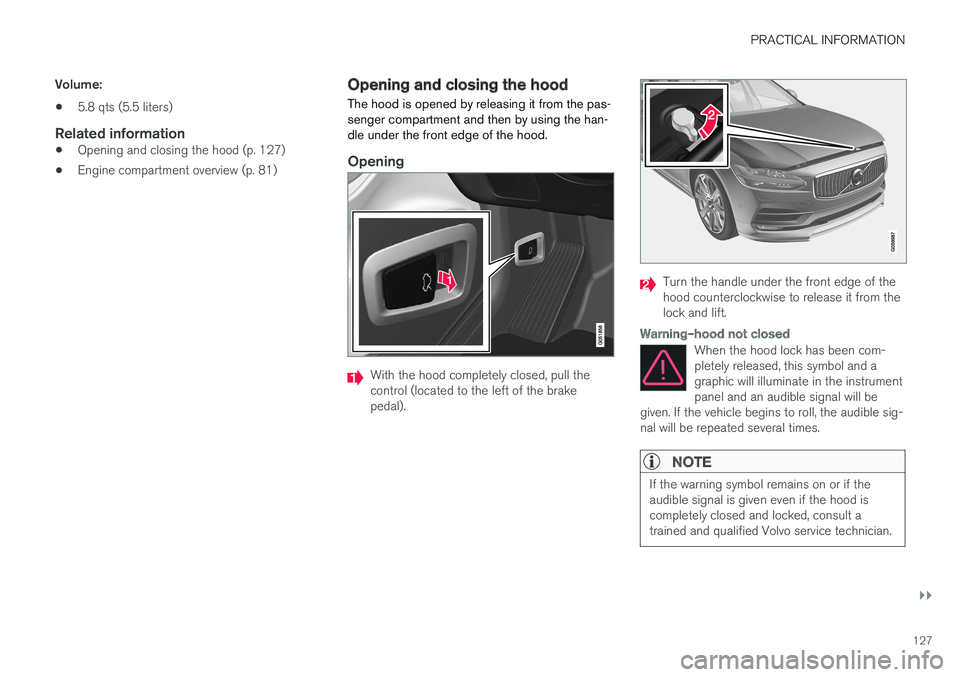
With the hood completely closed, pull the control (located to the left of the brakepedal).
Turn the handle under the front edge of the hood counterclockwise to release it from thelock and lift.
Warning–hood not closed
When the hood lock has been com- pletely released, this symbol and agraphic will illuminate in the instrumentpanel and an audible signal will be
given. If the vehicle begins to roll, the audible sig-nal will be repeated several times.
NOTE
If the warning symbol remains on or if the audible signal is given even if the hood iscompletely closed and locked, consult atrained and qualified Volvo service technician.