belt VOLVO S90 T8 2018 Owner´s Manual
[x] Cancel search | Manufacturer: VOLVO, Model Year: 2018, Model line: S90 T8, Model: VOLVO S90 T8 2018Pages: 166, PDF Size: 4.72 MB
Page 80 of 166
IMPORTANT INFORMATION
78
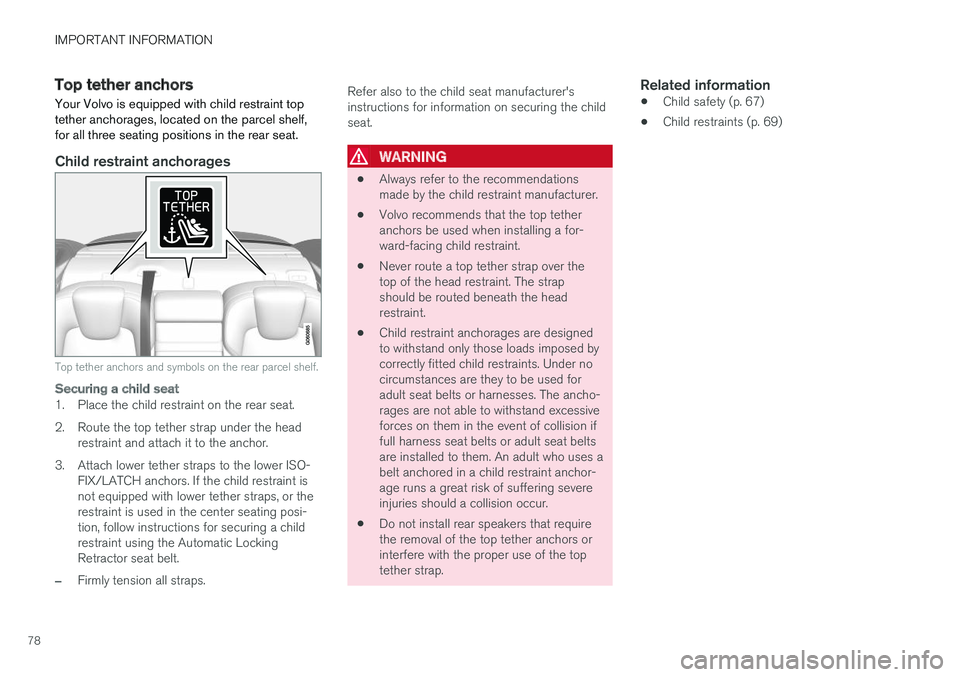
Top tether anchorsYour Volvo is equipped with child restraint top tether anchorages, located on the parcel shelf,for all three seating positions in the rear seat.
Child restraint anchorages
Top tether anchors and symbols on the rear parcel shelf.
Securing a child seat
1. Place the child restraint on the rear seat.
2. Route the top tether strap under the head restraint and attach it to the anchor.
3. Attach lower tether straps to the lower ISO- FIX/LATCH anchors. If the child restraint is not equipped with lower tether straps, or therestraint is used in the center seating posi-tion, follow instructions for securing a childrestraint using the Automatic LockingRetractor seat belt.
–Firmly tension all straps. Refer also to the child seat manufacturer's instructions for information on securing the childseat.
WARNING
•
Always refer to the recommendations made by the child restraint manufacturer.
• Volvo recommends that the top tetheranchors be used when installing a for-ward-facing child restraint.
• Never route a top tether strap over thetop of the head restraint. The strapshould be routed beneath the headrestraint.
• Child restraint anchorages are designedto withstand only those loads imposed bycorrectly fitted child restraints. Under nocircumstances are they to be used foradult seat belts or harnesses. The ancho-rages are not able to withstand excessiveforces on them in the event of collision iffull harness seat belts or adult seat beltsare installed to them. An adult who uses abelt anchored in a child restraint anchor-age runs a great risk of suffering severeinjuries should a collision occur.
• Do not install rear speakers that requirethe removal of the top tether anchors orinterfere with the proper use of the toptether strap.
Related information
• Child safety (p. 67)
• Child restraints (p. 69)
Page 87 of 166
PRACTICAL INFORMATION
}}
* Option/accessory.85
WARNING
•Stop the engine, put the gear selector in P
, and apply the parking brake when
loading or unloading long objects.
• The vehicle's driving characteristics may change depending on the weight and dis-tribution of the load.
• A 44-pound (20 kg) object produces aforce of 2,200 pounds (1,000 kg) in ahead-on collision at 30 mph (50 km/h).
• The cargo compartment and rear seatshould not be loaded to a level higherthan 2 in. (5 cm) below the upper edge ofthe rear side windows. Objects placedhigher than this level could impede thefunction of the Inflatable Curtain.
WARNING
• Cover sharp edges on long loads to help prevent injury to occupants. Secure theload to help prevent shifting during sud-den stops.
• Always secure large and heavy objectswith a seat belt or cargo retaining straps.
• Always secure the load to help prevent itfrom moving in the event of sudden stops.
• Switch off the engine, apply the parking brake and put the gear selector in
P
when loading and unloading the vehicle.
Extra loading spaceThe vehicle has flexible cargo capacity that makes it possible to load and secure largeobjects and loading capacity can be increasedwhen needed. By folding down the rear seat backrests, the cargo capacity of the vehicle increases consider-ably. Use the load anchoring eyelets or the gro-cery bag holder to secure objects. The hatch in the center section of the rear seat backrest * can be opened without folding the
backrest down to transport long objects such as skis, etc. The jack *, tire sealing system and tools can be
found under the floor of the trunk.
WARNING
• Boxes, suitcases, etc. wedged behind the front seats could impede the function ofthe Whiplash Protection System.
• If the rear seat backrests are foldeddown, cargo must be secured to preventit from sliding forward against the frontseat backrests in the event of a collisionfrom the rear. This could interfere withthe action of the Whiplash ProtectionSystem.
WARNING
• Cover sharp edges on long loads to help prevent injury to occupants. Secure theload to help prevent shifting during sud-den stops.
• Always secure large and heavy objectswith a seat belt or cargo retaining straps.
• Always secure the load to help prevent itfrom moving in the event of sudden stops.
• Switch off the engine, apply the parking brake and put the gear selector in
P
when loading and unloading the vehicle.
Roof loadsLoad carriers are available as Volvo accessories. Observe the following points when in use:
• To avoid damaging your vehicle and toachieve maximum safety when driving, werecommend using the load carriers that Volvohas developed especially for your vehicle.
• Volvo-approved removable roof racks aredesigned to carry the maximum allowableroof load for this vehicle (see the article"Weights" for specific information).
• Never exceed the rack manufacturer's weighlimits.
• Avoid single-point loads. Distribute loadsevenly.
Page 88 of 166
||
PRACTICAL INFORMATION
86•
Place heavier cargo at the bottom of the load.
• Secure the cargo correctly with appropriatetie-down equipment.
• Check periodically that the load carriers andload are properly secured.
• Remember that the vehicle's center of gravityand handling change when you carry a loadon the roof.
• The vehicle's wind resistance and fuel con-sumption will increase with the size of theload.
• Drive smoothly. Avoid rapid starts, fast cor-nering and hard braking.
CAUTION
The optional panoramic roof should not be opened while load carriers are installed onthe vehicle.
See the article "Weights" for information about the maximum permissible load that can be trans-ported on the roof.
Related information
•
Weights (p. 149)
• Load anchoring eyelets (p. 86)
• Whiplash protection system (p. 51)
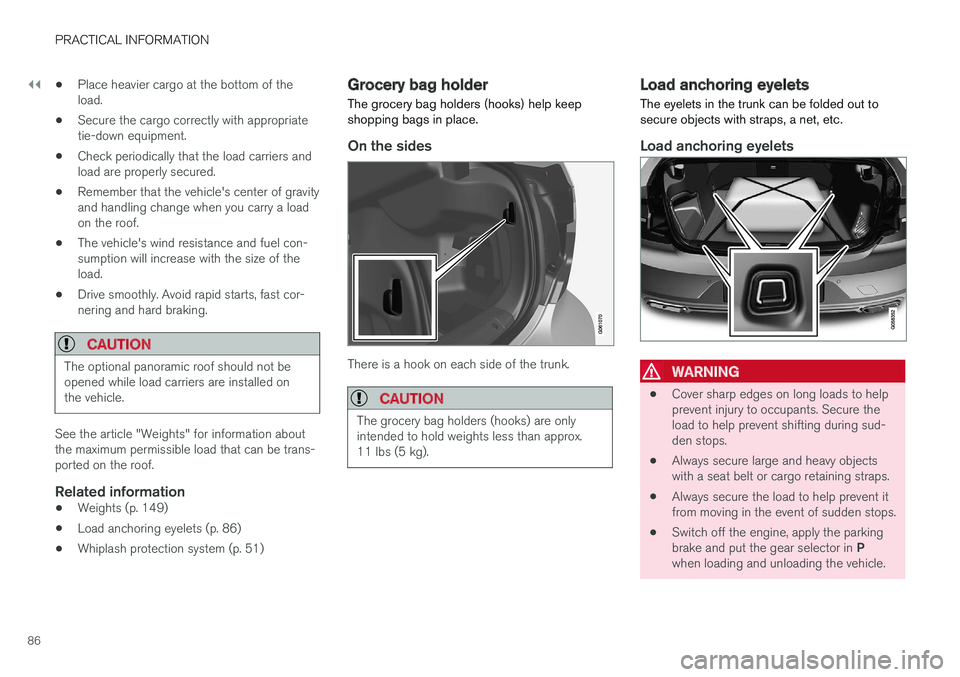
Grocery bag holder
The grocery bag holders (hooks) help keep shopping bags in place.
On the sides
There is a hook on each side of the trunk.
CAUTION
The grocery bag holders (hooks) are only intended to hold weights less than approx.11 lbs (5 kg).
Load anchoring eyelets The eyelets in the trunk can be folded out to secure objects with straps, a net, etc.
Load anchoring eyelets
WARNING
• Cover sharp edges on long loads to help prevent injury to occupants. Secure theload to help prevent shifting during sud-den stops.
• Always secure large and heavy objectswith a seat belt or cargo retaining straps.
• Always secure the load to help prevent itfrom moving in the event of sudden stops.
• Switch off the engine, apply the parking brake and put the gear selector in
P
when loading and unloading the vehicle.
Page 139 of 166
FUSES
}}
* Option/accessory.137
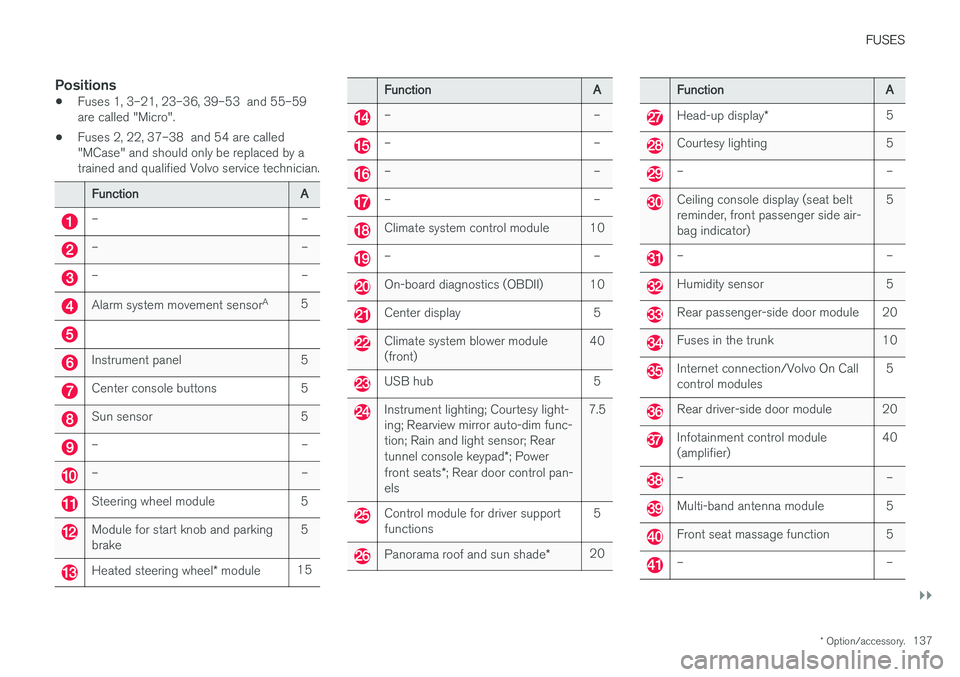
Positions
•Fuses 1, 3–21, 23–36, 39–53 and 55–59 are called "Micro".
• Fuses 2, 22, 37–38 and 54 are called"MCase" and should only be replaced by atrained and qualified Volvo service technician.
Function
A
– –
– –
– –
Alarm system movement sensorA
5
Instrument panel 5
Center console buttons 5
Sun sensor 5
– –
– –
Steering wheel module 5
Module for start knob and parking brake 5
Heated steering wheel
* module 15
Function
A
– –
– –
– –
– –
Climate system control module 10
– –
On-board diagnostics (OBDII) 10
Center display 5
Climate system blower module (front)40
USB hub 5
Instrument lighting; Courtesy light- ing; Rearview mirror auto-dim func-tion; Rain and light sensor; Rear tunnel console keypad
*; Power
front seats *; Rear door control pan-
els 7.5
Control module for driver support functions
5
Panorama roof and sun shade
*20
Function
A
Head-up display* 5
Courtesy lighting 5
– –
Ceiling console display (seat belt reminder, front passenger side air-bag indicator) 5
– –
Humidity sensor 5
Rear passenger-side door module 20
Fuses in the trunk 10
Internet connection/Volvo On Call control modules
5
Rear driver-side door module 20
Infotainment control module (amplifier)40
– –
Multi-band antenna module 5
Front seat massage function 5
– –
Page 141 of 166
FUSES
}}
* Option/accessory.139
Fuses in the trunk The fuses in the trunk help protect electrical components such as power seats *, airbags and
seat belt tensioners.
Page 143 of 166
FUSES
* Option/accessory.141
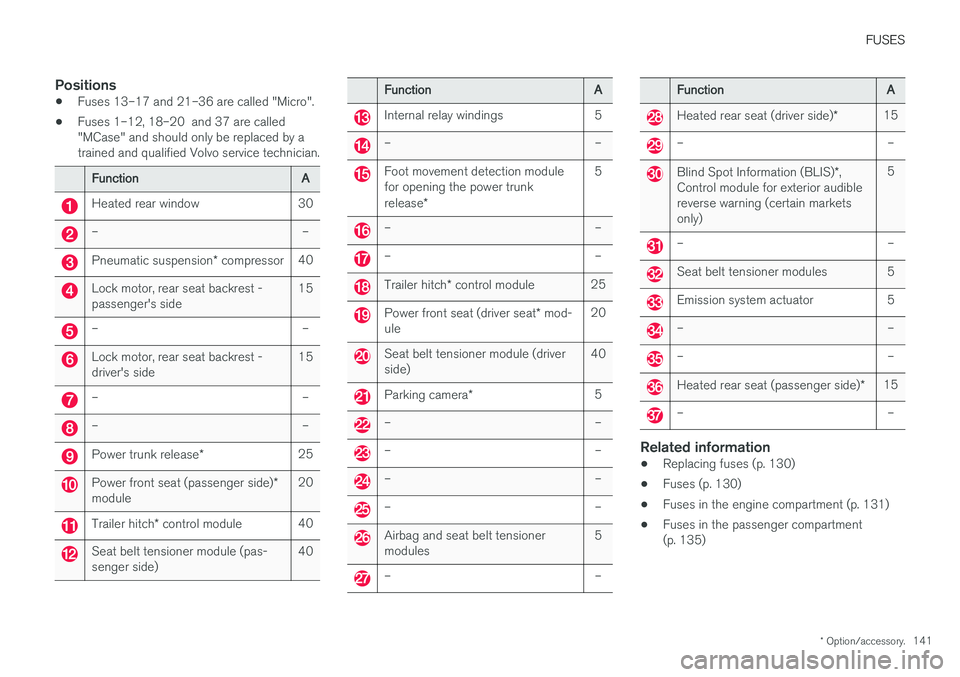
Positions
•Fuses 13–17 and 21–36 are called "Micro".
• Fuses 1–12, 18–20 and 37 are called "MCase" and should only be replaced by atrained and qualified Volvo service technician.
Function
A
Heated rear window 30
– –
Pneumatic suspension* compressor 40
Lock motor, rear seat backrest - passenger's side 15
– –
Lock motor, rear seat backrest - driver's side15
– –
– –
Power trunk release
*25
Power front seat (passenger side)
*
module 20
Trailer hitch
* control module 40
Seat belt tensioner module (pas- senger side) 40
Function
A
Internal relay windings 5
– –
Foot movement detection module for opening the power trunk release* 5
– –
– –
Trailer hitch
* control module 25
Power front seat (driver seat
* mod-
ule 20
Seat belt tensioner module (driver side)
40
Parking camera
* 5
– –
– –
– –
– –
Airbag and seat belt tensioner modules 5
– –
Function
A
Heated rear seat (driver side)*15
– –
Blind Spot Information (BLIS)
*,
Control module for exterior audible reverse warning (certain marketsonly) 5
– –
Seat belt tensioner modules 5
Emission system actuator 5
– –
– –
Heated rear seat (passenger side)
*15
– –
Related information
•Replacing fuses (p. 130)
• Fuses (p. 130)
• Fuses in the engine compartment (p. 131)
• Fuses in the passenger compartment (p. 135)
Page 163 of 166
INDEX
161
P
Parking light bulb, replacing 120 Passenger compartmentfuses 135
Permissible axle weight 149
Pregnancy, using seat belts during 50
R
Rear fog lights 121
Recalls 50
Recalls, child restraints 69
Refrigerant (A/C system) 151
Refueling 87 fuel filler door 88
Registering child restraints 69
Replacing bulbs 116
Replacing fuses 130, 131, 135, 139
Reporting safety defects 49
Roadside Assistance 6
S
Safety, occupant 48
Safety defects, reporting 49
Safety mode 65Seat belt reminder 56
Seat belts Automatic locking retractor/Emergency
locking retractor 69
buckling 54
pretensioners 52, 53
reminder 56
securing child restraint systems 70, 72, 75
unbuckling 54
use during pregnancy 50
using 52
Sensus 9
Side impact airbags 64
Snow chains 97
Snow tires 97Specifications bulbs 123
Starting the vehicle after a crash (crash mode) 65, 66
Storage compartments 80
Studded tires 97
Sun visor 84
T
Technician certification 45
Tire inflation pressure 156
Tire Pressure Monitoring System 103, 105 calibrating 106
Tire Pressure Monitoring System (TPMS) 106
Tires 89, 99 changing 99
changing from summer to winter 94
glossary of terms 93
improving economy 89
inflation pressure 97
inflation pressure table 156installing (mounting) a wheel on the
vehicle 102
rotation 90
snow 97
specifications 91
storing 90
studded 97
tire pressure monitoring system 103, 105
tire sealing system 108, 110, 114
tread wear indicator 95
uniform tire quality grading 96
wheel bolts 100