lock VOLVO S90 TWIN ENGINE 2019 Owners Manual
[x] Cancel search | Manufacturer: VOLVO, Model Year: 2019, Model line: S90 TWIN ENGINE, Model: VOLVO S90 TWIN ENGINE 2019Pages: 669, PDF Size: 14.33 MB
Page 561 of 669

WHEELS AND TIRES
}}
* Option/accessory.559
1.Turn on the vehicle's hazard warning flashersif a wheel change must be performed in anarea with traffic.
2.Apply the parking brake and put the gearselector in P.
For vehicles with Leveling Control*: If thevehicle is equipped with pneumatic suspen-sion, this must be switched off before thevehicle is lifted with the jack*.
3.Take out the jack*, lug wrench* and tool forremoving the plastic covers, which arestowed in the foam block.
Tool for removing the plastic covers on the wheel bolts.
4. Place chocks in front of and behind thewheels that are still on the ground. For exam-ple, use heavy wooden blocks or largestones.
5.Using the lug wrench*, screw the towing eyeinto place as far as possible according to theinstructions.
CAUTION
The towing eyelet must be screwed into thelug wrench* as far as possible.
6. Remove the plastic covers from the wheelbolts using the designated tool.
7. With the vehicle still on the ground, use thelug wrench/towing eye to loosen the wheelbolts ½-1 turn by pressing downward (coun-terclockwise).
8.When hoisting the vehicle, it is important thatthe jack* or garage lift arms are positionedon the designated points under the vehicle.The triangle markings on the plastic coverindicate where the jack attachment points/lifting points are located. There are two jackattachment points on each side of the vehi-cle. There is a groove for the jack at eachattachment point.
9. Position the jack under the attachment pointbeing used, ensuring that the surface is firm,flat and not slippery.
Page 562 of 669
||
WHEELS AND TIRES
* Option/accessory.560
10. Crank it up until it is properly aligned and it isin contact with the vehicle's jack attachmentpoint. Make sure the top of the jack (or thegarage lift arms) is correctly positioned in theattachment point, with the bump on the topof the jack in the recess in the attachmentpoint and the base positioned vertically underthe attachment point.
11. Turn the jack so that the crank is as far aspossible from the side of the vehicle, whichwill position the jack's arms perpendicular tothe vehicle's direction of movement.
12. Raise the vehicle until the wheel to bechanged can move freely. Unscrew the wheelbolts and lift off the wheel.
Related information
Leveling control settings* (p. 453)
When changing wheels (p. 556)
Hoisting the vehicle (p. 592)
Jack* (p. 557)
Tool kit (p. 556)
Installing a wheel (p. 560)
Installing a wheel
Instructions for installing a wheel during a wheelchange.
NOTE
The jack provided with your vehicle isintended to be used only in temporary situa-tions such as changing wheels in the event ofa flat tire. Only the jack that came with yourparticular model should be used to lift thevehicle. If the vehicle needs to be lifted morefrequently or for a prolonged period, using agarage jack or hoist is recommended. Alwaysfollow this device's instructions for use.
WARNING
Apply the parking brake and put the gearselector in the Park (P) position.
Block the wheels standing on the ground,use rigid wooden blocks or large stones.
Check that the jack is not damaged, thethreads are properly lubricated and it isfree from dirt.
Be sure the jack is on a firm, level, non-slippery surface and that it is upright andnot leaning.
The jack must correctly engage in thejack attachment.
No objects should be placed between thebase of the jack and the ground, orbetween the jack and the attachment baron the vehicle.
Never let anyone remain in the vehiclewhen it is raised on a jack.
If a tire must be changed near passingtraffic, make sure all passengers move toa safe location.
Use a jack intended for the vehicle whenchanging a tire. For any other job, usestands to support the vehicle.
Never crawl under or allow any part ofyour body to be extended under a vehiclesupported by a jack.
Page 566 of 669

||
WHEELS AND TIRES
564
CAUTION
Snow chains can be used on the vehicle, withthe following restrictions:
Volvo recommends not using snowchains on wheel dimensions larger than18 inches.
Always follow the manufacturer's installa-tion instructions carefully. Install chainsas tightly as possible and retighten peri-odically.
Only put snow chains on the front wheels(also applies to all-wheel drive vehicles).
If accessory, aftermarket or "custom"tires and wheels with different dimen-sions than the original tires and wheelsare used, snow chains in some casesmay NOT be used. Sufficient distancebetween the chains and brakes, suspen-sion and body components must bemaintained.
Check local regulations regarding the useof snow chains before installing.
Never exceed the snow chain manufac-turer's specified maximum speed limit.Under no circumstances should youexceed 50 km/h (30 mph).
Avoid bumps, holes or sharp turns whendriving with snow chains.
Avoid driving on surfaces without snow asthis wears out both the snow chains andthe tires.
The handling of the vehicle can beadversely affected when driving withchains. Avoid fast or sharp turns as wellas locked wheel braking.
Some types of strap-on chains affectbrake components and therefore mustNOT be used.
Consult a Volvo retailer for more informationabout snow chains.
Related information
Winter driving (p. 458)
Tire sealing system16
The temporary tire sealing system can be usedto seal a puncture in a tire or to check andadjust the pressure in the tire.
Models equipped with a spare wheel17 do nothave the tire sealing system.
WARNING
California Proposition 65
Operating, servicing and maintaining a pas-senger vehicle can expose you to chemicalsincluding engine exhaust, carbon monoxide,phthalates, and lead, which are known to theState of California to cause cancer and birthdefects or other reproductive harm. To mini-mize exposure, avoid breathing exhaust, donot idle the engine except as necessary, serv-ice your vehicle in a well ventilated area andwear gloves or wash your hands frequentlywhen servicing your vehicle. For more infor-mation go to www.P65Warnings.ca.gov/passenger-vehicle.
The tire sealing system consists of a compressorand a bottle containing sealing compound. Thesealing functions as a temporary repair.
Page 567 of 669

WHEELS AND TIRES
}}
565
NOTE
The sealing compound effectively seals tireswith punctures in the tread but may not beable to fully seal tires with punctures in thesidewall. Do not use the tire sealing systemon tires with large tears, cracks or similardamage.
NOTE
The compressor is intended for temporary tiresealing and is approved by Volvo.
Location
The tire sealing system is located in a foam blockunder the floor of the trunk.
Sealing compound expiration date
The sealing compound bottle must be replaced ifits expiration date has passed (see the decal onthe bottle). Handle the old bottle as hazardouswaste.
Related information
Using the tire sealing system (p. 565)
Inflate tires with the compressor included inthe tire sealing system (p. 569)
Tires (p. 542)
Using the tire sealing system
Sealing a tire using the tire sealing system, theTemporary Mobility Kit (TMK).
Overview
Electrical cable
Hose
Air release valve
Protective hose cover
Speed limit sticker
Bottle holder (orange cover)
Air pressure gauge
16Certain models only.17Not available on all models.
Page 578 of 669

||
LOADING, STORAGE AND PASSENGER COMPARTMENT
* Option/accessory.576
12 V outlet in the tunnel console, rear seat.
12 V outlet in trunk/cargo compartment*.
Related information
Passenger compartment interior (p. 574)
Using the electrical outlets (p. 576)
Using the electrical outlets
The 12 V outlet can be used for devicesintended for this such as MP3 players, coolersand cellular phones.
The ignition must be in at least mode I for theoutlets to supply current. The outlets will then beactive as long as there is sufficient charge in thestart battery.
If the engine is turned off and the vehicle islocked, the outlets will be deactivated. If theengine is turned off and the vehicle remainsunlocked, the sockets will remain active for up to7 minutes.
NOTE
Bear in mind that using the electrical outletswhen the engine is off could cause the starterbattery to have too low of a charge level,which could limit other functionality.
Accessories connected to the electrical out-lets can be activated even when the vehicleelectrical system is off or if preconditioning isused. For this reason, disconnect plugs whenthey are not in use to prevent the starter bat-tery from becoming discharged.
WARNING
Do not use accessories with large orheavy plugs – they could damage the out-let or come loose while you are driving.
Do not use accessories that could causedisruptions to e.g. the vehicle's radioreceiver or electrical system.
Position the accessory so that there is norisk of it injuring the driver or passengersin the event of heavy braking or a colli-sion.
Pay attention to connected accessoriesas they can generate heat that could burnpassengers or the interior.
Using 12 V outlets
1. Remove the stopper (tunnel console) or folddown the cover (trunk/cargo compartment)over the socket and plug in the device.
2. Unplug the device and put the stopper backin (tunnel console) or fold up the cover(trunk/cargo compartment) when the socketis not in use or left unattended.
CAUTION
The maximum power is 120 W (10 A) peroutlet.
Page 579 of 669

LOADING, STORAGE AND PASSENGER COMPARTMENT
}}
* Option/accessory.577
Related information
Electrical outlets (p. 575)
Passenger compartment interior (p. 574)
Using the glove compartment
The glove compartment is located on the pas-senger side. The glove compartment can beused to store the Owner's Manual, maps, etc.There is also room for a pen and a card holder.
Locking and unlocking the glove box *
The glove compartment can be locked when thevehicle is left at a workshop, hotel, etc. The glovecompartment can then only be locked/unlockedwith the glove compartment key.
Storage compartment for the key. The illustration isgeneric – the design may vary.
Page 580 of 669

||
LOADING, STORAGE AND PASSENGER COMPARTMENT
* Option/accessory.578
The illustration is generic – the design may vary.
To lock the glove compartment:
Insert the key into the lock on the glove com-partment.
Turn the key 90 degrees clockwise.
Remove the key from the lock.
–To unlock, perform the above steps inreverse.
Using the glove box as a cooled area
The glove compartment can be used to cool e.g.drinks or food. Cooling is possible when the cli-mate system is active (i.e. when the ignition is inmode II or when the engine is running).
The illustration is generic – the design may vary.
Activate cooling
Deactivate cooling
–Activate or deactivate cooling by moving thecontrol as far as possible toward the passen-ger compartment/glove compartment.
Related information
Passenger compartment interior (p. 574)
Private Locking (p. 264)
Sun visors
In the ceiling in front of the driver and front pas-senger, there are sun visors that can be loweredand angled to the side as necessary.
The illustration is generic – the design may vary.
The mirror lighting* comes on automatically whenthe cover is lifted up.
The mirror frame has a holder for e.g. cards ortickets.
Related information
Passenger compartment interior (p. 574)
Page 581 of 669

LOADING, STORAGE AND PASSENGER COMPARTMENT
* Option/accessory.579
Folding down the armrest in the
rear seat*
The rear seat armrest* can be folded down forincreased comfort.
The armrest is locked in the raised position andneeds to be unlocked before it is folded down.The handle for unlocking the armrest is locateddirectly underneath the head restraint.
1. Grasp the handle and rotate it toward you tounlock the armrest.
2. When the handle is rotated to its maximumposition, the armrest is unlocked and can befolded down.
CAUTION
Before moving down the armrest, makesure to unlock it by rotating the handle. Donot pull the handle if the armrest is locked.
Make sure the armrest is securely lockedinto position after it is folded up.
Cargo compartment
Loads can be secured in the trunk to keep themin place while driving.
The folding* rear seat backrests can helpincrease the cargo capacity of the trunk. Loadanchoring eyelets and grocery bag holders areprovided to help secure objects in place.
If the vehicle is equipped with a temporary sparetire, this is secured to the cargo compartmentfloor under the cover. The towing eyelet and tiresealing system are located under the cargo com-partment floor.
Related information
Loading recommendations (p. 580)
Grocery bag holders (p. 581)
Load anchoring eyelets (p. 582)
Page 584 of 669
LOADING, STORAGE AND PASSENGER COMPARTMENT
* Option/accessory.582
Load anchoring eyelets
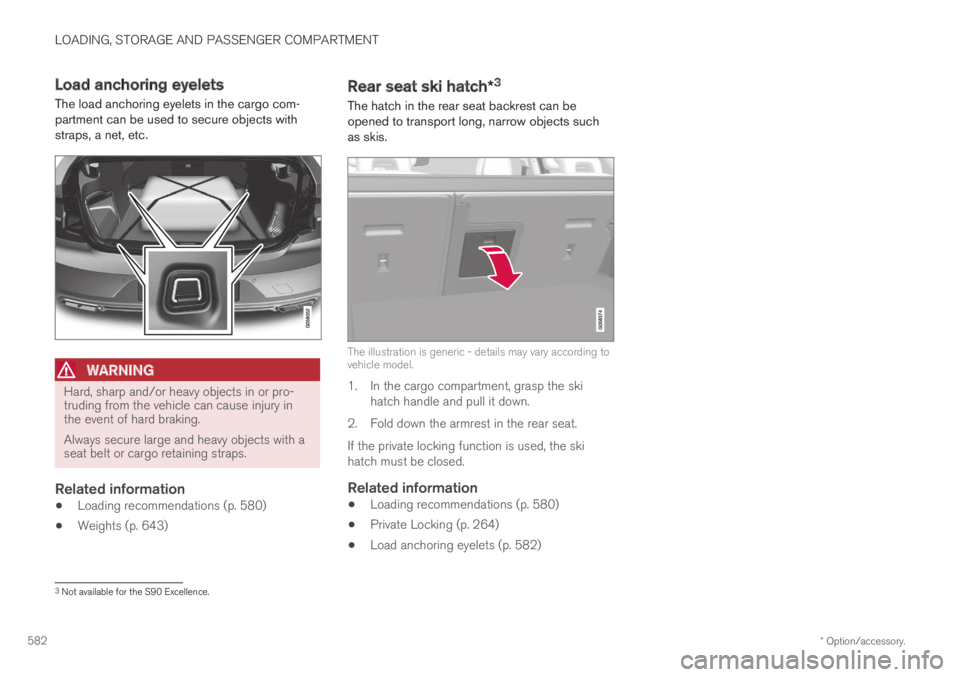
The load anchoring eyelets in the cargo com-partment can be used to secure objects withstraps, a net, etc.
WARNING
Hard, sharp and/or heavy objects in or pro-truding from the vehicle can cause injury inthe event of hard braking.
Always secure large and heavy objects with aseat belt or cargo retaining straps.
Related information
Loading recommendations (p. 580)
Weights (p. 643)
Rear seat ski hatch*3
The hatch in the rear seat backrest can beopened to transport long, narrow objects suchas skis.
The illustration is generic - details may vary according tovehicle model.
1. In the cargo compartment, grasp the skihatch handle and pull it down.
2. Fold down the armrest in the rear seat.
If the private locking function is used, the skihatch must be closed.
Related information
Loading recommendations (p. 580)
Private Locking (p. 264)
Load anchoring eyelets (p. 582)
3Not available for the S90 Excellence.
Page 588 of 669

||
MAINTENANCE AND SERVICE
586
Monthly:
Check cold tire pressure in all tires. Inspectthe tires for wear.
Check that engine coolant and other fluidlevels are between the indicated "min" and"max" markings.
Clean interior glass surfaces with a glasscleaner and soft paper towels.
Wipe driver information displays with a softcloth.
Visually inspect battery terminals for corro-sion. Corrosion may indicate a loose terminalconnector, or a battery near the end of itsuseful service life. Consult your Volvo retailerfor additional information.
As needed:
Wash the car, including the undercarriage, toreduce wear that can be caused by a buildup ofdirt, and corrosion that can be caused by salt res-idues.
Clean leaves and twigs from air intake vents atthe base of the windshield, and from other placeswhere they may collect.
NOTE
Complete service information for qualifiedtechnicians is available online for purchase orsubscription at www.volvotechinfo.com.
Related information
Vehicle status (p. 588)
Scheduling service and repairs (p. 589)
Connecting equipment to the vehicle's datalink connector (p. 37)
Technician certification (p. 38)
Climate control system service (p. 595)
Maintenance of the brake system (p. 433)
Engine compartment overview (p. 596)
Data transfer between vehicle andworkshop over Wi-Fi
Volvo workshops have a designated Wi-Fi net-work for secure data transfer between your vehi-cle and the workshop. Your visit to the workshopwill be easier and more effective when diagnos-tics information and software can be transferredover the workshop's network.
When you arrive at the workshop, your servicetechnician can connect your vehicle to the work-shop's Wi-Fi network to perform troubleshootingand download software. For this type of commu-nication, the vehicle only connects to a work-shop's network. It is not possible to connect thevehicle to another Wi-Fi network (e.g. your homenetwork) in the same way as to a workshop's net-work.
Connecting with remote key
Connection is usually managed by the servicetechnician, who will use the remote key buttons. Itis therefore important to bring a key with buttonswith you when you visit the workshop. Pressingthe lock button on the remote key three times willconnect the vehicle to the workshop's Wi-Fi net-work.
When the car is connected to a Wi-Fi network,
the symbol appears in the center display.