wheel VOLVO S90 TWIN ENGINE 2019 Owners Manual
[x] Cancel search | Manufacturer: VOLVO, Model Year: 2019, Model line: S90 TWIN ENGINE, Model: VOLVO S90 TWIN ENGINE 2019Pages: 669, PDF Size: 14.33 MB
Page 564 of 669

||
WHEELS AND TIRES
562
WARNING
The vehicle must never be driven withmore than one "Temporary Spare" tiremounted.
Driving with a spare wheel may alter thedriving characteristics of the vehicle.Replace the spare wheel with a normalwheel as soon as possible.
The spare wheel is smaller than the nor-mal wheel, which affects the vehicle'sground clearance. Watch for high curbsand do not wash the vehicle in an auto-matic car wash when a spare wheel ismounted.
Follow the manufacturer's recommendedtire inflation pressure for the spare wheel.
On all-wheel drive vehicles, the drive onthe rear axle can be disconnected.
If the spare wheel is mounted on thefront axle, snow chains must not be used.
The spare wheel must not be repaired.
CAUTION
The vehicle must not be driven with wheels ofdifferent dimensions or with a spare tire otherthan the one that came with the vehicle. Theuse of different size wheels can seriouslydamage your vehicle's transmission.
Related information
When changing wheels (p. 556)
Recommended tire pressure (p. 551)
Accessing the spare wheel
Follow these instructions regarding handling thespare wheel.
The spare wheel is stored in a bag and should besecured with two straps onto the floor of thetrunk/cargo compartment when the vehicle isbeing driven. The straps should be strappeddown crosswise over the wheel, attached to theload anchoring eyelets and pulled taut.
Wheel changing tools are located under thecargo compartment floor.
Related information
Spare wheel (p. 561)
Page 565 of 669

WHEELS AND TIRES
}}
563
Snow tires
Snow tires are designed for winter driving.
Volvo recommends snow tires with specificdimensions. The tire dimensions vary dependingon engine type. When driving with snow tires, thecorrect type of tires must be mounted on all fourwheels.
NOTE
Contact a Volvo dealer for advice on the bestchoice of rims and tires.
Tips for changing snow tires
When switching between regular tires and snowtires, mark the tires according to which side theywere mounted on, e.g. L for left and R for right.
Studded tires
Studded tires should be broken in by driving500–1000 km (300–600 miles) slowly and gen-tly to help the studs settle properly in the tires.This gives the tire, and especially the studs, alonger service life.
NOTE
Regulations regarding the use of studdedtires vary from country to country.
Tread depth
Road conditions with ice, slush and low tempera-tures place considerably higher demands on tiresthan summer conditions. Volvo therefore recom-mends not driving on snow tires that have a treaddepth of less than 4 mm (0.15 inch).
Related information
When changing wheels (p. 556)
Winter driving (p. 458)
Tread wear indicator (p. 545)
Snow chains
Using snow chains and/or snow tires can helpimprove traction in winter driving conditions.
WARNING
Use Volvo genuine snow chains or equivalentsnow chains that are suitable for the vehiclemodel and the tire and wheel sizes. Only one-sided snow chains are permitted.
If uncertain about snow chains, Volvo recom-mends contacting an authorized Volvo work-shop. Use of the wrong snow chains couldcause serious damage to the vehicle andresult in an accident.
Page 566 of 669

||
WHEELS AND TIRES
564
CAUTION
Snow chains can be used on the vehicle, withthe following restrictions:
Volvo recommends not using snowchains on wheel dimensions larger than18 inches.
Always follow the manufacturer's installa-tion instructions carefully. Install chainsas tightly as possible and retighten peri-odically.
Only put snow chains on the front wheels(also applies to all-wheel drive vehicles).
If accessory, aftermarket or "custom"tires and wheels with different dimen-sions than the original tires and wheelsare used, snow chains in some casesmay NOT be used. Sufficient distancebetween the chains and brakes, suspen-sion and body components must bemaintained.
Check local regulations regarding the useof snow chains before installing.
Never exceed the snow chain manufac-turer's specified maximum speed limit.Under no circumstances should youexceed 50 km/h (30 mph).
Avoid bumps, holes or sharp turns whendriving with snow chains.
Avoid driving on surfaces without snow asthis wears out both the snow chains andthe tires.
The handling of the vehicle can beadversely affected when driving withchains. Avoid fast or sharp turns as wellas locked wheel braking.
Some types of strap-on chains affectbrake components and therefore mustNOT be used.
Consult a Volvo retailer for more informationabout snow chains.
Related information
Winter driving (p. 458)
Tire sealing system16
The temporary tire sealing system can be usedto seal a puncture in a tire or to check andadjust the pressure in the tire.
Models equipped with a spare wheel17 do nothave the tire sealing system.
WARNING
California Proposition 65
Operating, servicing and maintaining a pas-senger vehicle can expose you to chemicalsincluding engine exhaust, carbon monoxide,phthalates, and lead, which are known to theState of California to cause cancer and birthdefects or other reproductive harm. To mini-mize exposure, avoid breathing exhaust, donot idle the engine except as necessary, serv-ice your vehicle in a well ventilated area andwear gloves or wash your hands frequentlywhen servicing your vehicle. For more infor-mation go to www.P65Warnings.ca.gov/passenger-vehicle.
The tire sealing system consists of a compressorand a bottle containing sealing compound. Thesealing functions as a temporary repair.
Page 567 of 669

WHEELS AND TIRES
}}
565
NOTE
The sealing compound effectively seals tireswith punctures in the tread but may not beable to fully seal tires with punctures in thesidewall. Do not use the tire sealing systemon tires with large tears, cracks or similardamage.
NOTE
The compressor is intended for temporary tiresealing and is approved by Volvo.
Location
The tire sealing system is located in a foam blockunder the floor of the trunk.
Sealing compound expiration date
The sealing compound bottle must be replaced ifits expiration date has passed (see the decal onthe bottle). Handle the old bottle as hazardouswaste.
Related information
Using the tire sealing system (p. 565)
Inflate tires with the compressor included inthe tire sealing system (p. 569)
Tires (p. 542)
Using the tire sealing system
Sealing a tire using the tire sealing system, theTemporary Mobility Kit (TMK).
Overview
Electrical cable
Hose
Air release valve
Protective hose cover
Speed limit sticker
Bottle holder (orange cover)
Air pressure gauge
16Certain models only.17Not available on all models.
Page 568 of 669
||
WHEELS AND TIRES
566
Sealing compound bottle
Switch
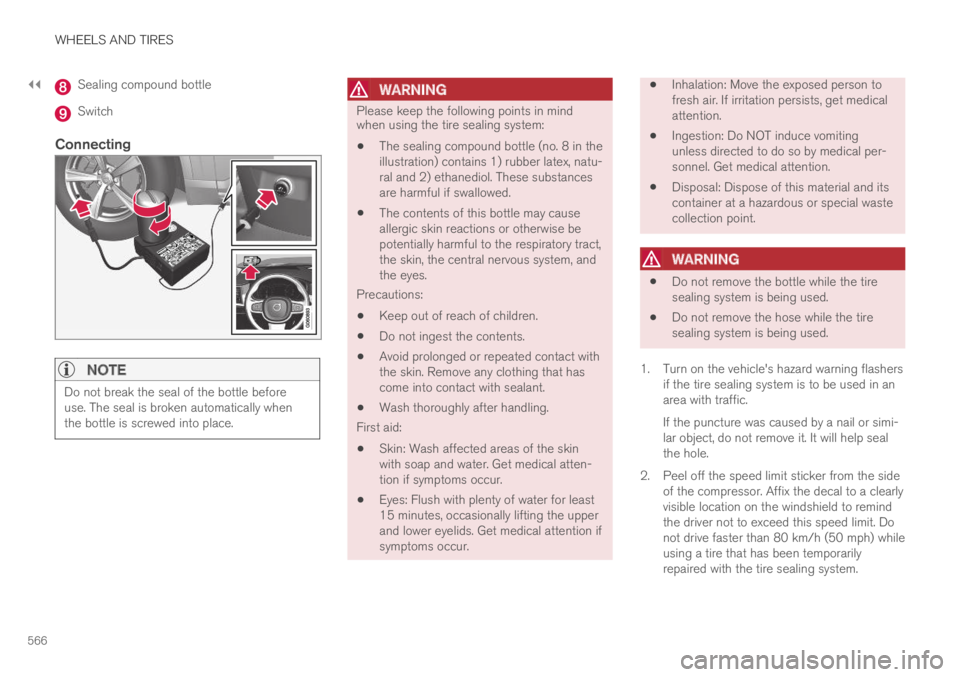
Connecting
NOTE
Do not break the seal of the bottle beforeuse. The seal is broken automatically whenthe bottle is screwed into place.
WARNING
Please keep the following points in mindwhen using the tire sealing system:
The sealing compound bottle (no. 8 in theillustration) contains 1) rubber latex, natu-ral and 2) ethanediol. These substancesare harmful if swallowed.
The contents of this bottle may causeallergic skin reactions or otherwise bepotentially harmful to the respiratory tract,the skin, the central nervous system, andthe eyes.
Precautions:
Keep out of reach of children.
Do not ingest the contents.
Avoid prolonged or repeated contact withthe skin. Remove any clothing that hascome into contact with sealant.
Wash thoroughly after handling.
First aid:
Skin: Wash affected areas of the skinwith soap and water. Get medical atten-tion if symptoms occur.
Eyes: Flush with plenty of water for least15 minutes, occasionally lifting the upperand lower eyelids. Get medical attention ifsymptoms occur.
Inhalation: Move the exposed person tofresh air. If irritation persists, get medicalattention.
Ingestion: Do NOT induce vomitingunless directed to do so by medical per-sonnel. Get medical attention.
Disposal: Dispose of this material and itscontainer at a hazardous or special wastecollection point.
WARNING
Do not remove the bottle while the tiresealing system is being used.
Do not remove the hose while the tiresealing system is being used.
1.Turn on the vehicle's hazard warning flashersif the tire sealing system is to be used in anarea with traffic.
If the puncture was caused by a nail or simi-lar object, do not remove it. It will help sealthe hole.
2.Peel off the speed limit sticker from the sideof the compressor. Affix the decal to a clearlyvisible location on the windshield to remindthe driver not to exceed this speed limit. Donot drive faster than 80 km/h (50 mph) whileusing a tire that has been temporarilyrepaired with the tire sealing system.
Page 569 of 669

WHEELS AND TIRES
}}
567
3.Make sure the switch is in the 0 (Off) posi-tion and take out the electric cable and thehose.
4.Unscrew the orange cover on the compres-sor and unscrew the cap on the sealing com-pound bottle.
5.Screw the bottle onto the bottle holder as faras possible.
The bottle and the bottle holder are equip-ped with catches to help prevent the sealingcompound from leaking. Once the bottle isscrewed into place into the bottle holder, itcannot be unscrewed. The bottle can only beremoved by a workshop. Volvo recommendsan authorized Volvo workshop.
WARNING
Do not unscrew the bottle. It is equipped witha catch to prevent leakage.
6. Unscrew the tire's valve cap and screw thehose's valve connector as far as possibleonto the valve.
Be sure the air release valve on the com-pressor's hose is completely closed.
7.Connect the electrical cable to the nearest12 V outlet and start the vehicle.
NOTE
Make sure that none of the vehicle's other12 V sockets are used while the compressoris running.
WARNING
Never leave children unattended in the vehiclewhile the engine is running.
WARNING
Inhaling exhaust fumes could lead to seriousinjury. Never leave the engine running in anenclosed space or a space without sufficientventilation.
8. Start the compressor by moving the switch tothe I (On) position.
WARNING
Never stand next to a tire being inflated withthe compressor. If cracks, bulges, etc. form onthe tire, switch off the compressor immedi-ately. The vehicle should not be driven. Callroadside assistance to have the vehicle towedto a workshop for inspection/replacement ofthe tire. Volvo recommends an authorizedworkshop.
NOTE
When the compressor first starts, air pressuremay temporarily increase up to 6 bar (88 psi)but should decrease again after approxi-mately 30 seconds.
9. Inflate the tire for 7 minutes.
CAUTION
To help avoid overheating, the compressorshould never be used for more than10 minutes at a time.
Page 570 of 669

||
WHEELS AND TIRES
568
10. Switch off the compressor and check theinflation pressure using the air pressuregauge. The inflation pressure should bebetween 1.8 bar (22 psi) and 3.5 bar(51 psi). If the inflation pressure is too high,use the air release valve to release air.
WARNING
If pressure falls below 1.8 bar (22 psi), thehole in the tire may be too large. The vehicleshould not be driven. Call roadside assistanceto have the vehicle towed to a workshop forinspection/replacement of the tire. Volvo rec-ommends an authorized workshop.
11. Switch off the compressor and remove theelectrical cable.
12.Unscrew the hose from the tire's valve andscrew the valve cap back on.
NOTE
After inflating a tire, always replace thevalve cap to help prevent valve damagecaused by gravel, dirt, etc.
Use plastic valve caps only. Metal capscould corrode and become difficult toremove.
13. Put the protective hose cover onto the hoseto help prevent leakage of any residual seal-ing compound. Return the equipment to thecargo compartment.
14. Immediately drive the vehicle at least 3 km(2 miles) at a maximum speed of 80 km/h(50 mph) to allow the sealing compound toseal the tire, and then recheck the inflationpressure.
NOTE
During the tire's first revolution, some sealingcompound may spray out of the puncturehole.
WARNING
Before driving away, make sure that no one isnear the vehicle who could be sprayed withsealing compound. Make sure no one iswithin 2 meters(7 feet) of the vehicle.
15.Rechecking the inflation pressure
Connect the hose to the tire's valve andscrew the hose connector onto the valve asfar as possible. The compressor must beswitched off.
16. Check the inflation pressure on the air pres-sure gauge.
If the pressure is under 1.3 bar (19 psi),the tire is not sufficiently sealed. The vehi-cle should not be driven. Call roadsideassistance to have the vehicle towed.
If the inflation pressure is higher than1.3 bar (19 psi), the tire must be inflatedto the inflation pressure specified on thetire pressure decal on the driver's sidedoor pillar (1 bar = 100 kPa = 14.5 psi). Ifthe inflation pressure is too high, use theair release valve to release air.
NOTE
Replace the sealing compound bottle andhose after use. Volvo recommends havingthese replaced by an authorized Volvo work-shop.
WARNING
Check inflation pressure regularly.
Volvo recommends driving to the nearest author-ized Volvo workshop to have the tire replaced/repaired. Inform the workshop that the tire con-tains sealing compound.
Page 571 of 669
WHEELS AND TIRES
}}
569
The sealing compound bottle must be replacedafter use. Volvo recommends contacting anauthorized Volvo workshop for replacement.
WARNING
After using the tire sealing system, the vehicleshould not be driven farther than approxi-mately 200 km (120 miles).
NOTE
The compressor is an electric device. Followlocal regulations for disposal.
Related information
Recommended tire pressure (p. 551)
Tire sealing system (p. 564)
Inflate tires with the compressor included inthe tire sealing system (p. 569)
Inflate tires with the compressorincluded in the tire sealing system
The vehicle's original tires can be inflated usingthe compressor in the tire sealing system.
1. The compressor must be switched off. Makesure that the switch is in the 0 (Off) positionand take out the electrical cable and thehose.
2. Unscrew the tire's valve cap and screw thehose's valve connector as far as possibleonto the valve.
Be sure the air release valve on the com-pressor's hose is completely closed.
3.Connect the electrical cable to the nearest12 V outlet and start the vehicle.
WARNING
Inhaling exhaust fumes could lead to seriousinjury. Never leave the engine running in anenclosed space or a space without sufficientventilation.
WARNING
Never leave children unattended in the vehiclewhile the engine is running.
4. Start the compressor by moving the switch tothe I (On) position.
CAUTION
Risk of overheating. The compressor shouldnot be running for longer than 10 minutes ata time.
5. Inflate the tire to the pressure specified onthe tire pressure decal on the driver's sidedoor pillar. If the inflation pressure is toohigh, use the air release valve to release air.
6. Switch off the compressor. Remove the hoseand the electrical cable.
7.Screw the valve cap back onto the tire.
NOTE
After inflating a tire, always replace thevalve cap to help prevent valve damagecaused by gravel, dirt, etc.
Use plastic valve caps only. Metal capscould corrode and become difficult toremove.
NOTE
The compressor is an electric device. Followlocal regulations for disposal.
Page 572 of 669
||
WHEELS AND TIRES
570
Related information
Recommended tire pressure (p. 551)
Using the tire sealing system (p. 565)
Tire sealing system (p. 564)
Determining the vehicle's permittedweight
Properly loading your vehicle will provide maxi-mum return of vehicle design performance.
Weight designations
Before loading your vehicle, familiarize yourselfwith the following terms for determining yourvehicle's weight ratings, with or without a trailer,from the vehicle's Federal/Canadian Motor Vehi-cle Safety Standards (FMVSS/CMVSS) label, andthe vehicle's tire information placard:
Curb weight
The weight of the vehicle including a full tank offuel and all standard equipment. It does notinclude passengers, cargo, or optional equipment.
Capacity weight
All weight added to the curb weight, includingcargo and optional equipment. When towing, tow-bar weight is also part of cargo weight.
Permissible axle weight
The maximum allowable weight that can be car-ried by a single axle (front or rear). These num-bers are shown on the Federal/Canadian MotorVehicle Safety Standards (FMVSS/CMVSS) label.The total load on each axle must never exceed itsmaximum permissible weight.
Gross vehicle weight (GVW)
The vehicle's curb weight + cargo + passengers.
Steps for Determining Correct Load
Limit
1. Locate the statement "the combined weightof occupants and cargo should never exceedXXX kg or XXX lbs." on your vehicle's plac-ard.
2. Determine the combined weight of the driverand passengers that will be riding in yourvehicle.
3. Subtract the combined weight of the driverand passengers from XXX kg or XXX lbs.
4. The resulting figure equals the availableamount of cargo and luggage load capacity.For example, if the "XXX" amount equals1400 lbs. and there will be five 150 lb. pas-sengers in your vehicle, the amount of availa-ble cargo and luggage load capacity is 650lbs. (1400 - 750 (5 × 150) = 650 lbs.)
5. Determine the combined weight of luggageand cargo being loaded on the vehicle. Thatweight may not safely exceed the availablecargo and luggage load capacity calculatedin Step 4.
6. If your vehicle will be towing a trailer, loadfrom your trailer will be transferred to yourvehicle. Consult this manual to determinehow this reduces the available cargo and lug-gage load capacity of your vehicle.
Page 573 of 669
WHEELS AND TIRES
571
WARNING
Exceeding the permissible axle weight,gross vehicle weight, or any other weightrating limits can cause tire overheatingresulting in permanent deformation orcatastrophic failure.
Do not use replacement tires with lowerload carrying capacities than the tires thatwere original equipment on the vehiclebecause this will lower the vehicle's GVWrating. Use only tires with the correct loadcarrying capacity. Consult your Volvoretailer for information.
Related information
Loading recommendations (p. 580)