headlights VOLVO S90 TWIN ENGINE 2019 User Guide
[x] Cancel search | Manufacturer: VOLVO, Model Year: 2019, Model line: S90 TWIN ENGINE, Model: VOLVO S90 TWIN ENGINE 2019Pages: 669, PDF Size: 14.33 MB
Page 344 of 669
DRIVER SUPPORT
342
City Safety braking for oncomingvehicles
City Safety can help you apply the brakes for anoncoming vehicle in your lane.
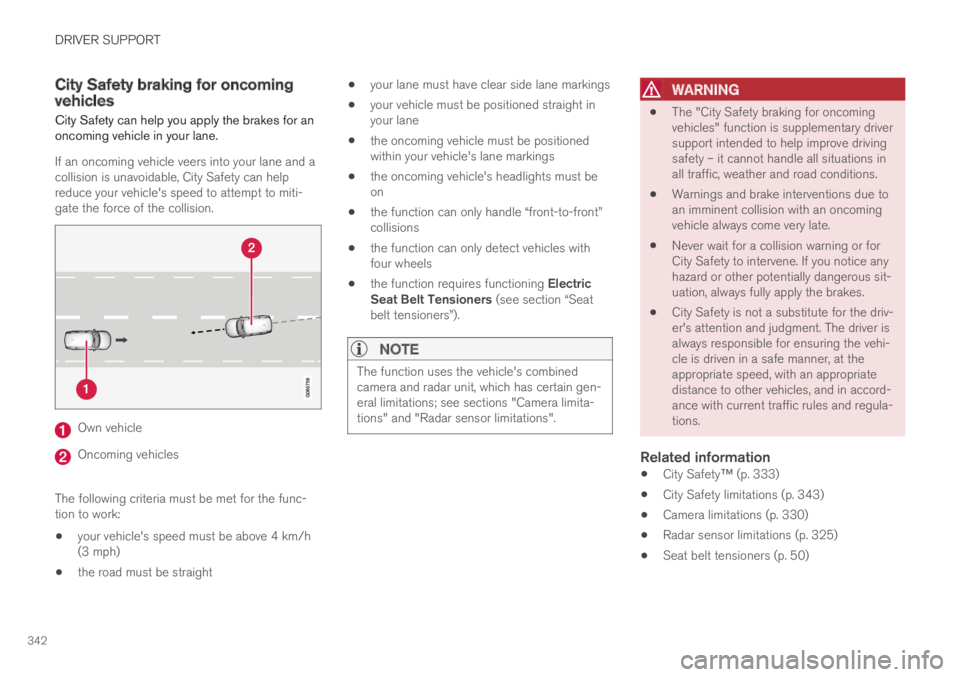
If an oncoming vehicle veers into your lane and acollision is unavoidable, City Safety can helpreduce your vehicle's speed to attempt to miti-gate the force of the collision.
Own vehicle
Oncoming vehicles
The following criteria must be met for the func-tion to work:
your vehicle's speed must be above 4 km/h(3 mph)
the road must be straight
your lane must have clear side lane markings
your vehicle must be positioned straight inyour lane
the oncoming vehicle must be positionedwithin your vehicle's lane markings
the oncoming vehicle's headlights must beon
the function can only handle “front-to-front”collisions
the function can only detect vehicles withfour wheels
the function requires functioning ElectricSeat Belt Tensioners (see section “Seatbelt tensioners”).
NOTE
The function uses the vehicle's combinedcamera and radar unit, which has certain gen-eral limitations; see sections "Camera limita-tions" and "Radar sensor limitations".
WARNING
The "City Safety braking for oncomingvehicles" function is supplementary driversupport intended to help improve drivingsafety – it cannot handle all situations inall traffic, weather and road conditions.
Warnings and brake interventions due toan imminent collision with an oncomingvehicle always come very late.
Never wait for a collision warning or forCity Safety to intervene. If you notice anyhazard or other potentially dangerous sit-uation, always fully apply the brakes.
City Safety is not a substitute for the driv-er's attention and judgment. The driver isalways responsible for ensuring the vehi-cle is driven in a safe manner, at theappropriate speed, with an appropriatedistance to other vehicles, and in accord-ance with current traffic rules and regula-tions.
Related information
City Safety™ (p. 333)
City Safety limitations (p. 343)
Camera limitations (p. 330)
Radar sensor limitations (p. 325)
Seat belt tensioners (p. 50)
Page 431 of 669

STARTING AND DRIVING
* Option/accessory.429
Ignition modes
The vehicle's ignition can be put in variousmodes (levels) to make different functions availa-ble.
To enable the use of a limited number of func-tions when the engine is not running, the ignitioncan be put in one of three different levels: 0, Iand II. These levels are referred to as "ignitionmodes" in the Owner's Manual.
The following table shows which functions areavailable in each ignition mode:
Mode Functions
0The odometer, clock and tem-
perature gauge are illuminatedA.
The power* seats can beadjusted.
The power windows can be used.
The center display is activated
and can be usedA.
The infotainment system can be
usedA.
In this mode, the functions are availa-ble for a limited time and then switchoff automatically.
IThe panoramic roof, power win-dows, 12-volt electrical socket inthe passenger compartment,Bluetooth, navigation, phone,blower and windshield wipers canbe used.
The power seats can be adjusted.
The 12-volt electrical socket* inthe trunk can be used.
Electrical current will be takenfrom the battery in this ignitionmode.
Mode Functions
IIThe headlights illuminate.
Warning/indicator lights illumi-nate for 5 seconds.
A number of other systems areactivated. However, seat and rearwindow heating can only be acti-vated when the engine is running.
This ignition mode uses a lot ofcurrent from the battery andshould be avoided whenever pos-sible!
AAlso activated when the door is opened.
Related information
Starting the vehicle (p. 426)
Adjusting the steering wheel (p. 193)
Jump starting using another battery (p. 466)
Selecting ignition mode (p. 430)
Page 468 of 669

STARTING AND DRIVING
466
Battery drain
The electrical functions in the vehicle drain thebattery to varying degrees. Avoid using ignitionmode II when the engine is switched off. Useignition mode I instead, as this uses less electri-cal current.
Note that certain accessories may also drainpower from the electrical system. Do not usefunctions that use a lot of electrical current whenthe engine is turned off. Examples of such func-tions are:
blower
headlights
windshield wipers
audio system (especially at high volume).
If the starter battery voltage is low, a message isshown in the driver display. The vehicle's energy-saving function will then turn off or reduce certainfunctions, such as the blower and/or the audiosystem.
–Charge the battery by starting the engineand let it run for at least 15 minutes (drivingcharges the battery faster than letting theengine idle).
Related information
Start battery (p. 601)
Ignition modes (p. 429)
Jump starting using another battery
If the start battery is discharged, current fromanother battery can be used to start the vehicle.
Jumper cable connecting points.
CAUTION
The charging point of the vehicle is onlyintended for jump starting the vehicle in ques-tion. The charging point is not intended forjump-starting another vehicle. Using thecharging point to start another vehicle couldcause a fuse to blow, which would cause thecharging point to stop working.
If a fuse has blown, 12 V Battery Fuse failureService required will be displayed in the instru-ment panel. Volvo recommends contacting anauthorized Volvo workshop.
To avoid short circuits or other damage, the fol-lowing steps are recommended when jump star-ting the battery:
Page 587 of 669

MAINTENANCE AND SERVICE
}}
585
Periodic maintenance helps minimize
emissions
NOTE
Refer to your Service and Warranty Book-let for a comprehensive service and main-tenance schedule up to 240,000 km(150,000 miles). This program containsinspections and services necessary forthe proper function of your vehicle andincludes components that affect vehicleemissions.
The Warranty and Service Records Infor-mation booklet also contains detailedinformation concerning the warrantiesthat apply to your vehicle.
On-board Diagnostic System
OBD II is part of your vehicle's computerizedengine management system. It stores diagnosticinformation about your vehicle's emission con-trols. It can light the Check Engine light (MIL) if itdetects an emission control "fault." A "fault" is acomponent or system that is not performingwithin an expected range. A fault may be perma-nent or temporary. OBD II will store a messageabout any fault.
Emission inspection readiness
How do states use OBD II for emission
inspections?
Many states connect a computer directly to avehicle's OBD II system. The inspector can thenread "faults." In some states, this type of inspec-tion has replaced the tailpipe emission test.
How can my vehicle fail OBD II emission
inspection?
Your vehicle can fail OBD II emission inspectionfor any of the following reasons:
If your Check Engine (MIL) light is lit, yourvehicle may fail inspection.
If your vehicle's Check Engine light was lit,but went out without any action on your part,OBD II will still have a recorded fault. Yourvehicle may pass or fail, depending on theinspection practices in your area.
If you had recent service that required dis-connecting the battery, OBD II diagnosticinformation may be incomplete and "notready" for inspection. A vehicle that is notready may fail inspection.
How can I prepare for my next OBD II
emission inspection?
If your Check Engine (MIL) light is lit or waslit but went out without service, have your
vehicle diagnosed and, if necessary, servicedby a qualified Volvo technician.
If you recently had service for a lit CheckEngine light, or if you had service thatrequired disconnecting the battery, a periodof driving is necessary to bring the OBD IIsystem to "ready" for inspection. Two half-hour trips of mixed stop-and-go/highwaydriving are typically needed to allow OBD II toreach readiness. Your Volvo retailer can pro-vide you with more information on planning atrip.
Maintain your vehicle in accordance with yourvehicle's maintenance schedule.
Owner maintenance
Periodic maintenance requirements and intervalsare described in your vehicle's Warranty andService Records Information booklet.
The following points can be carried out betweenthe normally scheduled maintenance services.
Each time the car is refueled:
Check the engine oil level.
Clean the windshield, windshield wipers,headlights, and taillights.
Page 602 of 669

||
MAINTENANCE AND SERVICE
* Option/accessory.600
Unscrew the cover in the plastic covering.
Unscrew the expansion tank cap and fillcoolant as needed. The level should notexceed the yellow MAX mark inside theexpansion tank.
Put the components back in place in the reverseorder.
CAUTION
Do not ingest the contents. May causedamage to organs (kidneys).
Use premixed coolant according to Vol-vo's recommendations. If concentratedcoolant is used, make sure that the cool-ant mixture is 50% coolant and 50%water of acceptable quality.
Do not mix different types of coolant.
To help ensure sufficient corrosion pro-tection in the system, only use new cool-ant when replacing larger components inthe cooling system.
Never run the engine unless the coolingsystem is properly filled. An improperlyfilled cooling system could lead to hightemperatures and cracks in the cylinderheads.
High levels of chlorine, chlorides andother salts may cause corrosion in thecooling system.
Related information
Engine compartment overview (p. 596)
Coolant specifications (p. 647)
Replacing bulbs
Halogen headlights are not available on all mod-els and markets. Contact a Volvo retailer formore information.
LED14 bulbs must be replaced by a workshop.An authorized Volvo workshop is recommended.
NOTE
For information on lights not mentioned inthis article, contact a Volvo dealer or a certi-fied Volvo service technician.
NOTE
Exterior lighting such as headlights and tail-lights may develop temporary condensationon the inside of the lens. This is normal. Allexterior lighting is designed to resist this.Condensation is normally vented out of thelamp housing once the light has been lit forsome period of time.
NOTE
Bulbs for active curve lighting* contain tracesof mercury and should therefore always besubmitted to a certified Volvo service techni-cian.
Page 628 of 669

||
MAINTENANCE AND SERVICE
626
Wash using a sponge, car washing detergentand plenty of lukewarm water.
Clean the wiper blades with lukewarm soapsolution or car washing detergent.
Dry the vehicle using a clean, soft chamois ora squeegee. Try not to let drops of water dryin strong sunlight. This could cause waterdrying stains that may need to be polishedout.
In areas with heavy industrial emissions,more frequent washing of the vehicle's exte-rior is recommended.
Tar spots from asphalt may remain even afterwashing. Use a tar remover to remove thesespots after washing the vehicle.
WARNING
Always entrust engine washing to a workshop.If the engine is hot, there is a risk of fire.
CAUTION
Dirty headlights do not work as well. Cleanthem regularly, e.g. when refueling.
Do not use corrosive cleaners. Use water anda non-abrasive sponge.
NOTE
Exterior lighting such as headlights and tail-lights may develop temporary condensationon the inside of the lens. This is normal. Allexterior lighting is designed to resist this.Condensation is normally vented out of thelamp housing once the light has been lit forsome period of time.
CAUTION
Make sure that the panoramic roof andsun shade are closed before washing thevehicle.
Never use abrasive polishing agents onthe panoramic roof.
Never use wax on the rubber sealsaround the panoramic roof.
CAUTION
Remember to remove dirt from the drainholes in the doors and sills after washing thevehicle.
Related information
Cleaning the exterior (p. 624)
Polishing and waxing (p. 625)
Automatic car washes (p. 627)
High-pressure washing (p. 628)
Cleaning the wiper blades (p. 628)
Cleaning exterior plastic, rubber and trimcomponents (p. 629)
Cleaning rims (p. 630)
Corrosion protection (p. 630)
Settings for automatically activating the park-ing brake (p. 436)
Page 637 of 669

MAINTENANCE AND SERVICE
* Option/accessory.635
Filling washer fluid
Washer fluid is used to help keep the headlightsand windshield clean. Washer fluid containinganti-freeze should be used in very cold weather(below-freezing temperatures).
Fill washer fluid into the reservoir with the bluecover. The reservoir is used for both the wind-shield washer and the headlight washer*
NOTE
When there is approximately 1 liter (1 qt) ofwasher fluid remaining, the message Washer
fluid Level low, refill and the symbolwill be displayed in the instrument panel.
Recommended grade: Washer fluid recom-mended by Volvo, with frost protection during
cold weather and temperatures below the freez-ing point.
CAUTION
Use Volvo's original washer fluid or an equiva-lent fluid with the recommended pH valuebetween 6 and 8, diluted as recommended,e.g. in a 1:1 solution with pH-neutral water.
CAUTION
Use washer fluid with anti-freeze when tem-peratures are below the freezing point to helpkeep the pump, reservoir and hoses fromfreezing.
Volume:
The washer fluid reservoir has a volume of 5.5 lit-ers (5.8 qts).
Related information
Using the rain sensor (p. 176)
Using the windshield and headlight washers(p. 178)
Using the rain sensor's memory function(p. 177)
Windshield wipers in the service position(p. 634)
Replacing windshield wiper blades (p. 633)
Using the windshield wipers (p. 176)
Wiper blades and washer fluid (p. 175)
Page 655 of 669
INDEX
653
Charging
hybrid battery 409
opening and closing the charging
door 414
start charging 415
Status 417, 419
stop charging 421
Charging cable 411
Charging current 411
Checking engine oil level 598
Child restraints 63, 65
booster cushions 71
convertible seats 69
infant seats 67
ISOFIX/LATCH anchors 74
lower attachment points 73
recalls and registration 65
top tether anchors 72
Child safety 63
Child safety locks 259
Circuit breaker 413
City Safety 333, 334, 336, 337, 343, 345
City Safety braking for oncoming vehicles 342
City Safety in crossing traffic 339, 340
City Safety when evasive maneuver preven-
ted341
Cleaning621, 623, 624
automatic car wash627
car wash624, 625, 627, 628, 629, 630
center display619
Seat belts621
textile upholstery619, 621, 622
upholstery 619, 621, 622, 623, 624
wheels630
Cleaning wheels630
Cleaning wiper blades628
Clean Zone199
Clean Zone Interior Package199
Climate196
auto-regulation214
blower control219, 220
parking224
perceived temperature197
Sensors196
temperature control221, 222
voice control197
zones196
Climate controls207
center display207
rear seat207
Climate system196, 207
Refrigerant648
repairs595
Clock, setting89
Collision42, 47, 52, 61
Collision warner
detection of pedestrians337
radar sensor324
Collision warning333, 346
Color code, paintwork632
Color codes632
Compass474
calibration475
Condensation in headlights625, 627,
628, 629
Connecting vehicle to Internet
No connection or poor connection 528
via a mobile device (WiFi)525
via cellular phone (Bluetooth) 525
via vehicle's modem526
Connect phone515
Contact information26
Convertible seats69
coolant647
Coolant, filling599
Cooling system
overheating465
Corner Traction Control271
Corrosion protection630
Crash, see Collision42
Page 660 of 669

INDEX
658
low beams 151
position lights 150
rear fog light 155
settings 149
Turn signals 154
Lighting, replacing bulbs 600
Limp home 440
Load anchoring eyelets
cargo compartment 582
Load anchoring hooks 581
Load carriers 581
Load index 546
Loading
general 580
load anchoring eyelets 582
long load 580
Lock indication 236
setting 237
Locking/unlocking
trunk lid 241, 255
Locking wheel bolts 557
Locks
Locking 240
unlocking 240
Long-term storage 424
Low battery charge level
start battery 466
Low beams151
Low oil level598
M
Maintained climate comfort229
start/stop229
Maintenance584
corrosion protection630
Max. axle weight643
Max. roof load643
Media player500, 502
compatible file formats507, 508
voice control144
Messages and symbols
Adaptive Cruise Control306
Collision warner with auto-brake345
Messages in BLIS351
Messages in display101, 136
handling102, 136
saved103, 137
Mileage85
electric motor455
Misting
condensation in headlights 624, 627
Mood lighting159
O
Occupant safety43
Occupant weight sensor56
Octane rating462
Oil, see also Engine oil646
On-board diagnostics584
On-board Diagnostic socket37
Option/accessory21
Outside temperature gauge90
Overheating465
Owner's information16
OWNER'S MANUAL21
in cellular phone20
in the center display17, 18
P
Paddle at steering wheel193
Paint
color code632
paint damage and touch-up631, 632
Panoramic roof
opening and closing171
pinch protection162
Page 666 of 669
INDEX
664
Volvo ID 26
create and register 26
W
Warning light
Adaptive Cruise Control295
stability and traction control system271
Warning lights
airbags SRS93
alternator does not charge93
brake system error93
low oil pressure93
parking brake applied93
seat belt reminder93
starter battery not charging93
WARNING93
Warning sound
parking brake436
warning symbols93
Warning symbols
safety42
Warranties584
Washer
Headlights178
washer fluid, filling635
Windshield178
Washer fluid175, 635
Washer nozzles, heated175
Waxing625
Weights
Curb weight 643
Wheel bolts 557
locking 557
Wheels
cleaning 630
mounting 560
removal 558
Snow chains 563
Wheels and tires
Load index and speed symbol 546
Whiplash protection 46
Whiplash Protection System 46
WHIPS (Whiplash Protection System) 46
Wi-Fi
connecting vehicle to Internet 525
delete network 529
sharing Internet connection, tethering,
hotspot 527
technology and security 529
Window
sun shade 166
Windows and glass 162
Windshield
heating217
projected image138, 140
Windshield washing178
Windshield wipers176
rain sensor176, 177
Winter driving458
Winter tires563
Winter wheels563
Wiper blade175
replacing633
service position634
Wiper blade and washing fluid175