brake VOLVO V4 2001 User Guide
[x] Cancel search | Manufacturer: VOLVO, Model Year: 2001, Model line: V4, Model: VOLVO V4 2001Pages: 87, PDF Size: 2.34 MB
Page 39 of 87
If accessory, aftermarket or "custom" tires and wheels are installed and are of a size different than the original tires
and wheels, chains in some cases CANNOT be used. Sufficient clearances between chains and brakes, suspension and
body components must be maintained.
· Some strap on type chains will interfere with brake components and therefore CANNOT be used.
Consult your Volvo retailer for additional snow chain information.
Snow tires, studded tires *
Tires for winter use:
Owners who live in or regularly commute through areas with sustained periods of snow or icy driving
conditions are strongly advised to fit suitable winter tires to help retain the highest degree of traction.
It is important to install winter tires on all four wheels to help retain traction during cornering, braking, and
accelerating. Failure to do so could reduce traction to an unsafe level or adversely affect handling. Do not mix tires of
different design as this could also negatively affect overall tire road grip. Volvo recommends 195/55 R15 winter tires
on 15" steel rims on all S/V 40 models.
Winter tires wear more quickly on dry roads in warm weather. They should be removed when the winter driving
season has ended.
Studded tires should be run-in 300-600 miles (50-1000 km) during which the car should be driven as smoothly as
possible to give the studs the opportunity to seat properly in the tires. The car tires should have the same rotational
direction throughout their entire lifetime. In other words, if you wish to rotate the wheels, make sure that the same
wheels are always on the same side of the car.
NOTE: Please consult state or provincial regulations restricting the use of studded winter tires before installing such
tires.
CAUTION:
· Check local regulations regarding the use of snow chains before installing.
· Always follow the chain manufacturer's installation instructions carefully. Install chains as tightly as possible and
retighten periodically.
· Never exceed the chain manufacturer's specified maximum speed limit. (Under no circumstances should that limit be
higher than 30 mph (45 km/h).
· Avoid bumps, holes or sharp turns when driving with snow chains.
· The handling of the vehicle can be adversely affected when driving with chains. Avoid fast or sharp turns as well as
locked wheel braking.
* Where permitted.
pg. 80 Wheels and tires
Checking and correcting tire pressure
ProCarManuals.com
Page 44 of 87
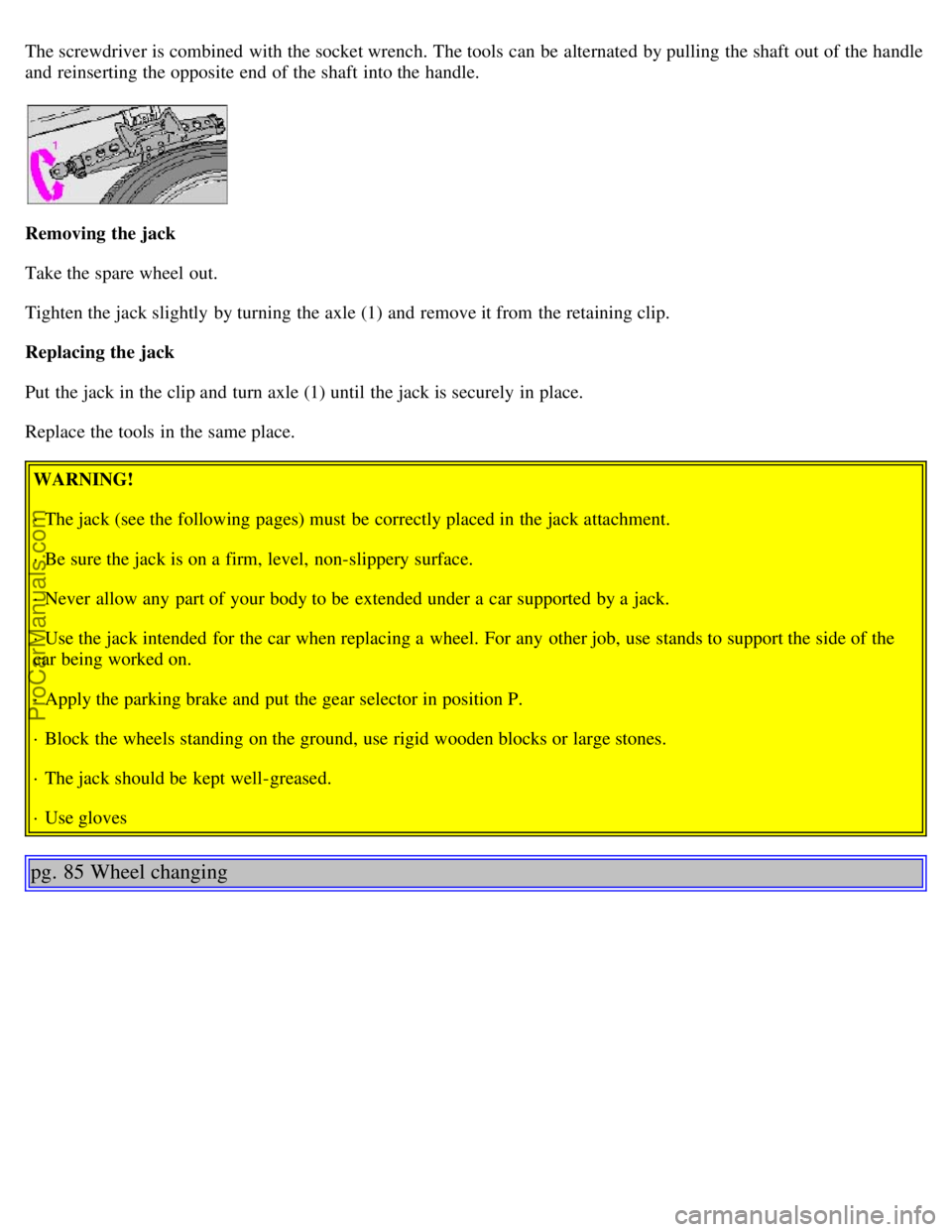
The screwdriver is combined with the socket wrench. The tools can be alternated by pulling the shaft out of the handle
and reinserting the opposite end of the shaft into the handle.
Removing the jack
Take the spare wheel out.
Tighten the jack slightly by turning the axle (1) and remove it from the retaining clip.
Replacing the jack
Put the jack in the clip and turn axle (1) until the jack is securely in place.
Replace the tools in the same place.WARNING!
· The jack (see the following pages) must be correctly placed in the jack attachment.
· Be sure the jack is on a firm, level, non-slippery surface.
· Never allow any part of your body to be extended under a car supported by a jack.
· Use the jack intended for the car when replacing a wheel. For any other job, use stands to support the side of the
car being worked on.
· Apply the parking brake and put the gear selector in position P.
· Block the wheels standing on the ground, use rigid wooden blocks or large stones.
· The jack should be kept well-greased.
· Use gloves
pg. 85 Wheel changing
ProCarManuals.com
Page 45 of 87
Changing a wheel
· Engage the parking brake.
· Put the gear selector in (P)ark.
· Get all the passengers to move to a safe place outside the car.
· Close all doors.
· Block the wheels remaining on the ground with wooden blocks, stones or something similar.
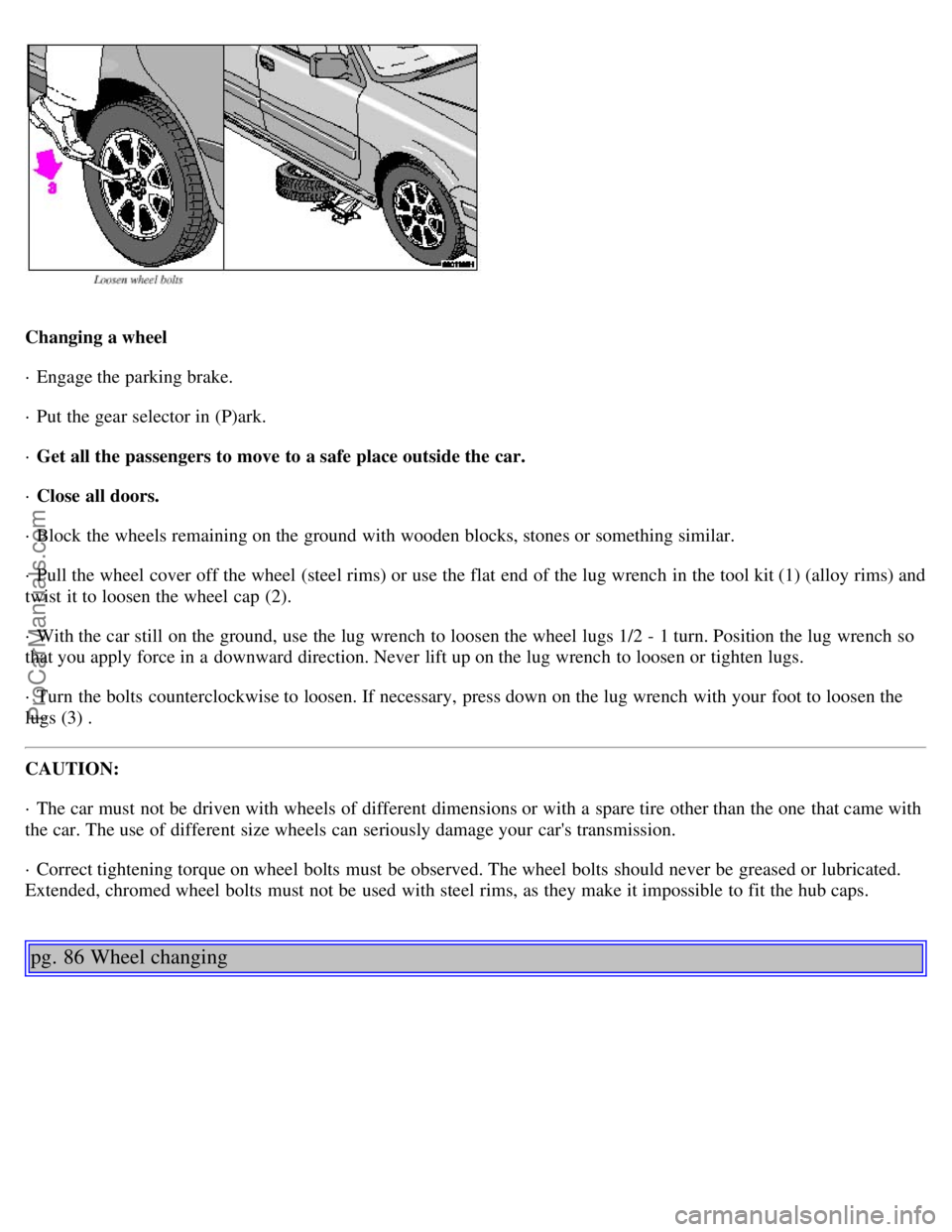
· Pull the wheel cover off the wheel (steel rims) or use the flat end of the lug wrench in the tool kit (1) (alloy rims) and
twist it to loosen the wheel cap (2).
· With the car still on the ground, use the lug wrench to loosen the wheel lugs 1/2 - 1 turn. Position the lug wrench so
that you apply force in a downward direction. Never lift up on the lug wrench to loosen or tighten lugs.
· Turn the bolts counterclockwise to loosen. If necessary, press down on the lug wrench with your foot to loosen the
lugs (3) .
CAUTION:
· The car must not be driven with wheels of different dimensions or with a spare tire other than the one that came with
the car. The use of different size wheels can seriously damage your car's transmission.
· Correct tightening torque on wheel bolts must be observed. The wheel bolts should never be greased or lubricated.
Extended, chromed wheel bolts must not be used with steel rims, as they make it impossible to fit the hub caps.
pg. 86 Wheel changing
ProCarManuals.com
Page 50 of 87
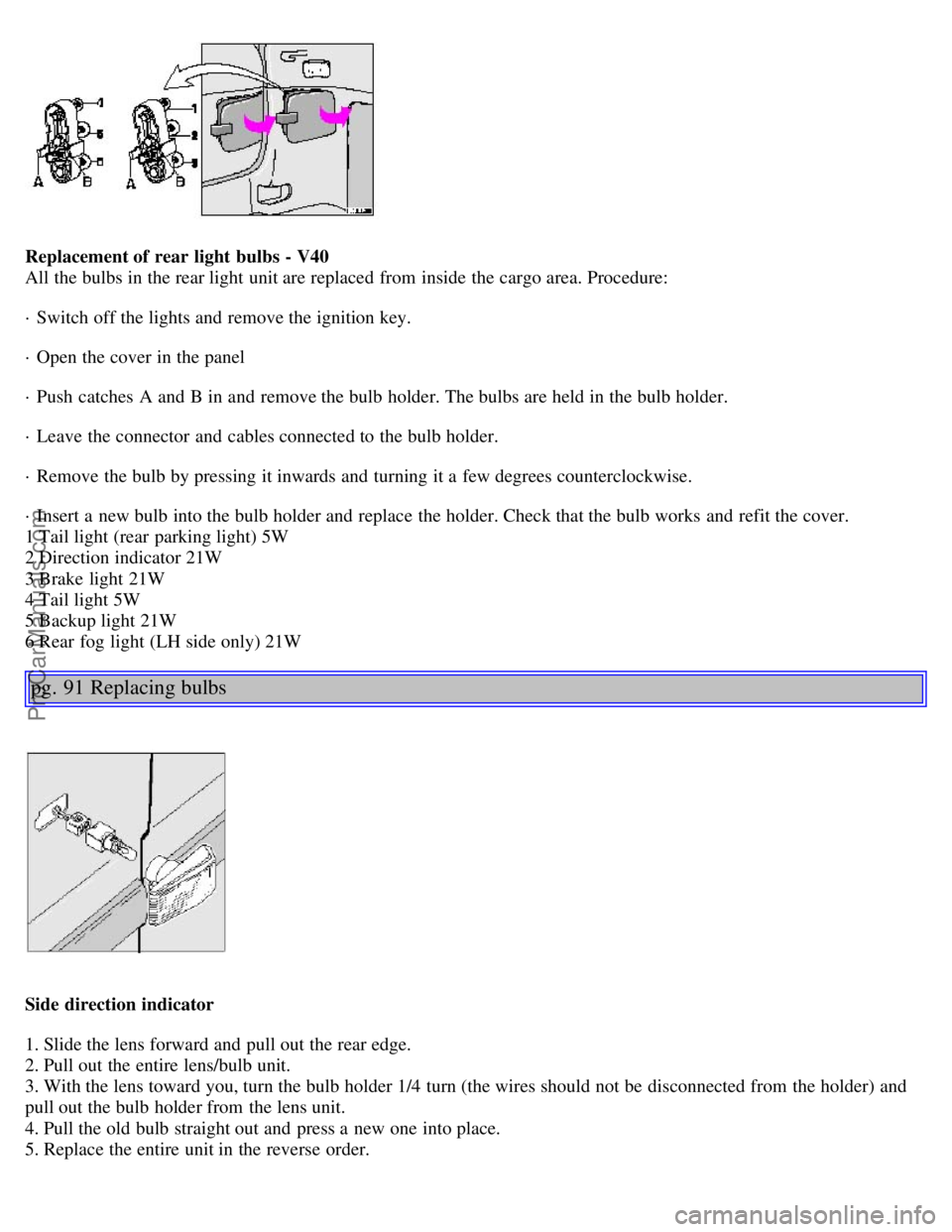
Replacement of rear light bulbs - V40
All the bulbs in the rear light unit are replaced from inside the cargo area. Procedure:
· Switch off the lights and remove the ignition key.
· Open the cover in the panel
· Push catches A and B in and remove the bulb holder. The bulbs are held in the bulb holder.
· Leave the connector and cables connected to the bulb holder.
· Remove the bulb by pressing it inwards and turning it a few degrees counterclockwise.
· Insert a new bulb into the bulb holder and replace the holder. Check that the bulb works and refit the cover.
1 Tail light (rear parking light) 5W
2 Direction indicator 21W
3 Brake light 21W
4 Tail light 5W
5 Backup light 21W
6 Rear fog light (LH side only) 21W
pg. 91 Replacing bulbs
Side direction indicator
1. Slide the lens forward and pull out the rear edge.
2. Pull out the entire lens/bulb unit.
3. With the lens toward you, turn the bulb holder 1/4 turn (the wires should not be disconnected from the holder) and
pull out the bulb holder from the lens unit.
4. Pull the old bulb straight out and press a new one into place.
5. Replace the entire unit in the reverse order.
ProCarManuals.com
Page 54 of 87
· Tar spots can be removed with kerosene or tar remover after the car has been washed.
· A stiff-bristle brush and lukewarm soapy water can be used to clean the wiper blades. Frequent cleaning improves
visibility considerably.
· Wash off the dirt from the underside (wheel housings fenders, etc.).
· In areas of high industrial fallout, more frequent washing is recommended.
CAUTION: During high pressure washing, the spray nozzle must never be closer to the vehicle than 13" (30 cm). Do
not spray into the locks.
· When washing or steam cleaning the engine, avoid spraying water or steam directly on the electrical components or
toward the rear side of the engine.
· After cleaning the engine, the spark plug wells should be inspected for water and blown dry if necessary.
Suitable detergents
Special car washing detergents should be used. A suitable mixture is about 2.5 fl. oz. (8.5 cl) of detergent to 2.6 US
gal. (10 liters) of warm water. After washing with a detergent the car should be well rinsed with clean water.
WARNING!
· When the car is driven immediately after being washed, apply the brakes several times in order to remove any
moisture from the brake linings.
· Engine cleaning agents should not be used when the engine is warm. This may constitute a fire risk.
NOTE: When washing the car, remember to remove dirt from the drain holes in the doors and sills. Bumpers: Wash
the bumpers with the same cleaning agent used on the rest of the car. Never clean the bumpers with gasoline or paint
thinner. Difficult spots can be removed with denatured alcohol. To avoid scratches, do not dry the bumpers with paper.
pg. 102 Automatic car washing, Polishing and waxing
Automatic washing simple and quick
Brushless car washes are recommended. An automatic wash is a simple and quick way to clean your car, but it is
worth remembering that it may not be as thorough as when you yourself go over the car with sponge and water.
Keeping the underbody clean is most important, especially in the winter. Some automatic washers do not have
facilities for washing the underbody.
Before driving into an automatic wash, make sure that side view mirrors, auxiliary lamps, etc., are secure, otherwise
there is risk of the machine dislodging them. You should also lower the antenna (sedans).
We do NOT recommend washing your car in an automatic wash during the first six months because the paint
will not have hardened sufficiently.
Polishing and waxing
Normally, polishing is not required during the first year after delivery, however, waxing is recommended.
ProCarManuals.com
Page 57 of 87
2 0 0 1
VOLVO
S40 & V 40
Chapter 8 - Volvo Service
pg. 105 Volvo Service
Service - an investment
An investment which will pay dividends in the form of improved reliability, durability and resale value. Label information
106
Maintenance service, Warranty107
Maintenance schedule108
Servicing110
Engine compartment111
Fuel/emissions systems112
Lubrication113
Engine oil114
Power steering fluid, Brake fluid reservoir116
Coolant, drive belt117
Washer fluid reservoir118
Battery maintenance119
Proposition 65 Battery Warning119
pg. 106 Label information
1 Vehicle Emission Control Information
Your Volvo is designed to meet all applicable emission standards, as evidenced by the certification label on the
underside of the hood. For further information regarding these regulations, please consult your Volvo retailer.
2 Vacuum hose routing
ProCarManuals.com
Page 61 of 87
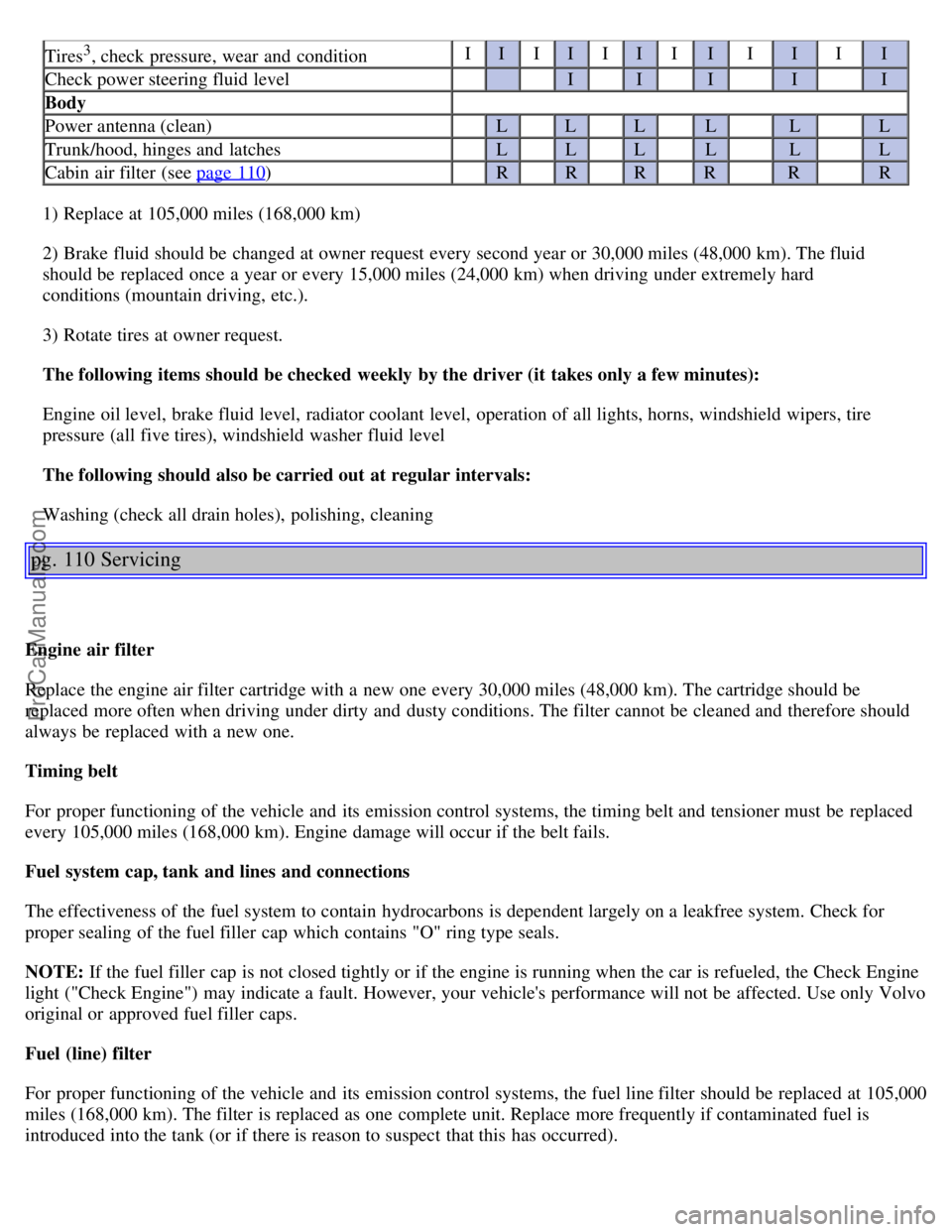
Tires3, check pressure, wear and conditionII II II I I I II I
Check power steering fluid level I I I I I
Body
Power antenna (clean) L L L L L L
Trunk/hood, hinges and latches L L L L L L
Cabin air filter (see page 110
) R R R R R R
1) Replace at 105,000 miles (168,000 km)
2) Brake fluid should be changed at owner request every second year or 30,000 miles (48,000 km). The fluid
should be replaced once a year or every 15,000 miles (24,000 km) when driving under extremely hard
conditions (mountain driving, etc.).
3) Rotate tires at owner request.
The following items should be checked weekly by the driver (it takes only a few minutes):
Engine oil level, brake fluid level, radiator coolant level, operation of all lights, horns, windshield wipers, tire
pressure (all five tires), windshield washer fluid level
The following should also be carried out at regular intervals:
Washing (check all drain holes), polishing, cleaning
pg. 110 Servicing
Engine air filter
Replace the engine air filter cartridge with a new one every 30,000 miles (48,000 km). The cartridge should be
replaced more often when driving under dirty and dusty conditions. The filter cannot be cleaned and therefore should
always be replaced with a new one.
Timing belt
For proper functioning of the vehicle and its emission control systems, the timing belt and tensioner must be replaced
every 105,000 miles (168,000 km). Engine damage will occur if the belt fails.
Fuel system cap, tank and lines and connections
The effectiveness of the fuel system to contain hydrocarbons is dependent largely on a leakfree system. Check for
proper sealing of the fuel filler cap which contains "O" ring type seals.
NOTE: If the fuel filler cap is not closed tightly or if the engine is running when the car is refueled, the Check Engine
light ("Check Engine") may indicate a fault. However, your vehicle's performance will not be affected. Use only Volvo
original or approved fuel filler caps.
Fuel (line) filter
For proper functioning of the vehicle and its emission control systems, the fuel line filter should be replaced at 105,000
miles (168,000 km). The filter is replaced as one complete unit. Replace more frequently if contaminated fuel is
introduced into the tank (or if there is reason to suspect that this has occurred).
ProCarManuals.com
Page 62 of 87
PCV system
The orifice nipple in the intake manifold and the filter at the end of the PCV hose in the air cleaner should be
inspected at 60,000 miles (96,000 km) and thereafter, at 30,000 mile (48,000 km) intervals.
Cabin air filter
Replace the cabin air filter with a new one according every 15,000 miles (24,000 km). Volvo recommends replacing
the filter more often if the car is driven under dirty and dusty conditions. The filter cannot be cleaned and therefore
should always be replaced with a new one.
pg. 111 Engine compartment
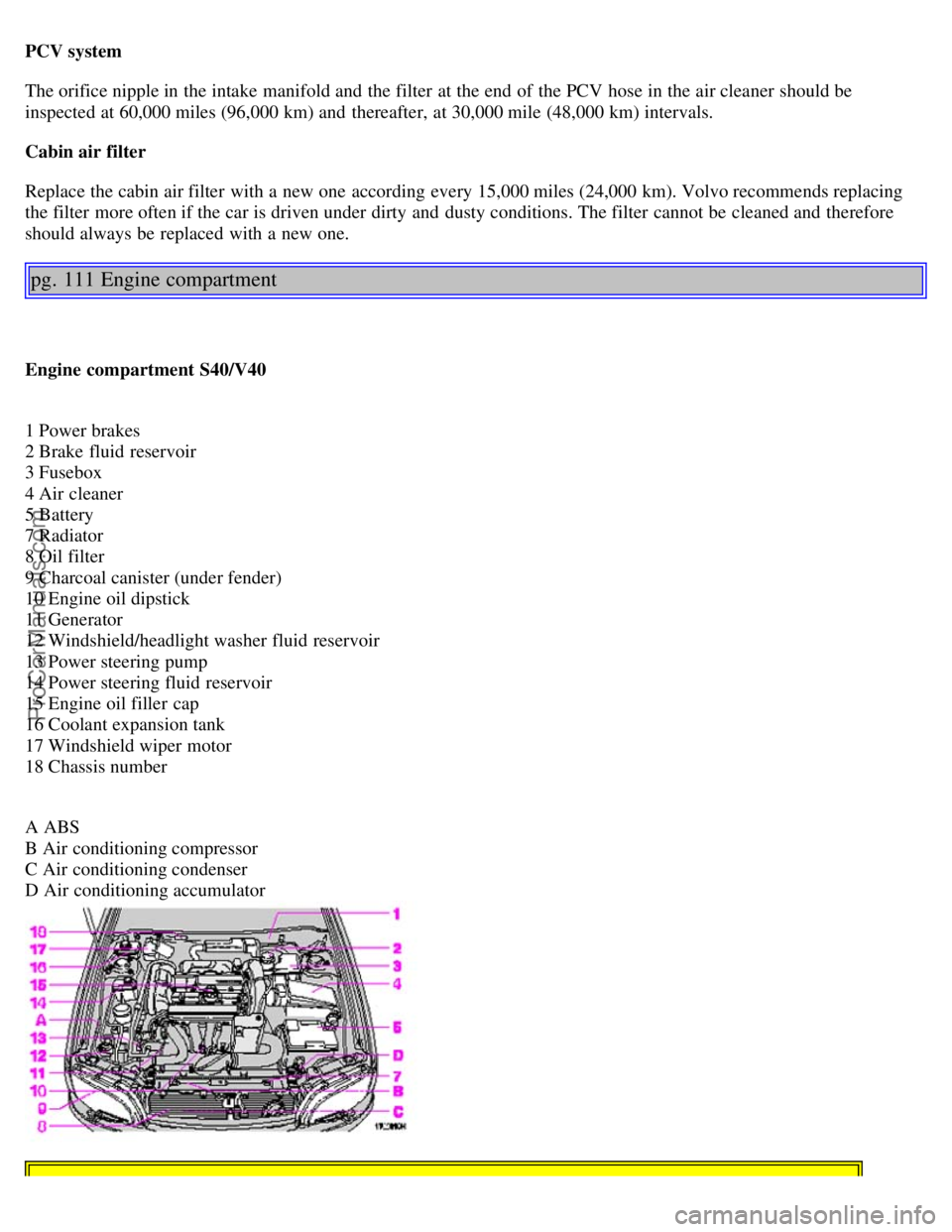
Engine compartment S40/V40
1 Power brakes
2 Brake fluid reservoir
3 Fusebox
4 Air cleaner
5 Battery
7 Radiator
8 Oil filter
9 Charcoal canister (under fender)
10 Engine oil dipstick
11 Generator
12 Windshield/headlight washer fluid reservoir
13 Power steering pump
14 Power steering fluid reservoir
15 Engine oil filler cap
16 Coolant expansion tank
17 Windshield wiper motor
18 Chassis number
A ABS
B Air conditioning compressor
C Air conditioning condenser
D Air conditioning accumulator
ProCarManuals.com
Page 66 of 87
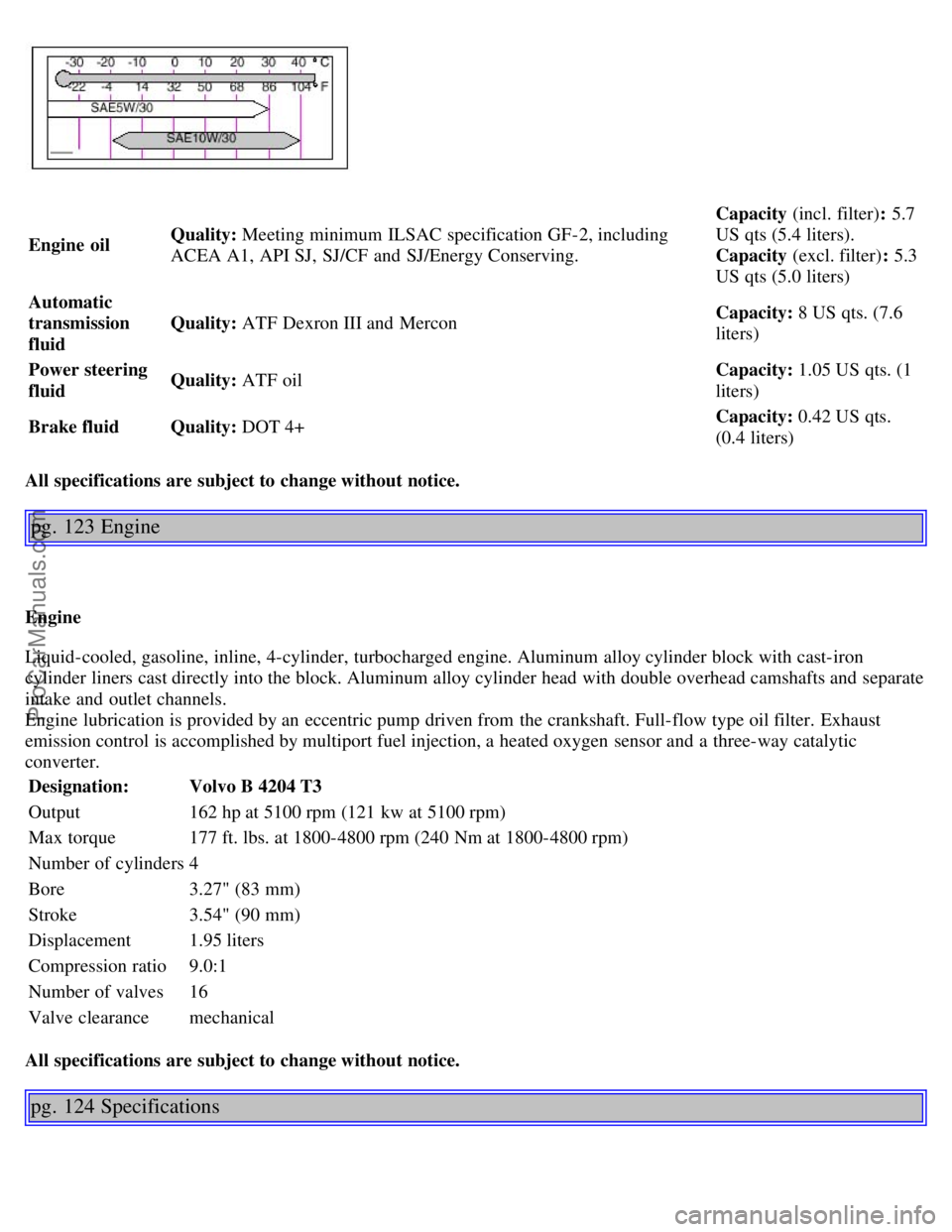
Engine oilQuality:
Meeting minimum ILSAC specification GF-2, including
ACEA A1, API SJ, SJ/CF and SJ/Energy Conserving. Capacity (incl. filter)
: 5.7
US qts (5.4 liters).
Capacity (excl. filter) : 5.3
US qts (5.0 liters)
Automatic
transmission
fluid Quality:
ATF Dexron III and Mercon Capacity:
8 US qts. (7.6
liters)
Power steering
fluid Quality:
ATF oil Capacity:
1.05 US qts. (1
liters)
Brake fluid Quality: DOT 4+ Capacity:
0.42 US qts.
(0.4 liters)
All specifications are subject to change without notice.
pg. 123 Engine
Engine
Liquid-cooled, gasoline, inline, 4-cylinder, turbocharged engine. Aluminum alloy cylinder block with cast-iron
cylinder liners cast directly into the block. Aluminum alloy cylinder head with double overhead camshafts and separate
intake and outlet channels.
Engine lubrication is provided by an eccentric pump driven from the crankshaft. Full-flow type oil filter. Exhaust
emission control is accomplished by multiport fuel injection, a heated oxygen sensor and a three-way catalytic
converter. Designation: Volvo B 4204 T3
Output 162 hp at 5100 rpm (121 kw at 5100 rpm)
Max torque 177 ft. lbs. at 1800-4800 rpm (240 Nm at 1800-4800 rpm)
Number of cylinders 4
Bore 3.27" (83 mm)
Stroke 3.54" (90 mm)
Displacement 1.95 liters
Compression ratio 9.0:1
Number of valves 16
Valve clearance mechanical
All specifications are subject to change without notice.
pg. 124 Specifications
ProCarManuals.com
Page 68 of 87
Toe-in measured on tire sides: 2.6 mm + - 0.8 mm
Rear suspension
Multilink individual rear wheel suspension with longitudinal support arms, double link arms and track rods.
Toe-in measured on the tire sides: 2.6 mm + - 0.8 mm
pg. 125 Specifications
Power transmission
Automatic transmission: AW 50-50
4speed automatic electronically controlled gearbox comprising a hydraulic torque converter with a lockup function;
planetary gear, integrated final drive.
Operation via a floor mounted gear selector lever. Drive shafts with symmetrical joint location. Overdrive.
Final drive ratio 2.76:1
Reduction ratios
1st gear 4.77:1
2nd gear 2.99:1
3rd gear 1.96:1
4th gear 1.32:1
5th gear 1.02:1
Reverse 3.23:1
Capacities
Fuel tank : 16 US gal. (60 liters)
Cooling system : 6 US qts. (5,7 liters)
Engine oil (incl. filter) : 5.7 US qts. ( 5.4 liters)
Engine oil (excl. filter) : 5.3 US qts. ( 5.0 liters)
Automatic transmission : 8 US qts (7.6 liters)
Power steering fluid : 1.05 US qts (1 liters)
Washer fluid reservoir : 3.9 US qts. (3.75 liters)
Brake system : 0.42 US qts (0.4 liters)
Vehicle loading
ProCarManuals.com