change wheel VOLVO V60 2012 Owner's Guide
[x] Cancel search | Manufacturer: VOLVO, Model Year: 2012, Model line: V60, Model: VOLVO V60 2012Pages: 400, PDF Size: 9.28 MB
Page 297 of 400
07 Wheels and tyres
General
07
* Option/accessory, for more information, see Introduction.295
Wear and maintenanceThe correct tyre pressure results in more even
wear, see page 301. Driving style, tyre pres-
sure, climate and road condition affect how
quickly your tyres age and wear. To avoid dif-
ferences in tread depth and to prevent wear
patterns arising, the front and rear wheels can
be switched with each other. A suitable dis-
tance for the first change is approx. 5000 km
and then at 10 000 km intervals. Volvo recom-
mends that you contact an authorised Volvo
workshop for checking if you are uncertain
about tread depth. If significant differences in
wear (>1 mm difference in tread depth)
between tyres have already occurred, the least
worn tyres must always be placed on the rear.
Understeer is normally easier to correct than
oversteer, and leads to the car continuing for-
wards in a straight line rather than having the
rear end skidding to one side, resulting in pos-
sible complete loss of control over the car. This
is why it is important for the rear wheels never
to lose grip before the front wheels.
Wheels should be stored lying down or hanging
up - and not standing up.
WARNING
A damaged tyre can lead to loss of control
of the car.
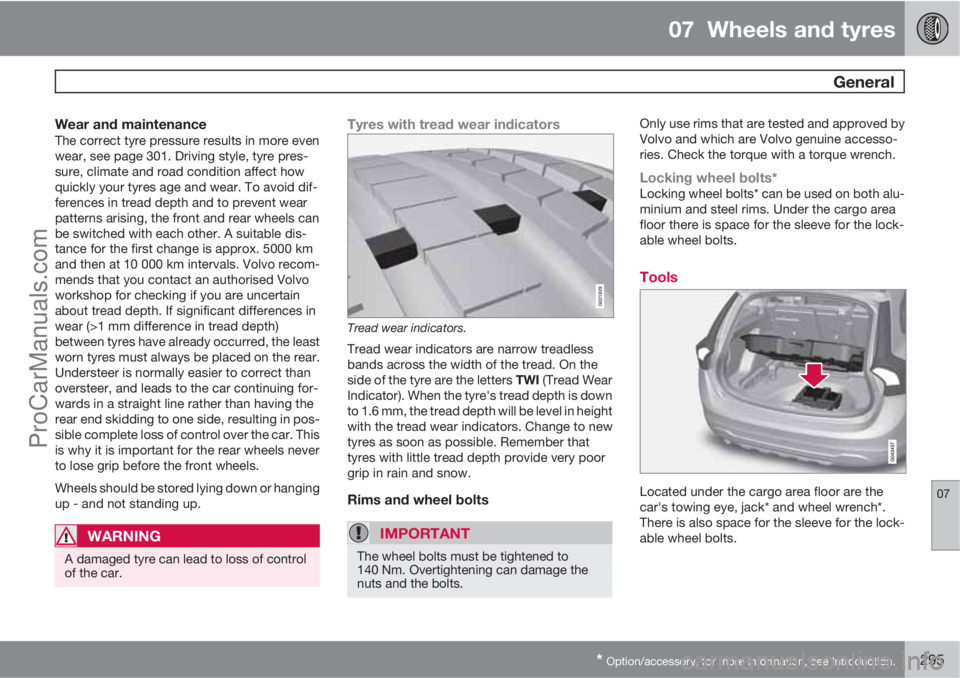
Tyres with tread wear indicators
G021829
Tread wear indicators.
Tread wear indicators are narrow treadless
bands across the width of the tread. On the
side of the tyre are the letters TWI (Tread Wear
Indicator). When the tyre's tread depth is down
to 1.6 mm, the tread depth will be level in height
with the tread wear indicators. Change to new
tyres as soon as possible. Remember that
tyres with little tread depth provide very poor
grip in rain and snow.
Rims and wheel bolts
IMPORTANT
The wheel bolts must be tightened to
140 Nm. Overtightening can damage the
nuts and the bolts.
Only use rims that are tested and approved by
Volvo and which are Volvo genuine accesso-
ries. Check the torque with a torque wrench.
Locking wheel bolts*Locking wheel bolts* can be used on both alu-
minium and steel rims. Under the cargo area
floor there is space for the sleeve for the lock-
able wheel bolts.
Tools
Located under the cargo area floor are the
car's towing eye, jack* and wheel wrench*.
There is also space for the sleeve for the lock-
able wheel bolts.
ProCarManuals.com
Page 303 of 400
07 Wheels and tyres
Tyre pressure
07
301
Tyre pressure
G021830
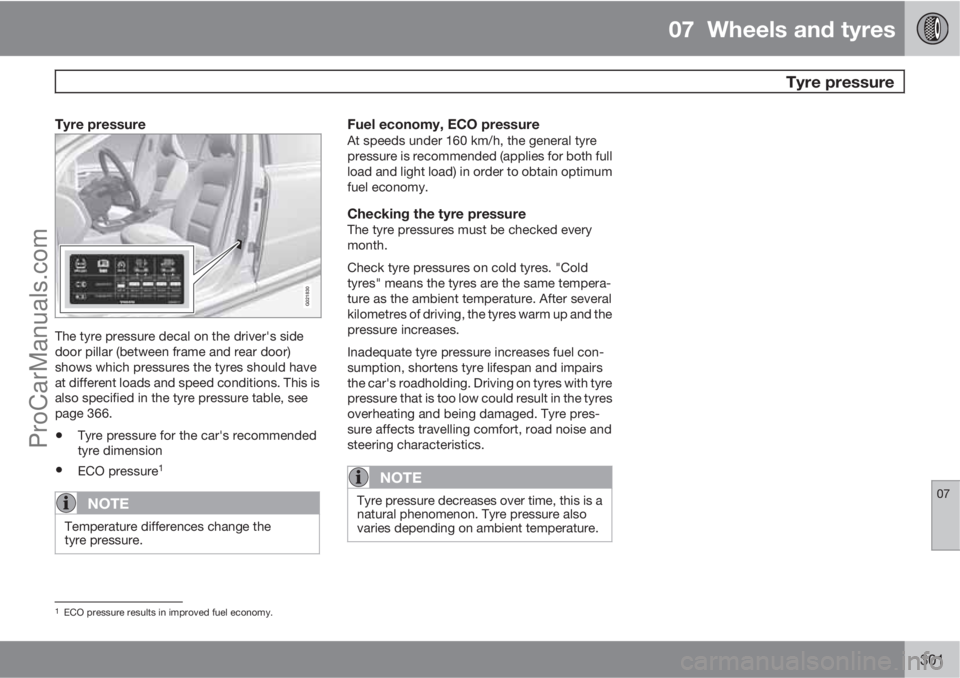
The tyre pressure decal on the driver's side
door pillar (between frame and rear door)
shows which pressures the tyres should have
at different loads and speed conditions. This is
also specified in the tyre pressure table, see
page 366.
•Tyre pressure for the car's recommended
tyre dimension
•ECO pressure1
NOTE
Temperature differences change the
tyre pressure.
Fuel economy, ECO pressureAt speeds under 160 km/h, the general tyre
pressure is recommended (applies for both full
load and light load) in order to obtain optimum
fuel economy.
Checking the tyre pressureThe tyre pressures must be checked every
month.
Check tyre pressures on cold tyres. "Cold
tyres" means the tyres are the same tempera-
ture as the ambient temperature. After several
kilometres of driving, the tyres warm up and the
pressure increases.
Inadequate tyre pressure increases fuel con-
sumption, shortens tyre lifespan and impairs
the car's roadholding. Driving on tyres with tyre
pressure that is too low could result in the tyres
overheating and being damaged. Tyre pres-
sure affects travelling comfort, road noise and
steering characteristics.
NOTE
Tyre pressure decreases over time, this is a
natural phenomenon. Tyre pressure also
varies depending on ambient temperature.
1ECO pressure results in improved fuel economy.
ProCarManuals.com
Page 306 of 400
07 Wheels and tyres
Tyre pressure monitoring (TPMS)*
07
304* Option/accessory, for more information, see Introduction.
>
A X is shown in the display if the system
is activated, the option disappears if the
system is deactivated.
Recommendations
•Volvo recommends that TPMS sensors are
fitted to all wheels on the car.
•Volvo recommends that sensors are not
moved between different wheels.
WARNING
When inflating a tyre equipped with TPMS,
hold the nozzle of the pump directly against
the valve to avoid damaging the valve.
Driveable punctured tyres*
If Self Supporting run flat Tyres (SST)* have
been selected then the car is also equipped
with TPMS.
This type of tyre has a specially reinforced side
wall that makes continued driving possible to
a limited extent despite the tyre losing all or
some of its pressure. These tyres are fitted on
a special rim. (Normal tyres can also be fitted
to this rim).
If an SST tyre loses tyre pressure then the yel-
low TPMS lamp on the instrument panel illumi-
nates and a message is shown in the text
panel. If this occurs, reduce speed tomax. 80 km/h. The tyre must be replaced as
soon as possible.
Drive carefully, in some cases it can be difficult
to see which tyre is faulty. In order to establish
which tyre needs attention, check all four tyres.
WARNING
SST tyres should only be fitted by individu-
als with expertise on SST tyres.
SST tyres must only be fitted together with
TPMS.
After a fault message on low tyre pressure
has been shown, do not drive faster than
80 km/h.
Maximum driving distance to tyre change is
80 km.
Avoid hard driving such as sudden braking
or turning.
SST tyres must be replaced if they are dam-
aged or punctured.
ProCarManuals.com
Page 318 of 400
08 Maintenance and service
Engine compartment
08
316
IMPORTANT
In the event of the message Oil level low
Refill 0,5 Ltr, only fill with 0.5 litres.
NOTE
The oil level is only detected by the system
during driving. The system cannot directly
detect changes when the oil is filled or
drained. The car must be driven
about 30 km before the oil level display is
correct.
WARNING
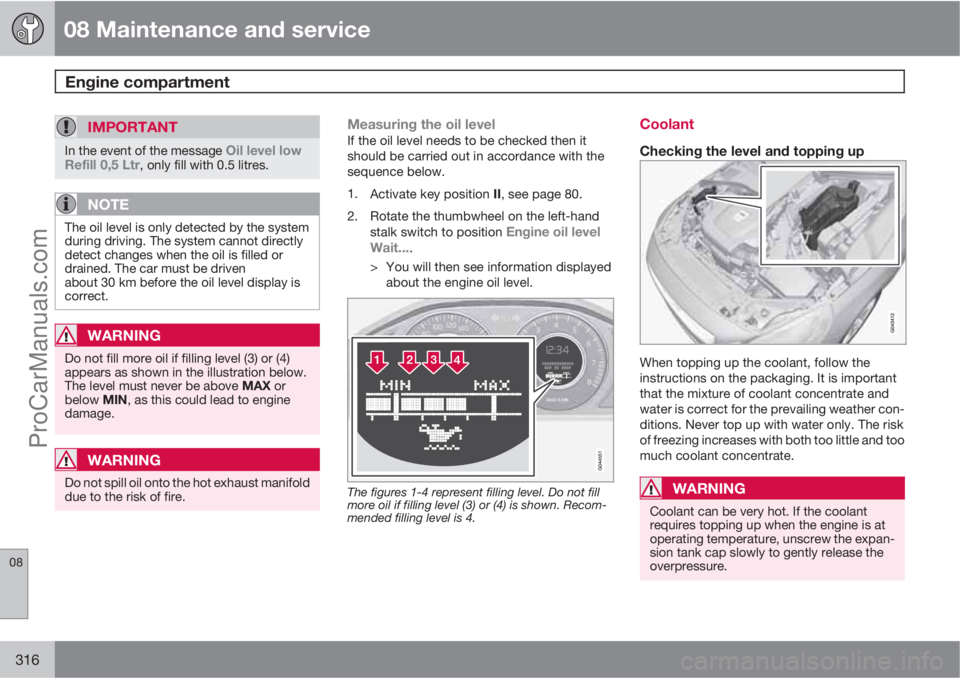
Do not fill more oil if filling level (3) or (4)
appears as shown in the illustration below.
The level must never be above MAX or
below MIN, as this could lead to engine
damage.
WARNING
Do not spill oil onto the hot exhaust manifold
due to the risk of fire.
Measuring the oil levelIf the oil level needs to be checked then it
should be carried out in accordance with the
sequence below.
1.
Activate key position II, see page 80.
2. Rotate the thumbwheel on the left-hand
stalk switch to position
Engine oil level
Wait....
> You will then see information displayed
about the engine oil level.
The figures 1-4 represent filling level. Do not fill
more oil if filling level (3) or (4) is shown. Recom-
mended filling level is 4.
Coolant
Checking the level and topping up
When topping up the coolant, follow the
instructions on the packaging. It is important
that the mixture of coolant concentrate and
water is correct for the prevailing weather con-
ditions. Never top up with water only. The risk
of freezing increases with both too little and too
much coolant concentrate.
WARNING
Coolant can be very hot. If the coolant
requires topping up when the engine is at
operating temperature, unscrew the expan-
sion tank cap slowly to gently release the
overpressure.
ProCarManuals.com