fuel consumption VOLVO V60 2013 User Guide
[x] Cancel search | Manufacturer: VOLVO, Model Year: 2013, Model line: V60, Model: VOLVO V60 2013Pages: 422, PDF Size: 9.59 MB
Page 332 of 422
09 Maintenance and service
Engine compartment 09
330
Volvo recommends Castrol oil products.
When driving under adverse conditions, see
page 378.
IMPORTANT
In order to fulfil the requirements for the
engine's service intervals all engines are
filled with a specially adapted synthetic
engine oil at the factory. The choice of oil
has been made very carefully with regard to
service life, starting characteristics, fuel
consumption and environmental impact.
An approved engine oil must be used in
order that the recommended service inter-
vals can be applied. Only use a prescribed
grade of oil for both filling and oil change,
otherwise you will risk affecting service life,
starting characteristics, fuel consumption
and environmental impact.
Volvo Car Corporation disclaims all war-
ranty liability if engine oil of the prescribed
grade and viscosity is not used.
Volvo recommends that oil changes are car-
ried out at an authorised Volvo workshop.
Volvo uses different systems for warning of
low/high oil level or low/high oil pressure. Cer-
tain variants have an oil pressure sensor, and
then the lamp for oil pressure is used. Other
variants have an oil level sensor, and then thedriver is informed via the warning symbol in the
centre of the instrument unit as well as by dis-
play texts. Certain models have both variants.
Contact a Volvo dealer for more information.
Change the engine oil and oil filter in accord-
ance with the intervals specified in the Service
and Warranty Booklet.
Using oil of a higher than specified grade is
permitted. If the car is driven in adverse con-
ditions, Volvo recommends using an oil of a
higher grade, see page 378.
For capacities,see page 379 and onwards.
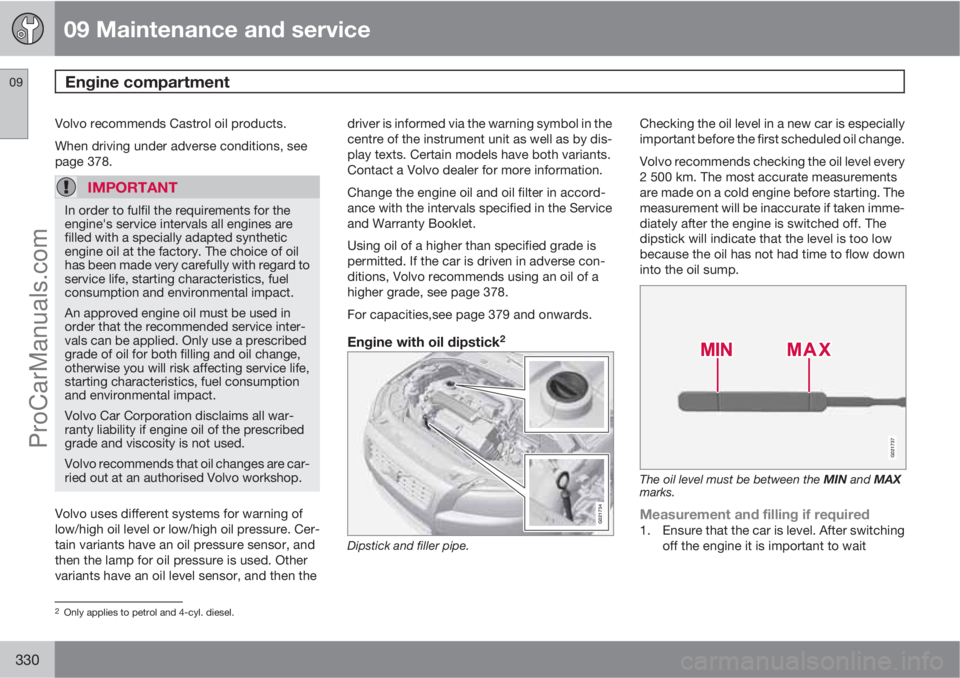
Engine with oil dipstick2
G021734
Dipstick and filler pipe.
Checking the oil level in a new car is especially
important before the first scheduled oil change.
Volvo recommends checking the oil level every
2 500 km. The most accurate measurements
are made on a cold engine before starting. The
measurement will be inaccurate if taken imme-
diately after the engine is switched off. The
dipstick will indicate that the level is too low
because the oil has not had time to flow down
into the oil sump.
G021737
The oil level must be between the MIN and MAX
marks.
Measurement and filling if required1. Ensure that the car is level. After switching
off the engine it is important to wait
2Only applies to petrol and 4-cyl. diesel.
ProCarManuals.com
Page 350 of 422

09 Maintenance and service
Battery 09
348
NOTE
•The higher the current take-off in the car
(extra cooling/heating, etc.) the more
the batteries must be charged =
increased fuel consumption.
•When the capacity of the battery has
fallen below the lowest permissible level
then the Start/Stop function is disen-
gaged.
Temporarily reduced Start/Stop function due
to high current take-off means:
•The engine starts automatically2 without
the driver depressing the clutch pedal
(manual gearbox).
•The engine starts automatically without the
driver lifting his/her foot off the foot brake
pedal (automatic gearbox).
Location of the batteries
A: Left-hand drive car. B: Right-hand drive car. 1.
Battery for starting3 2. Support battery.
The support battery normally requires no more
service than the normal battery that is used for
starting. A workshop should be contacted in
the event of questions or problems - an author-
ised Volvo workshop is recommended.
IMPORTANT
If the following instruction is not observed
then the Start/Stop function may temporar-
ily cease to work after the connection of an
external battery or battery charger:
•The negative battery terminal on the
car's main battery must never be used
for connecting an external battery or
battery charger - only the car chassis
may be used as the grounding point.
See the section "Start assistance" - for a
description of how the cable clamps must
be attached.
2Automatic starting can only take place if the gear lever is in neutral position.3The battery for starting is described in detail on page 345.
ProCarManuals.com
Page 380 of 422
10 Specifications
Engine oil
10
378
Adverse driving conditions
Adverse driving conditions can lead to abnor-
mally high oil temperature or oil consumption.
Below are some examples of adverse driving
conditions.
Check the oil level more frequently for long
journeys:
•towing a caravan or trailer
•in mountainous regions
•at high speeds
•in temperatures colder than -30 °C or hot-
ter than +40 °C
The above also apply to shorter driving dis-
tances at low temperatures.Choose a fully synthetic engine oil for adverse
driving conditions. It provides extra protection
for the engine.
Volvo recommends Castrol oil products.
IMPORTANT
In order to fulfil the requirements for the
engine's service intervals all engines are
filled with a specially adapted synthetic
engine oil at the factory. The choice of oil
has been made very carefully with regard to
service life, starting characteristics, fuel
consumption and environmental impact.
An approved engine oil must be used in
order that the recommended service inter-
vals can be applied. Only use a prescribed
grade of oil for both filling and oil change,
otherwise you will risk affecting service life,
starting characteristics, fuel consumption
and environmental impact.
Volvo Car Corporation disclaims all war-
ranty liability if engine oil of the prescribed
grade and viscosity is not used.
Volvo recommends that oil changes are car-
ried out at an authorised Volvo workshop.
ProCarManuals.com
Page 386 of 422
10 Specifications
Fuel
10
384
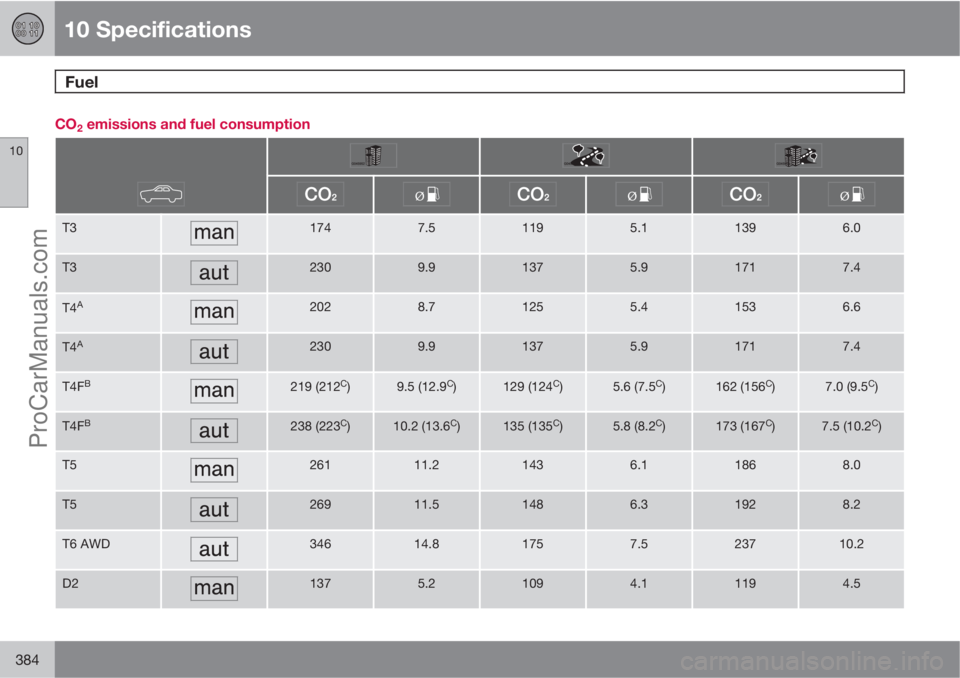
CO2 emissions and fuel consumption
T31747.51195.11396.0
T32309.91375.91717.4
T4A2028.71255.41536.6
T4A2309.91375.91717.4
T4FB219 (212C)9.5 (12.9C)129 (124C)5.6 (7.5C)162 (156C)7.0 (9.5C)
T4FB238 (223C)10.2 (13.6C)135 (135C)5.8 (8.2C)173 (167C)7.5 (10.2C)
T526111.21436.11868.0
T526911.51486.31928.2
T6 AWD34614.81757.523710.2
D21375.21094.11194.5
ProCarManuals.com
Page 388 of 422
10 Specifications
Fuel
10
386
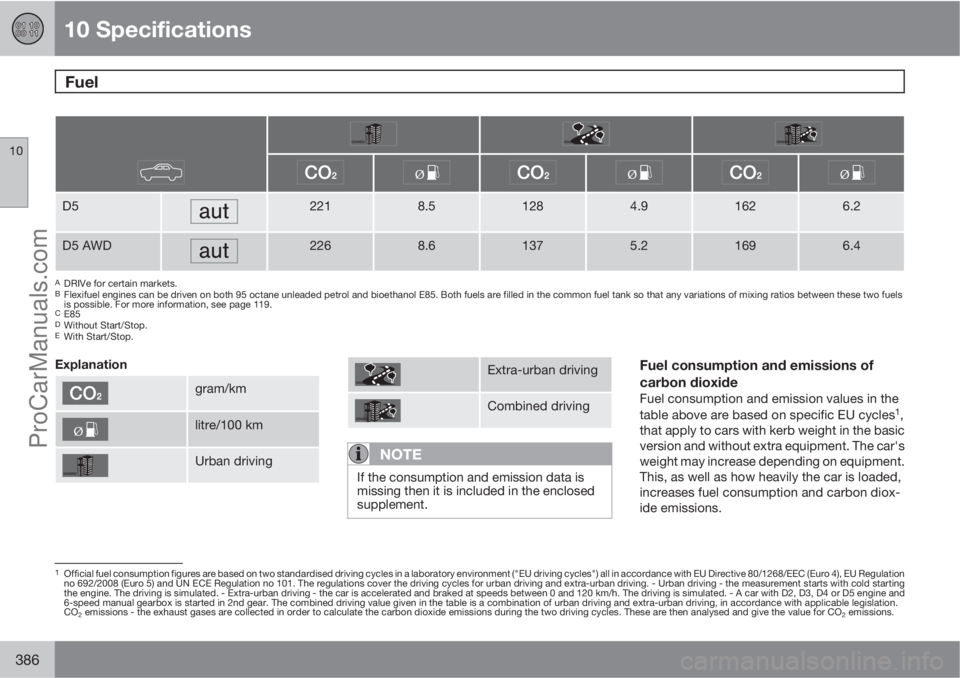
D52218.51284.91626.2
D5 AWD2268.61375.21696.4
ADRIVe for certain markets.BFlexifuel engines can be driven on both 95 octane unleaded petrol and bioethanol E85. Both fuels are filled in the common fuel tank so that any variations of mixing ratios between these two fuels
is possible. For more information, see page 119.
CE85DWithout Start/Stop.EWith Start/Stop.
Explanation
gram/km
litre/100 km
Urban driving
Extra-urban driving
Combined driving
NOTE
If the consumption and emission data is
missing then it is included in the enclosed
supplement.
Fuel consumption and emissions of
carbon dioxide
Fuel consumption and emission values in the
table above are based on specific EU cycles1,
that apply to cars with kerb weight in the basic
version and without extra equipment. The car's
weight may increase depending on equipment.
This, as well as how heavily the car is loaded,
increases fuel consumption and carbon diox-
ide emissions.
1Official fuel consumption figures are based on two standardised driving cycles in a laboratory environment ("EU driving cycles") all in accordance with EU Directive 80/1268/EEC (Euro 4), EU Regulation
no 692/2008 (Euro 5) and UN ECE Regulation no 101. The regulations cover the driving cycles for urban driving and extra-urban driving. - Urban driving - the measurement starts with cold starting
the engine. The driving is simulated. - Extra-urban driving - the car is accelerated and braked at speeds between 0 and 120 km/h. The driving is simulated. - A car with D2, D3, D4 or D5 engine and
6-speed manual gearbox is started in 2nd gear. The combined driving value given in the table is a combination of urban driving and extra-urban driving, in accordance with applicable legislation.
CO
2 emissions - the exhaust gases are collected in order to calculate the carbon dioxide emissions during the two driving cycles. These are then analysed and give the value for CO2 emissions.
ProCarManuals.com
Page 389 of 422
10 Specifications
Fuel
10
387
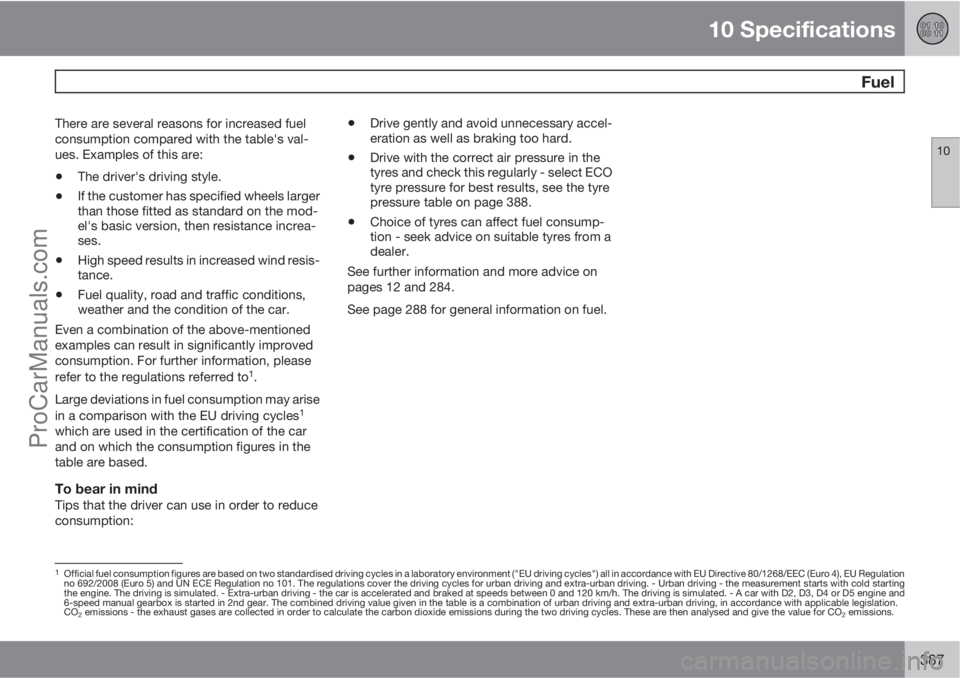
There are several reasons for increased fuel
consumption compared with the table's val-
ues. Examples of this are:
•The driver's driving style.
•If the customer has specified wheels larger
than those fitted as standard on the mod-
el's basic version, then resistance increa-
ses.
•High speed results in increased wind resis-
tance.
•Fuel quality, road and traffic conditions,
weather and the condition of the car.
Even a combination of the above-mentioned
examples can result in significantly improved
consumption. For further information, please
refer to the regulations referred to
1.
Large deviations in fuel consumption may arise
in a comparison with the EU driving cycles
1
which are used in the certification of the car
and on which the consumption figures in the
table are based.
To bear in mindTips that the driver can use in order to reduce
consumption:
•Drive gently and avoid unnecessary accel-
eration as well as braking too hard.
•Drive with the correct air pressure in the
tyres and check this regularly - select ECO
tyre pressure for best results, see the tyre
pressure table on page 388.
•Choice of tyres can affect fuel consump-
tion - seek advice on suitable tyres from a
dealer.
See further information and more advice on
pages 12 and 284.
See page 288 for general information on fuel.
1Official fuel consumption figures are based on two standardised driving cycles in a laboratory environment ("EU driving cycles") all in accordance with EU Directive 80/1268/EEC (Euro 4), EU Regulation
no 692/2008 (Euro 5) and UN ECE Regulation no 101. The regulations cover the driving cycles for urban driving and extra-urban driving. - Urban driving - the measurement starts with cold starting
the engine. The driving is simulated. - Extra-urban driving - the car is accelerated and braked at speeds between 0 and 120 km/h. The driving is simulated. - A car with D2, D3, D4 or D5 engine and
6-speed manual gearbox is started in 2nd gear. The combined driving value given in the table is a combination of urban driving and extra-urban driving, in accordance with applicable legislation.
CO
2 emissions - the exhaust gases are collected in order to calculate the carbon dioxide emissions during the two driving cycles. These are then analysed and give the value for CO2 emissions.
ProCarManuals.com
Page 413 of 422
11 Alphabetical Index
11
411
ECO pressure.......................................... 317
Eco Start/Stop DRIVe.............................. 127
Electrical socket......................................229
cargo area........................................... 293
front seat............................................. 229
Electric parking brake.............................. 137
low battery voltage.............................137
releasing automatically....................... 138
releasing manually.............................. 138
Emergency equipment
warning triangle.................................. 318
Emergency puncture repair..................... 321
Emissions of carbon dioxide................... 291
Engine
overheating......................................... 298
starting................................................ 113
Engine block heater................................. 118
fuel-driven........................................... 220
Engine compartment
coolant................................................ 332
oil........................................................ 329
overview.............................................. 329
power steering fluid............................ 334
Engine drag control ................................146Engine oil.........................................329, 378
adverse driving conditions.................. 378
capacities........................................... 378
filter..................................................... 329
oil grade.............................................. 378
Engine specifications............................... 376
Environmental labelling, FSC, owner's
manual.......................................................12
Error messages
Adaptive Cruise Control..................... 162
Driver Alert Control............................. 183
Lane Departure Warning..................... 186
see Messages and symbols.......139, 162
Error messages in BLIS........................... 196
Error messages in Distance Alert............ 167
ERS - Remote Start................................. 114
ETC, electronic temperature control ....... 214
Expectant mothers, seatbelt...................... 17
External dimensions................................372
F
Fan........................................................... 215
Fault tracing for the camera sensor. 170, 178First aid equipment.................................. 318
First aid kit .............................................. 318
Flexifuel.................................................... 118
adaptation........................................... 119
Fluids, capacities..................................... 381
Fluids and oils.......................................... 381
Fog lamps
rear........................................................ 91
Foot brake............................................... 135
FOUR-C – Active chassis........................226
FSC, environmental labelling..................... 12
Fuel.......................................................... 288
fuel consumption................................ 384
fuel economy...................................... 317
fuel filter.............................................. 290
Fuse box.................................................. 350
glovebox............................................. 355
Fuses.......................................................350
box in cargo area................................ 358
changing............................................. 350
cold zone............................................ 359
general................................................ 350
relay/fuse box in engine compartment 351
Start/Stop........................................... 359
ProCarManuals.com