weight VOLVO V60 2013 User Guide
[x] Cancel search | Manufacturer: VOLVO, Model Year: 2013, Model line: V60, Model: VOLVO V60 2013Pages: 422, PDF Size: 9.59 MB
Page 293 of 422
07 During your journey
Fuel
07
291 Fuel consumption and emissions of
carbon dioxide
Fuel consumption figures may change if the car
is equipped with extra equipment that affects
the car's weight. See information on weights
page 373 and table page 384.
The manner in which the car is driven, and
other non-technical factors can also affect fuel
consumption.
Consumption is higher and power output lower
for fuel with an octane rating of 91 RON.
NOTE
Extreme weather conditions, driving with a
trailer or driving at high altitudes in combi-
nation with fuel grade are factors that could
affect the car's performance.
ProCarManuals.com
Page 294 of 422

07 During your journey
Loading
07
292
General information on loading
Payload depends on the car's kerb weight. The
total of the weight of the passengers and all
accessories reduces the car's payload by a
corresponding weight. For more detailed infor-
mation on weights, see page 373.
The tailgate is opened via a button on
the lighting panel or the remote con-
trol key, see page 59.
WARNING
The car's driving characteristics change
depending on the weight and distribution of
the load.
To bear in mind when loading
•Position the load firmly against the rear
seat's backrest.
Note that objects must not prevent the function
of the WHIPS system for the front seats if any
of the rear seat's backrests is folded down,see
page 27.
•Centre the load.
•Heavy objects should be placed as low as
possible. Avoid placing heavy loads on
lowered backrests.
•Cover sharp edges with something soft to
avoid damaging the upholstery.
•Secure all loads to the load retaining eye-
lets with straps or web lashings.
WARNING
A loose object weighing 20 kg can, in a
frontal collision at a speed of 50 km/h, carry
the impact of an item weighing 1000 kg.
WARNING
The protection provided by the inflatable
curtain in the headlining may be compro-
mised or eliminated by high loads.
•Never load cargo above the backrest.
WARNING
Always secure the load. During heavy brak-
ing the load may otherwise shift, causing
injury to the car's occupants.
Cover sharp edges and sharp corners with
something soft.
Switch off the engine and apply the parking
brake when loading/unloading long items.
Otherwise you may accidentally knock the
gear lever or gear selector with the load into
a drive position - and the car could then
move off.
Front seat
The passenger seat backrest can also be
folded for an extra long load, see page 80.
Roof load
Using load carriersTo avoid damaging the car and for maximum
possible safety while driving, the load carriers
designed by Volvo are recommended.
Carefully follow the installation instructions
supplied with the carriers.
•Check periodically that the load carriers
and load are properly secured. Lash the
load securely with retaining straps.
•Distribute the load evenly over the load
carriers. Put the heaviest objects at the
bottom.
•The size of the area exposed to the wind,
and therefore fuel consumption, increase
with the size of the load.
•Drive gently. Avoid quick acceleration,
heavy braking and hard cornering.
WARNING
The car's centre of gravity and driving cha-
racteristics are altered by roof loads. For
information on maximum permitted roof
load, including load carriers and any space
box, see page 373.
ProCarManuals.com
Page 300 of 422
07 During your journey
Driving with a trailer
07
298* Option/accessory, for more information, see Introduction.
General
Payload depends on the car's kerb weight. The
total of the weight of the passengers and all
accessories, e.g. towbar, reduces the car's
payload by a corresponding weight. For more
detailed information on weights, see
page 373.
If the towing bracket is mounted by Volvo, then
the car is delivered with the necessary equip-
ment for driving with a trailer.
•The car's towing bracket must be of an
approved type.
•If the towbar is retrofitted, check with your
Volvo dealer that the car is fully equipped
for driving with a trailer.
•Distribute the load on the trailer so that the
weight on the towing bracket complies
with the specified maximum towball load.
•Increase the tyre pressure to the recom-
mended pressure for a full load. For tyre
pressure label location, see page 317.
•The engine is loaded more heavily than
usual when driving with a trailer.
•Do not tow a heavy trailer when the car is
brand new. Wait until it has been driven at
least 1000 km.
•The brakes are loaded much more than
usual on long and steep downhill slopes.
Downshift to a lower gear and adjust your
speed.
•For safety reasons, the maximum permit-
ted speed for the car when coupled with a
trailer should not be exceeded. Follow the
regulations in force for the permitted
speeds and weights.
•Maintain a low speed when driving with a
trailer up long, steep ascents.
•Avoid driving with a trailer on inclines of
more than 12%.
Trailer cableAn adapter is required if the car's towing
bracket has 13 pin electrics and the trailer has
7 pin electrics. Use an adapter cable approved
by Volvo. Make sure the cable does not drag
on the ground.
Direction indicators and brake lights on
the trailer
If any of the trailer's lamps for direction indica-
tors are broken, then the combined instrument
panel's symbol for direction indicators flashes
faster than normal and the display shows the
text
Bulb fail - Ind. signal trailer.
If any of the trailer's lamps for the brake light
are broken then the
Bulb fail - Stop lamp
trailer text is shown.
Level control*The rear shock absorbers maintain a constant
height irrespective of the car's load (up to the
maximum permissible weight). When the car isstationary the rear of the car lowers slightly,
which is normal.
Trailer weightsFor information on Volvo's permitted trailer
weights, see page 374.
NOTE
The stated maximum permitted trailer
weights are those permitted by Volvo.
National vehicle regulations can further limit
trailer weights and speeds. Towbars can be
certified for higher towing weights than the
car can actually tow.
WARNING
Follow the stated recommendations for
trailer weights. Otherwise, the car and trailer
may be difficult to control in the event of
sudden movement and braking.
Manual gearbox
OverheatingWhen driving with a trailer in hilly terrain in a hot
climate there may be a risk of overheating.
•Do not run the engine at higher revolutions
than 4500 rpm (diesel engines: 3500 rpm)
- otherwise the oil temperature may
become too high.
ProCarManuals.com
Page 315 of 422
08 Wheels and tyres
General
08
313
16Rim diameter in
inches
50Off-set in mm (dis-
tance from wheel
centre to wheel con-
tact surface against
the hub)
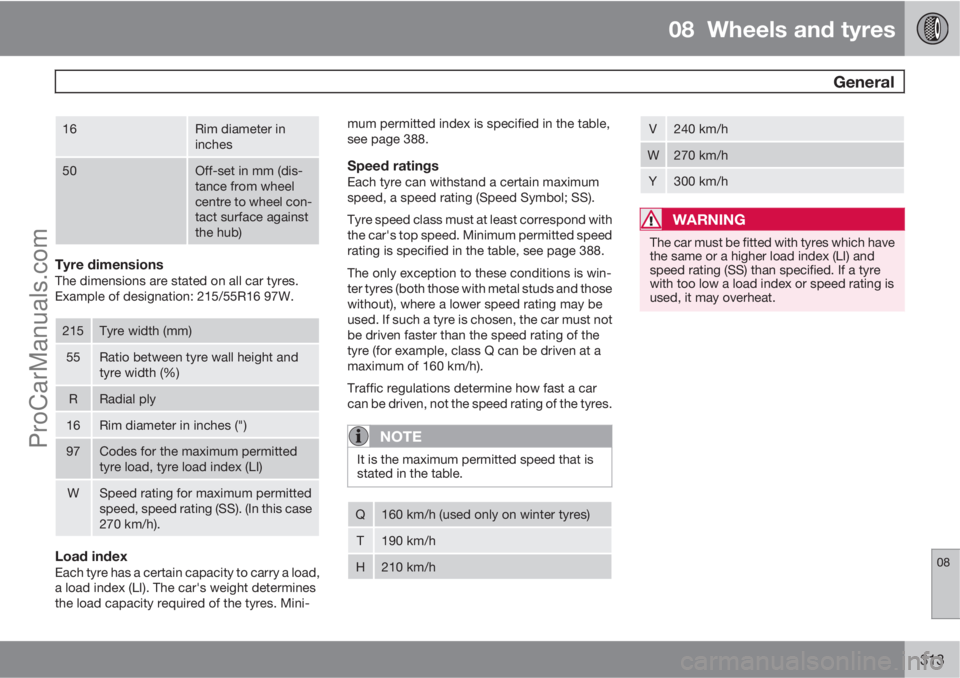
Tyre dimensionsThe dimensions are stated on all car tyres.
Example of designation: 215/55R16 97W.
215Tyre width (mm)
55Ratio between tyre wall height and
tyre width (%)
RRadial ply
16Rim diameter in inches (")
97Codes for the maximum permitted
tyre load, tyre load index (LI)
WSpeed rating for maximum permitted
speed, speed rating (SS). (In this case
270 km/h).
Load indexEach tyre has a certain capacity to carry a load,
a load index (LI). The car's weight determines
the load capacity required of the tyres. Mini-mum permitted index is specified in the table,
see page 388.
Speed ratingsEach tyre can withstand a certain maximum
speed, a speed rating (Speed Symbol; SS).
Tyre speed class must at least correspond with
the car's top speed. Minimum permitted speed
rating is specified in the table, see page 388.
The only exception to these conditions is win-
ter tyres (both those with metal studs and those
without), where a lower speed rating may be
used. If such a tyre is chosen, the car must not
be driven faster than the speed rating of the
tyre (for example, class Q can be driven at a
maximum of 160 km/h).
Traffic regulations determine how fast a car
can be driven, not the speed rating of the tyres.
NOTE
It is the maximum permitted speed that is
stated in the table.
Q160 km/h (used only on winter tyres)
T190 km/h
H210 km/h
V240 km/h
W270 km/h
Y300 km/h
WARNING
The car must be fitted with tyres which have
the same or a higher load index (LI) and
speed rating (SS) than specified. If a tyre
with too low a load index or speed rating is
used, it may overheat.
ProCarManuals.com
Page 370 of 422
368
Type designations................................................................................. 370
Dimensions and weights....................................................................... 372
Engine specifications............................................................................ 376
Engine oil............................................................................................... 378
Fluids and lubricants............................................................................. 381
Fuel....................................................................................................... 384
Wheel and tyres, dimensions and pressure ......................................... 388
Electrical system................................................................................... 391
Type approval....................................................................................... 392
Symbols in the display.......................................................................... 404
ProCarManuals.com
Page 373 of 422
10 Specifications
Type designations
10
371
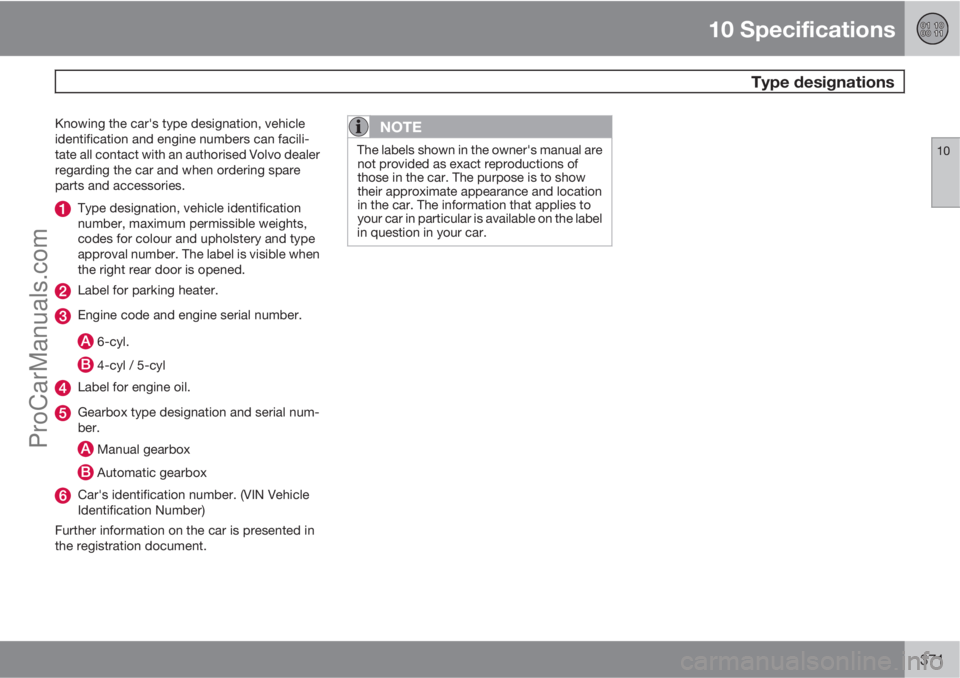
Knowing the car's type designation, vehicle
identification and engine numbers can facili-
tate all contact with an authorised Volvo dealer
regarding the car and when ordering spare
parts and accessories.
Type designation, vehicle identification
number, maximum permissible weights,
codes for colour and upholstery and type
approval number. The label is visible when
the right rear door is opened.
Label for parking heater.
Engine code and engine serial number.
6-cyl.
4-cyl / 5-cyl
Label for engine oil.
Gearbox type designation and serial num-
ber.
Manual gearbox
Automatic gearbox
Car's identification number. (VIN Vehicle
Identification Number)
Further information on the car is presented in
the registration document.
NOTE
The labels shown in the owner's manual are
not provided as exact reproductions of
those in the car. The purpose is to show
their approximate appearance and location
in the car. The information that applies to
your car in particular is available on the label
in question in your car.
ProCarManuals.com
Page 374 of 422
10 Specifications
Dimensions and weights
10
372
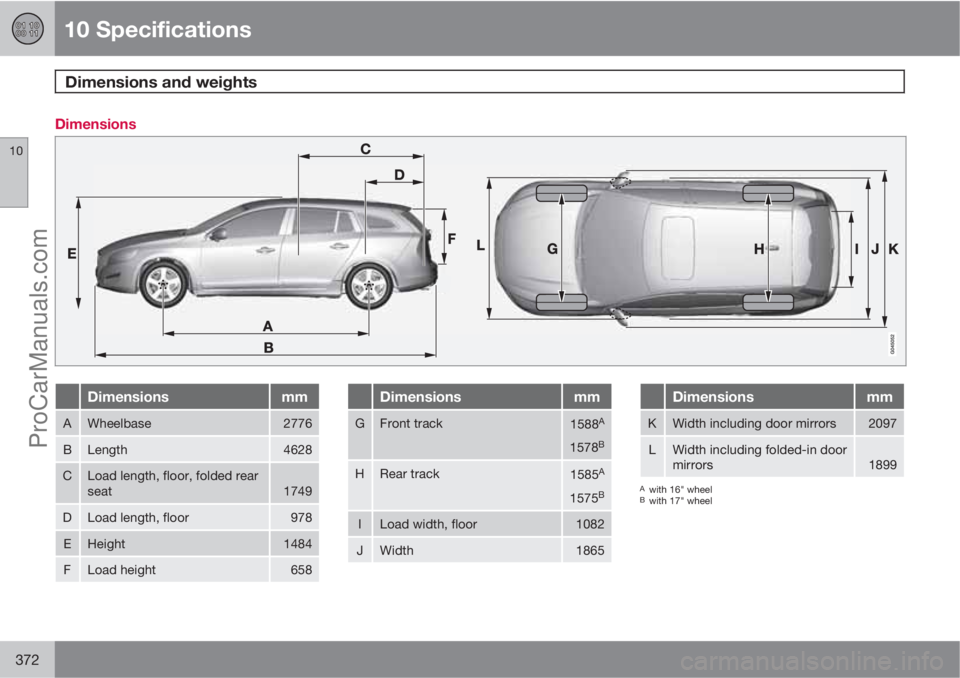
Dimensions
Dimensionsmm
AWheelbase2776
BLength4628
CLoad length, floor, folded rear
seat1749
DLoad length, floor978
EHeight1484
FLoad height658
Dimensionsmm
GFront track1588A
1578B
HRear track1585A
1575B
ILoad width, floor1082
JWidth1865
Dimensionsmm
KWidth including door mirrors2097
LWidth including folded-in door
mirrors1899
Awith 16" wheelBwith 17" wheel
ProCarManuals.com
Page 375 of 422

10 Specifications
Dimensions and weights
10
373 Weights
Kerb weight includes the driver, the fuel tank
90% full and all fluids.
The weight of passengers and accessories,
and towball load (when a trailer is hitched, see
table page 374) influences the payload and is
not included in the kerb weight.
Permitted max. load = Gross vehicle weight -
Kerb weight.
NOTE
The documented kerb weight applies to
cars in the standard version - i.e. a car with-
out extra equipment or accessories. This
means that for every accessory added the
loading capacity of the car is reduced cor-
respondingly by the weight of the acces-
sory.
Examples of accessories that reduce load-
ing capacity are the Kinetic/Momentum/
Summum equipment levels, as well as other
accessories such as Towbar, Load carriers,
Space box, Audio system, Auxiliary lamps,
GPS, Fuel-driven heater, Safety grille, Car-
pets, Cargo cover, Power seats, etc.
Weighing the car is a certain way of ascer-
taining the kerb weight of your own partic-
ular car.
WARNING
The car's driving characteristics change
depending on how heavily it is loaded and
how the load is distributed.
For information on decal location, see page 370.
Max. gross vehicle weight
Max. train weight (car+trailer)
Max. front axle load
Max. rear axle load
Equipment level
Max. load: See registration document.
Max. roof load: 75 kg.
ProCarManuals.com
Page 376 of 422
10 Specifications
Dimensions and weights
10
374
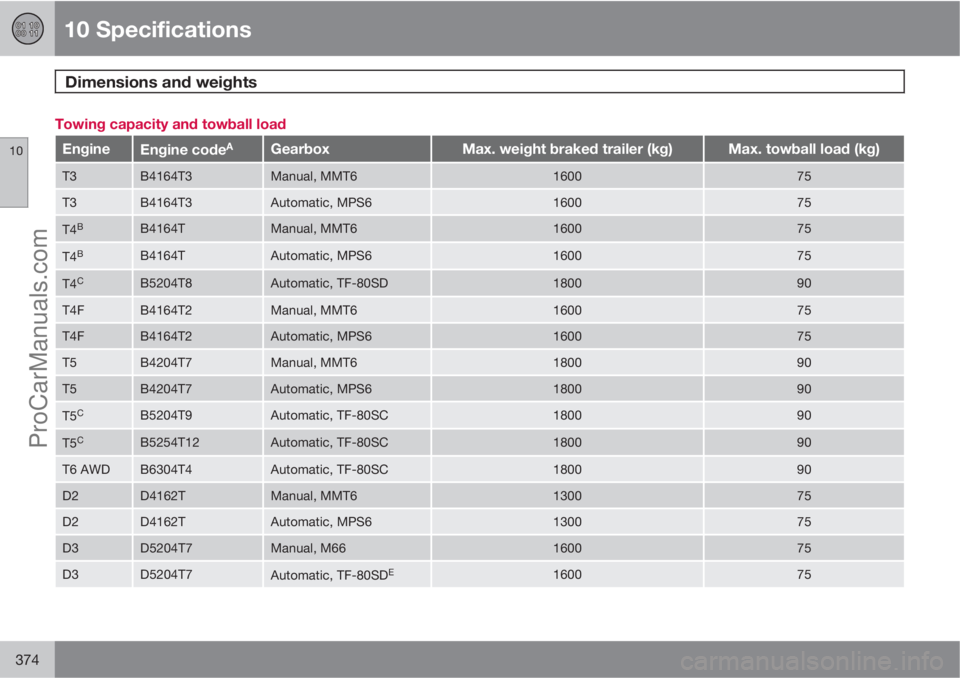
Towing capacity and towball load
EngineEngine codeAGearboxMax. weight braked trailer (kg)Max. towball load (kg)
T3B4164T3Manual, MMT6160075
T3B4164T3Automatic, MPS6160075
T4BB4164TManual, MMT6160075
T4BB4164TAutomatic, MPS6160075
T4CB5204T8Automatic, TF-80SD180090
T4FB4164T2Manual, MMT6160075
T4FB4164T2Automatic, MPS6160075
T5B4204T7Manual, MMT6180090
T5B4204T7Automatic, MPS6180090
T5CB5204T9Automatic, TF-80SC180090
T5CB5254T12Automatic, TF-80SC180090
T6 AWDB6304T4Automatic, TF-80SC180090
D2D4162TManual, MMT6130075
D2D4162TAutomatic, MPS6130075
D3D5204T7Manual, M66160075
D3D5204T7Automatic, TF-80SDE160075
ProCarManuals.com
Page 377 of 422
10 Specifications
Dimensions and weights
10
375
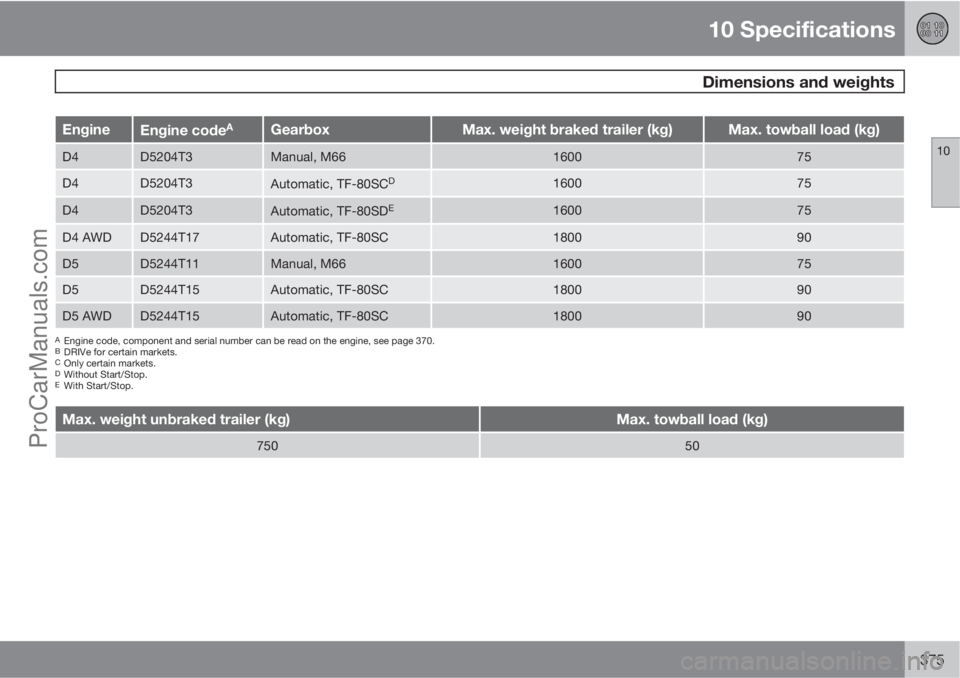
EngineEngine codeAGearboxMax. weight braked trailer (kg)Max. towball load (kg)
D4D5204T3Manual, M66160075
D4D5204T3Automatic, TF-80SCD160075
D4D5204T3Automatic, TF-80SDE160075
D4 AWDD5244T17Automatic, TF-80SC180090
D5D5244T11Manual, M66160075
D5D5244T15Automatic, TF-80SC180090
D5 AWDD5244T15Automatic, TF-80SC180090
AEngine code, component and serial number can be read on the engine, see page 370.BDRIVe for certain markets.COnly certain markets.DWithout Start/Stop.EWith Start/Stop.
Max. weight unbraked trailer (kg)Max. towball load (kg)
75050
ProCarManuals.com