refuelling VOLVO V60 2013 Owners Manual
[x] Cancel search | Manufacturer: VOLVO, Model Year: 2013, Model line: V60, Model: VOLVO V60 2013Pages: 422, PDF Size: 9.59 MB
Page 6 of 422
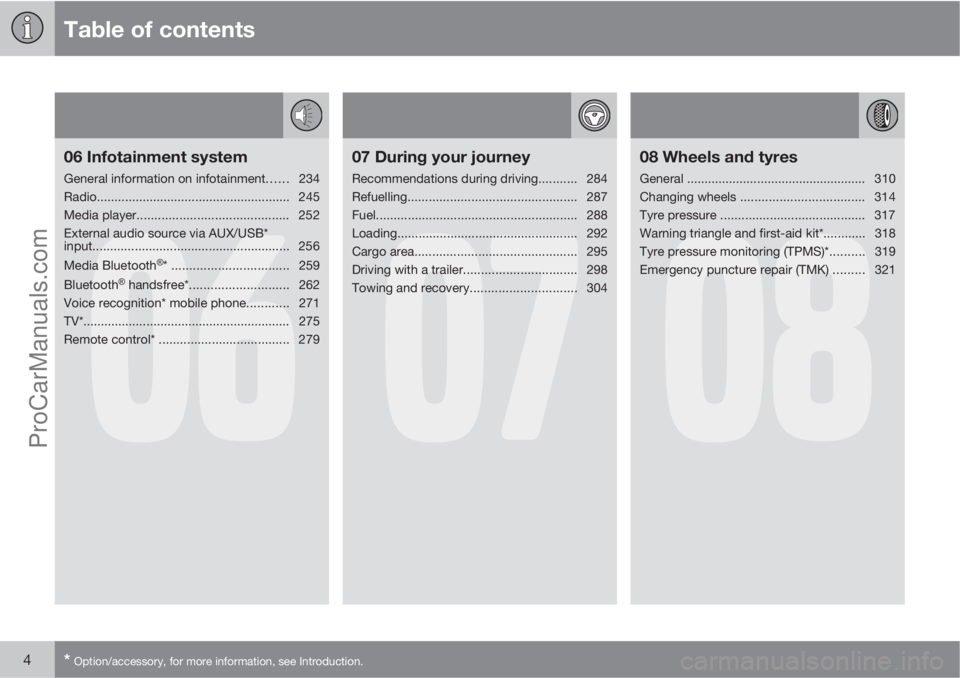
Table of contents
4* Option/accessory, for more information, see Introduction.
06
06 Infotainment system
General information on infotainment...... 234
Radio....................................................... 245
Media player........................................... 252
External audio source via AUX/USB*
input........................................................ 256
Media Bluetooth
Ÿ* ................................. 259
BluetoothŸ handsfree*............................262
Voice recognition* mobile phone............ 271
TV*........................................................... 275
Remote control* ..................................... 279
07
07 During your journey
Recommendations during driving........... 284
Refuelling................................................ 287
Fuel......................................................... 288
Loading................................................... 292
Cargo area.............................................. 295
Driving with a trailer................................298
Towing and recovery.............................. 304
08
08 Wheels and tyres
General ................................................... 310
Changing wheels ................................... 314
Tyre pressure ......................................... 317
Warning triangle and first-aid kit*............ 318
Tyre pressure monitoring (TPMS)*.......... 319
Emergency puncture repair (TMK) ......... 321
ProCarManuals.com
Page 74 of 422
03 Your driving environment
Instruments and controls
03
72* Option/accessory, for more information, see Introduction.
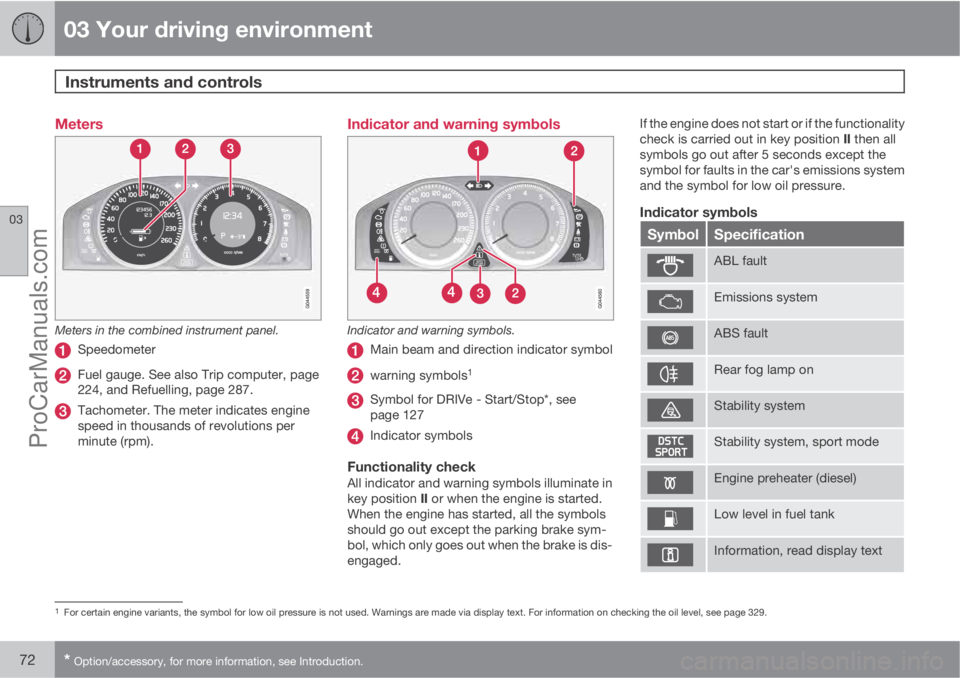
Meters
Meters in the combined instrument panel.
Speedometer
Fuel gauge. See also Trip computer, page
224, and Refuelling, page 287.
Tachometer. The meter indicates engine
speed in thousands of revolutions per
minute (rpm).
Indicator and warning symbols
Indicator and warning symbols.
Main beam and direction indicator symbol
warning symbols1
Symbol for DRIVe - Start/Stop*, see
page 127
Indicator symbols
Functionality checkAll indicator and warning symbols illuminate in
key position II or when the engine is started.
When the engine has started, all the symbols
should go out except the parking brake sym-
bol, which only goes out when the brake is dis-
engaged.If the engine does not start or if the functionality
check is carried out in key position II then all
symbols go out after 5 seconds except the
symbol for faults in the car's emissions system
and the symbol for low oil pressure.
Indicator symbols
SymbolSpecification
ABL fault
Emissions system
ABS fault
Rear fog lamp on
Stability system
Stability system, sport mode
Engine preheater (diesel)
Low level in fuel tank
Information, read display text
1For certain engine variants, the symbol for low oil pressure is not used. Warnings are made via display text. For information on checking the oil level, see page 329.
ProCarManuals.com
Page 222 of 422
05 Comfort and driving pleasure
Fuel-driven engine block heater and passenger compartment heater*
05
220* Option/accessory, for more information, see Introduction.
Fuel-driven heater
General information about the parking
heater
The parking heater heats the engine and pas-
senger compartment and can be started
directly or with the timer.
Two different times can be selected using the
timer. Here, time refers to the time when the car
is heated and ready. The car's electronic sys-
tem calculates when heating should be started
based on the outside temperature.
The heater cannot start if the outside tempera-
ture exceeds 15 °C. At –5 °C or lower the
maximum running time of the parking heater is
50 minutes.
WARNING
The car must be outdoors when the parking
heater is used.
NOTE
When the parking heater is active there may
be smoke from the right-hand wheel hous-
ing, which is perfectly normal.
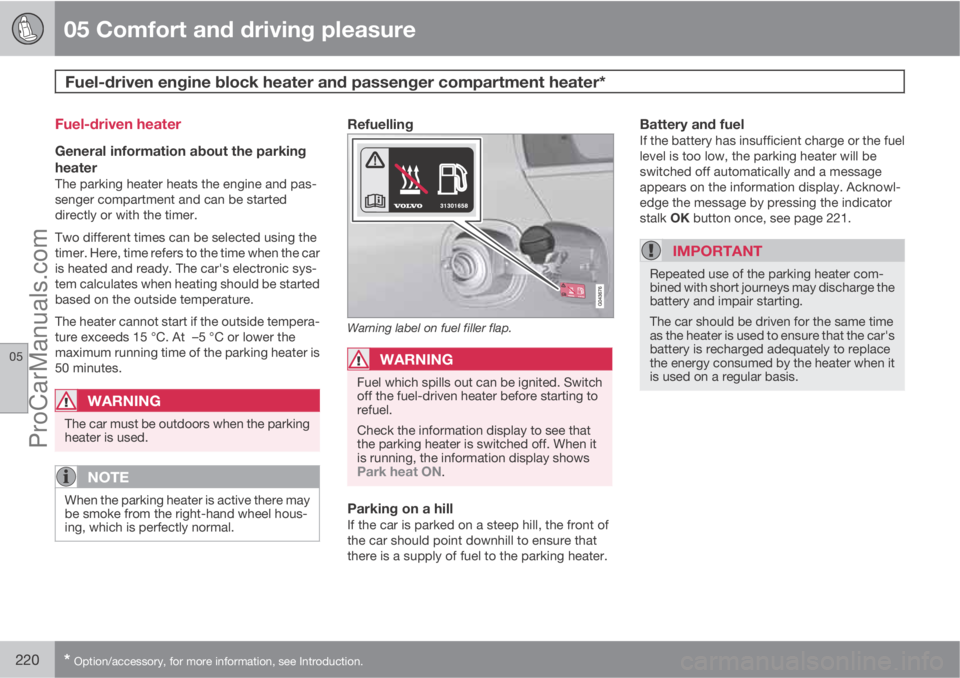
Refuelling
Warning label on fuel filler flap.
WARNING
Fuel which spills out can be ignited. Switch
off the fuel-driven heater before starting to
refuel.
Check the information display to see that
the parking heater is switched off. When it
is running, the information display shows
Park heat ON.
Parking on a hillIf the car is parked on a steep hill, the front of
the car should point downhill to ensure that
there is a supply of fuel to the parking heater.
Battery and fuelIf the battery has insufficient charge or the fuel
level is too low, the parking heater will be
switched off automatically and a message
appears on the information display. Acknowl-
edge the message by pressing the indicator
stalk OK button once, see page 221.
IMPORTANT
Repeated use of the parking heater com-
bined with short journeys may discharge the
battery and impair starting.
The car should be driven for the same time
as the heater is used to ensure that the car's
battery is recharged adequately to replace
the energy consumed by the heater when it
is used on a regular basis.
ProCarManuals.com
Page 284 of 422
282
Recommendations during driving......................................................... 284
Refuelling.............................................................................................. 287
Fuel....................................................................................................... 288
Loading................................................................................................. 292
Cargo area............................................................................................ 295
Driving with a trailer.............................................................................. 298
Towing and recovery............................................................................. 304
ProCarManuals.com
Page 289 of 422
07 During your journey
Refuelling
07
287 Refuelling
Opening/closing the fuel filler flap
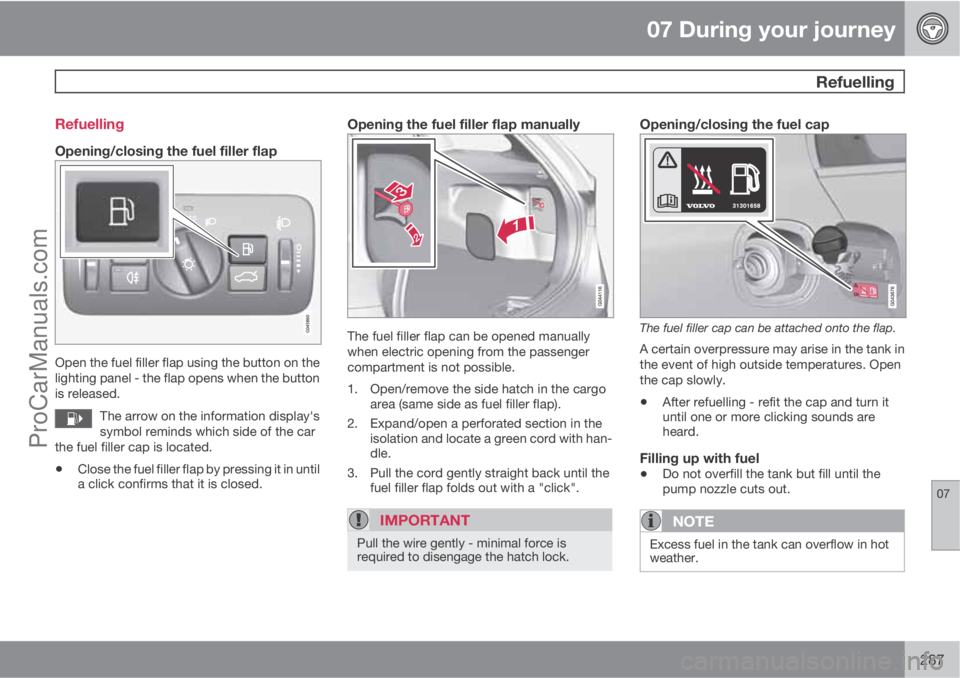
Open the fuel filler flap using the button on the
lighting panel - the flap opens when the button
is released.
The arrow on the information display's
symbol reminds which side of the car
the fuel filler cap is located.
•Close the fuel filler flap by pressing it in until
a click confirms that it is closed.
Opening the fuel filler flap manually
The fuel filler flap can be opened manually
when electric opening from the passenger
compartment is not possible.
1. Open/remove the side hatch in the cargo
area (same side as fuel filler flap).
2. Expand/open a perforated section in the
isolation and locate a green cord with han-
dle.
3. Pull the cord gently straight back until the
fuel filler flap folds out with a "click".
IMPORTANT
Pull the wire gently - minimal force is
required to disengage the hatch lock.
Opening/closing the fuel cap
The fuel filler cap can be attached onto the flap.
A certain overpressure may arise in the tank in
the event of high outside temperatures. Open
the cap slowly.
•After refuelling - refit the cap and turn it
until one or more clicking sounds are
heard.
Filling up with fuel
•Do not overfill the tank but fill until the
pump nozzle cuts out.
NOTE
Excess fuel in the tank can overflow in hot
weather.
ProCarManuals.com
Page 290 of 422
07 During your journey
Fuel
07
288
General information on fuel
Fuel of a lower quality than that recommended
by Volvo must not be used as engine power
and fuel consumption is negatively affected.
WARNING
Always avoid inhaling fuel vapour and get-
ting fuel splashes in the eyes.
In the event of fuel in the eyes, remove any
contact lenses and rinse the eyes in plenty
of water for at least 15 minutes and seek
medical attention.
Never swallow fuel. Fuels such as petrol,
bioethanol and mixtures of them and diesel
are highly toxic and could cause permanent
injury or be fatal if swallowed. Seek medical
attention immediately if fuel has been swal-
lowed.
WARNING
Fuel which spills onto the ground can be
ignited.
Switch off the fuel-driven heater before star-
ting to refuel.
Never carry an activated mobile phone
when refuelling. The ring signal could cause
spark build-up and ignite petrol fumes,
leading to fire and injury.
IMPORTANT
Mixing different types of fuel or the use of
fuel not recommended invalidates Volvo's
guarantees, and any associated service
agreement. This applies to all engines.
NOTE: It does not apply to cars with engines
that are adapted to run on ethanol fuel (E85).
NOTE
Extreme weather conditions, driving with a
trailer or driving at high altitudes in combi-
nation with fuel grade are factors that could
affect the car's performance.
Catalytic convertersThe purpose of the catalytic converters is to
purify exhaust gases. They are located close to
the engine so that operating temperature is
reached quickly.
The catalytic converters consist of a monolith
(ceramic or metal) with channels. The channel
walls are lined with a thin layer of platinum/rho-
dium/palladium. These metals act as catalysts,
i.e. they participate in and accelerate a chem-
ical reaction without being used up them-
selves.
Lambda-sondTM oxygen sensorThe Lambda-sond is part of a control system
intended to reduce emissions and improve fuel
economy.
An oxygen sensor monitors the oxygen content
of the exhaust gases leaving the engine. This
value is fed into an electronic system that con-
tinuously controls the injectors. The ratio of fuel
to air directed to the engine is continuously
adjusted. These adjustments create optimal
conditions for efficient combustion, and
together with the three-way catalytic converter
reduce harmful emissions (hydrocarbons, car-
bon monoxide and nitrous oxides).
Petrol
Petrol must fulfil the EN 228 standard. Most
engines can be run with octane ratings of 95
and 98 RON. Only in exceptional cases should
91 RON be used.
•95 RON can be used for normal driving.
•98 RON is recommended for optimum per-
formance and minimum fuel consumption.
When driving in temperatures above +38 °C,
fuel with the highest possible octane rating is
recommended for optimum performance and
fuel economy.
ProCarManuals.com
Page 291 of 422
07 During your journey
Fuel
07
289
IMPORTANT
•Always refuel with unleaded petrol so as
not to damage the catalytic converter.
•Do not use additives not recommended
by Volvo.
Bioethanol E85
Do not modify the fuel system or its compo-
nents, and do not replace components with
parts that are not specifically designed for use
with bioethanol.
WARNING
Methanol must not be used. A decal on the
inside of the fuel filler flap shows the correct
alternative fuel.
The use of components not designed for
bioethanol engines could cause fire, injury
or engine damage.
Reserve fuel canThe reserve fuel can should be filled with petrol,
see the NOTE box, page 118.
IMPORTANT
Make sure the reserve fuel can is securely
fastened and that its cap is sealed.
WARNING
Ethanol is sensitive to sparks, and explosive
gases could form in the reserve fuel can if it
is refuelled with ethanol.
Diesel
Only use diesel fuel from well-known produc-
ers. Never use diesel of dubious quality. Diesel
should fulfil the EN 590 or JIS K2204 stand-
ards. Diesel engines are sensitive to contami-
nants in the fuel, such as excessively high vol-
umes of sulphur particles for example.
At low temperatures (-6 °C to -40 °C), a paraffin
precipitate may form in the diesel fuel, which
may lead to ignition problems. Special diesel
fuel designed for low temperatures around
freezing point is available from the major oil
companies. This fuel is less viscous at low tem-
peratures and reduces the risk of paraffin pre-
cipitate.
The risk of condensation in the fuel tank is
reduced if the tank is kept well filled. Whenrefuelling, check that the area around the fuel
filler pipe is clean. Avoid spilling fuel onto the
paintwork. Wash off any spillage with deter-
gent and water.
IMPORTANT
Only ever use fuel that fulfils the European
diesel standard.
The sulphur content must be a maximum of
50 ppm.
IMPORTANT
Diesel type fuels that must not be used:
•Special additives
•Marine diesel fuel
•Heating oil
•FAME1 (Fatty Acid Methyl Ester) and
vegetable oil.
These fuels do not fulfil the requirements in
accordance with Volvo recommendations
and generate increased wear and engine
damage that is not covered by the Volvo
warranty.
Empty tankThe design of the fuel system in a diesel engine
means that if the vehicle runs out of fuel, the
1Diesel fuel may contain a certain amount of FAME, but further amounts must not be added.
ProCarManuals.com
Page 330 of 422
09 Maintenance and service
Engine compartment 09
328
General
Volvo service programmeTo keep the car as safe and reliable as possi-
ble, follow the Volvo service programme as
specified in the Service and Warranty Booklet.
Volvo recommends engaging an authorised
Volvo workshop to perform the service and
maintenance work. Volvo workshops have the
personnel, special tools and service literature
to guarantee the highest quality of service.
IMPORTANT
For the Volvo warranty to apply, check and
follow the instructions in the Service and
Warranty Booklet.
Check regularlyCheck the following oils and fluids at regular
intervals, e.g. when refuelling:
•Coolant
•Engine oil
•Power steering fluid
•Washer fluid
WARNING
Remember that the radiator fan (located at
the front of the engine compartment, behind
the radiator) may start automatically some
after the engine has been switched off.
Always have the engine cleaned by a work-
shop. There is a risk of fire if the engine is
hot.
Raising the car
NOTE
Volvo recommends only using the jack that
belongs to the car model in question. If a
jack is selected other than the one recom-
mended by Volvo, follow the instructions for
use supplied with the equipment.
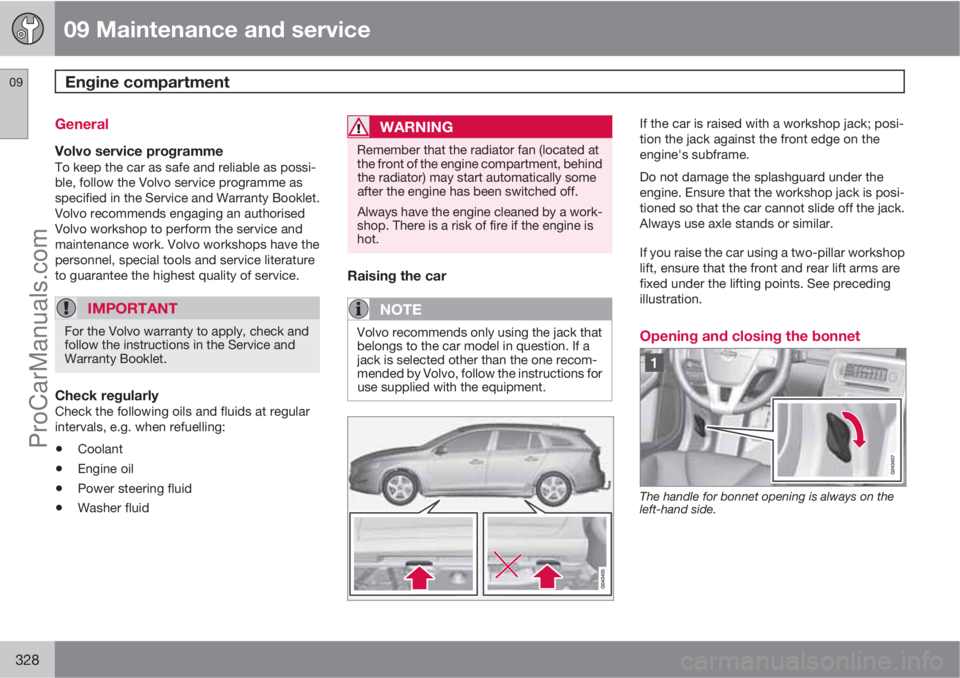
If the car is raised with a workshop jack; posi-
tion the jack against the front edge on the
engine's subframe.
Do not damage the splashguard under the
engine. Ensure that the workshop jack is posi-
tioned so that the car cannot slide off the jack.
Always use axle stands or similar.
If you raise the car using a two-pillar workshop
lift, ensure that the front and rear lift arms are
fixed under the lifting points. See preceding
illustration.
Opening and closing the bonnet
The handle for bonnet opening is always on the
left-hand side.
ProCarManuals.com
Page 363 of 422
09 Maintenance and service
Car care09
361 Washing the car
Wash the car as soon as it becomes dirty.
Wash the car in a car wash with oil separator.
Use car shampoo.
•Remove bird droppings from the paintwork
as soon as possible. Bird droppings con-
tain chemicals that affect and discolour
paintwork very quickly. An authorised
Volvo workshop is recommended for the
removal of any discoloration.
•Hose down the underbody.
•Rinse the whole car until the loose dirt has
been removed in order to reduce the risk
of scratches from washing. Do not spray
directly onto the locks.
•If necessary, use cold degreasing agent on
very dirty surfaces. Note that the surfaces
must not then be warmed up by the sun!
•Wash using a sponge, car shampoo and
plenty of lukewarm water.
•Clean the wiper blades with a lukewarm
soap solution or car shampoo.
•Use cold degreasing agent on very dirty
surfaces.
•Dry the car using a clean, soft chamois or
a water scraper. If you avoid allowing water
droplets to dry in strong sunlight then the
risk of water stains that may need to be
polished away is reduced.
WARNING
Always have the engine cleaned by a work-
shop. There is a risk of fire if the engine is
hot.
IMPORTANT
Dirty headlamps have impaired functional-
ity. Clean them regularly, when refuelling for
example.
Do not use any corrosive cleaning agents
but use water and a non-scratching sponge
instead.
NOTE
Outside lighting such as headlamps, fog
lamps and rear lamps may temporarily have
condensation on the inside of the lens. This
is normal, all exterior lighting is designed to
withstand this. Condensation is normally
vented out of the lamp housing when the
lamp has been switched on for a time.
Cleaning the wiper bladesAsphalt, dust and salt residue on wiper blades,
as well as insects, ice etc. on the windscreen,
impair the service life of wiper blades.For cleaning:
–Set the wiper blades in service position,
see page 341.
NOTE
Wash the wiper blades and windscreen reg-
ularly with lukewarm soap solution or car
shampoo.
Do not use any strong solvents.
Automatic car washesAn automatic car wash is a simple and quick
way of washing the car, but it cannot reach
everywhere. Handwashing the car is recom-
mended for achieving optimum results.
NOTE
During the first few months a new car must
only be handwashed. This is because the
paintwork is more sensitive when it is new.
High-pressure washingWhen using high-pressure washing, use
sweeping movements and make sure that the
nozzle does not come closer than 30 cm to the
surface of the car (the distance applies to all
exterior parts). Do not spray directly onto the
locks.
ProCarManuals.com
Page 417 of 422
11 Alphabetical Index
11
415
Petrol grade............................................. 288
Phone
connect............................................... 263
handsfree............................................ 262
incoming calls..................................... 264
making calls........................................ 264
phone book......................................... 266
phone book, shortcut.........................266
receiving a call.................................... 265
register phone..................................... 263
voice control....................................... 271
Pinch protection, sunroof........................108
Polishing.................................................. 362
Position/parking lamps.............................. 91
Power seat................................................. 81
Powershift gearbox..........................125, 304
Power sunroof......................................... 107
Power windows....................................... 101
Privacy locking........................................... 49
Q
Queue Assist............................................ 159
Queue Assistant....................................... 159
R
Radar sensor........................................... 154
limitations........................................... 160
Radio ...................................................... 245
AM/FM ............................................... 245
DAB ................................................... 249
Rain sensor................................................ 98
Rear bulbs
location............................................... 338
Rearview and door mirrors
compass............................................. 106
door.................................................... 103
electrically retractable......................... 104
heating................................................ 104
interior................................................. 105
Rear window, defrosting.......................... 104
Recirculation............................................ 217
Recommendations during driving............ 284
Recommended child seats, table.............. 32
Recovery.................................................. 306
Refrigerant............................................... 334
Refuelling................................................. 287
fuel cap............................................... 287
fuel filler flap, electrical opening......... 287fuel filler flap, manual opening............ 287
refuelling............................................. 287
Relay/fuse box: see Fuses....................... 350
Remote control ....................................... 279
battery replacement ........................... 280
Remote control, HomeLink
Ÿ
programmable ................................... 141
Remote control key................................... 44
battery replacement.............................. 51
detachable key blade........................... 48
functions............................................... 45
range..................................................... 46
Remote control key system, type appro-
val............................................................392
Remote Start - ERS.................................114
Resetting the door mirrors.......................104
Resetting the power windows................. 103
Retractable power door mirrors............... 104
Reverse gear inhibitor.............................. 122
Rims
cleaning.............................................. 362
Road sign information.............................148
Roof load, max. weight ...........................373
Rustproofing............................................ 363
ProCarManuals.com