clutch VOLVO V60 2014 User Guide
[x] Cancel search | Manufacturer: VOLVO, Model Year: 2014, Model line: V60, Model: VOLVO V60 2014Pages: 442, PDF Size: 13.85 MB
Page 279 of 442
08 Starting and driving
08
277
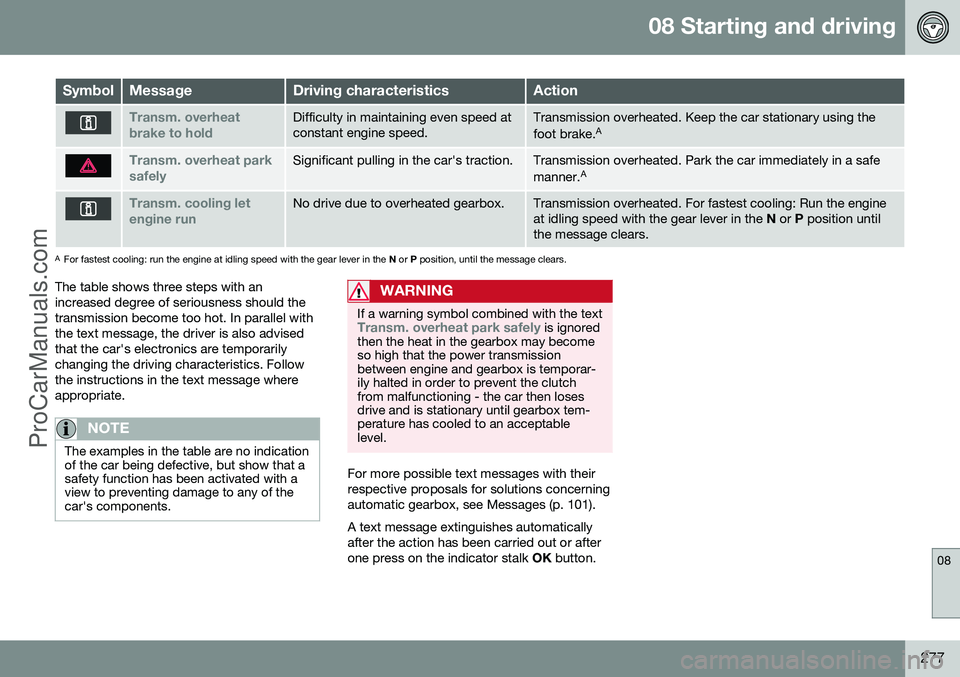
SymbolMessageDriving characteristicsAction
Transm. overheat brake to holdDifficulty in maintaining even speed at constant engine speed.Transmission overheated. Keep the car stationary using the foot brake.A
Transm. overheat park safelySignificant pulling in the car's traction.Transmission overheated. Park the car immediately in a safe manner.A
Transm. cooling let engine runNo drive due to overheated gearbox.Transmission overheated. For fastest cooling: Run the engine at idling speed with the gear lever in the
N or P position until
the message clears.
A For fastest cooling: run the engine at idling speed with the gear lever in the N or P position, until the message clears.
The table shows three steps with an increased degree of seriousness should thetransmission become too hot. In parallel withthe text message, the driver is also advisedthat the car's electronics are temporarilychanging the driving characteristics. Followthe instructions in the text message whereappropriate.
NOTE
The examples in the table are no indication of the car being defective, but show that asafety function has been activated with aview to preventing damage to any of thecar's components.
WARNING
If a warning symbol combined with the textTransm. overheat park safely is ignored
then the heat in the gearbox may become so high that the power transmissionbetween engine and gearbox is temporar-ily halted in order to prevent the clutchfrom malfunctioning - the car then losesdrive and is stationary until gearbox tem-perature has cooled to an acceptablelevel.
For more possible text messages with their respective proposals for solutions concerningautomatic gearbox, see Messages (p. 101). A text message extinguishes automatically after the action has been carried out or afterone press on the indicator stalk OK button.
ProCarManuals.co’
Page 282 of 442
||
08 Starting and driving
08
280* Option/accessory, for more information, see Introduction.
The Start/Stop function gives the driver the opportunity for a more active environmentallyconscious way of driving the car by means ofbeing able to allow the engine to stop auto-matically, whenever appropriate. Manual or Automatic Note that there are differences in the Start/Stop function depending on whether thegearbox is manual or automatic.
Related information
• Start/Stop* - function and operation (p. 280)
• Starting the engine (p. 264)
• Start/Stop* - settings (p. 285)
• Start/Stop* - the engine does not auto-start (p. 284)
• Start/Stop* - the engine auto-starts (p.283)
• Start/Stop* - the engine does not stop (p.282)
• Start/Stop* - involuntary engine stoppagemanual gearbox (p. 284)
• Start/Stop* - symbols and messages (p.286)
• Battery - Start/Stop (p. 365)
Start/Stop* - function and operation
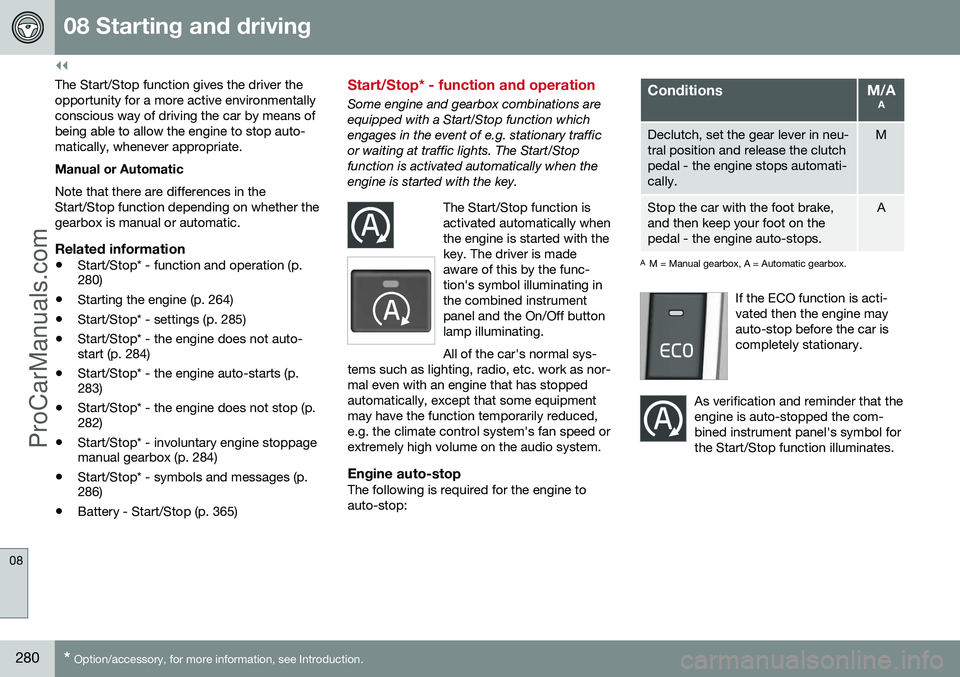
Some engine and gearbox combinations are equipped with a Start/Stop function whichengages in the event of e.g. stationary trafficor waiting at traffic lights. The Start/Stopfunction is activated automatically when theengine is started with the key.
The Start/Stop function isactivated automatically whenthe engine is started with thekey. The driver is madeaware of this by the func-tion's symbol illuminating inthe combined instrumentpanel and the On/Off buttonlamp illuminating. All of the car's normal sys-
tems such as lighting, radio, etc. work as nor- mal even with an engine that has stoppedautomatically, except that some equipmentmay have the function temporarily reduced,e.g. the climate control system's fan speed orextremely high volume on the audio system.
Engine auto-stopThe following is required for the engine to auto-stop:
ConditionsM/A A
Declutch, set the gear lever in neu- tral position and release the clutchpedal - the engine stops automati-cally.M
Stop the car with the foot brake, and then keep your foot on thepedal - the engine auto-stops.A
AM = Manual gearbox, A = Automatic gearbox.
If the ECO function is acti- vated then the engine mayauto-stop before the car iscompletely stationary.
As verification and reminder that the engine is auto-stopped the com-bined instrument panel's symbol forthe Start/Stop function illuminates.
ProCarManuals.co’
Page 283 of 442
08 Starting and driving
08
* Option/accessory, for more information, see Introduction.281
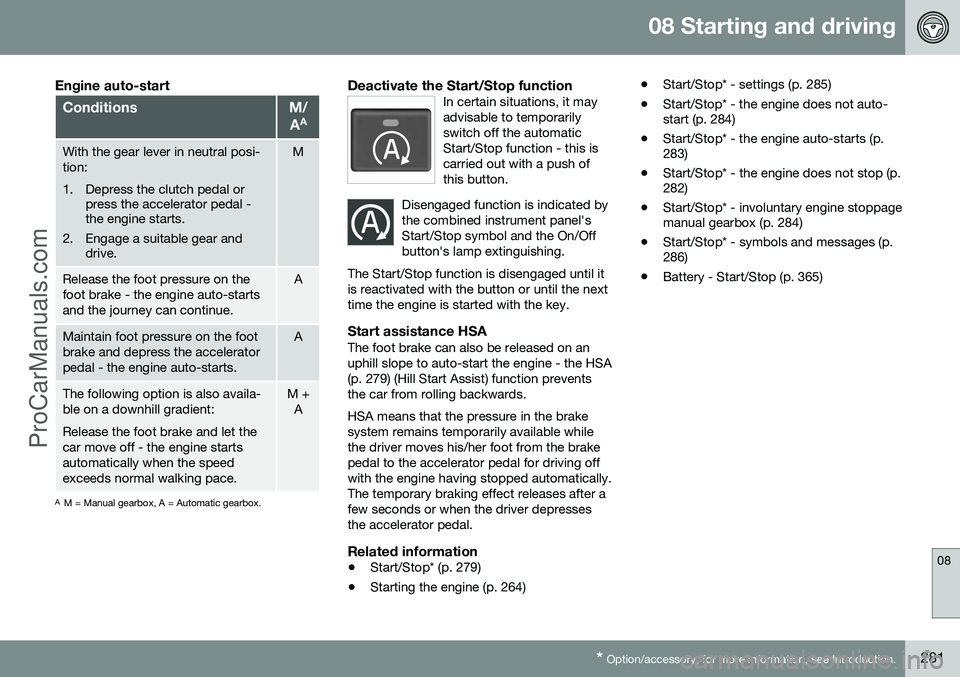
Engine auto-start
ConditionsM/
A A
With the gear lever in neutral posi- tion:
1. Depress the clutch pedal or
press the accelerator pedal - the engine starts.
2. Engage a suitable gear and drive.M
Release the foot pressure on the foot brake - the engine auto-startsand the journey can continue.A
Maintain foot pressure on the foot brake and depress the acceleratorpedal - the engine auto-starts.A
The following option is also availa- ble on a downhill gradient: Release the foot brake and let the car move off - the engine startsautomatically when the speedexceeds normal walking pace.M +
A
A M = Manual gearbox, A = Automatic gearbox.
Deactivate the Start/Stop functionIn certain situations, it may advisable to temporarilyswitch off the automaticStart/Stop function - this iscarried out with a push ofthis button.
Disengaged function is indicated by the combined instrument panel'sStart/Stop symbol and the On/Offbutton's lamp extinguishing.
The Start/Stop function is disengaged until it is reactivated with the button or until the nexttime the engine is started with the key.
Start assistance HSAThe foot brake can also be released on anuphill slope to auto-start the engine - the HSA(p. 279) (Hill Start Assist) function preventsthe car from rolling backwards. HSA means that the pressure in the brake system remains temporarily available whilethe driver moves his/her foot from the brakepedal to the accelerator pedal for driving offwith the engine having stopped automatically.The temporary braking effect releases after afew seconds or when the driver depressesthe accelerator pedal.
Related information
• Start/Stop* (p. 279)
• Starting the engine (p. 264) •
Start/Stop* - settings (p. 285)
• Start/Stop* - the engine does not auto- start (p. 284)
• Start/Stop* - the engine auto-starts (p.283)
• Start/Stop* - the engine does not stop (p.282)
• Start/Stop* - involuntary engine stoppagemanual gearbox (p. 284)
• Start/Stop* - symbols and messages (p.286)
• Battery - Start/Stop (p. 365)
ProCarManuals.co’
Page 285 of 442
08 Starting and driving
08
* Option/accessory, for more information, see Introduction.283
Start/Stop* - the engine auto-starts
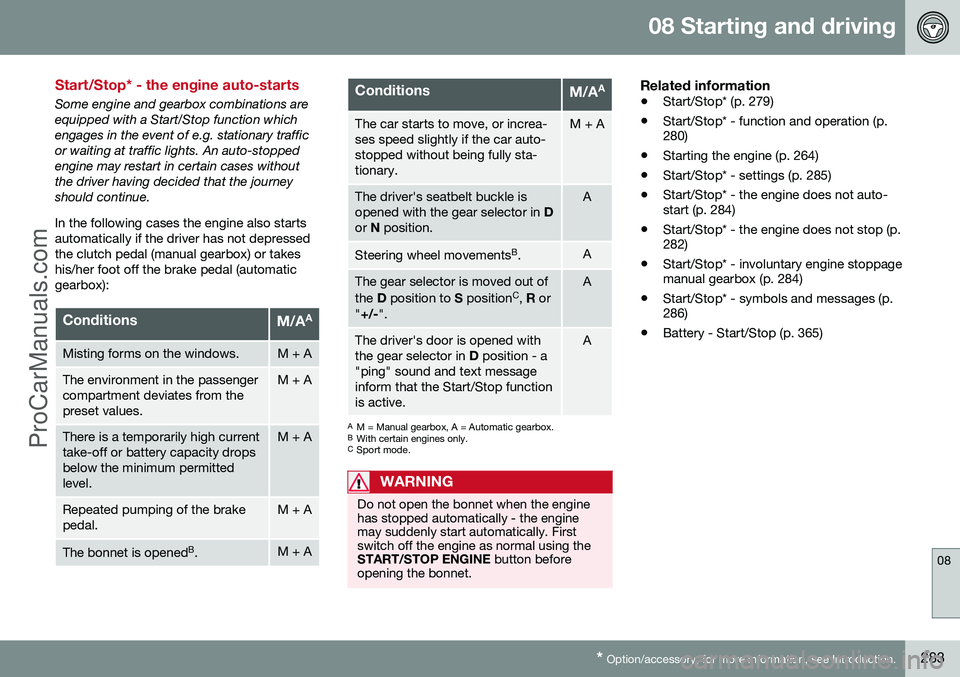
Some engine and gearbox combinations are equipped with a Start/Stop function whichengages in the event of e.g. stationary trafficor waiting at traffic lights. An auto-stoppedengine may restart in certain cases withoutthe driver having decided that the journeyshould continue. In the following cases the engine also starts automatically if the driver has not depressedthe clutch pedal (manual gearbox) or takeshis/her foot off the brake pedal (automaticgearbox):
ConditionsM/A A
Misting forms on the windows.M + A
The environment in the passenger compartment deviates from thepreset values.M + A
There is a temporarily high current take-off or battery capacity dropsbelow the minimum permittedlevel.M + A
Repeated pumping of the brake pedal.M + A
The bonnet is opened
B
.M + A
ConditionsM/A A
The car starts to move, or increa- ses speed slightly if the car auto-stopped without being fully sta-tionary.M + A
The driver's seatbelt buckle is opened with the gear selector in
D
or N position.A
Steering wheel movements B
.A
The gear selector is moved out of the D position to S position C
, R or
" +/- ".A
The driver's door is opened with the gear selector in D position - a
"ping" sound and text messageinform that the Start/Stop functionis active.A
A M = Manual gearbox, A = Automatic gearbox.
B With certain engines only.
C Sport mode.
WARNING
Do not open the bonnet when the engine has stopped automatically - the enginemay suddenly start automatically. Firstswitch off the engine as normal using theSTART/STOP ENGINE button before
opening the bonnet.
Related information
• Start/Stop* (p. 279)
• Start/Stop* - function and operation (p. 280)
• Starting the engine (p. 264)
• Start/Stop* - settings (p. 285)
• Start/Stop* - the engine does not auto-start (p. 284)
• Start/Stop* - the engine does not stop (p.282)
• Start/Stop* - involuntary engine stoppagemanual gearbox (p. 284)
• Start/Stop* - symbols and messages (p.286)
• Battery - Start/Stop (p. 365)
ProCarManuals.co’
Page 286 of 442
08 Starting and driving
08
284* Option/accessory, for more information, see Introduction.
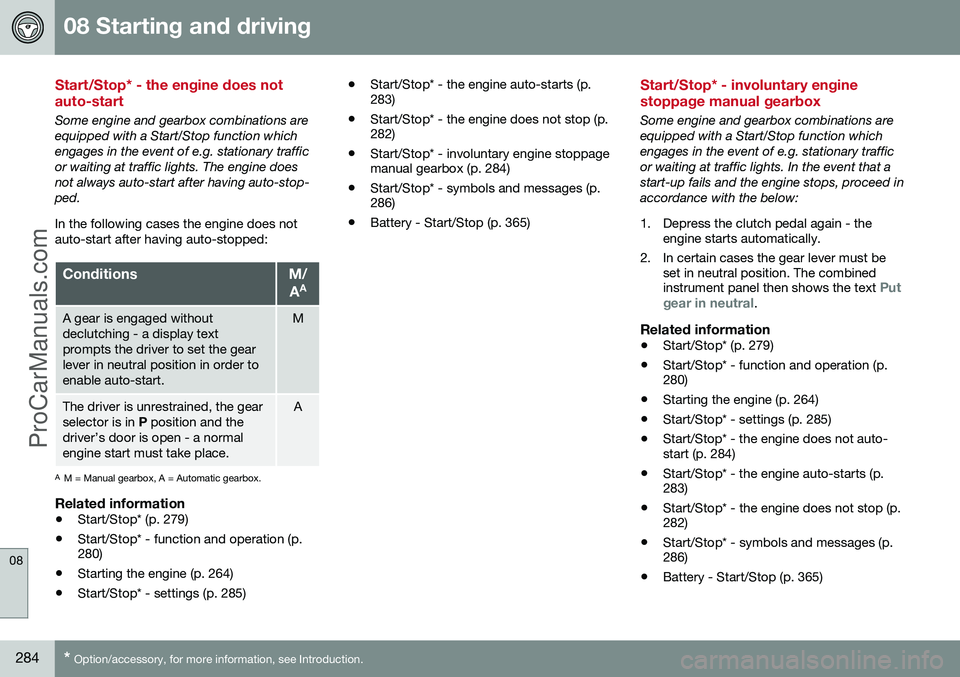
Start/Stop* - the engine does not auto-start
Some engine and gearbox combinations are equipped with a Start/Stop function whichengages in the event of e.g. stationary trafficor waiting at traffic lights. The engine doesnot always auto-start after having auto-stop-ped. In the following cases the engine does not auto-start after having auto-stopped:
ConditionsM/
A A
A gear is engaged without declutching - a display textprompts the driver to set the gearlever in neutral position in order toenable auto-start.M
The driver is unrestrained, the gear selector is in
P position and the
driver’s door is open - a normalengine start must take place.A
A M = Manual gearbox, A = Automatic gearbox.
Related information
• Start/Stop* (p. 279)
• Start/Stop* - function and operation (p. 280)
• Starting the engine (p. 264)
• Start/Stop* - settings (p. 285) •
Start/Stop* - the engine auto-starts (p.283)
• Start/Stop* - the engine does not stop (p.282)
• Start/Stop* - involuntary engine stoppagemanual gearbox (p. 284)
• Start/Stop* - symbols and messages (p.286)
• Battery - Start/Stop (p. 365)
Start/Stop* - involuntary engine stoppage manual gearbox
Some engine and gearbox combinations are equipped with a Start/Stop function whichengages in the event of e.g. stationary trafficor waiting at traffic lights. In the event that astart-up fails and the engine stops, proceed inaccordance with the below:
1. Depress the clutch pedal again - the
engine starts automatically.
2. In certain cases the gear lever must be set in neutral position. The combined instrument panel then shows the text
Put
gear in neutral.
Related information
• Start/Stop* (p. 279)
• Start/Stop* - function and operation (p. 280)
• Starting the engine (p. 264)
• Start/Stop* - settings (p. 285)
• Start/Stop* - the engine does not auto-start (p. 284)
• Start/Stop* - the engine auto-starts (p.283)
• Start/Stop* - the engine does not stop (p.282)
• Start/Stop* - symbols and messages (p.286)
• Battery - Start/Stop (p. 365)
ProCarManuals.co’
Page 288 of 442
08 Starting and driving
08
286* Option/accessory, for more information, see Introduction.
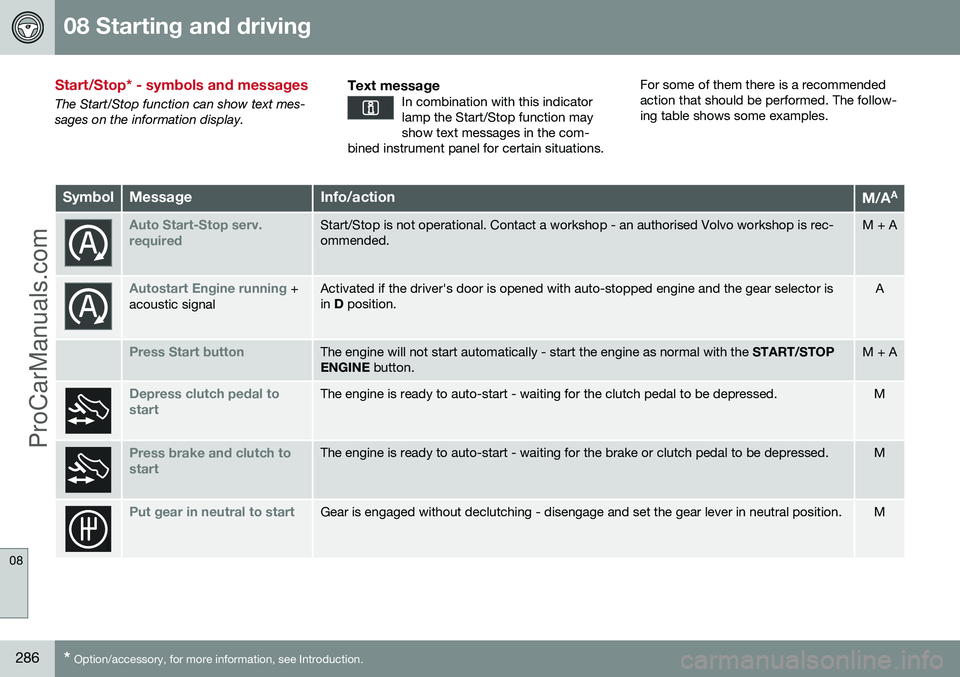
Start/Stop* - symbols and messages
The Start/Stop function can show text mes- sages on the information display.
Text messageIn combination with this indicatorlamp the Start/Stop function mayshow text messages in the com-
bined instrument panel for certain situations.
For some of them there is a recommended action that should be performed. The follow-ing table shows some examples.
SymbolMessageInfo/actionM/A A
Auto Start-Stop serv. requiredStart/Stop is not operational. Contact a workshop - an authorised Volvo workshop is rec- ommended.M + A
Autostart Engine running +
acoustic signalActivated if the driver's door is opened with auto-stopped engine and the gear selector is in D position.A
Press Start buttonThe engine will not start automatically - start the engine as normal with the START/STOP
ENGINE button.M + A
Depress clutch pedal to startThe engine is ready to auto-start - waiting for the clutch pedal to be depressed.M
Press brake and clutch to startThe engine is ready to auto-start - waiting for the brake or clutch pedal to be depressed.M
Put gear in neutral to startGear is engaged without declutching - disengage and set the gear lever in neutral position.M
ProCarManuals.co’
Page 292 of 442
08 Starting and driving
08
290* Option/accessory, for more information, see Introduction.
All Wheel Drive - AWD*
The best traction possible is achieved with all- wheel drive.
All Wheel Drive is always available
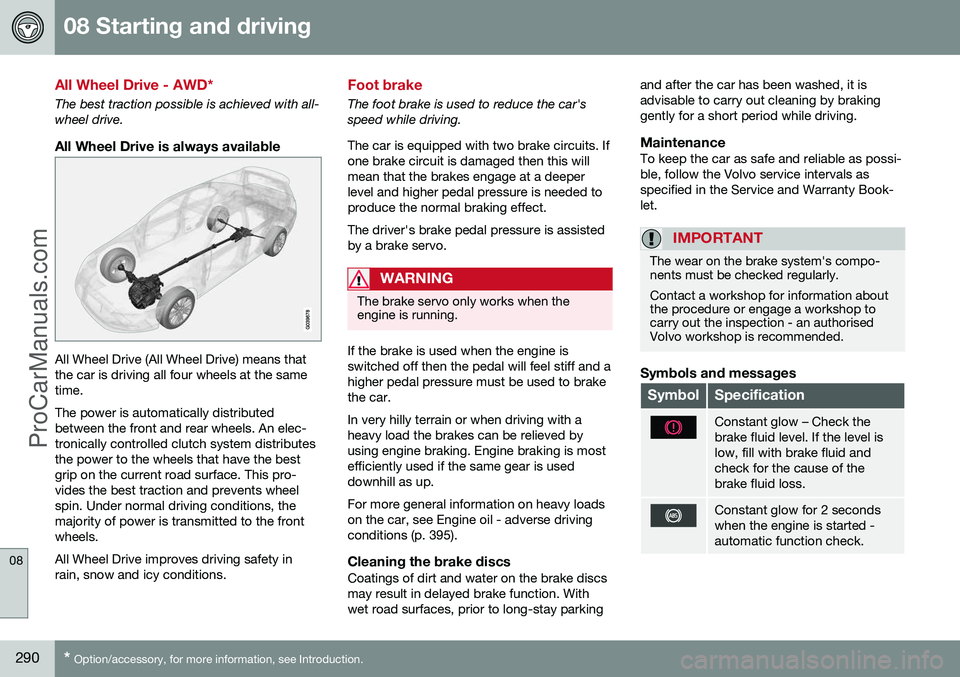
All Wheel Drive (All Wheel Drive) means that the car is driving all four wheels at the sametime. The power is automatically distributed between the front and rear wheels. An elec-tronically controlled clutch system distributesthe power to the wheels that have the bestgrip on the current road surface. This pro-vides the best traction and prevents wheelspin. Under normal driving conditions, themajority of power is transmitted to the frontwheels. All Wheel Drive improves driving safety in rain, snow and icy conditions.
Foot brake
The foot brake is used to reduce the car's speed while driving. The car is equipped with two brake circuits. If one brake circuit is damaged then this willmean that the brakes engage at a deeperlevel and higher pedal pressure is needed toproduce the normal braking effect. The driver's brake pedal pressure is assisted by a brake servo.
WARNING
The brake servo only works when the engine is running.
If the brake is used when the engine is switched off then the pedal will feel stiff and ahigher pedal pressure must be used to brakethe car. In very hilly terrain or when driving with a heavy load the brakes can be relieved byusing engine braking. Engine braking is mostefficiently used if the same gear is useddownhill as up. For more general information on heavy loads on the car, see Engine oil - adverse drivingconditions (p. 395).
Cleaning the brake discsCoatings of dirt and water on the brake discsmay result in delayed brake function. Withwet road surfaces, prior to long-stay parking and after the car has been washed, it isadvisable to carry out cleaning by brakinggently for a short period while driving.
MaintenanceTo keep the car as safe and reliable as possi-ble, follow the Volvo service intervals asspecified in the Service and Warranty Book-let.
IMPORTANT
The wear on the brake system's compo- nents must be checked regularly. Contact a workshop for information about the procedure or engage a workshop tocarry out the inspection - an authorisedVolvo workshop is recommended.
Symbols and messages
SymbolSpecification
Constant glow – Check the brake fluid level. If the level islow, fill with brake fluid andcheck for the cause of thebrake fluid loss.
Constant glow for 2 seconds when the engine is started -automatic function check.
ProCarManuals.co’
Page 296 of 442
||
08 Starting and driving
08
294
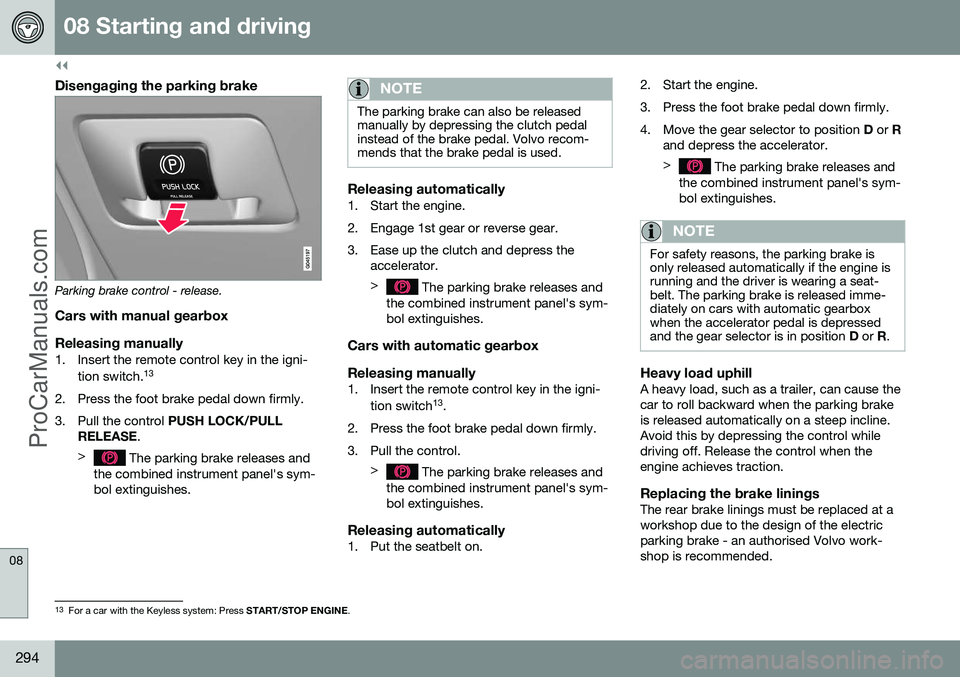
Disengaging the parking brake
Parking brake control - release.
Cars with manual gearbox
Releasing manually
1. Insert the remote control key in the igni- tion switch. 13
2. Press the foot brake pedal down firmly.
3. Pull the control PUSH LOCK/PULL
RELEASE .
>
The parking brake releases and
the combined instrument panel's sym- bol extinguishes.
NOTE
The parking brake can also be released manually by depressing the clutch pedalinstead of the brake pedal. Volvo recom-mends that the brake pedal is used.
Releasing automatically1. Start the engine.
2. Engage 1st gear or reverse gear.
3. Ease up the clutch and depress the accelerator. >
The parking brake releases and
the combined instrument panel's sym- bol extinguishes.
Cars with automatic gearbox Releasing manually
1. Insert the remote control key in the igni-
tion switch 13
.
2. Press the foot brake pedal down firmly.
3. Pull the control. >
The parking brake releases and
the combined instrument panel's sym- bol extinguishes.
Releasing automatically1. Put the seatbelt on. 2. Start the engine.
3. Press the foot brake pedal down firmly.
4. Move the gear selector to position
D or R
and depress the accelerator. >
The parking brake releases and
the combined instrument panel's sym- bol extinguishes.
NOTE
For safety reasons, the parking brake is only released automatically if the engine isrunning and the driver is wearing a seat-belt. The parking brake is released imme-diately on cars with automatic gearboxwhen the accelerator pedal is depressedand the gear selector is in position D or R.
Heavy load uphillA heavy load, such as a trailer, can cause the car to roll backward when the parking brakeis released automatically on a steep incline.Avoid this by depressing the control whiledriving off. Release the control when theengine achieves traction.
Replacing the brake liningsThe rear brake linings must be replaced at aworkshop due to the design of the electricparking brake - an authorised Volvo work-shop is recommended.
13
For a car with the Keyless system: Press START/STOP ENGINE.
ProCarManuals.co’
Page 305 of 442
08 Starting and driving
08
303
tion, see Key positions (p. 70) for more information.
2. Press the START button without
depressing the brake and/or clutch pedal.
3. Wait approx. 1 minute.
4. To start the engine: Depress the brake and/or clutch pedal and then press the START button again.
NOTE
Before filling with fuel in the event of fuel shortage:
• Stop the car on as flat/level ground as possible - if the car is tilting there is arisk of air pockets in the fuel supply.
Draining condensation from the fuel filter
The fuel filter separates condensation from the fuel. Condensation can disrupt engineoperation. The fuel filter must be drained at the intervals specified in the Service and Warranty Bookletor if you suspect that the car has been filledwith contaminated fuel. For more information,see Volvo service programme (p. 340).
IMPORTANT
Certain special additives remove the water separation in the fuel filter.
Related information
•
Fuel - handling (p. 301)
• Diesel particle filter (DPF) (p. 305)
• Fuel consumption and CO2 emissions (p. 403)
Catalytic converters
The purpose of the catalytic converters is to purify exhaust gases. They are located closeto the engine so that operating temperature isreached quickly. The catalytic converters consist of a monolith (ceramic or metal) with channels. The channelwalls are lined with a thin layer of platinum/rhodium/palladium. These metals act as cata-lysts, i.e. they participate in and accelerate achemical reaction without being used upthemselves.
Lambda-sond TM
oxygen sensorThe Lambda-sond is part of a control systemintended to reduce emissions and improvefuel economy (see Fuel consumption andCO2 emissions (p. 403)). An oxygen sensor monitors the oxygen con- tent of the exhaust gases leaving the engine.This value is fed into an electronic systemthat continuously controls the injectors. Theratio of fuel to air directed to the engine iscontinuously adjusted. These adjustmentscreate optimal conditions for efficient com-bustion, and together with the three-way cat-alytic converter reduce harmful emissions(hydrocarbons, carbon monoxide and nitrousoxides).
ProCarManuals.co’
Page 345 of 442
10 Maintenance and service
10
343
Bonnet - opening and closing
The bonnet can be opened when the handle in the passenger compartment has beenturned clockwise and the lock by the grille hasbeen moved to the left.
The handle for bonnet opening is always on the left-hand side.
Turn the handle about 20-25 degrees clockwise. You will hear when the catchreleases.
Move the catch to the left and open the bonnet. (The catch hook is locatedbetween the headlamp and grille, seeillustration.)
WARNING
Check that the bonnet locks properly when closed.
Related information
•Engine compartment - checking (p. 344)
• Engine compartment - overview (p. 343)
Engine compartment - overview
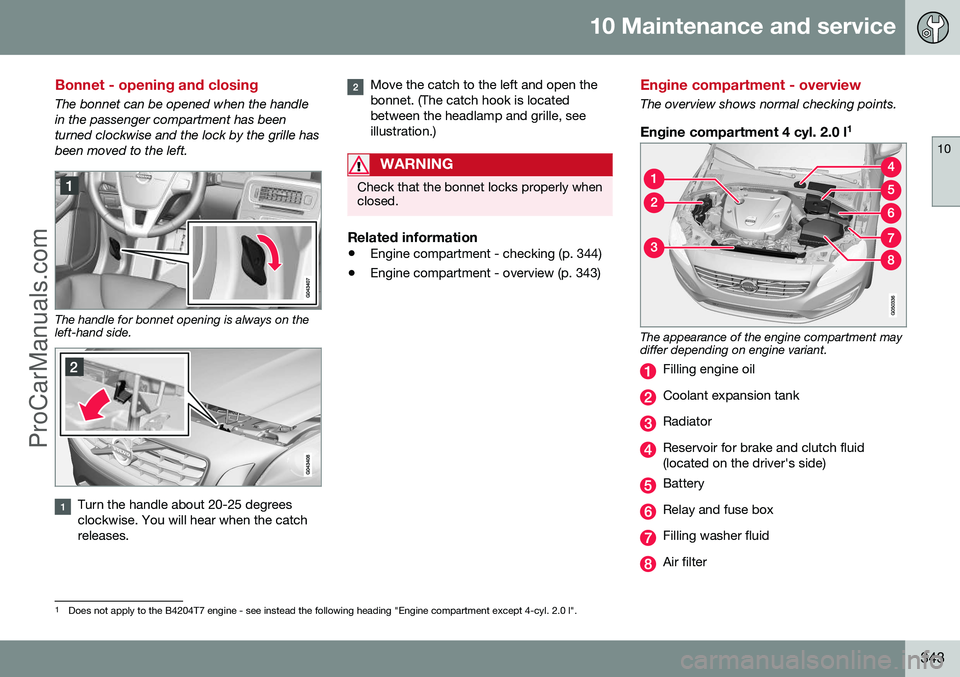
The overview shows normal checking points.
Engine compartment 4 cyl. 2.0 l 1
The appearance of the engine compartment may differ depending on engine variant.
Filling engine oil
Coolant expansion tank
Radiator
Reservoir for brake and clutch fluid (located on the driver's side)
Battery
Relay and fuse box
Filling washer fluid
Air filter
1
Does not apply to the B4204T7 engine - see instead the following heading "Engine compartment except 4-cyl. 2.0 l".
ProCarManuals.co’