fuel consumption VOLVO V60 2014 User Guide
[x] Cancel search | Manufacturer: VOLVO, Model Year: 2014, Model line: V60, Model: VOLVO V60 2014Pages: 442, PDF Size: 13.85 MB
Page 290 of 442
08 Starting and driving
08
288* Option/accessory, for more information, see Introduction.
ECO*
ECO is an innovative Volvo function for auto- matic-gearbox cars, capable of reducing fuelconsumption by up to 5%, depending on thedriver's driving style. The function gives thedriver the option of a more active environ-mentally conscious way of driving.
GeneralThe following are changedupon activation of the ECOfunction:
• Gearbox gearshift points.
• Engine management and response from the accelerator pedal.
• Start/Stop function - the engine can alsoauto-stop before the car has stopped tobeing fully stationary.
• The Eco Coast function is activated -engine braking ceases.
• Climate control system settings - someelectricity consumers are deactivated oroperate at reduced power.
NOTE
When the ECO function is activated, sev- eral parameters in the climate control sys-tem's settings are changed, and severalelectricity consumer functions are reduced- a press of the
AC button resets the cli-
mate control system, but then withreduced AC function.
ECO - Operation
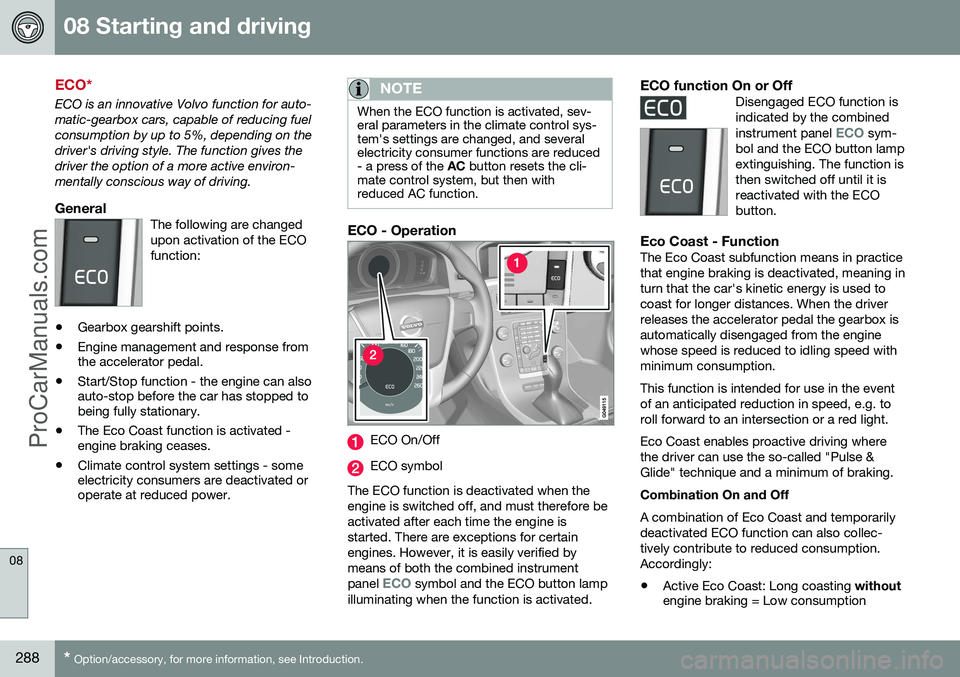
ECO On/Off
ECO symbol
The ECO function is deactivated when the engine is switched off, and must therefore beactivated after each time the engine isstarted. There are exceptions for certainengines. However, it is easily verified bymeans of both the combined instrument panel
ECO symbol and the ECO button lamp
illuminating when the function is activated.
ECO function On or OffDisengaged ECO function is indicated by the combined instrument panel
ECO sym-
bol and the ECO button lamp extinguishing. The function isthen switched off until it isreactivated with the ECObutton.
Eco Coast - FunctionThe Eco Coast subfunction means in practice that engine braking is deactivated, meaning inturn that the car's kinetic energy is used tocoast for longer distances. When the driverreleases the accelerator pedal the gearbox isautomatically disengaged from the enginewhose speed is reduced to idling speed withminimum consumption. This function is intended for use in the event of an anticipated reduction in speed, e.g. toroll forward to an intersection or a red light. Eco Coast enables proactive driving where the driver can use the so-called "Pulse &Glide" technique and a minimum of braking. Combination On and Off A combination of Eco Coast and temporarily deactivated ECO function can also collec-tively contribute to reduced consumption.Accordingly:
• Active Eco Coast: Long coasting
without
engine braking = Low consumption
ProCarManuals.co’
Page 301 of 442
08 Starting and driving
08
299
Before a long journey
Before a long journey, it makes good sense to go through the following points: •Check that the engine is working normally and that fuel consumption (p. 403) is nor-mal.
• Make sure that there are no leaks (fuel, oilor other fluid).
• Check all bulbs and tyre tread depths.
• Carrying a warning triangle (p. 329) is alegal requirement in certain countries.
Related information
• Engine oil - checking and filling (p. 346)
• Changing wheels - removing wheels (p.324)
• Lamp replacement (p. 352)
Winter driving
For winter driving it is important to perform certain checks in order to ensure that the carcan be driven safely. Check the following in particular before the cold season:
• The engine coolant (p. 349) must contain at least 50% glycol. This mixture protectsthe engine against frost erosion down toapproximately –35 °C. To achieve opti-mum antifreeze protection, different typesof glycol must not be mixed.
• The fuel tank must be kept filled to pre-vent condensation.
• Engine oil viscosity is important. Oils withlower viscosity (thinner oils) facilitate star-ting in cold weather and also reduce fuelconsumption while the engine is cold. Formore information on suitable oils, seeEngine oil - adverse driving conditions (p.395).
IMPORTANT
Low viscosity oil must not be used for hard driving or in hot weather.
•The condition of the starter battery and charge level must be inspected. Coldweather places great demands on the starter battery and its capacity is reducedby the cold.
• Use washer fluid (p. 361) to avoid iceforming in the washer fluid reservoir.
To achieve optimum roadholding Volvo rec- ommends using winter tyres on all wheels ifthere is a risk of snow or ice.
NOTE
The use of winter tyres is a legal require- ment in certain countries. Studded tyresare not permitted in all countries.
Slippery driving conditionsPractise driving on slippery surfaces under controlled conditions to learn how the carreacts.
ProCarManuals.co’
Page 303 of 442
08 Starting and driving
08
301
Filling with a fuel can14When filling with a fuel can, use the funnel located under the floor hatch in the cargoarea. The funnel is located by the spare wheelor in the well under the floor hatch. Make sure you insert the funnel's pipe firmly into the filler pipe. The filler pipe has an open-able cap and the funnel's pipe must bemoved past the cap before filling can begin.
Related information
•
Fuel filler flap - manual opening (p. 300)
• Fuel - handling (p. 301)
Fuel - handling
Fuel of a lower quality than that recom- mended by Volvo must not be used as enginepower and fuel consumption is negativelyaffected.
WARNING
Always avoid inhaling fuel vapour and get- ting fuel splashes in the eyes. In the event of fuel in the eyes, remove any contact lenses and rinse the eyes in plentyof water for at least 15 minutes and seekmedical attention. Never swallow fuel. Fuels such as petrol, bioethanol and mixtures of them and die-sel are highly toxic and could cause per-manent injury or be fatal if swallowed.Seek medical attention immediately if fuelhas been swallowed.
WARNING
Fuel which spills onto the ground can be ignited. Switch off the fuel-driven heater before starting to refuel. Never carry an activated mobile phone when refuelling. The ring signal couldcause spark build-up and ignite petrolfumes, leading to fire and injury.
IMPORTANT
Mixing different types of fuel or the use of fuel not recommended invalidates Volvo'sguarantees, and any associated serviceagreement. This applies to all engines.NOTE: It does not apply to cars withengines that are adapted to run on ethanolfuel (E85).
NOTE
Extreme weather conditions, driving with a trailer or driving at high altitudes in combi-nation with fuel grade are factors thatcould affect the car's performance.
Related information
•Economical driving (p. 305)
• Fuel - diesel (p. 302)
• Diesel particle filter (DPF) (p. 305)
• Fuel consumption and CO2 emissions (p. 403)
• Fuel tank - volume (p. 402)
14
Only applies to cars with diesel engine.
ProCarManuals.co’
Page 304 of 442
08 Starting and driving
08
302
Fuel - petrol
Petrol is used as fuel. Petrol must fulfil the EN 228 standard. Most engines can be run with octane ratings of 95and 98 RON. Only in exceptional casesshould 91 RON be used.
• 95 RON can be used for normal driving.
• 98 RON is recommended for optimum performance and minimum fuel consump-tion.
When driving in temperatures above +38 °C, fuel with the highest possible octane rating isrecommended for optimum performance andfuel economy.
IMPORTANT
• Always refuel with unleaded petrol so as not to damage the catalytic con-verter.
• Do not use additives not recom-mended by Volvo.
Related information
•
Fuel - handling (p. 301)
• Economical driving (p. 305)
• Fuel consumption and CO2 emissions (p. 403)
• Fuel tank - volume (p. 402)
Fuel - diesel
Diesel is used as fuel. Only use diesel fuel from well-known produc- ers. Never use diesel of dubious quality. Die-sel should fulfil the EN 590 or JIS K2204standards. Diesel engines are sensitive tocontaminants in the fuel, such as excessivelyhigh volumes of sulphur particles for exam-ple. At low temperatures (-6 °C to -40 °C), a par- affin precipitate may form in the diesel fuel,which may lead to ignition problems. Specialdiesel fuel designed for low temperaturesaround freezing point is available from themajor oil companies. This fuel is less viscousat low temperatures and reduces the risk ofparaffin precipitate. The risk of condensation in the fuel tank is reduced if the tank is kept well filled. Whenrefuelling, check that the area around the fuelfiller pipe is clean. Avoid spilling fuel onto thepaintwork. Wash off any spillage with deter-gent and water.
IMPORTANT
Only ever use fuel that fulfils the European diesel standard. The sulphur content must be a maximum of 50 ppm.
IMPORTANT
Diesel type fuels that must not be used:
• Special additives
• Marine diesel fuel
• Heating oil
• FAME 15
(Fatty Acid Methyl Ester) and
vegetable oil.
These fuels do not fulfil the requirements in accordance with Volvo recommendationsand generate increased wear and enginedamage that is not covered by the Volvowarranty.
Empty tankThe design of the fuel system in a diesel engine means that if the vehicle runs out offuel, the tank may need to be vented in theworkshop in order to restart the engine afterfuelling. Once the engine has stopped due to fuel starvation, the fuel system needs a fewmoments to carry out a check. Do this beforestarting the engine, once the fuel tank hasbeen filled with diesel:
1. Insert the remote control key in the igni- tion switch and push it in to the end posi-
15Diesel fuel may contain a certain amount of FAME, but further amounts must not be added.
ProCarManuals.co’
Page 305 of 442
08 Starting and driving
08
303
tion, see Key positions (p. 70) for more information.
2. Press the START button without
depressing the brake and/or clutch pedal.
3. Wait approx. 1 minute.
4. To start the engine: Depress the brake and/or clutch pedal and then press the START button again.
NOTE
Before filling with fuel in the event of fuel shortage:
• Stop the car on as flat/level ground as possible - if the car is tilting there is arisk of air pockets in the fuel supply.
Draining condensation from the fuel filter
The fuel filter separates condensation from the fuel. Condensation can disrupt engineoperation. The fuel filter must be drained at the intervals specified in the Service and Warranty Bookletor if you suspect that the car has been filledwith contaminated fuel. For more information,see Volvo service programme (p. 340).
IMPORTANT
Certain special additives remove the water separation in the fuel filter.
Related information
•
Fuel - handling (p. 301)
• Diesel particle filter (DPF) (p. 305)
• Fuel consumption and CO2 emissions (p. 403)
Catalytic converters
The purpose of the catalytic converters is to purify exhaust gases. They are located closeto the engine so that operating temperature isreached quickly. The catalytic converters consist of a monolith (ceramic or metal) with channels. The channelwalls are lined with a thin layer of platinum/rhodium/palladium. These metals act as cata-lysts, i.e. they participate in and accelerate achemical reaction without being used upthemselves.
Lambda-sond TM
oxygen sensorThe Lambda-sond is part of a control systemintended to reduce emissions and improvefuel economy (see Fuel consumption andCO2 emissions (p. 403)). An oxygen sensor monitors the oxygen con- tent of the exhaust gases leaving the engine.This value is fed into an electronic systemthat continuously controls the injectors. Theratio of fuel to air directed to the engine iscontinuously adjusted. These adjustmentscreate optimal conditions for efficient com-bustion, and together with the three-way cat-alytic converter reduce harmful emissions(hydrocarbons, carbon monoxide and nitrousoxides).
ProCarManuals.co’
Page 307 of 442
08 Starting and driving
08
* Option/accessory, for more information, see Introduction.305
Diesel particle filter (DPF)
Diesel cars are equipped with a particle filter, which results in more efficient emission con-trol. The particles in the exhaust gases are collec- ted in the filter during normal driving. So-called "regeneration" is started in order toburn away the particles and empty the filter.This requires the engine to have reached nor-mal operating temperature. Regeneration of the particle filter is automatic and normally takes 10-20 minutes. It maytake a little longer at a low average speed.Fuel consumption may increase slightly dur-ing regeneration.
Regeneration in cold weatherIf the car is frequently driven short distancesin cold weather then the engine does notreach normal operating temperature. Thismeans that regeneration of the diesel particlefilter does not take place and the filter is notemptied. When the filter has become approx. 80% full of particles, a yellow warning triangle isshown in the combined instrument panel, and the message
Soot filter full See manual is
shown in its information display. Start regeneration of the filter by driving the car until the engine reaches normal operatingtemperature, preferably on a main road or motorway. The car should then be driven forapproximately 20 minutes more.
NOTE
The following may arise during regenera- tion:
• a smaller reduction of engine power may be noticed temporarily
• fuel consumption may increase tem-porarily
• a smell of burning may arise.
When regeneration is complete the warning text is cleared automatically. Use the parking heater* in cold weather - the engine then reaches normal operating tem-perature more quickly.
IMPORTANT
If the filter is completely filled with parti- cles, it may be difficult to start the engineand the filter is non-functional. Then thereis a risk that the filter will need to bereplaced.
Related information
•
Fuel - handling (p. 301)
• Fuel - diesel (p. 302)
• Fuel consumption and CO2 emissions (p. 403)
• Fuel tank - volume (p. 402)
Economical driving
Driving economically means driving smoothly while thinking ahead and adjusting your driv-ing style and speed to the prevailing condi-tions.
ProCarManuals.com
Page 308 of 442
||
08 Starting and driving
08
306* Option/accessory, for more information, see Introduction.
• For lowest fuel consumption, activate ECO (p. 288)* 16
.
• Use the ECO Guide which indicates how fuel-efficiently the car is being driven, seeEco guide & Power guide* (p. 63).
• Drive in the highest gear possible, adap-ted to the current traffic situation androad - lower engine speeds result in lowerfuel consumption. Use the gear indicator(p. 272).
• Avoid sudden unnecessary accelerationand heavy braking.
• High speed results in increased fuel con-sumption - the wind resistance increaseswith speed.
• Do not run the engine to operating tem-perature at idling speed, but rather drivewith a light load as soon as possible - acold engine consumes more fuel than awarm one.
• Drive with the correct air pressure in thetyres and check this regularly - selectECO tyre pressure for best results, seeTyres - approved tyre pressures (p. 407).
• Choice of tyres can affect fuel consump-tion - seek advice on suitable tyres from adealer.
• Remove unnecessary items from the car -the greater the load the higher the con-sumption. •
Use engine braking to slow down, when itcan take place without risk to other roadusers.
• A roof load and ski box increase air resis-tance, leading to higher consumption -remove the load carriers when not in use.
• Avoid driving with open windows.
For information about Volvo Car Corpora- tion's environmental philosophy, see VolvoCars' environmental philosophy (p. 19). For more information about fuel consumption, see Fuel consumption and CO2 emissions (p.403).
WARNING
Never switch off the engine while moving, such as downhill, this deactivates impor-tant systems such as the power steeringand brake servo.
Related information
• Fuel - handling (p. 301)
• Fuel consumption and CO2 emissions (p. 403)
• Fuel tank - volume (p. 402)
Driving with a trailer
When driving with a trailer there are a number of important points to think about regardinge.g. the towing bracket, the trailer and howthe load is positioned in the trailer. Payload depends on the car's kerb weight. The total of the weight of the passengers andall accessories, e.g. towbar, reduces the car'spayload by a corresponding weight. For moredetailed information on weights, see Weights(p. 390). If the towing bracket is mounted by Volvo, then the car is delivered with the necessaryequipment for driving with a trailer. • The car's towing bracket must be of an approved type.
• If the towbar is retrofitted, check withyour Volvo dealer that the car is fullyequipped for driving with a trailer.
• Distribute the load on the trailer so thatthe weight on the towing bracket com-plies with the specified maximum towballload.
• Increase the tyre pressure to the recom-mended pressure for a full load. For tyrepressure label location, see Tyres - airpressure (p. 328).
• The engine is loaded more heavily thanusual when driving with a trailer.
16
Only applies to cars with automatic gearbox.
ProCarManuals.co’
Page 330 of 442
09 Wheels and tyres
09
328
Tyres - air pressure
Tyres can have different air pressures which are measured in bar.
Check the air pressure in the tyresThe tyre pressures must be checked everymonth.
• Tyre pressure for the car's recommended tyre dimension
• ECO pressure 2
NOTE
•
Check the tyre pressure when the tyres are cold. "Cold tyres" means thatthe tyres are at the same temperatureas the outdoor temperature. The tyreswill heat up and the tyre pressures willincrease after driving for a few kilome-tres.
• Tyre pressures which are too low willincrease fuel consumption, reduce tyreservice life and impair the car's han-dling. Driving with tyre pressureswhich are too low may lead to thetyres overheating and sustaining dam-age. Tyre pressures affect ride com-fort, road noise and steering.
• Tyre pressure decreases over time,this is a natural phenomenon. Tyrepressure also varies depending onambient temperature.
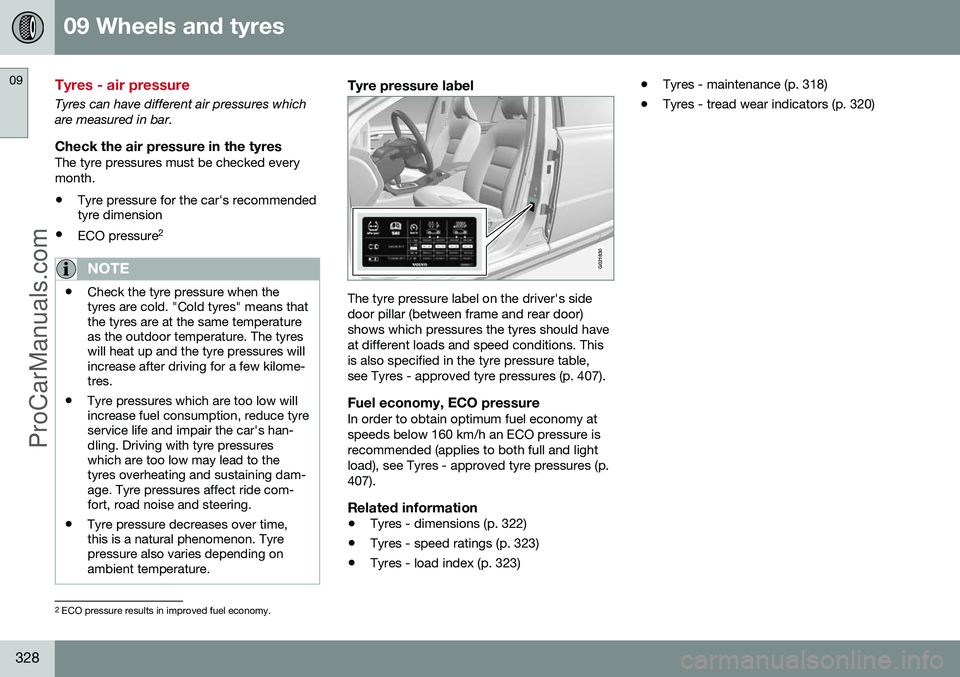
Tyre pressure label
G021830
The tyre pressure label on the driver's side door pillar (between frame and rear door)shows which pressures the tyres should haveat different loads and speed conditions. Thisis also specified in the tyre pressure table,see Tyres - approved tyre pressures (p. 407).
Fuel economy, ECO pressureIn order to obtain optimum fuel economy atspeeds below 160 km/h an ECO pressure isrecommended (applies to both full and lightload), see Tyres - approved tyre pressures (p.407).
Related information
•
Tyres - dimensions (p. 322)
• Tyres - speed ratings (p. 323)
• Tyres - load index (p. 323) •
Tyres - maintenance (p. 318)
• Tyres - tread wear indicators (p. 320)
2
ECO pressure results in improved fuel economy.
ProCarManuals.co’
Page 347 of 442
10 Maintenance and service
10
345
•
Power steering fluid - level (p. 351)
• Washer fluid - filling (p. 361)
Engine oil - general
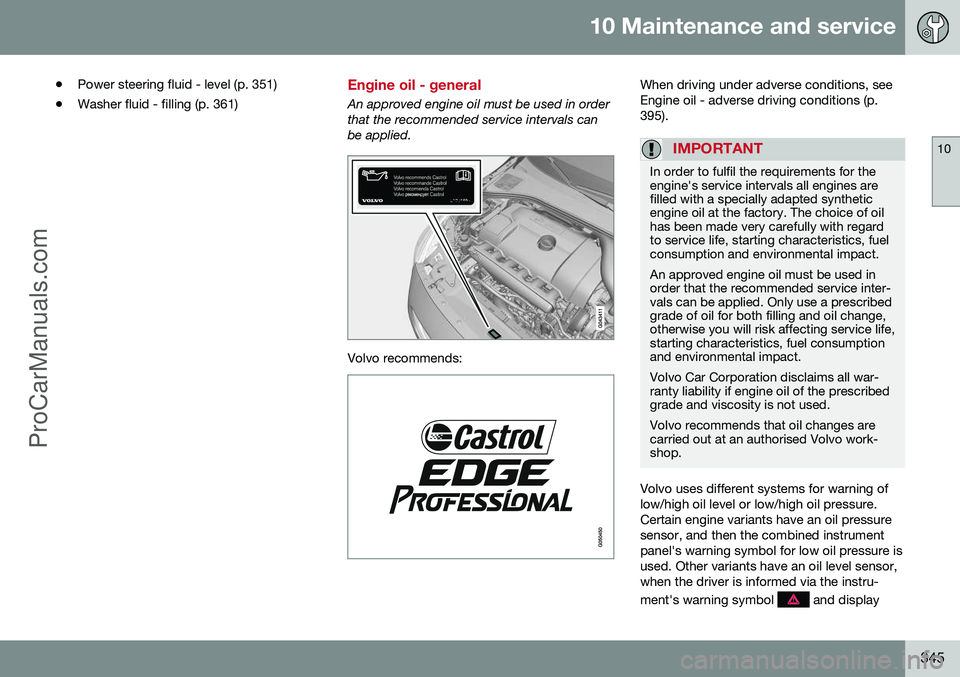
An approved engine oil must be used in order that the recommended service intervals canbe applied.
Volvo recommends:
When driving under adverse conditions, see Engine oil - adverse driving conditions (p.395).
IMPORTANT
In order to fulfil the requirements for the engine's service intervals all engines arefilled with a specially adapted syntheticengine oil at the factory. The choice of oilhas been made very carefully with regardto service life, starting characteristics, fuelconsumption and environmental impact. An approved engine oil must be used in order that the recommended service inter-vals can be applied. Only use a prescribedgrade of oil for both filling and oil change,otherwise you will risk affecting service life,starting characteristics, fuel consumptionand environmental impact. Volvo Car Corporation disclaims all war- ranty liability if engine oil of the prescribedgrade and viscosity is not used. Volvo recommends that oil changes are carried out at an authorised Volvo work-shop.
Volvo uses different systems for warning of low/high oil level or low/high oil pressure.Certain engine variants have an oil pressuresensor, and then the combined instrumentpanel's warning symbol for low oil pressure isused. Other variants have an oil level sensor,when the driver is informed via the instru- ment's warning symbol
and display
ProCarManuals.co’
Page 367 of 442
10 Maintenance and service
10
* Option/accessory, for more information, see Introduction.365
For more information on the car's battery - Electrical system (p. 410).
Battery - Start/Stop
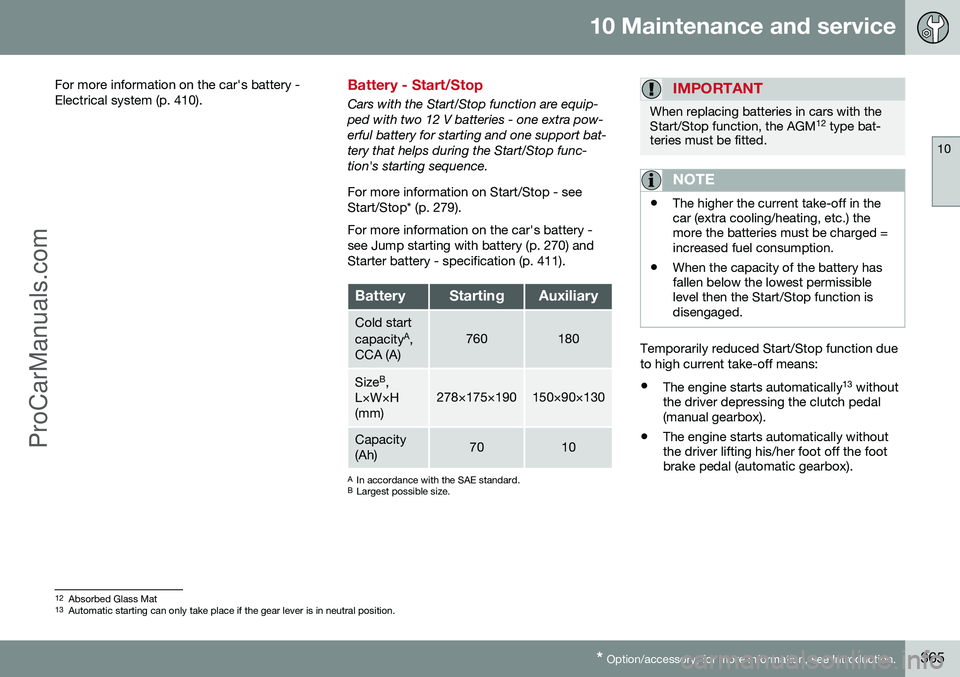
Cars with the Start/Stop function are equip- ped with two 12 V batteries - one extra pow-erful battery for starting and one support bat-tery that helps during the Start/Stop func-tion's starting sequence. For more information on Start/Stop - see Start/Stop* (p. 279). For more information on the car's battery - see Jump starting with battery (p. 270) andStarter battery - specification (p. 411).
BatteryStartingAuxiliary
Cold start capacity
A
,
CCA (A)760180
Size B
,
L×W×H (mm)278×175×190150×90×130
Capacity (Ah)7010
A In accordance with the SAE standard.
B Largest possible size.
IMPORTANT
When replacing batteries in cars with the Start/Stop function, the AGM 12
type bat-
teries must be fitted.
NOTE
• The higher the current take-off in the car (extra cooling/heating, etc.) themore the batteries must be charged =increased fuel consumption.
• When the capacity of the battery hasfallen below the lowest permissiblelevel then the Start/Stop function isdisengaged.
Temporarily reduced Start/Stop function due to high current take-off means: •
The engine starts automatically 13
without
the driver depressing the clutch pedal (manual gearbox).
• The engine starts automatically withoutthe driver lifting his/her foot off the footbrake pedal (automatic gearbox).
12
Absorbed Glass Mat
13 Automatic starting can only take place if the gear lever is in neutral position.
ProCarManuals.co’