battery VOLVO V60 2014 Owner's Manual
[x] Cancel search | Manufacturer: VOLVO, Model Year: 2014, Model line: V60, Model: VOLVO V60 2014Pages: 442, PDF Size: 13.85 MB
Page 175 of 442
06 Locks and alarm
06
173
Alarm signals
When the alarm (p. 171) is triggered a siren sounds and all direction indicators flash. •A siren sounds for 30 seconds or until the alarm is switched off. The siren has itsown battery and works independently ofthe car battery.
• The direction indicators flash for 5minutes or until the alarm is switched off.
Reduced alarm level
Reduced guard means that the movement and tilt detectors can be temporarily deacti-vated. To avoid accidental triggering of the alarm (p. 171) - e.g. if a dog is left in a locked car orduring transport on a car train or car ferry -temporarily deactivate the movement and tiltdetectors. The procedure is the same as with the tem- porary disengaging of deadlocks (p. 168) 5
.
Related information
• Alarm indicator (p. 172)
5
Only in combination with alarm.
ProCarManuals.co’
Page 261 of 442
08 Starting and driving
08
* Option/accessory, for more information, see Introduction.259
Alcolock*
The function of the Alcolock 1
is to prevent the
car from being driven by individuals under the influence of alcohol. Before the engine can bestarted the driver must take a breath test thatverifies that he/she is not under the influenceof alcohol. Alcolock calibration takes place inaccordance with each market's limit value inforce for driving legally.
WARNING
The Alcolock is an aid and does not exempt the driver from responsibility. It isalways the responsibility of the driver to besober and to drive the car safely.
Related information
• Alcolock* - functions and operation (p. 259)
• Alcolock* - to bear in mind (p. 261)
• Alcolock* - storage (p. 260)
• Alcolock* - before starting the engine (p.260)
• Alcolock* - symbols and text messages(p. 263)
Alcolock* - functions and operation
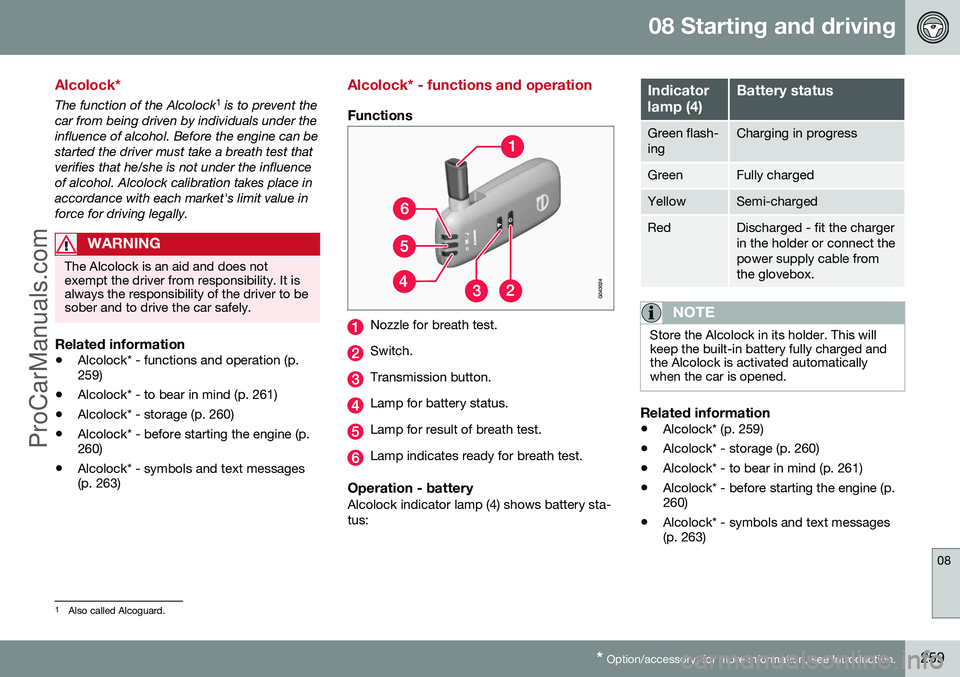
Functions
Nozzle for breath test.
Switch.
Transmission button.
Lamp for battery status.
Lamp for result of breath test.
Lamp indicates ready for breath test.
Operation - batteryAlcolock indicator lamp (4) shows battery sta- tus:
Indicator lamp (4)Battery status
Green flash- ingCharging in progress
GreenFully charged
YellowSemi-charged
RedDischarged - fit the charger in the holder or connect thepower supply cable fromthe glovebox.
NOTE
Store the Alcolock in its holder. This will keep the built-in battery fully charged andthe Alcolock is activated automaticallywhen the car is opened.
Related information
•Alcolock* (p. 259)
• Alcolock* - storage (p. 260)
• Alcolock* - to bear in mind (p. 261)
• Alcolock* - before starting the engine (p. 260)
• Alcolock* - symbols and text messages(p. 263)
1
Also called Alcoguard.
ProCarManuals.co’
Page 266 of 442
08 Starting and driving
08
264* Option/accessory, for more information, see Introduction.
Starting the engine
The engine is started and switched off using the remote control key and the START/STOP
ENGINE button.
Petrol and diesel engine
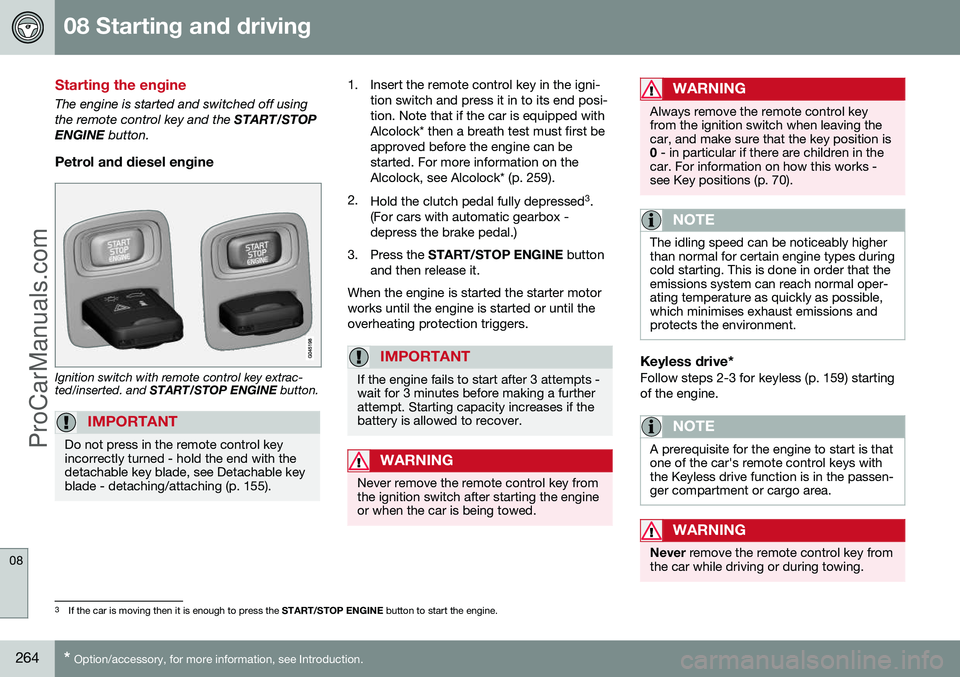
Ignition switch with remote control key extrac- ted/inserted. and START/STOP ENGINE button.
IMPORTANT
Do not press in the remote control key incorrectly turned - hold the end with thedetachable key blade, see Detachable keyblade - detaching/attaching (p. 155).
1. Insert the remote control key in the igni-
tion switch and press it in to its end posi- tion. Note that if the car is equipped withAlcolock* then a breath test must first beapproved before the engine can bestarted. For more information on theAlcolock, see Alcolock* (p. 259).
2. Hold the clutch pedal fully depressed 3
.
(For cars with automatic gearbox -depress the brake pedal.)
3. Press the START/STOP ENGINE button
and then release it.
When the engine is started the starter motorworks until the engine is started or until theoverheating protection triggers.
IMPORTANT
If the engine fails to start after 3 attempts - wait for 3 minutes before making a furtherattempt. Starting capacity increases if thebattery is allowed to recover.
WARNING
Never remove the remote control key from the ignition switch after starting the engineor when the car is being towed.
WARNING
Always remove the remote control key from the ignition switch when leaving thecar, and make sure that the key position is0 - in particular if there are children in the
car. For information on how this works -see Key positions (p. 70).
NOTE
The idling speed can be noticeably higher than normal for certain engine types duringcold starting. This is done in order that theemissions system can reach normal oper-ating temperature as quickly as possible,which minimises exhaust emissions andprotects the environment.
Keyless drive*Follow steps 2-3 for keyless (p. 159) starting of the engine.
NOTE
A prerequisite for the engine to start is that one of the car's remote control keys withthe Keyless drive function is in the passen-ger compartment or cargo area.
WARNING
Never remove the remote control key from
the car while driving or during towing.
3 If the car is moving then it is enough to press the START/STOP ENGINE button to start the engine.
ProCarManuals.co’
Page 268 of 442
08 Starting and driving
08
266* Option/accessory, for more information, see Introduction.
Remote start (ERS)*
Remote start (ERS – Engine Remote Start) means that the car's engine can be startedremotely using the remote control key or thePCC key. This is so that the passenger com-partment can be warmed up/cooled downbefore departure. The climate control system and audio system start with the same settings that were in usewhen the car was parked. An ERS-started engine is activated for a maximum of 15 minutes, then it is switchedoff. After two ERS-activations the enginemust be started in the normal way beforeERS can be re-used. The optional ERS function is available on most cars with automatic gearbox.
NOTE
The service life of the remote control key's battery is affected by the ERS function. Inthe event of frequent use of ERS the bat-tery should therefore be changed once peryear, see Remote control key/PCC -replacing the battery (p. 158).
NOTE
Follow local/national rules/regulations on idling.
WARNING
To remote-start the engine, the following criteria must be met:
• The car must be supervised.
• There must be no people or animals inside the car.
• The car must not be parked in aclosed, unventilated area - the exhaustgases may seriously injure humansand animals.
Related information
•
Remote start (ERS) - operation (p. 266)
• Remote start (ERS) - symbols and mes- sages (p. 268)
Remote start (ERS) - operation
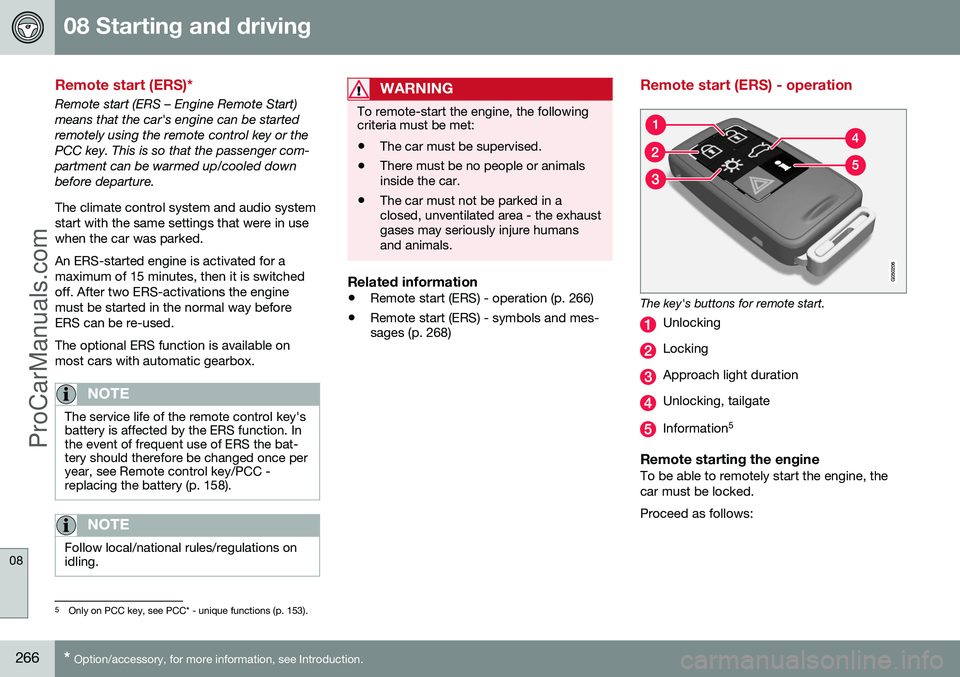
The key's buttons for remote start.
Unlocking
Locking
Approach light duration
Unlocking, tailgate
Information 5
Remote starting the engineTo be able to remotely start the engine, the car must be locked. Proceed as follows:
5
Only on PCC key, see PCC* - unique functions (p. 153).
ProCarManuals.co’
Page 270 of 442
08 Starting and driving
08
268* Option/accessory, for more information, see Introduction.
Remote start (ERS) - symbols and messages
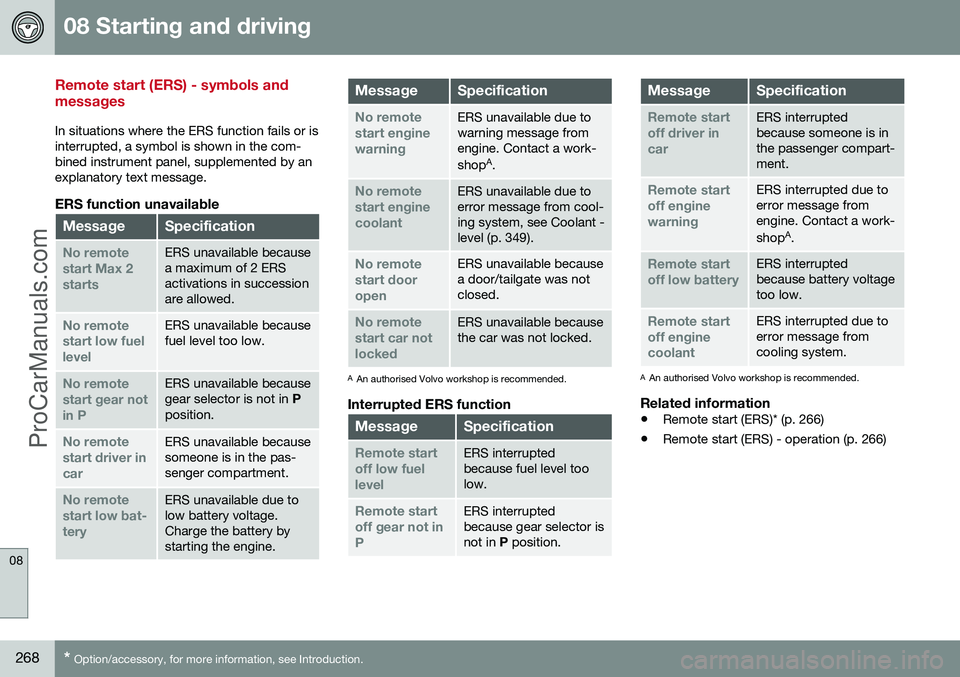
In situations where the ERS function fails or is interrupted, a symbol is shown in the com-bined instrument panel, supplemented by anexplanatory text message.
ERS function unavailable
MessageSpecification
No remote start Max 2startsERS unavailable because a maximum of 2 ERSactivations in successionare allowed.
No remote start low fuellevelERS unavailable because fuel level too low.
No remote start gear notin PERS unavailable because gear selector is not in P
position.
No remote start driver incarERS unavailable because someone is in the pas-senger compartment.
No remote start low bat-teryERS unavailable due to low battery voltage.Charge the battery bystarting the engine.
MessageSpecification
No remote start enginewarningERS unavailable due to warning message fromengine. Contact a work- shop A
.
No remote start enginecoolantERS unavailable due to error message from cool-ing system, see Coolant -level (p. 349).
No remote start dooropenERS unavailable because a door/tailgate was notclosed.
No remote start car notlockedERS unavailable because the car was not locked.
A An authorised Volvo workshop is recommended.
Interrupted ERS function
MessageSpecification
Remote start off low fuellevelERS interrupted because fuel level toolow.
Remote start off gear not inPERS interrupted because gear selector isnot in P position.
MessageSpecification
Remote start off driver incarERS interrupted because someone is inthe passenger compart-ment.
Remote start off enginewarningERS interrupted due to error message fromengine. Contact a work- shop A
.
Remote start off low batteryERS interrupted because battery voltagetoo low.
Remote start off enginecoolantERS interrupted due to error message fromcooling system.
A An authorised Volvo workshop is recommended.
Related information
• Remote start (ERS)* (p. 266)
• Remote start (ERS) - operation (p. 266)
ProCarManuals.co’
Page 272 of 442
||
08 Starting and driving
08
270
IMPORTANT
After the fuel mixture in the tank has been changed an adaptation should be made bydriving at an even speed for about 15minutes.
If the battery has been discharged or discon- nected then a slightly longer period of drivingis required for the adaptation as the memoryfor the electronics has been cleared.
Related information
•Jump starting with battery (p. 270)
• Starting the engine (p. 264)
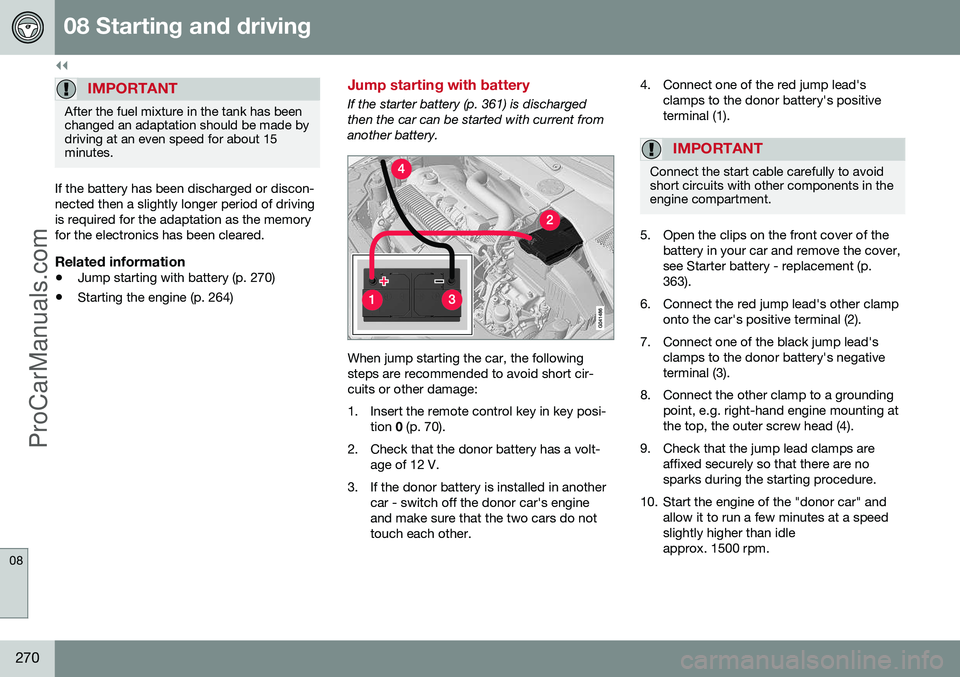
Jump starting with battery
If the starter battery (p. 361) is discharged then the car can be started with current fromanother battery.
When jump starting the car, the following steps are recommended to avoid short cir-cuits or other damage:
1. Insert the remote control key in key posi-
tion 0 (p. 70).
2. Check that the donor battery has a volt- age of 12 V.
3. If the donor battery is installed in another car - switch off the donor car's engine and make sure that the two cars do nottouch each other. 4. Connect one of the red jump lead's
clamps to the donor battery's positiveterminal (1).
IMPORTANT
Connect the start cable carefully to avoid short circuits with other components in theengine compartment.
5. Open the clips on the front cover of thebattery in your car and remove the cover, see Starter battery - replacement (p.363).
6. Connect the red jump lead's other clamp onto the car's positive terminal (2).
7. Connect one of the black jump lead's clamps to the donor battery's negativeterminal (3).
8. Connect the other clamp to a grounding point, e.g. right-hand engine mounting atthe top, the outer screw head (4).
9. Check that the jump lead clamps are affixed securely so that there are nosparks during the starting procedure.
10. Start the engine of the "donor car" and allow it to run a few minutes at a speedslightly higher than idleapprox. 1500 rpm.
ProCarManuals.co’
Page 273 of 442
08 Starting and driving
08
* Option/accessory, for more information, see Introduction.271
11. Start the engine in the car with the dis-
charged battery.
IMPORTANT
Do not touch the crocodile clips during the start procedure. There is a risk of sparksforming.
12. Remove the jump leads in reverse order -first the black and then the red.
> Make sure that none of the black jumplead's clamps comes into contact with the battery's positive terminal or theclamp connected to the red jump lead!
WARNING
• The battery can generate oxyhydrogen gas, which is highly explosive. A sparkcan be formed if a jump lead is con-nected incorrectly, and this can beenough for the battery to explode.
• The battery contains sulphuric acid,which can cause serious burns.
• If sulphuric acid comes into contactwith eyes, skin or clothing, flush withlarge quantities of water. If acidsplashes into the eyes - seek medicalattention immediately.
Related information
•
Starting the engine (p. 264)
Gearboxes
There are two main types of gearbox. Manual gearbox and automatic gearbox.
• Manual gearbox (p. 271)
• Automatic gearbox - Geartronic (p. 273) and Powershift (p. 276)
IMPORTANT
To prevent damage to any drive system components, the working temperature ofthe gearbox is checked. If there is a risk ofoverheating, a warning symbol is illumi-nated in the combined instrument panel inconjunction with a text message beingshown. Follow the recommendation givenin the text message.
Related information
•Automatic gearbox -- Geartronic* (p. 273)
Manual gearbox
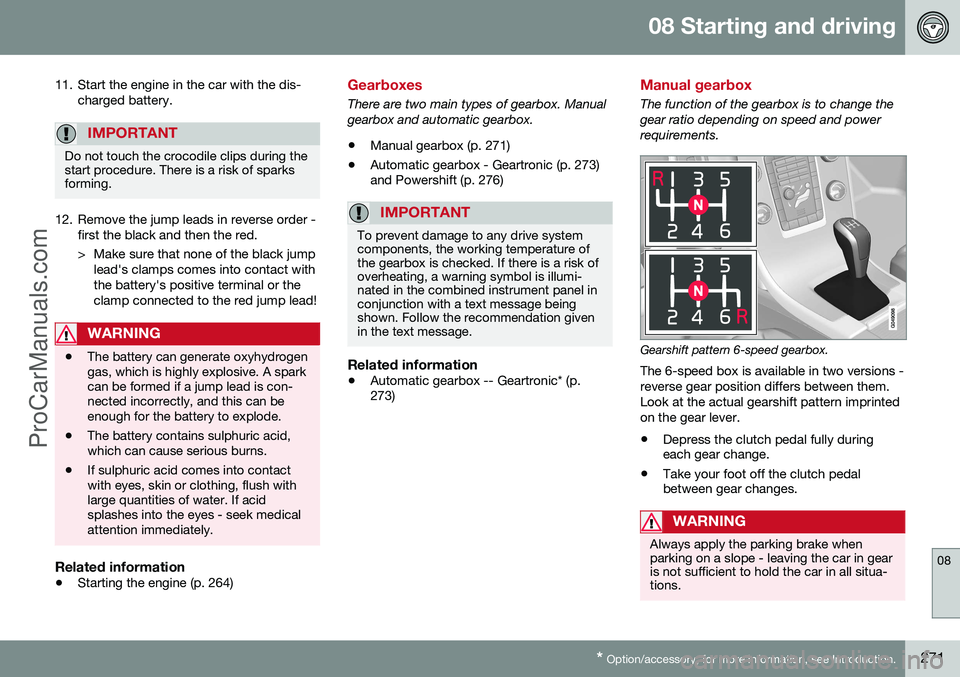
The function of the gearbox is to change the gear ratio depending on speed and powerrequirements.
Gearshift pattern 6-speed gearbox.
The 6-speed box is available in two versions - reverse gear position differs between them.Look at the actual gearshift pattern imprintedon the gear lever. • Depress the clutch pedal fully during each gear change.
• Take your foot off the clutch pedalbetween gear changes.
WARNING
Always apply the parking brake when parking on a slope - leaving the car in gearis not sufficient to hold the car in all situa-tions.
ProCarManuals.co’
Page 280 of 442
08 Starting and driving
08
278
Gear selector inhibitor
There are two different types of gear selector inhibitor - mechanical and automatic.
Mechanical gear selector inhibitor
G021351
The gear selector can be moved forward and back freely between N and D. Other positions
are locked with a latch that is released withthe inhibitor button on the gear selector. With the inhibitor button depressed the lever can be moved forwards or backwardsbetween P, R , N and D.
Automatic gear selector inhibitorThe automatic gearbox has special safetysystems: Parking position (P) Stationary car with engine running: •
Keep your foot on the brake pedal when moving the gear selector to another posi-tion.
Electric gear inhibitor – Shiftlock
Parking position (P)
To be able to move the gear selector from P
to other gear positions, the brake pedal must be depressed and the remote control keymust be in key position II (p. 70).
Shiftlock – Neutral (N)If the gear selector is in N position and the
car has been stationary for at least 3 seconds(irrespective of whether the engine is running)then the gear selector is locked. To be able to move the gear selector from N
to other gear positions, the brake pedal must be depressed and the remote control keymust be in key position II.
Deactivate automatic gear selector inhibitor
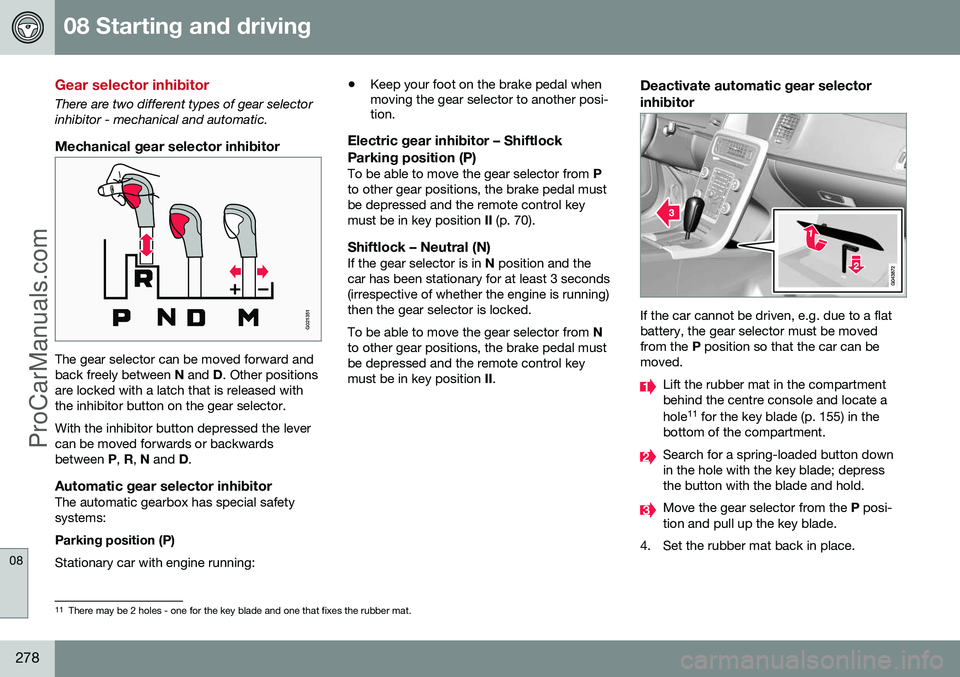
If the car cannot be driven, e.g. due to a flat battery, the gear selector must be movedfrom the P position so that the car can be
moved.
Lift the rubber mat in the compartment behind the centre console and locate a hole 11
for the key blade (p. 155) in the
bottom of the compartment.
Search for a spring-loaded button down in the hole with the key blade; depressthe button with the blade and hold.
Move the gear selector from the P posi-
tion and pull up the key blade.
4. Set the rubber mat back in place.
11 There may be 2 holes - one for the key blade and one that fixes the rubber mat.
ProCarManuals.co’
Page 282 of 442
||
08 Starting and driving
08
280* Option/accessory, for more information, see Introduction.
The Start/Stop function gives the driver the opportunity for a more active environmentallyconscious way of driving the car by means ofbeing able to allow the engine to stop auto-matically, whenever appropriate. Manual or Automatic Note that there are differences in the Start/Stop function depending on whether thegearbox is manual or automatic.
Related information
• Start/Stop* - function and operation (p. 280)
• Starting the engine (p. 264)
• Start/Stop* - settings (p. 285)
• Start/Stop* - the engine does not auto-start (p. 284)
• Start/Stop* - the engine auto-starts (p.283)
• Start/Stop* - the engine does not stop (p.282)
• Start/Stop* - involuntary engine stoppagemanual gearbox (p. 284)
• Start/Stop* - symbols and messages (p.286)
• Battery - Start/Stop (p. 365)
Start/Stop* - function and operation
Some engine and gearbox combinations are equipped with a Start/Stop function whichengages in the event of e.g. stationary trafficor waiting at traffic lights. The Start/Stopfunction is activated automatically when theengine is started with the key.
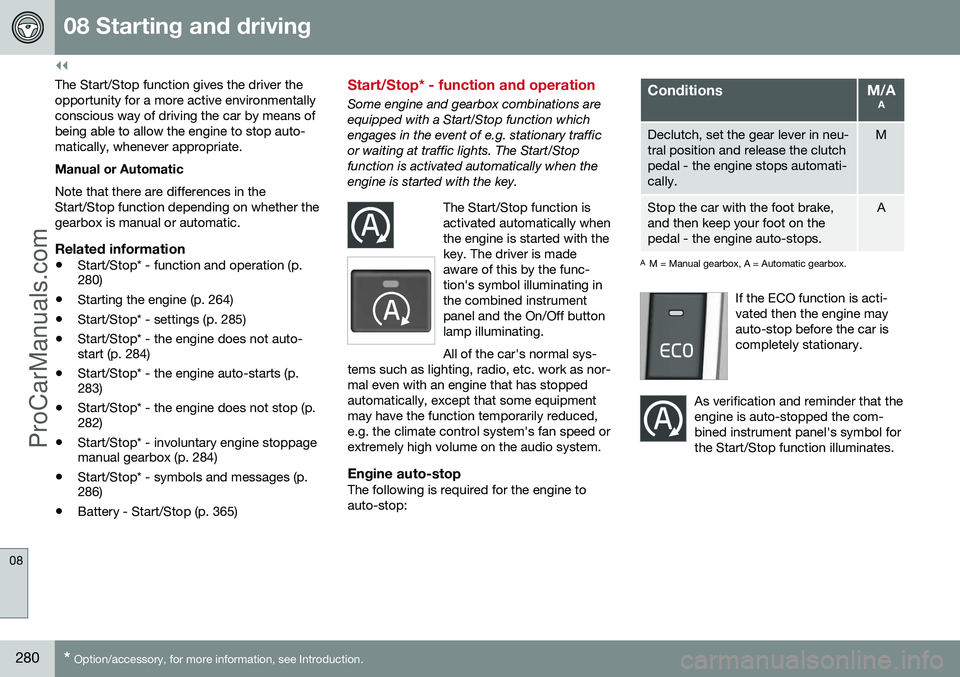
The Start/Stop function isactivated automatically whenthe engine is started with thekey. The driver is madeaware of this by the func-tion's symbol illuminating inthe combined instrumentpanel and the On/Off buttonlamp illuminating. All of the car's normal sys-
tems such as lighting, radio, etc. work as nor- mal even with an engine that has stoppedautomatically, except that some equipmentmay have the function temporarily reduced,e.g. the climate control system's fan speed orextremely high volume on the audio system.
Engine auto-stopThe following is required for the engine to auto-stop:
ConditionsM/A A
Declutch, set the gear lever in neu- tral position and release the clutchpedal - the engine stops automati-cally.M
Stop the car with the foot brake, and then keep your foot on thepedal - the engine auto-stops.A
AM = Manual gearbox, A = Automatic gearbox.
If the ECO function is acti- vated then the engine mayauto-stop before the car iscompletely stationary.
As verification and reminder that the engine is auto-stopped the com-bined instrument panel's symbol forthe Start/Stop function illuminates.
ProCarManuals.co’
Page 283 of 442
08 Starting and driving
08
* Option/accessory, for more information, see Introduction.281
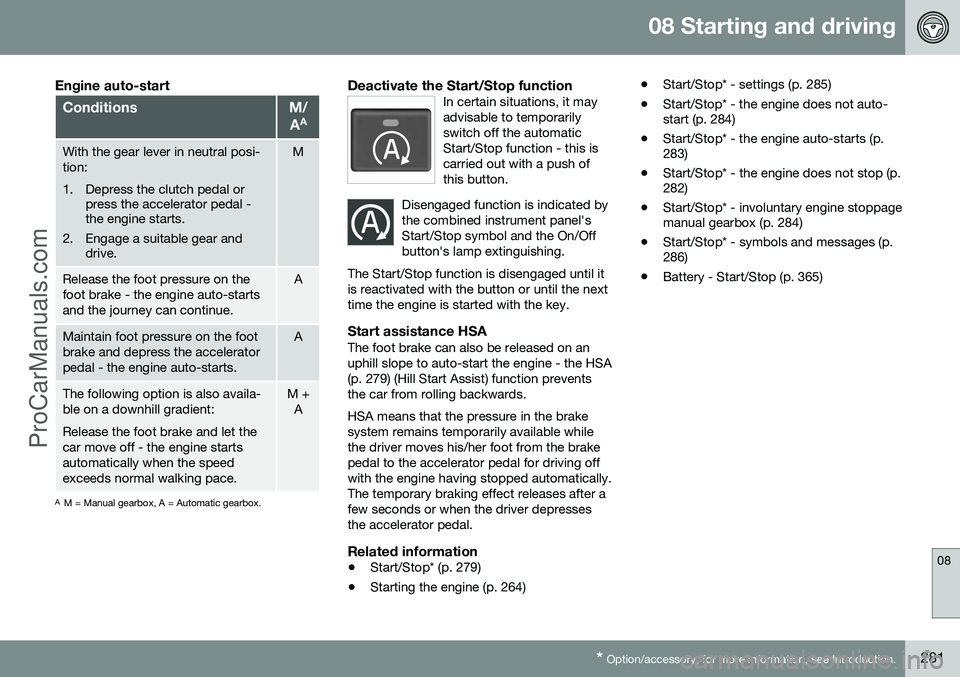
Engine auto-start
ConditionsM/
A A
With the gear lever in neutral posi- tion:
1. Depress the clutch pedal or
press the accelerator pedal - the engine starts.
2. Engage a suitable gear and drive.M
Release the foot pressure on the foot brake - the engine auto-startsand the journey can continue.A
Maintain foot pressure on the foot brake and depress the acceleratorpedal - the engine auto-starts.A
The following option is also availa- ble on a downhill gradient: Release the foot brake and let the car move off - the engine startsautomatically when the speedexceeds normal walking pace.M +
A
A M = Manual gearbox, A = Automatic gearbox.
Deactivate the Start/Stop functionIn certain situations, it may advisable to temporarilyswitch off the automaticStart/Stop function - this iscarried out with a push ofthis button.
Disengaged function is indicated by the combined instrument panel'sStart/Stop symbol and the On/Offbutton's lamp extinguishing.
The Start/Stop function is disengaged until it is reactivated with the button or until the nexttime the engine is started with the key.
Start assistance HSAThe foot brake can also be released on anuphill slope to auto-start the engine - the HSA(p. 279) (Hill Start Assist) function preventsthe car from rolling backwards. HSA means that the pressure in the brake system remains temporarily available whilethe driver moves his/her foot from the brakepedal to the accelerator pedal for driving offwith the engine having stopped automatically.The temporary braking effect releases after afew seconds or when the driver depressesthe accelerator pedal.
Related information
• Start/Stop* (p. 279)
• Starting the engine (p. 264) •
Start/Stop* - settings (p. 285)
• Start/Stop* - the engine does not auto- start (p. 284)
• Start/Stop* - the engine auto-starts (p.283)
• Start/Stop* - the engine does not stop (p.282)
• Start/Stop* - involuntary engine stoppagemanual gearbox (p. 284)
• Start/Stop* - symbols and messages (p.286)
• Battery - Start/Stop (p. 365)
ProCarManuals.co’