battery VOLVO V60 2014 User Guide
[x] Cancel search | Manufacturer: VOLVO, Model Year: 2014, Model line: V60, Model: VOLVO V60 2014Pages: 442, PDF Size: 13.85 MB
Page 134 of 442
04 Climate control
04
132* Option/accessory, for more information, see Introduction.
Engine block heater and passenger compartment heater* - messages
Symbols and display messages regarding the engine block and passenger compartment
heater (p. 129) differ depending on whetherthe combined instrument panel (p. 59) is ana-logue or digital.
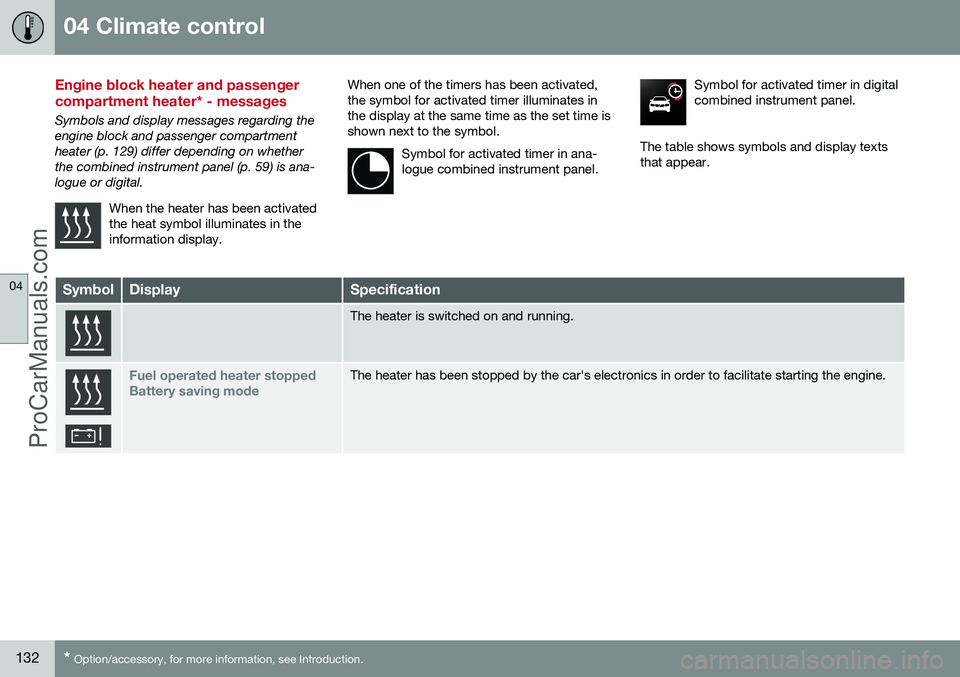
When the heater has been activatedthe heat symbol illuminates in theinformation display.
When one of the timers has been activated, the symbol for activated timer illuminates inthe display at the same time as the set time isshown next to the symbol.Symbol for activated timer in ana-logue combined instrument panel.Symbol for activated timer in digital combined instrument panel.
The table shows symbols and display texts that appear.
SymbolDisplaySpecification
The heater is switched on and running.
Fuel operated heater stopped Battery saving modeThe heater has been stopped by the car's electronics in order to facilitate starting the engine.
ProCarManuals.co’
Page 143 of 442
05 Loading and storage
05
* Option/accessory, for more information, see Introduction.141
Tunnel console - 12 V-sockets
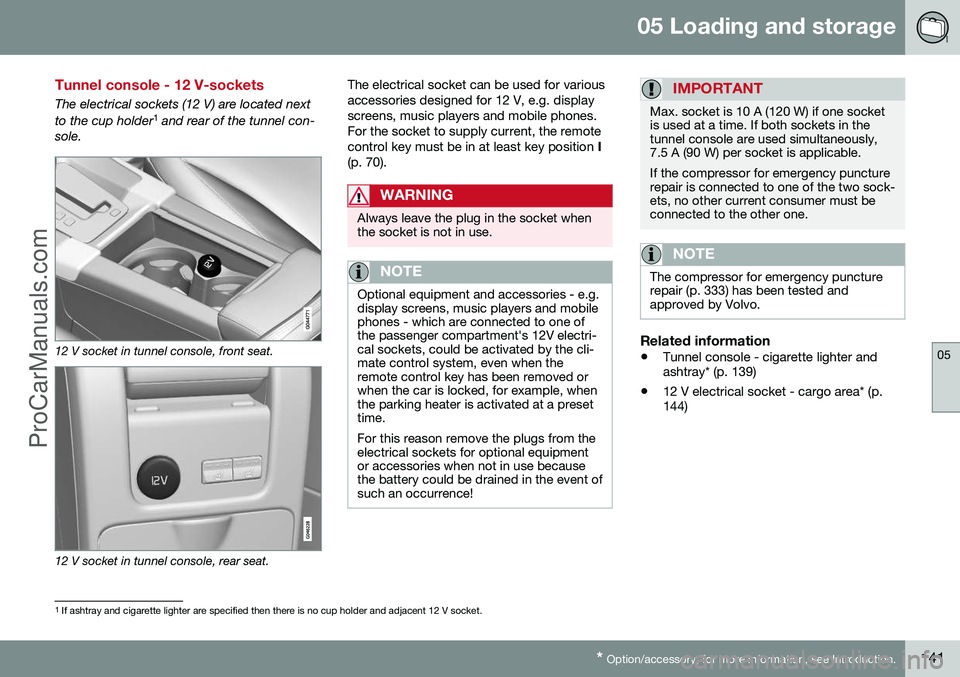
The electrical sockets (12 V) are located next to the cup holder 1
and rear of the tunnel con-
sole.
12 V socket in tunnel console, front seat.
12 V socket in tunnel console, rear seat. The electrical socket can be used for various accessories designed for 12 V, e.g. displayscreens, music players and mobile phones.For the socket to supply current, the remotecontrol key must be in at least key position
I
(p. 70).
WARNING
Always leave the plug in the socket when the socket is not in use.
NOTE
Optional equipment and accessories - e.g. display screens, music players and mobilephones - which are connected to one ofthe passenger compartment's 12V electri-cal sockets, could be activated by the cli-mate control system, even when theremote control key has been removed orwhen the car is locked, for example, whenthe parking heater is activated at a presettime. For this reason remove the plugs from the electrical sockets for optional equipmentor accessories when not in use becausethe battery could be drained in the event ofsuch an occurrence!
IMPORTANT
Max. socket is 10 A (120 W) if one socket is used at a time. If both sockets in thetunnel console are used simultaneously,7.5 A (90 W) per socket is applicable. If the compressor for emergency puncture repair is connected to one of the two sock-ets, no other current consumer must beconnected to the other one.
NOTE
The compressor for emergency puncture repair (p. 333) has been tested andapproved by Volvo.
Related information
• Tunnel console - cigarette lighter and ashtray* (p. 139)
• 12 V electrical socket - cargo area* (p.144)
1
If ashtray and cigarette lighter are specified then there is no cup holder and adjacent 12 V socket.
ProCarManuals.co’
Page 146 of 442
05 Loading and storage
05
144* Option/accessory, for more information, see Introduction.
Loading - bag holder
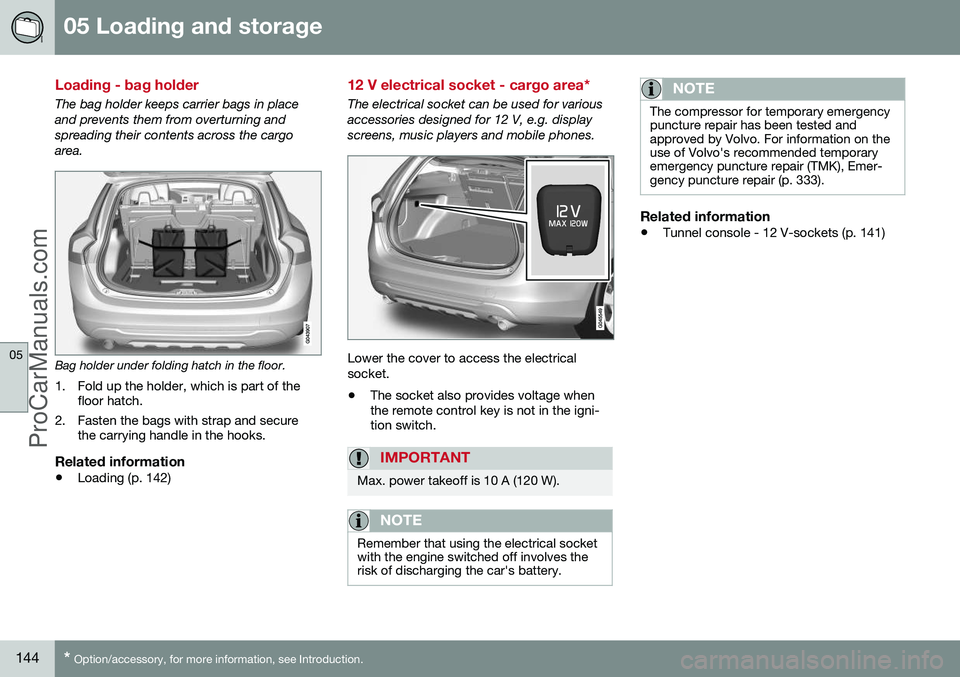
The bag holder keeps carrier bags in place and prevents them from overturning andspreading their contents across the cargoarea.
Bag holder under folding hatch in the floor.
1. Fold up the holder, which is part of the floor hatch.
2. Fasten the bags with strap and secure the carrying handle in the hooks.
Related information
• Loading (p. 142)
12 V electrical socket - cargo area*
The electrical socket can be used for various accessories designed for 12 V, e.g. displayscreens, music players and mobile phones.
Lower the cover to access the electrical socket. •The socket also provides voltage when the remote control key is not in the igni-tion switch.
IMPORTANT
Max. power takeoff is 10 A (120 W).
NOTE
Remember that using the electrical socket with the engine switched off involves therisk of discharging the car's battery.
NOTE
The compressor for temporary emergency puncture repair has been tested andapproved by Volvo. For information on theuse of Volvo's recommended temporaryemergency puncture repair (TMK), Emer-gency puncture repair (p. 333).
Related information
• Tunnel console - 12 V-sockets (p. 141)
ProCarManuals.co’
Page 158 of 442
||
06 Locks and alarm
06
156* Option/accessory, for more information, see Introduction.
Related information
• Detachable key blade - unlocking doors (p. 156)
• Child safety locks - manual activation (p.169)
• Passenger airbag - activating/deactivat-ing* (p. 30)
Detachable key blade - unlocking doors
The detachable key blade (p. 155) can be used if central locking cannot be activatedwith the remote control key (p. 149), e.g. if thekey's battery has run out. If central locking cannot be activated with the remote control key - e.g. if the batteries aredischarged - then the left-hand front door canbe opened as follows:
1. Unlock the left-hand front door with the
key blade in the door handle's lock cylin- der. For illustration and more information,see Keyless drive* - unlocking with thekey blade (p. 162).
NOTE
When the door has been unlocked using the key blade and is opened, the alarm istriggered.
2. Deactivate the alarm by inserting theremote control key in the ignition switch.
For cars with the Keyless system, see Keyless drive* - unlocking with the key blade(p. 162).
Related information
• Remote control key with key blade (p. 149)
• Remote control key/PCC - replacing thebattery (p. 158)
Privacy locking*
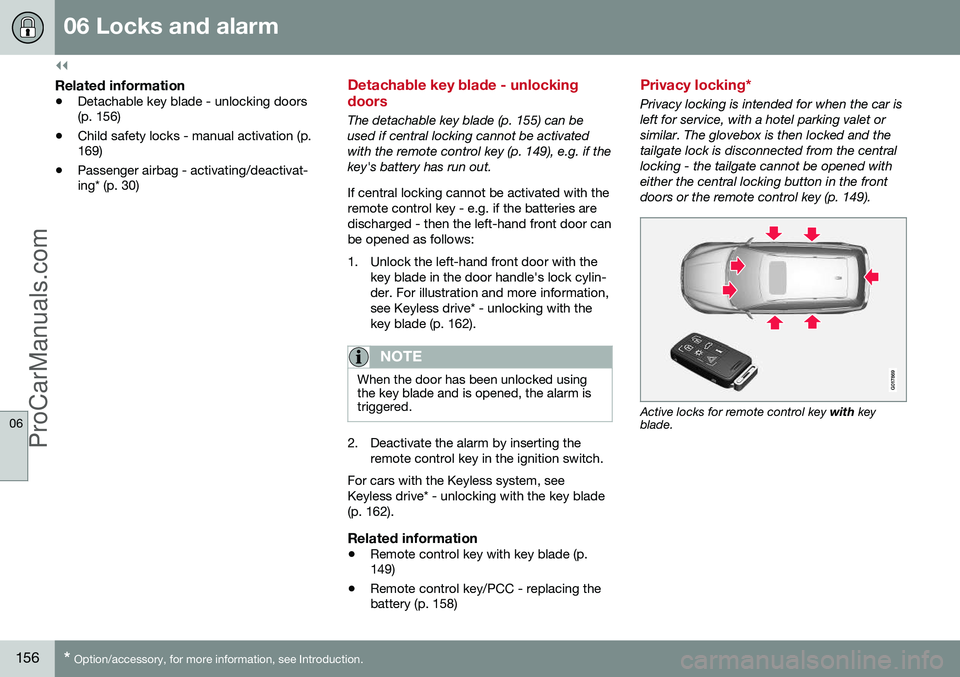
Privacy locking is intended for when the car is left for service, with a hotel parking valet orsimilar. The glovebox is then locked and thetailgate lock is disconnected from the centrallocking - the tailgate cannot be opened witheither the central locking button in the frontdoors or the remote control key (p. 149).
G017869
Active locks for remote control key
with key
blade.
ProCarManuals.com
Page 160 of 442
06 Locks and alarm
06
158* Option/accessory, for more information, see Introduction.
Remote control key/PCC - replacing the battery
The batteries for the remote control key/PCC can be replaced. The batteries for the remote control key/PCC should be replaced if: • the information symbol in the combined instrument panel illuminates and the dis- play shows
Low battery in remote
control. Please change batteries.
and/or
• the locks repeatedly do not react to sig- nals from the remote control key within20 metres from the car.
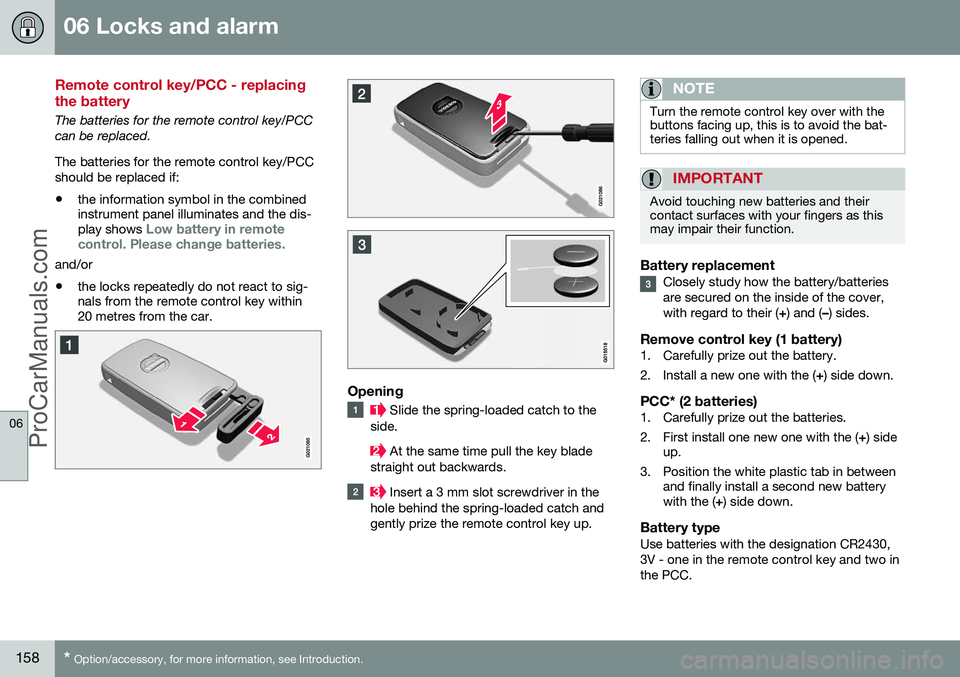
Opening
Slide the spring-loaded catch to the
side.
At the same time pull the key blade
straight out backwards.
Insert a 3 mm slot screwdriver in the
hole behind the spring-loaded catch and gently prize the remote control key up.
NOTE
Turn the remote control key over with the buttons facing up, this is to avoid the bat-teries falling out when it is opened.
IMPORTANT
Avoid touching new batteries and their contact surfaces with your fingers as thismay impair their function.
Battery replacementClosely study how the battery/batteries are secured on the inside of the cover,with regard to their ( +) and ( –) sides.
Remove control key (1 battery)1. Carefully prize out the battery.
2. Install a new one with the ( +) side down.
PCC* (2 batteries)1. Carefully prize out the batteries.
2. First install one new one with the ( +) side
up.
3. Position the white plastic tab in between and finally install a second new battery with the ( +) side down.
Battery typeUse batteries with the designation CR2430, 3V - one in the remote control key and two inthe PCC.
ProCarManuals.co’
Page 162 of 442
||
06 Locks and alarm
06
160* Option/accessory, for more information, see Introduction.
When the PCC has been returned to the car, the warning message goes off and the audi-ble reminder ceases once either/or:
• a door has been opened and closed
• the PCC is inserted into the ignition switch
• the
OK button has been pressed.
Related information
• Keyless drive* (p. 159)
• Keyless drive* - antenna location (p. 163)
Keyless drive* - handling the PCC safely
It is important to handle all remote control keys with great care. If a PCC with keyless function is left in the car, it is deactivated temporarily when the caris locked. This prevents unauthorised entry. However, if someone breaks into the car and finds the PCC, it can be reactivated. It istherefore important to handle all PCCs withgreat care.
IMPORTANT
Never leave a PCC in the car.
Related information
•
Keyless drive* (p. 159)
Keyless drive* - interference to PCC function
Electromagnetic fields and screening can interfere with the Keyless function.
NOTE
Do not place/store the PCC near a mobile phone or metal object - no closer than10-15 cm.
If interference is experienced nonetheless, use the PCC and the key blade as a remotecontrol key, see Remote control key - func-tions (p. 151).
Related information
• Remote control key/PCC - replacing the battery (p. 158)
• Keyless drive* - handling the PCC safely(p. 160)
• Keyless drive* - PCC range (p. 159)
ProCarManuals.co’
Page 166 of 442
||
06 Locks and alarm
06
164* Option/accessory, for more information, see Introduction.
WARNING
People who have had a pacemaker opera- tion should not come closer than 22 cm tothe Keyless system's antennas with theirpacemaker. This is to prevent interferencebetween the pacemaker and the Keylesssystem.
Related information
• Keyless drive* (p. 159)
Locking/unlocking - from the outside
Locking/unlocking from the outside is carried out using the remote control key (p. 149). Theremote control key can lock/unlock all doorsand the tailgate simultaneously. Differentsequences for unlocking can be selected, seeRemote control key - functions (p. 151). In order that the lock sequence can be acti- vated, the driver's door must be closed - ifany of the other doors or the tailgate is open,then it/they is/are locked and the alarm isactivated only when it/they are closed. Withthe Keyless* system all the doors and tailgatemust be closed.
NOTE
Be aware of the risk of locking the remote control key in the car.
If it is not possible to lock/unlock with the remote control key, the battery may be dis-charged - lock or unlock the left-hand frontdoor with the detachable key blade, seeDetachable key blade - detaching/attaching(p. 155).
NOTE
Remember that the alarm is triggered when the door is opened after beingunlocked with the key blade - the alarm isswitched off when the remote control keyis inserted into the ignition switch.
WARNING
Be aware of the risk of being locked in the car when it is locked from the outsideusing the remote control key - it is then notpossible to open any of the doors from theinside with the door controls. For moreinformation, see Deadlocks* (p. 168).
Automatic relockingIf none of the doors or the tailgate is opened within two minutes of unlocking, all arelocked again automatically. This functionreduces the risk that the car is left unlockedunintentionally. (For cars with alarm, seeAlarm (p. 171).)
Related information
•Locking/unlocking - from the inside (p. 165)
• Locking/unlocking - from the outside (p.164)
ProCarManuals.co’
Page 167 of 442
06 Locks and alarm
06
* Option/accessory, for more information, see Introduction.165
Manual locking of the door
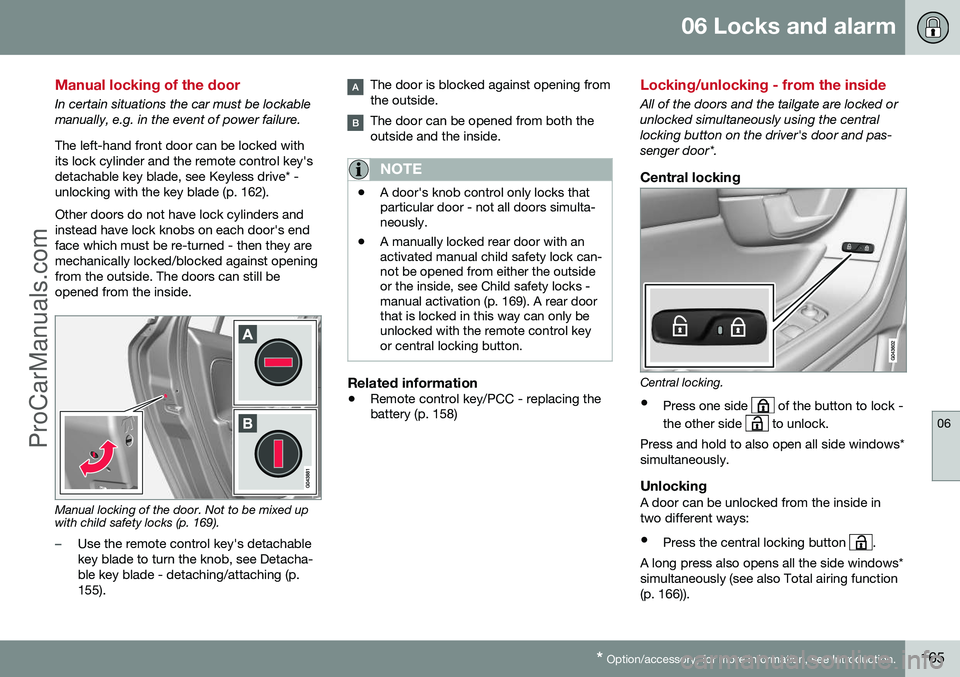
In certain situations the car must be lockable manually, e.g. in the event of power failure. The left-hand front door can be locked with its lock cylinder and the remote control key'sdetachable key blade, see Keyless drive* -unlocking with the key blade (p. 162). Other doors do not have lock cylinders and instead have lock knobs on each door's endface which must be re-turned - then they aremechanically locked/blocked against openingfrom the outside. The doors can still beopened from the inside.
Manual locking of the door. Not to be mixed up with child safety locks (p. 169).
–Use the remote control key's detachable key blade to turn the knob, see Detacha-ble key blade - detaching/attaching (p.155).
The door is blocked against opening from the outside.
The door can be opened from both the outside and the inside.
NOTE
• A door's knob control only locks that particular door - not all doors simulta-neously.
• A manually locked rear door with anactivated manual child safety lock can-not be opened from either the outsideor the inside, see Child safety locks -manual activation (p. 169). A rear doorthat is locked in this way can only beunlocked with the remote control keyor central locking button.
Related information
•
Remote control key/PCC - replacing the battery (p. 158)
Locking/unlocking - from the inside
All of the doors and the tailgate are locked or unlocked simultaneously using the centrallocking button on the driver's door and pas-senger door*.
Central locking
Central locking.
• Press one side
of the button to lock -
the other side
to unlock.
Press and hold to also open all side windows* simultaneously.
UnlockingA door can be unlocked from the inside intwo different ways:
• Press the central locking button
.
A long press also opens all the side windows* simultaneously (see also Total airing function(p. 166)).
ProCarManuals.co’
Page 173 of 442
06 Locks and alarm
06
* Option/accessory, for more information, see Introduction.171
Alarm
The alarm is a device that warns in the event of e.g. a break-in in the car. Activated alarm is triggered if:
• a door, the bonnet or the tailgate is opened
• a movement is detected in the passengercompartment (if fitted with a movementdetector*)
• the car is raised or towed away (if fittedwith a tilt detector*)
• the battery's cable is disconnected
• the siren is disconnected.
If there is a fault in the alarm system then the information display in the combined instru-ment panel shows a message. In which case,contact a workshop - an authorised Volvoworkshop is recommended.NOTE
The movement sensors trigger an alarm in the event of movement in the passengercompartment - air currents are also regis-tered. For this reason the alarm is trig-gered if the car is left with a window or thesunroof open or if the passenger compart-ment heater is used. To avoid this: Close the window/sunroof when leaving the car. If the car's inte-grated passenger compartment heater (ora portable electric heater) shall be used -direct the airflow from the air vents so thatthey are not pointing upwards in the pas-senger compartment. Alternatively,reduced alarm level can be used, seeReduced alarm level (p. 173).
NOTE
Do not attempt to repair or alter compo- nents in the alarm system yourself. Anysuch attempts may affect the terms of theinsurance.
Arming the alarm–Press the remote control key lock button.
Deactivate the alarm–Press the remote control key unlock but- ton.
Deactivating a triggered alarm–Press the remote control key unlock but- ton or insert the remote control key in theignition switch.
Related information
• Alarm indicator (p. 172)
• Alarm - automatic re-arming (p. 172)
• Alarm - remote control key not working (p. 172)
ProCarManuals.co’
Page 174 of 442
06 Locks and alarm
06
172
Alarm indicator
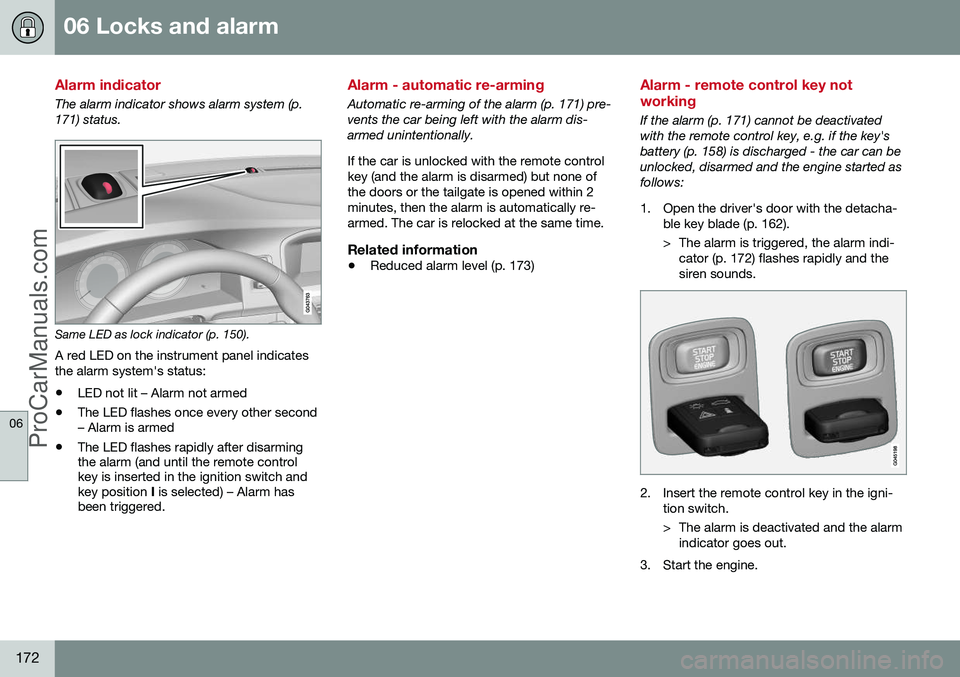
The alarm indicator shows alarm system (p. 171) status.
Same LED as lock indicator (p. 150).
A red LED on the instrument panel indicates the alarm system's status:
• LED not lit – Alarm not armed
• The LED flashes once every other second – Alarm is armed
• The LED flashes rapidly after disarmingthe alarm (and until the remote controlkey is inserted in the ignition switch andkey position
I is selected) – Alarm has
been triggered.
Alarm - automatic re-arming
Automatic re-arming of the alarm (p. 171) pre- vents the car being left with the alarm dis-armed unintentionally. If the car is unlocked with the remote control key (and the alarm is disarmed) but none ofthe doors or the tailgate is opened within 2minutes, then the alarm is automatically re-armed. The car is relocked at the same time.
Related information
• Reduced alarm level (p. 173)
Alarm - remote control key not working
If the alarm (p. 171) cannot be deactivated with the remote control key, e.g. if the key'sbattery (p. 158) is discharged - the car can beunlocked, disarmed and the engine started asfollows:
1. Open the driver's door with the detacha-
ble key blade (p. 162).
> The alarm is triggered, the alarm indi-cator (p. 172) flashes rapidly and the siren sounds.
2. Insert the remote control key in the igni- tion switch.
> The alarm is deactivated and the alarmindicator goes out.
3. Start the engine.
ProCarManuals.co’