check engine VOLVO V60 2014 Owner's Guide
[x] Cancel search | Manufacturer: VOLVO, Model Year: 2014, Model line: V60, Model: VOLVO V60 2014Pages: 442, PDF Size: 13.85 MB
Page 308 of 442
||
08 Starting and driving
08
306* Option/accessory, for more information, see Introduction.
• For lowest fuel consumption, activate ECO (p. 288)* 16
.
• Use the ECO Guide which indicates how fuel-efficiently the car is being driven, seeEco guide & Power guide* (p. 63).
• Drive in the highest gear possible, adap-ted to the current traffic situation androad - lower engine speeds result in lowerfuel consumption. Use the gear indicator(p. 272).
• Avoid sudden unnecessary accelerationand heavy braking.
• High speed results in increased fuel con-sumption - the wind resistance increaseswith speed.
• Do not run the engine to operating tem-perature at idling speed, but rather drivewith a light load as soon as possible - acold engine consumes more fuel than awarm one.
• Drive with the correct air pressure in thetyres and check this regularly - selectECO tyre pressure for best results, seeTyres - approved tyre pressures (p. 407).
• Choice of tyres can affect fuel consump-tion - seek advice on suitable tyres from adealer.
• Remove unnecessary items from the car -the greater the load the higher the con-sumption. •
Use engine braking to slow down, when itcan take place without risk to other roadusers.
• A roof load and ski box increase air resis-tance, leading to higher consumption -remove the load carriers when not in use.
• Avoid driving with open windows.
For information about Volvo Car Corpora- tion's environmental philosophy, see VolvoCars' environmental philosophy (p. 19). For more information about fuel consumption, see Fuel consumption and CO2 emissions (p.403).
WARNING
Never switch off the engine while moving, such as downhill, this deactivates impor-tant systems such as the power steeringand brake servo.
Related information
• Fuel - handling (p. 301)
• Fuel consumption and CO2 emissions (p. 403)
• Fuel tank - volume (p. 402)
Driving with a trailer
When driving with a trailer there are a number of important points to think about regardinge.g. the towing bracket, the trailer and howthe load is positioned in the trailer. Payload depends on the car's kerb weight. The total of the weight of the passengers andall accessories, e.g. towbar, reduces the car'spayload by a corresponding weight. For moredetailed information on weights, see Weights(p. 390). If the towing bracket is mounted by Volvo, then the car is delivered with the necessaryequipment for driving with a trailer. • The car's towing bracket must be of an approved type.
• If the towbar is retrofitted, check withyour Volvo dealer that the car is fullyequipped for driving with a trailer.
• Distribute the load on the trailer so thatthe weight on the towing bracket com-plies with the specified maximum towballload.
• Increase the tyre pressure to the recom-mended pressure for a full load. For tyrepressure label location, see Tyres - airpressure (p. 328).
• The engine is loaded more heavily thanusual when driving with a trailer.
16
Only applies to cars with automatic gearbox.
ProCarManuals.co’
Page 316 of 442
||
08 Starting and driving
08
314
WARNING
•Check that the steering lock is unlocked before towing.
• The remote control key must be in keyposition
II - in position I all airbags are
deactivated.
• Never remove the remote control keyfrom the ignition switch when the caris being towed.
WARNING
The brake servo and power steering do not work when the engine is switched off - thebrake pedal needs to be depressedabout 5 times more heavily and the steer-ing is considerably heavier than normal.
Manual gearboxPrior to towing:
–Move gear lever into neutral and release the parking brake.
Automatic gearbox GeartronicPrior to towing:
–Move the gear selector to position
N and
release the parking brake.
Automatic gearbox PowershiftThe model with Powershift transmission should not be towed as it is dependent on theengine running in order to receive sufficient lubrication. If towing still has to take place,the route must be as short as possible andthen with very low speed. In the event of uncertainty as to whether or not the car is equipped with Powershift trans-mission, this can be verified by checking thedesignation on the gearbox label under thebonnet, see Type designations (p. 386). Thedesignation ”MPS6” means that it isPowershift transmission - otherwise it isGeartronic automatic transmission.
IMPORTANT
Avoid towing.
• However, the car can be towed for a short distance at low speed to move itfrom a dangerous position - not furtherthan 10 km and not faster than10 km/h. Note that the car mustalways be towed with the wheels roll-ing forward.
• In the event of moving a longer dis-tance than 10 km, the car must betransported with the drive wheelsraised from the road - professionalrecovery is recommended.
Prior to towing:
–Move the gear selector to position
N and
release the parking brake.
Jump startingDo not tow the car to bump start the engine. Use a donor battery if the battery is dis-charged and the engine does not start, seeJump starting with battery (p. 270).
IMPORTANT
The catalytic converter may be damaged during attempts to tow-start the engine.
Related information
• Towing eye (p. 315)
ProCarManuals.co’
Page 332 of 442
09 Wheels and tyres
09
330* Option/accessory, for more information, see Introduction.
Tyre pressure monitoring*
Tyre pressure monitoring (TPMS) (Tyre Pressure Monitoring System) 3
warns the
driver when the pressure is too low in one or more of the car's tyres. Tyre pressure monitoring uses sensors located inside the air valve in each wheel.When the car is driven at about 40 km/h thesystem detects the tyre pressure. If the pres- sure is too low then a warning lamp
in the
combined instrument panel illuminates and a message is shown in the information display. Both factory-fitted and optional wheels can be equipped with TPMS sensors in thevalves. If wheels without TPMS sensors are used or if a sensor has failed then
Tyre press. syst
Service required will be shown.
Always check the system after changing a wheel in order to ensure that replacementwheels work with the system. For information on the correct tyre pressure, see Tyres - air pressure (p. 328). The system does not replace normal tyre maintenance.
IMPORTANT
If a fault should arise in the tyre pressure system a warning lamp
in the com-
bined instrument panel will illuminate and a message will be shown. This can be forvarious reasons, e.g. fitting a wheel notequipped with a sensor adapted for Vol-vo's tyre pressure monitoring system.
Related information
• Tyre pressure monitoring* - adjust (recali- bration) (p. 330)
• Tyre pressure monitoring* - rectifying lowtyre pressure (p. 331)
• Tyre pressure monitoring* - activate/deactivate (p. 331)
• Tyre pressure monitoring* - recommenda-tions (p. 332)
• Tyre pressure monitoring - driveablepunctured tyres* (p. 332)
Tyre pressure monitoring* - adjust (recalibration)
Tyre pressure monitoring (TPMS) (Tyre Pressure Monitoring System) 4
warns the
driver when the pressure is too low in one or more of the car's tyres. TPMS can be adjusted in order to follow Vol- vo's tyre pressure recommendations (p. 328),when driving with a heavy load for example.
NOTE
The engine must not be running when the tyres are calibrated.
The settings are made with the control in the centre console, see MY CAR (p. 103).
1. Inflate the tyres to the required pressure and select key position I or II.
2. Select the menu system MY CAR to open
the menus for tyre pressure.
3. Select
Calibrate tyre pressure.
4. Press OK.
5. Start the car and drive at least at 40 km/h for a total of at least 1 minute and check that the message disappears.
> Then the TPMS is recalibrated to thenew tyre pressure.
3Option only in certain markets.
4 Option only in certain markets.
ProCarManuals.co’
Page 333 of 442
09 Wheels and tyres
09
* Option/accessory, for more information, see Introduction.331
Related information
• Tyre pressure monitoring* (p. 330)
• Tyres - air pressure (p. 328)
Tyre pressure monitoring* - rectifying low tyre pressure
Tyre pressure monitoring TPMS (Tyre Pressure Monitoring System) 5
warns the
driver when the pressure is too low in one or more of the car's tyres. If a message for low tyre pressure is shown in the display:
1. Check the tyre pressure in all four tyres.
2. Inflate the tyre(s) to the correct pressure.
3. Drive at least at 40 km/h for a total of at least 1 minute and check that the mes- sage disappears.
Related information
• Tyre pressure monitoring* (p. 330)
Tyre pressure monitoring* - activate/ deactivate
Tyre pressure monitoring (TPMS) (Tyre Pressure Monitoring System) 6
warns the
driver when the pressure is too low in one or more of the car's tyres.
NOTE
The engine must not be running when tyre pressure monitoring is activated/deacti-vated.
The settings are made with the control in the centre console, see MY CAR (p. 103).
1. Select key position I or II.
2. Select the system MY CAR to open the
menus for tyre pressure.
3. Select Tyre pressure system/Pressure monitoring and press OK.
> An
X is shown in the information dis-
play if the system is activated, the option disappears if the system isdeactivated.
Related information
• Tyre pressure monitoring* (p. 330)
5
Option only in certain markets.
6 Option only in certain markets.
ProCarManuals.co’
Page 337 of 442
09 Wheels and tyres
09
}}
335
Emergency puncture repair - operation
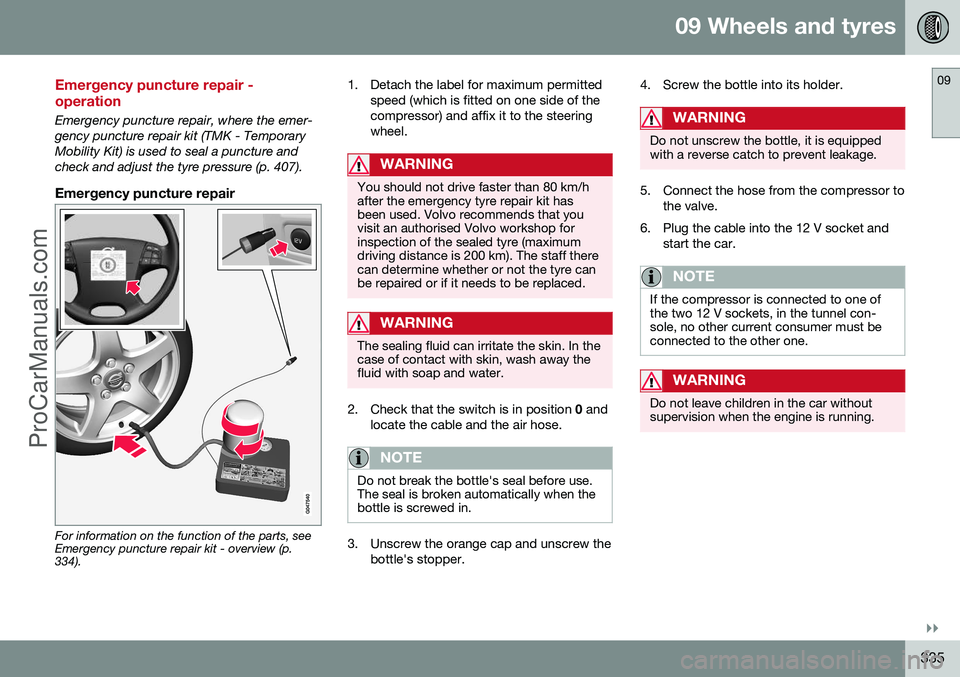
Emergency puncture repair, where the emer- gency puncture repair kit (TMK - TemporaryMobility Kit) is used to seal a puncture andcheck and adjust the tyre pressure (p. 407).
Emergency puncture repair
For information on the function of the parts, see Emergency puncture repair kit - overview (p.334).1. Detach the label for maximum permitted
speed (which is fitted on one side of the compressor) and affix it to the steeringwheel.
WARNING
You should not drive faster than 80 km/h after the emergency tyre repair kit hasbeen used. Volvo recommends that youvisit an authorised Volvo workshop forinspection of the sealed tyre (maximumdriving distance is 200 km). The staff therecan determine whether or not the tyre canbe repaired or if it needs to be replaced.
WARNING
The sealing fluid can irritate the skin. In the case of contact with skin, wash away thefluid with soap and water.
2. Check that the switch is in position 0 and
locate the cable and the air hose.
NOTE
Do not break the bottle's seal before use. The seal is broken automatically when thebottle is screwed in.
3. Unscrew the orange cap and unscrew the bottle's stopper. 4. Screw the bottle into its holder.
WARNING
Do not unscrew the bottle, it is equipped with a reverse catch to prevent leakage.
5. Connect the hose from the compressor to
the valve.
6. Plug the cable into the 12 V socket and start the car.
NOTE
If the compressor is connected to one of the two 12 V sockets, in the tunnel con-sole, no other current consumer must beconnected to the other one.
WARNING
Do not leave children in the car without supervision when the engine is running.
ProCarManuals.co’
Page 339 of 442
09 Wheels and tyres
09
337
WARNING
Do not unscrew the bottle, it is equipped with a reverse catch to prevent leakage.
3. Make sure the compressor is switchedoff. Detach the air hose and cable. Fit the valve cap.
NOTE
•After a tyre has been inflated, always refit the dust cap in order to avoiddamage to the valve from gravel, dirt,etc.
• Only use plastic dust caps. Metal dustcaps can rust and become difficult tounscrew.
NOTE
The sealing fluid bottle and the hose must be replaced after use. Volvo recommendsthat this replacement is performed by anauthorised Volvo workshop.
WARNING
Check the tyre pressure regularly.
Volvo recommends that you drive to the near- est authorised Volvo workshop for thereplacement/repair of the damaged tyre. Advise the workshop that the tyre containssealing fluid.
WARNING
You should not drive faster than 80 km/h after the emergency tyre repair kit hasbeen used. Volvo recommends that youvisit an authorised Volvo workshop forinspection of the sealed tyre (maximumdriving distance is 200 km). The staff therecan determine whether or not the tyre canbe repaired or if it needs to be replaced.
Related information
•
Emergency puncture repair (p. 333)
• Emergency puncture repair - operation (p. 335)
• Emergency puncture repair kit - overview(p. 334)
Emergency puncture repair kit - inflating the tyres
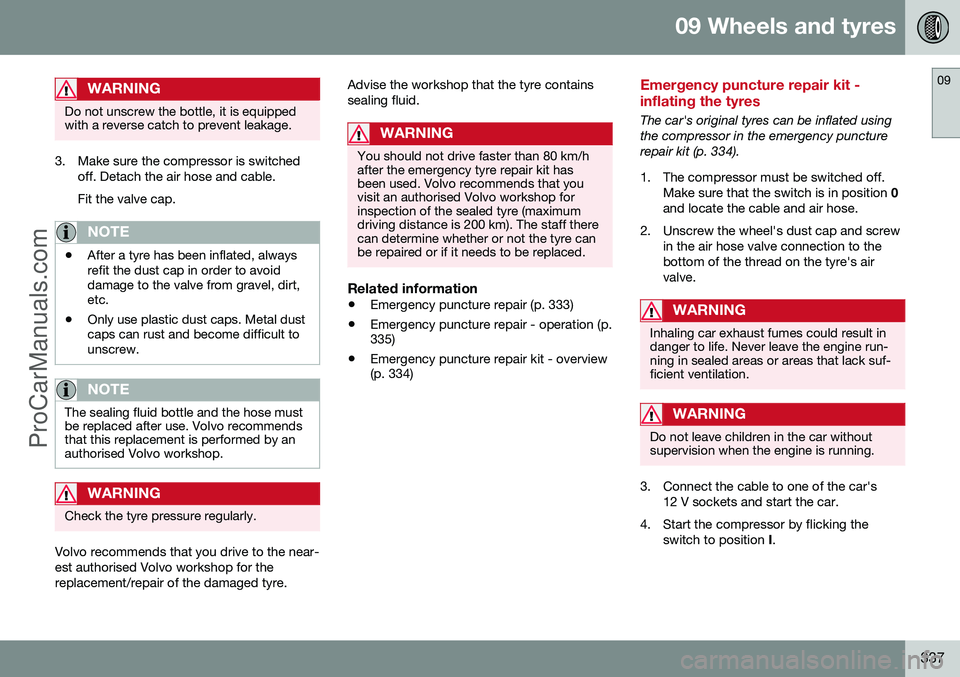
The car's original tyres can be inflated using the compressor in the emergency puncturerepair kit (p. 334).
1. The compressor must be switched off.
Make sure that the switch is in position 0
and locate the cable and air hose.
2. Unscrew the wheel's dust cap and screw in the air hose valve connection to the bottom of the thread on the tyre's airvalve.
WARNING
Inhaling car exhaust fumes could result in danger to life. Never leave the engine run-ning in sealed areas or areas that lack suf-ficient ventilation.
WARNING
Do not leave children in the car without supervision when the engine is running.
3. Connect the cable to one of the car's 12 V sockets and start the car.
4. Start the compressor by flicking the switch to position I.
ProCarManuals.co’
Page 345 of 442
10 Maintenance and service
10
343
Bonnet - opening and closing
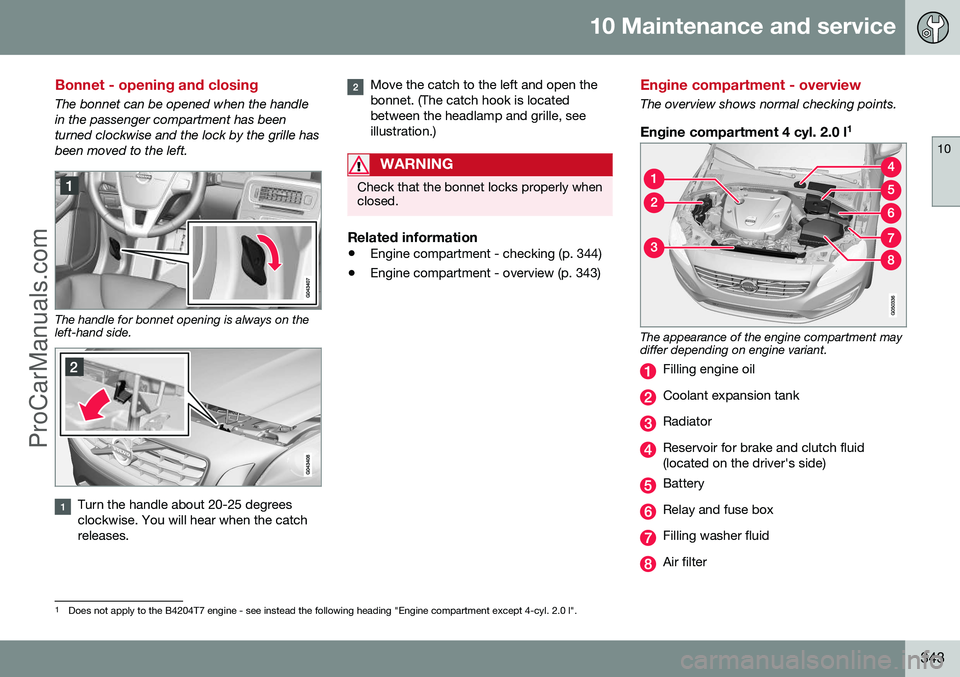
The bonnet can be opened when the handle in the passenger compartment has beenturned clockwise and the lock by the grille hasbeen moved to the left.
The handle for bonnet opening is always on the left-hand side.
Turn the handle about 20-25 degrees clockwise. You will hear when the catchreleases.
Move the catch to the left and open the bonnet. (The catch hook is locatedbetween the headlamp and grille, seeillustration.)
WARNING
Check that the bonnet locks properly when closed.
Related information
•Engine compartment - checking (p. 344)
• Engine compartment - overview (p. 343)
Engine compartment - overview
The overview shows normal checking points.
Engine compartment 4 cyl. 2.0 l 1
The appearance of the engine compartment may differ depending on engine variant.
Filling engine oil
Coolant expansion tank
Radiator
Reservoir for brake and clutch fluid (located on the driver's side)
Battery
Relay and fuse box
Filling washer fluid
Air filter
1
Does not apply to the B4204T7 engine - see instead the following heading "Engine compartment except 4-cyl. 2.0 l".
ProCarManuals.co’
Page 346 of 442
||
10 Maintenance and service
10
344
WARNING
The ignition system has very high voltage and output. The voltage in the ignition sys-tem is highly dangerous. The car's electri-cal system must always be in key position0 when work is being performed in the
engine compartment; see Key positions -functions at different levels (p. 70). Do not touch the spark plugs or ignition coil when the car's electrical system is inkey position II or when the engine is hot.
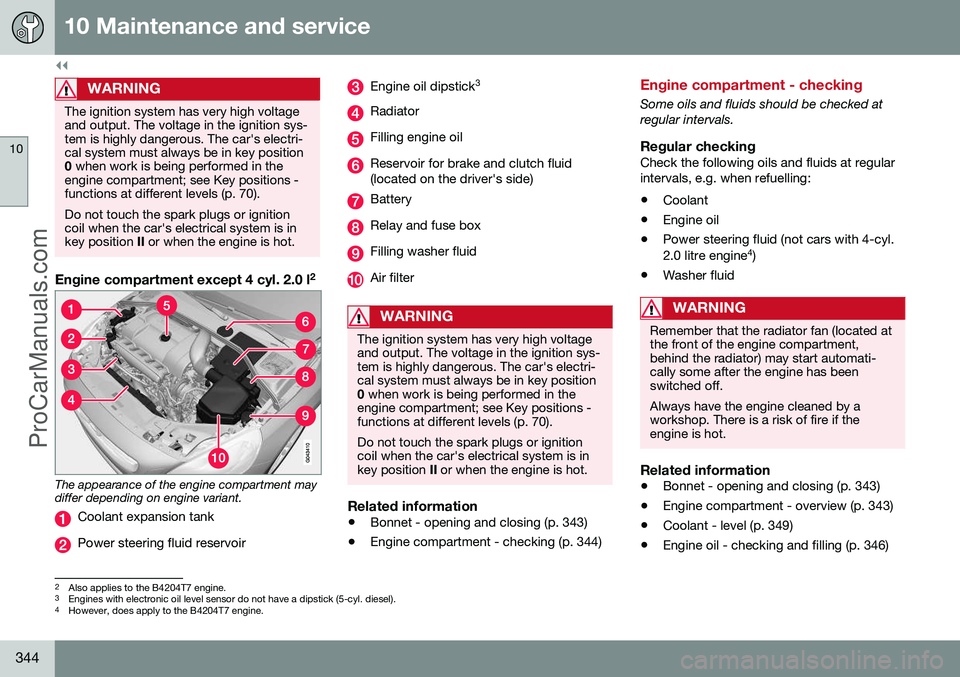
Engine compartment except 4 cyl. 2.0 l 2
The appearance of the engine compartment may differ depending on engine variant.
Coolant expansion tank
Power steering fluid reservoir
Engine oil dipstick
3
Radiator
Filling engine oil
Reservoir for brake and clutch fluid (located on the driver's side)
Battery
Relay and fuse box
Filling washer fluid
Air filter
WARNING
The ignition system has very high voltage and output. The voltage in the ignition sys-tem is highly dangerous. The car's electri-cal system must always be in key position0
when work is being performed in the
engine compartment; see Key positions -functions at different levels (p. 70). Do not touch the spark plugs or ignition coil when the car's electrical system is inkey position II or when the engine is hot.
Related information
• Bonnet - opening and closing (p. 343)
• Engine compartment - checking (p. 344)
Engine compartment - checking
Some oils and fluids should be checked at regular intervals.
Regular checkingCheck the following oils and fluids at regularintervals, e.g. when refuelling:
• Coolant
• Engine oil
• Power steering fluid (not cars with 4-cyl. 2.0 litre engine 4
)
• Washer fluid
WARNING
Remember that the radiator fan (located at the front of the engine compartment,behind the radiator) may start automati-cally some after the engine has beenswitched off. Always have the engine cleaned by a workshop. There is a risk of fire if theengine is hot.
Related information
• Bonnet - opening and closing (p. 343)
• Engine compartment - overview (p. 343)
• Coolant - level (p. 349)
• Engine oil - checking and filling (p. 346)
2
Also applies to the B4204T7 engine.3 Engines with electronic oil level sensor do not have a dipstick (5-cyl. diesel).
4 However, does apply to the B4204T7 engine.
ProCarManuals.co’
Page 348 of 442
||
10 Maintenance and service
10
346
texts. Certain variants have both systems. Contact a Volvo dealer for more information. Change the engine oil and oil filter in accord- ance with the intervals specified in the Serv-ice and Warranty Booklet. Using oil of a higher than specified grade is permitted. If the car is driven in adverse con-ditions, Volvo recommends using an oil of ahigher grade; see Engine oil - adverse drivingconditions (p. 395). For filling capacities, see Engine oil - grade and volume (p. 396).
Related information
•Engine oil - checking and filling (p. 346)
Engine oil - checking and filling
The oil level is checked on certain engine vari- ants with the electronic oil level sensor, onother engine variants with the oil dipstick.
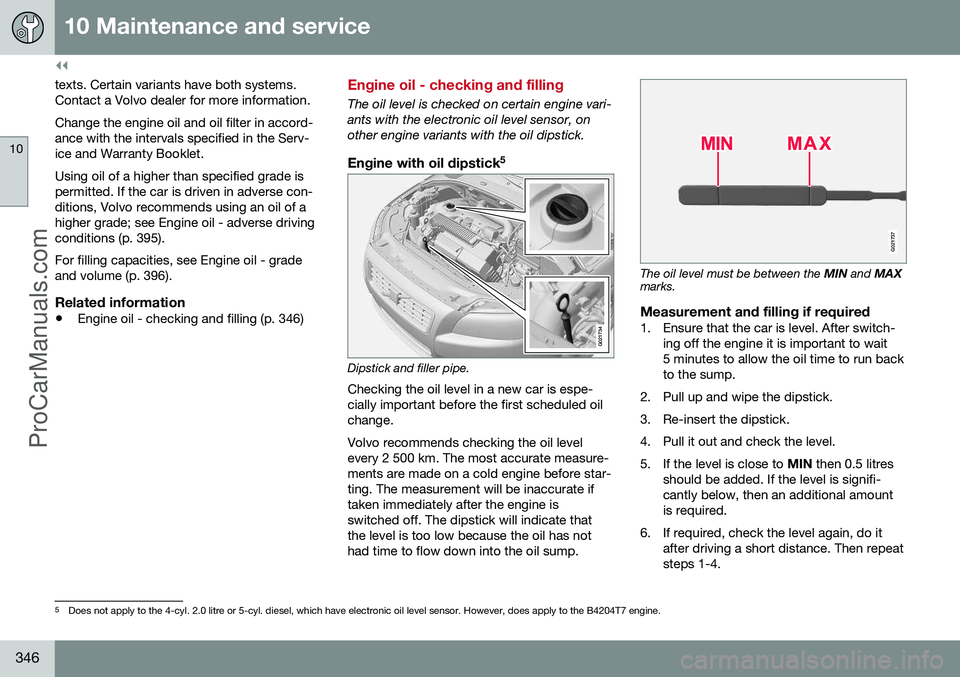
Engine with oil dipstick 5
G021734
Dipstick and filler pipe. Checking the oil level in a new car is espe- cially important before the first scheduled oilchange. Volvo recommends checking the oil level every 2 500 km. The most accurate measure-ments are made on a cold engine before star-ting. The measurement will be inaccurate iftaken immediately after the engine isswitched off. The dipstick will indicate thatthe level is too low because the oil has nothad time to flow down into the oil sump.
G021737
The oil level must be between the
MIN and MAX
marks.
Measurement and filling if required1. Ensure that the car is level. After switch-
ing off the engine it is important to wait 5 minutes to allow the oil time to run backto the sump.
2. Pull up and wipe the dipstick.
3. Re-insert the dipstick.
4. Pull it out and check the level.
5. If the level is close to MIN then 0.5 litres
should be added. If the level is signifi- cantly below, then an additional amountis required.
6. If required, check the level again, do it after driving a short distance. Then repeatsteps 1-4.
5Does not apply to the 4-cyl. 2.0 litre or 5-cyl. diesel, which have electronic oil level sensor. However, does apply to the B4204T7 engine.
ProCarManuals.co’
Page 349 of 442
10 Maintenance and service
10
}}
347
WARNING
Never fill above the MAX mark. The level
should never be above MAX or below MIN
as this could lead to engine damage.
WARNING
Do not spill oil onto the hot exhaust mani- fold due to the risk of fire.
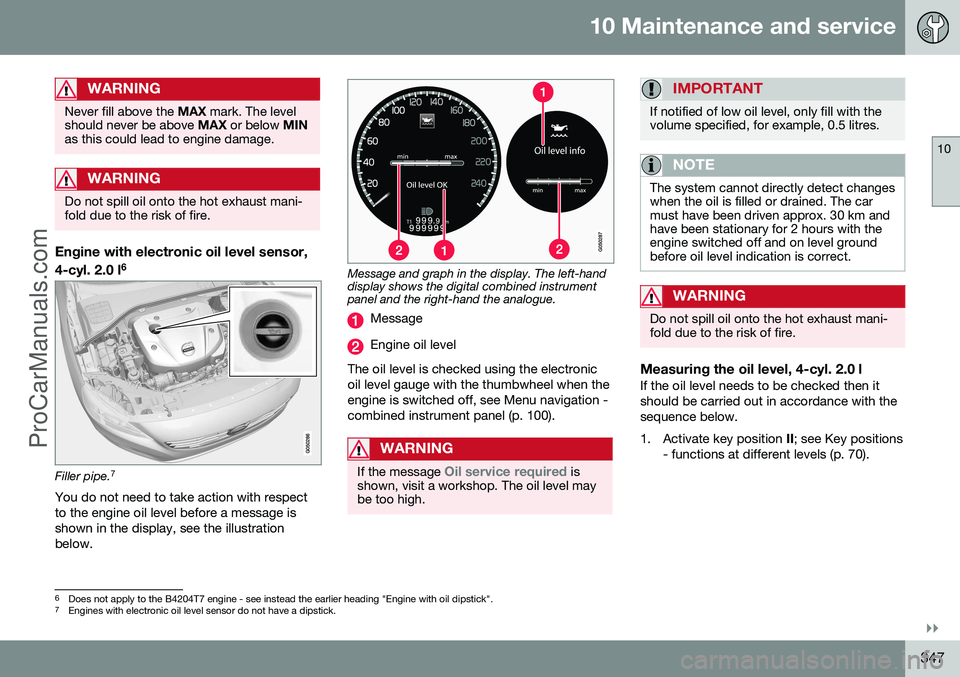
Engine with electronic oil level sensor, 4-cyl. 2.0 l 6
Filler pipe.
7
You do not need to take action with respect to the engine oil level before a message isshown in the display, see the illustrationbelow.
Message and graph in the display. The left-hand display shows the digital combined instrumentpanel and the right-hand the analogue.
Message
Engine oil level
The oil level is checked using the electronic oil level gauge with the thumbwheel when theengine is switched off, see Menu navigation -combined instrument panel (p. 100).
WARNING
If the message Oil service required is
shown, visit a workshop. The oil level may be too high.
IMPORTANT
If notified of low oil level, only fill with the volume specified, for example, 0.5 litres.
NOTE
The system cannot directly detect changes when the oil is filled or drained. The carmust have been driven approx. 30 km andhave been stationary for 2 hours with theengine switched off and on level groundbefore oil level indication is correct.
WARNING
Do not spill oil onto the hot exhaust mani- fold due to the risk of fire.
Measuring the oil level, 4-cyl. 2.0 lIf the oil level needs to be checked then it should be carried out in accordance with thesequence below.
1. Activate key position II; see Key positions
- functions at different levels (p. 70).
6 Does not apply to the B4204T7 engine - see instead the earlier heading "Engine with oil dipstick".7
Engines with electronic oil level sensor do not have a dipstick.
ProCarManuals.co’