towing VOLVO V60 2016 Owner´s Manual
[x] Cancel search | Manufacturer: VOLVO, Model Year: 2016, Model line: V60, Model: VOLVO V60 2016Pages: 402, PDF Size: 10.3 MB
Page 301 of 402
09 Wheels and tires
09
* Option/accessory, for more information, see Introduction.299
Changing a wheel – spare wheel
Wheel changes should always be carried out correctly.
Spare tireA spare tire can be purchased for your vehi-cle as an accessory. Follow the instructionsincluded with the spare tire regarding use andstowing in the vehicle. See also Changing awheel – removing wheel (p. 296) for additionalinformation.
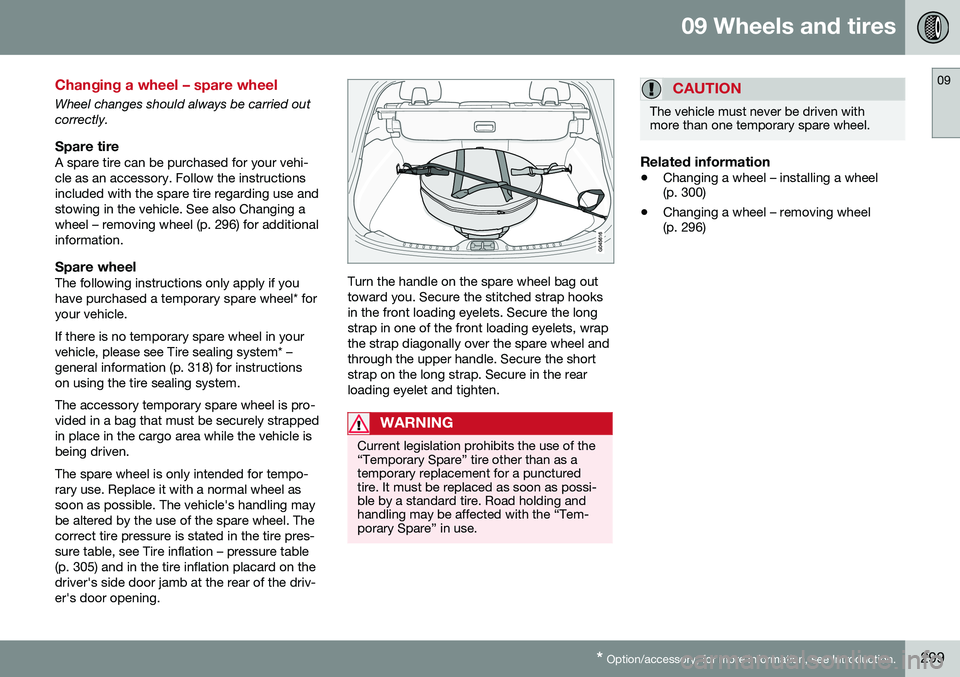
Spare wheelThe following instructions only apply if youhave purchased a temporary spare wheel* foryour vehicle. If there is no temporary spare wheel in your vehicle, please see Tire sealing system* –general information (p. 318) for instructionson using the tire sealing system. The accessory temporary spare wheel is pro- vided in a bag that must be securely strappedin place in the cargo area while the vehicle isbeing driven. The spare wheel is only intended for tempo- rary use. Replace it with a normal wheel assoon as possible. The vehicle's handling maybe altered by the use of the spare wheel. Thecorrect tire pressure is stated in the tire pres-sure table, see Tire inflation – pressure table(p. 305) and in the tire inflation placard on thedriver's side door jamb at the rear of the driv-er's door opening.Turn the handle on the spare wheel bag out toward you. Secure the stitched strap hooksin the front loading eyelets. Secure the long strap in one of the front loading eyelets, wrapthe strap diagonally over the spare wheel andthrough the upper handle. Secure the shortstrap on the long strap. Secure in the rearloading eyelet and tighten.
WARNING
Current legislation prohibits the use of the “Temporary Spare” tire other than as atemporary replacement for a puncturedtire. It must be replaced as soon as possi-ble by a standard tire. Road holding andhandling may be affected with the “Tem-porary Spare” in use.
CAUTION
The vehicle must never be driven with more than one temporary spare wheel.
Related information
• Changing a wheel – installing a wheel (p. 300)
• Changing a wheel – removing wheel(p. 296)
Page 308 of 402
09 Wheels and tires
09
306
Loading specifications
Properly loading your vehicle will provide maximum return of vehicle design perform-ance. Before loading your vehicle, familiarize your- self with the following terms for determiningyour vehicle's weight ratings, with or withouta trailer, from the vehicle's Federal/CanadianMotor Vehicle Safety Standards (FMVSS/CMVSS) label, and the vehicle's tire informa-tion placard:
Curb weightThe weight of the vehicle including a full tankof fuel and all standard equipment. It doesnot include passengers, cargo, or optionalequipment.
Capacity weightAll weight added to the curb weight, includingcargo and optional equipment. When towing,trailer hitch tongue load is also part of cargoweight.
Permissible axle weightThe maximum allowable weight that can becarried by a single axle (front or rear). Thesenumbers are shown on the Federal/CanadianMotor Vehicle Safety Standards (FMVSS/CMVSS) label. The total load on each axlemust never exceed its maximum permissibleweight.
Gross vehicle weight (GVW)The vehicle's curb weight + cargo + passen-gers.
NOTE
•The location of the various labels in your vehicle, see Label information(p. 371).
• A table listing important weight limitsfor your vehicle, see Weights (p. 378).
Loading specifications – load limit
The load limit of your vehicle is the combined weight of the occupants and cargo.
Steps for Determining Correct Load
Limit
1. Locate the statement "the combined weight of occupants and cargo shouldnever exceed XXX pounds" on your vehi-cle's placard.
2. Determine the combined weight of the driver and passengers that will be ridingin your vehicle.
3. Subtract the combined weight of the driver and passengers from XXX kilo-grams or XXX pounds.
4. The resulting figure equals the available amount of cargo and luggage loadcapacity. For example, if the "XXX"amount equals 1400 lbs. and there will befive 150 lb. passengers in your vehicle,the amount of available cargo and lug-gage load capacity is 650 lbs. (1400 – 750 (5 × 150) = 650 lbs.)
5. Determine the combined weight of lug- gage and cargo being loaded on the vehi-cle. That weight may not safely exceedthe available cargo and luggage loadcapacity calculated in Step 4.
Page 309 of 402
09 Wheels and tires
09
}}
307
6. If your vehicle will be towing a trailer, load
from your trailer will be transferred to your vehicle.
WARNING
•Exceeding the permissible axle weight, gross vehicle weight, or any otherweight rating limits can cause tireoverheating resulting in permanentdeformation or catastrophic failure.
• Do not use replacement tires withlower load carrying capacities than thetires that were original equipment onthe vehicle because this will lower thevehicle's GVW rating. Use only tireswith the correct load carrying capacity.Consult your Volvo retailer for informa-tion.
Tire specifications – terminology
The following is a glossary of tire-related terms. The tire suppliers may have additional mark- ings, notes or warnings such as standardload, radial tubeless, etc.
• Tire information placard
: A placard
showing the OE (Original Equipment) tire sizes, recommended inflation pressure,and the maximum weight the vehicle cancarry.
• Tire Identification Number (TIN)
: A
number on the sidewall of each tire pro-viding information about the tire brandand manufacturing plant, tire size anddate of manufacturer.
• Inflation pressure
: A measure of the
amount of air in a tire.
• Standard load
: A class of P-metric or
Metric tires designed to carry a maximumload at 35 psi [37 psi (2.5 bar) for Metrictires]. Increasing the inflation pressurebeyond this pressure will not increase thetires load carrying capability.
• Extra load
: A class of P-metric or Metric
tires designed to carry a heavier maxi-mum load at 41 psi [43 psi (2.9 bar) forMetric tires]. Increasing the inflation pres-sure beyond this pressure will notincrease the tire's load carrying capabil-ity. •
kPa
: Kilopascal, a metric unit of air pres-
sure.
• PSI
: Pounds per square inch, a standard
unit of air pressure.
• B-pillar
: The structural member at the
side of the vehicle behind the front door.
• Bead area of the tire
: Area of the tire
next to the rim.
• Sidewall of the tire
: Area between the
bead area and the tread.
• Tread area of the tire
: Area of the perim-
eter of the tire that contacts the roadwhen mounted on the vehicle.
• Rim
: The metal support (wheel) for a tire
or a tire and tube assembly upon whichthe tire beads are seated.
• Maximum load rating
: a figure indicating
the maximum load in pounds and kilo-grams that can be carried by the tire. Thisrating is established by the tire manufac-turer.
• Maximum permissible inflation pressure
: the greatest amount of air
pressure that should ever be put in the tire. This limit is set by the tire manufac-turer.
• Recommended tire inflation pressure
:
inflation pressure, established by Volvo,which is based on the type of tires thatare mounted on a vehicle at the factory.This information can be found on the tireinflation placard(s) located on the driver's
Page 324 of 402
||
09 Wheels and tires
09
322
WARNING
•Never stand next to the tire being infla- ted when the compressor is in opera-tion.
• If cracks, bubbles, etc. form on the tire,switch off the compressor immediately.
• If there is visible damage to the sidewallor the rim, the tire cannot be repaired.The vehicle should not be driven if thisoccurs. Contact a towing service orVolvo On Call Roadside Assistance ifapplicable.
NOTE
The air pressure gauge will temporarily show an increase in pressure to approxi-mately 88 psi (6 bar) while the sealingcompound is being pumped into the tire.The pressure should return to a normallevel after approximately 30 seconds.
9. Within seven minutes, inflate the tire to
between 22—44 psi (1.8—3.0 bar). Switch off the compressor briefly to get aclear reading from the pressure gauge.
CAUTION
The compressor should not be used for more than 10 minutes at a time to avoidoverheating.
WARNING
If the pressure remains below 22 psi (1.8 bar) after approximately sevenminutes, turn off the compressor. In thiscase, the hole is too large to be sealed andthe vehicle should not be driven.
10. Switch off the compressor and discon-nect the electrical wire from the 12-volt socket.
11. Unscrew the hose from the tire’s inflation valve and reinstall the valve cap.
CAUTION
•After inflating the tires, always reinstall the valve cap to help avoid damage tothe valve from dirt, gravel, etc.
• Use plastic valve caps only. Metal capscould corrode and become difficult toremove.
12. Immediately drive the vehicle for approxi-
mately 2 miles (3 km) at a maximum speed of 50 mph (80 km/h) to distributethe sealing compound in the tire.
CAUTION
If your vehicle is equipped with the Tire Pressure Monitoring System (TPMS), theuse of the sealing compound may lead toincorrect tire pressure readings or in rarecases, damage to the tire pressure sensor.Use the tire sealing system to check andadjust the damaged tire's inflation pres-sure.
NOTE
•Safely stow the tire sealing system in a convenient place as it will soon beused again to check the tire’s inflationpressure.
• The empty bottle of sealing compoundcannot be removed from the bottleholder. Consult a trained and qualifiedVolvo service technician to have thebottle removed and properly disposedof.
WARNING
If heavy vibrations, unsteady steering behavior, or noises should occur whiledriving, reduce speed and park the vehiclein a safe place. Recheck the tire forbumps, cracks, or other visible damage,and recheck its inflation pressure. If thepressure is below 19 psi (1.3 bar), do notcontinue driving. Have the vehicle towedto a trained and qualified Volvo servicetechnician.
Page 394 of 402
12 Index
12
392
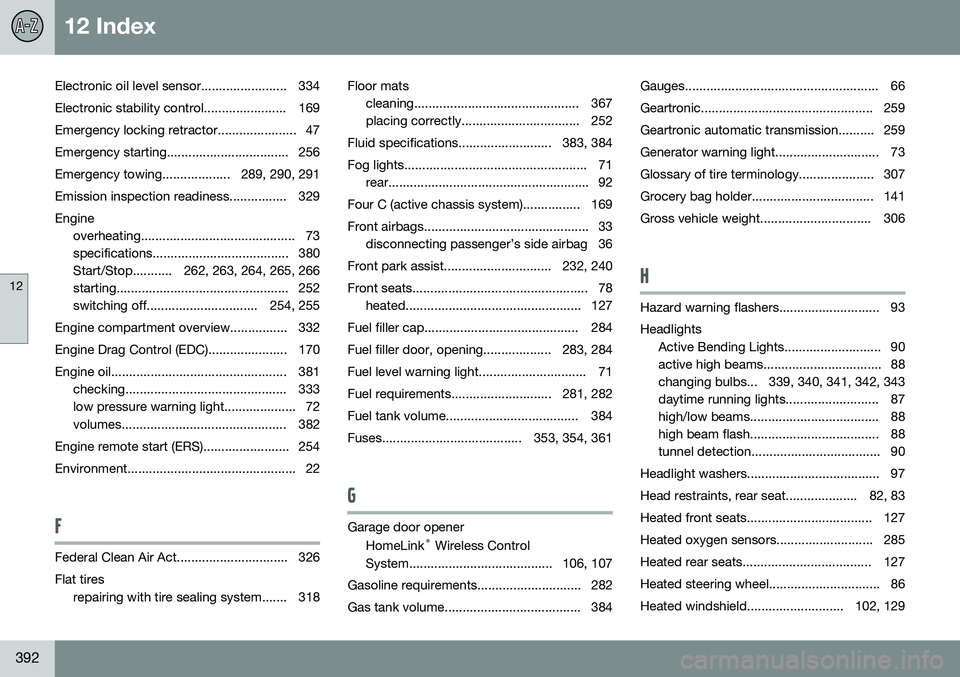
Electronic oil level sensor........................ 334
Electronic stability control....................... 169Emergency locking retractor...................... 47
Emergency starting.................................. 256
Emergency towing................... 289, 290, 291
Emission inspection readiness................ 329Engine overheating........................................... 73
specifications...................................... 380
Start/Stop........... 262, 263, 264, 265, 266
starting................................................ 252
switching off............................... 254, 255
Engine compartment overview................ 332
Engine Drag Control (EDC)...................... 170
Engine oil................................................. 381 checking............................................. 333
low pressure warning light.................... 72
volumes.............................................. 382
Engine remote start (ERS)........................ 254
Environment............................................... 22
F
Federal Clean Air Act............................... 326 Flat tires repairing with tire sealing system....... 318 Floor mats
cleaning.............................................. 367
placing correctly................................. 252
Fluid specifications.......................... 383, 384
Fog lights................................................... 71 rear........................................................ 92
Four C (active chassis system)................ 169
Front airbags.............................................. 33 disconnecting passenger’s side airbag 36
Front park assist.............................. 232, 240
Front seats................................................. 78 heated................................................. 127
Fuel filler cap........................................... 284
Fuel filler door, opening................... 283, 284
Fuel level warning light.............................. 71
Fuel requirements............................ 281, 282
Fuel tank volume..................................... 384
Fuses....................................... 353, 354, 361
G
Garage door opener HomeLink ®
Wireless Control
System........................................ 106, 107
Gasoline requirements............................. 282
Gas tank volume...................................... 384 Gauges...................................................... 66
Geartronic................................................ 259
Geartronic automatic transmission.......... 259
Generator warning light............................. 73
Glossary of tire terminology..................... 307
Grocery bag holder.................................. 141
Gross vehicle weight............................... 306
H
Hazard warning flashers............................ 93 Headlights
Active Bending Lights........................... 90
active high beams................................. 88
changing bulbs... 339, 340, 341, 342, 343
daytime running lights.......................... 87
high/low beams.................................... 88
high beam flash.................................... 88
tunnel detection.................................... 90
Headlight washers..................................... 97
Head restraints, rear seat.................... 82, 83
Heated front seats................................... 127
Heated oxygen sensors........................... 285
Heated rear seats.................................... 127
Heated steering wheel............................... 86
Heated windshield........................... 102, 129
Page 398 of 402
12 Index
12
396
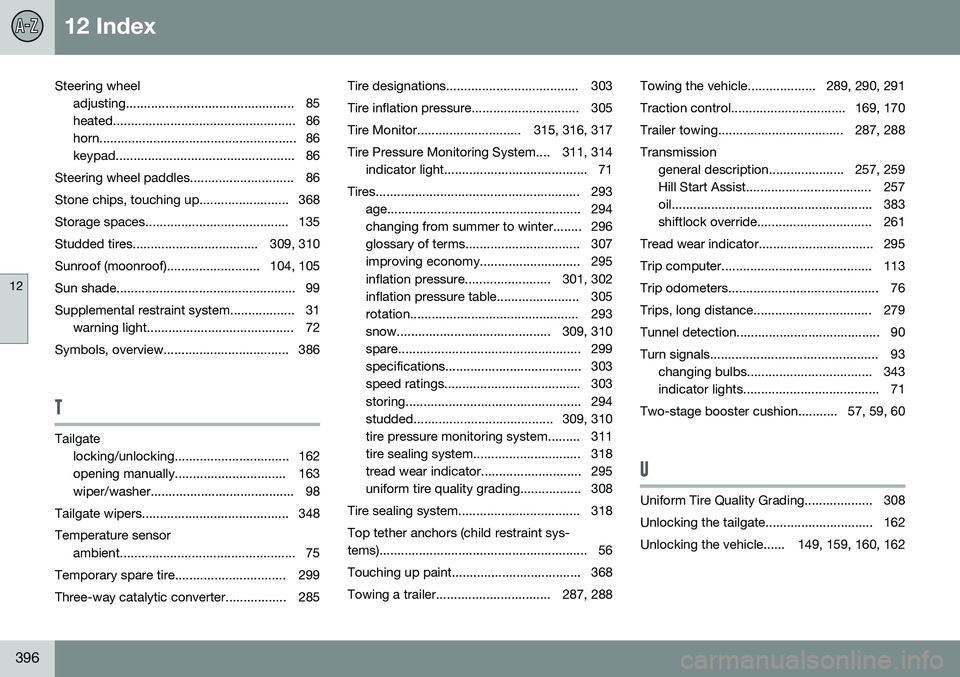
Steering wheeladjusting............................................... 85
heated................................................... 86
horn....................................................... 86
keypad.................................................. 86
Steering wheel paddles............................. 86
Stone chips, touching up......................... 368
Storage spaces........................................ 135
Studded tires................................... 309, 310
Sunroof (moonroof).......................... 104, 105 Sun shade.................................................. 99
Supplemental restraint system.................. 31 warning light......................................... 72
Symbols, overview................................... 386
T
Tailgate locking/unlocking................................ 162
opening manually............................... 163
wiper/washer........................................ 98
Tailgate wipers......................................... 348 Temperature sensor ambient................................................. 75
Temporary spare tire............................... 299
Three-way catalytic converter................. 285 Tire designations..................................... 303
Tire inflation pressure.............................. 305
Tire Monitor............................. 315, 316, 317
Tire Pressure Monitoring System.... 311, 314
indicator light........................................ 71
Tires......................................................... 293 age...................................................... 294
changing from summer to winter........ 296
glossary of terms................................ 307
improving economy............................ 295
inflation pressure........................ 301, 302
inflation pressure table....................... 305
rotation............................................... 293
snow........................................... 309, 310
spare................................................... 299
specifications...................................... 303
speed ratings...................................... 303
storing................................................. 294
studded....................................... 309, 310
tire pressure monitoring system......... 311
tire sealing system.............................. 318
tread wear indicator............................ 295
uniform tire quality grading................. 308
Tire sealing system.................................. 318 Top tether anchors (child restraint sys-
tems).......................................................... 56
Touching up paint.................................... 368
Towing a trailer................................ 287, 288 Towing the vehicle................... 289, 290, 291
Traction control................................ 169, 170
Trailer towing................................... 287, 288Transmission
general description..................... 257, 259
Hill Start Assist................................... 257
oil........................................................ 383
shiftlock override................................ 261
Tread wear indicator................................ 295
Trip computer.......................................... 113
Trip odometers.......................................... 76
Trips, long distance................................. 279
Tunnel detection........................................ 90
Turn signals............................................... 93 changing bulbs................................... 343
indicator lights...................................... 71
Two-stage booster cushion........... 57, 59, 60
U
Uniform Tire Quality Grading................... 308
Unlocking the tailgate.............................. 162
Unlocking the vehicle...... 149, 159, 160, 162