ESP VOLVO V60 2016 Owner´s Manual
[x] Cancel search | Manufacturer: VOLVO, Model Year: 2016, Model line: V60, Model: VOLVO V60 2016Pages: 402, PDF Size: 10.3 MB
Page 312 of 402
09 Wheels and tires
09
310
Snow tires/studded tires5
Owners who live in or regularly commute through areas with sustained periods of snowor icy driving conditions are strongly advisedto fit suitable winter tires to help retain thehighest degree of traction.
Tires for winter use:
•
It is important to install winter tires on all four wheels to help retain traction duringcornering, braking, and accelerating. Fail-ure to do so could reduce traction to anunsafe level or adversely affect handling.
• Do not mix tires of different design as thiscould also negatively affect overall tireroad grip.
• Winter tires wear more quickly on dryroads in warm weather. They should beremoved when the winter driving seasonhas ended.
• Studded tires should be run-in 300 – 600 miles (500 – 1000 km) during whichthe vehicle should be driven as smoothlyas possible to give the studs the opportu-nity to seat properly in the tires. The tiresshould have the same rotational directionthroughout their entire lifetime.
NOTE
Please consult state or provincial regula- tions restricting the use of studded wintertires before installing such tires.
Tire pressure monitoring - introduction
Volvo provides two different systems to moni- tor tire pressure: Tire Pressure MonitoringSystem (TPMS) or Tire Monitor.
Determining which tire monitoring system is in your vehicle
To see which system is installed in your vehi- cle, press the
MY CAR button on the center
console. Go to
SettingsCar settings.
• If your vehicle has a menu called
Tire
monitoring, see Tire Monitor - introduc-
tion (p. 315).
• If your vehicle has a menu called
Tire
pressure, see Tire Pressure Monitoring
System (TPMS) – general information (p. 311).
Introduction
Each tire, including the spare 6
(if provided),
should be checked monthly when cold and inflated to the inflation pressure recom-mended by the vehicle manufacturer on thevehicle placard or tire inflation pressure label.(If your vehicle has tires of a different sizethan the size indicated on the vehicle placardor tire inflation pressure label, you shoulddetermine the proper tire inflation pressure forthose tires.) As an added safety feature, your vehicle has been equipped with a tire pressure monitor-ing system that illuminates a low tire pressure telltale (
) when one or more of your tires
is significantly under-inflated. Accordingly, when the low tire pressure telltale illuminates,you should stop and check your tires as soonas possible, and inflate them to the properpressure. Driving on a significantly under-inflated tire causes the tire to overheat and can lead totire failure. Under-inflation also reduces fuelefficiency and tire tread life, and may affectthe vehicle's handling and stopping ability.Please note that a tire pressure monitoringsystem is not a substitute for proper tiremaintenance, and it is the driver's responsi-bility to maintain correct tire pressure, even ifunder-inflation has not reached the level to
5 Where permitted
Page 322 of 402
09 Wheels and tires
09
320* Option/accessory, for more information, see Introduction.
Tire sealing system* – overview
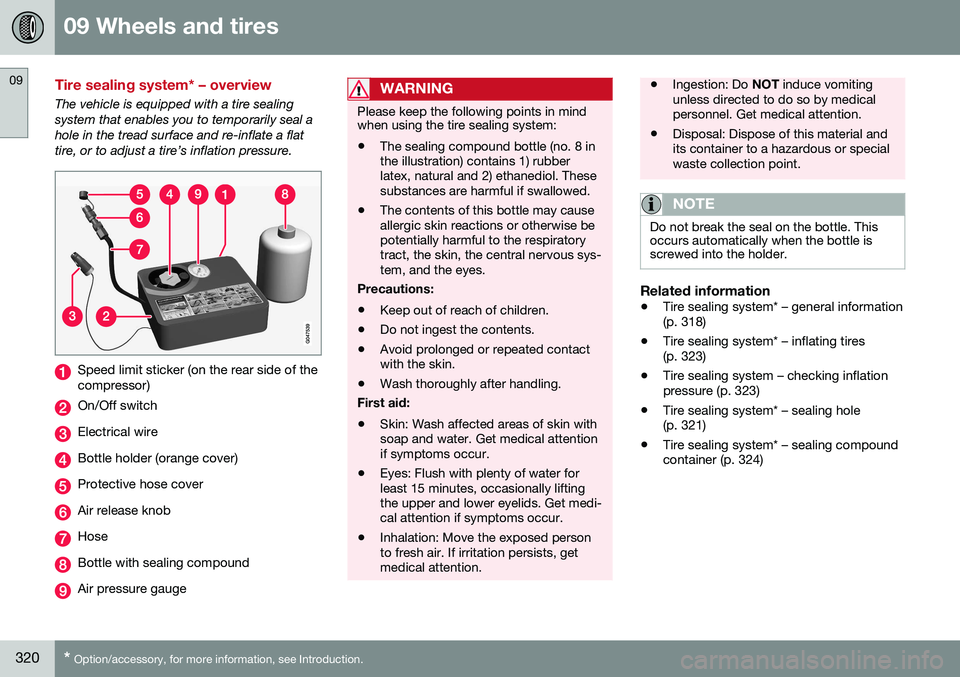
The vehicle is equipped with a tire sealing system that enables you to temporarily seal ahole in the tread surface and re-inflate a flattire, or to adjust a tire’s inflation pressure.
Speed limit sticker (on the rear side of the compressor)
On/Off switch
Electrical wire
Bottle holder (orange cover)
Protective hose cover
Air release knob
Hose
Bottle with sealing compound
Air pressure gauge
WARNING
Please keep the following points in mind when using the tire sealing system:
• The sealing compound bottle (no. 8 in the illustration) contains 1) rubberlatex, natural and 2) ethanediol. Thesesubstances are harmful if swallowed.
• The contents of this bottle may causeallergic skin reactions or otherwise bepotentially harmful to the respiratorytract, the skin, the central nervous sys-tem, and the eyes.
Precautions: • Keep out of reach of children.
• Do not ingest the contents.
• Avoid prolonged or repeated contact with the skin.
• Wash thoroughly after handling.
First aid:
• Skin: Wash affected areas of skin withsoap and water. Get medical attentionif symptoms occur.
• Eyes: Flush with plenty of water forleast 15 minutes, occasionally liftingthe upper and lower eyelids. Get medi-cal attention if symptoms occur.
• Inhalation: Move the exposed personto fresh air. If irritation persists, getmedical attention.
• Ingestion: Do
NOT induce vomiting
unless directed to do so by medical personnel. Get medical attention.
• Disposal: Dispose of this material andits container to a hazardous or specialwaste collection point.
NOTE
Do not break the seal on the bottle. This occurs automatically when the bottle isscrewed into the holder.
Related information
•
Tire sealing system* – general information (p. 318)
• Tire sealing system* – inflating tires(p. 323)
• Tire sealing system – checking inflationpressure (p. 323)
• Tire sealing system* – sealing hole(p. 321)
• Tire sealing system* – sealing compoundcontainer (p. 324)
Page 351 of 402
10 Maintenance and servicing
10
}}
349
Battery – symbols
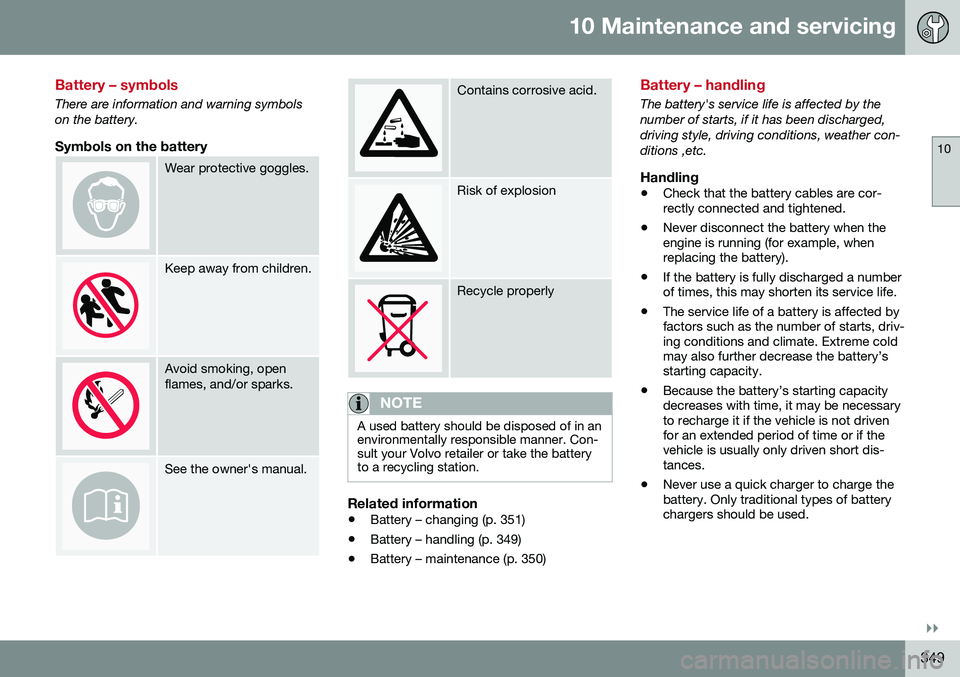
There are information and warning symbols on the battery.
Symbols on the battery
Wear protective goggles.
Keep away from children.
Avoid smoking, open flames, and/or sparks.
See the owner's manual.
Contains corrosive acid.
Risk of explosion
Recycle properly
NOTE
A used battery should be disposed of in an environmentally responsible manner. Con-sult your Volvo retailer or take the batteryto a recycling station.
Related information
•Battery – changing (p. 351)
• Battery – handling (p. 349)
• Battery – maintenance (p. 350)
Battery – handling
The battery's service life is affected by the number of starts, if it has been discharged,driving style, driving conditions, weather con-ditions ,etc.
Handling
• Check that the battery cables are cor- rectly connected and tightened.
• Never disconnect the battery when theengine is running (for example, whenreplacing the battery).
• If the battery is fully discharged a numberof times, this may shorten its service life.
• The service life of a battery is affected byfactors such as the number of starts, driv-ing conditions and climate. Extreme coldmay also further decrease the battery’sstarting capacity.
• Because the battery’s starting capacitydecreases with time, it may be necessaryto recharge it if the vehicle is not drivenfor an extended period of time or if thevehicle is usually only driven short dis-tances.
• Never use a quick charger to charge thebattery. Only traditional types of batterychargers should be used.
Page 367 of 402
10 Maintenance and servicing
10
}}
365
Automatic car wash
The vehicle should be washed at regular inter- vals since dirt, dust, insects and tar spotsadhere to the paint and may cause damage.To help prevent corrosion, it is particularlyimportant to wash the car frequently in thewintertime.• We do NOT recommend washing your car in an automatic wash during the firstfew months (because the paint will nothave hardened sufficiently).
• An automatic wash is a simple and quickway to clean your car, but it is worthremembering that it may not be as thor-ough as when you yourself go over thecar with sponge and water. Keeping theunderbody clean is most important, espe-cially in the winter. Some automaticwashers do not have facilities for washingthe underbody.
NOTE
Condensation may form temporarily on the inside of the lenses of exterior lights suchas headlights, fog lights, or taillights. Thisis normal and the lights are designed towithstand moisture. Normally, condensa-tion will dissipate after the lights have beenon for a short time.
CAUTION
• Before driving into an automatic car wash, turn off the optional rain sensorto avoid damaging the windshield wip-ers.
• Make sure that side view mirrors, aux-iliary lamps, etc, are secure, and thatany antenna(s) are retracted orremoved. Otherwise there is risk of themachine dislodging them.
• Chromed wheels:
Clean chrome-
plated wheels using the same deter-gents used for the body of the vehicle.Aggressive wheel-cleaning agents canpermanently stain chrome-platedwheels.
WARNING
• When the vehicle is driven immediately after being washed, apply the brakes,including the parking brake, severaltimes in order to remove any moisturefrom the brake linings.
• Engine cleaning agents should not beused when the engine is warm. Thisconstitutes a fire risk.
Related information
•
Polishing and waxing (p. 365)
• Cleaning the interior (p. 366)
• Washing the car (p. 364)
Polishing and waxing
Normally, polishing is not required during the first year after delivery, however, waxing maybe beneficial.
• Before applying polish or wax the vehicle must be washed and dried. Tar spots canbe removed with kerosene or tar remover.Difficult spots may require a fine rubbingcompound.
• After polishing use liquid or paste wax.
• Several commercially available productscontain both polish and wax.
• Waxing alone does not substitute for pol-ishing a dull surface.
• A wide range of polymer-based waxescan be purchased today. These waxesare easy to use and produce a long-last-ing, high-gloss finish that protects thebodywork against oxidation, road dirt andfading.
• Do not polish or wax your vehicle in directsunlight (the surface of the vehicle shouldnot be warmer than 113 °F (45 °C).
Page 369 of 402
10 Maintenance and servicing
10
}}
367
Protecting leather upholstery1. Put a small amount of protectant creamon a cloth and apply a thin coating of cream to the upholstery with light circularmovements.
2. Allow the leather to dry for 20 minutes. This will help the leather resist staining and protect against sunlight's harmful UV rays.
CAUTION
• Under no circumstances should gaso- line, naphtha or similar cleaning agentsbe used on the plastic or the leathersince these can cause damage.
• Take extra care when removing stainssuch as ink or lipstick since the color-ing can spread.
• Use solvents sparingly. Too much sol-vent can damage the seat padding.
• Start from the outside of the stain andwork toward the center.
• Sharp objects (e.g. pencils or pens in apocket) or Velcro fasteners on clothingmay damage the textile upholstery.
• Clothing that is not colorfast, such asnew jeans or suede garments, maystain the upholstery.
Cleaning a leather-covered steering wheel
•
Remove soil, dust, etc., with a damp sponge and a neutral soap solution.
• Leather should be allowed to breath.Never cover the steering wheel with aplastic protector.
• Volvo recommends cleaning, protectingand conditioning the steering wheel withVolvo's Leather Care Kit 951 0251 andLeather Softener 943 7429.
If there are stains on the steering wheel: Type 1 (ink, wine, coffee, milk, sweat or
blood)
–Use a soft cloth or sponge. Wipe the wheel with a solution with 5% ammonia.For blood stains, mix approx. 1 cup (2 dl)of water and one ounce (25g) of salt andwipe the stain.
Type 2 (fat, oil, sauces, or chocolate)
1. Same procedure as for type I stains.
2. Finish by rubbing the wheel with absorb- ent paper or a towel.
Type 3 (dry soil or dust)
1. Remove the soil/dust with a soft brush.
2. Same procedure as for type I stains.
CAUTION
Sharp objects, such as rings, could dam- age the leather on the steering wheel.
Cleaning the seat beltsClean only with lukewarm water and a mild soap solution.
Cleaning floor matsThe floor mats should be vacuumed orbrushed clean regularly, especially duringwinter when they should be taken out for dry-ing. Spots on textile mats can be removedwith a mild detergent. For best protection inwinter, Volvo recommends the use of Volvorubber floor mats. Consult your Volvo retailer.
Spots on interior plastic, metal, or wood surfaces
Cleaning interior plastic components should be done with a cleaning agent speciallydesigned for this purpose. Consult your Volvoretailer.
Page 375 of 402
11 Specifications
11
373
List of labelsVehicle Emission Control Information. Your Volvo is designed to meet all appli- cable emission standards, as evidencedby the certification label on the undersideof the hood. For further information regar-ding these regulations, please consultyour Volvo retailer.
Engine oil. This label contains the recom-
mended engine oil specifications.
Vehicle Identification Number (VIN). The VIN plate is located on the top left surface of the dashboard. The VehicleIdentification Number (VIN) should alwaysbe quoted in all correspondence concern-ing your vehicle with the retailer and whenordering parts.
Tire inflation pressures. This label indi-
cates the correct inflation pressures for the tires that were on the vehicle when itleft the factory.
Federal Motor Vehicle Safety Stand- ards (FMVSS) specifications (USA) andMinistry of Transport (CMVSS) stand- ards (Canada). Your Volvo is designed to
meet all applicable safety standards, as evidenced by the certification label on thedriver's side B-pillar (the structural mem-ber at the side of the vehicle, at the rearof the driver's door opening). This labelalso includes codes for paint color, etc.For further information regarding theseregulations, please consult your Volvoretailer. U.S. models have the upperdecal; Canadian models have the lowerone.
Related information
• Weights (p. 378)
• Engine specifications (p. 380)
Page 382 of 402
11 Specifications
11
380
Engine specifications
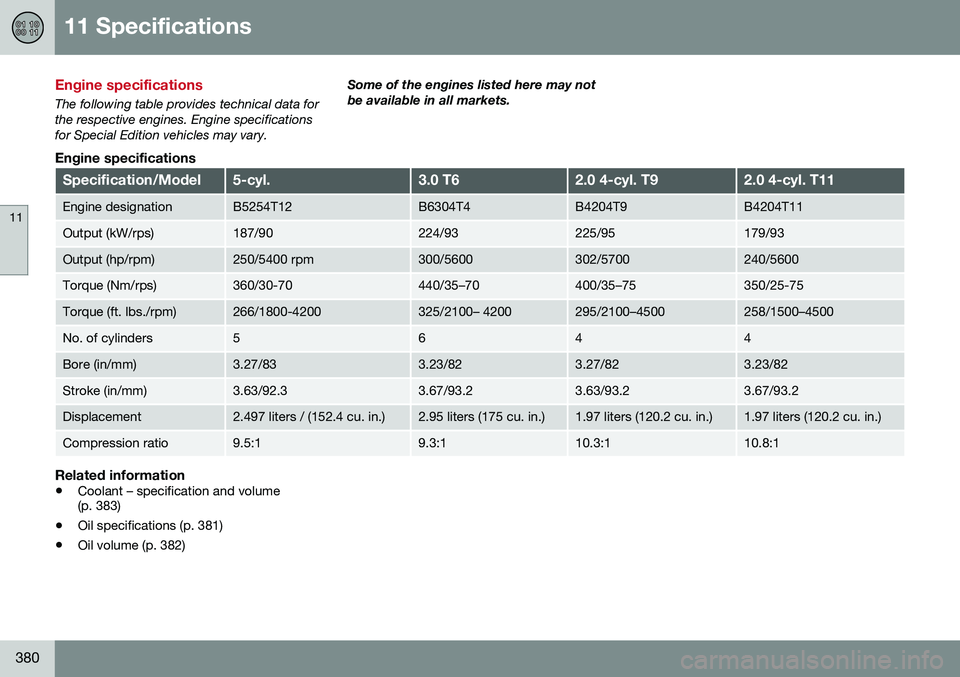
The following table provides technical data for the respective engines. Engine specificationsfor Special Edition vehicles may vary.Some of the engines listed here may notbe available in all markets.
Engine specifications
Specification/Model5-cyl.3.0 T62.0 4-cyl. T92.0 4-cyl. T11
Engine designationB5254T12B6304T4B4204T9B4204T11
Output (kW/rps)187/90224/93225/95179/93
Output (hp/rpm)250/5400 rpm300/5600302/5700240/5600
Torque (Nm/rps)360/30-70440/35–70400/35–75350/25-75
Torque (ft. lbs./rpm)266/1800-4200325/2100– 4200295/2100–4500258/1500–4500
No. of cylinders5644
Bore (in/mm)3.27/833.23/823.27/823.23/82
Stroke (in/mm)3.63/92.33.67/93.23.63/93.23.67/93.2
Displacement2.497 liters / (152.4 cu. in.)2.95 liters (175 cu. in.)1.97 liters (120.2 cu. in.)1.97 liters (120.2 cu. in.)
Compression ratio9.5:19.3:110.3:110.8:1
Related information
•
Coolant – specification and volume (p. 383)
• Oil specifications (p. 381)
• Oil volume (p. 382)
Page 384 of 402
11 Specifications
11
382
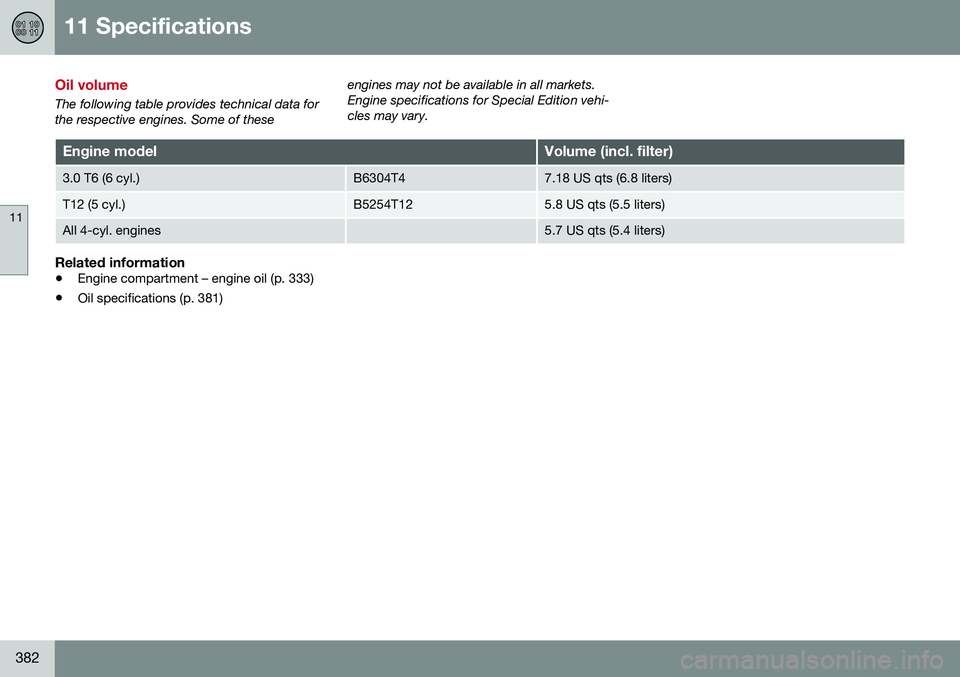
Oil volume
The following table provides technical data for the respective engines. Some of theseengines may not be available in all markets.Engine specifications for Special Edition vehi-cles may vary.
Engine modelVolume (incl. filter)
3.0 T6 (6 cyl.)B6304T47.18 US qts (6.8 liters)
T12 (5 cyl.)B5254T125.8 US qts (5.5 liters)
All 4-cyl. engines5.7 US qts (5.4 liters)
Related information
•
Engine compartment – engine oil (p. 333)
• Oil specifications (p. 381)
Page 385 of 402
11 Specifications
11
383
Coolant – specification and volume
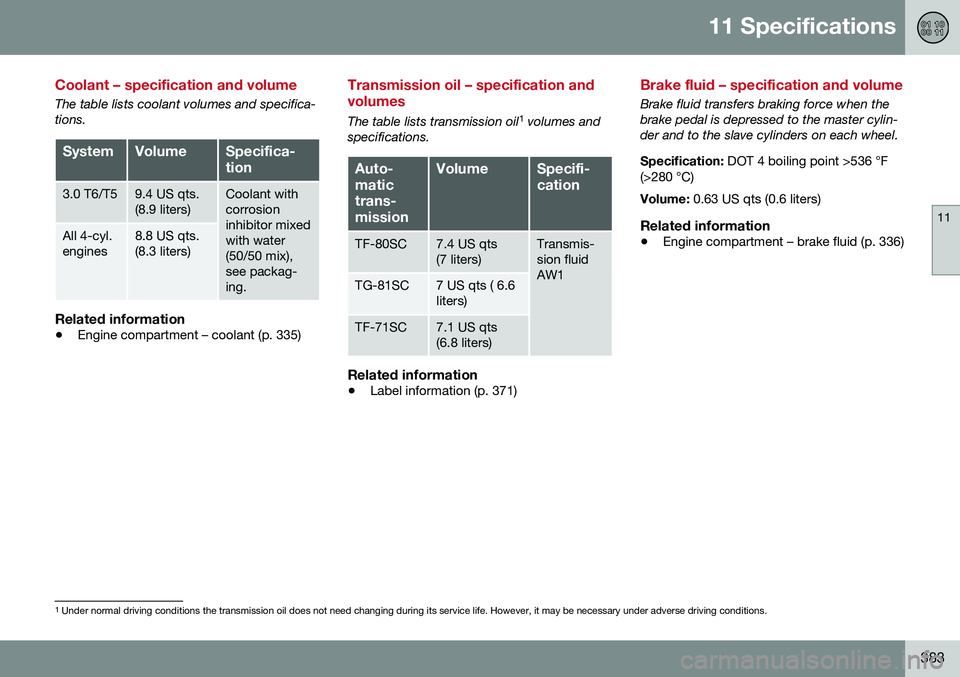
The table lists coolant volumes and specifica- tions.
SystemVolumeSpecifica- tion
3.0 T6/T59.4 US qts. (8.9 liters)Coolant with corrosioninhibitor mixedwith water(50/50 mix),see packag-ing.
All 4-cyl. engines8.8 US qts. (8.3 liters)
Related information
•Engine compartment – coolant (p. 335)
Transmission oil – specification and volumes
The table lists transmission oil 1
volumes and
specifications.
Auto- matictrans-missionVolumeSpecifi- cation
TF-80SC7.4 US qts (7 liters)Transmis- sion fluidAW1
TG-81SC7 US qts ( 6.6 liters)
TF-71SC7.1 US qts (6.8 liters)
Related information
• Label information (p. 371)
Brake fluid – specification and volume
Brake fluid transfers braking force when the brake pedal is depressed to the master cylin-der and to the slave cylinders on each wheel. Specification:
DOT 4 boiling point >536 °F
(>280 °C) Volume: 0.63 US qts (0.6 liters)
Related information
•Engine compartment – brake fluid (p. 336)
1
Under normal driving conditions the transmission oil does not need changing during its service life. However, it may be necessary under adverse driving conditions.
Page 386 of 402
11 Specifications
11
384
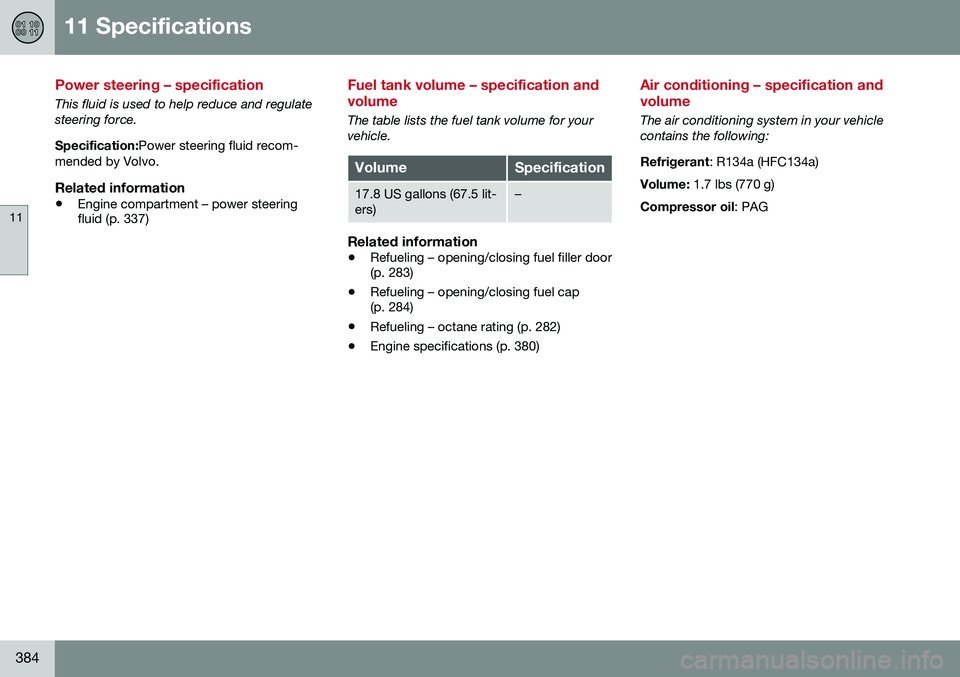
Power steering – specification
This fluid is used to help reduce and regulate steering force. Specification:Power steering fluid recom-
mended by Volvo.
Related information
• Engine compartment – power steering fluid (p. 337)
Fuel tank volume – specification and volume
The table lists the fuel tank volume for your vehicle.
VolumeSpecification
17.8 US gallons (67.5 lit- ers)–
Related information
•Refueling – opening/closing fuel filler door (p. 283)
• Refueling – opening/closing fuel cap(p. 284)
• Refueling – octane rating (p. 282)
• Engine specifications (p. 380)
Air conditioning – specification and volume
The air conditioning system in your vehicle contains the following: Refrigerant
: R134a (HFC134a)
Volume: 1.7 lbs (770 g)
Compressor oil : PAG