fog light VOLVO V60 2018 Owner´s Manual
[x] Cancel search | Manufacturer: VOLVO, Model Year: 2018, Model line: V60, Model: VOLVO V60 2018Pages: 406, PDF Size: 9.59 MB
Page 351 of 406
MAINTENANCE AND SERVICING
349
Related information
•Bulbs – specifications (p. 351)
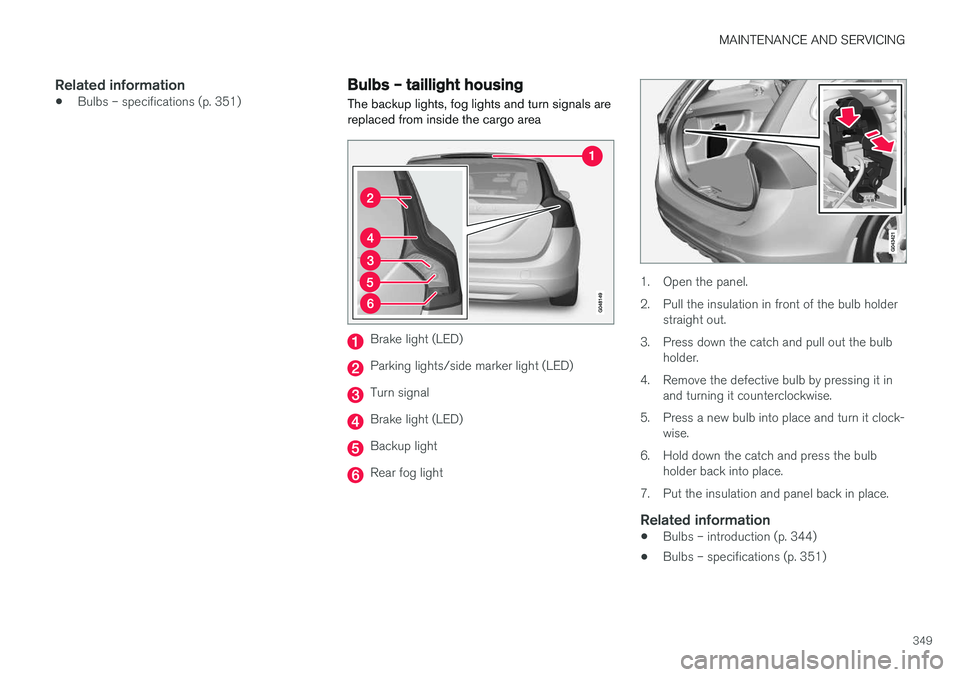
Bulbs – taillight housing The backup lights, fog lights and turn signals are replaced from inside the cargo area
Brake light (LED)
Parking lights/side marker light (LED)
Turn signal
Brake light (LED)
Backup light
Rear fog light
1. Open the panel.
2. Pull the insulation in front of the bulb holder
straight out.
3. Press down the catch and pull out the bulb holder.
4. Remove the defective bulb by pressing it in and turning it counterclockwise.
5. Press a new bulb into place and turn it clock- wise.
6. Hold down the catch and press the bulb holder back into place.
7. Put the insulation and panel back in place.
Related information
• Bulbs – introduction (p. 344)
• Bulbs – specifications (p. 351)
Page 353 of 406
MAINTENANCE AND SERVICING
}}
* Option/accessory.351
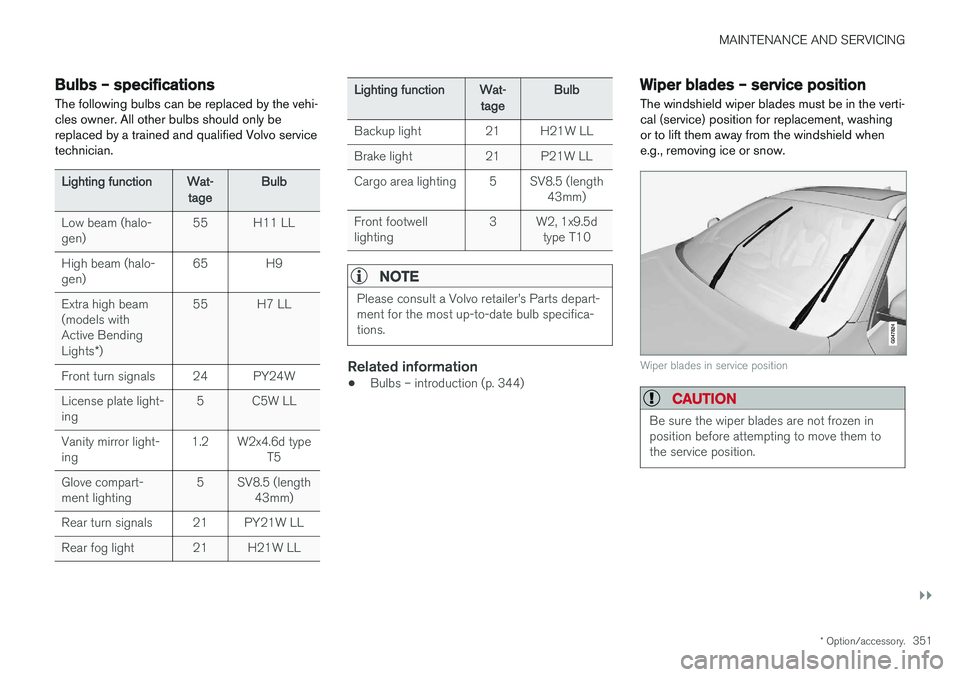
Bulbs – specifications The following bulbs can be replaced by the vehi- cles owner. All other bulbs should only bereplaced by a trained and qualified Volvo servicetechnician.
Lighting function Wat-
tage Bulb
Low beam (halo- gen) 55 H11 LL
High beam (halo-gen) 65 H9
Extra high beam(models withActive Bending Lights *) 55 H7 LL
Front turn signals 24 PY24W License plate light- ing 5 C5W LL
Vanity mirror light-ing 1.2 W2x4.6d type
T5
Glove compart-ment lighting 5 SV8.5 (length
43mm)
Rear turn signals 21 PY21W LL
Rear fog light 21 H21W LL
Lighting function Wat-
tage Bulb
Backup light 21 H21W LL
Brake light 21 P21W LL
Cargo area lighting 5 SV8.5 (length 43mm)
Front footwell lighting 3 W2, 1x9.5d
type T10
NOTE
Please consult a Volvo retailer
Page 372 of 406
||
MAINTENANCE AND SERVICING
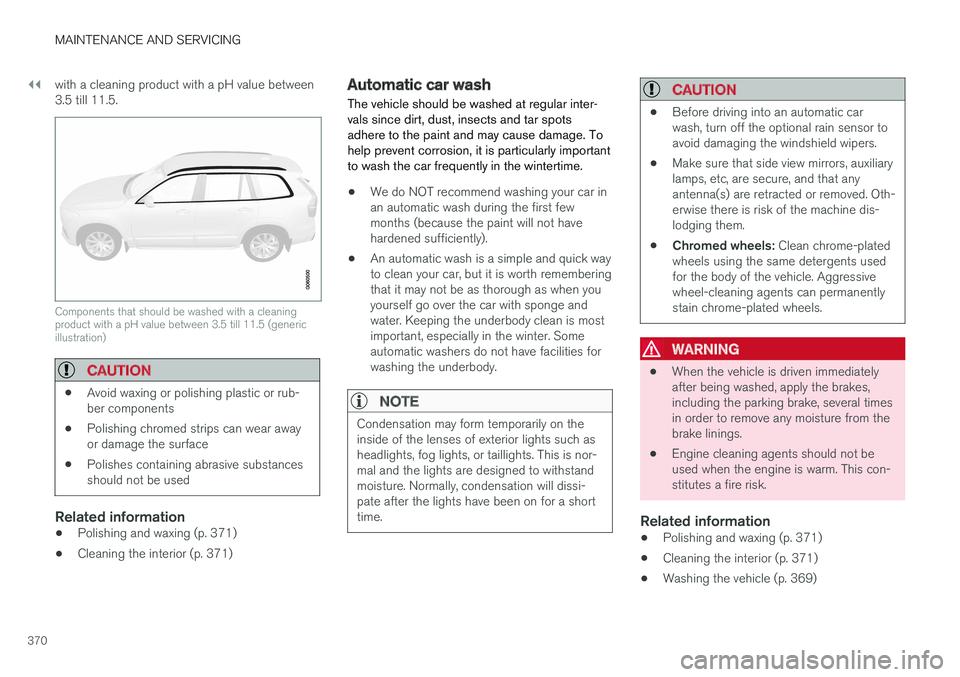
370with a cleaning product with a pH value between 3.5 till 11.5.
Components that should be washed with a cleaning product with a pH value between 3.5 till 11.5 (genericillustration)
CAUTION
•
Avoid waxing or polishing plastic or rub- ber components
• Polishing chromed strips can wear awayor damage the surface
• Polishes containing abrasive substancesshould not be used
Related information
• Polishing and waxing (p. 371)
• Cleaning the interior (p. 371)
Automatic car wash
The vehicle should be washed at regular inter- vals since dirt, dust, insects and tar spotsadhere to the paint and may cause damage. Tohelp prevent corrosion, it is particularly importantto wash the car frequently in the wintertime.
• We do NOT recommend washing your car in an automatic wash during the first fewmonths (because the paint will not havehardened sufficiently).
• An automatic wash is a simple and quick wayto clean your car, but it is worth rememberingthat it may not be as thorough as when youyourself go over the car with sponge andwater. Keeping the underbody clean is mostimportant, especially in the winter. Someautomatic washers do not have facilities forwashing the underbody.
NOTE
Condensation may form temporarily on the inside of the lenses of exterior lights such asheadlights, fog lights, or taillights. This is nor-mal and the lights are designed to withstandmoisture. Normally, condensation will dissi-pate after the lights have been on for a shorttime.
CAUTION
•
Before driving into an automatic car wash, turn off the optional rain sensor toavoid damaging the windshield wipers.
• Make sure that side view mirrors, auxiliarylamps, etc, are secure, and that anyantenna(s) are retracted or removed. Oth-erwise there is risk of the machine dis-lodging them.
• Chromed wheels:
Clean chrome-plated
wheels using the same detergents usedfor the body of the vehicle. Aggressivewheel-cleaning agents can permanentlystain chrome-plated wheels.
WARNING
• When the vehicle is driven immediately after being washed, apply the brakes,including the parking brake, several timesin order to remove any moisture from thebrake linings.
• Engine cleaning agents should not beused when the engine is warm. This con-stitutes a fire risk.
Related information
•
Polishing and waxing (p. 371)
• Cleaning the interior (p. 371)
• Washing the vehicle (p. 369)
Page 393 of 406

SPECIFICATIONS
}}
* Option/accessory.391
Indicator symbols
The following tables list the most common warn- ing and indicator lights and symbols and a refer-ence to where more detailed information can befound.
: The red warning symbol illuminates to
indicate a problem related to safety and/or driva- bility. A message will also appear in the maininstruments panel's display.
: The information symbol illuminates and a
text message is displayed to provide the driver with necessary information about one of thevehicle's systems.
Indicator symbols in the instrument panel
Symbol Description See
Fault in the Active Bend- ing Light (ABL)*system (p. 75)
Malfunction indicator light
(p. 75)
Anti-lock brake system (ABS)(p. 75)
Rear fog lights on (p. 75)
Stability system, Hill Descent Control, Trailer Stability Assist
*(p. 75)
Symbol
Description See
Tire pressure monitoring sensor (TPMS)(p. 75)
Low fuel level (p. 75)
Information symbol, see text in information dis-play(p. 75)
High beam indicator (p. 75)
Left turn signal indicator (p. 75)
Right turn signal indica- tor
(p. 75)
Stability system , Sport mode(p. 175)
Related information
•
Information displays – indicator symbols (p. 75)
• Information displays – warning symbols(p. 77)
• Information display – messages (p. 117)
Information symbols
The following tables list the most common warn- ing and indicator lights and symbols and a refer-ence to where more detailed information can befound.
: The red warning symbol illuminates to
indicate a problem related to safety and/or driva- bility. A message will also appear in the maininstruments panel's display.
: The information symbol illuminates and a
text message is displayed to provide the driver with necessary information about one of thevehicle's systems.
Information symbols in the instrument panel
Symbol Description See
Adaptive Cruise Con- trol * (p. 183)
Adaptive Cruise Con- trol
* (p. 183)
Adaptive Cruise Con- trol
* (p. 183)
Adaptive Cruise Con- trol
* (Distance alert) (p. 183)
Radar sensor
*(p. 193)
Page 399 of 406
INDEX
397
Emergency starting 262
Emergency towing 295, 296
Emission inspection readiness 335Engine
overheating 78
specifications 383
Start/Stop 268, 269, 270, 271, 272
starting 258
switching off 260, 261
Engine compartment overview 338
Engine Drag Control (EDC) 174
Engine oil 384 checking 339
low pressure warning light 77
volumes 385
Engine remote start (ERS) 260
Environment 23
F
Federal Clean Air Act 332 Flat tires repairing with tire sealing system 324
Floor mats cleaning 373
placing correctly 258
Fluid specifications 386, 387
Fog lights 76rear 98
Front airbags 35 disconnecting passenger
Page 401 of 406
INDEX
399
M
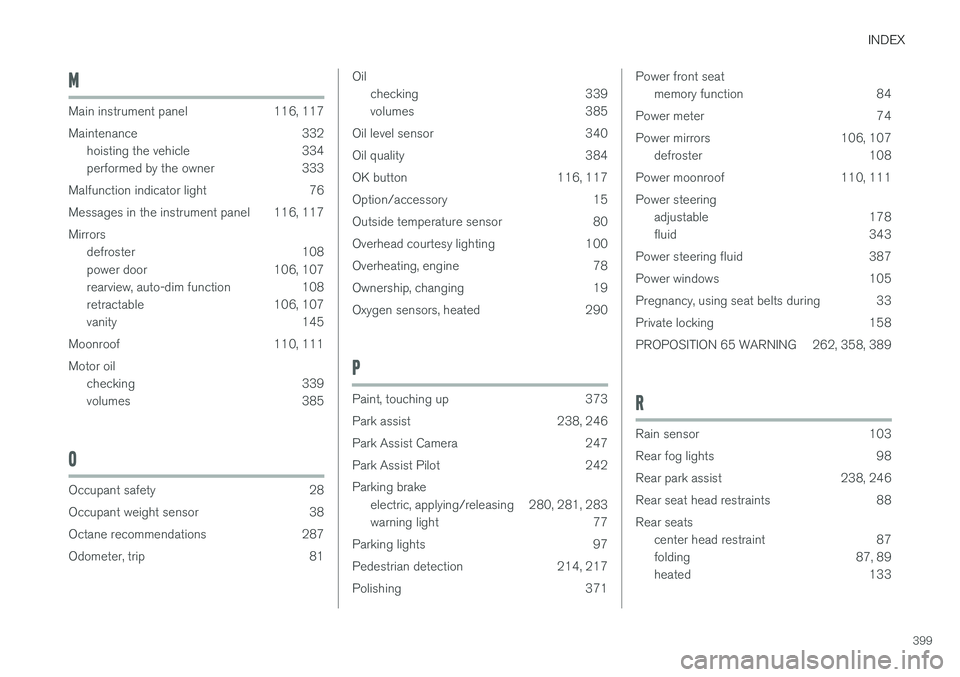
Main instrument panel 116, 117
Maintenance 332hoisting the vehicle 334
performed by the owner 333
Malfunction indicator light 76
Messages in the instrument panel 116, 117Mirrors defroster 108
power door 106, 107
rearview, auto-dim function 108
retractable 106, 107
vanity 145
Moonroof 110, 111 Motor oil checking 339
volumes 385
O
Occupant safety 28
Occupant weight sensor 38
Octane recommendations 287
Odometer, trip 81
Oil checking 339
volumes 385
Oil level sensor 340
Oil quality 384
OK button 116, 117
Option/accessory 15
Outside temperature sensor 80
Overhead courtesy lighting 100
Overheating, engine 78
Ownership, changing 19
Oxygen sensors, heated 290
P
Paint, touching up 373
Park assist 238, 246
Park Assist Camera 247
Park Assist Pilot 242Parking brake electric, applying/releasing 280, 281, 283
warning light 77
Parking lights 97
Pedestrian detection 214, 217
Polishing 371
Power front seat memory function 84
Power meter 74
Power mirrors 106, 107 defroster 108
Power moonroof 110, 111Power steering adjustable 178
fluid 343
Power steering fluid 387
Power windows 105
Pregnancy, using seat belts during 33
Private locking 158
PROPOSITION 65 WARNING 262, 358, 389
R
Rain sensor 103
Rear fog lights 98
Rear park assist 238, 246
Rear seat head restraints 88Rear seats center head restraint 87
folding 87, 89
heated 133