light VOLVO V60 TWIN ENGINE 2020 Owners Manual
[x] Cancel search | Manufacturer: VOLVO, Model Year: 2020, Model line: V60 TWIN ENGINE, Model: VOLVO V60 TWIN ENGINE 2020Pages: 673, PDF Size: 14.2 MB
Page 386 of 673

||
HYBRID INFORMATION
384
Charging cable handle and charging socket.
Charging status is indicated in three ways:
The indicator lights in the charging module (the unit connected to the wall outlet).
Indicator light in the vehicle's chargingsocket.
Images and text in the instrument panel.
The start battery is charged while the hybridbattery is charging and stops charging whenthe hybrid battery is fully charged. If the hybrid battery's temperature is below -10 ºC (14 ºF) or above 40 ºC (104 ºF), some
of the vehicle's functions may be reduced ornot available at all. The electric motor cannot be used if the bat- tery's temperature is too low or too high. If thePURE drive mode is selected, the gasolineengine will start.
Charging using the gasoline engine
The vehicle generates electrical current to charge the battery, e.g. when the driver lightly presses the brakepedal or when engine braking is used on down-grades.
The vehicle can also generate current to the hybrid battery to charge it. The hybrid battery can also be recharged by lightly depressing the brake pedal, i.e.during light braking. This converts thevehicle's kinetic energy to electricalenergy, which is used to charge the hybridbattery.
In gear position
B, the electric motor
brakes the vehicle when the acceleratorpedal is released and the hybrid battery isrecharged at the same time.
The combustion engine can also helprecharge the hybrid battery.
Related information
Charge cable (p. 385)
Charging current (p. 385)
Opening and closing the charging socketcover (p. 388)
Initiating hybrid battery charging (p. 388)
Stopping hybrid battery charging (p. 394)
Charging status in the charging cable'scharging module (p. 391)
Charging status in the vehicle's chargingsocket (p. 390)
Charging status in the instrument panel(p. 392)
Twin Engine symbols and messages in theinstrument panel (p. 395)
Automatic transmission (p. 414)
Changing drive mode (p. 425)
Long-term storage of vehicles with hybridbatteries (p. 397)
Page 387 of 673

HYBRID INFORMATION
}}
385
Charging current Charging current is used to charge the hybrid battery and precondition the vehicle. Charg-ing is performed by connecting a chargingcable between the vehicle's charging socketand a 120/240 V electrical socket (alternat-ing current).
When the charging cable is activated, a mes- sage will be displayed in the instrument paneland an indicator light in the vehicle's chargingsocket will illuminate. Charging current is pri-marily used for battery charging, but is alsoused for preconditioning. The vehicle's startbattery is charged along with the hybrid bat-tery.
CAUTION
Never detach the charging cable from the 120/240 V outlet (AC, alternating current)while charging is in progress – the120/240 V outlet could be damaged insuch circumstances. Always interruptcharging first and then disconnect thecharging cable – first from the vehicle'scharging socket and then from the120/240 V outlet.
NOTE
In extremely cold or hot weather, part of the charging current is used to heat/cool the hybrid battery and the passen-ger compartment, resulting in a longercharging time.
The charging time is longer if precondi-tioning has been selected. The timerequired depends primarily on theambient temperature.
FuseThere are normally several 120/240 V power consumers in one fuse circuit, which meansthat more than one power consumer (e.g.lighting, vacuum cleaner, electric drill, etc.)may use the same fuse.
Related information
Charge cable (p. 385)
Charging status in the instrument panel(p. 392)
Charging status in the vehicle's chargingsocket (p. 390)
Starting and stopping preconditioning(p. 222)
Stopping hybrid battery charging (p. 394)
Charge cable
The charging cable is used to recharge your vehicle's hybrid battery.
The charging cable is stored in a storage compart- ment under the cargo compartment floor.
WARNING
Only use the charging cable provided with your vehicle or a replacement cable pur-chased from a Volvo retailer.
Specifications, charging cable Enclosure class Compliance IP67
SAE J1772
Ambient tempera- ture -32
ºC to 50 ºC
(-25 ºF till 122 ºF)
Page 388 of 673
||
HYBRID INFORMATION
386
WARNING
The charging cable must be grounded when in use. It is equipped with a cordwith a grounding conductor and agrounding plug. The plug must beinserted into an appropriate outlet thatis properly installed and grounded inaccordance with all local codes andordinances and is not damaged in anyway.
Children should be supervised when inthe vicinity of the charging cable whenit is plugged in.
High voltage is present in your electricmeter housing and power distributionservice panel. Contact with high volt-age can cause death or serious per-sonal injury.
Do not use the charging cable if it isdamaged in any way. A damaged ormalfunctioning charging cable mayonly be repaired by a workshop – anauthorized Volvo workshop is recom-mended.
Always position the charging cable sothat it will not be driven over, steppedon, tripped over or otherwise damaged,or cause personal injury.
Disconnect the charger from the walloutlet before cleaning it.
Never connect the charging cable to an extension cord or a multiple plugsocket.
Also, refer to the manufacturer's instruc- tions for using the charging cable and itscomponents.
CAUTION
Power strips, extension cords, surge pro- tectors or similar devices must not be usedtogether with the charging cable since thismay involve a risk of fire, electric shocks,etc. An adapter may not be used between the 120/240 V outlet (AC, alternating current)and the charging cable.
CAUTION
Never detach the charging cable from the 120/240 V outlet (AC, alternating current)while charging is in progress – the120/240 V outlet could be damaged insuch circumstances. Always interruptcharging first and then disconnect thecharging cable – first from the vehicle'scharging socket and then from the120/240 V outlet.
CAUTION
Wipe the charging cable with a clean cloth lightly moistened with water or a milddetergent. Do not use chemicals or sol-vents.
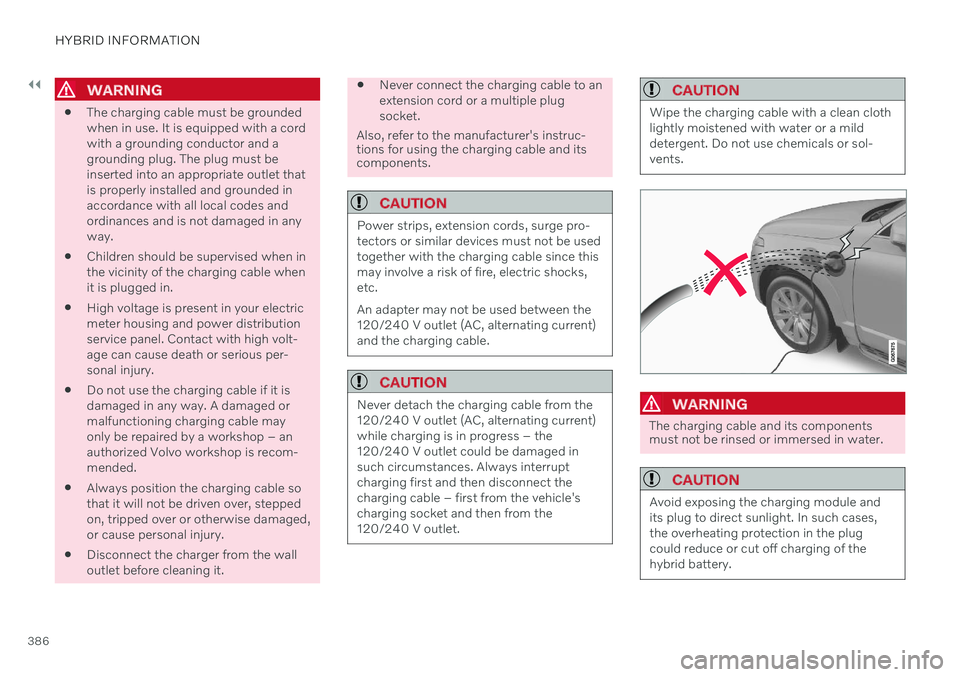
WARNING
The charging cable and its components must not be rinsed or immersed in water.
CAUTION
Avoid exposing the charging module and its plug to direct sunlight. In such cases,the overheating protection in the plugcould reduce or cut off charging of thehybrid battery.
Page 389 of 673

HYBRID INFORMATION
387
Charging cable components
Charge module
240 V adapter clip
240 V adapter
Charge coupler
Release button
Related information
Charging cable residual current device (p. 387)
Charging cable temperature monitoring(p. 388)
Charging the hybrid battery (p. 383)
Charging status in the charging cable'scharging module (p. 391)
Charging cable residual current device The charging cable has a circuit breaker that helps protect against current overloads andthermal overheating.
WARNING
Charging the hybrid battery may only be done from approved, grounded 120/240 Voutlets (AC, alternating current). If the elec-trical circuit or electrical socket's capacityis not known, let a licensed electricianinspect the electrical circuit's capacity.Using a charge level that exceeds the elec-trical circuit's or electrical outlet's capacitymay start a fire or damage the electrical cir-cuit.
WARNING
The charging cable's residual current breaker helps protect the vehicle'scharging system but cannot ensurethat an current overload will neveroccur.
Never use visibly worn or damagedelectrical sockets. Doing so could leadto fires or serious injury.
Never connect the charging cable to anextension cord.
Maintenance or replacement of thehybrid battery may only be performedby a trained and qualified Volvo servicetechnician.
If the charging cable's residual current device
is triggered, the blue indicator light in thecharging module will not illuminate when thecharging cable is plugged into an electricaloutlet (or the red warning light will glowsteadily). Have the outlet checked by alicensed electrician or try using another walloutlet.
Related information
Charge cable (p. 385)
Charging status in the charging cable'scharging module (p. 391)
Page 390 of 673
HYBRID INFORMATION
388
Charging cable temperature monitoringTo help ensure the vehicle's hybrid battery is reliably charged each time it is connected,charging is stopped if the temperature in thecharging cable becomes too high and rea-ches a critical limit.
CAUTION
If charging is often inadvertently interrup- ted, have the charging cable and the vehi-cle's charging system inspected by atrained and qualified Volvo service techni-cian.
Related information
Charge cable (p. 385)
Opening and closing the charging socket cover
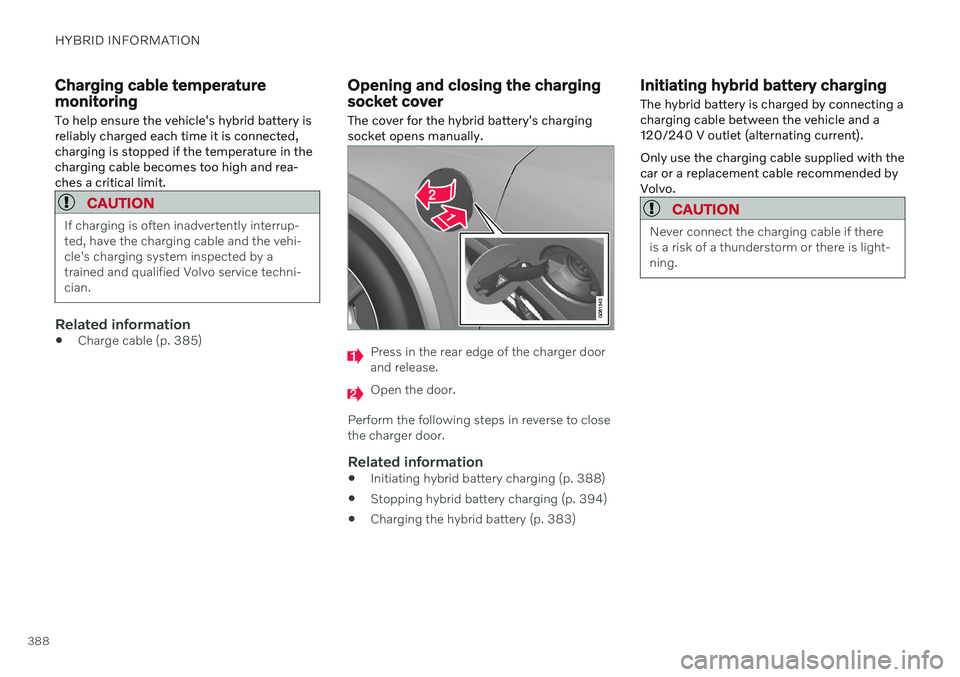
The cover for the hybrid battery's charging socket opens manually.
Press in the rear edge of the charger door and release.
Open the door.
Perform the following steps in reverse to close the charger door.
Related information
Initiating hybrid battery charging (p. 388)
Stopping hybrid battery charging (p. 394)
Charging the hybrid battery (p. 383)
Initiating hybrid battery charging
The hybrid battery is charged by connecting a charging cable between the vehicle and a120/240 V outlet (alternating current). Only use the charging cable supplied with the car or a replacement cable recommended byVolvo.
CAUTION
Never connect the charging cable if there is a risk of a thunderstorm or there is light-ning.
Page 392 of 673
||
HYBRID INFORMATION
3902. The charging cable handle will lock into
place and charging will begin within 5 seconds. When charging starts, thegreen LED light in the charging socket willbegin to flash. The approximate remainingcharging time or the charging status willbe displayed in the instrument panel. Charging may be temporarily interrupted if the vehicle is unlocked:
and a door is open
‒ charging will
restart within a few minutes.
if no door is opened
‒ the vehicle will
automatically relock. Charging willresume after 1 minute.
CAUTION
Never detach the charging cable from the 120/240 V outlet (AC, alternating current)while charging is in progress – the120/240 V outlet could be damaged insuch circumstances. Always interruptcharging first and then disconnect thecharging cable – first from the vehicle'scharging socket and then from the120/240 V outlet.
During charging, condensation from the air conditioning may form under the vehicle. Thisis normal and is caused by the hybrid batterycooling.
Related information
Charging the hybrid battery (p. 383)
Opening and closing the charging socketcover (p. 388)
Charging status in the vehicle's chargingsocket (p. 390)
Charging status in the instrument panel(p. 392)
Charging status in the charging cable's charging module (p. 391)
Stopping hybrid battery charging (p. 394)
Charging status in the vehicle's charging socket
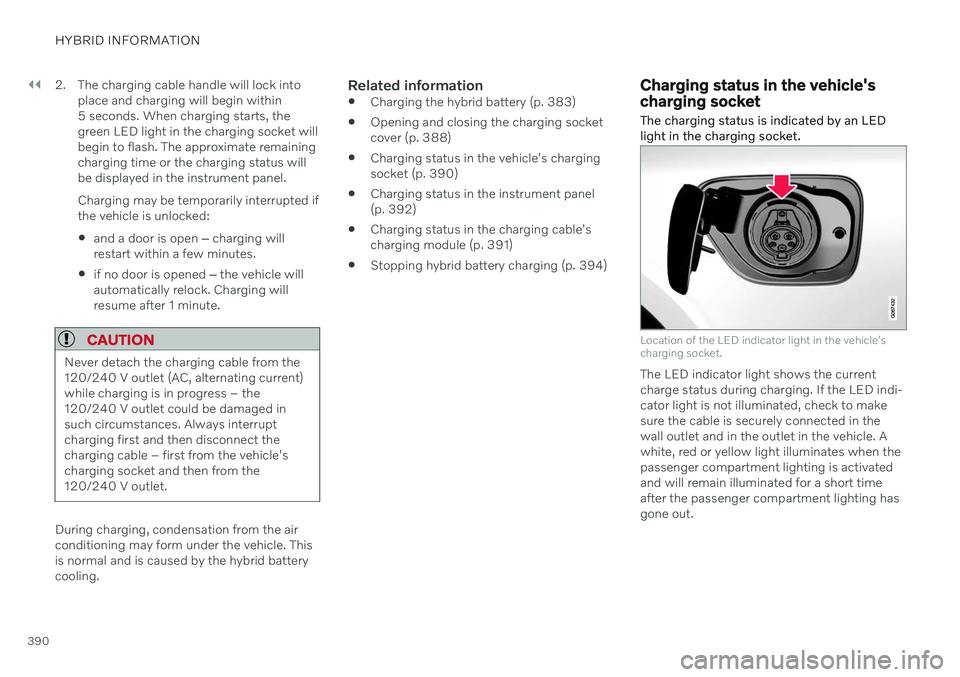
The charging status is indicated by an LED light in the charging socket.
Location of the LED indicator light in the vehicle's charging socket.
The LED indicator light shows the current charge status during charging. If the LED indi-cator light is not illuminated, check to makesure the cable is securely connected in thewall outlet and in the outlet in the vehicle. Awhite, red or yellow light illuminates when thepassenger compartment lighting is activatedand will remain illuminated for a short timeafter the passenger compartment lighting hasgone out.
Page 393 of 673

HYBRID INFORMATION
391
LED indicator light's colorMeaning
White Courtesy light. Yellow Wait modeA
– waiting for
charging to start.
Flashing green Charging is in progress B
.
Green Charging completed C
.
Red Malfunction.
A E.g. after a door has been opened or if the charging cable handle is not locked in place.
B The more slowly the light flashes, the closer the battery is tobeing fully charged.
C The light will go out after a short time.
Related information
Charging the hybrid battery (p. 383)
Charging status in the instrument panel (p. 392)
Charging status in the charging cable'scharging module (p. 391)
Stopping hybrid battery charging (p. 394)
Charging status in the charging cable's charging module
The red and blue lights in the charging mod- ule indicate the status of ongoing and com-pleted charging.
Charge module: 1. Red warning light, 2. Blue status indicator
When the charge module is initially plugged into a wall outlet, the red warning light willflash once to indicate that a startup safetycheck has been performed. When the safetycheck has been completed, the blue statusindicator will glow steadily and the red warn-ing light will be off. The charger is now readyto be used. If the red warning light continuesto flash or glows steadily, a fault has beendetected and the charger will not deliverpower to the vehicle. Contact a Volvo retaileror a certified Volvo service technician. When the charging cable is connected to thevehicle's charging socket, the blue light willflash once. Charging cable connected to the vehicle's charging socket:
Indicator light's color
Meaning
Flashing blue Charging is in progress. Thelight flashes about onceevery other second.
Solid blue Charging completed. This will also be indicated in theinstrument panel.
Related information
Charging the hybrid battery (p. 383)
Charging status in the vehicle's charging socket (p. 390)
Charging status in the instrument panel(p. 392)
Stopping hybrid battery charging (p. 394)
Page 394 of 673

HYBRID INFORMATION
392
Charging status in the instrument panelCharging status is indicated in the instrument panel using both graphics and messages. This information is displayed as long as theinstrument panel is active.
Graphic Message
Meaning
Fully charged at: [Time] displayed along with an animated blue
pulsing light through the charging cable. Charging is in progress and the approximate time at which the battery will be fully charged is displayed.
Charging complete is displayed. An image will be superimposed
over the graphic of the vehicle with a green LED indicator light in the socket. The battery is fully charged.
Charging error will be displayed. The LED indicator light in the
charging socket will be red. Malfunction. Make sure the charging cable is correctly con- nected to the vehicle's charging socket and to the120/240 V outlet (alternating current).
Page 404 of 673

||
STARTING AND DRIVING
402
CAUTION
When starting in cold weather, the automatic transmission may shift up atslightly higher engine speeds than nor-mal until the automatic transmissionfluid reaches normal operating tem-perature.
Do not race a cold engine immediatelyafter starting. This could prevent fluidsfrom properly lubricating vital compo-nents in the engine before it hasreached the proper operating tempera-ture.
The engine should be idling when thegear selector is moved. Never acceler-ate until the gear is fully engaged.Accelerating rapidly before a gear isproperly engaged could lead to harderwear of components.
To help prevent the transmission oilfrom overheating, select
P or N when
idling at a standstill for prolonged peri-ods of time.
NOTE
With a cold start, idling speed may be con- siderably higher than normal for certainengine types. This is done to get the emis-sions system up to normal operating tem-perature as quickly as possible, which min-imizes exhaust emissions and protects theenvironment.
Related information
Switching off the vehicle (p. 402)
Ignition modes (p. 403)
Adjusting the steering wheel (p. 197)
Jump starting using another battery (p. 442)
Selecting ignition mode (p. 404)
Switching off the vehicle
The vehicle can be switched off using the start knob in the tunnel console.
Start knob in the tunnel console.
To switch off the vehicle:
–Turn the start knob clockwise and release to switch off the vehicle. The control willautomatically return to the original posi-tion.
If the vehicle rolls:
–Turn clockwise and hold the knob until the vehicle switches off.
Related information
Starting the vehicle (p. 400)
Ignition modes (p. 403)
Adjusting the steering wheel (p. 197)
Page 406 of 673

||
STARTING AND DRIVING
* Option/accessory.
404
Mode Functions
I The panoramic roof, power windows, 12-volt electricalsocket in the passenger com-partment, Bluetooth, naviga-tion, phone, blower and wind-shield wipers can be used.
The power seats can beadjusted.
The 12-volt electrical socket
* in
the cargo compartment can beused.
Electrical current will be taken
from the battery in this ignitionmode.
II The headlights illuminate.
Warning/indicator lights illumi-nate for 5 seconds.
A number of other systems areactivated. However, seat andrear window heating can onlybe activated when the engineis running.
This ignition mode uses a lot of
current from the battery andshould be avoided wheneverpossible!
A Also activated when the door is opened.
Related information
Starting the vehicle (p. 400)
Adjusting the steering wheel (p. 197)
Jump starting using another battery (p. 442)
Selecting ignition mode (p. 404)
Selecting ignition mode
The vehicle's ignition can be put in various modes (levels) to make different functionsavailable.
Selecting an ignition mode
Start knob in the tunnel console.
Ignition mode 0
– Unlock the vehicle and
keep the remote key in the passenger compartment.
NOTE
To set level I or II without engine start –
do not depress the brake pedal (or clutch
pedal for vehicles with manual transmis- sion) when selecting this ignition mode.
Ignition mode I
– Turn the start knob
clockwise and release it. The control will