light VOLVO V60 TWIN ENGINE 2020 Owners Manual
[x] Cancel search | Manufacturer: VOLVO, Model Year: 2020, Model line: V60 TWIN ENGINE, Model: VOLVO V60 TWIN ENGINE 2020Pages: 673, PDF Size: 14.2 MB
Page 567 of 673

LOADING, STORAGE AND PASSENGER COMPARTMENT
}}
* Option/accessory.565
Sun visors
In the ceiling in front of the driver's and front passenger's seats, there are sun visors thatcan be lowered and angled to the side asnecessary.
The illustration is generic – the design may vary.
The mirror lighting * comes on automatically
when the visor is lifted up. The mirror frame has a holder for e.g. cards or tickets.
Related information
Passenger compartment interior (p. 558)
Cargo compartment
The vehicle has a flexible cargo compartment that makes it possible to carry and securelarge objects.
The cargo capacity of the vehicle can be con- siderably increased by folding down the rearseat backrests. Use the load anchoring eyeletsor grocery bag holders to help secure objectsin place, and the retractable cargo compart- ment cover * to help conceal objects in the
cargo compartment. If the vehicle is equipped with a temporary spare tire, this is secured to the cargo com-partment floor under the cover. The towingeyelet and tire sealing system are locatedunder the cargo compartment floor.
Related information
Loading recommendations (p. 565)
Grocery bag holders (p. 567)
Load anchoring eyelets (p. 568)
Installing and removing the cargo com- partment cover
* (p. 569)
Loading recommendations
There are a number of things that are impor- tant to consider when carrying loads in or onthe vehicle.
Load-carrying capacity is determined by the vehicle's curb weight. The total weight of allpassengers and any installed accessoriesreduces the vehicle's load-carrying capacity bythe corresponding amount.
WARNING
The vehicle's driving characteristics change depending on the weight and position ofthe load.
Loading the cargo compartment/trunkKeep the following in mind when loading:
Position objects so they are pressing against the rear seat backrests.
Heavy objects should be positioned as lowas possible. Avoid placing heavy objectson folded-down seat backrests.
Cover sharp corners with a soft cloth orsimilar to help prevent damage to theupholstery.
Use the load anchoring eyelets and ten-sioning straps or similar to secure allobjects.
Page 572 of 673
||
LOADING, STORAGE AND PASSENGER COMPARTMENT
* Option/accessory.
570
Fully open
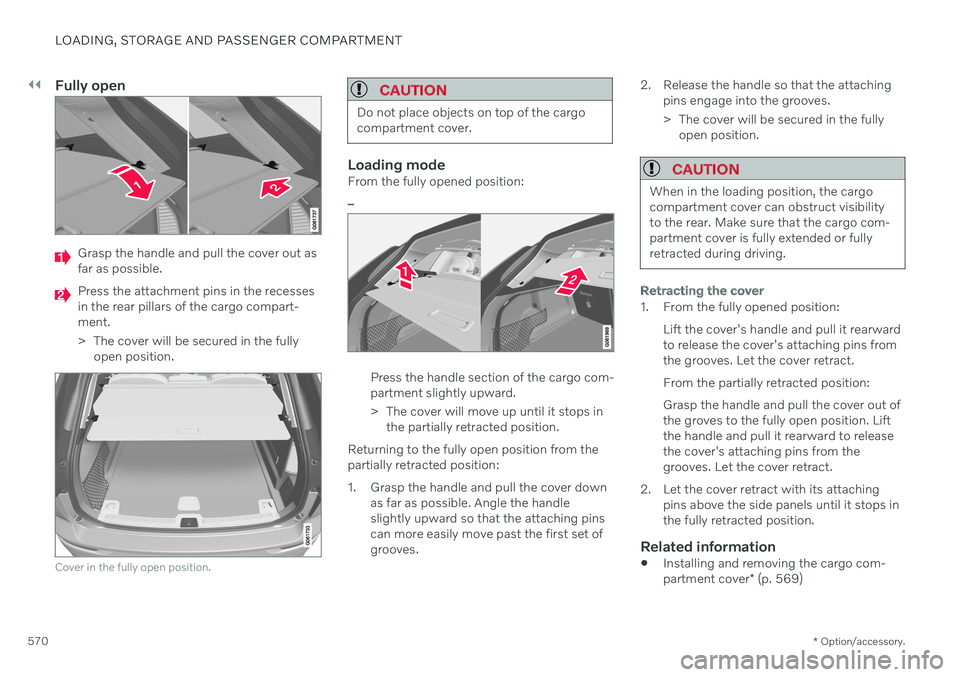
Grasp the handle and pull the cover out as far as possible.
Press the attachment pins in the recesses in the rear pillars of the cargo compart-ment.
> The cover will be secured in the fully
open position.
Cover in the fully open position.
CAUTION
Do not place objects on top of the cargo compartment cover.
Loading modeFrom the fully opened position:
–
Press the handle section of the cargo com- partment slightly upward.
> The cover will move up until it stops in the partially retracted position.
Returning to the fully open position from the partially retracted position:
1. Grasp the handle and pull the cover down as far as possible. Angle the handle slightly upward so that the attaching pinscan more easily move past the first set ofgrooves. 2. Release the handle so that the attaching
pins engage into the grooves.
> The cover will be secured in the fullyopen position.
CAUTION
When in the loading position, the cargo compartment cover can obstruct visibilityto the rear. Make sure that the cargo com-partment cover is fully extended or fullyretracted during driving.
Retracting the cover
1. From the fully opened position:
Lift the cover's handle and pull it rearward to release the cover's attaching pins fromthe grooves. Let the cover retract. From the partially retracted position:Grasp the handle and pull the cover out of the groves to the fully open position. Liftthe handle and pull it rearward to releasethe cover's attaching pins from thegrooves. Let the cover retract.
2. Let the cover retract with its attaching pins above the side panels until it stops inthe fully retracted position.
Related information
Installing and removing the cargo com- partment cover
* (p. 569)
Page 576 of 673
||
LOADING, STORAGE AND PASSENGER COMPARTMENT
574
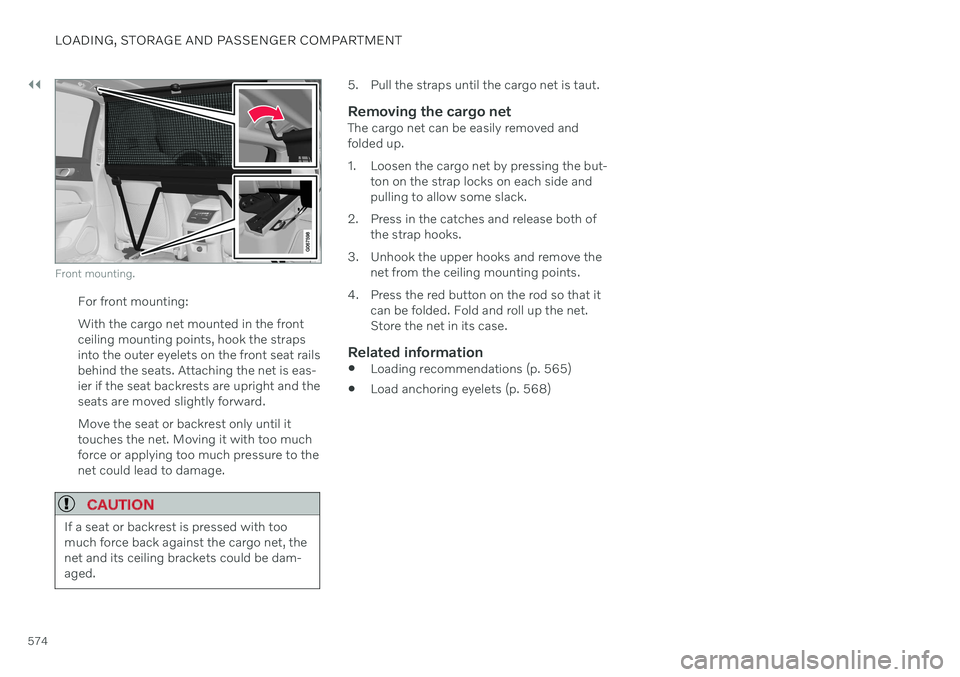
Front mounting.
For front mounting: With the cargo net mounted in the front ceiling mounting points, hook the strapsinto the outer eyelets on the front seat railsbehind the seats. Attaching the net is eas-ier if the seat backrests are upright and theseats are moved slightly forward. Move the seat or backrest only until it touches the net. Moving it with too muchforce or applying too much pressure to thenet could lead to damage.
CAUTION
If a seat or backrest is pressed with too much force back against the cargo net, thenet and its ceiling brackets could be dam-aged.
5. Pull the straps until the cargo net is taut.
Removing the cargo netThe cargo net can be easily removed and folded up.
1. Loosen the cargo net by pressing the but-ton on the strap locks on each side and pulling to allow some slack.
2. Press in the catches and release both of the strap hooks.
3. Unhook the upper hooks and remove the net from the ceiling mounting points.
4. Press the red button on the rod so that it can be folded. Fold and roll up the net.Store the net in its case.
Related information
Loading recommendations (p. 565)
Load anchoring eyelets (p. 568)
Page 579 of 673

MAINTENANCE AND SERVICE
}}
577
Applicable warranties - U.S./Canada
In accordance with applicable U.S. and Cana- dian regulations, the following list of warran-ties is provided. New Vehicle Limited Warranty
Parts and Accessories Limited Warranty
Corrosion Protection Limited Warranty
Seat Belt and Supplemental Restraint Systems Limited Warranty
Emission Design and Defect Warranty
Emission Performance Warranty
These are federal warranties; other warrantiesare provided as required by state/provinciallaw. Refer to your separate Warranty andService Records Information booklet fordetailed information concerning each of thewarranties.
Periodic maintenance helps minimize emissions
NOTE
Refer to your Service and Warranty Booklet for a comprehensive serviceand maintenance schedule up to240,000 km (150,000 miles). Thisprogram contains inspections and ser-vices necessary for the proper functionof your vehicle and includes compo-nents that affect vehicle emissions.
The Warranty and Service RecordsInformation booklet also containsdetailed information concerning thewarranties that apply to your vehicle.
On-board Diagnostic SystemOBD II is part of your vehicle's computerized engine management system. It stores diag-nostic information about your vehicle's emis-sion controls. It can light the Check Enginelight (MIL) if it detects an emission control"fault." A "fault" is a component or systemthat is not performing within an expectedrange. A fault may be permanent or temporary.OBD II will store a message about any fault.
Emission inspection readiness
How do states use
OBD II for emission
inspections?
Many states connect a computer directly to a vehicle's OBD II system. The inspector canthen read "faults." In some states, this type ofinspection has replaced the tailpipe emissiontest.
How can my vehicle fail OBD II emission
inspection?
Your vehicle can fail OBD II emission inspec- tion for any of the following reasons: If your Check Engine (MIL) light is lit, your vehicle may fail inspection.
If your vehicle's Check Engine light was lit,but went out without any action on yourpart, OBD II will still have a recorded fault.Your vehicle may pass or fail, dependingon the inspection practices in your area.
If you had recent service that required dis-connecting the battery, OBD II diagnosticinformation may be incomplete and "notready" for inspection. A vehicle that is notready may fail inspection.
Page 580 of 673

||
MAINTENANCE AND SERVICE
578
How can I prepare for my next OBD II
emission inspection?
If your Check Engine (MIL) light is lit or was lit but went out without service, haveyour vehicle diagnosed and, if necessary,serviced by a qualified Volvo technician.
If you recently had service for a lit CheckEngine light, or if you had service thatrequired disconnecting the battery, aperiod of driving is necessary to bring theOBD II system to "ready" for inspection.Two half-hour trips of mixed stop-and-go/highway driving are typically needed toallow OBD II to reach readiness. YourVolvo retailer can provide you with moreinformation on planning a trip.
Maintain your vehicle in accordance withyour vehicle's maintenance schedule.
Owner maintenancePeriodic maintenance requirements and inter-vals are described in your vehicle's Warrantyand Service Records Information booklet. The following points can be carried out between the normally scheduled maintenance services.
Each time the vehicle is refueled:
Check the engine oil level.
Clean the windshield, windshield wipers, headlights, and taillights.
Monthly:
Check cold tire pressure in all tires. Inspect the tires for wear.
Check that engine coolant and other fluidlevels are between the indicated "min"and "max" markings.
Clean interior glass surfaces with a glasscleaner and soft paper towels.
Wipe driver information displays with asoft cloth.
Visually inspect battery terminals for cor-rosion. Corrosion may indicate a loose ter-minal connector, or a battery near the endof its useful service life. Consult your Volvoretailer for additional information.
As needed:
Wash the vehicle, including the undercarriage, to reduce wear that can be caused by abuildup of dirt, and corrosion that can becaused by salt residues. Clean leaves and twigs from air intake vents at the base of the windshield, and from other pla-ces where they may collect.
NOTE
Complete service information for qualified technicians is available online for purchaseor subscription at www.volvotechinfo.com.
Related information
Vehicle status (p. 581)
Scheduling service and repairs (p. 581)
Connecting equipment to the vehicle's data link connector (p. 37)
Technician certification (p. 38)
Climate control system service (p. 585)
Maintenance of the brake system (p. 408)
Engine compartment overview (p. 587)
Page 587 of 673

MAINTENANCE AND SERVICE
}}
* Option/accessory.585
Climate control system service
Service and repairs on the air conditioning system should only be done by an authorizedworkshop.
Troubleshooting and repairsThe air conditioning system contains a fluores- cent tracer substance. Ultraviolet light is usedto search for leaks in the system. Volvo recommends contacting an authorized Volvo workshop.
Vehicles with R134a refrigerant
WARNING
The air conditioning system contains the refrigerant R134a under pressure. Serviceand repairs to the system should only bedone by an authorized workshop.
Related information
Volvo's service program (p. 576)
Replacing a windshield with head- up display
*
Vehicles with a head-up display have a spe- cial type of windshield that meets therequirements for displaying projected infor-mation.
Volvo recommends contacting an authorized Volvo workshop for assistance replacing thewindshield. The correct type of replacementwindshield must be used in order for the head-up display to function properly.
Related information
Head-up display
* (p. 139)
Cleaning the head-up display
* (p. 620)
Opening and closing the hood
To open the hood, pull the lever in the pas- senger compartment and then turn the han-dle under the hood.
Opening the hood
Pull the lever near the pedals to release the hood from its fully closed position.
Page 594 of 673

MAINTENANCE AND SERVICE
* Option/accessory.
592
Replacing bulbs
This vehicle is equipped with only LED 16
lights, which means it does not have any replaceable bulbs. Contact a workshop 15
if
you experience any problems with the light- ing. If there is a problem with an LED 16
light, the
entire lamp unit will normally need to be replaced.
NOTE
For information on lights not mentioned in the Owner's Manual, contact a Volvodealer or a certified Volvo service techni-cian.
NOTE
Exterior lighting such as headlights and taillights may develop temporary conden-sation on the inside of the lens. This is nor-mal. All exterior lighting is designed toresist this. Condensation is normally ven-ted out of the lamp housing once the lighthas been lit for some period of time.
NOTE
Bulbs for active curve lighting * contain
traces of mercury and should therefore always be submitted to a certified Volvoservice technician.
16 LED (Light Emitting Diode)
15 An authorized Volvo workshop is recommended.
Page 605 of 673
MAINTENANCE AND SERVICE
}}
* Option/accessory.603
Function Ampere Type
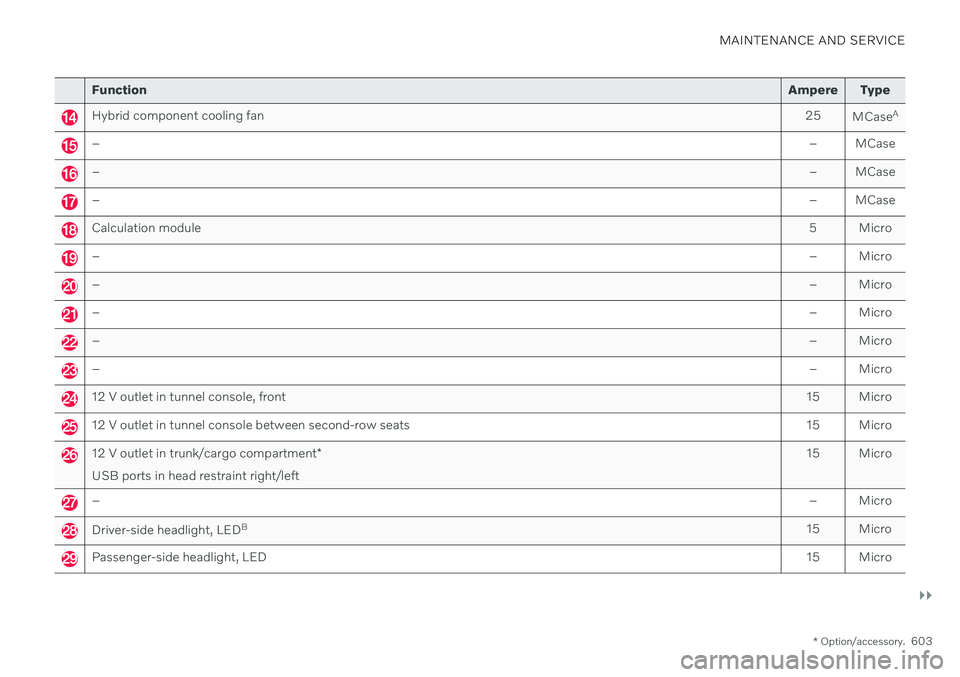
Hybrid component cooling fan 25
MCaseA
–
– MCase
–– MCase
–– MCase
Calculation module 5 Micro
–– Micro
–– Micro
–– Micro
–– Micro
–– Micro
12 V outlet in tunnel console, front15 Micro
12 V outlet in tunnel console between second-row seats15 Micro
12 V outlet in trunk/cargo compartment*
USB ports in head restraint right/left 15 Micro
–
– Micro
Driver-side headlight, LEDB
15 Micro
Passenger-side headlight, LED 15 Micro
Page 606 of 673
||
MAINTENANCE AND SERVICE
* Option/accessory.
604
Function Ampere Type
– – Micro
–– MCase
–– MCase
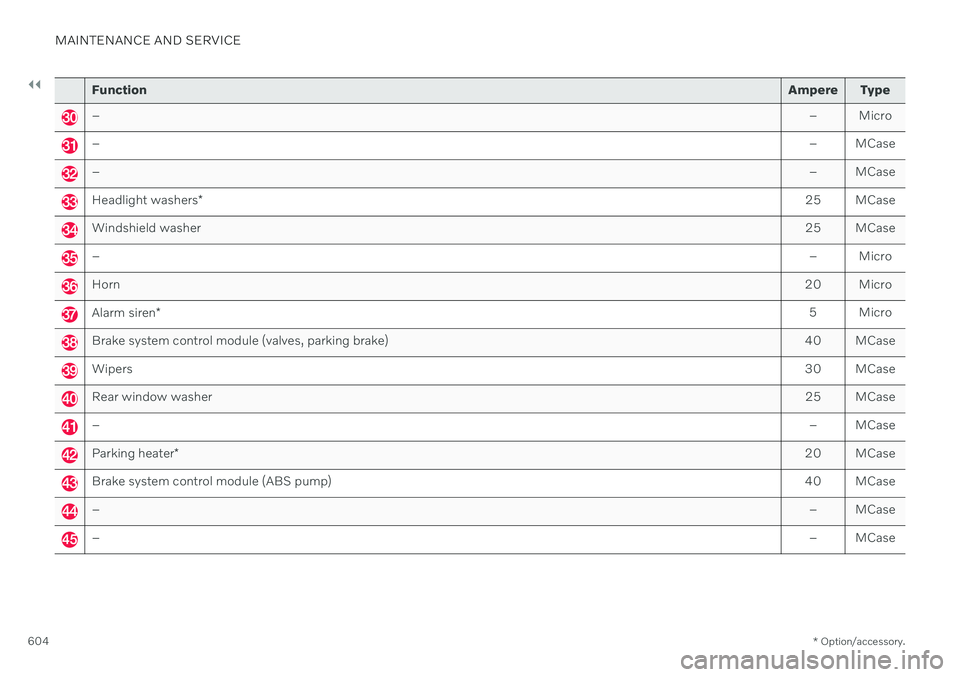
Headlight washers* 25 MCase
Windshield washer
25 MCase
– – Micro
Horn20 Micro
Alarm siren* 5 Micro
Brake system control module (valves, parking brake)
40 MCase
Wipers30 MCase
Rear window washer 25 MCase
– – MCase
Parking heater* 20 MCase
Brake system control module (ABS pump)
40 MCase
– – MCase
–– MCase
Page 607 of 673
MAINTENANCE AND SERVICE
}}
605
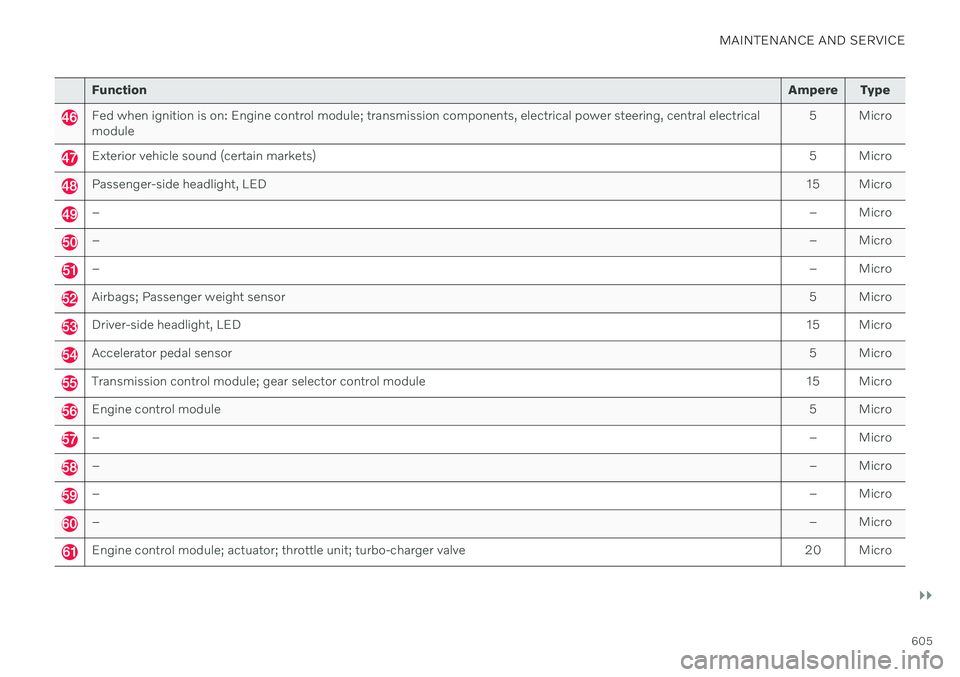
FunctionAmpere Type
Fed when ignition is on: Engine control module; transmission components, electrical power steering, central electrical module 5 Micro
Exterior vehicle sound (certain markets)
5 Micro
Passenger-side headlight, LED15 Micro
– – Micro
–– Micro
–– Micro
Airbags; Passenger weight sensor 5 Micro
Driver-side headlight, LED15 Micro
Accelerator pedal sensor 5 Micro
Transmission control module; gear selector control module15 Micro
Engine control module 5 Micro
–– Micro
–– Micro
–– Micro
–– Micro
Engine control module; actuator; throttle unit; turbo-charger valve20 Micro