overheating VOLVO V60 TWIN ENGINE 2020 User Guide
[x] Cancel search | Manufacturer: VOLVO, Model Year: 2020, Model line: V60 TWIN ENGINE, Model: VOLVO V60 TWIN ENGINE 2020Pages: 673, PDF Size: 14.2 MB
Page 443 of 673
STARTING AND DRIVING
441
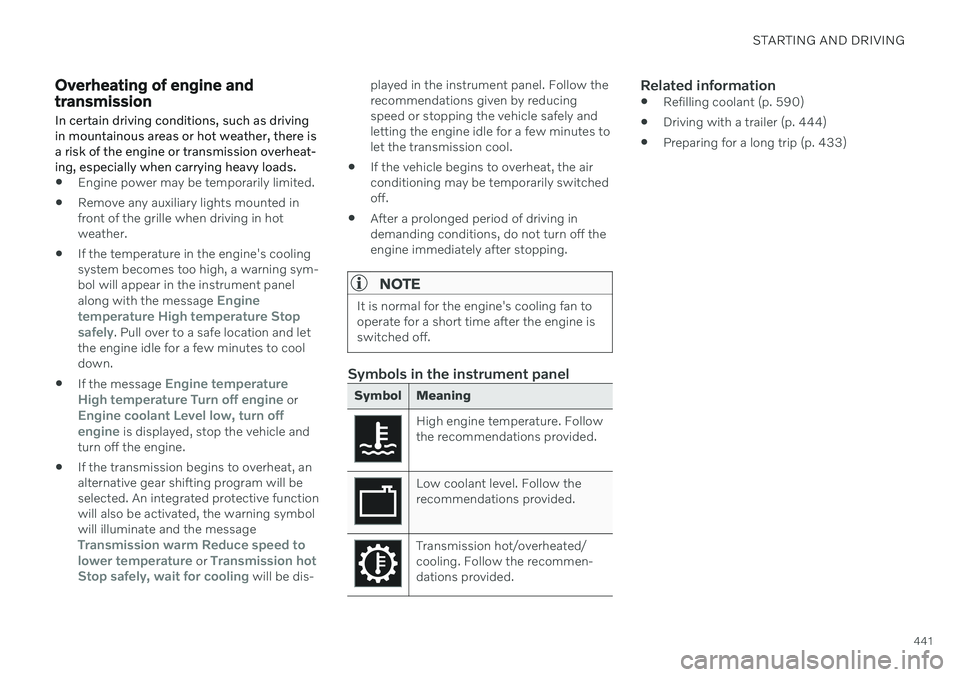
Overheating of engine and transmission
In certain driving conditions, such as driving in mountainous areas or hot weather, there isa risk of the engine or transmission overheat-ing, especially when carrying heavy loads.
Engine power may be temporarily limited.
Remove any auxiliary lights mounted in front of the grille when driving in hotweather.
If the temperature in the engine's coolingsystem becomes too high, a warning sym-bol will appear in the instrument panel along with the message
Engine
temperature High temperature Stop
safely. Pull over to a safe location and let
the engine idle for a few minutes to cool down.
If the message
Engine temperature
High temperature Turn off engine orEngine coolant Level low, turn off
engine is displayed, stop the vehicle and
turn off the engine.
If the transmission begins to overheat, an alternative gear shifting program will beselected. An integrated protective functionwill also be activated, the warning symbolwill illuminate and the message
Transmission warm Reduce speed to
lower temperature or Transmission hot
Stop safely, wait for cooling will be dis- played in the instrument panel. Follow the recommendations given by reducingspeed or stopping the vehicle safely andletting the engine idle for a few minutes tolet the transmission cool.
If the vehicle begins to overheat, the airconditioning may be temporarily switchedoff.
After a prolonged period of driving indemanding conditions, do not turn off theengine immediately after stopping.
NOTE
It is normal for the engine's cooling fan to operate for a short time after the engine isswitched off.
Symbols in the instrument panel
Symbol Meaning
High engine temperature. Follow the recommendations provided.
Low coolant level. Follow the recommendations provided.
Transmission hot/overheated/ cooling. Follow the recommen-dations provided.
Related information
Refilling coolant (p. 590)
Driving with a trailer (p. 444)
Preparing for a long trip (p. 433)
Page 448 of 673
||
STARTING AND DRIVING
* Option/accessory.
446
Related information
Trailer Stability Assist
* (p. 446)
Checking trailer lights (p. 447)
Towing capacity and tongue weight (p. 646)
Overheating of engine and transmission(p. 441)
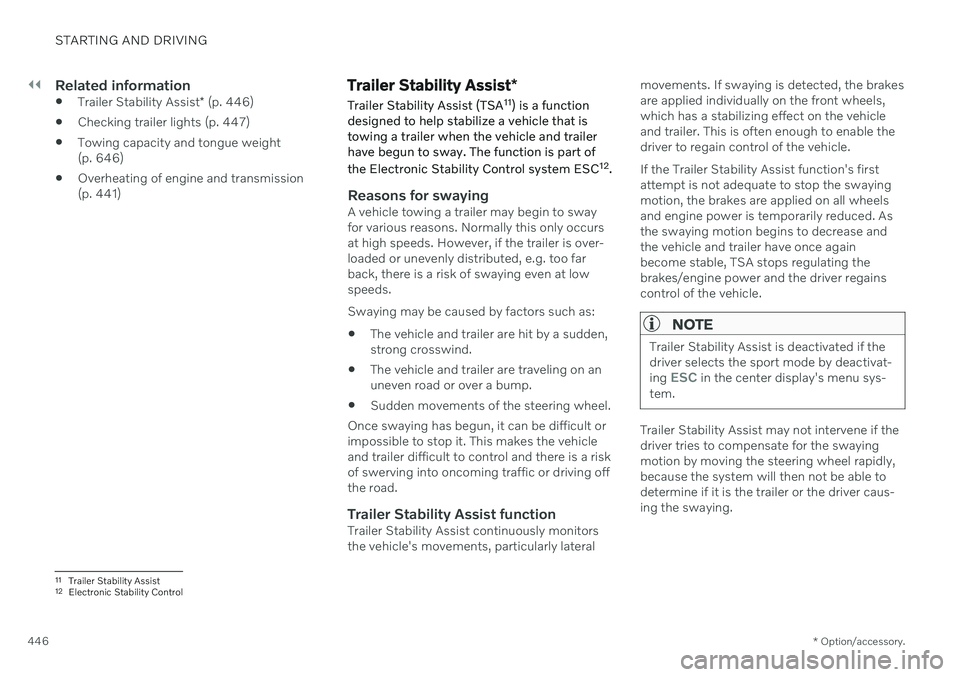
Trailer Stability Assist
*
Trailer Stability Assist (TSA 11
) is a function
designed to help stabilize a vehicle that is towing a trailer when the vehicle and trailerhave begun to sway. The function is part of the Electronic Stability Control system ESC 12
.
Reasons for swayingA vehicle towing a trailer may begin to sway for various reasons. Normally this only occursat high speeds. However, if the trailer is over-loaded or unevenly distributed, e.g. too farback, there is a risk of swaying even at lowspeeds. Swaying may be caused by factors such as:
The vehicle and trailer are hit by a sudden, strong crosswind.
The vehicle and trailer are traveling on anuneven road or over a bump.
Sudden movements of the steering wheel.
Once swaying has begun, it can be difficult orimpossible to stop it. This makes the vehicleand trailer difficult to control and there is a riskof swerving into oncoming traffic or driving offthe road.
Trailer Stability Assist functionTrailer Stability Assist continuously monitorsthe vehicle's movements, particularly lateral movements. If swaying is detected, the brakesare applied individually on the front wheels,which has a stabilizing effect on the vehicleand trailer. This is often enough to enable thedriver to regain control of the vehicle. If the Trailer Stability Assist function's first attempt is not adequate to stop the swayingmotion, the brakes are applied on all wheelsand engine power is temporarily reduced. Asthe swaying motion begins to decrease andthe vehicle and trailer have once againbecome stable, TSA stops regulating thebrakes/engine power and the driver regainscontrol of the vehicle.
NOTE
Trailer Stability Assist is deactivated if the driver selects the sport mode by deactivat- ing
ESC in the center display's menu sys-
tem.
Trailer Stability Assist may not intervene if the driver tries to compensate for the swayingmotion by moving the steering wheel rapidly,because the system will then not be able todetermine if it is the trailer or the driver caus-ing the swaying.
11 Trailer Stability Assist
12 Electronic Stability Control
Page 554 of 673

||
WHEELS AND TIRES
5528. Start the compressor by moving the
switch to the I (On) position.
WARNING
Never stand next to a tire being inflated with the compressor. If cracks, bulges, etc.form on the tire, switch off the compressorimmediately. The vehicle should not bedriven. Call roadside assistance to have thevehicle towed to a workshop for inspec-tion/replacement of the tire. Volvo recom-mends an authorized workshop.
NOTE
When the compressor first starts, air pres- sure may temporarily increase up to 6 bar(88 psi) but should decrease again afterapproximately 30 seconds.
9. Inflate the tire for 7 minutes.
CAUTION
To help avoid overheating, the compressor should never be used for more than10 minutes at a time.
10. Switch off the compressor and check the
inflation pressure using the air pressure gauge. The inflation pressure should bebetween 1.8 bar (22 psi) and 3.5 bar(51 psi). If the inflation pressure is toohigh, use the air release valve to releaseair.
WARNING
If pressure falls below 1.8 bar (22 psi), the hole in the tire may be too large. The vehi-cle should not be driven. Call roadsideassistance to have the vehicle towed to aworkshop for inspection/replacement ofthe tire. Volvo recommends an authorizedworkshop.
11. Switch off the compressor and remove the electrical cable.
12. Unscrew the hose from the tire's valve and screw the valve cap back on.
NOTE
After inflating a tire, always replace the valve cap to help prevent valve damagecaused by gravel, dirt, etc.
Use plastic valve caps only. Metal capscould corrode and become difficult toremove.
13. Put the protective hose cover onto the
hose to help prevent leakage of any resid- ual sealing compound. Return the equip-ment to the cargo compartment.
14. Immediately drive the vehicle at least 3 km (2 miles) at a maximum speed of80 km/h (50 mph) to allow the sealingcompound to seal the tire, and thenrecheck the inflation pressure.
WARNING
During the tire's first revolution, some seal- ing compound may spray out of the punc-ture hole. Before driving away, make surethat no one is near the vehicle who couldbe sprayed with sealing compound. Makesure no one is within 2 meters(7 feet) ofthe vehicle.
15. Rechecking the inflation pressure Connect the hose to the tire's valve and screw the hose connector onto the valveas far as possible. The compressor mustbe switched off.
Page 556 of 673
||
WHEELS AND TIRES
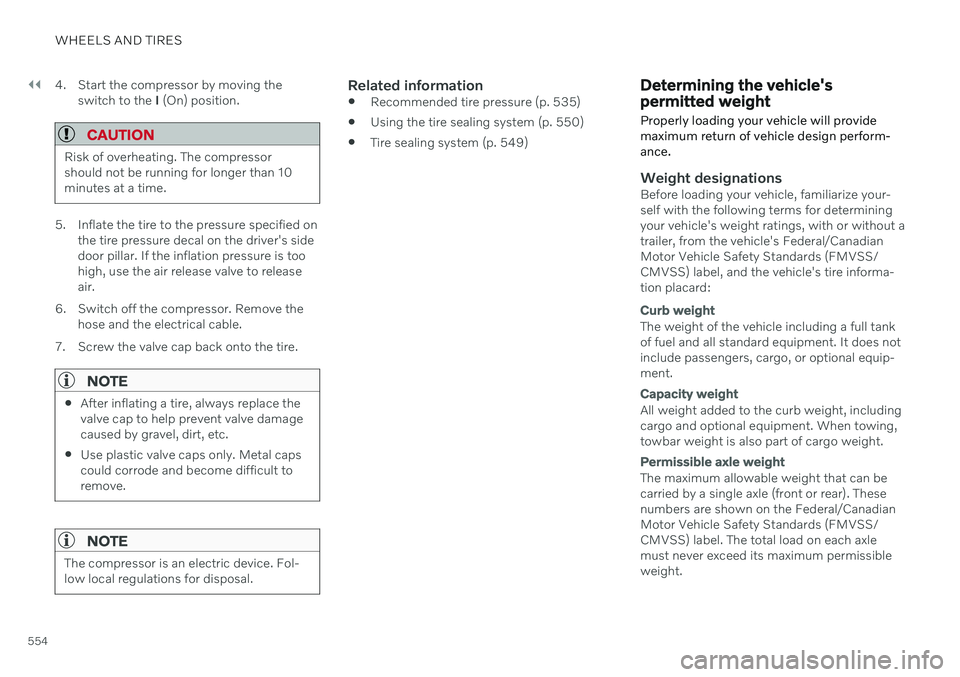
5544. Start the compressor by moving the
switch to the I (On) position.
CAUTION
Risk of overheating. The compressor should not be running for longer than 10minutes at a time.
5. Inflate the tire to the pressure specified on
the tire pressure decal on the driver's side door pillar. If the inflation pressure is toohigh, use the air release valve to releaseair.
6. Switch off the compressor. Remove the hose and the electrical cable.
7. Screw the valve cap back onto the tire.
NOTE
After inflating a tire, always replace the valve cap to help prevent valve damagecaused by gravel, dirt, etc.
Use plastic valve caps only. Metal capscould corrode and become difficult toremove.
NOTE
The compressor is an electric device. Fol- low local regulations for disposal.
Related information
Recommended tire pressure (p. 535)
Using the tire sealing system (p. 550)
Tire sealing system (p. 549)
Determining the vehicle's permitted weight
Properly loading your vehicle will provide maximum return of vehicle design perform-ance.
Weight designationsBefore loading your vehicle, familiarize your- self with the following terms for determiningyour vehicle's weight ratings, with or without atrailer, from the vehicle's Federal/CanadianMotor Vehicle Safety Standards (FMVSS/CMVSS) label, and the vehicle's tire informa-tion placard:
Curb weight
The weight of the vehicle including a full tank of fuel and all standard equipment. It does notinclude passengers, cargo, or optional equip-ment.
Capacity weight
All weight added to the curb weight, including cargo and optional equipment. When towing,towbar weight is also part of cargo weight.
Permissible axle weight
The maximum allowable weight that can be carried by a single axle (front or rear). Thesenumbers are shown on the Federal/CanadianMotor Vehicle Safety Standards (FMVSS/CMVSS) label. The total load on each axlemust never exceed its maximum permissibleweight.
Page 658 of 673

INDEX
656Color codes 632
Compass 454, 455
calibration 455
Condensation in headlights 625, 627, 628, 629
Connecting vehicle to Internet No connection or poor connection 509
via a mobile device (WiFi) 505
via cellular phone (Bluetooth) 505
via vehicle's modem 506
Connect phone 496
Contact information 26
Convertible seats 69
coolant 649 filling 590
Cooling system overheating 441
Cornering assistance 302 activating/deactivating 303
limitations 303
Cornering illumination 158
Corner Traction Control 269
Corrosion protection 630 Covering cargo compartment 569
Crash, see Collision 42
Crash event data 33
Cross Traffic Alert 333 activating/deactivating 334
limitations 334
messages 336
Cruise control 275 activating 276
manage speed 298
standby mode 277
turn off 277
Curb weight 645
Customer Privacy Policy 35
CZIP (Clean Zone Interior Package) 204
D
Data recording 33 transferring between vehicle and
workshop 579
Data sharing 510, 511
Daytime running lights 153Decals location 640
Defrosting 216 Detecting obstacles City Safety 318
Dimensions 643
Dipstick, electronic 589
Direction of rotation 528Display
driver information 80
Display lighting 162
Distance Alert 273 activating/deactivating 274
limitations 274
Set time interval 299
DivX ®
484
Door mirrors 169 compass 454, 455
dimming 170
outer 169
power folding 170
resetting 170
store position 186, 187
Download Center 579 use 580
Driveline transmission 414
Drive mode 421 changing 425
driver support 301
Driver Alert Control 342 activating/deactivating 343
Page 659 of 673

INDEX
657
limitations 344
rest stop guidance 343
Driver performance 88 settings 89
Driver profile 133 edit 134, 135, 137
select 134
Driver support system 268 Drive mode 301
Drive systems 420 Driving cooling system 441
with a trailer 444
Driving economy 429
Driving through standing water 434driving with a trailer towball load 646
towing capacity 646
E
Economical driving 429
Electrical outlet 560
use 562
Electrical system 593
Electric drive motor specifications 647
electric motor 420 Range 431
Electric parking brake 408
Electronic immobilizer 247
emergency brake lights 159
Emission inspection readiness 576Energy distribution using map data 426
Engine automatic start and stop of combus-
tion engine 421
overheating 441
start 400
turn off 402
Engine braking 405, 415 Engine compartment coolant 590
engine oil 588
overview 587
Engine drag control 269
Engine oil 588 filling 589
filter 588
grade and volume 648
Engine shutdown 402Engine specifications 647 Engine temperature high 441
Environment 28Ethanol content max. 10% by volume 437
Exterior dimensions 643
Extra heater (Auxiliary heater) 229
F
Federal Clean Air Act 576
Ferry transport 427
Flooded road 434
Fluids, volumes 636, 650
Fluids and oils 649, 650 Fog lights front 157
rear 158
Four-C 427 Front seat blower 218
climate 211
heating 212, 213
temperature 219
ventilation 213
Page 663 of 673
INDEX
661
Max. axle weight 645
Max. roof load 645
Media player 479, 480, 481
compatible file formats 487
voice control 146
Messages and symbols Adaptive Cruise Control 285
Assistance at risk of collision 356
BLIS 332
City Safety 327
Cross Traffic Alert 336
Lane Keeping Aid 348
Park Assist Camera 370
Park Assist Pilot 379
Parking Assist 361
Pilot Assist 295
stability and traction control system 272
Messages in display 103, 137 handling 104, 138
saved 105, 138
Mileage 85 electric motor 431
Misting condensation in headlights 624, 627
Mood lighting 162 adjusting 162
N
Netcargo compartment 572
O
Occupant safety 43
Occupant weight sensor 56
Octane rating 438
Oil, see also Engine oil 648
On-board diagnostics 576
On-board Diagnostic socket 37
Option/accessory 21
Outside temperature gauge 90
Overheating 441, 444
Owner's information 16
OWNER'S MANUAL 21
environmental labeling 23
in cellular phone 20
in the center display 17, 18
P
Paddle at steering wheel 197 Paintcolor code 632
paint damage and touch-up 631, 632
Panoramic roof 172 opening and closing 173
pinch protection 166
sun shade 175
ventilation position 174
Parallel parking 371
Park Assist Camera 362 activating 368
limitations 309
sensor field 367
Symbols and messages 370
trajectory lines 365
views 363
Park Assist Pilot 371 limitations 376
parallel parking 372
perpendicular parking 372
pulling out of a parking space 376
Symbols and messages 379
use 373
parking on hills 411