towing VOLVO V60 TWIN ENGINE 2020 Owner's Manual
[x] Cancel search | Manufacturer: VOLVO, Model Year: 2020, Model line: V60 TWIN ENGINE, Model: VOLVO V60 TWIN ENGINE 2020Pages: 673, PDF Size: 14.2 MB
Page 545 of 673

WHEELS AND TIRES
* Option/accessory.543
5. Using the lug wrench, screw the towing
eye into place as far as possible according to the instructions.
CAUTION
The towing eyelet must be screwed into the lug wrench * as far as possible.
6. Remove the plastic covers from the wheel
bolts using the designated tool.
7. With the vehicle still on the ground, use the lug wrench/towing eye to loosen the wheel bolts ½-1 turn by pressing down-ward (counterclockwise). 8. When hoisting the vehicle, it is important
that the jack or garage lift arms are posi-tioned on the designated points under thevehicle. The triangle markings on the plas-tic cover indicate where the jack attach-ment points/lifting points are located.There are two jack attachment points oneach side of the vehicle. There is a groovefor the jack at each attachment point.
9. Position the jack under the attachmentpoint being used, ensuring that the sur- face is firm, flat and not slippery. 10. Crank it up until it is properly aligned and
it is in contact with the vehicle's jackattachment point. Make sure the top ofthe jack (or the garage lift arms) is cor-rectly positioned in the attachment point,with the bump on the top of the jack in therecess in the attachment point and thebase positioned vertically under theattachment point.
11. Turn the jack so that the crank is as far as possible from the side of the vehicle,which will position the jack's arms per-pendicular to the vehicle's direction ofmovement.
12. Raise the vehicle until the wheel to be changed can move freely. Unscrew thewheel bolts and lift off the wheel.
Related information
When changing wheels (p. 540)
Hoisting the vehicle (p. 583)
Jack
* (p. 541)
Attaching and removing the towing eyelet(p. 449)
Installing a wheel (p. 544)
Page 556 of 673
||
WHEELS AND TIRES
5544. Start the compressor by moving the
switch to the I (On) position.
CAUTION
Risk of overheating. The compressor should not be running for longer than 10minutes at a time.
5. Inflate the tire to the pressure specified on
the tire pressure decal on the driver's side door pillar. If the inflation pressure is toohigh, use the air release valve to releaseair.
6. Switch off the compressor. Remove the hose and the electrical cable.
7. Screw the valve cap back onto the tire.
NOTE
After inflating a tire, always replace the valve cap to help prevent valve damagecaused by gravel, dirt, etc.
Use plastic valve caps only. Metal capscould corrode and become difficult toremove.
NOTE
The compressor is an electric device. Fol- low local regulations for disposal.
Related information
Recommended tire pressure (p. 535)
Using the tire sealing system (p. 550)
Tire sealing system (p. 549)
Determining the vehicle's permitted weight
Properly loading your vehicle will provide maximum return of vehicle design perform-ance.
Weight designationsBefore loading your vehicle, familiarize your- self with the following terms for determiningyour vehicle's weight ratings, with or without atrailer, from the vehicle's Federal/CanadianMotor Vehicle Safety Standards (FMVSS/CMVSS) label, and the vehicle's tire informa-tion placard:
Curb weight
The weight of the vehicle including a full tank of fuel and all standard equipment. It does notinclude passengers, cargo, or optional equip-ment.
Capacity weight
All weight added to the curb weight, including cargo and optional equipment. When towing,towbar weight is also part of cargo weight.
Permissible axle weight
The maximum allowable weight that can be carried by a single axle (front or rear). Thesenumbers are shown on the Federal/CanadianMotor Vehicle Safety Standards (FMVSS/CMVSS) label. The total load on each axlemust never exceed its maximum permissibleweight.
Page 557 of 673

WHEELS AND TIRES
555
Gross vehicle weight (GVW)
The vehicle's curb weight + cargo + passen- gers.
Steps for Determining Correct Load
Limit
1. Locate the statement "the combined weight of occupants and cargo shouldnever exceed XXX kg or XXX lbs." on yourvehicle's placard.
2. Determine the combined weight of the driver and passengers that will be riding inyour vehicle.
3. Subtract the combined weight of the driver and passengers from XXX kg or XXXlbs.
4. The resulting figure equals the available amount of cargo and luggage loadcapacity. For example, if the "XXX"amount equals 1400 lbs. and there will befive 150 lb. passengers in your vehicle, theamount of available cargo and luggageload capacity is 650 lbs. (1400 - 750 (5 ×150) = 650 lbs.)
5. Determine the combined weight of lug- gage and cargo being loaded on the vehi-cle. That weight may not safely exceed theavailable cargo and luggage load capacitycalculated in Step 4. 6. If your vehicle will be towing a trailer, load
from your trailer will be transferred to yourvehicle. Consult this manual to determinehow this reduces the available cargo andluggage load capacity of your vehicle.WARNING
Exceeding the permissible axle weight, gross vehicle weight, or any otherweight rating limits can cause tire over-heating resulting in permanent defor-mation or catastrophic failure.
Do not use replacement tires withlower load carrying capacities than thetires that were original equipment onthe vehicle because this will lower thevehicle's GVW rating. Use only tireswith the correct load carrying capacity.Consult your Volvo retailer for informa-tion.
Related information
Loading recommendations (p. 565)
Page 567 of 673

LOADING, STORAGE AND PASSENGER COMPARTMENT
}}
* Option/accessory.565
Sun visors
In the ceiling in front of the driver's and front passenger's seats, there are sun visors thatcan be lowered and angled to the side asnecessary.
The illustration is generic – the design may vary.
The mirror lighting * comes on automatically
when the visor is lifted up. The mirror frame has a holder for e.g. cards or tickets.
Related information
Passenger compartment interior (p. 558)
Cargo compartment
The vehicle has a flexible cargo compartment that makes it possible to carry and securelarge objects.
The cargo capacity of the vehicle can be con- siderably increased by folding down the rearseat backrests. Use the load anchoring eyeletsor grocery bag holders to help secure objectsin place, and the retractable cargo compart- ment cover * to help conceal objects in the
cargo compartment. If the vehicle is equipped with a temporary spare tire, this is secured to the cargo com-partment floor under the cover. The towingeyelet and tire sealing system are locatedunder the cargo compartment floor.
Related information
Loading recommendations (p. 565)
Grocery bag holders (p. 567)
Load anchoring eyelets (p. 568)
Installing and removing the cargo com- partment cover
* (p. 569)
Loading recommendations
There are a number of things that are impor- tant to consider when carrying loads in or onthe vehicle.
Load-carrying capacity is determined by the vehicle's curb weight. The total weight of allpassengers and any installed accessoriesreduces the vehicle's load-carrying capacity bythe corresponding amount.
WARNING
The vehicle's driving characteristics change depending on the weight and position ofthe load.
Loading the cargo compartment/trunkKeep the following in mind when loading:
Position objects so they are pressing against the rear seat backrests.
Heavy objects should be positioned as lowas possible. Avoid placing heavy objectson folded-down seat backrests.
Cover sharp corners with a soft cloth orsimilar to help prevent damage to theupholstery.
Use the load anchoring eyelets and ten-sioning straps or similar to secure allobjects.
Page 568 of 673

||
LOADING, STORAGE AND PASSENGER COMPARTMENT
* Option/accessory.
566
WARNING
In a head-on collision at a speed of 50 km/h (30 mph), an unsecured objectweighing 20 kg (44 pounds) can reach aprojectile weight equivalent to 1000 kg(2200 pounds).
WARNING
If objects are loaded higher than the upper edge of the side windows, leave a 10 cm(4 in.) space between the objects and thewindow. Objects placed closer to thiscould impede the function of the inflatablecurtain concealed inside the headlining.
WARNING
Always secure the load. Otherwise, it may shift during heavy braking and injure peo-ple in the vehicle. Cover sharp edges and sharp corners with something soft. Turn off the engine and apply the parking brake when loading/unloading longobjects. Otherwise, it is possible for theload to reach the gear lever or gear selectorand move it to a drive position – whichcould cause the vehicle to begin rolling.
Extra cargo space
The rear seat backrests can be folded down to increase cargo space in the cargo compart- ment/trunk and simplify loading. If the rearseat backrests are folded down, make surethat no objects loaded into the vehicle preventthe WHIPS system for the front seats fromfunctioning correctly. The ski hatch in the rear seat can be folded down to carry skis or other long, thin objects.
Related information
Load anchoring eyelets (p. 568)
Folding down the rear seat backrests(p. 194)
Rear seat ski hatch (p. 568)
Roof loads and load carriers (p. 566)
Leveling control
* and suspension (p. 427)
Weights (p. 645)
Roof loads and load carriers
Volvo-developed load carriers are recom- mended for carrying loads on the roof of thevehicle.
Volvo load carriers are specially designed to help prevent damage to your vehicle and helpensure maximum safety while driving. Volvoload carriers are available from authorizedVolvo retailers. Carefully follow the installation instructions provided with the load carriers. Distribute the load evenly throughout the load carriers. Place heavier cargo at thebottom of the load.
Check periodically to ensure that the loadcarriers and load are properly secured.Secure the load firmly using tie straps orsimilar.
If the load is longer than the vehicle, suchas a canoe or kayak, attach the towingeyelet in its front outlet and secure the tiestraps in it.
The vehicle's wind resistance and fuelconsumption increase with the size of theload.
Drive smoothly. Avoid rapid acceleration,hard braking and fast cornering.
Page 647 of 673
SPECIFICATIONS
645
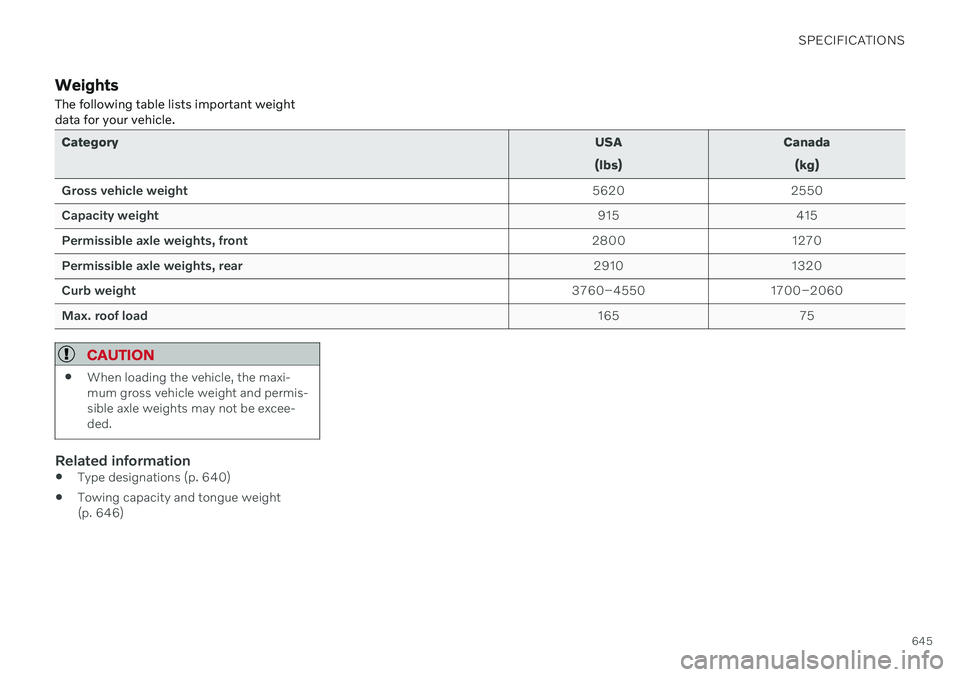
WeightsThe following table lists important weight data for your vehicle.
Category USA
(lbs) Canada
(kg)
Gross vehicle weight 5620 2550
Capacity weight 915 415
Permissible axle weights, front 2800 1270
Permissible axle weights, rear 2910 1320
Curb weight 3760–4550 1700–2060
Max. roof load 165 75
CAUTION
When loading the vehicle, the maxi- mum gross vehicle weight and permis-sible axle weights may not be excee-ded.
Related information
Type designations (p. 640)
Towing capacity and tongue weight (p. 646)
Page 648 of 673

SPECIFICATIONS
* Option/accessory.
646
Towing capacity and tongue weight Towing capacity and tongue weight are shown in the tables below.
Category
USA
(lbs) Canada
(kg)
Max. trailer weights Without brakes: 1650 750 With brakes:
2000 900
Max. tongue weight 200 90
CAUTION
The maximum trailer weights listed are only applicable for altitudes up to3280 ft (1,000 m) above sea level.With increasing altitude the enginepower and therefore the car's climbingability are impaired because of thereduced air density, so the maximumtrailer weight has to be reducedaccordingly. The weight of the car andtrailer must be reduced by 10% forevery further 3280 ft (1,000 m) (orpart thereof).
Related information
Type designations (p. 640)
Weights (p. 645)
Driving with a trailer (p. 444)
Trailer Stability Assist
* (p. 446)
Page 659 of 673

INDEX
657
limitations 344
rest stop guidance 343
Driver performance 88 settings 89
Driver profile 133 edit 134, 135, 137
select 134
Driver support system 268 Drive mode 301
Drive systems 420 Driving cooling system 441
with a trailer 444
Driving economy 429
Driving through standing water 434driving with a trailer towball load 646
towing capacity 646
E
Economical driving 429
Electrical outlet 560
use 562
Electrical system 593
Electric drive motor specifications 647
electric motor 420 Range 431
Electric parking brake 408
Electronic immobilizer 247
emergency brake lights 159
Emission inspection readiness 576Energy distribution using map data 426
Engine automatic start and stop of combus-
tion engine 421
overheating 441
start 400
turn off 402
Engine braking 405, 415 Engine compartment coolant 590
engine oil 588
overview 587
Engine drag control 269
Engine oil 588 filling 589
filter 588
grade and volume 648
Engine shutdown 402Engine specifications 647 Engine temperature high 441
Environment 28Ethanol content max. 10% by volume 437
Exterior dimensions 643
Extra heater (Auxiliary heater) 229
F
Federal Clean Air Act 576
Ferry transport 427
Flooded road 434
Fluids, volumes 636, 650
Fluids and oils 649, 650 Fog lights front 157
rear 158
Four-C 427 Front seat blower 218
climate 211
heating 212, 213
temperature 219
ventilation 213
Page 668 of 673

INDEX
666Tire tread 529
Tools 540Top tether anchors (child restraint sys-
tems) 73
Top view 129
Total airing function 234
Towing 448
Towing capacity and towball load 646
Towing eyelet 449TPMS - Tire Pressure Monitoring Sys-
tem 535
Traction control 269
Traffic information 466 Trailer
driving with a trailer 444
Lamps 447
swaying 446
Trailer Stability Assist 270 trailer 446
Trailer stabilizer 270, 446
Transmission 414 automatic 414, 415
Transmission fluid grade 649
Travel Link 474 Fuel 477
Notifications 476
Sports 478
weather 475
Tread depth 529 winter tires 547
Tread wear indicator 529
Trip computer 85 display in instrument panel 87
Trip odometer 85
Trip odometer resetting 88
Trip statistics 88 settings 89
Troubleshooting Adaptive Cruise Control 283
Camera unit 309
City Safety 324
Radar unit 309
TSA - Trailer Stability Assist 446
Tunnel detection 154
Turn off engine 402
Turn signals 156 Twin Engine general 382
Type approval HomeLink ® 454
radar system 306U
Uniform Tire Quality Grading 532
Units 129Unlocking settings 237
with key blade 246
USB socket for connecting media 486
V
Vehicle care 624, 625, 627, 628, 629, 630
leather upholstery 622
Vehicle Event Data 33 Vehicle functions in the center display 119
Vehicle key bat. low 239 Vehicle modem connecting vehicle to Internet 506
settings 507
Vehicle recovery 450
Vehicle status 581 inflation pressure 538
Vehicle upholstery 619, 621, 622, 623