roof VOLVO V70 2008 User Guide
[x] Cancel search | Manufacturer: VOLVO, Model Year: 2008, Model line: V70, Model: VOLVO V70 2008Pages: 274, PDF Size: 7.82 MB
Page 197 of 274
Insert the net's rod in the retaining bracket on the right side near the ceiling and press it forward. It will click into
place.
Extend the left section of the rod and insert it in the bracket on the left side of the cargo compartment. Press it
forward until it clicks into place.
Pull up the left side of the cargo net and secure it on the rod.
211 05 During your trip
Cargo area
NOTE
The net can be fastened in the same way if the rear seat backrests are folded down. In this case, use the retaining
brackets near the ceiling, above the front seats.
The front passenger's seat backrest can also be folded down for carrying long objects, see page 82.
Removing the cargo net cassettes
1. Retract the net(s) in the reverse order (see the section "With the backrests up" on page 210
).
2. Fold the entire rear seat backrest down.
3. Slide the cassettes outward until they release from the mounting brackets.
WARNING
When not in use, return the cassettes to their storage compartment under the cargo area floor.
Objects in the cargo area should be securely anchored, even if the cargo net is correctly installed and in use.
Using the cargo net with the cargo area cover
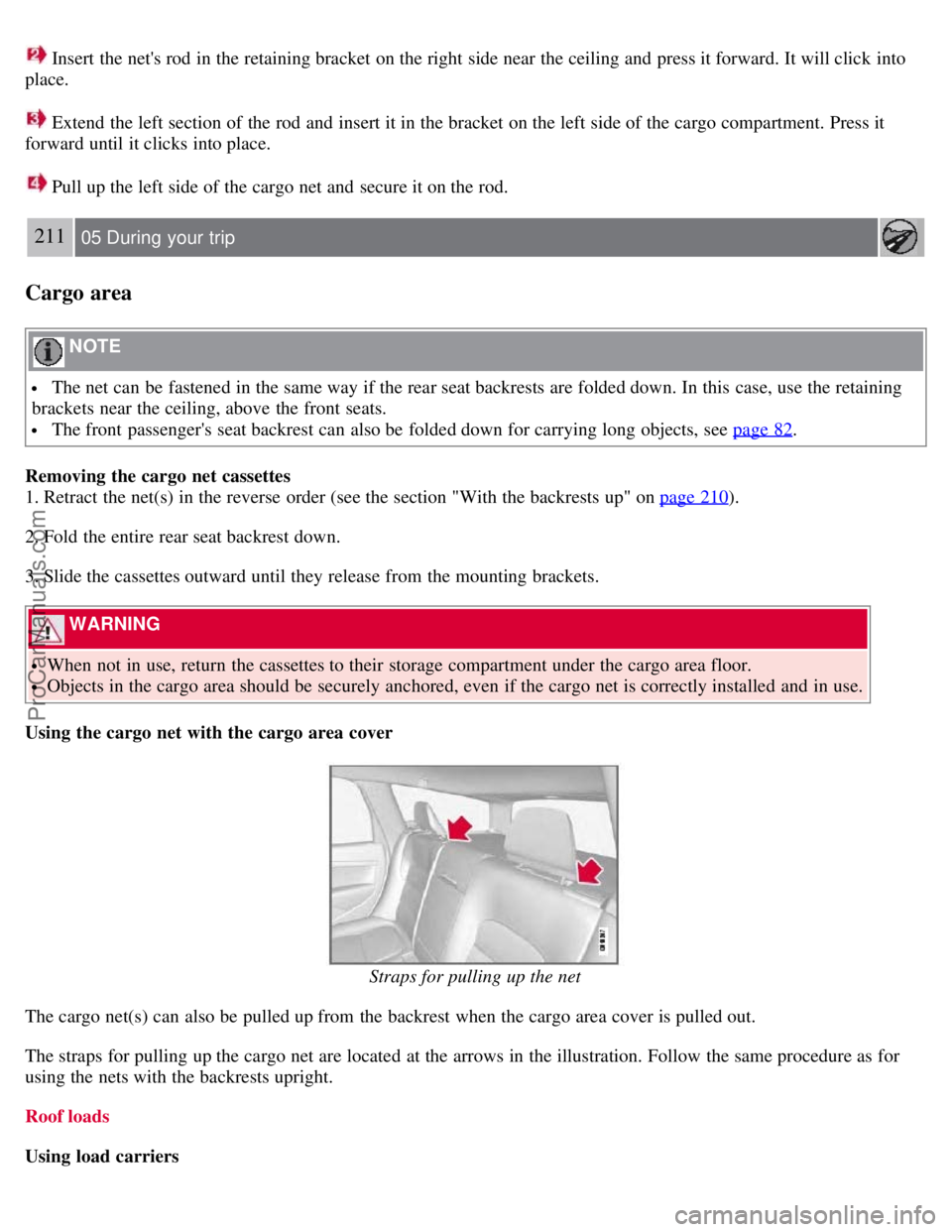
Straps for pulling up the net
The cargo net(s) can also be pulled up from the backrest when the cargo area cover is pulled out.
The straps for pulling up the cargo net are located at the arrows in the illustration. Follow the same procedure as for
using the nets with the backrests upright.
Roof loads
Using load carriers
ProCarManuals.com
Page 198 of 274

Load carriers are available as Volvo accessories. Observe the following points when in use:
To avoid damaging your vehicle and to achieve maximum safety when driving, we recommend using the load
carriers that Volvo has developed especially for your vehicle.
Volvo-approved removable roof racks are designed to carry the maximum allowable roof load for this vehicle: 220
lbs (100 kg). For non-Volvo roof racks, check the manufacturer's weight limits for the rack.
Never exceed the rack manufacturer's weigh limits and never exceed the maximum rated roof load of 220 lbs (100
kg).
Avoid single-point loads. Distribute loads evenly.
Place heavier cargo at the bottom of the load.
Secure the cargo correctly with appropriate tie-down equipment.
Check periodically that the load carriers and load are properly secured.
Remember that the vehicle's center of gravity and handling change when you carry a load on the roof.
212 05 During your trip
Cargo area
The vehicle's wind resistance and fuel consumption will increase with the size of the load.
Drive smoothly. Avoid rapid starts, fast cornering and hard braking.
213 05 During your trip
Towing a trailer
Introduction
Volvo recommends the use of Volvo trailer hitches that are specially designed for the vehicle.
NOTE
See page 274
for the maximum trailer and tongue weights recommended by Volvo.
Observe the legal requirements of the state/province in which the vehicles are
All Volvo models are equipped with energy- absorbing shock-mounted bumpers. Trailer hitch installation should
not interfere with the proper operation of this bumper system.
Trailer towing does not normally present any particular problems, but take into consideration:
Increase tire pressure to recommended full. See the tire inflation tables on pages 250 and 251.
When your vehicle is new, avoid towing heavy trailers during the first 620 miles (1,000 km).
Maximum speed when towing a trailer: 50 mph (80 km/h).
Engine and transmission are subject to increased loads. Therefore, engine coolant temperature should be closely
watched when driving in hot climates or hilly terrain. Use a lower gear and turn off the air conditioner if the
temperature gauge needle enters the red range.
If the automatic transmission begins to overheat, a message will be displayed in the text window.
Avoid overload and other abusive operation.
Hauling a trailer affects handling, durability, and economy.
It is necessary to balance trailer brakes with the towing vehicle brakes to provide a safe stop (check and observe
state/local regulations).
Do not connect the trailer's brake system directly to the vehicle's brake system.
ProCarManuals.com
Page 250 of 274

Washing the car
WARNING
Be sure that the compressor is not connected to a 12-volt socket while replacing the container.
The following points should be kept in mind when washing and cleaning the car:
The car should be washed at regular intervals since dirt, dust, insects and tar spots adhere to the paint and may cause
damage. To help prevent corrosion, it is particularly important to wash the car frequently in the wintertime.
Avoid washing your car in direct sunlight. Doing so may cause detergents and wax to dry out and become abrasive.
To avoid scratching, use lukewarm water to soften the dirt before you wash with a soft sponge, and plenty of sudsy
water.
Bird droppings : Remove from paintwork as soon as possible. Otherwise the finish may be permanently damaged.
A detergent can be used to facilitate the softening of dirt and oil.
A water-soluble grease solvent may be used in cases of sticky dirt. However, use a wash place equipped with a
drainage separator.
Dry the car with a clean chamois and remember to clean the drain holes in the doors and rocker panels.
Tar spots can be removed with kerosene or tar remover after the car has been washed.
A stiff-bristle brush and lukewarm soapy water can be used to clean the wiper blades. Frequent cleaning of the
windshield and wiper blades improves visibility considerably and also helps prolong the service life of the wiper
blades.
Wash off the dirt from the underside (wheel housings, fenders, etc).
In areas of high industrial fallout, more frequent washing is recommended.
After cleaning the engine, the spark plug wells should be inspected for water and blown dry if necessary.
NOTE
When washing the car, remember to remove dirt from the drain holes in the doors and sills.
CAUTION
During high pressure washing, the spray mouthpiece must never be closer to the vehicle than 13" (30 cm). Do not
spray into the locks.
When washing or steam cleaning the engine, avoid spraying water or steam directly on the electrical components
or toward the rear side of the engine.
Dirt, snow, etc., on the headlights can reduce lighting capacity considerably. Clean the headlights regularly, for
example when refueling
Always close the moonroof and sun shade before washing your vehicle.
Never use abrasive cleaning agents on the moonroof.
Never use wax on the rubber seals around the moonroof.
Exterior components
Volvo recommends the use of special cleaning products, available at your Volvo retailer, for cleaning colored plastic,
rubber, or ornamental components such as chromed strips on the exterior of your vehicle. The instructions for using
these products should be followed
266 06 Maintenance and specifications
Vehicle care
ProCarManuals.com
Page 268 of 274

Labels
list of271
location of270
Lane Departure Warning 176
LATCH anchors42
Leather care267
Lighting panel89
Load anchoring eyelets205
Loading
floor rails 205
hooks for securing loads205, 206
Loading the vehicle 202, 256
roof loads195
Locking
automatic 64
from the inside64
from the outside64
glove compartment65
tailgate65
Locking the vehicle 54
Locks, child safety48
Low beams89
Low fuel level warning light76
Low oil pressure warning light76
M
Main instrument panel126-127
Maintenance220
performed by the owner221
Malfunction indicator light 75
Menu system124
overview125
Messages in the instrument panel 126-127
Mirrors
defroster 102
power door101
rearview, auto-dim function102
retractable101
vanity188
Moonroof 103-104
Motor oil
checking 224
specifications276
volumes278
N
ProCarManuals.com
Page 269 of 274

Net in cargo area210
O
Occupant safety14
Occupant weight sensor22-24
Octane recommendations197
Odometer, trip78
Oil
checking 224
low pressure warning light76
specifications276
volumes278
On Call Roadside Assistance 281
Overhead courtesy lighting93-94
Overheating, engine77
Oxygen sensors, heated201
P
Pacemaker (keyless drive warning)63
Paint, touching up269
Panic alarm55
Park assist178-180
Parking brake
electric, applying/releasing 119
warning light76
Parking lights 90
changing bulbs230
Personal Car Communicator, unique functions 55-56
Polishing the vehicle267
Power front seat
memory function 83
with keyless drive84
Power mirrors 101
defroster102
Power moonroof 103-104
Power steering
fluid 227
, 279
speed-dependent155
Power tailgate (option) 203
Power windows99-100
laminated glass100
Pregnancy, using seat belts during 17
Private locking58
Proposition 65 warning9, 111, 239, 280
R
Radio
ProCarManuals.com
Page 270 of 274

functions143
Sirius satellite radio145- 148
Rails, floor205
Rain sensor96
READ button126
Rear fog light92
Rear park assist178-180
Rear seats
center head restraint 86
folding85
head restraint86
heated132
Rear window defroster 102
Rearview mirror
auto-dim function 102
compass151
Recall, child restraints 44
Refrigerant128, 279
Refueling196-197
fuel filler cap200
fuel filler door198
fuel tank volume279
octane recommendations197
Registering child restraints 44
Remote control52
approach lighting54
common functions54
immobilizer53
key blade52, 57-58
key memory53
locking the vehicle54
panic alarm55
Personal Car Communicator54- 56
private locking58
replacing battery60
unlocking the tailgate55
unlocking the vehicle54
Reporting safety defects 15
Roadside Assistance281
Roof loads211
S
Safety defects, reporting15
Safety, occupant14
Seat belts
ProCarManuals.com
Page 271 of 274

Automatic locking retractor/Emergency locking retractor33
buckling16
maintenance16
pretensioners16
reminder16
reminder warning light77
securing child restraint systems36, 38, 41
unbuckling16
use during pregnancy17
using16
Seats, front 82-83
Setting the clock79
Shiftlock override113
Side door mirrors101
Side impact airbags25
Side marker lights, changing bulbs231
Sirius satellite radio145-148
Snow chains259
Snow tires259
Sound settings, audio system139
Spare tire260
Speed -dependent steering155
Spin control153
SRS18
Stability system
indicator light 76
introduction153
operation153
symbols in the instrument panel154
Start inhibitor (immobilizer) 53
Starting the engine109
with keyless drive110
Starting the vehicle
after a crash (crash mode) 30
Steel grid in cargo area 208
Steering wheel
adjusting 87
horn88
keypad87, 124, 136
lock110
Storage spaces 186
Studded tires259
Sunroof (moonroof)103-104
Supplemental restraint system18
ProCarManuals.com
Page 273 of 274
Trip computer149
Trip odometers78
Trips, long distance193
Turn signals93
changing bulbs231
indicator lights76
Two-stage booster cushion 45
U
Uniform Tire Quality Grading258
Unlocking the tailgate55
Unlocking the vehicle54
Upholstery care267
V
Vanity mirror188
changing bulbs234
Vehicle dimensions
V70 272
XC70273
Vehicle event data 6, 220
Vehicle loading202, 256
roof loads211
Vehicle maintenance 220
performed by the owner221
Vehicle weights 274
Ventilated seats131
Volvo and the environment9
Volvo Inflatable Curtain27
Volvo maintenance220
Volvo On Call Roadside Assistance281
Volvo programs281
W
Warning flashers, hazard92
Warning lights74-77
Warning symbol78
Warning system, collision168-170
Warnings, general7
Warranties220
Washer fluid236, 279
Washers
headlight 97
windshield96
Water, driving through 193
Waxing the vehicle267
Weights274
ProCarManuals.com