brake VOLVO V90 1998 User Guide
[x] Cancel search | Manufacturer: VOLVO, Model Year: 1998, Model line: V90, Model: VOLVO V90 1998Pages: 175, PDF Size: 4.45 MB
Page 58 of 175
1998 Volvo S90
WARNING!
Always turn engine off and apply
parking brake when loading/
unloading the vehicle. Place
transmission selector in P (PARK)
position to help prevent
inadvertent movement of selector.
Alarm pg. 51
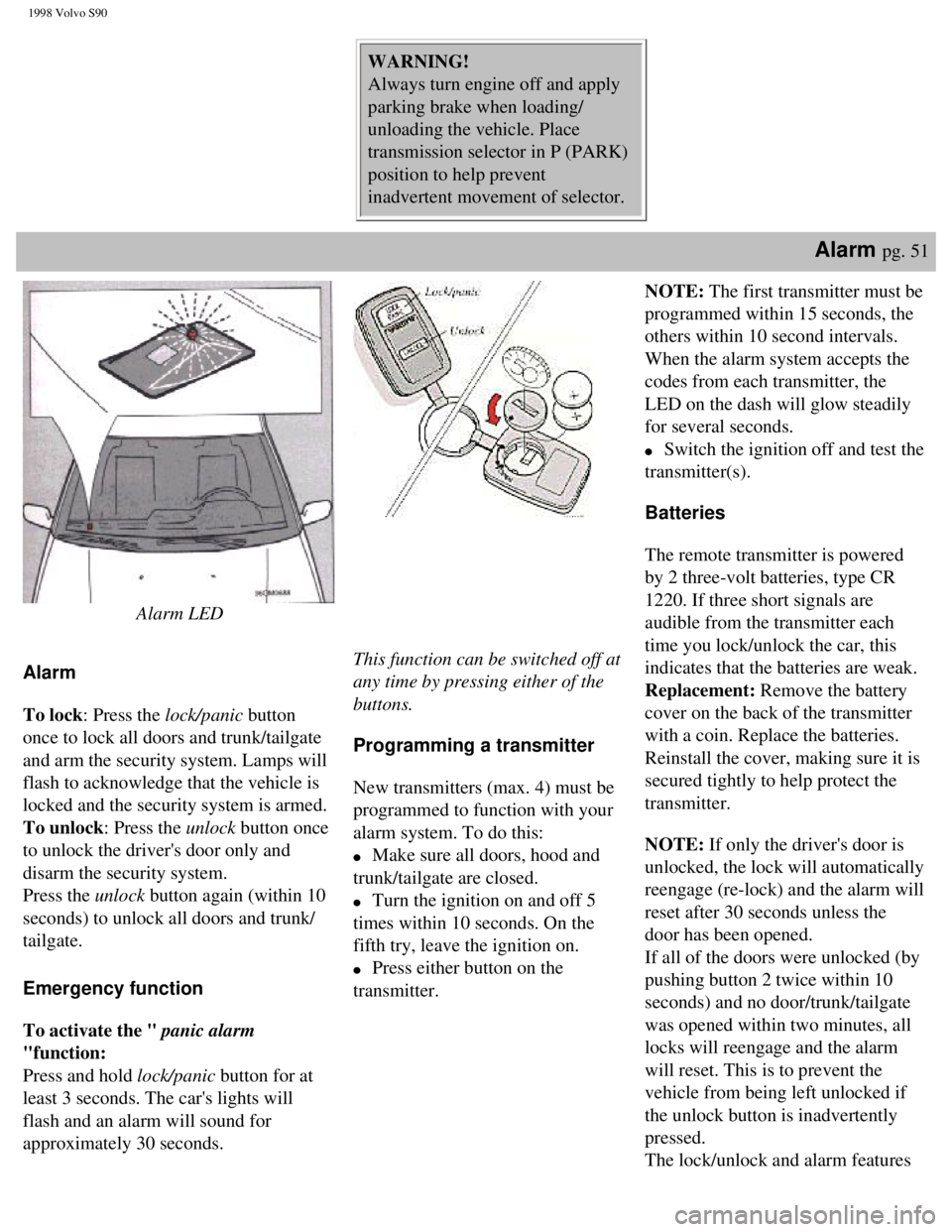
Alarm LED
Alarm
To lock: Press the lock/panic button
once to lock all doors and trunk/tailgate
and arm the security system. Lamps will
flash to acknowledge that the vehicle is
locked and the security system is armed.
To unlock: Press the unlock button once
to unlock the driver's door only and
disarm the security system.
Press the unlock button again (within 10
seconds) to unlock all doors and trunk/
tailgate.
Emergency function
To activate the " panic alarm
"function:
Press and hold lock/panic button for at
least 3 seconds. The car's lights will
flash and an alarm will sound for
approximately 30 seconds.
This function can be switched off at
any time by pressing either of the
buttons.
Programming a transmitter
New transmitters (max. 4) must be
programmed to function with your
alarm system. To do this:
l Make sure all doors, hood and
trunk/tailgate are closed.
l Turn the ignition on and off 5
times within 10 seconds. On the
fifth try, leave the ignition on.
l Press either button on the
transmitter. NOTE: The first transmitter must be
programmed within 15 seconds, the
others within 10 second intervals.
When the alarm system accepts the
codes from each transmitter, the
LED on the dash will glow steadily
for several seconds.
l Switch the ignition off and test the
transmitter(s).
Batteries
The remote transmitter is powered
by 2 three-volt batteries, type CR
1220. If three short signals are
audible from the transmitter each
time you lock/unlock the car, this
indicates that the batteries are weak.
Replacement: Remove the battery
cover on the back of the transmitter
with a coin. Replace the batteries.
Reinstall the cover, making sure it is
secured tightly to help protect the
transmitter.
NOTE: If only the driver's door is
unlocked, the lock will automatically
reengage (re-lock) and the alarm will
reset after 30 seconds unless the
door has been opened.
If all of the doors were unlocked (by
pushing button 2 twice within 10
seconds) and no door/trunk/tailgate
was opened within two minutes, all
locks will reengage and the alarm
will reset. This is to prevent the
vehicle from being left unlocked if
the unlock button is inadvertently
pressed.
The lock/unlock and alarm features
file:///K|/ownersdocs/1998/1998_SV90/98S90_048.htm (3 of 4)12/30/2006 \
1:52:40 PM
Page 60 of 175
1998 Volvo S90
Chapter 4 - Starting and driving
pg. 53
Starting and driving
This section on starting and driving contains items
such as starting the engine, operating gear selector, towing, trailers.
Break-in period pg. 54
Fuel requirements, Refueling pg. 54
Driving economy pg. 56
Starting the engine pg. 57
Automatic Transmission pg. 58
Points to remember pg. 60
Emergency towing pg. 63
Vehicle Towing Information pg. 64
Jump starting pg. 65
Three-way catalytic converter pg. 66
Brake system, ABS pg. 67
Trailer towing pg. 68
Winter driving pg. 69
Before a long distance trip pg. 70
Break-in period, Fuel requirements pg. 54
file:///K|/ownersdocs/1998/1998_SV90/98S90_053.htm (1 of 6)12/30/2006 \
1:52:41 PM
Page 63 of 175

1998 Volvo S90
Volvo allows the use of the
following "oxygenated fuels";
however, the octane ratings
listed on this page must still be
met. of fuel. Therefore, it is
advisable to refuel as soon as
possible when the needle nears
the red zone, or when the fuel
warning light comes on.
Driving economy pg. 56
Economical driving
conserves natural
resources
Better driving economy may be
obtained by thinking ahead,
avoiding rapid starts and stops
and adjusting the speed of your
vehicle to immediate traffic
conditions. Observe the
following rules:
l Bring the engine to normal
operating temperature as soon
as possible by driving with a
light foot on the accelerator
pedal for the first few minutes
of operation. A cold engine
uses more fuel and is subject to
increased wear.
l Whenever possible, avoid
using the car for driving short
distances. This does not allow
the engine to reach normal
operating temperature.
l Drive carefully and avoid
rapid acceleration and hard
braking.
l Do not exceed speed limit.
l Avoid carrying unnecessary
items (extra load) in the car.
l Check tire pressure regularly
l Remove snow tires when
threat of snow or ice has ended.
l Note that roof racks, ski
racks, etc., increase air
resistance and thereby fuel
consumption.
l Avoid using automatic
transmission kick-down feature
unless necessary.
l Avoid using the air
conditioning when it is not
required. When engaged, the
air conditioner's compressor
places places an additional load
on the engine. However, please
note that fuel consumption is
lower with the air conditioning
on than it is when driving with
the air conditioning switched
off and the windows down.
Other factors which decrease
gas mileage are:
l Worn or dirty spark plugs
l Incorrect spark plug gap
l Dirty air cleaner
l Dirty engine oil and clogged
oil filter
l Dragging brakes
l Incorrect front end alignment
Some of the above mentioned
file:///K|/ownersdocs/1998/1998_SV90/98S90_053.htm (4 of 6)12/30/2006 \
1:52:41 PM
Page 64 of 175
1998 Volvo S90
(check when tires are cold). items and others are checked at
the standard Maintenance
Service intervals.
NOTE: Since using (D)rive
improves fuel economy, it
should be used as often as
possible.
Starting the engine pg. 57
Starting and stopping a
car equipped with
automatic transmission
1 Fasten the seat belt.
WARNING! Before
starting, check that the seat
is adjusted properly. Make
sure the brake pedal can be
depressed completely. Move
the seat closer if necessary.
Refer to section "Front
seats".
2 Apply the parking brake, if
not already set. The gear
selector is locked in the (P)ark
position (SHIFTLOCK).
3Without touching the
accelerator pedal ,turn the
ignition key to the starting
position. Allow the starter to
operate for 5-10 seconds.
Release the key as soon as the
engine starts. If the engine fails
to start, repeat step 3.
5 Select desired gear. The gear
engages after a slight delay,
especially noticeable when
selecting R.
CAUTION: Engine should
be idling; never accelerate
until after you feel the gear
engage! Too rapid
acceleration immediately
after selecting a gear will
cause harsh engagement and
premature transmission
wear.
NOTE:Your car is equipped
with a KEYLOCK system.
When the engine is switched
off, the gear selector must be in
the (P)ark position before the
key can be removed from the
ignition switch.
Engine warm-up - initial
driving procedure
Engines in vehicles driven short
distances are subject to
abnormally rapid wear because
the engine never reaches normal
operating temperature. It is
therefore beneficial to reach
normal operating temperature as
soon as possible. This is best
achieved by driving with a light
foot on the accelerator pedal for
a few minutes after starting,
rather than prolonged idling.
B6304 S Engine
This engine features hydraulic
valve lifters which means that
valve clearance is adjusted
automatically. It is possible that
the valve lifters will produce a
ticking sound for the first few
seconds after the engine is
started, while the oil pressure is
increasing.
If the car has not been used for a
long period of time, this ticking
sound may last for up to 15
minutes. This is entirely normal.
file:///K|/ownersdocs/1998/1998_SV90/98S90_053.htm (5 of 6)12/30/2006 \
1:52:41 PM
Page 65 of 175
1998 Volvo S90
For cold starts at altitudes
above 6000 ft (1800 m),
depress the accelerator pedal
halfway and turn the key to the
starting position. Release the
accelerator pedal slowly when
the engine starts.
4 To release the gear selector,
depress the brake pedal .See
page 61 for instructions on
manually overriding the
SHIFTLOCK system if the
lever cannot be moved. Do not
race a cold engine immediately
after starting. Oil flow may not
reach some lubricating points
fast enough to prevent engine
damage. WARNING!
Never leave car unattended
with engine running.
Always open the garage
doors fully before starting
the engine inside a garage to
ensure adequate ventilation.
The exhaust gases contain
carbon monoxide, which is
invisible and odorless but
very poisonous.
NOTE:
l Do not exceed 3000rpm until
the ticking sound disappears.
l Selecting position P or N
when idling at a standstill for
prolonged periods of time will
help prevent overheating of the
transmission oil.
Contents | Top of Page
file:///K|/ownersdocs/1998/1998_SV90/98S90_053.htm (6 of 6)12/30/2006 \
1:52:41 PM
Page 66 of 175
1998 Volvo S90
Chapter 4 (cont)
Automatic transmission
pg. 58
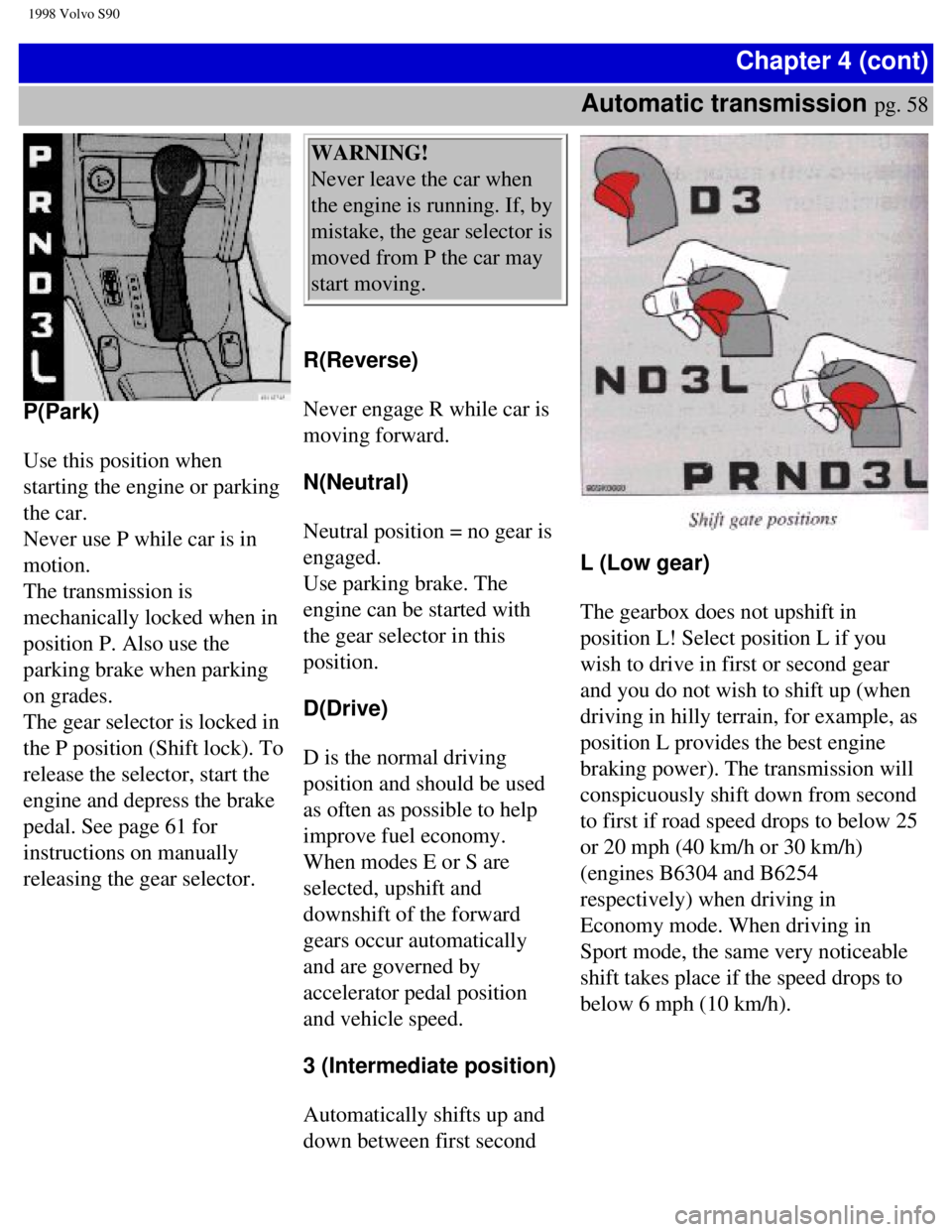
P(Park)
Use this position when
starting the engine or parking
the car.
Never use P while car is in
motion.
The transmission is
mechanically locked when in
position P. Also use the
parking brake when parking
on grades.
The gear selector is locked in
the P position (Shift lock). To
release the selector, start the
engine and depress the brake
pedal. See page 61 for
instructions on manually
releasing the gear selector. WARNING!
Never leave the car when
the engine is running. If, by
mistake, the gear selector is
moved from P the car may
start moving.
R(Reverse)
Never engage R while car is
moving forward.
N(Neutral)
Neutral position = no gear is
engaged.
Use parking brake. The
engine can be started with
the gear selector in this
position.
D(Drive)
D is the normal driving
position and should be used
as often as possible to help
improve fuel economy.
When modes E or S are
selected, upshift and
downshift of the forward
gears occur automatically
and are governed by
accelerator pedal position
and vehicle speed.
3 (Intermediate position)
Automatically shifts up and
down between first second
L (Low gear)
The gearbox does not upshift in
position L! Select position L if you
wish to drive in first or second gear
and you do not wish to shift up (when
driving in hilly terrain, for example, as
position L provides the best engine
braking power). The transmission will
conspicuously shift down from second
to first if road speed drops to below 25
or 20 mph (40 km/h or 30 km/h)
(engines B6304 and B6254
respectively) when driving in
Economy mode. When driving in
Sport mode, the same very noticeable
shift takes place if the speed drops to
below 6 mph (10 km/h).
file:///K|/ownersdocs/1998/1998_SV90/98S90_058.htm (1 of 7)12/30/2006 \
1:52:42 PM
Page 67 of 175
1998 Volvo S90
and third gears when in
driving modes E or S. There
is no upshift from third gear.
Position 3 can be used for
driving in hilly terrain, for
towing trailers or for
increased engine braking
power.
CAUTION: Never select P
or R while the car is in
motion. When initially
selecting positions D, 3, L
or R, your right foot should
press firmly on the brake
pedal to ensure that the car
is standing still with the
engine idling. The gear
selector should not be
downshifted to L at speeds
above 75 mph (125 km/h). -
Always observe posted
speed limits!
Automatic transmission pg. 59
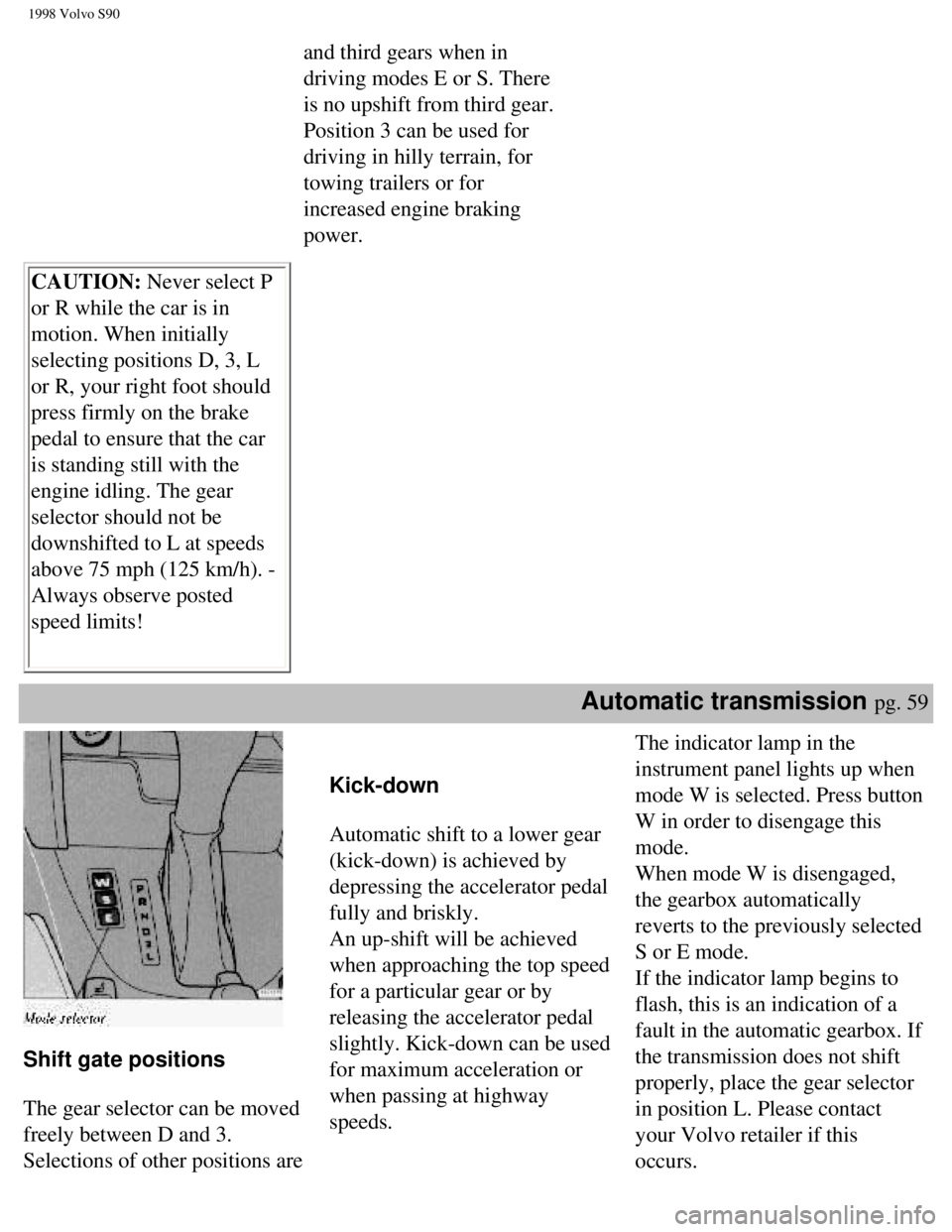
Shift gate positions
The gear selector can be moved
freely between D and 3.
Selections of other positions are
Kick-down
Automatic shift to a lower gear
(kick-down) is achieved by
depressing the accelerator pedal
fully and briskly.
An up-shift will be achieved
when approaching the top speed
for a particular gear or by
releasing the accelerator pedal
slightly. Kick-down can be used
for maximum acceleration or
when passing at highway
speeds.
The indicator lamp in the
instrument panel lights up when
mode W is selected. Press button
W in order to disengage this
mode.
When mode W is disengaged,
the gearbox automatically
reverts to the previously selected
S or E mode.
If the indicator lamp begins to
flash, this is an indication of a
fault in the automatic gearbox. If
the transmission does not shift
properly, place the gear selector
in position L. Please contact
your Volvo retailer if this
occurs.
file:///K|/ownersdocs/1998/1998_SV90/98S90_058.htm (2 of 7)12/30/2006 \
1:52:42 PM
Page 69 of 175
1998 Volvo S90
Special Tips - automatic transmission
l For driving down steep hills and when driving
for prolonged periods at low speeds, position L
should be selected. Avoid, however, repeated
changes since this can cause overheating of the
transmission oil. For driving on long continuous
uphill gradients, select position 3.
l Do not hold the car stationary on an incline by
using the accelerator pedal. Instead, apply the
hand brake (parking brake). This prevents the
transmission oil from becoming overheated.
l When towing a trailer, select shift position 3.
l The (E)conomy mode should be selected when
the cruise control is engaged.
l Never select P or R while the car is in motion.
l When initially selecting positions D, 3, L or R,
your right foot should press firmly on the brake
pedal to ensure that the car is standing still with
the engine idling.
l The gear selector should not be downshifted to
L at speeds above 75 mph (125 km/h). Always
observe posted speed limits. Cooling system
The risk for overheating is greatest, especially in
hot weather, when:
l towing a trailer up steep inclines for prolonged
periods at wide open throttle and low engine rpm.
l stopping the engine suddenly after high speed
driving (so-called "after-boiling" can occur).
To avoid overheating, the following rules should
be followed:
l Reduce speed and downshift when towing a
trailer up long, steep inclines. The risk of
overheating can be reduced by switching off the
air conditioning system for a short time.
l Do not let the engine idle unnecessarily for
prolonged periods.
l Do not mount auxiliary lamps in front of the
grill.
When the risk of overheating is imminent, or in
the event of overheating, (the temperature gauge
goes repeatedly into, or stays continually in, the
red section) the following precautions should be
taken:
l Switch off the air conditioning system.
l Pull off the road, away from traffic, stop the car
and put the gear lever into neutral. Do not stop the
engine!
l Switch the heater to full (maximum) position.
Increase the engine speed to approx. 2000 rpm
(twice idling speed) until the temperature begins
to drop.
See "Coolant" to check and top-up the coolant
level if necessary.
WARNING! Do not remove coolant expansion
tank cap. The coolant will be extremely hot.
Points to remember pg. 61
file:///K|/ownersdocs/1998/1998_SV90/98S90_058.htm (4 of 7)12/30/2006 \
1:52:42 PM
Page 73 of 175
1998 Volvo S90
Chapter 4 (cont)
Emergency towing (pulling of vehicles)
pg. 63
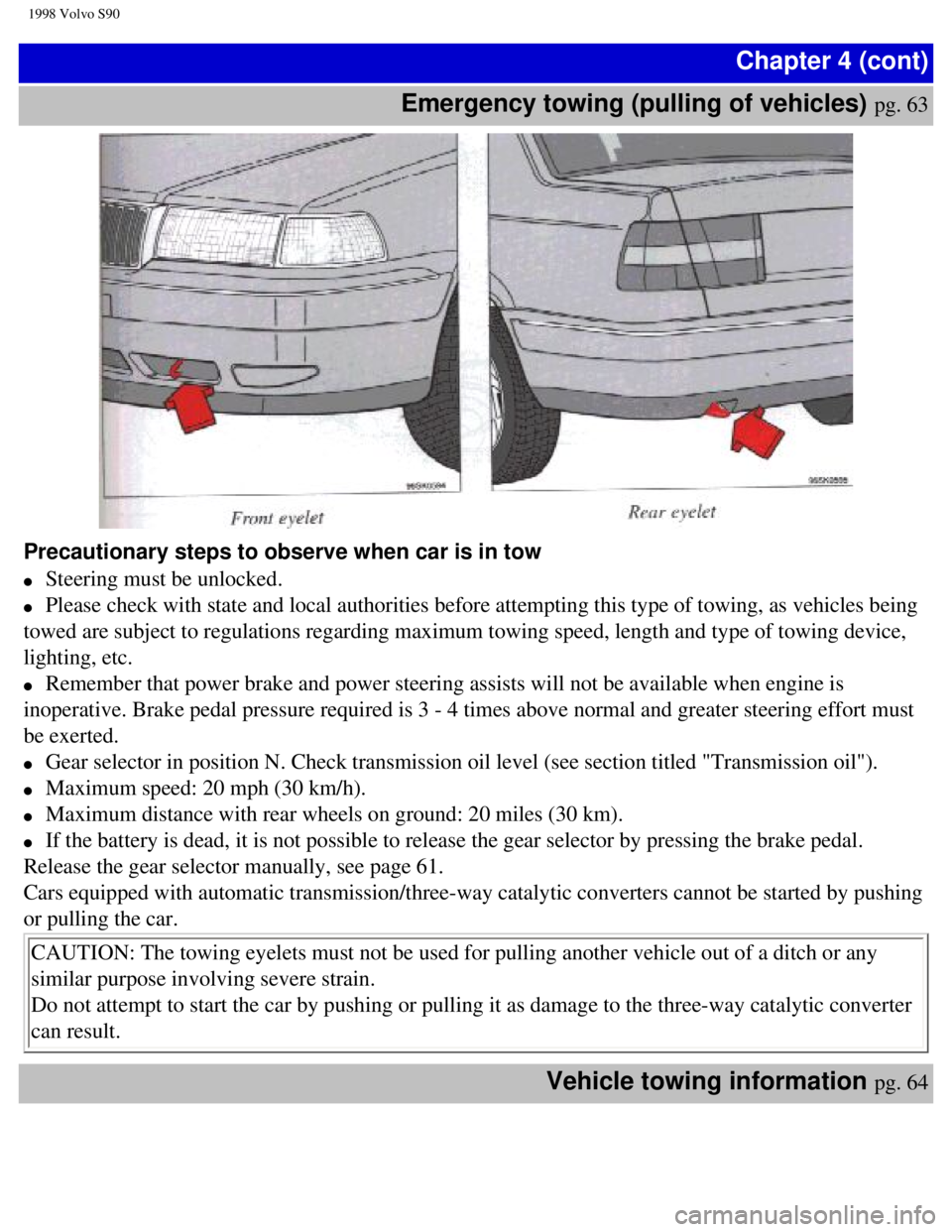
Precautionary steps to observe when car is in tow
l Steering must be unlocked.
l Please check with state and local authorities before attempting this typ\
e of towing, as vehicles being
towed are subject to regulations regarding maximum towing speed, length \
and type of towing device,
lighting, etc.
l Remember that power brake and power steering assists will not be availab\
le when engine is
inoperative. Brake pedal pressure required is 3 - 4 times above normal a\
nd greater steering effort must
be exerted.
l Gear selector in position N. Check transmission oil level (see section \
titled "Transmission oil").
l Maximum speed: 20 mph (30 km/h).
l Maximum distance with rear wheels on ground: 20 miles (30 km).
l If the battery is dead, it is not possible to release the gear selector \
by pressing the brake pedal.
Release the gear selector manually, see page 61.
Cars equipped with automatic transmission/three-way catalytic converters\
cannot be started by pushing
or pulling the car.
CAUTION: The towing eyelets must not be used for pulling another vehicle\
out of a ditch or any
similar purpose involving severe strain.
Do not attempt to start the car by pushing or pulling it as damage to th\
e three-way catalytic converter
can result.
Vehicle towing information pg. 64
file:///K|/ownersdocs/1998/1998_SV90/98S90_063.htm (1 of 4)12/30/2006 \
1:52:43 PM
Page 77 of 175
1998 Volvo S90
Chapter 4 (cont)
Brake system
pg. 67
If one of the brake
circuits should
malfunction, the red
warning light will come
on
The pedal stroke increases
slightly, the pedal feels softer
and extra pressure is required for
normal braking.
If the light comes on while
driving or braking, stop
immediately and check the brake
fluid level in the reservoir.
WARNING!
If the fluid level is below the
MIN mark in either section
of the reservoir: DO NOT
DRIVE. Tow the car to a
Volvo retailer and have the
brake system checked and
repaired.
Anti-lock Brake System
– ABS
If the warning lamp lights up
there is a malfunction of the
ABS system (the standard
braking system will however
The system performs a self-
diagnostic test when the vehicle
is started and at 4 mph (6 km/h).
The driver may detect one
pulsation of the brake pedal,
which is normal.
To obtain optimal effect from
the ABS system, constant
pressure should be kept on the
brake pedal while the system
is modulating the brakes. Do
not pump the brake pedal.
The switching of the ABS
modulator will be audible at this
time.
Please be aware that ABS does
not increase the absolute braking
potential of the vehicle.
While control will be enhanced,
ABS will not shorten stopping
distances on slippery surfaces.
Moisture on brake
discs and brake pads
affects braking.
Driving in rain and slush or
passing through an automatic car
wash can cause water to collect
on the brake discs and pads.
This will cause a delay in
braking effect when the pedal is
depressed. To avoid such a delay
when the brakes are needed,
depress the pedal occasionally
when driving through rain, slush
etc. This will remove the water
from the brakes. Check that
Severe strain on the
brake system
The brakes will be subject to
severe strain when driving in
mountains or hilly areas or
towing. The speed is usually low
which means that the cooling of
the brakes is less efficient than
when driving on level roads. To
reduce the strain on the brakes it
is advisable not to use the brakes
excessively. Instead, shift into a
lower gear, position 3 or in some
cases L ,and let the engine help
with the braking.
Do not forget that, if you are
towing a trailer, the brakes will
be subjected to greater load than
is normal.
If the brake power-
assist does not
function
The power assist to the brakes
functions only when the engine
is running. When the car is
moving without the engine
running the brake pedal pressure
required to stop the car is
increased by 3-4 times.
The brake pedal feels stiff and
hard.
file:///K|/ownersdocs/1998/1998_SV90/98S90_067.htm (1 of 5)12/30/2006 \
1:52:43 PM