warning light VOLVO V90 1998 Owner's Manual
[x] Cancel search | Manufacturer: VOLVO, Model Year: 1998, Model line: V90, Model: VOLVO V90 1998Pages: 175, PDF Size: 4.45 MB
Page 58 of 175
1998 Volvo S90
WARNING!
Always turn engine off and apply
parking brake when loading/
unloading the vehicle. Place
transmission selector in P (PARK)
position to help prevent
inadvertent movement of selector.
Alarm pg. 51
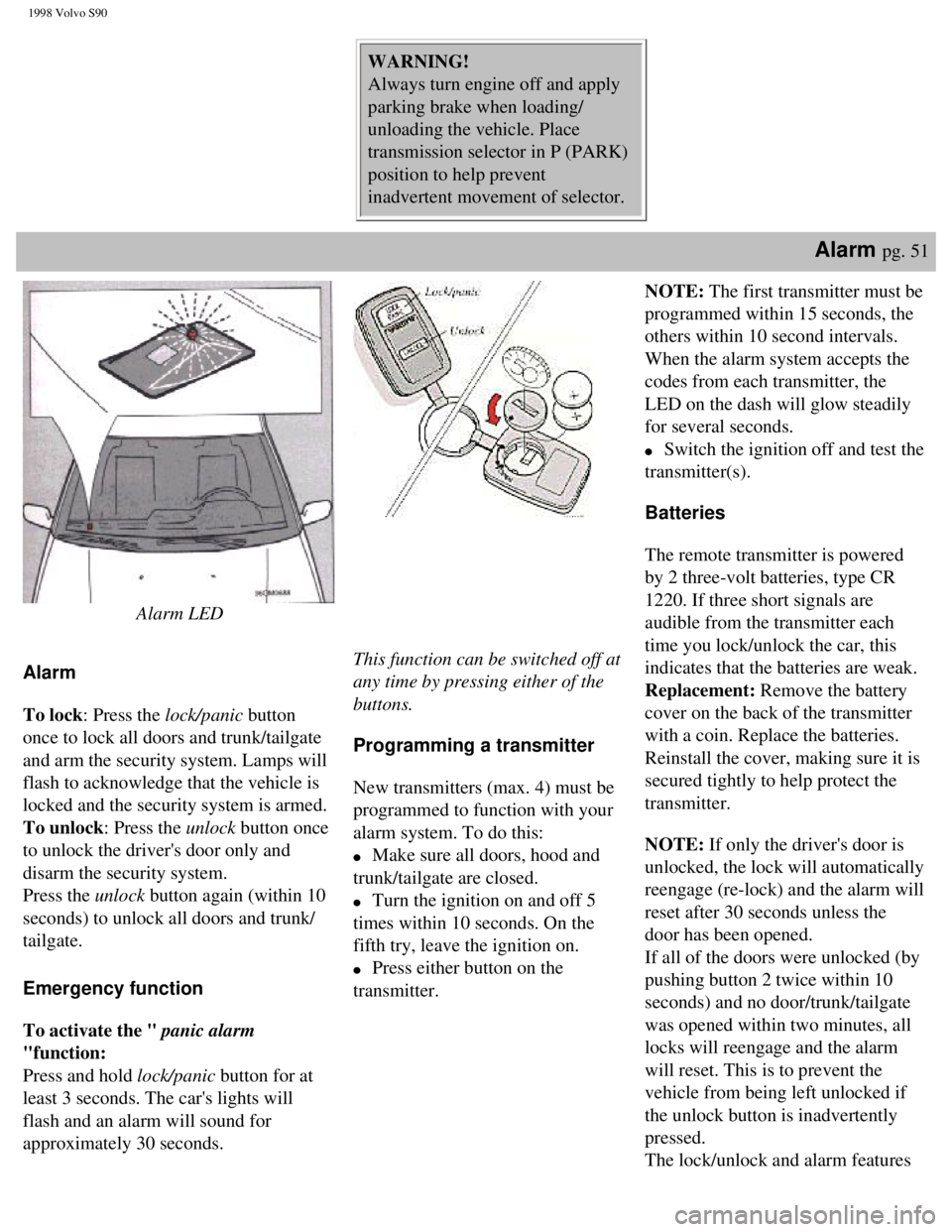
Alarm LED
Alarm
To lock: Press the lock/panic button
once to lock all doors and trunk/tailgate
and arm the security system. Lamps will
flash to acknowledge that the vehicle is
locked and the security system is armed.
To unlock: Press the unlock button once
to unlock the driver's door only and
disarm the security system.
Press the unlock button again (within 10
seconds) to unlock all doors and trunk/
tailgate.
Emergency function
To activate the " panic alarm
"function:
Press and hold lock/panic button for at
least 3 seconds. The car's lights will
flash and an alarm will sound for
approximately 30 seconds.
This function can be switched off at
any time by pressing either of the
buttons.
Programming a transmitter
New transmitters (max. 4) must be
programmed to function with your
alarm system. To do this:
l Make sure all doors, hood and
trunk/tailgate are closed.
l Turn the ignition on and off 5
times within 10 seconds. On the
fifth try, leave the ignition on.
l Press either button on the
transmitter. NOTE: The first transmitter must be
programmed within 15 seconds, the
others within 10 second intervals.
When the alarm system accepts the
codes from each transmitter, the
LED on the dash will glow steadily
for several seconds.
l Switch the ignition off and test the
transmitter(s).
Batteries
The remote transmitter is powered
by 2 three-volt batteries, type CR
1220. If three short signals are
audible from the transmitter each
time you lock/unlock the car, this
indicates that the batteries are weak.
Replacement: Remove the battery
cover on the back of the transmitter
with a coin. Replace the batteries.
Reinstall the cover, making sure it is
secured tightly to help protect the
transmitter.
NOTE: If only the driver's door is
unlocked, the lock will automatically
reengage (re-lock) and the alarm will
reset after 30 seconds unless the
door has been opened.
If all of the doors were unlocked (by
pushing button 2 twice within 10
seconds) and no door/trunk/tailgate
was opened within two minutes, all
locks will reengage and the alarm
will reset. This is to prevent the
vehicle from being left unlocked if
the unlock button is inadvertently
pressed.
The lock/unlock and alarm features
file:///K|/ownersdocs/1998/1998_SV90/98S90_048.htm (3 of 4)12/30/2006 \
1:52:40 PM
Page 63 of 175

1998 Volvo S90
Volvo allows the use of the
following "oxygenated fuels";
however, the octane ratings
listed on this page must still be
met. of fuel. Therefore, it is
advisable to refuel as soon as
possible when the needle nears
the red zone, or when the fuel
warning light comes on.
Driving economy pg. 56
Economical driving
conserves natural
resources
Better driving economy may be
obtained by thinking ahead,
avoiding rapid starts and stops
and adjusting the speed of your
vehicle to immediate traffic
conditions. Observe the
following rules:
l Bring the engine to normal
operating temperature as soon
as possible by driving with a
light foot on the accelerator
pedal for the first few minutes
of operation. A cold engine
uses more fuel and is subject to
increased wear.
l Whenever possible, avoid
using the car for driving short
distances. This does not allow
the engine to reach normal
operating temperature.
l Drive carefully and avoid
rapid acceleration and hard
braking.
l Do not exceed speed limit.
l Avoid carrying unnecessary
items (extra load) in the car.
l Check tire pressure regularly
l Remove snow tires when
threat of snow or ice has ended.
l Note that roof racks, ski
racks, etc., increase air
resistance and thereby fuel
consumption.
l Avoid using automatic
transmission kick-down feature
unless necessary.
l Avoid using the air
conditioning when it is not
required. When engaged, the
air conditioner's compressor
places places an additional load
on the engine. However, please
note that fuel consumption is
lower with the air conditioning
on than it is when driving with
the air conditioning switched
off and the windows down.
Other factors which decrease
gas mileage are:
l Worn or dirty spark plugs
l Incorrect spark plug gap
l Dirty air cleaner
l Dirty engine oil and clogged
oil filter
l Dragging brakes
l Incorrect front end alignment
Some of the above mentioned
file:///K|/ownersdocs/1998/1998_SV90/98S90_053.htm (4 of 6)12/30/2006 \
1:52:41 PM
Page 64 of 175
1998 Volvo S90
(check when tires are cold). items and others are checked at
the standard Maintenance
Service intervals.
NOTE: Since using (D)rive
improves fuel economy, it
should be used as often as
possible.
Starting the engine pg. 57
Starting and stopping a
car equipped with
automatic transmission
1 Fasten the seat belt.
WARNING! Before
starting, check that the seat
is adjusted properly. Make
sure the brake pedal can be
depressed completely. Move
the seat closer if necessary.
Refer to section "Front
seats".
2 Apply the parking brake, if
not already set. The gear
selector is locked in the (P)ark
position (SHIFTLOCK).
3Without touching the
accelerator pedal ,turn the
ignition key to the starting
position. Allow the starter to
operate for 5-10 seconds.
Release the key as soon as the
engine starts. If the engine fails
to start, repeat step 3.
5 Select desired gear. The gear
engages after a slight delay,
especially noticeable when
selecting R.
CAUTION: Engine should
be idling; never accelerate
until after you feel the gear
engage! Too rapid
acceleration immediately
after selecting a gear will
cause harsh engagement and
premature transmission
wear.
NOTE:Your car is equipped
with a KEYLOCK system.
When the engine is switched
off, the gear selector must be in
the (P)ark position before the
key can be removed from the
ignition switch.
Engine warm-up - initial
driving procedure
Engines in vehicles driven short
distances are subject to
abnormally rapid wear because
the engine never reaches normal
operating temperature. It is
therefore beneficial to reach
normal operating temperature as
soon as possible. This is best
achieved by driving with a light
foot on the accelerator pedal for
a few minutes after starting,
rather than prolonged idling.
B6304 S Engine
This engine features hydraulic
valve lifters which means that
valve clearance is adjusted
automatically. It is possible that
the valve lifters will produce a
ticking sound for the first few
seconds after the engine is
started, while the oil pressure is
increasing.
If the car has not been used for a
long period of time, this ticking
sound may last for up to 15
minutes. This is entirely normal.
file:///K|/ownersdocs/1998/1998_SV90/98S90_053.htm (5 of 6)12/30/2006 \
1:52:41 PM
Page 77 of 175
1998 Volvo S90
Chapter 4 (cont)
Brake system
pg. 67
If one of the brake
circuits should
malfunction, the red
warning light will come
on
The pedal stroke increases
slightly, the pedal feels softer
and extra pressure is required for
normal braking.
If the light comes on while
driving or braking, stop
immediately and check the brake
fluid level in the reservoir.
WARNING!
If the fluid level is below the
MIN mark in either section
of the reservoir: DO NOT
DRIVE. Tow the car to a
Volvo retailer and have the
brake system checked and
repaired.
Anti-lock Brake System
– ABS
If the warning lamp lights up
there is a malfunction of the
ABS system (the standard
braking system will however
The system performs a self-
diagnostic test when the vehicle
is started and at 4 mph (6 km/h).
The driver may detect one
pulsation of the brake pedal,
which is normal.
To obtain optimal effect from
the ABS system, constant
pressure should be kept on the
brake pedal while the system
is modulating the brakes. Do
not pump the brake pedal.
The switching of the ABS
modulator will be audible at this
time.
Please be aware that ABS does
not increase the absolute braking
potential of the vehicle.
While control will be enhanced,
ABS will not shorten stopping
distances on slippery surfaces.
Moisture on brake
discs and brake pads
affects braking.
Driving in rain and slush or
passing through an automatic car
wash can cause water to collect
on the brake discs and pads.
This will cause a delay in
braking effect when the pedal is
depressed. To avoid such a delay
when the brakes are needed,
depress the pedal occasionally
when driving through rain, slush
etc. This will remove the water
from the brakes. Check that
Severe strain on the
brake system
The brakes will be subject to
severe strain when driving in
mountains or hilly areas or
towing. The speed is usually low
which means that the cooling of
the brakes is less efficient than
when driving on level roads. To
reduce the strain on the brakes it
is advisable not to use the brakes
excessively. Instead, shift into a
lower gear, position 3 or in some
cases L ,and let the engine help
with the braking.
Do not forget that, if you are
towing a trailer, the brakes will
be subjected to greater load than
is normal.
If the brake power-
assist does not
function
The power assist to the brakes
functions only when the engine
is running. When the car is
moving without the engine
running the brake pedal pressure
required to stop the car is
increased by 3-4 times.
The brake pedal feels stiff and
hard.
file:///K|/ownersdocs/1998/1998_SV90/98S90_067.htm (1 of 5)12/30/2006 \
1:52:43 PM
Page 78 of 175
1998 Volvo S90
function) and the vehicle should
be driven to a Volvo retailer for
inspection.
The Anti-lock Braking System
(ABS) helps to improve vehicle
control (stopping and steering)
during severe braking conditions
by limiting brake lock-up. When
the system "senses" impending
lock-up, braking pressure is
automatically modulated in
order to help prevent lockup,
which could lead to a skid. brake application feels normal.
This should also be done after
washing or starting in very damp
or cold weather.
Trailer towing pg. 68
When preparing for
trailer towing, observe
the following:
l Volvo recommends the use of
Volvo trailer hitches which are
specially designed for the car.
For trailer weights exceeding
2000 lbs. (908 kg), use only a
trailer hitch offered as a
Genuine Volvo accessory.
NOTE: Models with automatic
transmission are equipped with
a transmission oil cooler as
standard equipment. This cooler
helps prevent overheating of the
transmission during times of
increased load, as when towing
a trailer.
l Maximum trailer weight
recommended by Volvo is:
Trailers without brakes: 1100
lbs (500kg)
Trailers with brakes: 2" ball -
3300 lbs (1500 kg), 1 7/8" ball -
2000 lbs (908 kg).
WARNING! Never connect a
trailer's hydraulic brake
system directly to the vehicle
brake system, nor a trailer's
lighting system directly to the
vehicle lighting system.
Consult your nearest
authorized Volvo retailer for
correct installation.
All Volvo models are equipped
with energy-absorbing shock-
mounted bumpers. Trailer hitch
installation should not interfere
with the proper operation of this
bumper system. Trailer towing
does not normally present any
particular problems, but take
into consideration:
l Recommended hitch tongue
load is 110 lbs (50 kgs) for
trailer weights below 2,650 lbs
(1,200 kgs) and 165 lbs (75 kgs)
for trailer weights above 2,650
lbs (1,200 kgs).
l For trailer weights between
2,650-3,300 lbs (1,200-1,500
l Avoid overload and other
abusive operation.
l Hauling a trailer affects
handling, durability, and
economy.
l It is necessary to balance
trailer brakes with the towing
vehicle brakes to provide a safe
stop (check and observe State/
Local regulations).
l Do not connect the trailer's
brake system directly to the
vehicle's brake system.
l More frequent vehicle
maintenance is required.
l Remove the ball and drawbar
assembly when the hitch is not
being used.
l Volvo recommends the use of
synthetic engine oil when towing
a trailer over long distances or in
mountainous areas.
l The trailer hitch tongue load
(110/165 lbs - 50/75 kg) is part
of the vehicle's capacity weight.
It may be necessary to reduce the
trunk/cargo area load when
file:///K|/ownersdocs/1998/1998_SV90/98S90_067.htm (2 of 5)12/30/2006 \
1:52:43 PM
Page 89 of 175
1998 Volvo S90
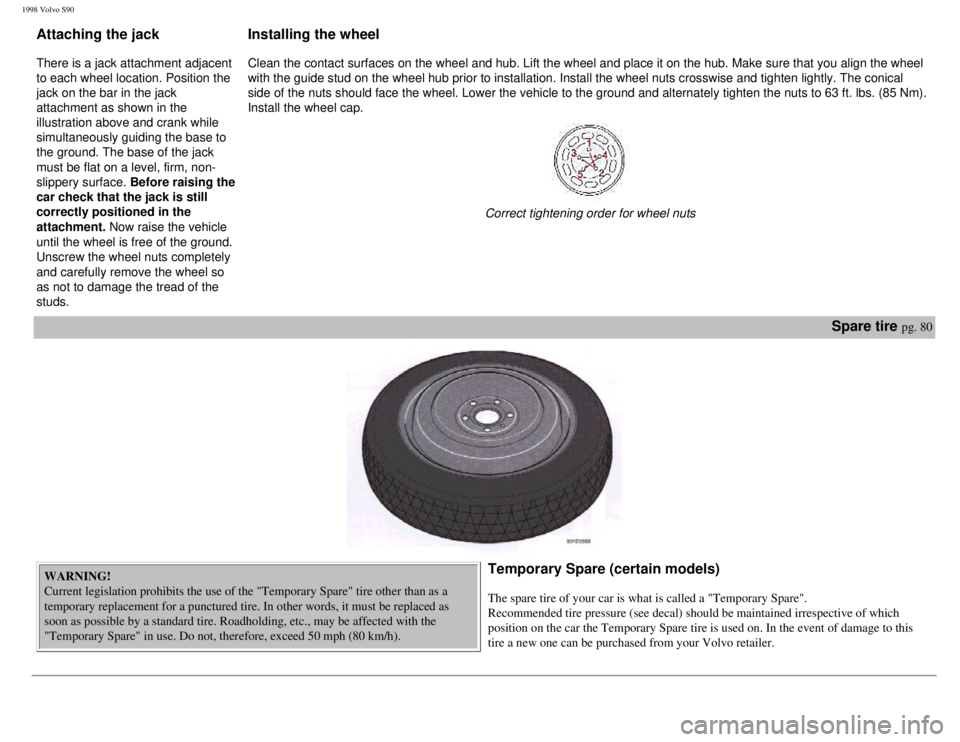
Attaching the jack
There is a jack attachment adjacent
to each wheel location. Position the
jack on the bar in the jack
attachment as shown in the
illustration above and crank while
simultaneously guiding the base to
the ground. The base of the jack
must be flat on a level, firm, non-
slippery surface. Before raising the
car check that the jack is still
correctly positioned in the
attachment. Now raise the vehicle
until the wheel is free of the ground.
Unscrew the wheel nuts completely
and carefully remove the wheel so
as not to damage the tread of the
studs. Installing the wheel
Clean the contact surfaces on the wheel and hub. Lift the wheel and plac\
e it on the hub. Make sure that you align the wheel
with the guide stud on the wheel hub prior to installation. Install the \
wheel nuts crosswise and tighten lightly. The conical
side of the nuts should face the wheel. Lower the vehicle to the ground \
and alternately tighten the nuts to 63 ft. lbs. (85 Nm).
Install the wheel cap.
Correct tightening order for wheel nuts
Spare tire pg. 80
WARNING!
Current legislation prohibits the use of the "Temporary Spare" tire othe\
r than as a
temporary replacement for a punctured tire. In other words, it must be r\
eplaced as
soon as possible by a standard tire. Roadholding, etc., may be affected \
with the
"Temporary Spare" in use. Do not, therefore, exceed 50 mph (80 km/h). \
Temporary Spare (certain models)
The spare tire of your car is what is called a "Temporary Spare".
Recommended tire pressure (see decal) should be maintained irrespectiv\
e of which
position on the car the Temporary Spare tire is used on. In the event of\
damage to this
tire a new one can be purchased from your Volvo retailer.
file:///K|/ownersdocs/1998/1998_SV90/98S90_077.htm (3 of 4)12/30/2006 \
1:52:45 PM
Page 91 of 175
1998 Volvo S90
Chapter 6 - (cont.)
Replacing bulbs
pg. 81
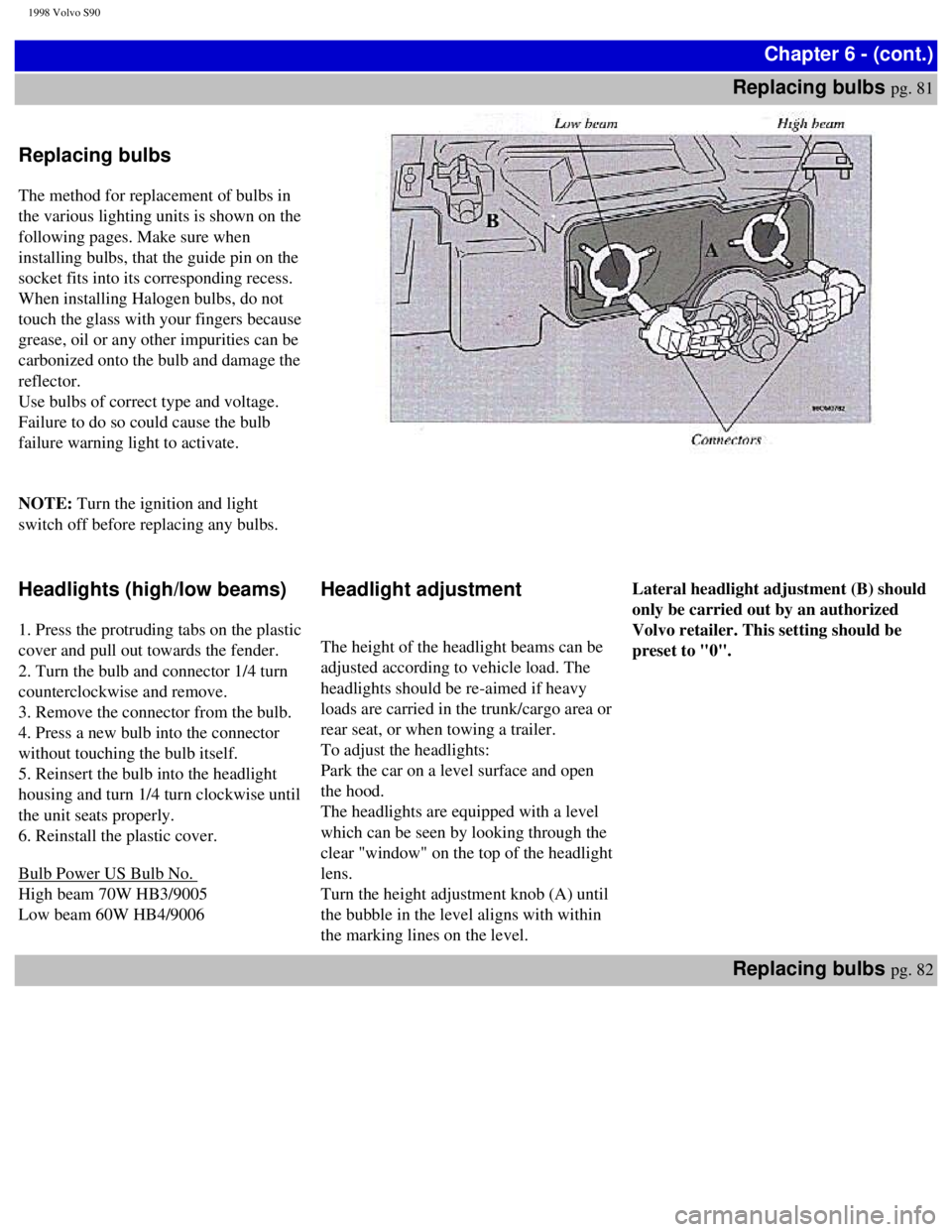
Replacing bulbs
The method for replacement of bulbs in
the various lighting units is shown on the
following pages. Make sure when
installing bulbs, that the guide pin on the
socket fits into its corresponding recess.
When installing Halogen bulbs, do not
touch the glass with your fingers because
grease, oil or any other impurities can be
carbonized onto the bulb and damage the
reflector.
Use bulbs of correct type and voltage.
Failure to do so could cause the bulb
failure warning light to activate.
NOTE: Turn the ignition and light
switch off before replacing any bulbs.
Headlights (high/low beams)
1. Press the protruding tabs on the plastic
cover and pull out towards the fender.
2. Turn the bulb and connector 1/4 turn
counterclockwise and remove.
3. Remove the connector from the bulb.
4. Press a new bulb into the connector
without touching the bulb itself.
5. Reinsert the bulb into the headlight
housing and turn 1/4 turn clockwise until
the unit seats properly.
6. Reinstall the plastic cover.
Bulb Power US Bulb No.
High beam 70W HB3/9005
Low beam 60W HB4/9006
Headlight adjustment
The height of the headlight beams can be
adjusted according to vehicle load. The
headlights should be re-aimed if heavy
loads are carried in the trunk/cargo area or
rear seat, or when towing a trailer.
To adjust the headlights:
Park the car on a level surface and open
the hood.
The headlights are equipped with a level
which can be seen by looking through the
clear "window" on the top of the headlight
lens.
Turn the height adjustment knob (A) until
the bubble in the level aligns with within
the marking lines on the level.
Lateral headlight adjustment (B) should
only be carried out by an authorized
Volvo retailer. This setting should be
preset to "0".
Replacing bulbs pg. 82
file:///K|/ownersdocs/1998/1998_SV90/98S90_081.htm (1 of 6)12/30/2006 \
1:52:45 PM
Page 94 of 175
1998 Volvo S90
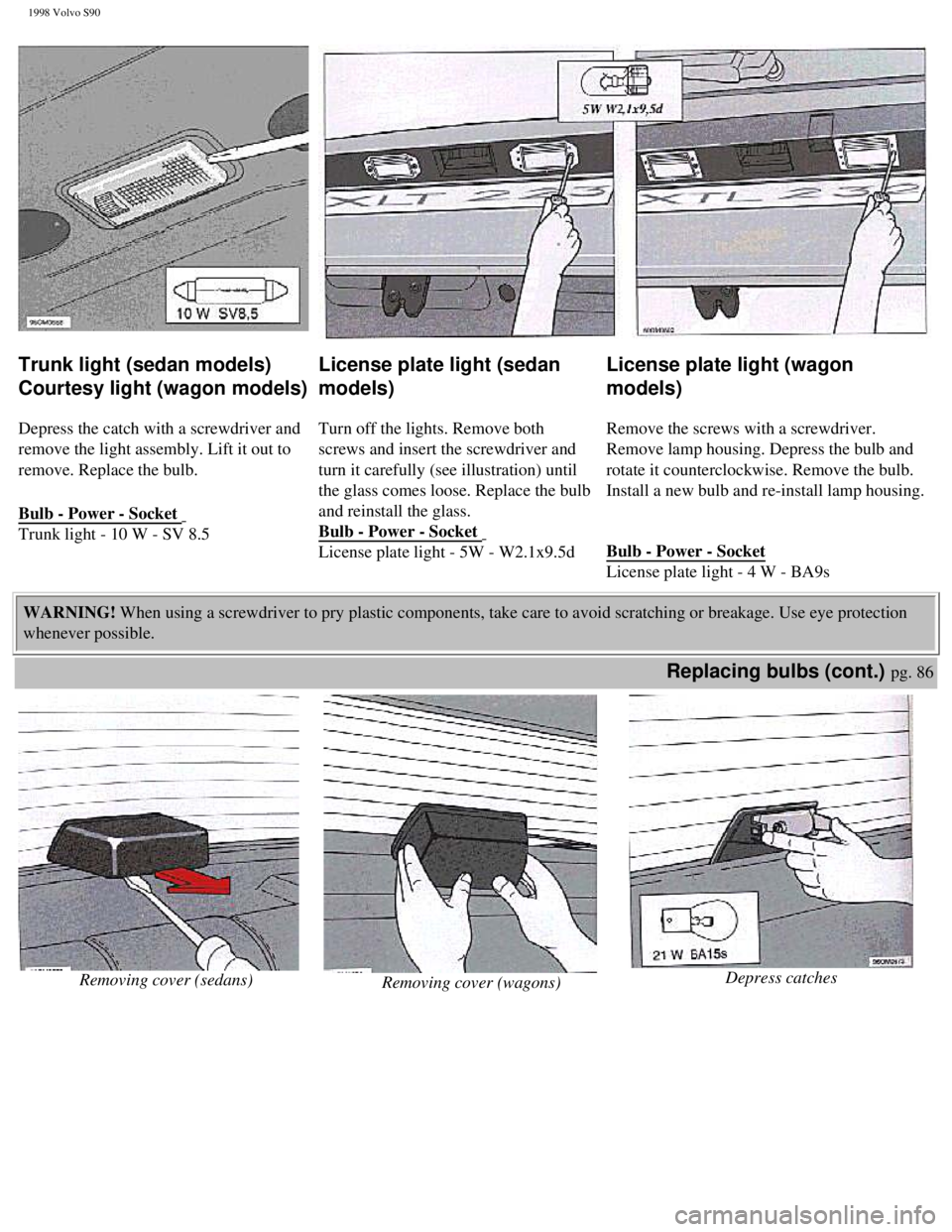
Trunk light (sedan models)
Courtesy light (wagon models)
Depress the catch with a screwdriver and
remove the light assembly. Lift it out to
remove. Replace the bulb.
Bulb - Power - Socket
Trunk light - 10 W - SV 8.5
License plate light (sedan
models)
Turn off the lights. Remove both
screws and insert the screwdriver and
turn it carefully (see illustration) until
the glass comes loose. Replace the bulb
and reinstall the glass.
Bulb - Power - Socket
License plate light - 5W - W2.1x9.5d
License plate light (wagon
models)
Remove the screws with a screwdriver.
Remove lamp housing. Depress the bulb and
rotate it counterclockwise. Remove the bulb.
Install a new bulb and re-install lamp housing.
Bulb - Power - Socket
License plate light - 4 W - BA9s
WARNING! When using a screwdriver to pry plastic components, take care to avoid \
scratching or breakage. Use eye protection
whenever possible.
Replacing bulbs (cont.) pg. 86
Removing cover (sedans)
Removing cover (wagons) Depress catches
file:///K|/ownersdocs/1998/1998_SV90/98S90_081.htm (4 of 6)12/30/2006 \
1:52:45 PM
Page 96 of 175
1998 Volvo S90
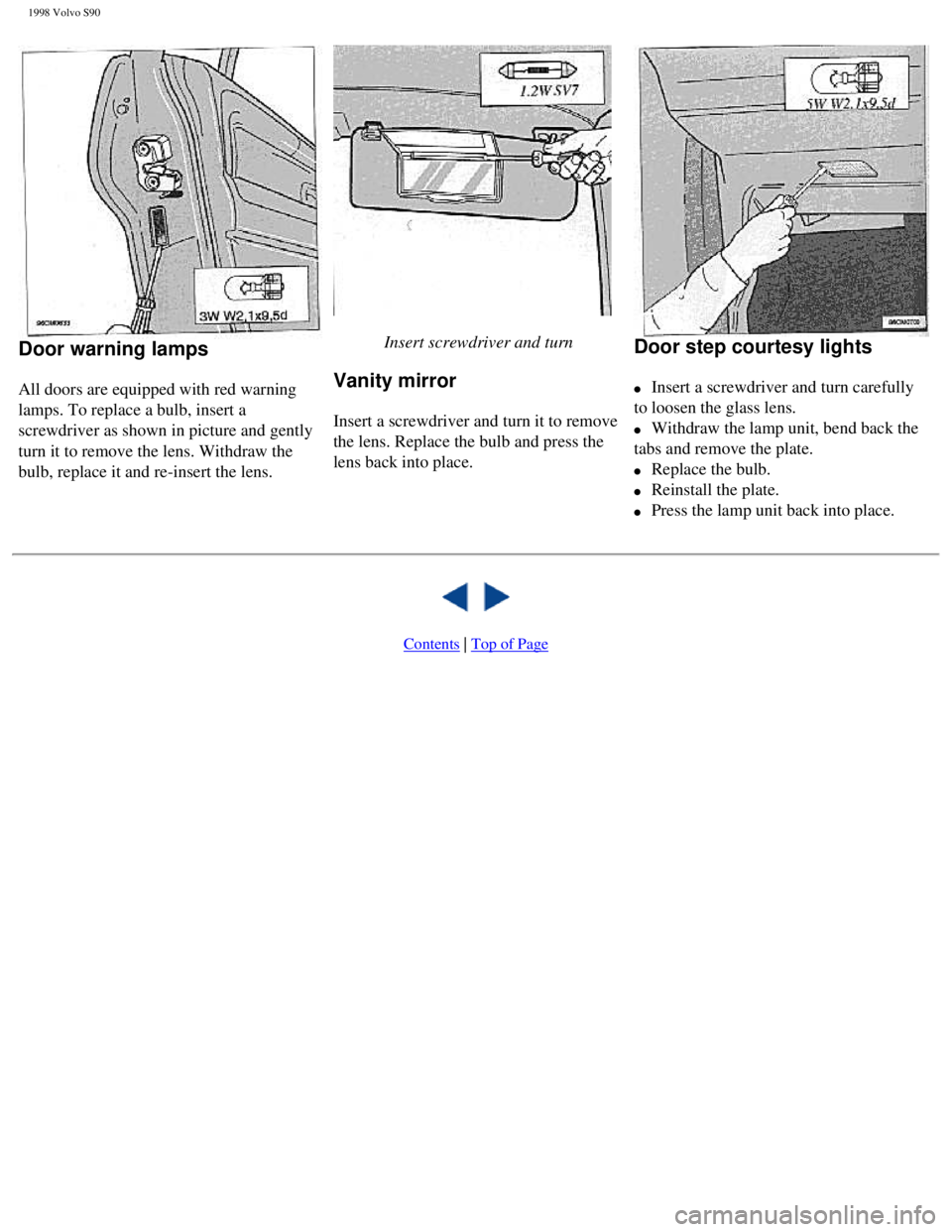
Door warning lamps
All doors are equipped with red warning
lamps. To replace a bulb, insert a
screwdriver as shown in picture and gently
turn it to remove the lens. Withdraw the
bulb, replace it and re-insert the lens.
Insert screwdriver and turn
Vanity mirror
Insert a screwdriver and turn it to remove
the lens. Replace the bulb and press the
lens back into place.
Door step courtesy lights
l Insert a screwdriver and turn carefully
to loosen the glass lens.
l Withdraw the lamp unit, bend back the
tabs and remove the plate.
l Replace the bulb.
l Reinstall the plate.
l Press the lamp unit back into place.
Contents | Top of Page
file:///K|/ownersdocs/1998/1998_SV90/98S90_081.htm (6 of 6)12/30/2006 \
1:52:45 PM
Page 99 of 175
1998 Volvo S90
2 Audio, Power seats, Hazard warning flashers,
Compartment Lights,
Power Antenna, Trailer Power, 50
3 Power Supply Relay "A" 50
4 Fuel System Relay, Ignition System Relay 50
5ABS-unit 50
6 Air pump, Starter Solenoid, Horn 50
7 Electric Cooling Fan 50
8 Pos./parking Light Relay, Headlight Relay, Fog light
relay 50
*Some of the equipment/systems listed may be
available on certain models only and/or as optional
items only.
Brake system pg. 91
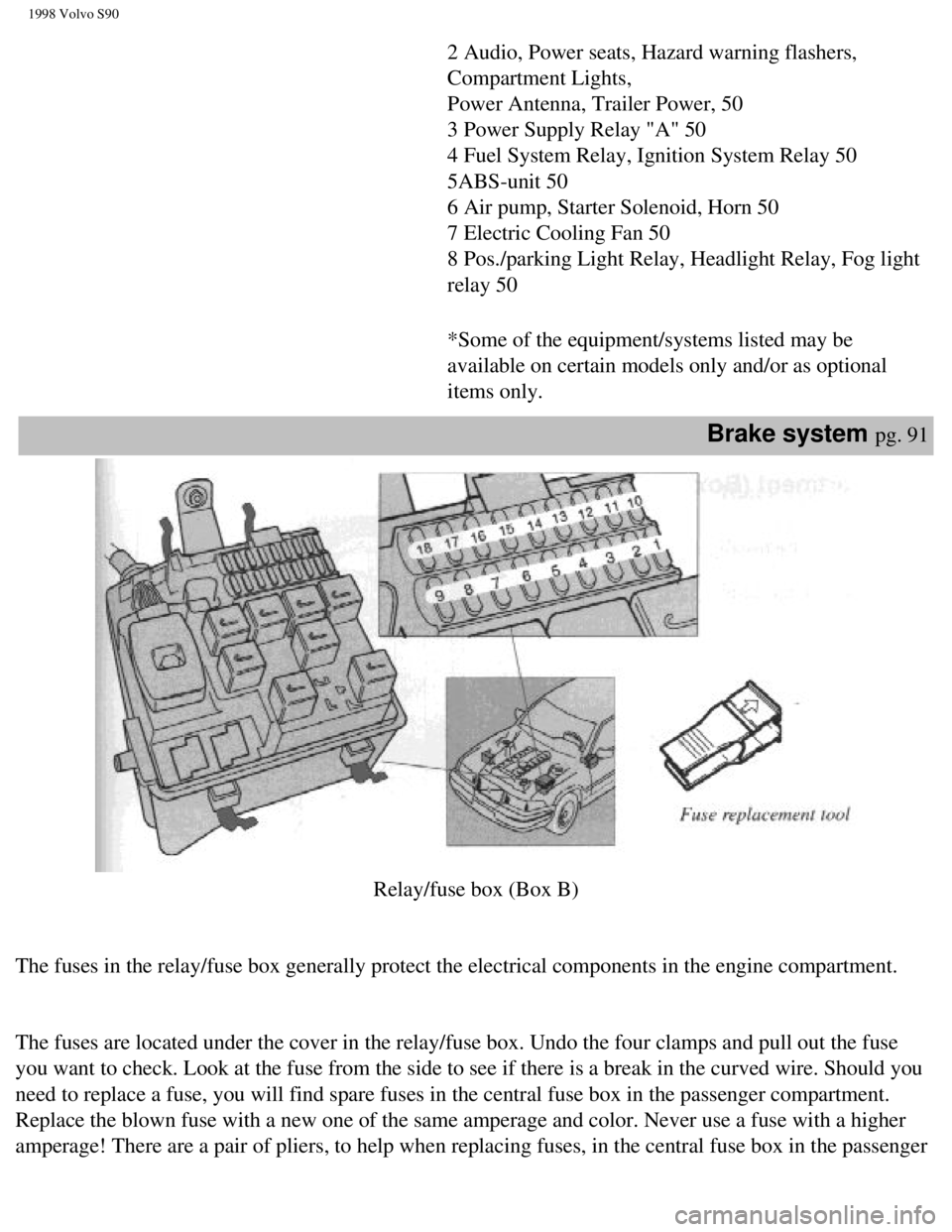
Relay/fuse box (Box B)
The fuses in the relay/fuse box generally protect the electrical compone\
nts in the engine compartment.
The fuses are located under the cover in the relay/fuse box. Undo the fo\
ur clamps and pull out the fuse
you want to check. Look at the fuse from the side to see if there is a b\
reak in the curved wire. Should you
need to replace a fuse, you will find spare fuses in the central fuse bo\
x in the passenger compartment.
Replace the blown fuse with a new one of the same amperage and color. Ne\
ver use a fuse with a higher
amperage! There are a pair of pliers, to help when replacing fuses, in t\
he central fuse box in the passenger
file:///K|/ownersdocs/1998/1998_SV90/98S90_089.htm (3 of 9)12/30/2006 \
1:52:46 PM