clock VOLVO V90 2017 User Guide
[x] Cancel search | Manufacturer: VOLVO, Model Year: 2017, Model line: V90, Model: VOLVO V90 2017Pages: 594, PDF Size: 15.07 MB
Page 253 of 594
LOCKS AND ALARM
}}
251
Detaching the key blade
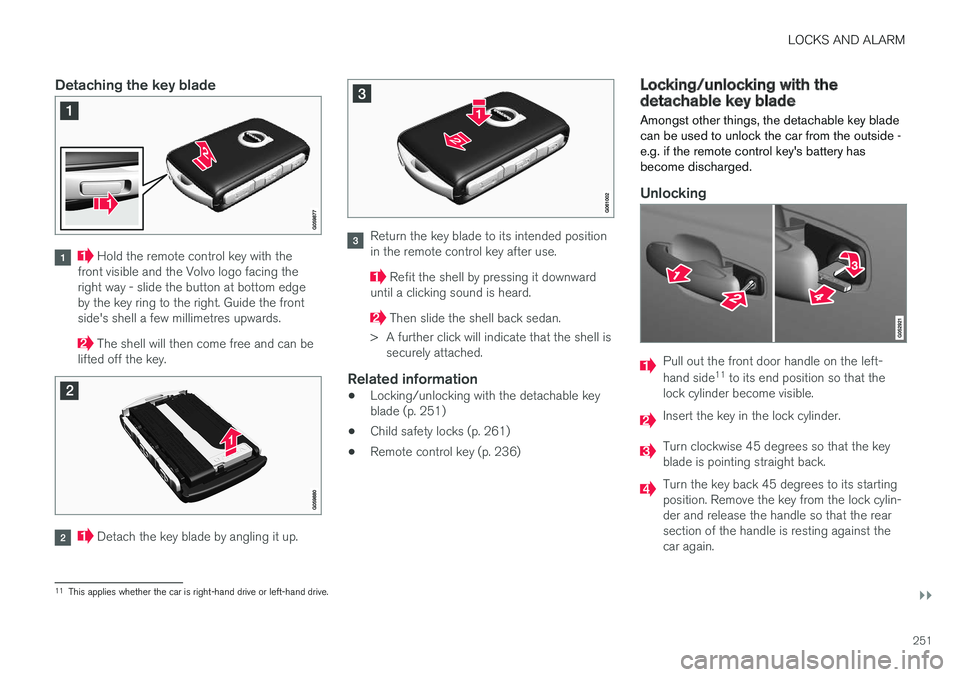
Hold the remote control key with the
front visible and the Volvo logo facing the right way - slide the button at bottom edgeby the key ring to the right. Guide the frontside's shell a few millimetres upwards.
The shell will then come free and can be
lifted off the key.
Detach the key blade by angling it up.
Return the key blade to its intended position in the remote control key after use.
Refit the shell by pressing it downward
until a clicking sound is heard.
Then slide the shell back sedan.
> A further click will indicate that the shell is securely attached.
Related information
• Locking/unlocking with the detachable key blade (p. 251)
• Child safety locks (p. 261)
• Remote control key (p. 236)
Locking/unlocking with the detachable key blade
Amongst other things, the detachable key blade can be used to unlock the car from the outside -e.g. if the remote control key's battery hasbecome discharged.
Unlocking
Pull out the front door handle on the left- hand side 11
to its end position so that the
lock cylinder become visible.
Insert the key in the lock cylinder.
Turn clockwise 45 degrees so that the key blade is pointing straight back.
Turn the key back 45 degrees to its starting position. Remove the key from the lock cylin-der and release the handle so that the rearsection of the handle is resting against thecar again.
11 This applies whether the car is right-hand drive or left-hand drive.
Page 254 of 594
||
LOCKS AND ALARM
* Option/accessory.
252 5. Pull out the handle.
> The door opens.
Locking will be performed in the same way, but with an anticlockwise turn 45 degrees instead ofclockwise in step (3).
Switching off the alarm *
NOTE
When the door is unlocked using the key blade and is then opened, the alarm is trig-gered.
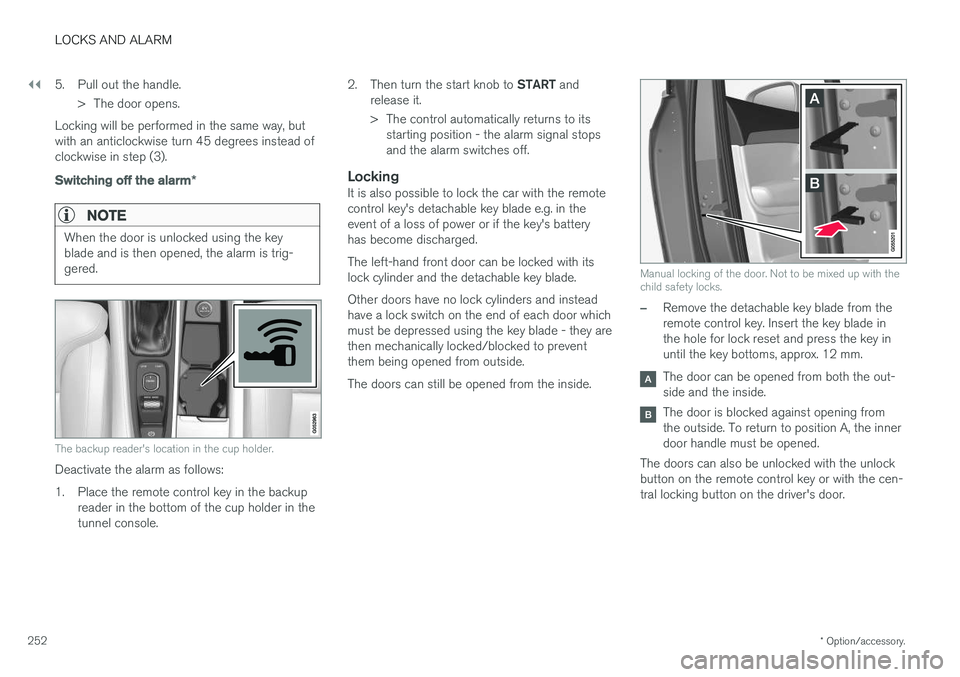
The backup reader's location in the cup holder.
Deactivate the alarm as follows:
1. Place the remote control key in the backup
reader in the bottom of the cup holder in the tunnel console. 2.
Then turn the start knob to START and
release it.
> The control automatically returns to its starting position - the alarm signal stops and the alarm switches off.
LockingIt is also possible to lock the car with the remotecontrol key's detachable key blade e.g. in theevent of a loss of power or if the key's batteryhas become discharged. The left-hand front door can be locked with its lock cylinder and the detachable key blade. Other doors have no lock cylinders and instead have a lock switch on the end of each door whichmust be depressed using the key blade - they arethen mechanically locked/blocked to preventthem being opened from outside. The doors can still be opened from the inside.
Manual locking of the door. Not to be mixed up with the child safety locks.
–Remove the detachable key blade from the remote control key. Insert the key blade inthe hole for lock reset and press the key inuntil the key bottoms, approx. 12 mm.
The door can be opened from both the out- side and the inside.
The door is blocked against opening from the outside. To return to position A, the innerdoor handle must be opened.
The doors can also be unlocked with the unlockbutton on the remote control key or with the cen-tral locking button on the driver's door.
Page 260 of 594
||
LOCKS AND ALARM
258
Opening and changing
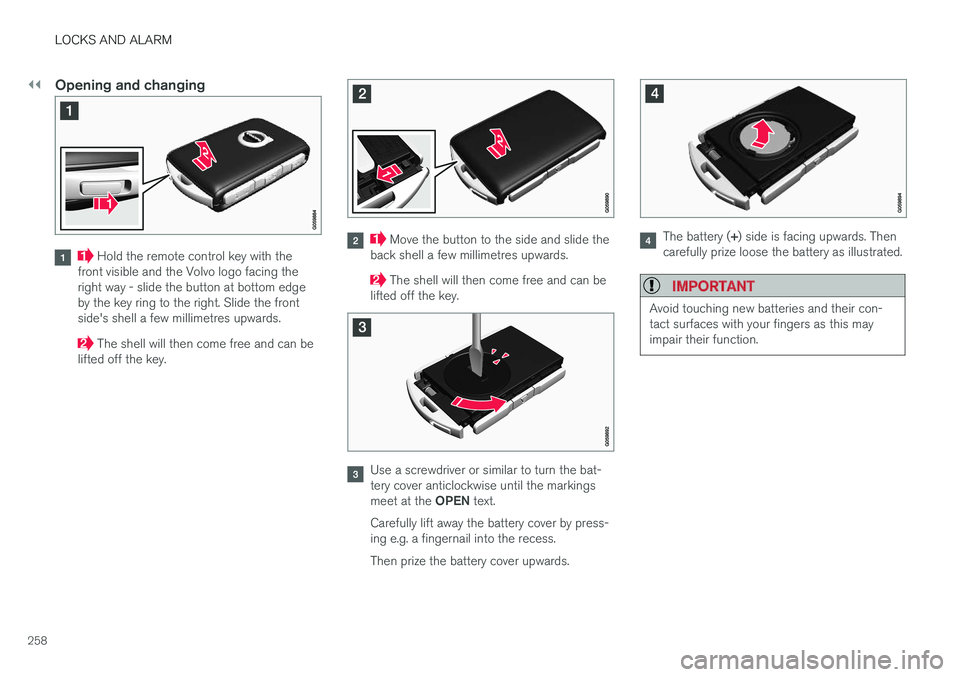
Hold the remote control key with the
front visible and the Volvo logo facing the right way - slide the button at bottom edgeby the key ring to the right. Slide the frontside's shell a few millimetres upwards.
The shell will then come free and can be
lifted off the key.
Move the button to the side and slide the
back shell a few millimetres upwards.
The shell will then come free and can be
lifted off the key.
Use a screwdriver or similar to turn the bat- tery cover anticlockwise until the markings meet at the OPEN text.
Carefully lift away the battery cover by press- ing e.g. a fingernail into the recess. Then prize the battery cover upwards.
The battery ( +) side is facing upwards. Then
carefully prize loose the battery as illustrated.
IMPORTANT
Avoid touching new batteries and their con- tact surfaces with your fingers as this mayimpair their function.
Page 261 of 594
LOCKS AND ALARM
}}
259
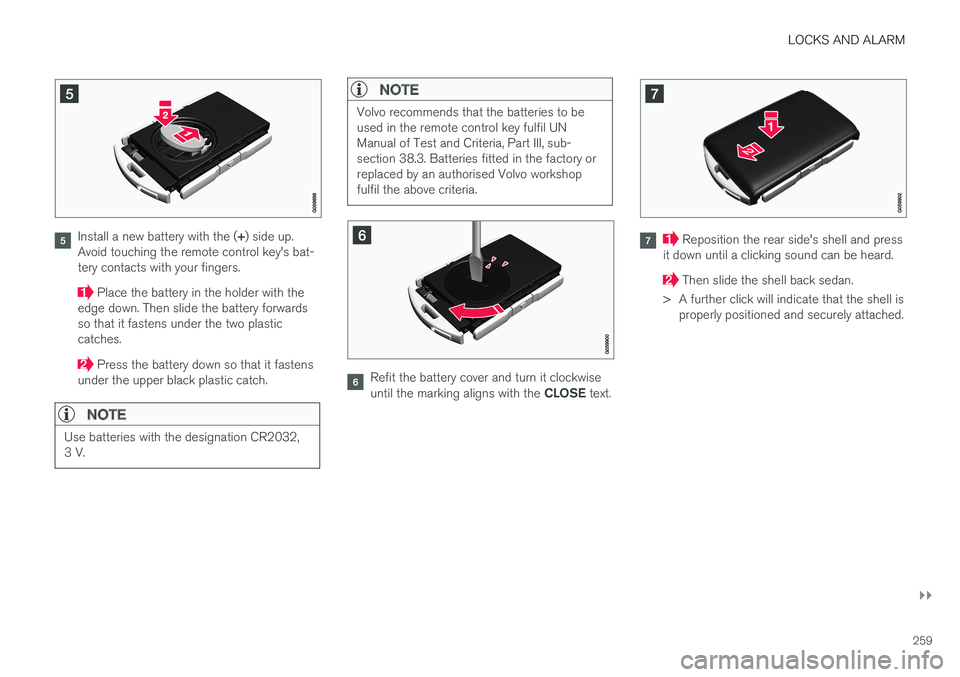
Install a new battery with the (+) side up.
Avoid touching the remote control key's bat- tery contacts with your fingers.
Place the battery in the holder with the
edge down. Then slide the battery forwards so that it fastens under the two plasticcatches.
Press the battery down so that it fastens
under the upper black plastic catch.
NOTE
Use batteries with the designation CR2032, 3 V.
NOTE
Volvo recommends that the batteries to be used in the remote control key fulfil UNManual of Test and Criteria, Part III, sub-section 38.3. Batteries fitted in the factory orreplaced by an authorised Volvo workshopfulfil the above criteria.
Refit the battery cover and turn it clockwise until the marking aligns with the CLOSE text.
Reposition the rear side's shell and press
it down until a clicking sound can be heard.
Then slide the shell back sedan.
> A further click will indicate that the shell is properly positioned and securely attached.
Page 387 of 594
STARTING AND DRIVING
}}
385
Ignition positions The car's electrical system can be set in different levels/positions and in this way make the differ-ent functions available.
In order to facilitate the use of a limited number of functions with the engine switched off, thecar's electrical system can be set in 3 different levels - 0, I and II. These levels are described
with the denomination "ignition position" throughout the owner's manual. The following table shows the functions available in each ignition position/level:
Level Functions
0 •Odometer, clock and temperature gauge are illuminated.
• Power seats can be adjusted.
• The power windows can be used.
• The centre display is started andcan be used.
• It is possible to start the audio.
The functions are time-controlled inthis ignition position and are switchedoff automatically after a period of time.
I •Panorama roof, power windows,12V socket in the passenger com-partment, navigation, phone, venti-lation fan and windscreen wiperscan be used.
• Power seats can be adjusted.
• 12 V sockets in the cargo areacan be used.
• The audio is started automaticallyif it was running when the car wasleft.
Power is taken from the battery inthis ignition position.Level Functions
II •The headlamps come on.
• Warning/indicator lamps illuminate for 5 seconds.
• Several other systems are acti-vated. However, heating in seatcushions and the rear window canonly be activated after the car hasbeen started.
This ignition position consumes alot of current from the battery andshould therefore be avoided!
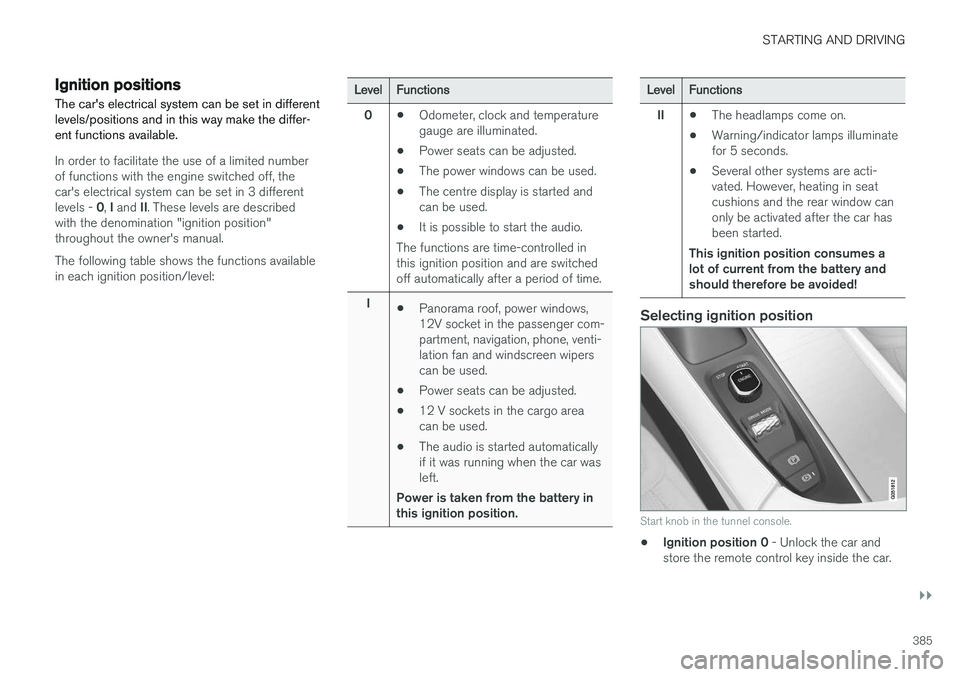
Selecting ignition position
Start knob in the tunnel console.
• Ignition position 0
- Unlock the car and
store the remote control key inside the car.
Page 416 of 594
||
STARTING AND DRIVING
414
IMPORTANT
Engine damage can occur if water enters the air filter. In depths greater than 25 cm, water could enter the transmission. This reduces the lubri-cating ability of the oils and shortens theservice life of these systems. Damage to any component, engine, transmis- sion, turbocharger, differential or its internalcomponents caused by flooding, hydrostaticlocking or oil shortage, is not covered by thewarranty. In the event of the engine stalling in water, do not try restart - tow the car from the water toa workshop - an authorised Volvo workshop isrecommended. Risk of engine breakdown.
Related information
•Towing (p. 431)
• Recovering the car (p. 432)
Overheating in the engine and drive system
Under special conditions, for example hard driv- ing in hilly terrain and hot climate, there is a riskthat the engine and drive system may overheat -in particular with a heavy load.
• In the event of overheating, the engine's power may be limited temporarily.
• Remove any auxiliary lamps from in front ofthe grille when driving in hot climates.
• If the temperature in the engine's coolingsystem becomes too high then a warningsymbol is illuminated and the driver display shows the message
Engine temperature
High temperature Stop safely. Stop the
car in a safe way and allow the engine to run at idling speed for several minutes and cooldown.
• If the message
Engine temperature High
temperature Turn off engine or Engine
coolant Level low, turn off engine is
shown, stop the car and switch off the engine.
• In the event of overheating in the gearbox, analternative gear shift program will beselected. In addition, a built-in protectionfunction is activated that, amongst otherthings, illuminates a warning symbol and thedriver display shows the message
Transmission warm Reduce speed to
lower temperature or Transmission hot Stop safely, wait for cooling
. Follow the
recommendation given, reduce speed or stop the car in a safe way and allow the engine torun at idling speed for several minutes toenable the gearbox to cool down.
• If the car overheats, the air conditioning maybe switched off temporarily.
• Do not turn the engine off immediately youstop after a hard drive.
NOTE
It is normal for the engine's cooling fan to operate for a time after the engine has beenswitched off.
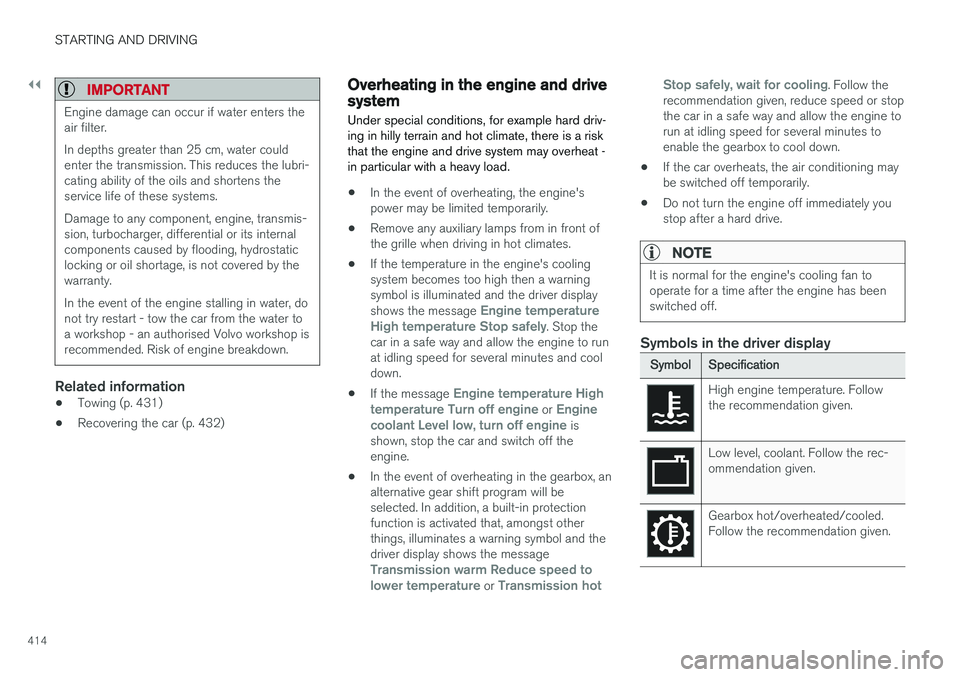
Symbols in the driver display
Symbol
Specification
High engine temperature. Follow the recommendation given.
Low level, coolant. Follow the rec- ommendation given.
Gearbox hot/overheated/cooled. Follow the recommendation given.
Page 498 of 594
||
WHEELS AND TYRES
* Option/accessory.
496
WARNING
Check that the jack is not damaged, that the threads are thoroughly lubricated and that it isfree from dirt.
3. Take out the jack *, wheel wrench * and tools
for the wheel bolts' plastic caps that are fitted in the foam block.
Tool for removing the plastic caps on the wheel bolts.
NOTE
The normal car jack is only designed for occa- sional, short-term use, such as when chang-ing a wheel after a puncture, changing to win-ter/summer wheels, etc. Only the jack for thespecific car model may be used to raise thecar. If the car is to be jacked up more often, orfor a longer time than is required just tochange a wheel, use of a garage jack is rec-ommended. In this instance, follow theinstructions for use that come with the equip-ment.
4. Place chocks in front of and behind the wheels which will remain on the ground to prevent them from rolling. Use heavy woodenblocks or large stones for example.
5. Screw together the towing eye with the wheel wrench * to the stop position.
IMPORTANT
The towing eye must be screwed all the way into the wheel bolt wrench.
6. Remove the plastic caps from the wheel
bolts with the intended tool.
7. Loosen the wheel bolts ½-1 turn anticlock- wise with the wheel wrench *.
WARNING
Never position anything between the ground and the jack, nor between the jack and thecar's jacking point.
IMPORTANT
The ground must be firm, smooth and level.
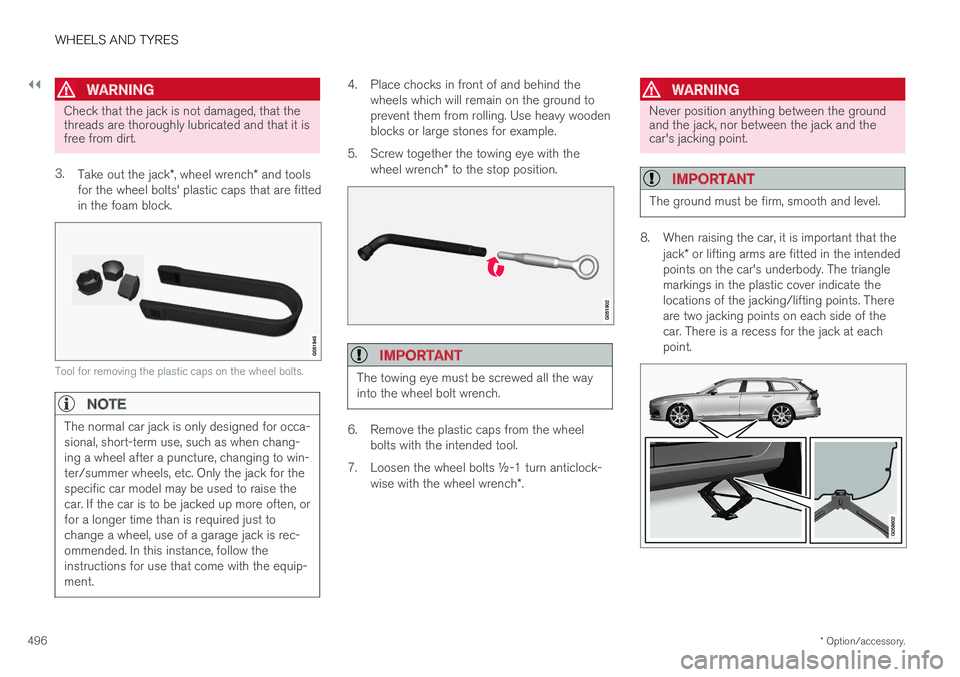
8. When raising the car, it is important that the
jack* or lifting arms are fitted in the intended
points on the car's underbody. The triangle markings in the plastic cover indicate thelocations of the jacking/lifting points. Thereare two jacking points on each side of thecar. There is a recess for the jack at eachpoint.
Page 516 of 594
MAINTENANCE AND SERVICE
514
Opening and closing the bonnet
The bonnet can be opened using the handle in the passenger compartment and a handle underthe bonnet.
Open the bonnet
Pull the handle near the foot pedals to release the bonnet from its fully closed posi-tion.
Turn the handle under the bonnet anticlock- wise to release the bonnet from the lockcatches and lift the bonnet.
Warning - bonnet not closed
When the bonnet is released, the warn- ing symbol and the graphics in thedriver display will light up and anacoustic reminder will sound. If the car
starts rolling, an acoustic warning signal willrepeat. For more information on graphics, see section "Door and seatbelt reminder".
NOTE
If the warning symbol is lit or the warning sig- nal is heard despite the bonnet being closedproperly, contact an authorised Volvo work-shop.
Close the bonnet1. Push the bonnet down until it starts to fall from its own weight.
2. When the bonnet stops against the lock catch, push the bonnet to close it completely.
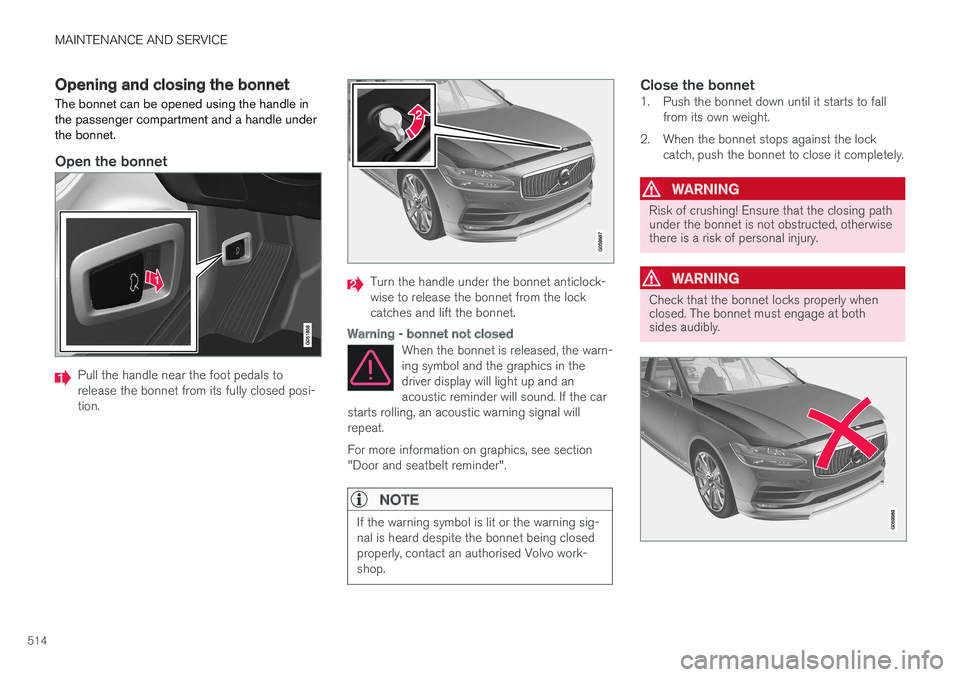
WARNING
Risk of crushing! Ensure that the closing path under the bonnet is not obstructed, otherwisethere is a risk of personal injury.
WARNING
Check that the bonnet locks properly when closed. The bonnet must engage at bothsides audibly.
Page 527 of 594
MAINTENANCE AND SERVICE
525
Related information
•Bulb replacement (p. 520)
• Bulb specifications (p. 526)
Replacing the reversing lamp bulb
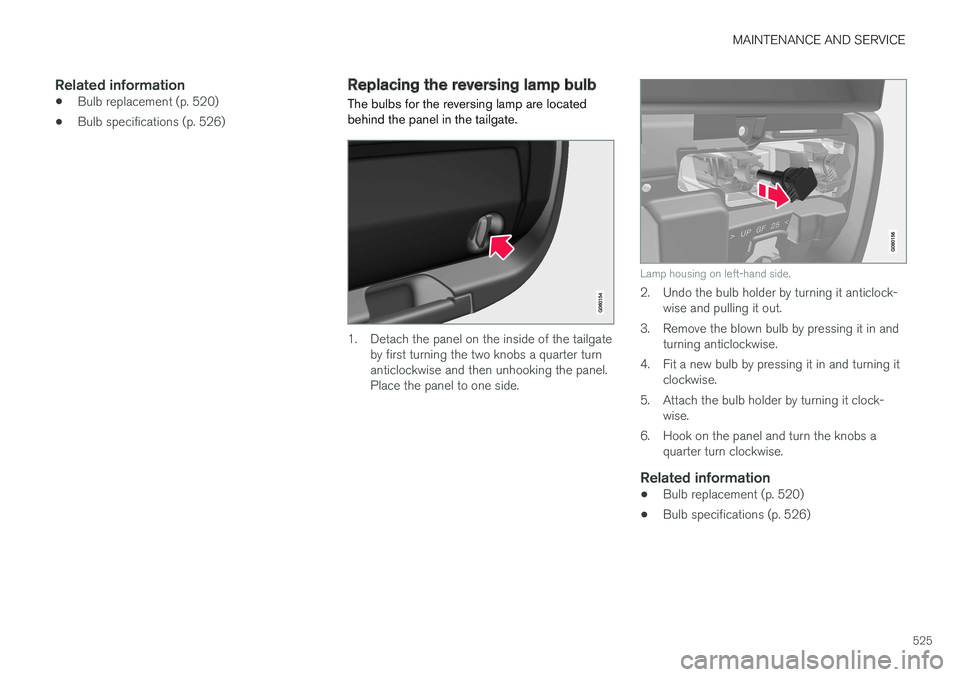
The bulbs for the reversing lamp are located behind the panel in the tailgate.
1. Detach the panel on the inside of the tailgate by first turning the two knobs a quarter turn anticlockwise and then unhooking the panel.Place the panel to one side.
Lamp housing on left-hand side.
2. Undo the bulb holder by turning it anticlock- wise and pulling it out.
3. Remove the blown bulb by pressing it in and turning anticlockwise.
4. Fit a new bulb by pressing it in and turning it clockwise.
5. Attach the bulb holder by turning it clock- wise.
6. Hook on the panel and turn the knobs a quarter turn clockwise.
Related information
• Bulb replacement (p. 520)
• Bulb specifications (p. 526)
Page 528 of 594
MAINTENANCE AND SERVICE
526
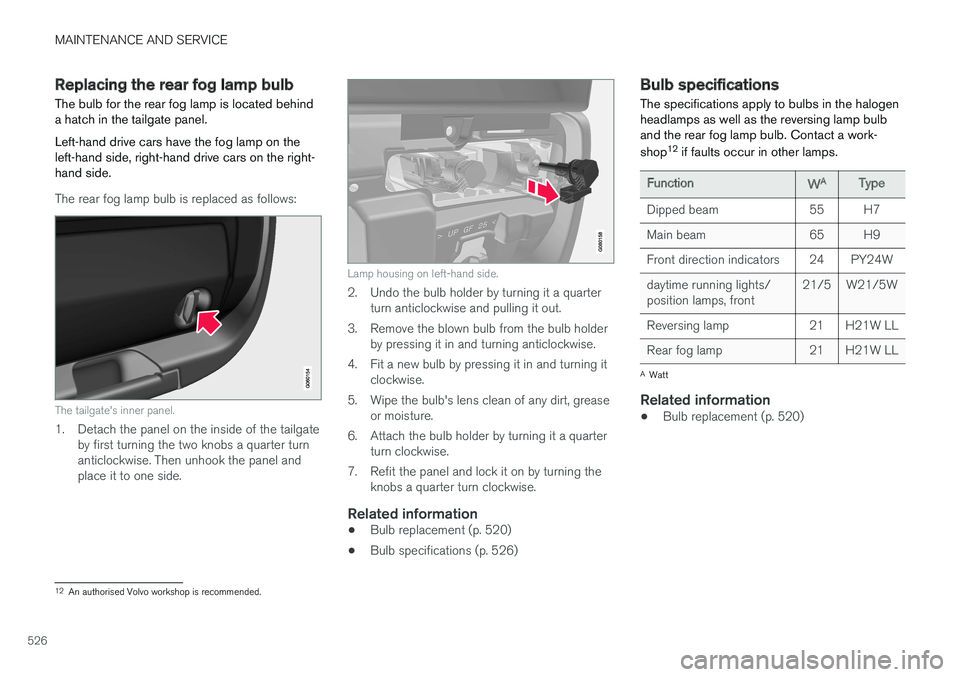
Replacing the rear fog lamp bulb The bulb for the rear fog lamp is located behind a hatch in the tailgate panel. Left-hand drive cars have the fog lamp on the left-hand side, right-hand drive cars on the right-hand side.
The rear fog lamp bulb is replaced as follows:
The tailgate's inner panel.
1. Detach the panel on the inside of the tailgateby first turning the two knobs a quarter turn anticlockwise. Then unhook the panel andplace it to one side.
Lamp housing on left-hand side.
2. Undo the bulb holder by turning it a quarterturn anticlockwise and pulling it out.
3. Remove the blown bulb from the bulb holder by pressing it in and turning anticlockwise.
4. Fit a new bulb by pressing it in and turning it clockwise.
5. Wipe the bulb's lens clean of any dirt, grease or moisture.
6. Attach the bulb holder by turning it a quarter turn clockwise.
7. Refit the panel and lock it on by turning the knobs a quarter turn clockwise.
Related information
• Bulb replacement (p. 520)
• Bulb specifications (p. 526)
Bulb specifications The specifications apply to bulbs in the halogen headlamps as well as the reversing lamp bulband the rear fog lamp bulb. Contact a work- shop 12
if faults occur in other lamps.
Function WA
Type
Dipped beam 55 H7
Main beam 65 H9
Front direction indicators 24 PY24Wdaytime running lights/ position lamps, front 21/5 W21/5W
Reversing lamp 21 H21W LL
Rear fog lamp 21 H21W LL
A Watt
Related information
• Bulb replacement (p. 520)
12
An authorised Volvo workshop is recommended.