fuel consumption VOLVO V90 2017 User Guide
[x] Cancel search | Manufacturer: VOLVO, Model Year: 2017, Model line: V90, Model: VOLVO V90 2017Pages: 594, PDF Size: 15.07 MB
Page 405 of 594
STARTING AND DRIVING
}}
* Option/accessory.403
In the centre display's function view
A car without drive mode con- trol has a function button for
Driving mode ECO in the
centre display's function view.
–Press the button in order to activate the function.
> An indicator in the button illuminates when the function is activated.
Freewheel function Eco Coast 10The freewheel function Eco Coast means in prac- tice that engine braking ceases, meaning in turnthat the car's kinetic energy is used to freewheelfor longer distances. When the driver releasesthe accelerator pedal the gearbox is automaticallydisengaged from the engine whose speed isreduced to idling speed with reduced consump-tion. The function is best used where it is possible to freewheel a long way, e.g. roads with a slightdownhill gradient or when there is a predictablespeed reduction to freewheel into a zone with alower speed limit.
Activating the freewheel function
The function is activated when the accelerator pedal is fully released, in combination with thefollowing parameters:
• Drive mode
Eco is activated.
• The gear selector is in
D position.
• Speed within the range of approx. 65-140 km/h (40-87 mph).
• The road's downhill gradient is not steeperthan approx. 6%.
The driver display shows
COASTING when the
freewheel function is being used.
Limitations
The freewheel function is not available if:
• Engine and/or gearbox are not at normal operating temperature.
• The cruise control is activated.
• The gear selector is moved from the
D posi-
tion and the manual position.
• The speed is outside the range ofapprox. 65-140 km/h (40-87 mph).
• The road's downhill gradient is steeper thanapprox. 6%.
• Manual gear changing is performed with the steering wheel paddles
*.
Deactivating and switching off the freewheel function
In certain situations it may be desirable to deacti- vate or switch off the function in order to useengine braking. Examples of such situations maybe on steep downhill gradients or before animminent overtaking manoeuvre - in order to beable to do it in the safest way possible. Deactivate the freewheel function as follows:
• Actuate the accelerator or brake pedal.
• Move the gear selector to manual position.
• Changing gear with steering wheel paddles
*.
Switch off the freewheel function as follows:
• Change drive mode
*, or switch off the
Driving mode ECO in the function view.
Even without the freewheel function, it is possible to freewheel for short distances. This, in turn,reduces consumption. However, for the best fueleconomy it is better to have the freewheel func-tion activated and be able to freewheel for longerdistances.
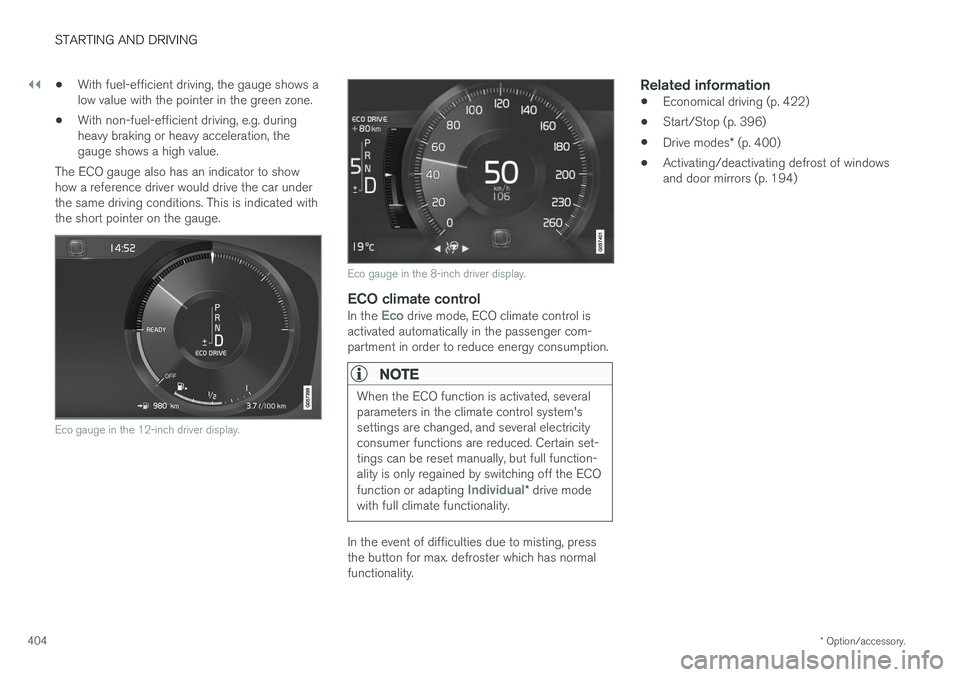
ECO gauge in the driver displayThe ECO gauge indicates how fuel-efficient thedriving is:
10 Only cars with automatic gearbox.
Page 406 of 594
||
STARTING AND DRIVING
* Option/accessory.
404 •
With fuel-efficient driving, the gauge shows a low value with the pointer in the green zone.
• With non-fuel-efficient driving, e.g. duringheavy braking or heavy acceleration, thegauge shows a high value.
The ECO gauge also has an indicator to showhow a reference driver would drive the car underthe same driving conditions. This is indicated withthe short pointer on the gauge.
Eco gauge in the 12-inch driver display.
Eco gauge in the 8-inch driver display.
ECO climate controlIn the Eco drive mode, ECO climate control is
activated automatically in the passenger com- partment in order to reduce energy consumption.
NOTE
When the ECO function is activated, several parameters in the climate control system'ssettings are changed, and several electricityconsumer functions are reduced. Certain set-tings can be reset manually, but full function-ality is only regained by switching off the ECO function or adapting
Individual* drive mode
with full climate functionality.
In the event of difficulties due to misting, press the button for max. defroster which has normalfunctionality.
Related information
• Economical driving (p. 422)
• Start/Stop (p. 396)
• Drive modes
* (p. 400)
• Activating/deactivating defrost of windowsand door mirrors (p. 194)
Page 417 of 594
STARTING AND DRIVING
}}
* Option/accessory.415
Related information
•Driving with a trailer under special conditions (p. 428)
• Preparations for a long trip (p. 415)
Overloading the starter battery
The electrical functions in the car load the starter battery to varying degrees. Avoid using the igni-tion position II when the car is switched off.
Instead, use ignition position I - which uses less
power.
Also, be aware of different accessories that load the electrical system. Do not use functions whichuse a lot of power when the car is switched off.Examples of such functions are:
• ventilation fan
• headlamps
• windscreen wiper
• audio system (high volume).
If the starter battery voltage is low, the message
12 V Battery Low charge, will soon enter
power save mode is shown in the driver display.
The energy-saving function then shuts down cer- tain functions or reduces certain functions suchas the ventilation fan and/or audio system.
–In which case, charge the starter battery by starting the car and then running it for atleast 15 minutes - starter battery charging ismore effective during driving than runningthe engine at idling speed while stationary.
Related information
• Ignition positions (p. 385)
• Starter battery (p. 530)
Preparations for a long trip
Before a driving holiday or some other type of long journey, it is important to check the car'sfunctions and equipment particularly carefully.
Check that:
• the engine is working normally and that fuel consumption is normal
• there are no leaks (fuel, oil or other fluid)
• all bulbs are working
• the tyres have sufficient tread depth andpressure
• a warning triangle and high-visibility vest arelocated in the car - legally required in certaincountries
• the wiper blades are in good condition.
Related information
•
Fuel consumption and CO2 emissions(p. 572)
• Checking the tyre pressures (p. 484)
• Filling washer fluid (p. 529)
• Winter driving (p. 416)
• Economical driving (p. 422)
• Settings for car modem
* (p. 468)
• Loading (p. 227)
• Pilot Assist
* (p. 304)
• Speed limiter
* (p. 277)
Page 420 of 594
||
STARTING AND DRIVING
4184. Do not overfill the tank but fill until the pump
nozzle cuts out the first time.
> The tank is full.
NOTE
Overfilled fuel in the tank can overflow in hot weather.
Filling with a fuel can 14When filling with a fuel can, use the funnel located under the floor hatch in the cargo area.
1. Open the fuel filler flap.
2. Insert the funnel in the fuel filler opening.
The filler pipe has two opening caps. The funnel's pipe must be pushed past both capsbefore filling can be started.
LabelNever use the fuel-driven heater when the car isin a filling station area.
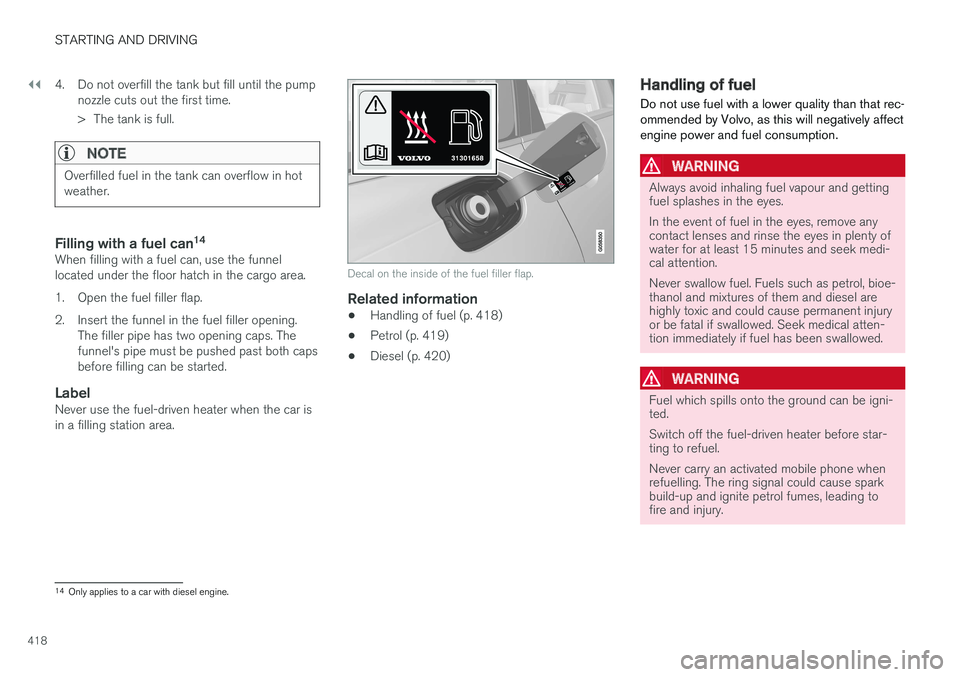
Decal on the inside of the fuel filler flap.
Related information
• Handling of fuel (p. 418)
• Petrol (p. 419)
• Diesel (p. 420)
Handling of fuel
Do not use fuel with a lower quality than that rec- ommended by Volvo, as this will negatively affectengine power and fuel consumption.
WARNING
Always avoid inhaling fuel vapour and getting fuel splashes in the eyes. In the event of fuel in the eyes, remove any contact lenses and rinse the eyes in plenty ofwater for at least 15 minutes and seek medi-cal attention. Never swallow fuel. Fuels such as petrol, bioe- thanol and mixtures of them and diesel arehighly toxic and could cause permanent injuryor be fatal if swallowed. Seek medical atten-tion immediately if fuel has been swallowed.
WARNING
Fuel which spills onto the ground can be igni- ted. Switch off the fuel-driven heater before star- ting to refuel. Never carry an activated mobile phone when refuelling. The ring signal could cause sparkbuild-up and ignite petrol fumes, leading tofire and injury.
14 Only applies to a car with diesel engine.
Page 421 of 594
STARTING AND DRIVING
419
IMPORTANT
Mixtures of various fuel types or use of fuels which are not recommended will invalidateVolvo's guarantees and any supplementaryservice agreements; this is applicable to allengines.
NOTE
Extreme weather conditions, driving with a trailer or driving at high altitudes in combina-tion with fuel grade are factors that couldaffect the car's performance.
Related information
•Petrol (p. 419)
• Diesel (p. 420)
• Opening/closing the fuel filler flap and refu- elling (p. 417)
• Economical driving (p. 422)
Petrol
Petrol is a type of engine fuel that is intended for cars with a petrol engine.
Only use petrol from well-known producers. Never use fuel of dubious quality. The petrol mustfulfil the EN 228 standard.
IMPORTANT
• Fuel that contains up to 10 percent by volume ethanol is permitted.
• EN 228 E10 petrol (max10 percent by volume ethanol) isapproved for use.
• Ethanol higher than E10 (max.10 percent by volume ethanol) is not per-mitted, e.g. E85 is not permitted.
Octane rating
•95 RON can be used for normal driving.
• 98 RON is recommended for optimum per- formance and minimum fuel consumption.
When driving in temperatures above +38 °C, fuelwith the highest possible octane rating is recom-mended for optimum performance and fuel econ-omy.
IMPORTANT
• Use only unleaded petrol to avoid damag- ing the catalytic converter.
• Fuel containing metallic additives mustnot be used.
• Do not use any additives which have notbeen recommended by Volvo.
Related information
•Handling of fuel (p. 418)
• Opening/closing the fuel filler flap and refu- elling (p. 417)
Page 423 of 594
STARTING AND DRIVING
* Option/accessory.421
Points to remember when filling with a fuel can
When filling diesel with a fuel can, use the funnel located under the floor hatch in the cargo area.Make sure you insert the funnel's pipe firmly intothe filler pipe. The filler pipe has an openablecover and the funnel's pipe must be slid past thecover before filling can begin.
Related information
•Diesel (p. 420)
• Fuel consumption and CO2 emissions(p. 572)
Diesel particulate filter Diesel-driven cars are equipped with a particu- late filter, which results in more efficient emis-sion control.
The particles in the exhaust gases are collected in the filter during normal driving. So-called"regeneration" is started in order to burn awaythe particles and empty the filter. This requiresthe engine to have reached normal operatingtemperature. Regeneration of the particulate filter is automatic and normally takes 10-20 minutes. It may take alittle longer at a low average speed. Fuel con-sumption may increase slightly during regenera-tion.
Regeneration in cold weatherIf the car is frequently driven short distances incold weather then the engine does not reachnormal operating temperature. This means thatregeneration of the diesel particulate filter doesnot take place and the filter is not emptied. When the filter has become approx. 80% full of particles, a yellow warning triangle illuminates, and the message
Particulate filter full See
Owner's manual is shown in the driver display.
Start regeneration of the filter by driving the car until the engine reaches normal operating tem-perature, preferably on a main road or motorway. The car should then be driven for approximately20 minutes more.
NOTE
The following may arise during regeneration:
• a smaller reduction of engine power may be noticed temporarily
• fuel consumption may increase temporar-ily
• a smell of burning may arise.
When regeneration is complete the warning text is cleared automatically. Use the parking heater
* in cold weather - the
engine then reaches normal operating tempera- ture more quickly.
IMPORTANT
If the filter is completely filled with particles, it may be difficult to start the engine and the fil-ter is non-functional. Then there is a risk thatthe filter will need to be replaced.
Related information
• Diesel (p. 420)
Page 424 of 594
STARTING AND DRIVING
* Option/accessory.
422
Economical driving
Drive economically and eco-consciously by driv- ing smoothly, thinking ahead, and adjusting yourdriving style and speed to the prevailing condi-tions.
• For lower fuel consumption, activate ECO drive mode.
• Use the Eco Coast 17
freewheel function -
engine braking will cease and the car'skinetic energy can be used to freewheel forlonger distances.
• Drive in the highest gear 18
possible, adapted
to the current traffic situation and road -lower engine speeds result in lower fuel con-sumption. Use the gear shift indicator.
• Drive at a steady speed and keep a good dis-tance to other vehicles and objects to mini-mise braking.
• High speed results in increased fuel con-sumption - the wind resistance increaseswith speed.
• Do not run the engine to operating tempera-ture at idling speed, but rather drive with anormal load right after starting - a coldengine consumes more fuel than a warmone. •
Drive with the correct air pressure in thetyres and check this regularly - select ECOtyre pressure for best results.
• Choice of tyres can affect fuel consumption -seek advice on suitable tyres from a dealer.
• Remove unnecessary items from the car -the greater the load the higher the consump-tion.
• Use engine braking to slow down, when itcan take place without risk to other roadusers.
• A roof load and space box increase windresistance, leading to higher consumption -remove the load carriers when not in use.
• Avoid driving with open windows.
WARNING
Never switch off the engine while moving, such as downhill, this deactivates importantsystems such as the power steering andbrake servo.
Related information
•
Drive mode ECO (p. 402)
• Approved tyre pressures (p. 574)
• Fuel consumption and CO2 emissions (p. 572)
• Drive-E - cleaner driving pleasure (p. 25)
Towing bracket
*
The car can be equipped with a towing bracket that makes it possible to tow e.g. a trailer afterthe car.
There may be different towing bracket variants available for the car; contact a Volvo dealer formore information. For information on towing capacity and towball load, see the section "Towing capacity and tow-ball load".
IMPORTANT
When the engine is switched off, the constant battery voltage to the trailer connector can beswitched off automatically so as not to drainthe starter battery.
IMPORTANT
The towball needs regular cleaning and lubri- cation with grease in order to prevent wear.
17 See the section "Drive mode ECO".
18 Applies to driving with manual gear changing.
Page 428 of 594
STARTING AND DRIVING
426
Driving with a trailer
When driving with a trailer, there are a number of points that are important to think about regar-ding the towing bracket, the trailer and how theload is positioned in the trailer.
Payload depends on the car's kerb weight. The total of the weight of the passengers and allaccessories, e.g. towbar, reduces the car's pay-load by a corresponding weight. The car is supplied with the necessary equipment for towing a trailer.
• The car's towing bracket must be of anapproved type.
• Distribute the load on the trailer so that theweight on the towing bracket complies withthe specified maximum towball load. Towballload is calculated as part of the car's payload.
• Increase the tyre pressure to the recom-mended pressure for a full load. For moreinformation on tyre pressure, see the section"Approved tyre pressures".
• The engine is loaded more heavily than usualwhen driving with a trailer.
• Do not tow a heavy trailer when the car isbrand new. Wait until it has been driven atleast 1000 km.
• The brakes are loaded much more than usualon long and steep downhill slopes. Downshiftto a lower gear and adjust your speed. •
Follow the regulations in force for the permit-ted speeds and weights.
• Maintain a low speed when driving with atrailer up long, steep ascents.
• The maximum trailer weights given only applyto altitudes up to 1000 metres above sealevel. At higher altitudes, engine power andthus the car's climbing ability is decreaseddue to the reduced air density, and the maxi-mum trailer weight must therefore bereduced. The weight of the car and trailermust be decreased by 10 % for each addi-tional 1000 m (or part thereof).
• Avoid driving with a trailer on inclines of morethan 12%.
NOTE
Extreme weather conditions, driving with a trailer or driving at high altitudes in combina-tion with fuel quality are factors that consider-ably increase the car's fuel consumption.
Trailer connectorAn adapter is required if the car's towing bracket has a 13 pin connector and the trailer has a 7 pinconnector. Use an adapter approved by Volvo.Make sure the cable does not drag on theground.
IMPORTANT
When the engine is switched off, the constant battery voltage to the trailer connector can beswitched off automatically so as not to drainthe starter battery.
Trailer weightsInformation about Volvo's permitted trailer weights is available in the article "Towingcapacity and towball load".
WARNING
Follow the stated recommendations for trailer weights. Otherwise, the car and trailer may bedifficult to control in the event of suddenmovement and braking.
NOTE
The stated maximum permitted trailer weights are those permitted by Volvo. National vehicleregulations can further limit trailer weightsand speeds. Towbars can be certified forhigher towing weights than the car canactually tow.
Direction indicators and brake lights on the trailer
If one or more of the trailer's direction indicators or brake light bulbs is broken, the driver display
Page 484 of 594
WHEELS AND TYRES
482
TyresAmongst other things, the function of the tyres is to carry load, provide grip on the road surface,dampen vibration and protect the wheel fromwear.
The tyres greatly affect the car's driving characte- ristics. The type of tyre, dimensions, tyre pressureand speed rating are important for how the carperforms.
Recommended tyresOn delivery, the car is equipped with Volvo origi- nal tyres that have the VOL 1
marking on the side
of the tyres. These tyres are carefully adapted to the car. In the event of changing tyres, it is there-fore important that the new tyres also have thismarking in order for the car's driving characteris-tics, comfort and fuel consumption to be main-tained.
New tyres
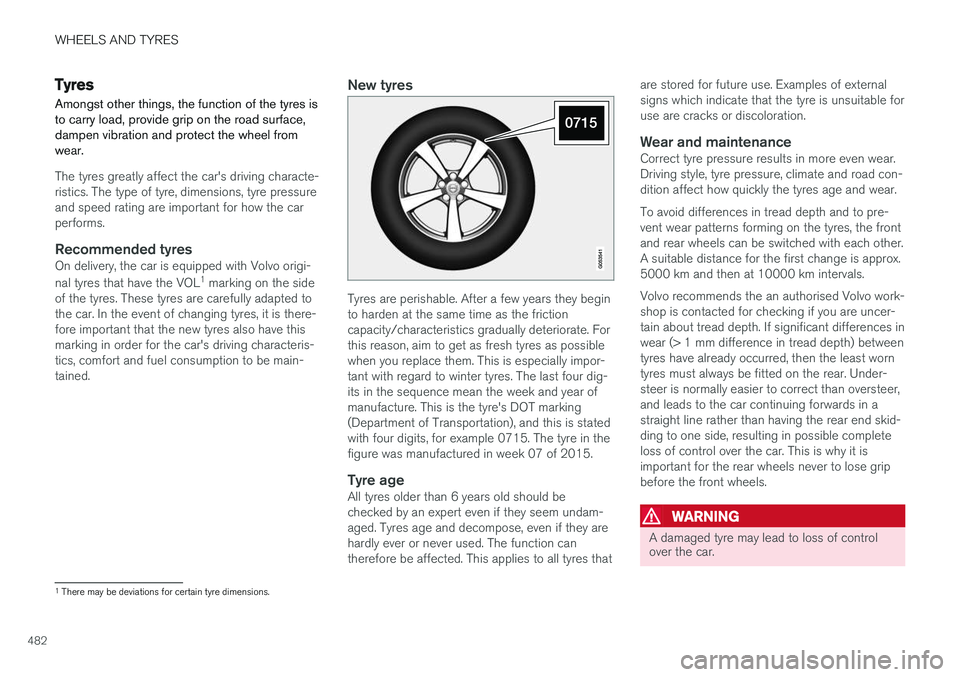
Tyres are perishable. After a few years they begin to harden at the same time as the frictioncapacity/characteristics gradually deteriorate. Forthis reason, aim to get as fresh tyres as possiblewhen you replace them. This is especially impor-tant with regard to winter tyres. The last four dig-its in the sequence mean the week and year ofmanufacture. This is the tyre's DOT marking(Department of Transportation), and this is statedwith four digits, for example 0715. The tyre in thefigure was manufactured in week 07 of 2015.
Tyre ageAll tyres older than 6 years old should bechecked by an expert even if they seem undam-aged. Tyres age and decompose, even if they arehardly ever or never used. The function cantherefore be affected. This applies to all tyres that are stored for future use. Examples of externalsigns which indicate that the tyre is unsuitable foruse are cracks or discoloration.
Wear and maintenanceCorrect tyre pressure results in more even wear.Driving style, tyre pressure, climate and road con-dition affect how quickly the tyres age and wear. To avoid differences in tread depth and to pre- vent wear patterns forming on the tyres, the frontand rear wheels can be switched with each other.A suitable distance for the first change is approx.5000 km and then at 10000 km intervals. Volvo recommends the an authorised Volvo work- shop is contacted for checking if you are uncer-tain about tread depth. If significant differences inwear (> 1 mm difference in tread depth) betweentyres have already occurred, then the least worntyres must always be fitted on the rear. Under-steer is normally easier to correct than oversteer,and leads to the car continuing forwards in astraight line rather than having the rear end skid-ding to one side, resulting in possible completeloss of control over the car. This is why it isimportant for the rear wheels never to lose gripbefore the front wheels.
WARNING
A damaged tyre may lead to loss of control over the car.
1
There may be deviations for certain tyre dimensions.
Page 486 of 594
WHEELS AND TYRES
484
Tread wear indicators on the tyres Tread wear indicators show the status of the tyre's tread depth.
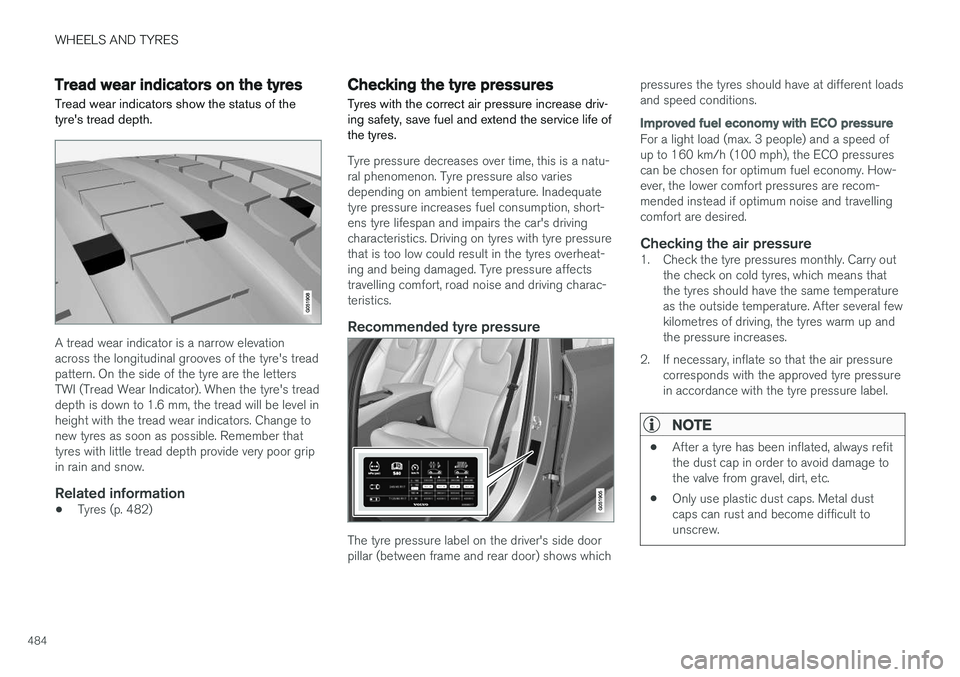
A tread wear indicator is a narrow elevation across the longitudinal grooves of the tyre's treadpattern. On the side of the tyre are the lettersTWI (Tread Wear Indicator). When the tyre's treaddepth is down to 1.6 mm, the tread will be level inheight with the tread wear indicators. Change tonew tyres as soon as possible. Remember thattyres with little tread depth provide very poor gripin rain and snow.
Related information
•Tyres (p. 482)
Checking the tyre pressures Tyres with the correct air pressure increase driv- ing safety, save fuel and extend the service life ofthe tyres.
Tyre pressure decreases over time, this is a natu- ral phenomenon. Tyre pressure also variesdepending on ambient temperature. Inadequatetyre pressure increases fuel consumption, short-ens tyre lifespan and impairs the car's drivingcharacteristics. Driving on tyres with tyre pressurethat is too low could result in the tyres overheat-ing and being damaged. Tyre pressure affectstravelling comfort, road noise and driving charac-teristics.
Recommended tyre pressure
The tyre pressure label on the driver's side door pillar (between frame and rear door) shows which pressures the tyres should have at different loadsand speed conditions.
Improved fuel economy with ECO pressure
For a light load (max. 3 people) and a speed of up to 160 km/h (100 mph), the ECO pressurescan be chosen for optimum fuel economy. How-ever, the lower comfort pressures are recom-mended instead if optimum noise and travellingcomfort are desired.
Checking the air pressure1. Check the tyre pressures monthly. Carry out
the check on cold tyres, which means thatthe tyres should have the same temperatureas the outside temperature. After several fewkilometres of driving, the tyres warm up andthe pressure increases.
2. If necessary, inflate so that the air pressure corresponds with the approved tyre pressurein accordance with the tyre pressure label.
NOTE
• After a tyre has been inflated, always refit the dust cap in order to avoid damage tothe valve from gravel, dirt, etc.
• Only use plastic dust caps. Metal dustcaps can rust and become difficult tounscrew.