ignition VOLVO V90 2017 User Guide
[x] Cancel search | Manufacturer: VOLVO, Model Year: 2017, Model line: V90, Model: VOLVO V90 2017Pages: 594, PDF Size: 15.07 MB
Page 137 of 594
INSTRUMENTS AND CONTROLS
}}
* Option/accessory.135
WARNING
The car's audio system is not able to deter- mine when daylight is too weak or sufficientlystrong, e.g. in fog and rain, in all situations. The driver is always responsible for ensuring that the car is driven with a beam pattern suit-able for the traffic situation and in accordancewith applicable traffic regulations.
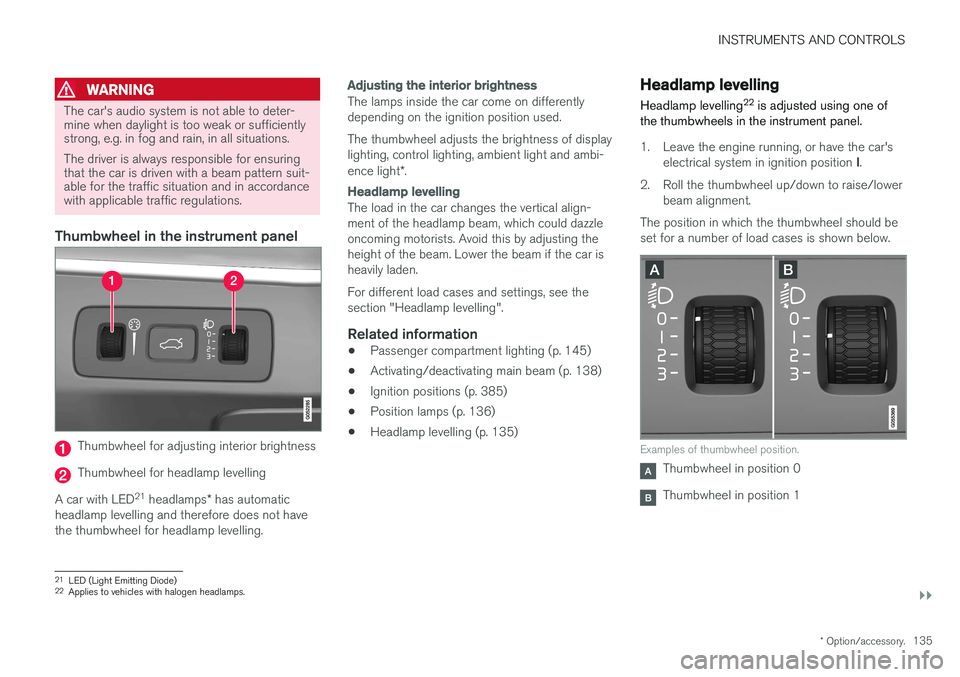
Thumbwheel in the instrument panel
Thumbwheel for adjusting interior brightness
Thumbwheel for headlamp levelling
A car with LED 21
headlamps * has automatic
headlamp levelling and therefore does not have the thumbwheel for headlamp levelling.
Adjusting the interior brightness
The lamps inside the car come on differently depending on the ignition position used. The thumbwheel adjusts the brightness of display lighting, control lighting, ambient light and ambi- ence light *.
Headlamp levelling
The load in the car changes the vertical align- ment of the headlamp beam, which could dazzleoncoming motorists. Avoid this by adjusting theheight of the beam. Lower the beam if the car isheavily laden. For different load cases and settings, see the section "Headlamp levelling".
Related information
• Passenger compartment lighting (p. 145)
• Activating/deactivating main beam (p. 138)
• Ignition positions (p. 385)
• Position lamps (p. 136)
• Headlamp levelling (p. 135)
Headlamp levelling
Headlamp levelling 22
is adjusted using one of
the thumbwheels in the instrument panel.
1. Leave the engine running, or have the car's
electrical system in ignition position I.
2. Roll the thumbwheel up/down to raise/lower beam alignment.
The position in which the thumbwheel should be set for a number of load cases is shown below.
Examples of thumbwheel position.
Thumbwheel in position 0
Thumbwheel in position 1
21 LED (Light Emitting Diode)
22 Applies to vehicles with halogen headlamps.
Page 138 of 594
||
INSTRUMENTS AND CONTROLS
136
Load caseThumb- wheelposition
Only driver. 0 Driver and passenger in the front passenger seat. 0
Driver and passenger in the frontpassenger seat. Three passengers in the rear seat. 1
Driver and passenger in the frontpassenger seat. Three passengers in the rear seat. 220 kg load in the cargo area. 1
Driver and maximum load in the cargo area. 2
Related information
•
Headlamp control (p. 134)
Position lamps
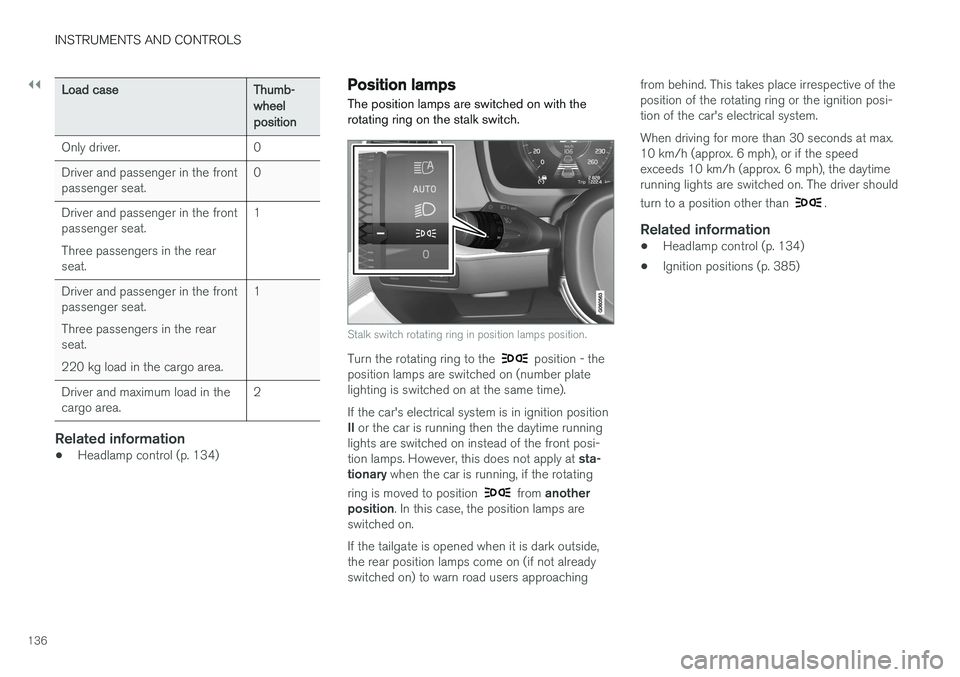
The position lamps are switched on with the rotating ring on the stalk switch.
Stalk switch rotating ring in position lamps position.
Turn the rotating ring to the position - the
position lamps are switched on (number plate lighting is switched on at the same time). If the car's electrical system is in ignition position II or the car is running then the daytime running
lights are switched on instead of the front posi-tion lamps. However, this does not apply at sta-
tionary when the car is running, if the rotating
ring is moved to position
from another
position . In this case, the position lamps are
switched on. If the tailgate is opened when it is dark outside, the rear position lamps come on (if not alreadyswitched on) to warn road users approaching from behind. This takes place irrespective of theposition of the rotating ring or the ignition posi-tion of the car's electrical system. When driving for more than 30 seconds at max. 10 km/h (approx. 6 mph), or if the speedexceeds 10 km/h (approx. 6 mph), the daytimerunning lights are switched on. The driver should turn to a position other than
.
Related information
•
Headlamp control (p. 134)
• Ignition positions (p. 385)
Page 139 of 594
INSTRUMENTS AND CONTROLS
}}
* Option/accessory.137
Daytime running lights The daytime running lights are switched on when the rotating ring on the stalk switch is in position
, or as well as when
the car's electrical system is in ignition position II
or when the car is running. For the
posi-
tion, this only applies in daylight. In weak daylight or darkness, dipped beam is switched oninstead.
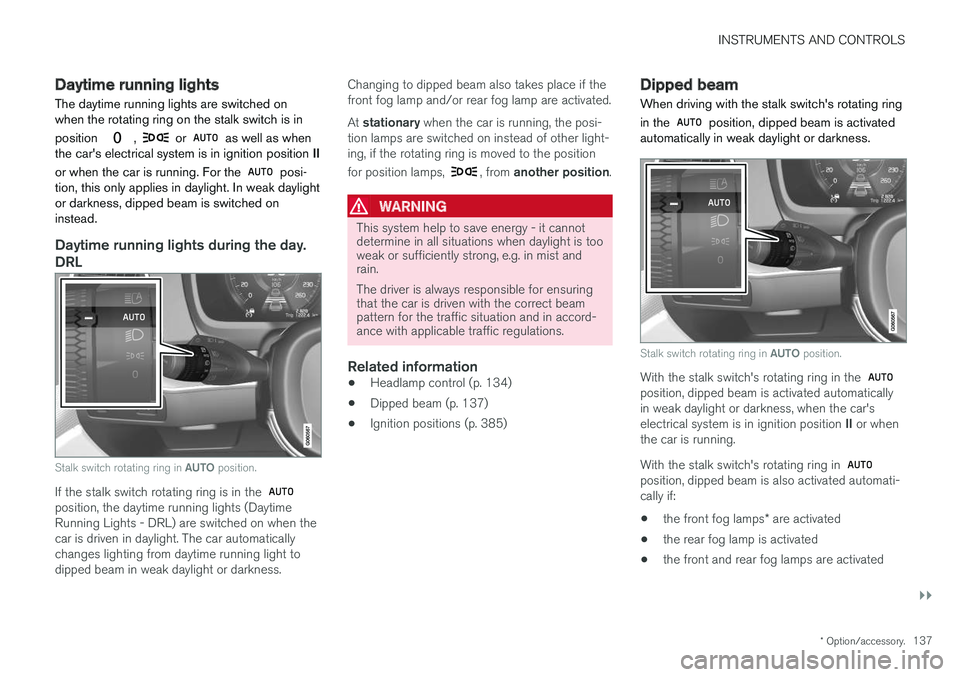
Daytime running lights during the day.
DRL
Stalk switch rotating ring in AUTO position.
If the stalk switch rotating ring is in the position, the daytime running lights (Daytime Running Lights - DRL) are switched on when thecar is driven in daylight. The car automaticallychanges lighting from daytime running light todipped beam in weak daylight or darkness. Changing to dipped beam also takes place if thefront fog lamp and/or rear fog lamp are activated. At
stationary when the car is running, the posi-
tion lamps are switched on instead of other light- ing, if the rotating ring is moved to the position for position lamps,
, from another position .
WARNING
This system help to save energy - it cannot determine in all situations when daylight is tooweak or sufficiently strong, e.g. in mist andrain. The driver is always responsible for ensuring that the car is driven with the correct beampattern for the traffic situation and in accord-ance with applicable traffic regulations.
Related information
•Headlamp control (p. 134)
• Dipped beam (p. 137)
• Ignition positions (p. 385)
Dipped beam
When driving with the stalk switch's rotating ring in the
position, dipped beam is activated
automatically in weak daylight or darkness.
Stalk switch rotating ring in AUTO position.
With the stalk switch's rotating ring in the position, dipped beam is activated automatically in weak daylight or darkness, when the car's electrical system is in ignition position II or when
the car is running. With the stalk switch's rotating ring in
position, dipped beam is also activated automati- cally if:
• the front fog lamps
* are activated
• the rear fog lamp is activated
• the front and rear fog lamps are activated
Page 140 of 594
||
INSTRUMENTS AND CONTROLS
138Dipped beam is always switched on when the rotating ring on the stalk switch is in position
when the car's electrical system is in igni-
tion position II or when the car is running.
Tunnel detection
The car detects when it is driven into a tunnel and switches from daytime running lights todipped beam. Note that the rotating ring in the left-hand stalk switch must be in
mode for tunnel detec-
tion to work.
Related information
• Daytime running lights (p. 137)
• Headlamp control (p. 134)
• Ignition positions (p. 385)
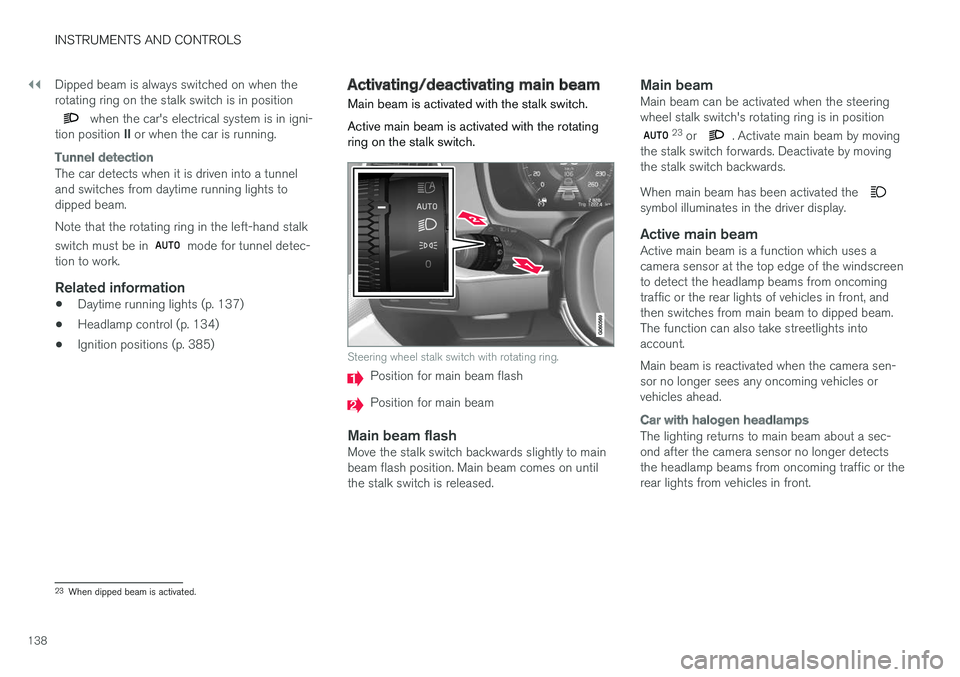
Activating/deactivating main beam Main beam is activated with the stalk switch. Active main beam is activated with the rotating ring on the stalk switch.
Steering wheel stalk switch with rotating ring.
Position for main beam flash
Position for main beam
Main beam flashMove the stalk switch backwards slightly to main beam flash position. Main beam comes on untilthe stalk switch is released.
Main beamMain beam can be activated when the steeringwheel stalk switch's rotating ring is in position
23
or . Activate main beam by moving
the stalk switch forwards. Deactivate by moving the stalk switch backwards. When main beam has been activated the
symbol illuminates in the driver display.
Active main beamActive main beam is a function which uses a camera sensor at the top edge of the windscreento detect the headlamp beams from oncomingtraffic or the rear lights of vehicles in front, andthen switches from main beam to dipped beam.The function can also take streetlights intoaccount. Main beam is reactivated when the camera sen- sor no longer sees any oncoming vehicles orvehicles ahead.
Car with halogen headlamps
The lighting returns to main beam about a sec- ond after the camera sensor no longer detectsthe headlamp beams from oncoming traffic or therear lights from vehicles in front.
23 When dipped beam is activated.
Page 144 of 594
INSTRUMENTS AND CONTROLS
* Option/accessory.
142
Front fog lamps/cornering lights *
The front fog lamps have cornering lights that shine diagonally to the side.
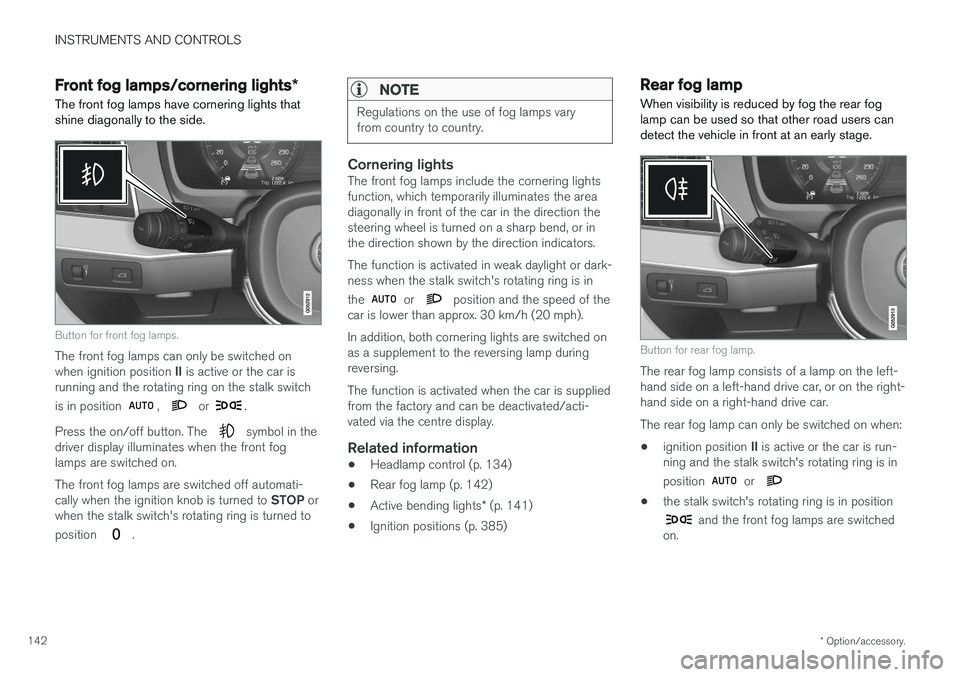
Button for front fog lamps.
The front fog lamps can only be switched on when ignition position II is active or the car is
running and the rotating ring on the stalk switch is in position
, or .
Press the on/off button. The
symbol in the
driver display illuminates when the front fog lamps are switched on. The front fog lamps are switched off automati- cally when the ignition knob is turned to STOP or
when the stalk switch's rotating ring is turned to position
.
NOTE
Regulations on the use of fog lamps vary from country to country.
Cornering lightsThe front fog lamps include the cornering lights function, which temporarily illuminates the areadiagonally in front of the car in the direction thesteering wheel is turned on a sharp bend, or inthe direction shown by the direction indicators. The function is activated in weak daylight or dark- ness when the stalk switch's rotating ring is in the
or position and the speed of the
car is lower than approx. 30 km/h (20 mph). In addition, both cornering lights are switched on as a supplement to the reversing lamp duringreversing. The function is activated when the car is supplied from the factory and can be deactivated/acti-vated via the centre display.
Related information
• Headlamp control (p. 134)
• Rear fog lamp (p. 142)
• Active bending lights
* (p. 141)
• Ignition positions (p. 385)
Rear fog lamp
When visibility is reduced by fog the rear fog lamp can be used so that other road users candetect the vehicle in front at an early stage.
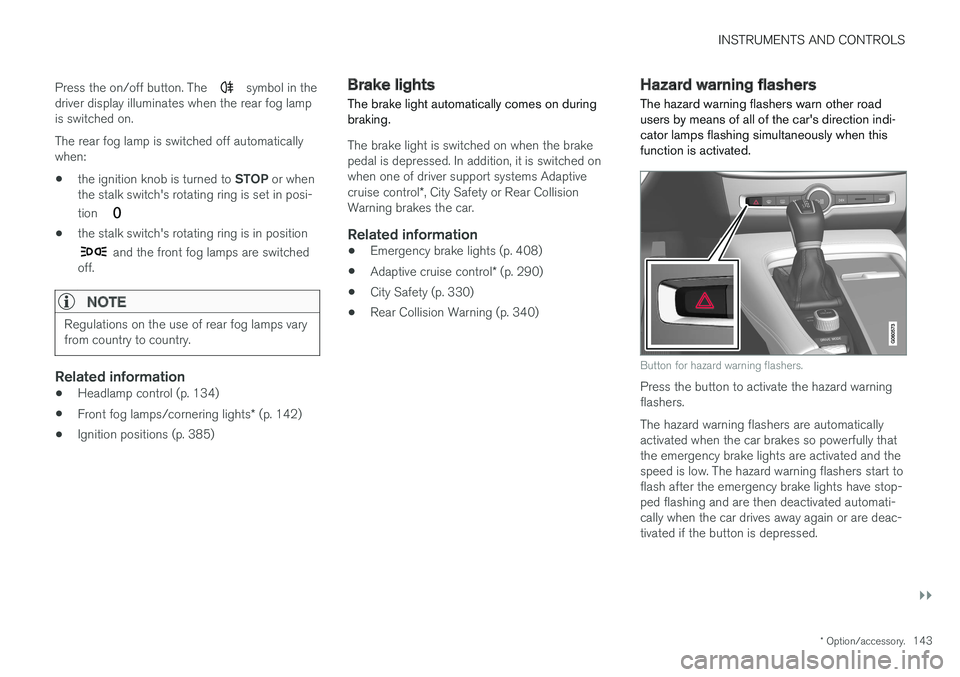
Button for rear fog lamp.
The rear fog lamp consists of a lamp on the left- hand side on a left-hand drive car, or on the right-hand side on a right-hand drive car. The rear fog lamp can only be switched on when:
• ignition position
II is active or the car is run-
ning and the stalk switch's rotating ring is in position
or
• the stalk switch's rotating ring is in position
and the front fog lamps are switched
on.
Page 145 of 594
INSTRUMENTS AND CONTROLS
}}
* Option/accessory.143
Press the on/off button. The
symbol in the
driver display illuminates when the rear fog lamp is switched on. The rear fog lamp is switched off automatically when:
• the ignition knob is turned to
STOP or when
the stalk switch's rotating ring is set in posi- tion
• the stalk switch's rotating ring is in position
and the front fog lamps are switched
off.
NOTE
Regulations on the use of rear fog lamps vary from country to country.
Related information
• Headlamp control (p. 134)
• Front fog lamps/cornering lights
* (p. 142)
• Ignition positions (p. 385)
Brake lights The brake light automatically comes on during braking.
The brake light is switched on when the brake pedal is depressed. In addition, it is switched onwhen one of driver support systems Adaptive cruise control
*, City Safety or Rear Collision
Warning brakes the car.
Related information
• Emergency brake lights (p. 408)
• Adaptive cruise control
* (p. 290)
• City Safety (p. 330)
• Rear Collision Warning (p. 340)
Hazard warning flashers
The hazard warning flashers warn other road users by means of all of the car's direction indi-cator lamps flashing simultaneously when thisfunction is activated.
Button for hazard warning flashers.
Press the button to activate the hazard warning flashers. The hazard warning flashers are automatically activated when the car brakes so powerfully thatthe emergency brake lights are activated and thespeed is low. The hazard warning flashers start toflash after the emergency brake lights have stop-ped flashing and are then deactivated automati-cally when the car drives away again or are deac-tivated if the button is depressed.
Page 147 of 594
INSTRUMENTS AND CONTROLS
}}
145
Passenger compartment lighting
The passenger compartment lighting is acti- vated/deactivated with the buttons in the over-head controls above the front seats and the rearseat.
All lighting in the passenger compartment can be switched on and off manually within 30 minutesfrom when:
• the car has been switched off and its electri- cal system is in ignition position
0
• the car has been unlocked but it has not been started.
Front lighting
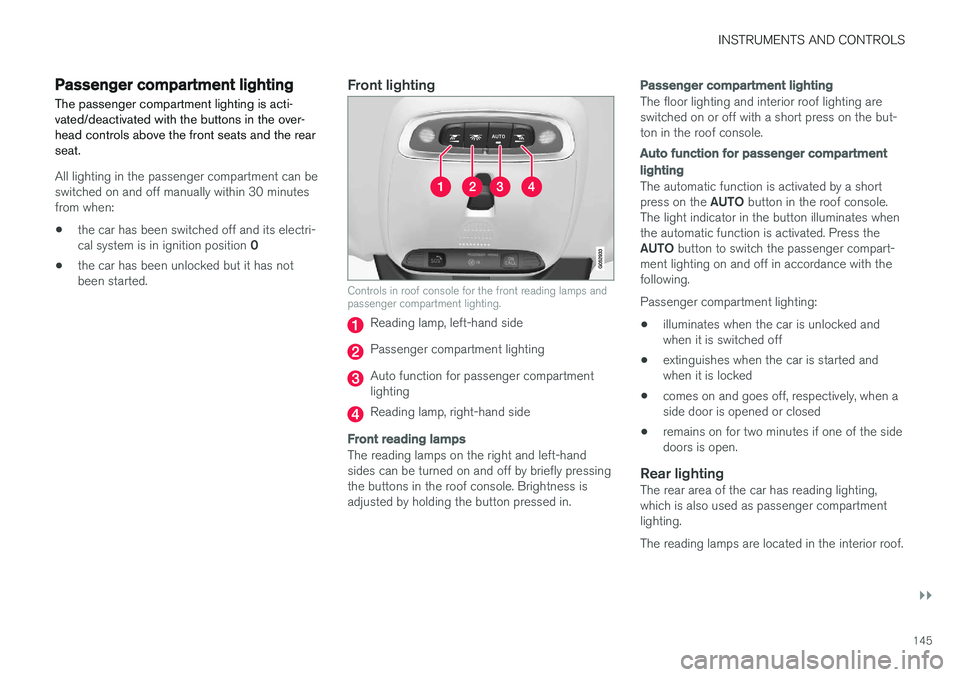
Controls in roof console for the front reading lamps and passenger compartment lighting.
Reading lamp, left-hand side
Passenger compartment lighting
Auto function for passenger compartment lighting
Reading lamp, right-hand side
Front reading lamps
The reading lamps on the right and left-hand sides can be turned on and off by briefly pressingthe buttons in the roof console. Brightness isadjusted by holding the button pressed in.
Passenger compartment lighting
The floor lighting and interior roof lighting are switched on or off with a short press on the but-ton in the roof console.
Auto function for passenger compartment lighting
The automatic function is activated by a short press on the
AUTO button in the roof console.
The light indicator in the button illuminates when the automatic function is activated. Press the AUTO button to switch the passenger compart-
ment lighting on and off in accordance with the following. Passenger compartment lighting: • illuminates when the car is unlocked and when it is switched off
• extinguishes when the car is started andwhen it is locked
• comes on and goes off, respectively, when aside door is opened or closed
• remains on for two minutes if one of the sidedoors is open.
Rear lightingThe rear area of the car has reading lighting,which is also used as passenger compartmentlighting. The reading lamps are located in the interior roof.
Page 149 of 594

INSTRUMENTS AND CONTROLS
147
The ambience lights can be changed via the cen- tre display:
Changing the brightness of the lights
1.
Press Settings in the top view in the centre
display.
2. Press
My CarLights and Lighting
Interior LightingInterior Mood Lighting.
3. Under
Interior Mood Light Intensity, select
from Off, Low and High.
Changing the colour of the light
1. Press Settings in the top view in the centre
display.
2. Press
My CarLights and Lighting
Interior LightingInterior Mood Lighting.
3. Choose between
By Temperature, By
Colour and Theme Colours in order to
change the colour of the light. With colour option
By Temperature, the
colour of the light changes according to the set passenger compartment temperature.
Controls located next to the steering wheel.
The intensity of the ambience light can be adjusted using the controls in the instrumentpanel:
–Turn the thumbwheel to adjust the intensity.
Lighting in storage compartments in doors
The lighting in storage compartments in doors is switched on when the car is running. The bright-ness can be finely adjusted using the control inthe instrument panel.
Lighting in front cup holders in tunnel
console
The lighting in the front cup holders is switchedon when the car is unlocked and is switched offwhen the car is locked. The brightness can befinely adjusted using the control in the instrumentpanel.
Related information
• Headlamp control (p. 134)
• Ignition positions (p. 385)
• Settings view (p. 169)
Page 151 of 594
INSTRUMENTS AND CONTROLS
}}
149
Continuous wipingRaise the stalk switch for the wipers to sweep at normal speed.
Raise the stalk switch further for the wip- ers to sweep at high speed.
IMPORTANT
Before activating the wipers - ensure that the wiper blades are not frozen in, and that anysnow or ice on the windscreen (and rear win-dow) is scraped away.
IMPORTANT
Use plenty of washer fluid when the wipers are cleaning the windscreen. The windscreenmust be wet when the windscreen wipers areoperating.
Related information
•Activating/deactivating the rain sensor (p. 149)
• Windscreen and headlamp washers (p. 150)
• Wiper blades in service position (p. 527)
Activating/deactivating the rain sensor
The rain sensor automatically starts the wind- screen wipers based on how much water itdetects on the windscreen. Rain sensor sensitiv-ity can be adjusted with the thumbwheel on theright-hand stalk switch.
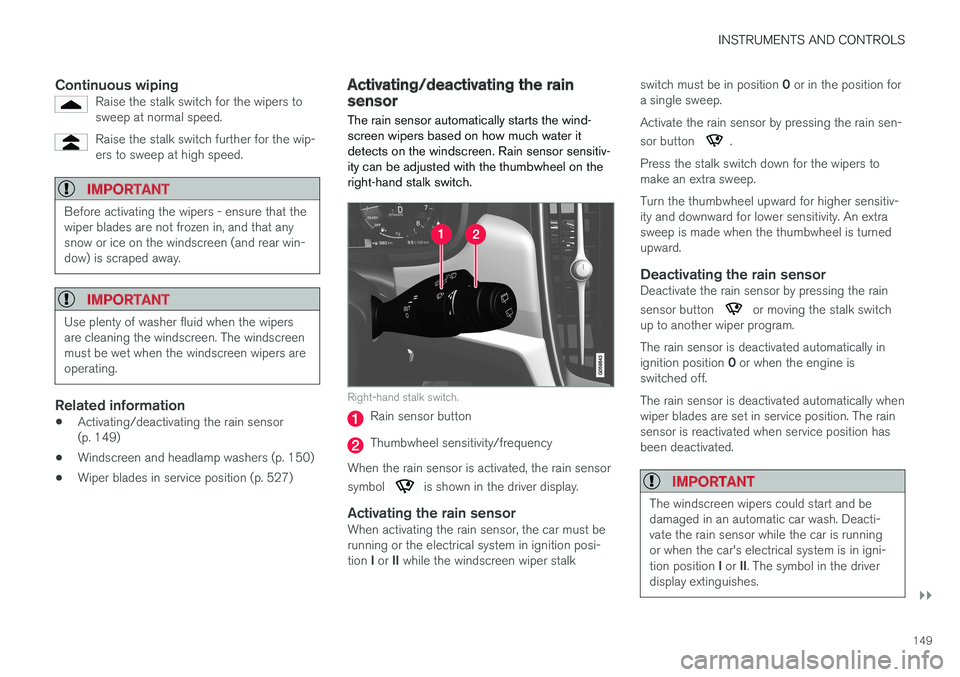
Right-hand stalk switch.
Rain sensor button
Thumbwheel sensitivity/frequency
When the rain sensor is activated, the rain sensor symbol
is shown in the driver display.
Activating the rain sensorWhen activating the rain sensor, the car must be running or the electrical system in ignition posi- tion I or II while the windscreen wiper stalk switch must be in position
0 or in the position for
a single sweep. Activate the rain sensor by pressing the rain sen- sor button
.
Press the stalk switch down for the wipers to make an extra sweep. Turn the thumbwheel upward for higher sensitiv- ity and downward for lower sensitivity. An extrasweep is made when the thumbwheel is turnedupward.
Deactivating the rain sensorDeactivate the rain sensor by pressing the rain sensor button
or moving the stalk switch
up to another wiper program. The rain sensor is deactivated automatically in ignition position 0 or when the engine is
switched off. The rain sensor is deactivated automatically when wiper blades are set in service position. The rainsensor is reactivated when service position hasbeen deactivated.
IMPORTANT
The windscreen wipers could start and be damaged in an automatic car wash. Deacti-vate the rain sensor while the car is runningor when the car's electrical system is in igni- tion position I or II. The symbol in the driver
display extinguishes.
Page 154 of 594
INSTRUMENTS AND CONTROLS
152
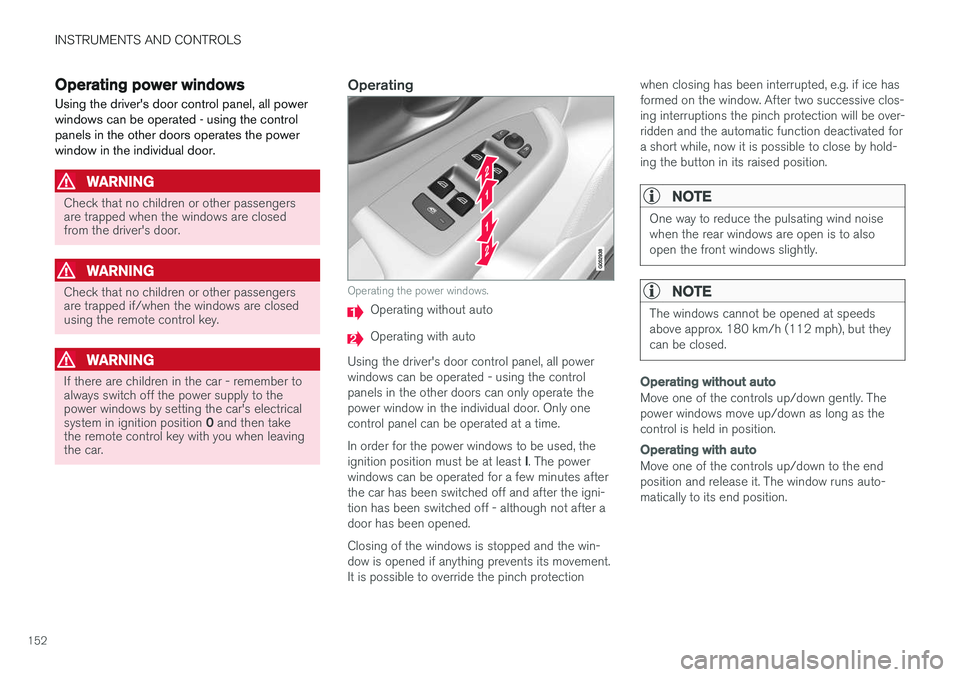
Operating power windows Using the driver's door control panel, all power windows can be operated - using the controlpanels in the other doors operates the powerwindow in the individual door.
WARNING
Check that no children or other passengers are trapped when the windows are closedfrom the driver's door.
WARNING
Check that no children or other passengers are trapped if/when the windows are closedusing the remote control key.
WARNING
If there are children in the car - remember to always switch off the power supply to thepower windows by setting the car's electrical system in ignition position 0 and then take
the remote control key with you when leaving the car.
Operating
Operating the power windows.
Operating without auto
Operating with auto
Using the driver's door control panel, all power windows can be operated - using the controlpanels in the other doors can only operate thepower window in the individual door. Only onecontrol panel can be operated at a time. In order for the power windows to be used, the ignition position must be at least I. The power
windows can be operated for a few minutes after the car has been switched off and after the igni-tion has been switched off - although not after adoor has been opened. Closing of the windows is stopped and the win- dow is opened if anything prevents its movement.It is possible to override the pinch protection when closing has been interrupted, e.g. if ice hasformed on the window. After two successive clos-ing interruptions the pinch protection will be over-ridden and the automatic function deactivated fora short while, now it is possible to close by hold-ing the button in its raised position.
NOTE
One way to reduce the pulsating wind noise when the rear windows are open is to alsoopen the front windows slightly.
NOTE
The windows cannot be opened at speeds above approx. 180 km/h (112 mph), but theycan be closed.
Operating without auto
Move one of the controls up/down gently. The power windows move up/down as long as thecontrol is held in position.
Operating with auto
Move one of the controls up/down to the end position and release it. The window runs auto-matically to its end position.