air condition VOLVO V90 2017 Owner's Manual
[x] Cancel search | Manufacturer: VOLVO, Model Year: 2017, Model line: V90, Model: VOLVO V90 2017Pages: 594, PDF Size: 15.07 MB
Page 329 of 594
DRIVER SUPPORT
}}
327
Limitations of the camera unit
The camera unit has certain limitations - which in turn also limits those functions that use the unit.
Impaired visionThe camera has limitations similar to the human eye, i.e. it can "see" worse in for example intensesnowfall or rain, dense fog, heavy dust stormsand snow flurries. Under such conditions, thefunctions of camera-dependent systems could besignificantly reduced or temporarily disengaged. Strong oncoming light, reflections in the carriage- way, snow or ice on the road surface, dirty roadsurfaces or unclear lane markings can also sig-nificantly reduce camera function when it is usedto scan the carriageway to detect pedestrians,cyclists, large animals and other vehicles.
Blocked unit
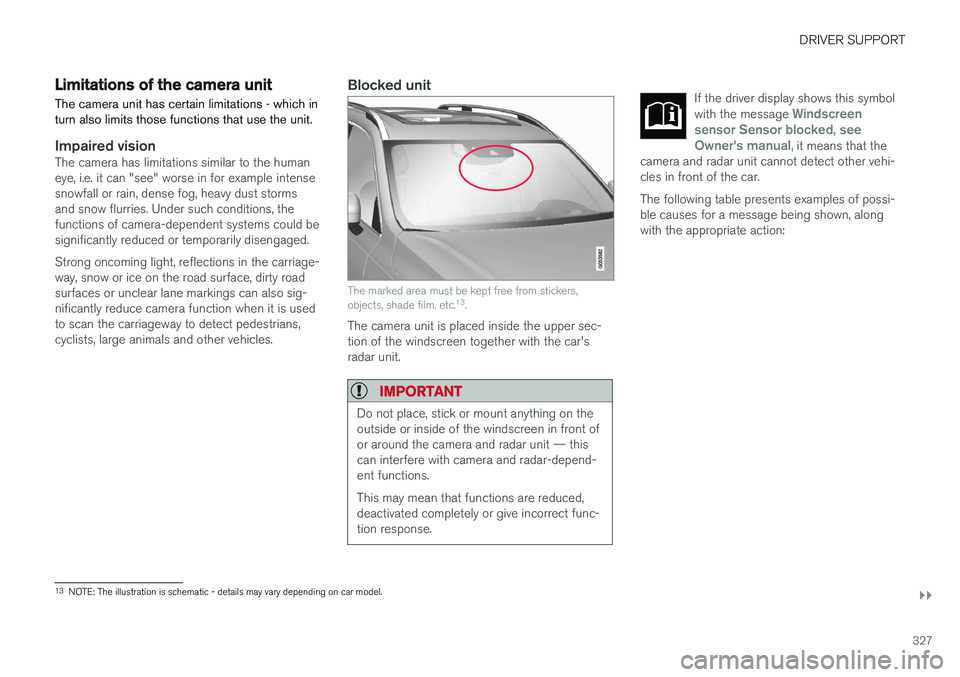
The marked area must be kept free from stickers, objects, shade film, etc. 13
.
The camera unit is placed inside the upper sec- tion of the windscreen together with the car'sradar unit.
IMPORTANT
Do not place, stick or mount anything on the outside or inside of the windscreen in front ofor around the camera and radar unit — thiscan interfere with camera and radar-depend-ent functions. This may mean that functions are reduced, deactivated completely or give incorrect func-tion response.
If the driver display shows this symbol with the message Windscreen
sensor Sensor blocked, see
Owner's manual, it means that the
camera and radar unit cannot detect other vehi- cles in front of the car.
The following table presents examples of possi- ble causes for a message being shown, alongwith the appropriate action:
13 NOTE: The illustration is schematic - details may vary depending on car model.
Page 407 of 594
STARTING AND DRIVING
* Option/accessory.405
Level control * and shock absorption
Level control and shock absorption are regula- ted automatically in the car.
With rear level control, the car maintains the same height at the rear regardless of load. Levelcontrol can also occur even after the car hasbeen parked.
Shock absorption (Four-C)The shock absorption is adapted according to theselected drive mode and according to the speedof the car. Shock absorption is normally set forthe best possible comfort and is regulated con-tinuously depending on the road surface, thecar's acceleration, braking and cornering.
Settings for level control
Deactivation of air suspension and level control
In certain cases, the function must be deacti- vated, e.g. before the car is raised with a jack *.
The difference in level created by raising the car with a jack can otherwise cause problems for theair suspension. Deactivating the function via the centre display:1. Press
Settings in the top view.
2. Press
My CarSuspension .
3. Select
Disable Leveling Control.
Change the damping level 11
Cars with active chassis (Four-C) and without the drive mode function
* can adjust the shock
absorption level via the centre display: 1. Press
Settings in the top view.
2. Tap on
My CarDrive ModeSuspension Control and select the level.
During transportDuring transport of the car on a ferry, train or truck, the car must be lashed around the tyresand not around other parts of the chassis.Changes in the air suspension may occur duringtransport, which could affect the lashing nega-tively.
Related information
• Drive modes
* (p. 400)
• Loading (p. 227)
All-wheel drive
*
All-wheel drive, AWD (All Wheel Drive), means that the car is driving all four wheels at the sametime, which improves traction.
To achieve the best possible traction and prevent wheel spin the motive force is distributed auto-matically to the wheels with the best grip. Thesystem continuously calculates the need for tor-que to the rear wheels, and can immediatelyredistribute up to half of the motor's torque to therear wheels. All-wheel drive also has a stabilising effect at higher speeds. Under normal driving conditions,the majority of power is transmitted to the frontwheels. When stationary, the all-wheel drive isalways engaged in preparation for maximum trac-tion during acceleration. All-wheel drive characteristics vary depending on the selected drive mode *.
Related information
• Drive modes
* (p. 400)
11
Depends on the car's equipment.
Page 416 of 594
||
STARTING AND DRIVING
414
IMPORTANT
Engine damage can occur if water enters the air filter. In depths greater than 25 cm, water could enter the transmission. This reduces the lubri-cating ability of the oils and shortens theservice life of these systems. Damage to any component, engine, transmis- sion, turbocharger, differential or its internalcomponents caused by flooding, hydrostaticlocking or oil shortage, is not covered by thewarranty. In the event of the engine stalling in water, do not try restart - tow the car from the water toa workshop - an authorised Volvo workshop isrecommended. Risk of engine breakdown.
Related information
•Towing (p. 431)
• Recovering the car (p. 432)
Overheating in the engine and drive system
Under special conditions, for example hard driv- ing in hilly terrain and hot climate, there is a riskthat the engine and drive system may overheat -in particular with a heavy load.
• In the event of overheating, the engine's power may be limited temporarily.
• Remove any auxiliary lamps from in front ofthe grille when driving in hot climates.
• If the temperature in the engine's coolingsystem becomes too high then a warningsymbol is illuminated and the driver display shows the message
Engine temperature
High temperature Stop safely. Stop the
car in a safe way and allow the engine to run at idling speed for several minutes and cooldown.
• If the message
Engine temperature High
temperature Turn off engine or Engine
coolant Level low, turn off engine is
shown, stop the car and switch off the engine.
• In the event of overheating in the gearbox, analternative gear shift program will beselected. In addition, a built-in protectionfunction is activated that, amongst otherthings, illuminates a warning symbol and thedriver display shows the message
Transmission warm Reduce speed to
lower temperature or Transmission hot Stop safely, wait for cooling
. Follow the
recommendation given, reduce speed or stop the car in a safe way and allow the engine torun at idling speed for several minutes toenable the gearbox to cool down.
• If the car overheats, the air conditioning maybe switched off temporarily.
• Do not turn the engine off immediately youstop after a hard drive.
NOTE
It is normal for the engine's cooling fan to operate for a time after the engine has beenswitched off.
Symbols in the driver display
Symbol
Specification
High engine temperature. Follow the recommendation given.
Low level, coolant. Follow the rec- ommendation given.
Gearbox hot/overheated/cooled. Follow the recommendation given.
Page 418 of 594
STARTING AND DRIVING
* Option/accessory.
416 •
Speed camera information
* (p. 350)
• Driving with a trailer (p. 426)
• Driving in water (p. 413)
• Alarm
* (p. 262)
• Level control
* and shock absorption (p. 405)
• Warning triangle (p. 500)
• Emergency puncture repair kit (p. 490)
• Spare wheel
* (p. 498)
Winter driving
For winter driving it is important to perform cer- tain checks of the car in order to ensure that itcan be driven safely.
Check the following in particular before the cold season:
• The engine coolant must contain 50% glycol.This mixture protects the engine againstfrost erosion down to approximately –35 °C.To avoid health risks, different types of glycolmust not be mixed.
• The fuel tank must be kept filled to preventcondensation.
• Engine oil viscosity is important. Oils withlower viscosity (thinner oils) facilitate startingin cold weather and also reduce fuel con-sumption while the engine is cold. Readmore about suitable oils in the section"Adverse driving conditions for engine oil".
IMPORTANT
Low viscosity oil must not be used for hard driving or in hot weather.
• The condition of the starter battery and charge level must be inspected. Coldweather places great demands on the starter battery and its capacity is reduced by thecold.
• Use washer fluid with antifreeze to avoid iceforming in the washer fluid reservoir.
Slippery driving conditionsTo achieve optimum roadholding Volvo recom-mends using winter tyres on all wheels if there isa risk of snow or ice.
NOTE
The use of winter tyres is a legal requirement in certain countries. Studded tyres are notpermitted in all countries.
Practise driving on slippery surfaces under con- trolled conditions to learn how the car reacts.
Related information
•Topping up coolant (p. 518)
• Adverse driving conditions for engine oil(p. 569)
• Starter battery (p. 530)
• Winter wheels (p. 499)
• Filling washer fluid (p. 529)
• Replacing a wiper blade (p. 528)
• Parking climate
* (p. 206)
• Activating/deactivating defrost of windowsand door mirrors (p. 194)
Page 422 of 594
STARTING AND DRIVING
420
Diesel Diesel is a type of engine fuel that is intended for cars with a diesel engine.
Only use diesel fuel from well-known producers. Never use fuel of dubious quality. Diesel fuelmust fulfil the EN 590 or SS 155435 standard.Diesel engines are sensitive to contaminants inthe fuel, such as excessively high volumes of sul-phur and metals. At low temperatures (lower than 0 °C) a paraffin precipitate may form in the diesel fuel, which maylead to ignition problems. The fuel qualities thatare sold must be adapted for season and climatezone, but for extreme weather conditions, old fuelor moving between climate zones, paraffin precip-itate may occur. The risk of condensation in the fuel tank is reduced if the tank is kept well filled. When refuelling, check that the area around the fuel filler pipe is clean. Avoid spilling fuel onto thepaintwork. Wash off any spillage with detergentand water.
IMPORTANT
Diesel fuel must: •fulfil the EN 590 and/or SS 155435 standards
• have a sulphur content not exceeding10 mg/kg
• have a maximum of 7 vol % FAME 15
(B7).
IMPORTANT
Diesel type fuels that must not be used:
• Special additives
• Marine diesel fuel
• Heating oil
• FAME 16
and vegetable oil.
These fuels do not fulfil the requirements in accordance with Volvo recommendations andgenerate increased wear and engine damagethat is not covered by the Volvo warranty.
Related information
• Empty tank and diesel engine (p. 420)
• Diesel particulate filter (p. 421)
Empty tank and diesel engine
Once the engine has stopped due to fuel starva- tion, the fuel system needs a few moments tocarry out a check.
Before starting the engine after the fuel tank has
been filled with diesel - proceed as follows:
1. The remote control key must be inside the car.
2. Set the car in ignition position II - turn the
ignition dial to START without depressing
the brake pedal and hold the knob in the START position for approx. 4 seconds. Then
release the knob, which automatically returns to its starting position.
3. Wait approx. one minute.
4. To start the engine: Depress the brake pedal and turn the ignition dial to START again.
NOTE
Before filling with fuel in the event of fuel shortage:
• Stop the car on as flat/level ground aspossible - if the car is tilting there is a riskof air pockets in the fuel supply.
15
Fatty Acid Methyl Ester
16 Diesel fuel with maximum 7 vol % FAME (B7) is permitted.
Page 428 of 594
STARTING AND DRIVING
426
Driving with a trailer
When driving with a trailer, there are a number of points that are important to think about regar-ding the towing bracket, the trailer and how theload is positioned in the trailer.
Payload depends on the car's kerb weight. The total of the weight of the passengers and allaccessories, e.g. towbar, reduces the car's pay-load by a corresponding weight. The car is supplied with the necessary equipment for towing a trailer.
• The car's towing bracket must be of anapproved type.
• Distribute the load on the trailer so that theweight on the towing bracket complies withthe specified maximum towball load. Towballload is calculated as part of the car's payload.
• Increase the tyre pressure to the recom-mended pressure for a full load. For moreinformation on tyre pressure, see the section"Approved tyre pressures".
• The engine is loaded more heavily than usualwhen driving with a trailer.
• Do not tow a heavy trailer when the car isbrand new. Wait until it has been driven atleast 1000 km.
• The brakes are loaded much more than usualon long and steep downhill slopes. Downshiftto a lower gear and adjust your speed. •
Follow the regulations in force for the permit-ted speeds and weights.
• Maintain a low speed when driving with atrailer up long, steep ascents.
• The maximum trailer weights given only applyto altitudes up to 1000 metres above sealevel. At higher altitudes, engine power andthus the car's climbing ability is decreaseddue to the reduced air density, and the maxi-mum trailer weight must therefore bereduced. The weight of the car and trailermust be decreased by 10 % for each addi-tional 1000 m (or part thereof).
• Avoid driving with a trailer on inclines of morethan 12%.
NOTE
Extreme weather conditions, driving with a trailer or driving at high altitudes in combina-tion with fuel quality are factors that consider-ably increase the car's fuel consumption.
Trailer connectorAn adapter is required if the car's towing bracket has a 13 pin connector and the trailer has a 7 pinconnector. Use an adapter approved by Volvo.Make sure the cable does not drag on theground.
IMPORTANT
When the engine is switched off, the constant battery voltage to the trailer connector can beswitched off automatically so as not to drainthe starter battery.
Trailer weightsInformation about Volvo's permitted trailer weights is available in the article "Towingcapacity and towball load".
WARNING
Follow the stated recommendations for trailer weights. Otherwise, the car and trailer may bedifficult to control in the event of suddenmovement and braking.
NOTE
The stated maximum permitted trailer weights are those permitted by Volvo. National vehicleregulations can further limit trailer weightsand speeds. Towbars can be certified forhigher towing weights than the car canactually tow.
Direction indicators and brake lights on the trailer
If one or more of the trailer's direction indicators or brake light bulbs is broken, the driver display
Page 466 of 594
||
AUDIO AND MEDIA
* Option/accessory.
464
Related information
• Connecting the car (p. 464)
• Apps (p. 434)
• Book service and repair (p. 506)
• System updates (p. 510)
• Volvo ID (p. 23)
• Symbols in the centre display's status bar (p. 45)
• Sharing Internet via Wi-Fi hotspot (p. 465)
Connecting the car Connect the car to the phone via Bluetooth, Wi-Fi or with the car's built-in modem
*.
The mobile phone and network operator must support tethering (sharing the Internet connec-tion) and the plan must include data.
NOTE
Data is transferred when using the internet (data traffic), which can have a cost. Activation of data roaming can result in fur- ther charges. Contact your network operator about the cost for data traffic.
NOTE
When using Apple CarPlay, it is only possible to connect the car to the Internet using Wi-Fi or car modem *.
NOTE
When using Android Auto, it is possible to connect the car to the Internet using Wi-Fi, Bluetooth or car modem *.
Read Terms and Conditions for Services and
Customer Privacy Policy at
support.volvocars.com before connecting.
Connecting with BluetoothSee Connecting a phone.
Connecting with Wi-Fi
1. Activate tethering (portable/personal hot- spot) on the mobile phone.
2. Press
Settings in top view.
3. Press
CommunicationWi-Fi.
4. Activate/deactivate by ticking/unticking the box for Wi-Fi.
5. Tap on the network name of the network to be connected.
6. Enter the network password.
7. If another connection source has been used in the past - confirm the option to change connection.
> The car connects to the network.
Note that certain phones switch off tethering after the contact with the car has been discon-nected, e.g. when leaving the car and until thenext time it is used. The tethering in the phonetherefore needs to be reactivated the next time itis used.
Page 486 of 594
WHEELS AND TYRES
484
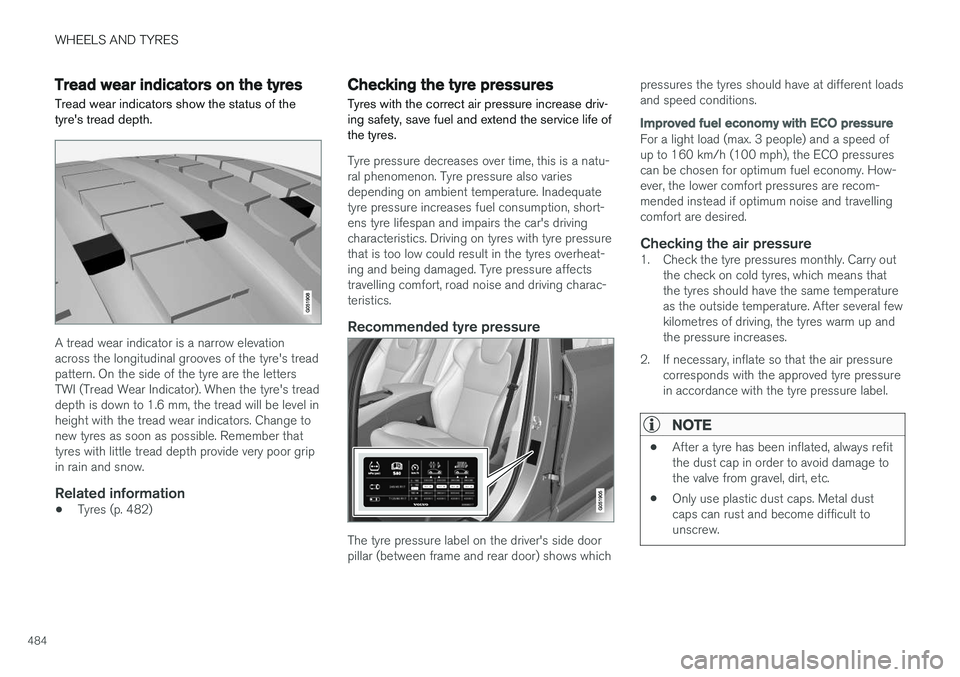
Tread wear indicators on the tyres Tread wear indicators show the status of the tyre's tread depth.
A tread wear indicator is a narrow elevation across the longitudinal grooves of the tyre's treadpattern. On the side of the tyre are the lettersTWI (Tread Wear Indicator). When the tyre's treaddepth is down to 1.6 mm, the tread will be level inheight with the tread wear indicators. Change tonew tyres as soon as possible. Remember thattyres with little tread depth provide very poor gripin rain and snow.
Related information
•Tyres (p. 482)
Checking the tyre pressures Tyres with the correct air pressure increase driv- ing safety, save fuel and extend the service life ofthe tyres.
Tyre pressure decreases over time, this is a natu- ral phenomenon. Tyre pressure also variesdepending on ambient temperature. Inadequatetyre pressure increases fuel consumption, short-ens tyre lifespan and impairs the car's drivingcharacteristics. Driving on tyres with tyre pressurethat is too low could result in the tyres overheat-ing and being damaged. Tyre pressure affectstravelling comfort, road noise and driving charac-teristics.
Recommended tyre pressure
The tyre pressure label on the driver's side door pillar (between frame and rear door) shows which pressures the tyres should have at different loadsand speed conditions.
Improved fuel economy with ECO pressure
For a light load (max. 3 people) and a speed of up to 160 km/h (100 mph), the ECO pressurescan be chosen for optimum fuel economy. How-ever, the lower comfort pressures are recom-mended instead if optimum noise and travellingcomfort are desired.
Checking the air pressure1. Check the tyre pressures monthly. Carry out
the check on cold tyres, which means thatthe tyres should have the same temperatureas the outside temperature. After several fewkilometres of driving, the tyres warm up andthe pressure increases.
2. If necessary, inflate so that the air pressure corresponds with the approved tyre pressurein accordance with the tyre pressure label.
NOTE
• After a tyre has been inflated, always refit the dust cap in order to avoid damage tothe valve from gravel, dirt, etc.
• Only use plastic dust caps. Metal dustcaps can rust and become difficult tounscrew.
Page 522 of 594
MAINTENANCE AND SERVICE
520
Servicing the climate control system The air conditioning system must only be serv- iced and repaired by an authorised workshop.
Troubleshooting and repairThe air conditioning system contains fluorescent tracing agents. Ultraviolet light must be used dur-ing leak detection. Volvo recommends that you contact an author- ised Volvo workshop.
Cars with R134a refrigerant
WARNING
The air conditioning system contains pressur- ised refrigerant R134a. This system must onlybe serviced and repaired by an authorisedworkshop.
Cars with R1234yf refrigerant
WARNING
The air conditioning system contains pressur- ised refrigerant R1234yf. In accordance withSAE J2845 (Technician Training for SafeService and Containment of RefrigerantsUsed in Mobile A/C System), service andrepair of the refrigerant system must only beperformed by trained and certified techniciansin order to ensure the safety of the system.
Related information
•Volvo service programme (p. 506)
Bulb replacement
The bulb in the halogen headlamp, reversing lamp and rear fog lamp can be replaced by thedriver.
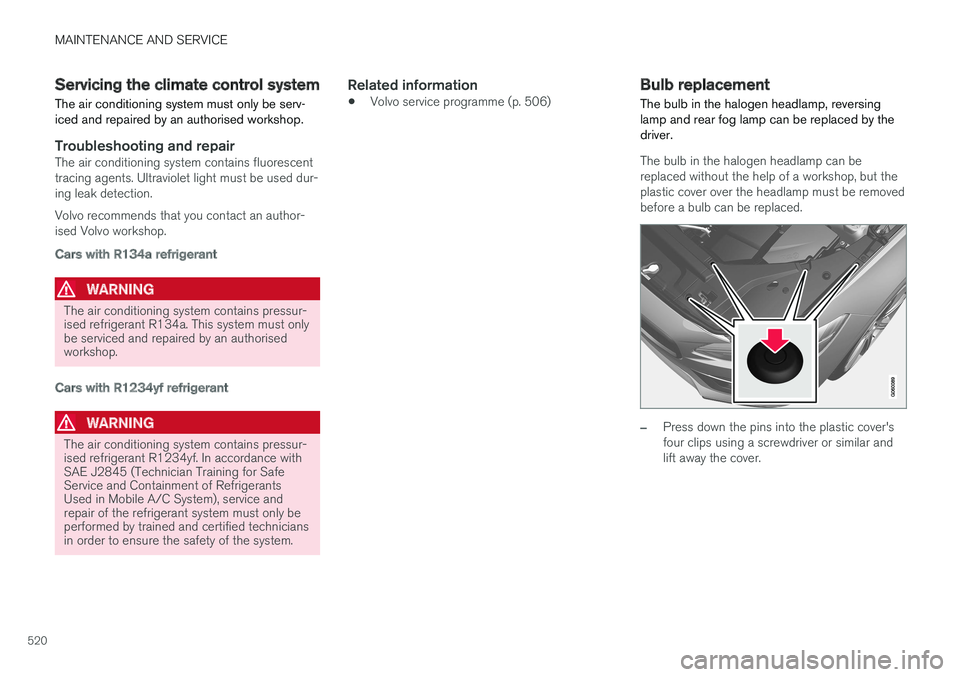
The bulb in the halogen headlamp can be replaced without the help of a workshop, but theplastic cover over the headlamp must be removedbefore a bulb can be replaced.
–Press down the pins into the plastic cover's four clips using a screwdriver or similar andlift away the cover.
Page 562 of 594
||
SPECIFICATIONS
560
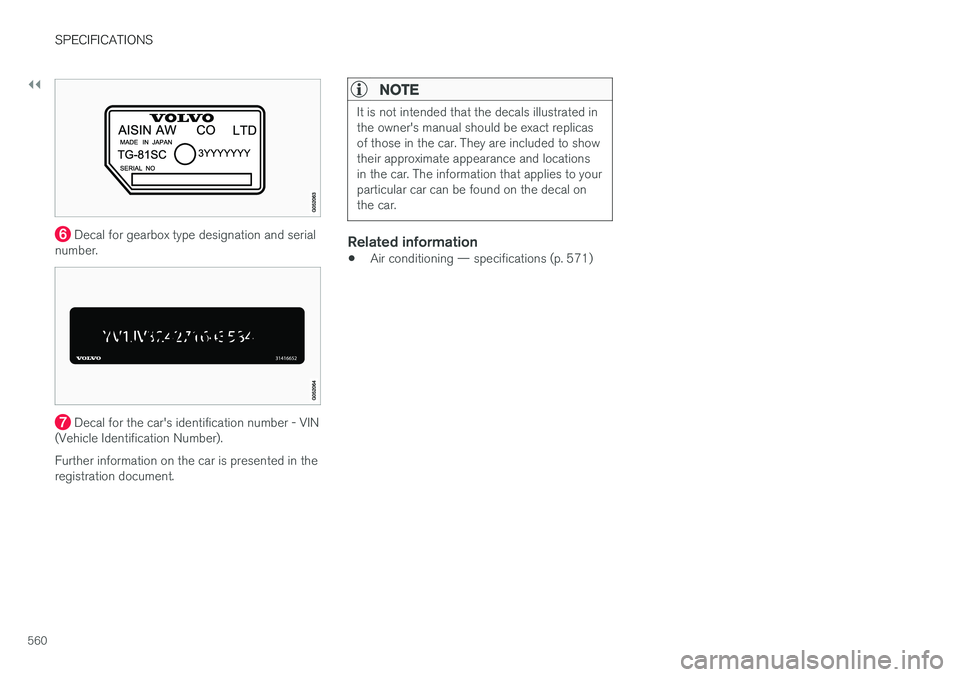
Decal for gearbox type designation and serial
number.
Decal for the car's identification number - VIN
(Vehicle Identification Number).
Further information on the car is presented in the registration document.
NOTE
It is not intended that the decals illustrated in the owner's manual should be exact replicasof those in the car. They are included to showtheir approximate appearance and locationsin the car. The information that applies to yourparticular car can be found on the decal onthe car.
Related information
• Air conditioning — specifications (p. 571)