tailgate VOLVO V90 2017 Owner's Guide
[x] Cancel search | Manufacturer: VOLVO, Model Year: 2017, Model line: V90, Model: VOLVO V90 2017Pages: 594, PDF Size: 15.07 MB
Page 264 of 594
||
LOCKS AND ALARM
* Option/accessory.
262
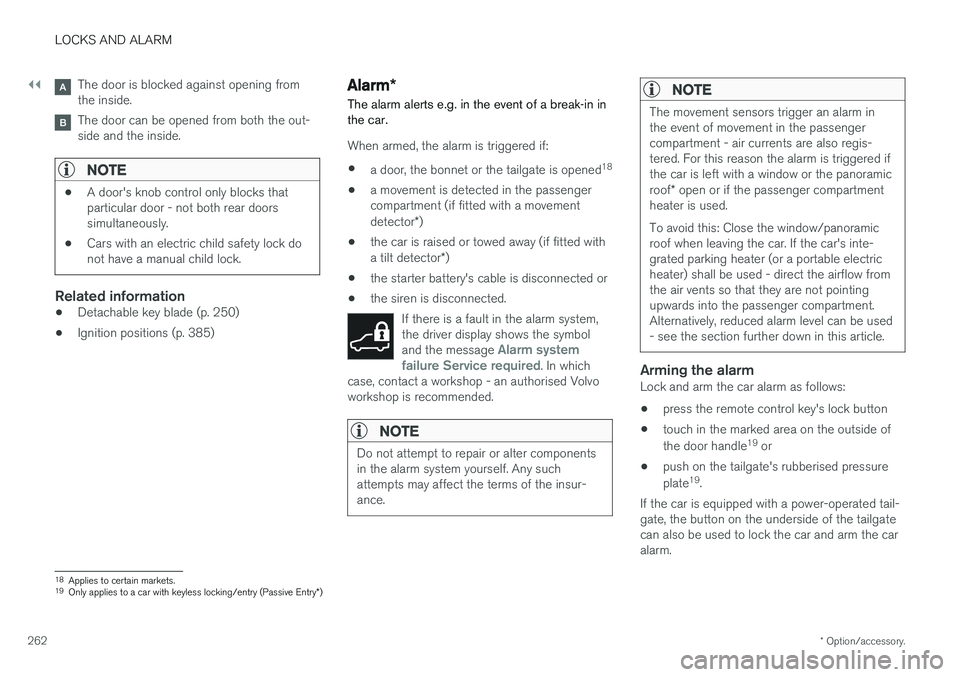
The door is blocked against opening from the inside.
The door can be opened from both the out- side and the inside.
NOTE
• A door's knob control only blocks that particular door - not both rear doorssimultaneously.
• Cars with an electric child safety lock donot have a manual child lock.
Related information
• Detachable key blade (p. 250)
• Ignition positions (p. 385)
Alarm
*
The alarm alerts e.g. in the event of a break-in in the car.
When armed, the alarm is triggered if:
• a door, the bonnet or the tailgate is opened 18
• a movement is detected in the passenger compartment (if fitted with a movement detector
*)
• the car is raised or towed away (if fitted witha tilt detector
*)
• the starter battery's cable is disconnected or
• the siren is disconnected.
If there is a fault in the alarm system, the driver display shows the symbol and the message
Alarm system
failure Service required. In which
case, contact a workshop - an authorised Volvo workshop is recommended.
NOTE
Do not attempt to repair or alter components in the alarm system yourself. Any suchattempts may affect the terms of the insur-ance.
NOTE
The movement sensors trigger an alarm in the event of movement in the passengercompartment - air currents are also regis-tered. For this reason the alarm is triggered ifthe car is left with a window or the panoramic roof * open or if the passenger compartment
heater is used. To avoid this: Close the window/panoramic roof when leaving the car. If the car's inte-grated parking heater (or a portable electricheater) shall be used - direct the airflow fromthe air vents so that they are not pointingupwards into the passenger compartment.Alternatively, reduced alarm level can be used- see the section further down in this article.
Arming the alarmLock and arm the car alarm as follows:
• press the remote control key's lock button
• touch in the marked area on the outside of the door handle 19
or
• push on the tailgate's rubberised pressureplate 19
.
If the car is equipped with a power-operated tail- gate, the button on the underside of the tailgatecan also be used to lock the car and arm the caralarm.
18 Applies to certain markets.
19 Only applies to a car with keyless locking/entry (Passive Entry *)
Page 265 of 594
LOCKS AND ALARM
* Option/accessory.263
Deactivate the alarmUnlock and disarm the car alarm as follows:
• press the remote control key's unlock button
• grip one of the door handles 19
or
• push on the tailgate's rubberised pressure plate 19
.
Switching off a triggered alarm
–Press the remote control key's unlock button or set the car in ignition position I by turning
the ignition dial to START and then releas-
ing.
NOTE
• Remember that the alarm is activated when the car is locked.
• If any of the doors are opened from theinside then the alarm is triggered.
Alarm signalsWhen the alarm has been triggered, the following happens:
• A siren sounds for 30 seconds or until thealarm is switched off.
• The direction indicators flash for 5 minutesor until the alarm is switched off. If the cause of alarm activation is not rectified, the alarm cycle is repeated up to 10 times
20
.
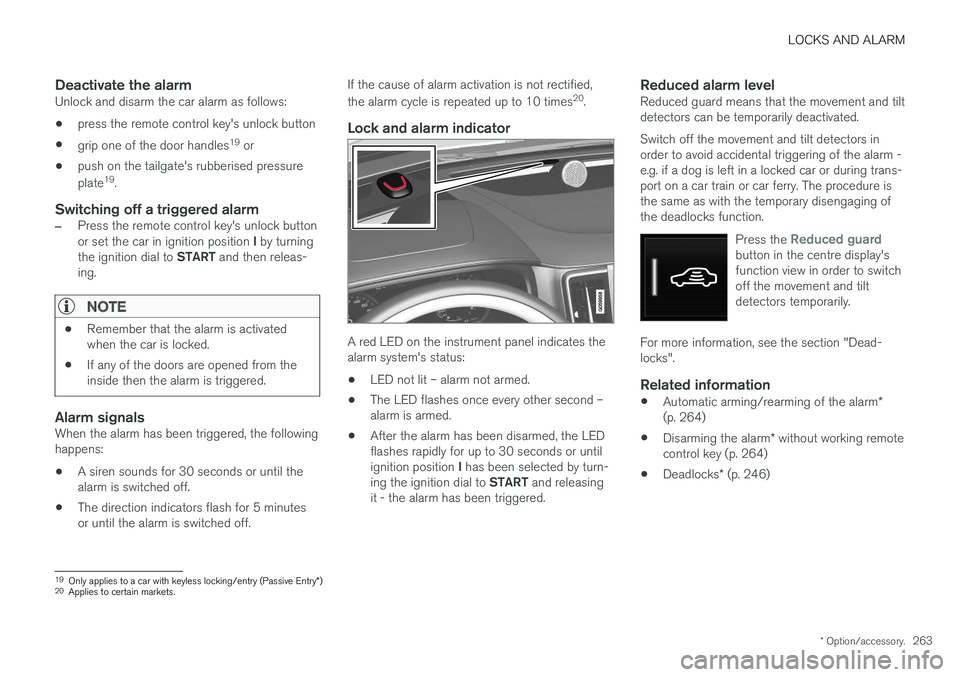
Lock and alarm indicator
A red LED on the instrument panel indicates the alarm system's status:
• LED not lit – alarm not armed.
• The LED flashes once every other second –alarm is armed.
• After the alarm has been disarmed, the LEDflashes rapidly for up to 30 seconds or until ignition position
I has been selected by turn-
ing the ignition dial to START and releasing
it - the alarm has been triggered.
Reduced alarm levelReduced guard means that the movement and tilt detectors can be temporarily deactivated. Switch off the movement and tilt detectors in order to avoid accidental triggering of the alarm -e.g. if a dog is left in a locked car or during trans-port on a car train or car ferry. The procedure isthe same as with the temporary disengaging ofthe deadlocks function.
Press the
Reduced guardbutton in the centre display's function view in order to switchoff the movement and tiltdetectors temporarily.
For more information, see the section "Dead- locks".
Related information
•Automatic arming/rearming of the alarm
*
(p. 264)
• Disarming the alarm
* without working remote
control key (p. 264)
• Deadlocks
* (p. 246)
19
Only applies to a car with keyless locking/entry (Passive Entry *)
20 Applies to certain markets.
Page 266 of 594
LOCKS AND ALARM
* Option/accessory.
264
Automatic arming/rearming of the alarm *
Automatic rearming of the alarm prevents the car being left with the alarm disarmed unintention-ally.
If the car is unlocked with the remote control key (which disarms the alarm) but none of the doorsor the tailgate is opened within two minutes, thenthe alarm is automatically re-armed. The car isrelocked at the same time. In certain markets, the alarm is re-armed auto- matically after a certain delay after the driver'sdoor has been opened and closed without beinglocked.
Related information
• Alarm
* (p. 262)
• Disarming the alarm
* without working remote
control key (p. 264)
Disarming the alarm * without
working remote control key
The car can be unlocked and disarmed even if the remote control key does not work, e.g. if theremote control key's battery is dead.
1. Open the driver's door with the detachable key blade.
> The alarm is triggered.
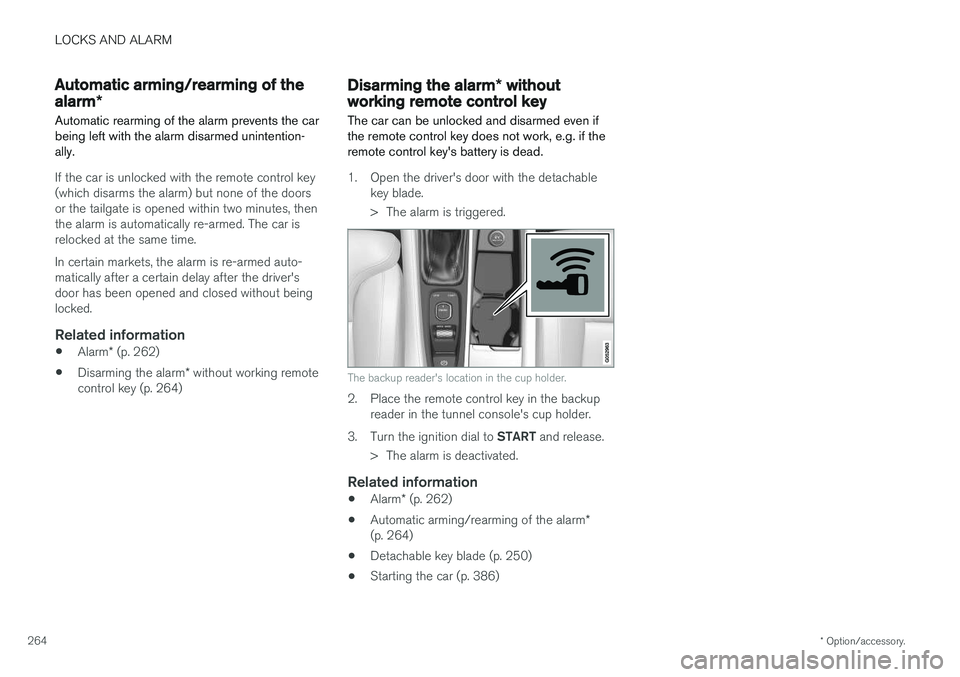
The backup reader's location in the cup holder.
2. Place the remote control key in the backupreader in the tunnel console's cup holder.
3. Turn the ignition dial to START and release.
> The alarm is deactivated.
Related information
• Alarm
* (p. 262)
• Automatic arming/rearming of the alarm
*
(p. 264)
• Detachable key blade (p. 250)
• Starting the car (p. 386)
Page 376 of 594

||
DRIVER SUPPORT
* Option/accessory.
374
The car's left-hand camera is out of order.
Black camera sector
A black camera sector is also shown in the fol- lowing instances, but then without the symbol for
defective camera:
• open door
• open tailgate
• folded-in door mirror.
Light conditionsThe camera image is adjusted automatically according to prevailing light conditions. Becauseof this, the image may vary slightly in brightnessand quality. Poor light conditions can result inreduced image quality.
MaintenanceClean camera lenses regularly with lukewarmwater and car shampoo - be careful not toscratch the lenses.
NOTE
Keep the camera lens clear of dirt, snow and ice to ensure optimum function. This is partic-ularly important in poor light.
Related information
•
Park Assist Camera
* (p. 368)
• Starting the Park Assist Camera
* (p. 372)
• Park assist lines and fields for the Park Assist Camera
* (p. 370)
Park Assist Pilot *
Active parking assistance (Park Assist Pilot - PAP) helps the driver to park in or leave a park-ing space.
PAP checks first if a space is sufficiently big and thereafter helps the driver to turn the steeringwheel and manoeuvre the car into the space. The centre display indicates with symbols, graph- ics and text the various operations to be carriedout and when to do so.
NOTE
The PAP function measures the space and steers the car - the driver's task is to:
• keep a close watch around the car
• follow the instructions in the centre dis-play
• change gear (reverse/forward)
• control and maintain a safe speed
• brake and stop.
Page 425 of 594
STARTING AND DRIVING
}}
* Option/accessory.423
NOTE
When a hitch with a vibration damper is used, the towball must not be lubricated. This also applies when fitting a bicycle rack that is clamped in around the towball.
NOTE
If the car is equipped with a towing bracket, there is no rear mounting for a towing eye.
Related information
•Driving with a trailer (p. 426)
• Towing capacity and towball load (p. 564)
• Trailer Stability Assist
* (p. 428)
• Towing bracket specifications
* (p. 425)
• Extendable/retractable towing brackets
*
(p. 423)
Extendable/retractable towing brackets *
The extendable/retractable towing hitch is always easily accessible and simple to extend orretract as needed. In the retracted position, thetowing hitch is completely concealed.
WARNING
Follow the instructions for retracting and extending the towing bracket carefully.
Extending the towing hitch
WARNING
Avoid standing close to the bumper in the centre behind the car when extending thetowing hitch.
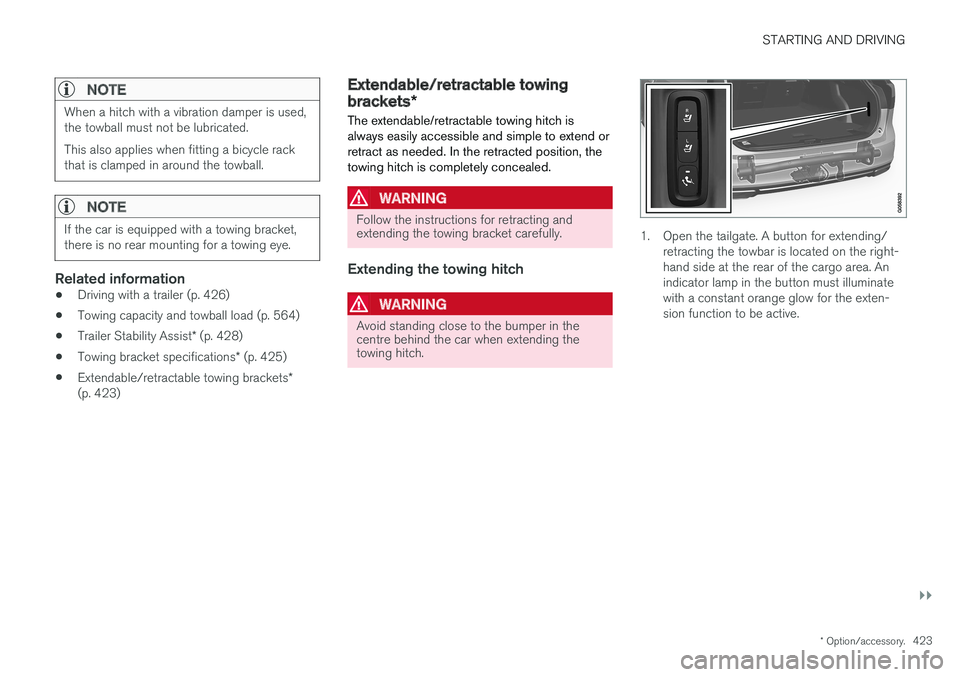
1. Open the tailgate. A button for extending/ retracting the towbar is located on the right- hand side at the rear of the cargo area. Anindicator lamp in the button must illuminatewith a constant orange glow for the exten-sion function to be active.
Page 426 of 594
||
STARTING AND DRIVING
424
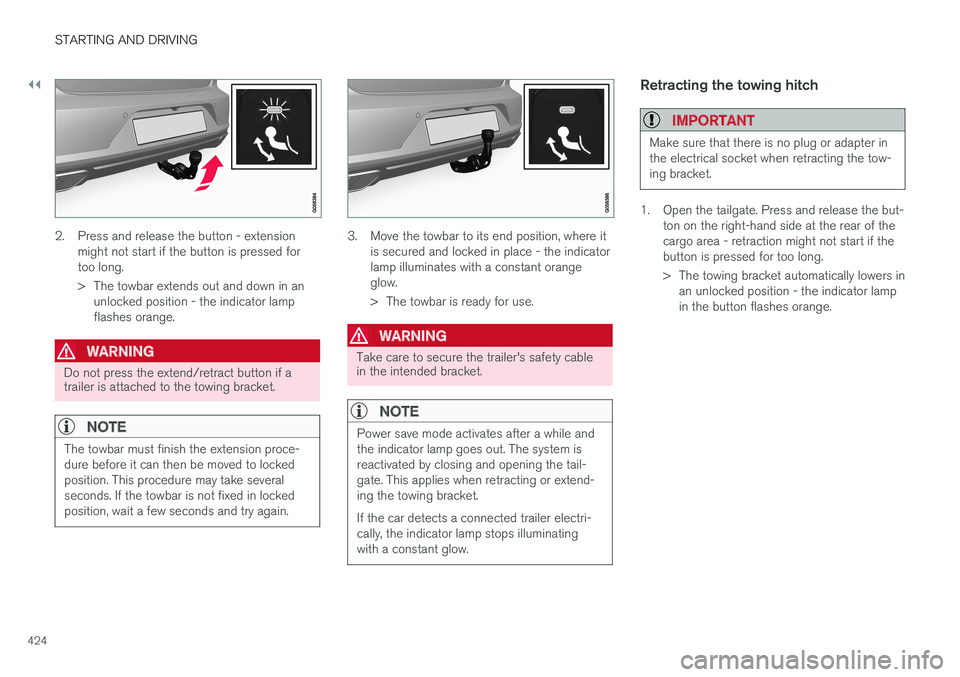
2. Press and release the button - extensionmight not start if the button is pressed for too long.
> The towbar extends out and down in anunlocked position - the indicator lamp flashes orange.
WARNING
Do not press the extend/retract button if a trailer is attached to the towing bracket.
NOTE
The towbar must finish the extension proce- dure before it can then be moved to lockedposition. This procedure may take severalseconds. If the towbar is not fixed in lockedposition, wait a few seconds and try again.
3. Move the towbar to its end position, where it is secured and locked in place - the indicator lamp illuminates with a constant orangeglow.
> The towbar is ready for use.
WARNING
Take care to secure the trailer's safety cable in the intended bracket.
NOTE
Power save mode activates after a while and the indicator lamp goes out. The system isreactivated by closing and opening the tail-gate. This applies when retracting or extend-ing the towing bracket. If the car detects a connected trailer electri- cally, the indicator lamp stops illuminatingwith a constant glow.
Retracting the towing hitch
IMPORTANT
Make sure that there is no plug or adapter in the electrical socket when retracting the tow-ing bracket.
1. Open the tailgate. Press and release the but- ton on the right-hand side at the rear of the cargo area - retraction might not start if thebutton is pressed for too long.
> The towing bracket automatically lowers inan unlocked position - the indicator lamp in the button flashes orange.
Page 502 of 594
WHEELS AND TYRES
* Option/accessory.
500
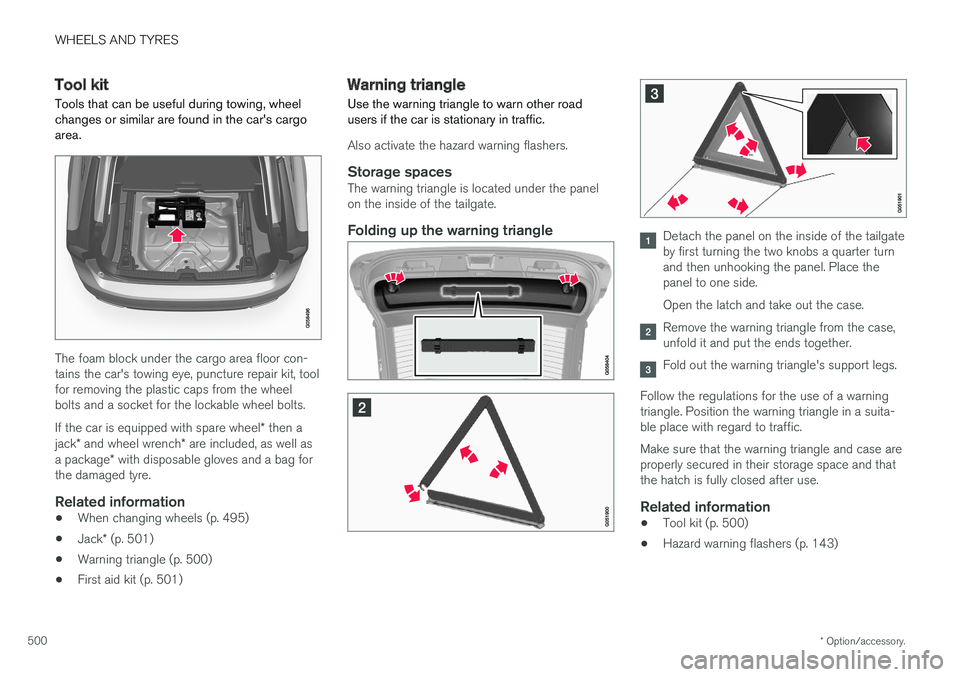
Tool kit Tools that can be useful during towing, wheel changes or similar are found in the car's cargoarea.
The foam block under the cargo area floor con- tains the car's towing eye, puncture repair kit, toolfor removing the plastic caps from the wheelbolts and a socket for the lockable wheel bolts. If the car is equipped with spare wheel * then a
jack * and wheel wrench * are included, as well as
a package * with disposable gloves and a bag for
the damaged tyre.
Related information
• When changing wheels (p. 495)
• Jack
* (p. 501)
• Warning triangle (p. 500)
• First aid kit (p. 501)
Warning triangle
Use the warning triangle to warn other road users if the car is stationary in traffic.
Also activate the hazard warning flashers.
Storage spacesThe warning triangle is located under the panel on the inside of the tailgate.
Folding up the warning triangleDetach the panel on the inside of the tailgate by first turning the two knobs a quarter turnand then unhooking the panel. Place thepanel to one side. Open the latch and take out the case.
Remove the warning triangle from the case, unfold it and put the ends together.
Fold out the warning triangle's support legs.
Follow the regulations for the use of a warning triangle. Position the warning triangle in a suita-ble place with regard to traffic. Make sure that the warning triangle and case are properly secured in their storage space and thatthe hatch is fully closed after use.
Related information
• Tool kit (p. 500)
• Hazard warning flashers (p. 143)
Page 527 of 594
MAINTENANCE AND SERVICE
525
Related information
•Bulb replacement (p. 520)
• Bulb specifications (p. 526)
Replacing the reversing lamp bulb
The bulbs for the reversing lamp are located behind the panel in the tailgate.
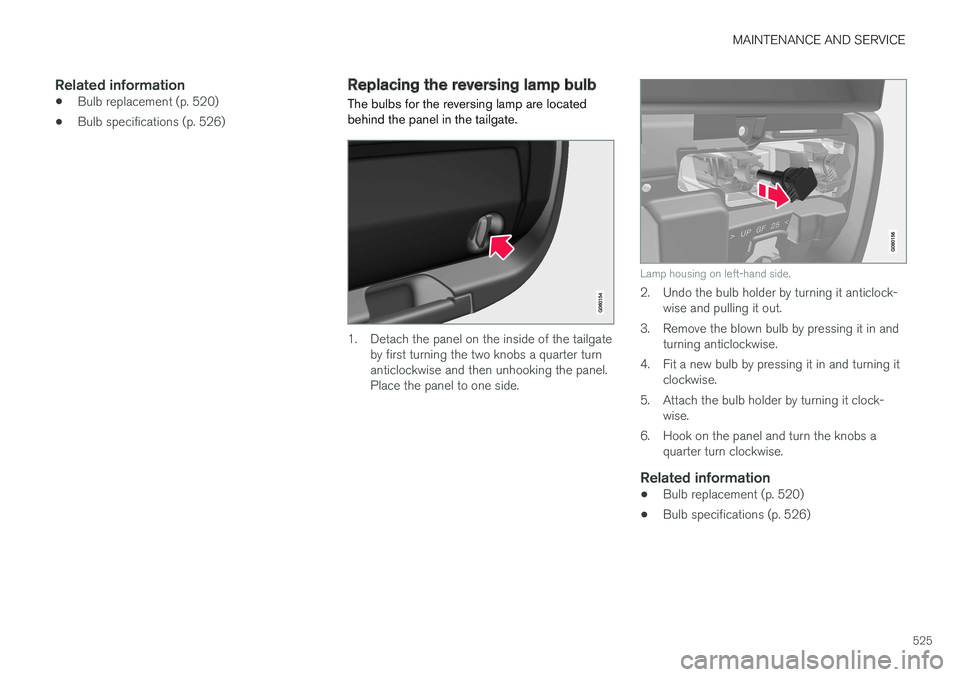
1. Detach the panel on the inside of the tailgate by first turning the two knobs a quarter turn anticlockwise and then unhooking the panel.Place the panel to one side.
Lamp housing on left-hand side.
2. Undo the bulb holder by turning it anticlock- wise and pulling it out.
3. Remove the blown bulb by pressing it in and turning anticlockwise.
4. Fit a new bulb by pressing it in and turning it clockwise.
5. Attach the bulb holder by turning it clock- wise.
6. Hook on the panel and turn the knobs a quarter turn clockwise.
Related information
• Bulb replacement (p. 520)
• Bulb specifications (p. 526)
Page 528 of 594
MAINTENANCE AND SERVICE
526
Replacing the rear fog lamp bulb The bulb for the rear fog lamp is located behind a hatch in the tailgate panel. Left-hand drive cars have the fog lamp on the left-hand side, right-hand drive cars on the right-hand side.
The rear fog lamp bulb is replaced as follows:
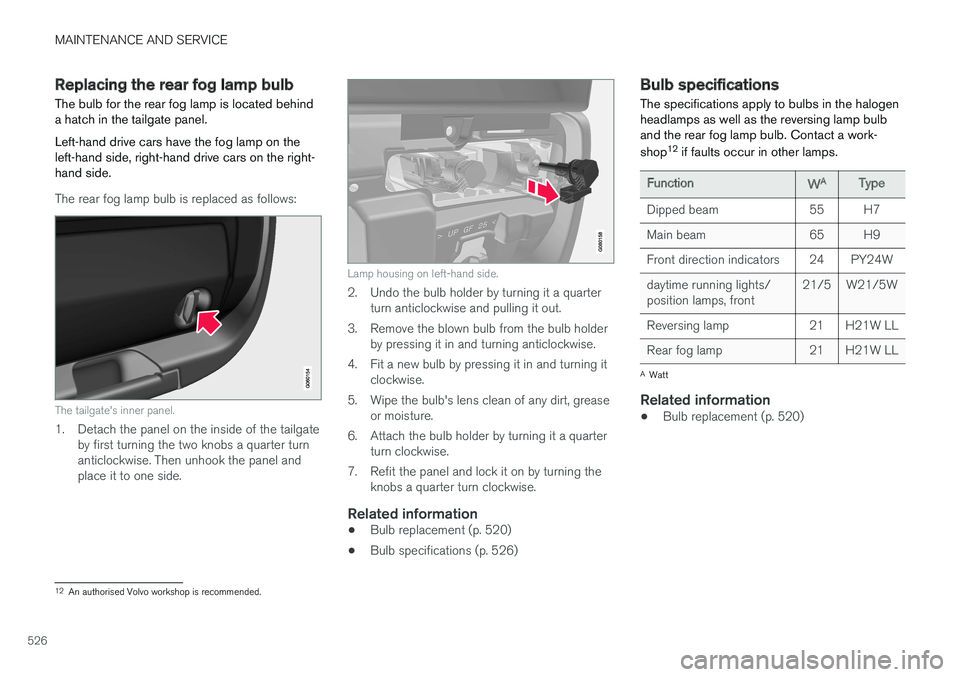
The tailgate's inner panel.
1. Detach the panel on the inside of the tailgateby first turning the two knobs a quarter turn anticlockwise. Then unhook the panel andplace it to one side.
Lamp housing on left-hand side.
2. Undo the bulb holder by turning it a quarterturn anticlockwise and pulling it out.
3. Remove the blown bulb from the bulb holder by pressing it in and turning anticlockwise.
4. Fit a new bulb by pressing it in and turning it clockwise.
5. Wipe the bulb's lens clean of any dirt, grease or moisture.
6. Attach the bulb holder by turning it a quarter turn clockwise.
7. Refit the panel and lock it on by turning the knobs a quarter turn clockwise.
Related information
• Bulb replacement (p. 520)
• Bulb specifications (p. 526)
Bulb specifications The specifications apply to bulbs in the halogen headlamps as well as the reversing lamp bulband the rear fog lamp bulb. Contact a work- shop 12
if faults occur in other lamps.
Function WA
Type
Dipped beam 55 H7
Main beam 65 H9
Front direction indicators 24 PY24Wdaytime running lights/ position lamps, front 21/5 W21/5W
Reversing lamp 21 H21W LL
Rear fog lamp 21 H21W LL
A Watt
Related information
• Bulb replacement (p. 520)
12
An authorised Volvo workshop is recommended.
Page 550 of 594
||
MAINTENANCE AND SERVICE
* Option/accessory.
548
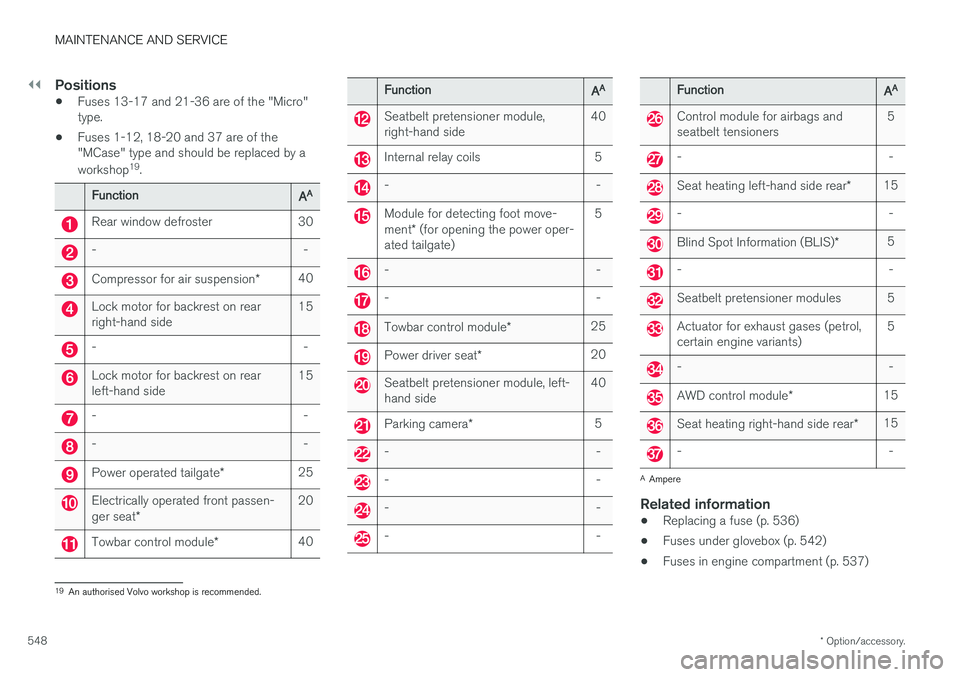
Positions
• Fuses 13-17 and 21-36 are of the "Micro" type.
• Fuses 1-12, 18-20 and 37 are of the"MCase" type and should be replaced by a workshop 19
.
Function AA
Rear window defroster 30
- -
Compressor for air suspension
*40
Lock motor for backrest on rear right-hand side 15
- -
Lock motor for backrest on rear left-hand side15
- -
- -
Power operated tailgate
*25
Electrically operated front passen- ger seat
* 20
Towbar control module
*40
Function
AA
Seatbelt pretensioner module, right-hand side 40
Internal relay coils 5
- -
Module for detecting foot move- ment
* (for opening the power oper-
ated tailgate) 5
- -
- -
Towbar control module
*25
Power driver seat
* 20
Seatbelt pretensioner module, left- hand side 40
Parking camera
* 5
- -
- -
- -
- -
Function
AA
Control module for airbags and seatbelt tensioners 5
- -
Seat heating left-hand side rear
*15
- -
Blind Spot Information (BLIS)
*5
- -
Seatbelt pretensioner modules 5
Actuator for exhaust gases (petrol, certain engine variants) 5
- -
AWD control module
*15
Seat heating right-hand side rear
*15
- -
A
Ampere
Related information
• Replacing a fuse (p. 536)
• Fuses under glovebox (p. 542)
• Fuses in engine compartment (p. 537)
19
An authorised Volvo workshop is recommended.