tow VOLVO V90 2017 Workshop Manual
[x] Cancel search | Manufacturer: VOLVO, Model Year: 2017, Model line: V90, Model: VOLVO V90 2017Pages: 594, PDF Size: 15.07 MB
Page 550 of 594
||
MAINTENANCE AND SERVICE
* Option/accessory.
548
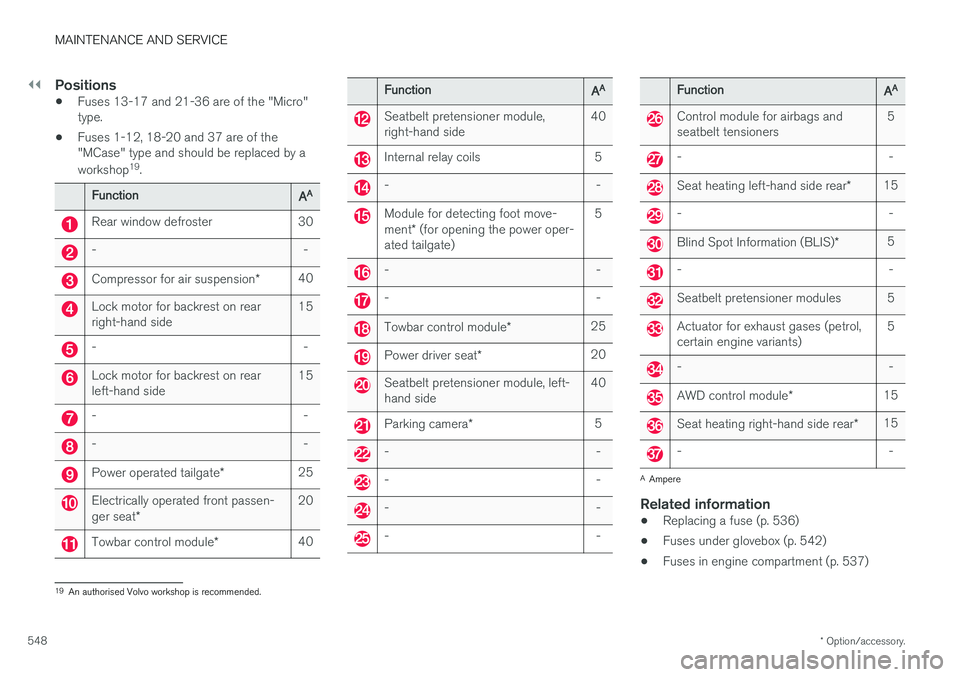
Positions
• Fuses 13-17 and 21-36 are of the "Micro" type.
• Fuses 1-12, 18-20 and 37 are of the"MCase" type and should be replaced by a workshop 19
.
Function AA
Rear window defroster 30
- -
Compressor for air suspension
*40
Lock motor for backrest on rear right-hand side 15
- -
Lock motor for backrest on rear left-hand side15
- -
- -
Power operated tailgate
*25
Electrically operated front passen- ger seat
* 20
Towbar control module
*40
Function
AA
Seatbelt pretensioner module, right-hand side 40
Internal relay coils 5
- -
Module for detecting foot move- ment
* (for opening the power oper-
ated tailgate) 5
- -
- -
Towbar control module
*25
Power driver seat
* 20
Seatbelt pretensioner module, left- hand side 40
Parking camera
* 5
- -
- -
- -
- -
Function
AA
Control module for airbags and seatbelt tensioners 5
- -
Seat heating left-hand side rear
*15
- -
Blind Spot Information (BLIS)
*5
- -
Seatbelt pretensioner modules 5
Actuator for exhaust gases (petrol, certain engine variants) 5
- -
AWD control module
*15
Seat heating right-hand side rear
*15
- -
A
Ampere
Related information
• Replacing a fuse (p. 536)
• Fuses under glovebox (p. 542)
• Fuses in engine compartment (p. 537)
19
An authorised Volvo workshop is recommended.
Page 551 of 594
MAINTENANCE AND SERVICE
}}
549
Cleaning the exterior
The car should be washed as soon as it becomes dirty. This means that the car is easierto clean since the dirt does not attach as firmly.It also reduces the risk of scratches and keepsthe car fresh. Wash the car in a car wash with oilseparator. Use car shampoo.
Handwashing
• Remove bird droppings from the paintwork as soon as possible. Bird droppings containchemicals that affect and discolour paintworkvery quickly. For example, use soft paper orsponge soaked in plenty of water. An author-ised Volvo workshop is recommended for theremoval of any discoloration.
• Hose down the underbody.
• Rinse the entire car until the dissolved dirthas been removed so as to reduce the risk ofscratches from washing. Do not spray directlyonto the locks.
• If necessary, use cold degreasing agent onvery dirty surfaces. Note that in this case, thesurfaces must not be hot from the sun.
• Wash using a sponge, car shampoo andplenty of lukewarm water.
• Clean the wiper blades with a lukewarm soapsolution or car shampoo.
• Dry the car using a clean, soft chamois or awater scraper. If you avoid allowing drops ofwater to dry in strong sunlight, you reduce the risk of water drying stains which mayneed to be polished out.
WARNING
Always have the engine cleaned by a work- shop. There is a risk of fire if the engine is hot.
IMPORTANT
Dirty headlamps have impaired functionality. Clean them regularly, e.g. when refuelling. Do not use any corrosive cleaning agents but use water and a non-scratching spongeinstead.
NOTE
Outside lighting such as headlamps and rear lamps may temporarily have condensation onthe inside of the lens. This is normal, all exte-rior lighting is designed to withstand this.Condensation is normally vented out of thelamp housing when the lamp has beenswitched on for a time.
Automatic car washAn automatic car wash is a simple and quick way of washing the car, but it cannot reach every-where. Washing the car by hand is recommendedto achieve a good result, or to supplement auto-matic car washes with washing by hand.
NOTE
The car must only be washed by hand over the first few months. This is because the paintis more delicate when it is new.
IMPORTANT
Before driving the car into an automatic car wash, deactivate the functions for Automaticbraking when stationary (Auto Hold) andAutomatic application of parking brake. Ifthese functions are not deactivated, the brakesystem will jam when the car is stationary andthe car will not be able to move.
In car washes where the car is towed through with rolling wheels, the following applies:
1. Drive into the automatic car wash.
2. Deactivate the function for automatic braking
when stationary (Auto Hold) using the switch in the tunnel console.
3. Deactivate the function for automatic appli- cation of parking brake via the centre display.
4. Move the gear lever to position N.
Page 552 of 594
||
MAINTENANCE AND SERVICE
* Option/accessory.
550 5. Switch off the engine by turning the start
knob in the tunnel console to STOP. Hold
the knob in STOP position for at least
4 seconds.
> The car is ready for the automatic car wash.
IMPORTANT
The system will automatically switch to P
mode unless the above step is followed. The wheels are locked in P mode, which they
should not be when putting the car through an automatic car wash.
High-pressure washingWhen using high-pressure washing, use sweep- ing movements and make sure that the nozzledoes not come closer than 30 cm to the surfaceof the car. Do not spray directly onto the locks.
Testing the brakesLightly depress the brake pedal now and thenwhen driving long distances in rain or slush. Theheat from the friction causes the brake linings towarm up and dry. Do the same thing after startingin very damp or cold weather.
WARNING
Always test the brakes after washing the car, including the parking brake, to ensure thatmoisture and corrosion do not attack thebrake linings and reduce braking perform-ance.
Wiper bladesAsphalt, dust and salt residue on wiper blades, as well as insects, ice etc. on the windscreen, impairthe service life of wiper blades. When cleaning, set the wiper blades in service position.
NOTE
Wash the wiper blades and windscreen regu- larly with lukewarm soap solution or carshampoo. Do not use any strong solvents.
Exterior plastic, rubber and trim components
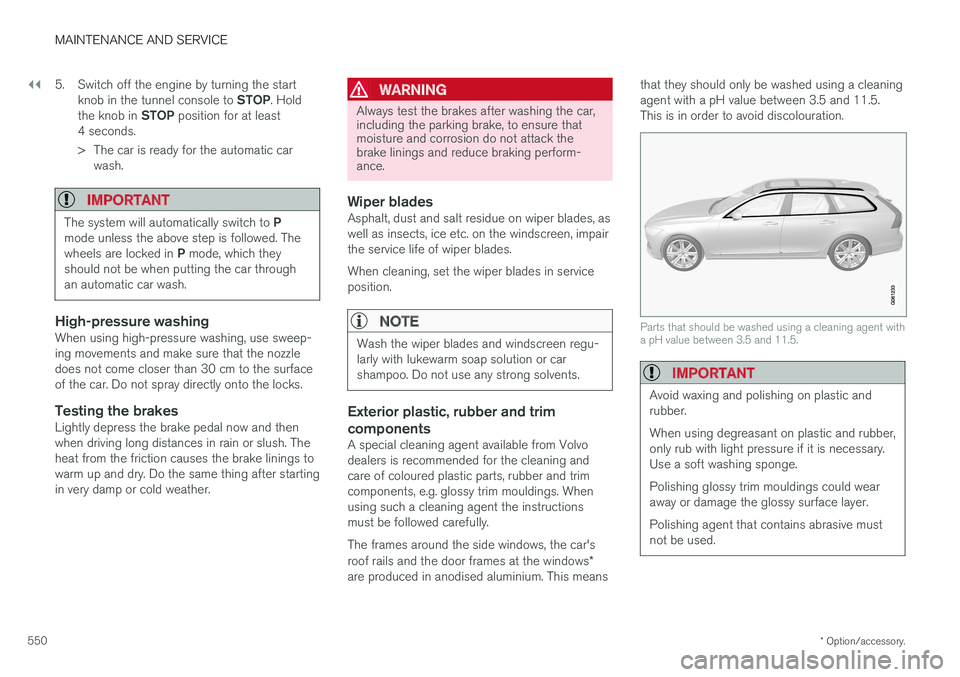
A special cleaning agent available from Volvo dealers is recommended for the cleaning andcare of coloured plastic parts, rubber and trimcomponents, e.g. glossy trim mouldings. Whenusing such a cleaning agent the instructionsmust be followed carefully. The frames around the side windows, the car's roof rails and the door frames at the windows *
are produced in anodised aluminium. This means that they should only be washed using a cleaning agent with a pH value between 3.5 and 11.5.This is in order to avoid discolouration.
Parts that should be washed using a cleaning agent with a pH value between 3.5 and 11.5.
IMPORTANT
Avoid waxing and polishing on plastic and rubber. When using degreasant on plastic and rubber, only rub with light pressure if it is necessary.Use a soft washing sponge. Polishing glossy trim mouldings could wear away or damage the glossy surface layer. Polishing agent that contains abrasive must not be used.
Page 556 of 594
||
MAINTENANCE AND SERVICE
554
IMPORTANT
The microfibre cloth used to clean the centre display must be free from sand and dirt.
IMPORTANT
When cleaning the centre display, only use gentle pressure on the screen. Heavy pres-sure can damage the screen.
IMPORTANT
Do not spray any liquid or caustic chemicals directly on the centre display. Do not use win-dow cleaning agent, other cleaning agents,aerosol spray, solvents, alcohol, ammonia orcleaning agent containing abrasive. Never use abrasive cloths, paper towels or tis- sue paper, these can scratch the centre dis-play.
Related information
•Cleaning the interior (p. 552)
• Overview of the centre display (p. 33)
Paint damage
Paint is an important part of the car's rustproof- ing and should therefore be checked regularly.The most common types of paintwork damageare stone chips, scratches, and marks on theedges of wings, doors and bumpers.
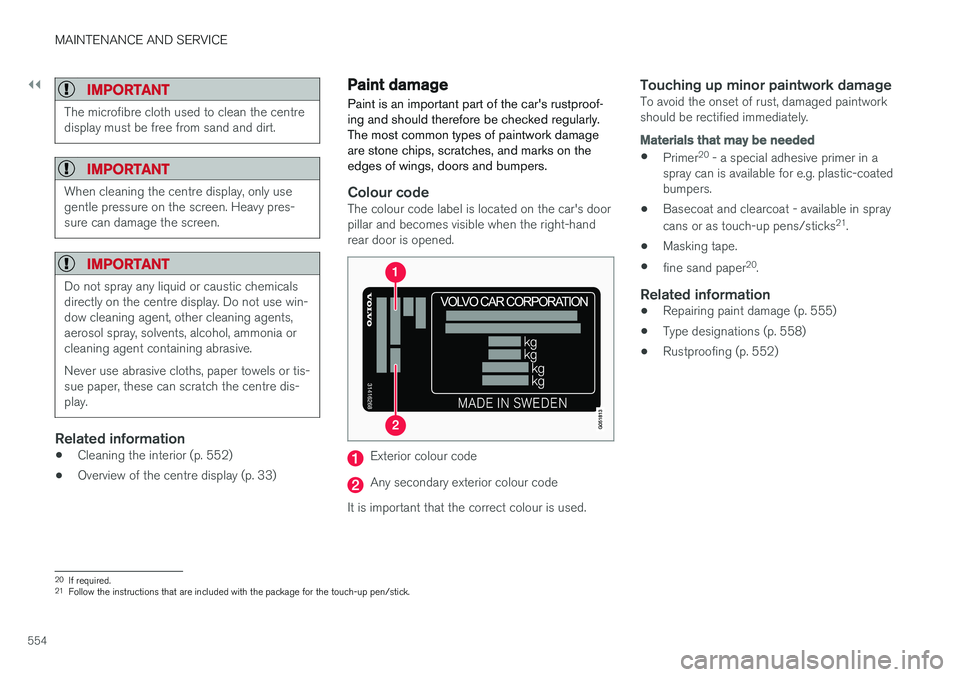
Colour codeThe colour code label is located on the car's door pillar and becomes visible when the right-handrear door is opened.
Exterior colour code
Any secondary exterior colour code
It is important that the correct colour is used.
Touching up minor paintwork damageTo avoid the onset of rust, damaged paintwork should be rectified immediately.
Materials that may be needed
• Primer 20
- a special adhesive primer in a
spray can is available for e.g. plastic-coated bumpers.
• Basecoat and clearcoat - available in spray cans or as touch-up pens/sticks 21
.
• Masking tape.
• fine sand paper 20
.
Related information
• Repairing paint damage (p. 555)
• Type designations (p. 558)
• Rustproofing (p. 552)
20
If required.
21 Follow the instructions that are included with the package for the touch-up pen/stick.
Page 565 of 594
SPECIFICATIONS
563
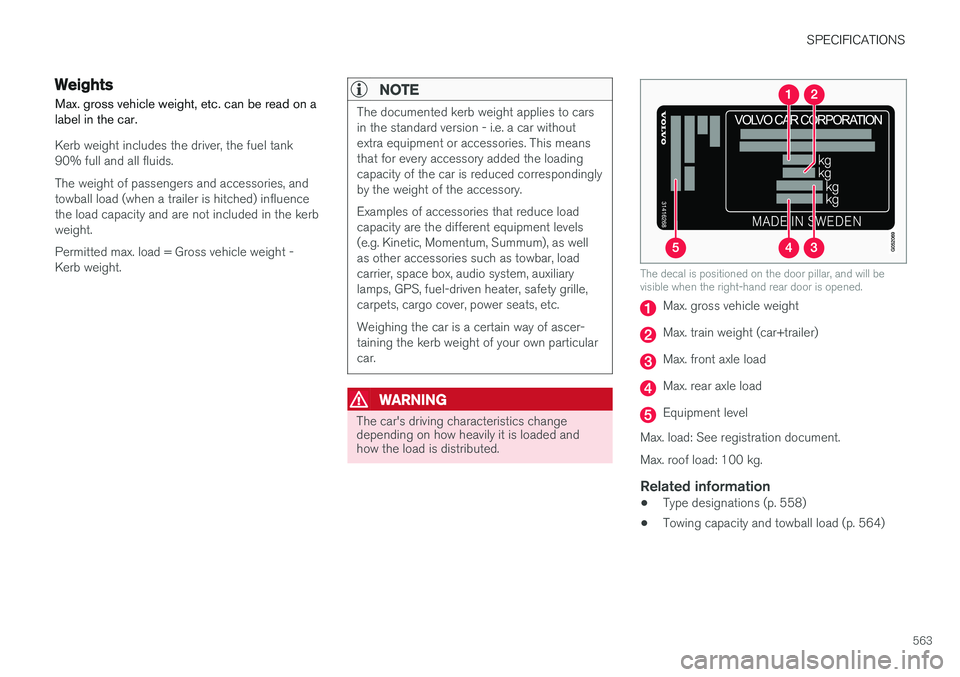
Weights Max. gross vehicle weight, etc. can be read on a label in the car.
Kerb weight includes the driver, the fuel tank 90% full and all fluids. The weight of passengers and accessories, and towball load (when a trailer is hitched) influencethe load capacity and are not included in the kerbweight. Permitted max. load = Gross vehicle weight - Kerb weight.
NOTE
The documented kerb weight applies to cars in the standard version - i.e. a car withoutextra equipment or accessories. This meansthat for every accessory added the loadingcapacity of the car is reduced correspondinglyby the weight of the accessory. Examples of accessories that reduce load capacity are the different equipment levels(e.g. Kinetic, Momentum, Summum), as wellas other accessories such as towbar, loadcarrier, space box, audio system, auxiliarylamps, GPS, fuel-driven heater, safety grille,carpets, cargo cover, power seats, etc. Weighing the car is a certain way of ascer- taining the kerb weight of your own particularcar.
WARNING
The car's driving characteristics change depending on how heavily it is loaded andhow the load is distributed.
The decal is positioned on the door pillar, and will be visible when the right-hand rear door is opened.
Max. gross vehicle weight
Max. train weight (car+trailer)
Max. front axle load
Max. rear axle load
Equipment level
Max. load: See registration document. Max. roof load: 100 kg.
Related information
• Type designations (p. 558)
• Towing capacity and towball load (p. 564)
Page 566 of 594
SPECIFICATIONS
564
Towing capacity and towball load
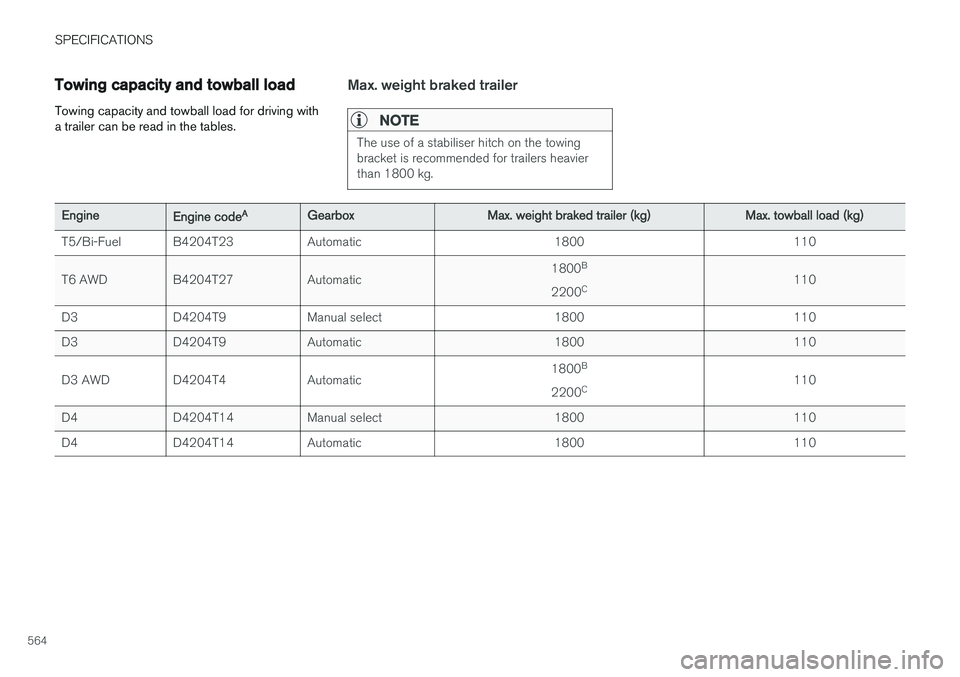
Towing capacity and towball load for driving with a trailer can be read in the tables.Max. weight braked trailer
NOTE
The use of a stabiliser hitch on the towing bracket is recommended for trailers heavierthan 1800 kg.
Engine Engine codeA
Gearbox Max. weight braked trailer (kg) Max. towball load (kg)
T5/Bi-Fuel B4204T23 Automatic 1800 110
T6 AWD B4204T27 Automatic 1800
B
2200 C 110
D3 D4204T9 Manual select 1800 110
D3 D4204T9 Automatic 1800 110
D3 AWD D4204T4 Automatic 1800
B
2200 C 110
D4 D4204T14 Manual select 1800 110
D4 D4204T14 Automatic 1800 110
Page 567 of 594
SPECIFICATIONS
* Option/accessory.565
Engine
Engine codeA
Gearbox Max. weight braked trailer (kg) Max. towball load (kg)
D4 AWD D4204T14 Automatic 1800
B
2200 C 110
D5 AWD D4204T23 Automatic 1800
B
2200 C 110
A
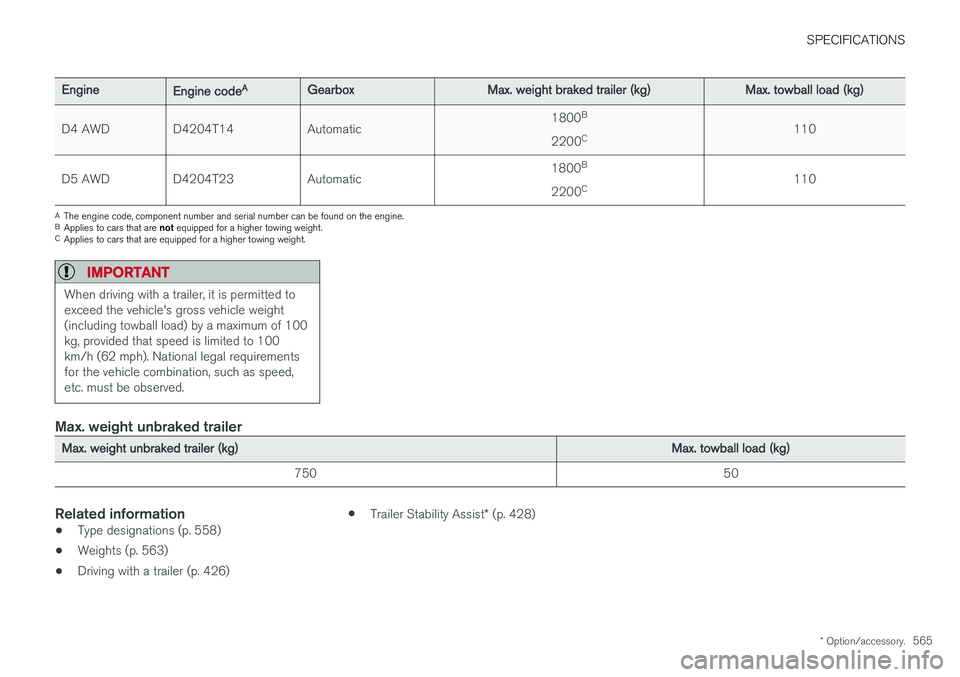
The engine code, component number and serial number can be found on the engine.
B Applies to cars that are not equipped for a higher towing weight.
C Applies to cars that are equipped for a higher towing weight.
IMPORTANT
When driving with a trailer, it is permitted to exceed the vehicle's gross vehicle weight(including towball load) by a maximum of 100kg, provided that speed is limited to 100km/h (62 mph). National legal requirementsfor the vehicle combination, such as speed,etc. must be observed.
Max. weight unbraked trailer
Max. weight unbraked trailer (kg) Max. towball load (kg)
750 50
Related information
•Type designations (p. 558)
• Weights (p. 563)
• Driving with a trailer (p. 426) •
Trailer Stability Assist
* (p. 428)
Page 571 of 594
SPECIFICATIONS
569
Adverse driving conditions for engine oil Adverse driving conditions can lead to abnor- mally high oil temperature or oil consumption.Below are some examples of adverse drivingconditions.
Check the oil level more frequently for long jour- neys:• towing a caravan or trailer
• in mountainous regions
• at high speeds
• in temperatures colder than -30 °C or hotterthan +40 °C.
The above also apply to shorter driving distancesat low temperatures. Choose a fully synthetic engine oil for adverse driving conditions. It provides extra protection forthe engine.
Volvo recommends:
IMPORTANT
In order to fulfil the requirements for the engine's service intervals all engines are filledwith a specially adapted synthetic engine oilat the factory. The choice of oil has beenmade very carefully with regard to service life,starting characteristics, fuel consumption andenvironmental impact. An approved engine oil must be used in order that the recommended service intervals canbe applied. Only use a prescribed grade of oilfor both filling and oil change, otherwise thereis a risk of the service life, starting characte-ristics, fuel consumption and environmentalimpact of the car being affected. If engine oil of the prescribed grade and vis- cosity is not used, engine related componentsmay become damaged. Volvo Car Corporationdisclaims any liability for any such damage. Volvo recommends that oil changes are car- ried out at an authorised Volvo workshop.
Related information
• Engine oil — specifications (p. 567)
• Engine oil (p. 516)
Page 582 of 594
ALPHABETICAL INDEX
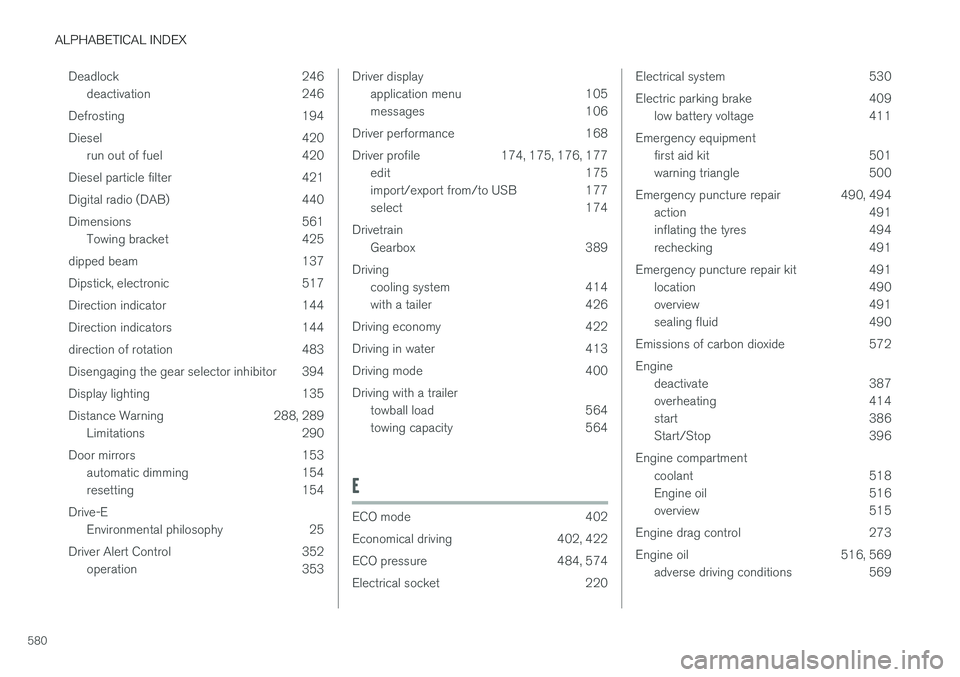
580Deadlock 246
deactivation 246
Defrosting 194
Diesel 420 run out of fuel 420
Diesel particle filter 421
Digital radio (DAB) 440
Dimensions 561 Towing bracket 425
dipped beam 137
Dipstick, electronic 517
Direction indicator 144
Direction indicators 144
direction of rotation 483
Disengaging the gear selector inhibitor 394
Display lighting 135
Distance Warning 288, 289 Limitations 290
Door mirrors 153 automatic dimming 154
resetting 154
Drive-E Environmental philosophy 25
Driver Alert Control 352 operation 353
Driver display
application menu 105
messages 106
Driver performance 168
Driver profile 174, 175, 176, 177 edit 175
import/export from/to USB 177
select 174
Drivetrain Gearbox 389
Driving cooling system 414
with a tailer 426
Driving economy 422
Driving in water 413
Driving mode 400Driving with a trailer towball load 564
towing capacity 564
E
ECO mode 402
Economical driving 402, 422
ECO pressure 484, 574
Electrical socket 220
Electrical system 530
Electric parking brake 409low battery voltage 411
Emergency equipment first aid kit 501
warning triangle 500
Emergency puncture repair 490, 494 action 491
inflating the tyres 494
rechecking 491
Emergency puncture repair kit 491 location 490
overview 491
sealing fluid 490
Emissions of carbon dioxide 572 Engine deactivate 387
overheating 414
start 386
Start/Stop 396
Engine compartment coolant 518
Engine oil 516
overview 515
Engine drag control 273
Engine oil 516, 569 adverse driving conditions 569
Page 588 of 594
ALPHABETICAL INDEX
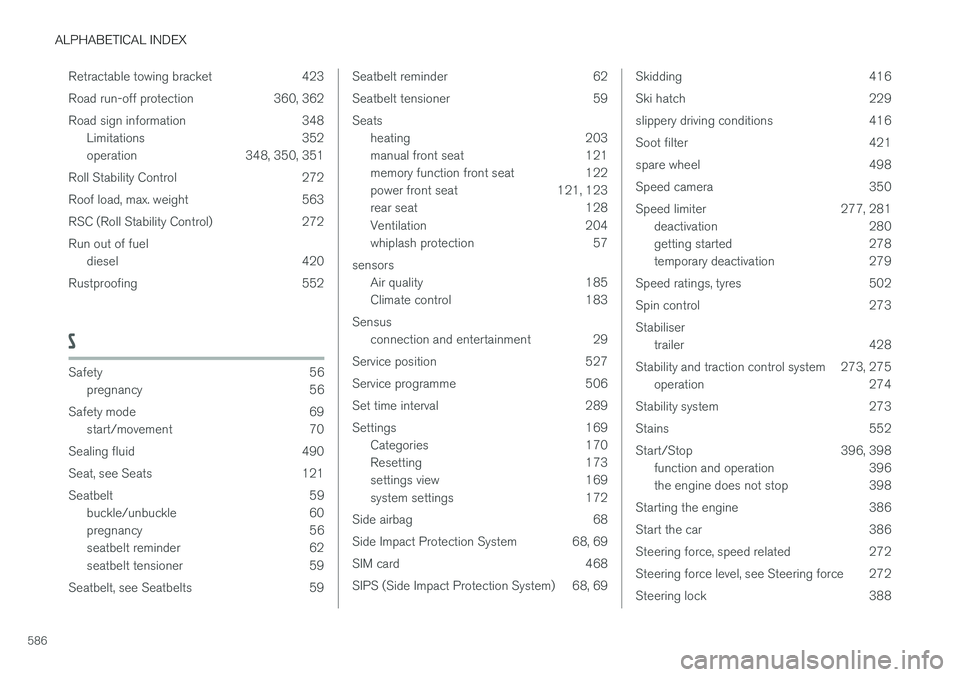
586Retractable towing bracket 423
Road run-off protection 360, 362
Road sign information 348
Limitations 352
operation 348, 350, 351
Roll Stability Control 272
Roof load, max. weight 563
RSC (Roll Stability Control) 272Run out of fuel diesel 420
Rustproofing 552
S
Safety 56 pregnancy 56
Safety mode 69 start/movement 70
Sealing fluid 490
Seat, see Seats 121
Seatbelt 59 buckle/unbuckle 60
pregnancy 56
seatbelt reminder 62
seatbelt tensioner 59
Seatbelt, see Seatbelts 59
Seatbelt reminder 62
Seatbelt tensioner 59Seats heating 203
manual front seat 121
memory function front seat 122
power front seat 121, 123
rear seat 128
Ventilation 204
whiplash protection 57
sensors Air quality 185
Climate control 183
Sensus connection and entertainment 29
Service position 527
Service programme 506
Set time interval 289
Settings 169 Categories 170
Resetting 173
settings view 169
system settings 172
Side airbag 68
Side Impact Protection System 68, 69
SIM card 468
SIPS (Side Impact Protection System) 68, 69Skidding 416
Ski hatch 229
slippery driving conditions 416
Soot filter 421
spare wheel 498
Speed camera 350
Speed limiter 277, 281 deactivation 280
getting started 278
temporary deactivation 279
Speed ratings, tyres 502
Spin control 273Stabiliser trailer 428
Stability and traction control system 273, 275 operation 274
Stability system 273
Stains 552
Start/Stop 396, 398 function and operation 396
the engine does not stop 398
Starting the engine 386
Start the car 386
Steering force, speed related 272
Steering force level, see Steering force 272
Steering lock 388