maintenance VOLVO V90 2017 Owners Manual
[x] Cancel search | Manufacturer: VOLVO, Model Year: 2017, Model line: V90, Model: VOLVO V90 2017Pages: 594, PDF Size: 15.07 MB
Page 3 of 594
VÄLKOMMEN!
We hope you will enjoy many years of driving pleasure in your Volvo. The car has been designed for the safety and comfort of you and your pas-sengers. Volvo is one of the world's safest passenger vehicles. YourVolvo is also designed to meet applicable safety and environmentalrequirements.In order to increase your enjoyment of your Volvo, we recommend thatyou read the instructions and maintenance information in this owner'smanual. The owner's manual is also available as a mobile app (VolvoManual) and on the Volvo Cars support site (support.volvocars.com).
Page 4 of 594
2
INTRODUCTION
This is how you find owner's information14
Digital owner's manual in the car 15
Navigating in the digital owner's manual 16
Owner's Manual in mobile devices 18
Volvo Cars support site 19
Reading the owner's manual 19
Recording data 22
Important information on accesso- ries, extra equipment and diagnosticsocket 23
Volvo ID 23
Drive-E - cleaner driving pleasure 25
IntelliSafe-driver support 28
Sensus - connection and maintenance 29
The owner's manual and the environment 32
Windows, glass and mirrors 32
Overview of the centre display 33
Operating the centre display 36
Navigating in the centre display's views 40
Symbols in the centre display's status bar 45
Change settings for the centre display 45
Function view with buttons for carfunctions 47
Using the keyboard in the centre display 49
Writing characters/letters by handon the screen 53
Introduction to vehicle gas (Bi-Fuel)
*
54
SAFETY
Safety
56
Safety during pregnancy 56
Whiplash Protection System 57
Pedestrian Protection System 58
Seatbelt 59
Seatbelt tensioner 59
Fastening/unfastening a seatbelt 60
Door and seatbelt reminder 62
Airbags 63
Driver and passenger airbags 64
Activating/deactivating the passen- ger airbag * 66
Side airbag 68
Inflatable curtain 69
Safety mode 69
Starting/moving the car after safety mode 70
Child safety 71
Child seats 71
Upper mounting points for child seats 73
Lower mounting points for child seats 74
Table for location of child seatsusing the car's seatbelts 75
i-Size/ISOFIX mounting points 77
Table for location of ISOFIX child seats 78
TABLE OF CONTENTS
Page 12 of 594
10
WHEELS AND TYRES
Tyres482
Tyres' rotation direction 483
Tread wear indicators on the tyres 484
Checking the tyre pressures 484
Tyre monitoring *
485
Checking tyre pressure with the tyre monitoring system * 487
Rectifying low tyre pressure with tyremonitoring * 488
Calibrating tyre monitoring *
489
Emergency puncture repair kit 490
Using the emergency puncture repair kit 491
Inflate tyres with the compressor from the emergency puncture repair kit 494
When changing wheels 495
Removing a wheel 495
Fitting the wheels 497
Wheel bolts 498
Spare wheel *
498
Winter wheels 499
Tool kit 500
Warning triangle 500
Jack *
501
First aid kit 501
Dimension designation for wheel rim 502
Dimension designation for tyre502
MAINTENANCE AND SERVICE
Volvo service programme506
Car status 506
Book service and repair 506
Inspection and service of the system for vehicle gas * 509
Remote updates 509
System updates 510
Data transmission between car and workshop 511
Raise the car 512
Opening and closing the bonnet 514
Engine compartment overview 515
Engine oil 516
Checking and filling with engine oil 517
Topping up coolant 518
Servicing the climate control system 520
Bulb replacement 520
Replacing the dipped beam bulb 522
Replacing the main beam lamp 523
Replacing daytime running lightbulb/position lamp bulb, front 524
Replacing the front direction indica-tor bulb 524
Replacing the reversing lamp bulb 525
Replacing the rear fog lamp bulb 526
Bulb specifications 526
Page 24 of 594
INTRODUCTION
22
Recording data As part of Volvo's safety and quality assurance, certain information about the vehicle's operation,functionality and incidents are recorded in thecar.
This vehicle is equipped with an "Event Data Recorder" (EDR). Its primary purpose is to regis-ter and record data related to traffic accidents orcollision-like situations, such as times when theairbag deploys or the vehicle strikes an obstaclein the road. The data is recorded in order toincrease understanding of how vehicle systemswork in these types of situations. The EDR isdesigned to record data related to vehicledynamics and safety systems for a short time,usually 30 seconds or less. The EDR in this vehicle is designed to record data related to the following in the event of trafficaccidents or collision-like situations: •How the various systems in the car worked
• Whether the driver and passenger seatbelts were fastened/tensioned
• The driver's use of the accelerator or brakepedal
• The travel speed of the vehicle
This information can help us better understandthe circumstances in which traffic accidents, inju-ries and damage occur. The EDR only recordsdata when a non-trivial collision situation occurs.The EDR does not record any data during normal driving conditions. Similarly, the system neverregisters who is driving the vehicle or the geo-graphic location of the accident or near-miss sit-uation. However, other parties, such as the police,could use the recorded data in combination withthe type of personally identifiable informationroutinely collected after a traffic accident. Specialequipment and access to either the vehicle or theEDR is required to be able to interpret the regis-tered data. In addition to the EDR, the car is equipped with a number of computers designed to continuallycheck and monitor the function of the car. Theycan record data during normal driving conditions,but in particular register faults affecting the vehi-cle's operation and functionality, or upon activa-tion of the vehicle's driver support function (e.g.City Safety and the auto brake function). Some of the recorded data is required to enable service and maintenance technicians to diagnoseand remedy any faults that occurred in the vehi-cle. The registered information is also needed toenable Volvo to satisfy legal requirements laid outin laws and by government authorities. Informa-tion registered in the vehicle is stored in its com-puter until the vehicle is serviced or repaired. In addition to the above, the registered informa- tion can be used in aggregate form for researchand product development with the aim of contin-uously improving the safety and quality of Volvocars.
Volvo will not contribute to the above-describedinformation being disclosed to third parties with-out the vehicle owner's consent. To comply withnational legislation and regulations, Volvo may beforced to disclose information of this nature tothe police or other authorities who may assert alegal right to access such. Special technicalequipment which Volvo and workshops that haveentered into agreements with Volvo have accessto is required to be able to read and interpret therecorded data. Volvo is responsible that the infor-mation, which is transferred to Volvo during serv-icing and maintenance, is securely stored andmanaged and that its management complies withrelevant legal requirements. For further informa-tion - contact a Volvo dealer.
Page 28 of 594
||
INTRODUCTION
* Option/accessory.
26
Contributing to a better environment
An energy-efficient and fuel-efficient car not only contributes to a reduced impact on the environ-ment, but also means reduced costs for theowner of the car. As the driver, it is easy toreduce fuel consumption and thereby savemoney and contribute to a better environment -here is some advice:
• Plan for an effective average speed. Speedsabove approx. 80 km/h (approx. 50 mph)and below 50 km/h (approx. 30 mph) lead toincreased energy consumption.
• Follow the Service and Warranty Booklet'srecommended intervals for service and main-tenance of the car.
• Avoid letting the engine idle - switch off theengine when stationary for longer periods.Pay attention to local regulations.
• Plan the journey - a lot of unnecessary stopsand uneven speed contribute to increasedfuel consumption.
• Use preconditioning
* before starting in cold
conditions - it improves starting capacity andreduces wear in cold weather. The enginereaches normal operating temperature morequickly, which decreases consumption andreduces emissions.
Also remember to always dispose of environmen-tally hazardous waste, such as batteries and oil, inan environmentally safe manner. Consult a work-shop in the event of uncertainty about how this type of waste should be discarded - an author-ised Volvo workshop is recommended.
Efficient emission controlYour Volvo is manufactured following the concept"Clean inside and out" – a concept that encom-passes a clean interior environment as well ashighly efficient emission control. In many casesthe exhaust emissions are well below the applica-ble standards.
Clean air in the passenger
compartment
A passenger compartment filter prevents dustand pollen from entering the passenger compart-ment via the air intake. The Interior Air Quality System (IAQS) * ensures
that the incoming air is cleaner than the air in the traffic outside. The system cleans the air in the passenger com- partment from contaminants such as particles,hydrocarbons, nitrous oxides and ground-levelozone. If the outside air is contaminated then theair intake is closed and the air is recirculated.Such a situation may arise in heavy traffic,queues and tunnels for example. IAQS is a part of the Clean Zone Interior Pack- age (CZIP) *, which also includes a function that
allows the fan to start when the car is unlocked with the remote control key.
InteriorThe material used in the interior of a Volvo iscarefully selected and has been tested in order tobe pleasant and comfortable. Some of the detailsare hand-made, such as the seams of the steer-ing wheel that are sewn by hand. The interior ismonitored in order not to emit strong odours orsubstances that cause discomfort in the event ofe.g. high heat and bright light.
Volvo workshops and the environmentRegular maintenance creates the conditions for along service life and low fuel consumption foryour car. In this way you also contribute to acleaner environment. When Volvo's workshopsare entrusted with the service and maintenanceof your car it becomes part of Volvo's system.Volvo makes clear demands regarding the way inwhich workshop premises shall be designed inorder to prevent spills and discharges into theenvironment. The workshop staff have the knowl-edge and the tools required to guarantee goodenvironmental care.
RecyclingSince Volvo works from a life cycle perspective, itis also important that the car is recycled in anenvironmentally sound manner. Almost all of thecar can be recycled. The last owner of the car istherefore requested to contact a dealer for refer-ral to a certified/approved recycling facility.
Page 31 of 594
INTRODUCTION
}}
* Option/accessory.29
Sensus - connection and maintenance
Sensus makes it possible to surf the Internet, use different types of apps and make the car aWi-Fi hotspot.
This is Sensus
Sensus offers an intelligent interface and online connectivity with the digital world. An intuitivenavigation structure makes it possible to receiverelevant support, information and entertainmentwhen it is necessary, without distracting thedriver. Sensus covers all solutions in the car that are connected with entertainment, online connectiv- ity, navigation * and the user interface between
driver and car. It is Sensus that makes communi- cation possible between you, the car and the out-side world.
Information when it is needed, where it is needed
The different displays in the car provide informa- tion at the right time. The information is shown indifferent locations based on how it should be pri-oritised by the driver.
Page 41 of 594
INTRODUCTION
39
NOTE
Hide the apps that you rarely or never use by moving them to the bottom, off the visiblescreen. This way it will be easier to find theapps you use more often.
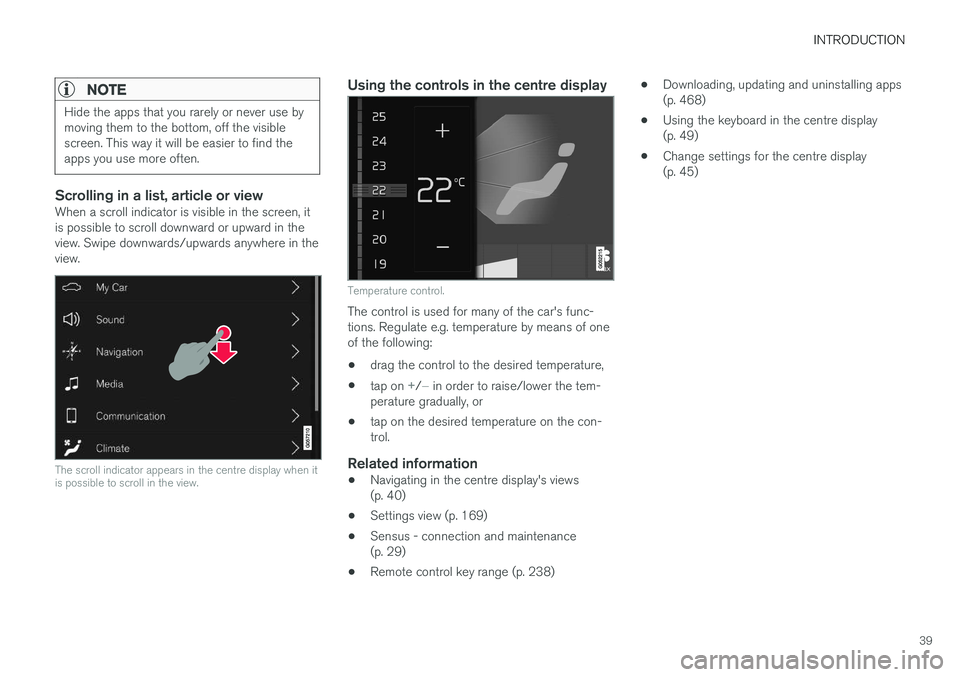
Scrolling in a list, article or viewWhen a scroll indicator is visible in the screen, it is possible to scroll downward or upward in theview. Swipe downwards/upwards anywhere in theview.
The scroll indicator appears in the centre display when it is possible to scroll in the view.
Using the controls in the centre display
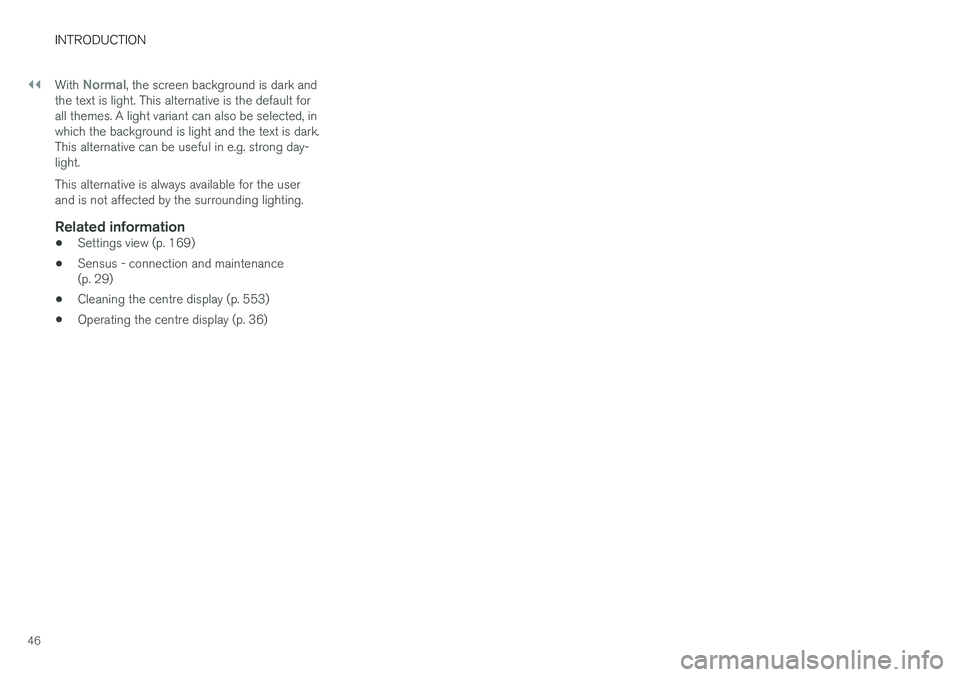
Temperature control.
The control is used for many of the car's func- tions. Regulate e.g. temperature by means of oneof the following: •drag the control to the desired temperature,
• tap on
+/− in order to raise/lower the tem-
perature gradually, or
• tap on the desired temperature on the con- trol.
Related information
•
Navigating in the centre display's views(p. 40)
• Settings view (p. 169)
• Sensus - connection and maintenance(p. 29)
• Remote control key range (p. 238) •
Downloading, updating and uninstalling apps(p. 468)
• Using the keyboard in the centre display(p. 49)
• Change settings for the centre display(p. 45)
Page 48 of 594
||
INTRODUCTION
46With
Normal, the screen background is dark and
the text is light. This alternative is the default for all themes. A light variant can also be selected, inwhich the background is light and the text is dark.This alternative can be useful in e.g. strong day-light. This alternative is always available for the user and is not affected by the surrounding lighting.
Related information
• Settings view (p. 169)
• Sensus - connection and maintenance(p. 29)
• Cleaning the centre display (p. 553)
• Operating the centre display (p. 36)
Page 109 of 594
INSTRUMENTS AND CONTROLS
}}
107
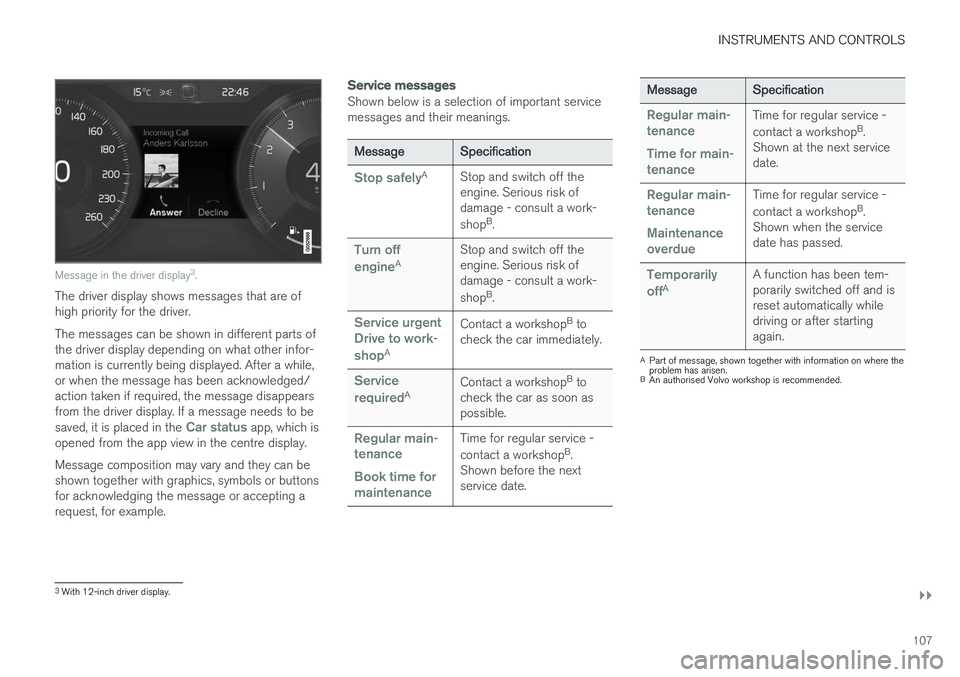
Message in the driver display3
.
The driver display shows messages that are of high priority for the driver. The messages can be shown in different parts of the driver display depending on what other infor-mation is currently being displayed. After a while,or when the message has been acknowledged/action taken if required, the message disappearsfrom the driver display. If a message needs to be saved, it is placed in the
Car status app, which is
opened from the app view in the centre display. Message composition may vary and they can be shown together with graphics, symbols or buttonsfor acknowledging the message or accepting arequest, for example.
Service messages
Shown below is a selection of important service messages and their meanings.
Message Specification
Stop safelyA
Stop and switch off the engine. Serious risk ofdamage - consult a work- shopB
.
Turn off engineA Stop and switch off the engine. Serious risk ofdamage - consult a work- shop
B
.
Service urgent Drive to work- shop
A Contact a workshop
B
to
check the car immediately.
Service requiredA Contact a workshop
B
to
check the car as soon as possible.
Regular main- tenance Book time for maintenanceTime for regular service - contact a workshop B
.
Shown before the next service date.
Message Specification
Regular main- tenance Time for main- tenanceTime for regular service - contact a workshopB
.
Shown at the next service date.
Regular main- tenance Maintenance overdueTime for regular service - contact a workshop B
.
Shown when the service date has passed.
Temporarily offA A function has been tem- porarily switched off and isreset automatically whiledriving or after startingagain.
A
Part of message, shown together with information on where the problem has arisen.
B An authorised Volvo workshop is recommended.
3With 12-inch driver display.
Page 293 of 594
DRIVER SUPPORT
}}
291
is clear again the car returns to the selected speed.
WARNING
The Adaptive cruise control is an aid, which cannot handle all traffic, weather and roadconditions. The driver must always be observant with regard to the prevailing traffic conditions andintervene if the Adaptive cruise control doesnot maintain a suitable speed or suitable timeinterval. Read all the sections about the adaptive cruise control in the owner's manual in orderto learn about its limitations, of which thedriver should be aware before the function isused. The driver always bears responsibility for maintaining the correct time interval andspeed - even when the Adaptive cruise con-trol is being used.
Adaptive cruise control regulates the speed with acceleration and braking. It is normal for thebrakes to emit a low sound when they are beingused to adjust the speed. The adaptive cruise control aims to control the speed in a smooth way. In situations that demandsudden braking the driver must brake himself/herself. This applies in case of large speed differ- ences or if the vehicle in front brakes suddenly.Due to the limitations of the radar unit, brakingmay come unexpectedly or not at all. The adaptive cruise control aims to follow the vehicle ahead in the same lane at a time intervalset by the driver. If the radar unit cannot see anyvehicle in front then the car will instead maintainthe speed set and stored by the driver. This alsotakes place if the speed of the vehicle aheadincreases and exceeds the stored speed. The following applies for cars with automatic gearbox:
• Adaptive cruise control can follow anothervehicle at speed from 0 km/h up to200 km/h (125 mph).
The following applies for cars with manual gear-box: • The Adaptive cruise control can follow another vehicle at speeds from 30 km/h(20 mph) up to 200 km/h (125 mph).
WARNING
Adaptive cruise control is not a collision avoid- ance system. The driver must intervene if thesystem does not detect a vehicle in front. The adaptive cruise control does not brake for humans or animals, and not for small vehiclessuch as bicycles and motorcycles. Nor for lowtrailers, oncoming, slow or stationary vehiclesand objects. Do not use the Adaptive cruise control, for example, in city traffic, at junctions, on slipperysurfaces, with a lot of water or slush on theroad, in heavy rain/snow, in poor visibility, onwinding roads or on slip roads.
IMPORTANT
Maintenance of adaptive cruise control com- ponents must only be performed at a work-shop - an authorised Volvo workshop is rec-ommended.