fog light VOLVO XC60 2009 Owner´s Manual
[x] Cancel search | Manufacturer: VOLVO, Model Year: 2009, Model line: XC60, Model: VOLVO XC60 2009Pages: 297, PDF Size: 21.16 MB
Page 170 of 297
04 Comfort and driving pleasureCity Safety™ 04
168 1.
Use the thumb wheel to scroll until City
Safety is displayed.
2. Press the RESET button for approximately
1 second until Off is displayed.
WARNINGThe laser sensor emits light when the igni-
tion is in mode II or higher, even if City
Safety™ has been switched off.
To switch City Safety™ on again:
\b
Follow the same procedure as for switch-
ing City Safety™ off but select On by
pressing RESET.
or
\b Vehicles not equipped with keyless
drive: Press lightly on the remote key to
release it partially from the ignition slot.
Press the remote key into the ignition slot
again. Depress the brake pedal and press
the START/STOP ENGINE button to start
the engine. This restarts City Safety™
.
\b Vehicles equipped with the optional
keyless drive: Press the START/STOP
ENGINE button to switch off the engine.
Depress the brake pedal and press the
START/STOP ENGINE button to start the
engine. This restarts City Safety™.
See page 79 for information on ignition modes. City Safety™ will be automatically switched on
the next time the engine is started, even if it was
off when the engine was switched off.
Limitations
The sensor used by City Safety™ is designed
to detect cars and other larger motor vehicles
ahead of your vehicle in both daylight and dark-
ness.
However, there are certain limitations and the
laser sensor’s function may be reduced by, for
example, heavy rain or snowfall, or by dense
fog or thick, blowing dust or snow. Condensa-
tion, dirt, ice or snow on the windshield may
also interfere with the sensor’s function.
Objects such as warning flags hanging from
long objects on the roof or accessories such as
auxiliary lights or protective arches on the front
of the vehicle that are higher than the hood may
also impede the sensor’s function.
Braking distance to the vehicle ahead increa-
ses on slippery road surfaces, which may
reduce City Safety’s capacity to avoid a colli-
sion. In situations like this, the DSTC system
(see page 155) will help provide the best pos-
sible braking capacity and stability.
City Safety™ emits infrared light and measures
the way in which the light is reflected. There-
fore, vehicles or objects with low-reflective sur-faces may not be detected. Normally, the
license plate and taillight reflectors give the
rear section of a vehicle ahead sufficient reflec-
tive surfaces to be detected.
NOTE
\b
Keep the windshield in front of the laser
sensor free of ice, snow, dirt, etc. See
the illustration on page
167
\b Snow or ice on the hood deeper than
2 inches (5 cm) may obstruct the sen-
sor. Keep the hood free of ice and snow.
\b Do not mount or in any way attach any-
thing on the windshield that could
obstruct the laser sensor. Troubleshooting
If Windshield sensors blocked appears in
the information display, this indicates that the
City Safety™ laser sensor is obstructed in
some way and cannot detect vehicles ahead of
you, which means that the system is not func-
tioning.
However, this message will not be displayed in
all situations in which the sensor is obstructed.
For this reason, the driver must ensure that the
area of the windshield in front of the sensor is
always kept clean.
Page 196 of 297
04 Comfort and driving pleasureBlind Spot Information System* 04
194
* Option/accessory, for more information, see Introduction.
When does BLIS function
The system functions when your vehicle is
moving at speeds above 6 mph (10 km/h).
When you pass another vehicle:The system reacts when you pass another
vehicle at a speed of up to 6 mph (10 km/h)
faster than that vehicle.
When you are passed by another vehicle:The system reacts if your vehicle is passed by
another vehicle at a speed of up to 43 mph
(70 km/h) faster than your vehicle.
WARNING
\b
BLIS does not function in sharp curves.
\b BLIS does not function when your vehi-
cle is backing up.
\b If you are towing a wide trailer, this may
prevent the BLIS cameras from detect-
ing other vehicles in adjacent lanes.
How BLIS functions in daylight and
darkness
Daylight
BLIS reacts to the shape of surrounding vehi-
cles. The system is designed to help detect
motor vehicles such as cars, trucks, buses,
motorcycles, etc.
DarknessBLIS reacts to the headlights of surrounding
vehicles. In order to be detected by BLIS, a
vehicle in the blind area must have its head-
lights on. This means, for example, that the
system will not detect a trailer without head-
lights that is being towed behind a car or truck.WARNING \b
BLIS does not react to cyclists or
mopeds.
\b BLIS does not react to vehicles that are
standing still.
\b The function of the BLIS cameras may
be affected by intense light, or when
driving at night in areas where there are
no external sources of light (e.g., street
lights, other vehicles, etc.). In such
cases, the system may react as if the
cameras were obscured.
\b In both of the above mentioned condi-
tions, a message will appear in the infor-
mation display.
\b When driving in such conditions, the
system\fs function will be limited or it
may be temporarily switched off, see
page 195 for instructions.
\b When the message is no longer dis-
played, BLIS will return to normal func-
tion.
\b The BLIS cameras have the same limi-
tation as the human eye. In other words,
their "vision is impaired" by adverse
weather conditions such as heavy
snowfall, dense fog, etc.
Page 198 of 297
04 Comfort and driving pleasureBlind Spot Information System* 04
196
* Option/accessory, for more information, see Introduction.switched off, and a text message is dis-
played.
\b BLIS can be switched on again by pressing
the button. The indicator light in the button
will illuminate and a new text message will
be displayed. Press the READ button (
see
page 123) to erase the message.
BLIS system messages Text in the dis-
play System status
Blind spot syst.
service required BLIS not functioning
properly. Contact an
authorized Volvo
service technician.
Blind spot syst.
camera blocked BLIS camera
obscured. Clean the
lenses.
Blind-spot info
system ON BLIS system on Text in the dis-
play System status
Blind-spot info
system off BLIS system off
Blind spot syst.
reduced function The BLIS cameras\f
function has been
reduced by e.g., fog,
or strong sunlight
directly into the
camea. The camera
will reset itself when
these conditions
have changed. have
been function
reduced
Page 234 of 297
06 Maintenance and specificationsReplacing bulbs 06
232
* Option/accessory, for more information, see Introduction.
Introduction
All bulb specifications are listed on page 238.
The following bulbs should only be replaced by
a trained and qualified Volvo service techni-
cian:
\b
Dome lighting
\b Reading lights
\b Glove compartment lighting
\b Turn signals in the door mirrors
\b Approach lighting in the door mirror
\b Parking lights
\b Rear side parking lights
\b Active Dual Xenon and LED bulbs
NOTE For information regarding any other bulbs
not mentioned in this section, please con-
tact your Volvo retailer or a trained and
authorized Volvo service technician.
WARNING \b
Active Dual Xenon headlights* – due to
the high voltage used by these head-
lights, these bulbs should only be
replaced by a trained and qualified
Volvo service technician.
\b Turn off the lights and remove the
remote key from the ignition before
changing any bulbs. Headlight housing
WARNING
\b
The engine should not be running when
changing bulbs.
\b When changing in the headlight hous-
ing, if the engine has been running just
prior to replacing bulbs, please be
aware that components in the engine
compartment will be hot. The entire headlight housing must be lifted out
when replacing all front bulbs (except for the
fog lights). G031935 G031936
Page 238 of 297
06 Maintenance and specificationsReplacing bulbs 06
236 1. Remove the headlight housing from the
vehicle (see page 233).
2. Remove the bulb holder by turning it coun-
terclockwise and pulling it out of the head-
light housing.
3. Pull out the burned out bulb and install a new one. It can only be inserted in one
position.
4. Reinsert the bulb holder into the headlight housing and turn it clockwise.
5. Reinstall the headlight housing.
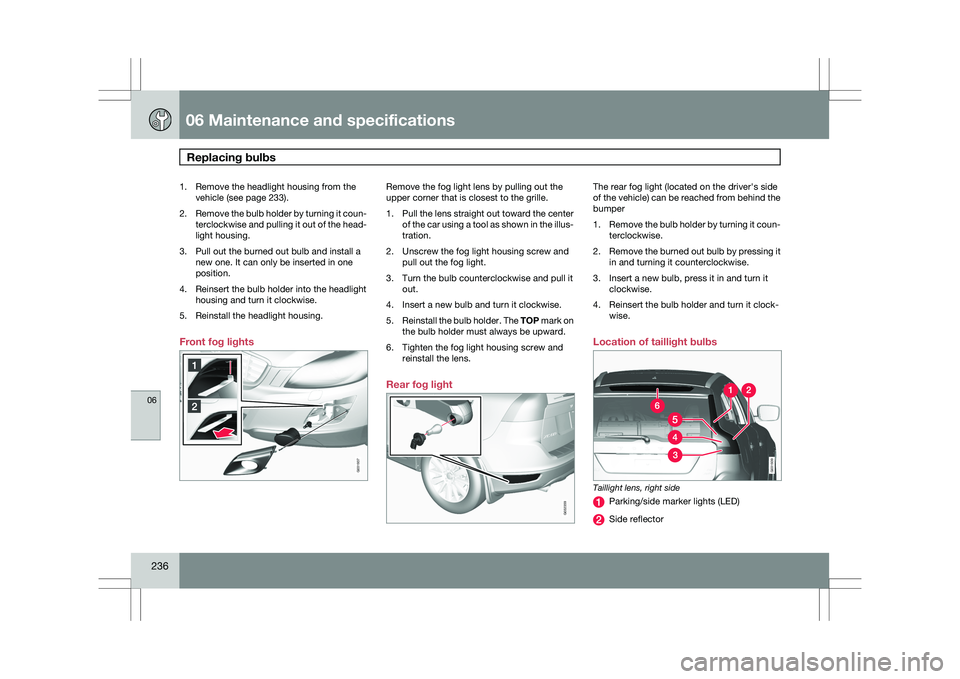
Front fog lights Remove the fog light lens by pulling out the
upper corner that is closest to the grille.
1.
Pull the lens straight out toward the center
of the car using a tool as shown in the illus-
tration.
2. Unscrew the fog light housing screw and pull out the fog light.
3. Turn the bulb counterclockwise and pull it out.
4. Insert a new bulb and turn it clockwise.
5. Reinstall the bulb holder. The TOP mark on
the bulb holder must always be upward.
6. Tighten the fog light housing screw and reinstall the lens.
Rear fog light The rear fog light (located on the driver\fs side
of the vehicle) can be reached from behind the
bumper
1.
Remove the bulb holder by turning it coun-
terclockwise.
2. Remove the burned out bulb by pressing it
in and turning it counterclockwise.
3. Insert a new bulb, press it in and turn it clockwise.
4. Reinsert the bulb holder and turn it clock- wise.
Location of taillight bulbs Taillight lens, right side
Parking/side marker lights (LED)
Side reflector G031937 G032359 G031939
Page 240 of 297
06 Maintenance and specificationsReplacing bulbs 06
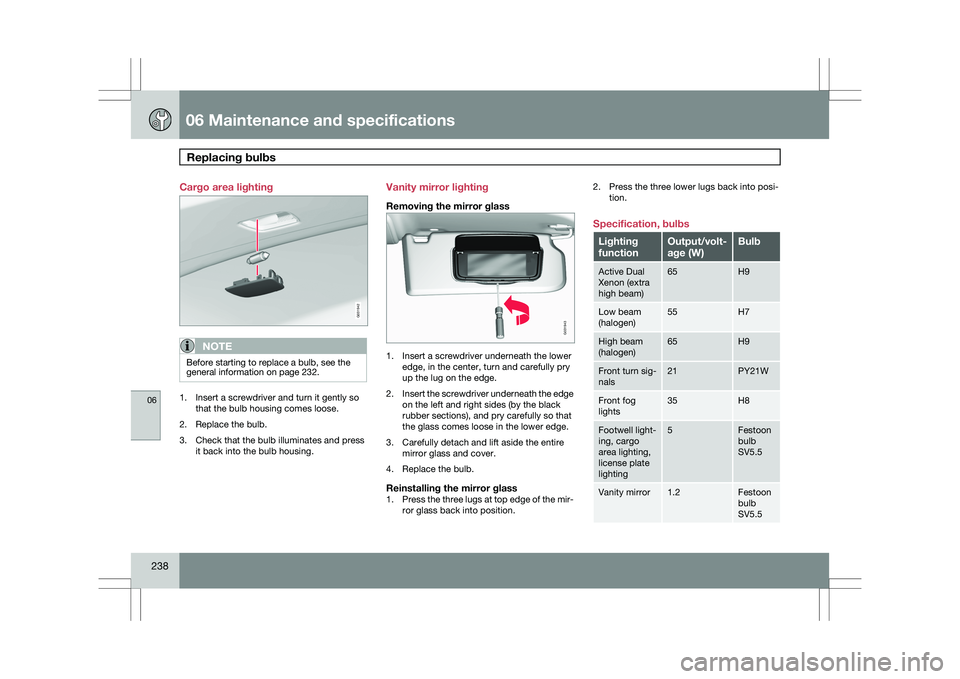
238 Cargo area lighting
NOTE
Before starting to replace a bulb, see the
general information on page 232.
1. Insert a screwdriver and turn it gently so
that the bulb housing comes loose.
2. Replace the bulb.
3. Check that the bulb illuminates and press it back into the bulb housing. Vanity mirror lighting
Removing the mirror glass
1. Insert a screwdriver underneath the lower
edge, in the center, turn and carefully pry
up the lug on the edge.
2. Insert the screwdriver underneath the edge
on the left and right sides (by the black
rubber sections), and pry carefully so that
the glass comes loose in the lower edge.
3. Carefully detach and lift aside the entire mirror glass and cover.
4. Replace the bulb.
Reinstalling the mirror glass1. Press the three lugs at top edge of the mir-
ror glass back into position. 2. Press the three lower lugs back into posi-
tion.
Specification, bulbs Lighting
function Output/volt-
age (W) Bulb
Active Dual
Xenon (extra
high beam) 65 H9
Low beam
(halogen) 55 H7
High beam
(halogen) 65 H9
Front turn sig-
nals 21 PY21W
Front fog
lights 35 H8
Footwell light-
ing, cargo
area lighting,
license plate
lighting 5 Festoon
bulb
SV5.5
Vanity mirror 1.2 Festoon
bulb
SV5.5 G031942 G031943
Page 251 of 297
06 Maintenance and specifications
Fuses06
}}
* Option/accessory, for more information, see Introduction. 249
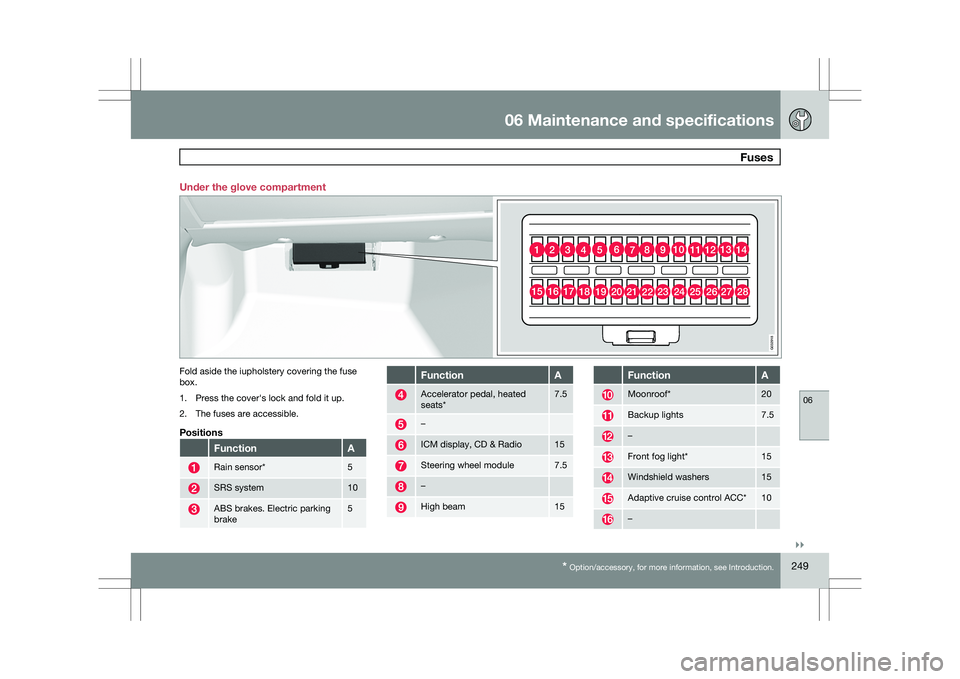
Under the glove compartment
Fold aside the iupholstery covering the fuse
box.
1. Press the cover\fs lock and fold it up.
2. The fuses are accessible.
Positions
Function A
Rain sensor* 5
SRS system 10
ABS brakes. Electric parking
brake 5 Function A
Accelerator pedal, heated
seats* 7.5
–
ICM display, CD & Radio 15
Steering wheel module 7.5
–
High beam 15 Function A
Moonroof* 20
Backup lights 7.5
–
Front fog light* 15
Windshield washers 15
Adaptive cruise control ACC* 10
– 1011121314123456789
2322212019181716152425262728
G032918
Page 277 of 297
06 Maintenance and specifications
Vehicle care06
}}
275
fully. Solvents or stain removers should not be
used.
CAUTION
\b
Avoid waxing or polishing plastic or rub-
ber components
\b Polishing chromed strips can wear
away or damage the surface
\b Polishes containing abrasive sub-
stances should not be used
Automatic car wash
\b
We do NOT recommend washing your car
in an automatic wash during the first six
months (because the paint will not have
hardened sufficiently).
\b An automatic wash is a simple and quick
way to clean your car, but it is worth
remembering that it may not be as thor-
ough as when you yourself go over the car
with sponge and water. Keeping the under-
body clean is most important, especially in
the winter. Some automatic washers do
not have facilities for washing the under-
body.
CAUTION \b
Before driving into an automatic car
wash, turn off the optional rain sensor
to avoid damaging the windshield wip-
ers.
\b Make sure that side view mirrors, auxil-
iary lamps, etc, are secure, and that any
antenna(s) are retracted or removed.
Otherwise there is risk of the machine
dislodging them.
\b Chromed wheels: Clean chrome-
plated wheels using the same deter-
gents used for the body of the vehicle.
Aggressive wheel-cleaning agents can
permanently stain chrome-plated
wheels.
WARNING \b
When the vehicle is driven immediately
after being washed, apply the brakes,
including the parking brake, several
times in order to remove any moisture
from the brake linings.
\b Engine cleaning agents should not be
used when the engine is warm. This
constitutes a fire risk.
Exterior lightingCondensation may form temporarily on the
inside of the lenses of exterior lights such as headlights, fog lights, or taillights. This is nor-
mal and the lights are designed to withstand
moisture. Normally, condensation will dissi-
pate after the lights have been on for a short
time.
Polishing and waxing
\b
Normally, polishing is not required during
the first year after delivery, however, wax-
ing may be beneficial.
\b Before applying polish or wax the vehicle
must be washed and dried. Tar spots can
be removed with kerosene or tar remover.
Difficult spots may require a fine rubbing
compound.
\b After polishing use liquid or paste wax.
\b Several commercially available products
contain both polish and wax.
\b Waxing alone does not substitute for pol-
ishing a dull surface.
\b A wide range of polymer-based waxes can
be purchased today. These waxes are easy
to use and produce a long-lasting, high-
gloss finish that protects the bodywork
against oxidation, road dirt and fading.
\b Do not polish or wax your vehicle in direct
sunlight (the surface of the vehicle should
not be warmer than 113 °F (45 °C).
Page 292 of 297
07 Index07
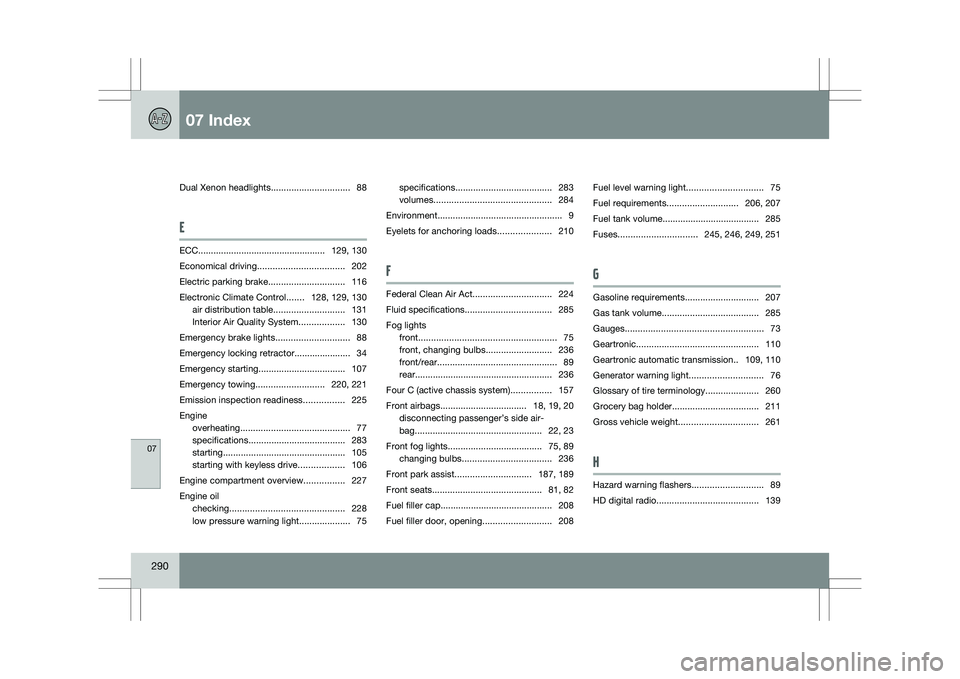
290 Dual Xenon headlights
...............................88
E ECC.................................................. 129, 130
Economical driving
.................................. 202
Electric parking brake ..............................116
Electronic Climate Control .......128, 129, 130
air distribution table ............................131
Interior Air Quality System.................. 130
Emergency brake lights .............................88
Emergency locking retractor
...................... 34
Emergency starting .................................. 107
Emergency towing ........................... 220, 221
Emission inspection readiness ................225
Engine overheating ........................................... 77
specifications ...................................... 283
starting ................................................ 105
starting with keyless drive ..................106
Engine compartment overview ................227
Engine oil checking ............................................. 228
low pressure warning light ....................75specifications
...................................... 283
volumes .............................................. 284
Environment ................................................. 9
Eyelets for anchoring loads .....................210
F Federal Clean Air Act
...............................224
Fluid specifications .................................. 285
Fog lights front...................................................... 75
front, changing bulbs ..........................236
front/rear............................................... 89
rear......................................................
236
Four C (active chassis system) ................157
Front airbags.................................. 18, 19, 20 disconnecting passenger’s side air-
bag.................................................. 22, 23
Front fog lights ..................................... 75, 89
changing bulbs ................................... 236
Front park assist.............................. 187, 189
Front seats ........................................... 81, 82
Fuel filler cap............................................ 208
Fuel filler door, opening ...........................208Fuel level warning light
..............................75
Fuel requirements ............................ 206, 207
Fuel tank volume
...................................... 285
Fuses............................... 245, 246, 249, 251
G Gasoline requirements
.............................207
Gas tank volume...................................... 285
Gauges...................................................... 73
Geartronic ................................................ 110
Geartronic automatic transmission
.. 109, 110
Generator warning light .............................76
Glossary of tire terminology .....................260
Grocery bag holder.................................. 211
Gross vehicle weight ............................... 261
H Hazard warning flashers
............................89
HD digital radio ........................................ 139
Page 295 of 297
07 Index07
293
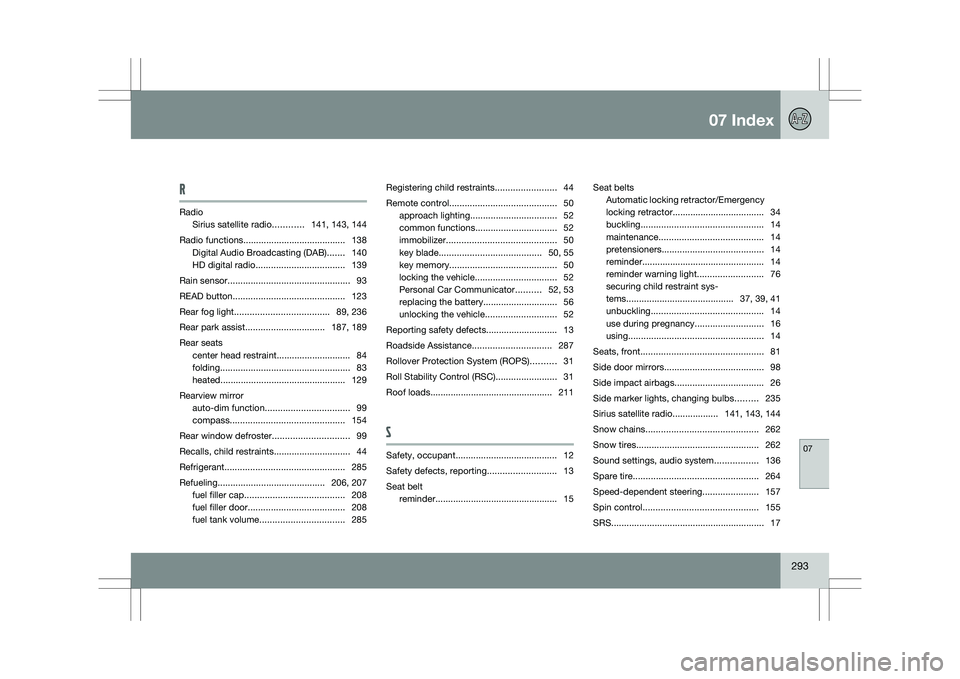
R
Radio
Sirius satellite radio ............141, 143, 144
Radio functions ........................................ 138
Digital Audio Broadcasting (DAB) .......140
HD digital radio ................................... 139
Rain sensor ................................................ 93
READ button............................................ 123
Rear fog light ..................................... 89, 236
Rear park assist............................... 187, 189
Rear seats center head restraint.............................
84
folding ................................................... 83
heated................................................. 129
Rearview mirror auto-dim function ................................. 99
compass............................................. 154
Rear window defroster.............................. 99
Recalls, child restraints ..............................44
Refrigerant ............................................... 285
Refueling .......................................... 206, 207
fuel filler cap....................................... 208
fuel filler door ...................................... 208
fuel tank volume ................................. 285Registering child restraints
........................44
Remote control .......................................... 50
approach lighting .................................. 52
common functions ................................ 52
immobilizer ........................................... 50
key blade........................................ 50, 55
key memory.......................................... 50
locking the vehicle ................................ 52
Personal Car Communicator ..........52, 53
replacing the battery .............................56
unlocking the vehicle ............................52
Reporting safety defects............................
13
Roadside Assistance ............................... 287
Rollover Protection System (ROPS) ..........31
Roll Stability Control (RSC) ........................31
Roof loads................................................ 211
S Safety, occupant........................................ 12
Safety defects, reporting...........................
13
Seat belt reminder................................................
15Seat belts
Automatic locking retractor/Emergency
locking retractor
.................................... 34
buckling ................................................ 14
maintenance ......................................... 14
pretensioners ........................................ 14
reminder................................................ 14
reminder warning light ..........................76
securing child restraint sys-
tems.......................................... 37, 39, 41
unbuckling ............................................ 14
use during pregnancy ...........................16
using ..................................................... 14
Seats, front................................................ 81
Side door mirrors....................................... 98
Side impact airbags................................... 26
Side marker lights, changing bulbs .........235
Sirius satellite radio.................. 141, 143, 144
Snow chains ............................................ 262
Snow tires................................................ 262
Sound settings, audio system .................136
Spare tire................................................. 264
Speed-dependent steering...................... 157
Spin control ............................................. 155
SRS............................................................ 17