light VOLVO XC60 2009 Owner´s Manual
[x] Cancel search | Manufacturer: VOLVO, Model Year: 2009, Model line: XC60, Model: VOLVO XC60 2009Pages: 297, PDF Size: 21.16 MB
Page 55 of 297
02 Locks and alarm
Remote key and key blade02
}}
* Option/accessory, for more information, see Introduction. 53
Approach lighting – As you approach the
vehicle, press the button on the remote control
to light the interior lighting, parking lights,
license plate lighting and the lights in the door
mirrors*.
These lights will switch off automatically after
30, 60 or 90 seconds.
Unlock tailgate – Press the button once to
disarm the alarm system and optional move-
ment sensor (the alarm indicator light on the
dashboard will go out), and unlock only the
tailgate.
NOTE
\b
This function also opens the tailgate on
models equipped with the optional
power tailgate.
\b As an added safety precaution, the
parking lights will come on automati-
cally for a short period when the tailgate
has been opened. After closing, the tailgate will not automatically
relock. Press Lock to relock it and rearm the
alarm.
See page 63 for information on unlocking the
tailgate from the passenger compartment. Panic alarm – This button can be used to
attract attention during emergency situations.
To activate the panic alarm, press and hold this
button for at least 3 seconds or press it twice
within 3 seconds. The turn signals and horn will
be activated. The panic alarm will stop auto-
matically after 2 minutes and 45 seconds.
To deactivate, wait approximately 5 seconds
and press the button again.
These lights will switch off automatically after
30, 60 or 90 seconds.
The Panic alarm button will not unlock the vehi-
cle.
RangeThe remote key has a range of approximately
60 ft. (20 m) from the vehicle.
NOTE
Buildings or other obstacles may interfere
with the function of the remote key. The
vehicle can also be locked or unlocked with
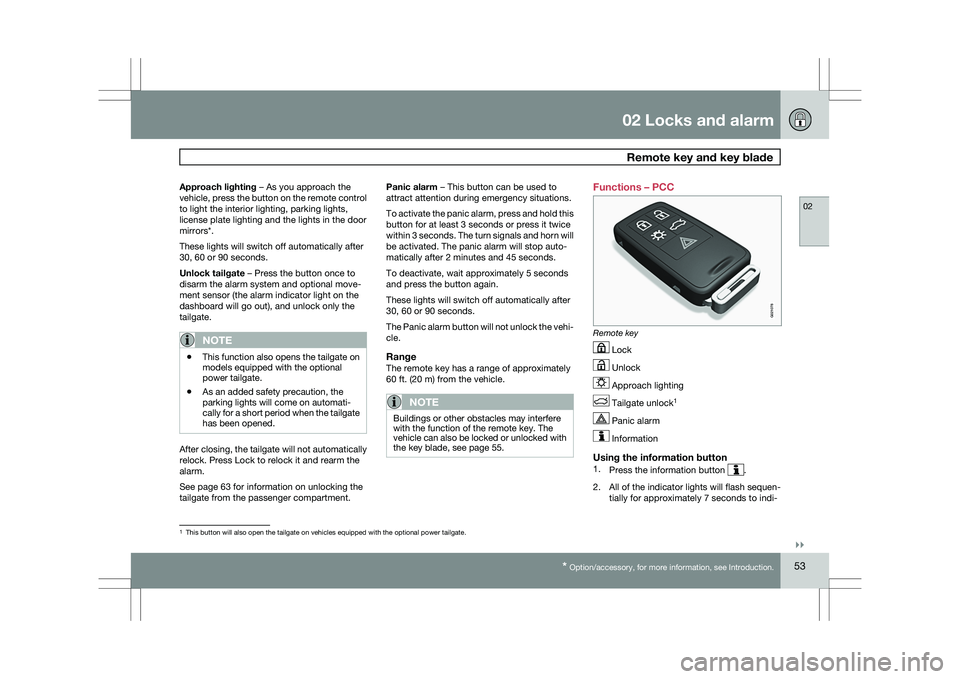
the key blade, see page 55. Functions – PCC
Remote key
Lock
Unlock
Approach lighting
Tailgate unlock
1 Panic alarm
Information
Using the information button1.
Press the information button .
2. All of the indicator lights will flash sequen- tially for approximately 7 seconds to indi- 1
This button will also open the tailgate on vehicles equipped with the op\
tional power tailgate. G021078
Page 56 of 297
02 Locks and alarmRemote key and key blade 02
54 cate that the PCC is receiving information
from the vehicle. If any of the buttons are
pressed during this 7-second period,
transmission of information to the PCC will
be interrupted.
NOTE
If none of the indicator lights flash when the
information button has been pressed sev-
eral times from different places in relation to
the vehicle, contact an authorized Volvo
service technician.
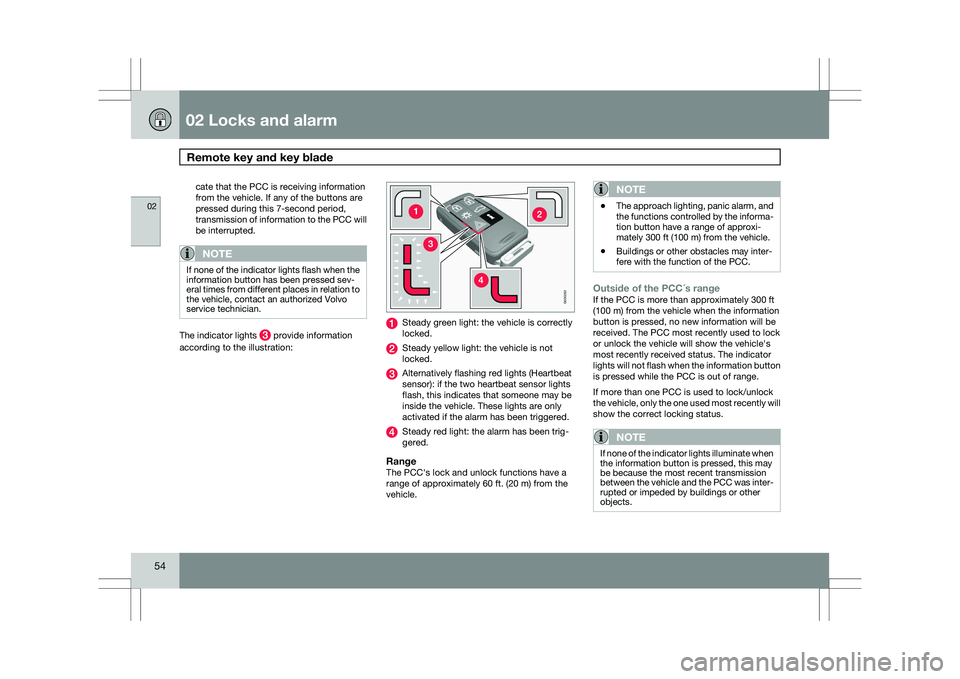
The indicator lights provide information
according to the illustration: Steady green light: the vehicle is correctly
locked.
Steady yellow light: the vehicle is not
locked.
Alternatively flashing red lights (Heartbeat
sensor): if the two heartbeat sensor lights
flash, this indicates that someone may be
inside the vehicle. These lights are only
activated if the alarm has been triggered.
Steady red light: the alarm has been trig-
gered.
RangeThe PCC\fs lock and unlock functions have a
range of approximately 60 ft. (20 m) from the
vehicle.
NOTE \b
The approach lighting, panic alarm, and
the functions controlled by the informa-
tion button have a range of approxi-
mately 300 ft (100 m) from the vehicle.
\b Buildings or other obstacles may inter-
fere with the function of the PCC.
Outside of the PCC´s rangeIf the PCC is more than approximately 300 ft
(100 m) from the vehicle when the information
button is pressed, no new information will be
received. The PCC most recently used to lock
or unlock the vehicle will show the vehicle\fs
most recently received status. The indicator
lights will not flash when the information button
is pressed while the PCC is out of range.
If more than one PCC is used to lock/unlock
the vehicle, only the one used most recently will
show the correct locking status.
NOTE If none of the indicator lights illuminate when
the information button is pressed, this may
be because the most recent transmission
between the vehicle and the PCC was inter-
rupted or impeded by buildings or other
objects. G03026
2
Page 64 of 297
02 Locks and alarmLocks 02
62
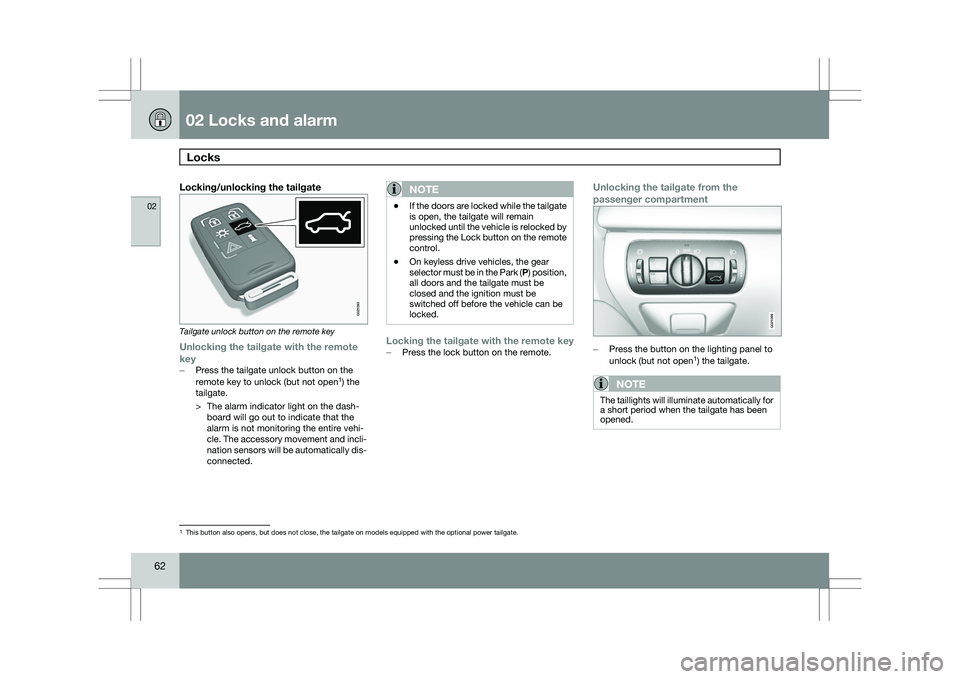
Locking/unlocking the tailgate Tailgate unlock button on the remote key
Unlocking the tailgate with the remote
key
–
Press the tailgate unlock button on the
remote key to unlock (but not open 1
) the
tailgate.
> The alarm indicator light on the dash- board will go out to indicate that the
alarm is not monitoring the entire vehi-
cle. The accessory movement and incli-
nation sensors will be automatically dis-
connected.
NOTE \b
If the doors are locked while the tailgate
is open, the tailgate will remain
unlocked until the vehicle is relocked by
pressing the Lock button on the remote
control.
\b On keyless drive vehicles, the gear
selector must be in the Park (P) position,
all doors and the tailgate must be
closed and the ignition must be
switched off before the vehicle can be
locked.
Locking the tailgate with the remote key– Press the lock button on the remote.
Unlocking the tailgate from the
passenger compartment –
Press the button on the lighting panel to
unlock (but not open 1
) the tailgate.
NOTE The taillights will illuminate automatically for
a short period when the tailgate has been
opened.
1
This button also opens, but does not close, the tailgate on models equip\
ped with the optional power tailgate. G021093 G021099
Page 65 of 297
02 Locks and alarm
Locks02
}}
* Option/accessory, for more information, see Introduction. 63
Power tailgate*
Power tailgate closing button
Automatic openingThe power tailgate can be opened automati-
cally in the three ways:
\b
By pressing and holding the but-
ton on the lighting panel until the tailgate
begins to open.
\b By pressing and holding the button
on the remote key until the tailgate begins
to open.
\b By pulling the outer handle on the tailgate.
The taillights illuminate automatically when the
automatic open function is used.
CAUTION Be sure that there is adequate space above
and behind the vehicle before opening the
tailgate automatically.
NOTE
If the tailgate has been opened and closed
continuously for more than 90 seconds, the
automatic function will be deactivated to
avoid overloading the electrical system. The
automatic function can be used again after
approximately 10 minutes.
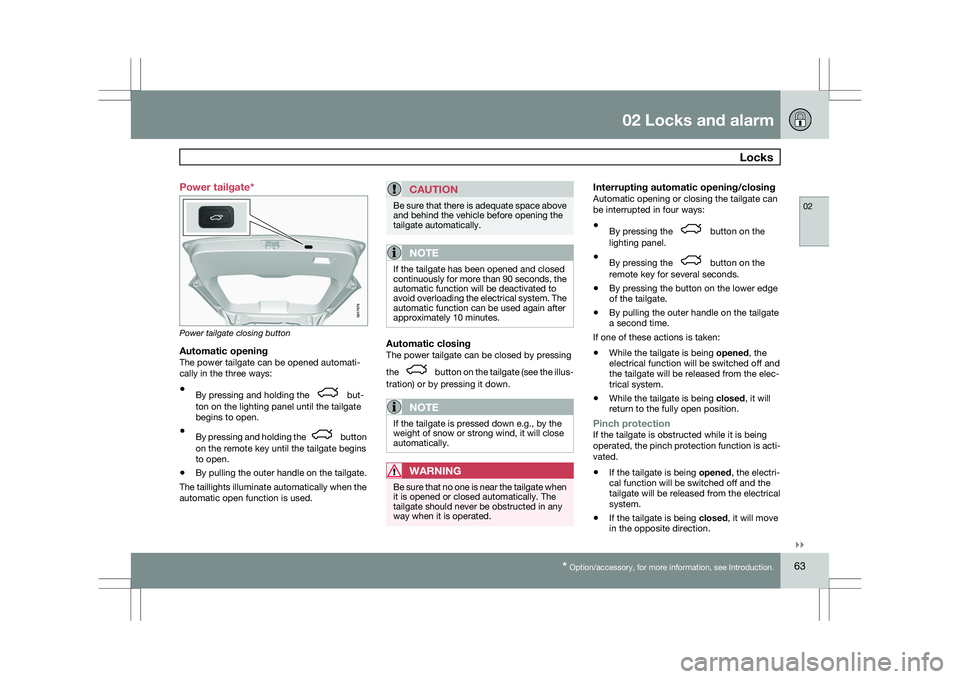
Automatic closingThe power tailgate can be closed by pressing
the
button on the tailgate (see the illus-
tration) or by pressing it down.
NOTE If the tailgate is pressed down e.g., by the
weight of snow or strong wind, it will close
automatically.
WARNING
Be sure that no one is near the tailgate when
it is opened or closed automatically. The
tailgate should never be obstructed in any
way when it is operated.
Interrupting automatic opening/closingAutomatic opening or closing the tailgate can
be interrupted in four ways:
\b
By pressing the button on the
lighting panel.
\b By pressing the button on the
remote key for several seconds.
\b By pressing the button on the lower edge
of the tailgate.
\b By pulling the outer handle on the tailgate
a second time.
If one of these actions is taken:
\b While the tailgate is being
opened, the
electrical function will be switched off and
the tailgate will be released from the elec-
trical system.
\b While the tailgate is being
closed, it will
return to the fully open position.
Pinch protectionIf the tailgate is obstructed while it is being
operated, the pinch protection function is acti-
vated.
\b If the tailgate is being opened, the electri-
cal function will be switched off and the
tailgate will be released from the electrical
system.
\b If the tailgate is being closed, it will move
in the opposite direction. G017876
Page 67 of 297
02 Locks and alarm
Child safety locks02
* Option/accessory, for more information, see Introduction. 65
Child safety locks
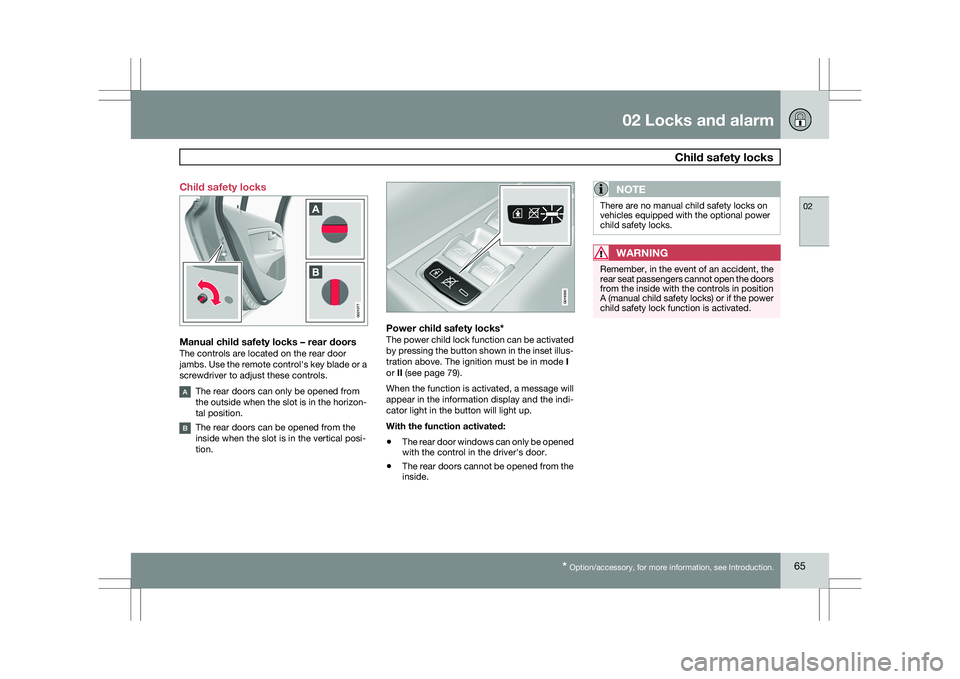
Manual child safety locks – rear doorsThe controls are located on the rear door
jambs. Use the remote control\fs key blade or a
screwdriver to adjust these controls.
The rear doors can only be opened from
the outside when the slot is in the horizon-
tal position.
The rear doors can be opened from the
inside when the slot is in the vertical posi-
tion.
Power child safety locks*The power child lock function can be activated
by pressing the button shown in the inset illus-
tration above. The ignition must be in mode
I
or II (see page 79).
When the function is activated, a message will
appear in the information display and the indi-
cator light in the button will light up.
With the function activated:
\b The rear door windows can only be opened
with the control in the driver\fs door.
\b The rear doors cannot be opened from the
inside.
NOTE There are no manual child safety locks on
vehicles equipped with the optional power
child safety locks.
WARNING
Remember, in the event of an accident, the
rear seat passengers cannot open the doors
from the inside with the controls in position
A (manual child safety locks) or if the power
child safety lock function is activated. G02107
7 G019300
Page 68 of 297
02 Locks and alarmAlarm 02
66 The alarm system
The alarm is automatically armed whenever the
vehicle is locked with the remote key or
optional Personal Car Communicator.
USA FCC ID: NWD5481
This device complies with part 15 of the FCC
rules. Operation is subject to the following con-
ditions: (1) This device may not cause harmful
interference, and (2) this device must accept
any interference received, including interfer-
ence that may cause undesired operation.
When armed, the alarm continuously monitors
a number of points on the vehicle. The follow-
ing conditions will trigger the alarm:
\b
The hood is forced open.
\b The tailgate is forced open.
\b A door is forced open.
\b The ignition slot is tampered with.
\b An attempt is made to start the vehicle with
a non-approved key (a key not coded to
the car\fs ignition).
\b If there is movement in the passenger com-
partment (if the vehicle is equipped with
the accessory movement sensor).
\b The vehicle is lifted or towed (if the vehicle
is equipped with the accessory inclination
sensor). \b
The battery is disconnected (while the
alarm is armed).
\b The siren is disconnected when the alarm
is disarmed.
A message will appear in the information dis-
play if a fault should occur in the alarm system.
Contact an authorized Volvo service techni-
cian.
NOTE Do not attempt to repair any of the compo-
nents in the alarm system yourself. This
could affect the insurance policy on the
vehicle.
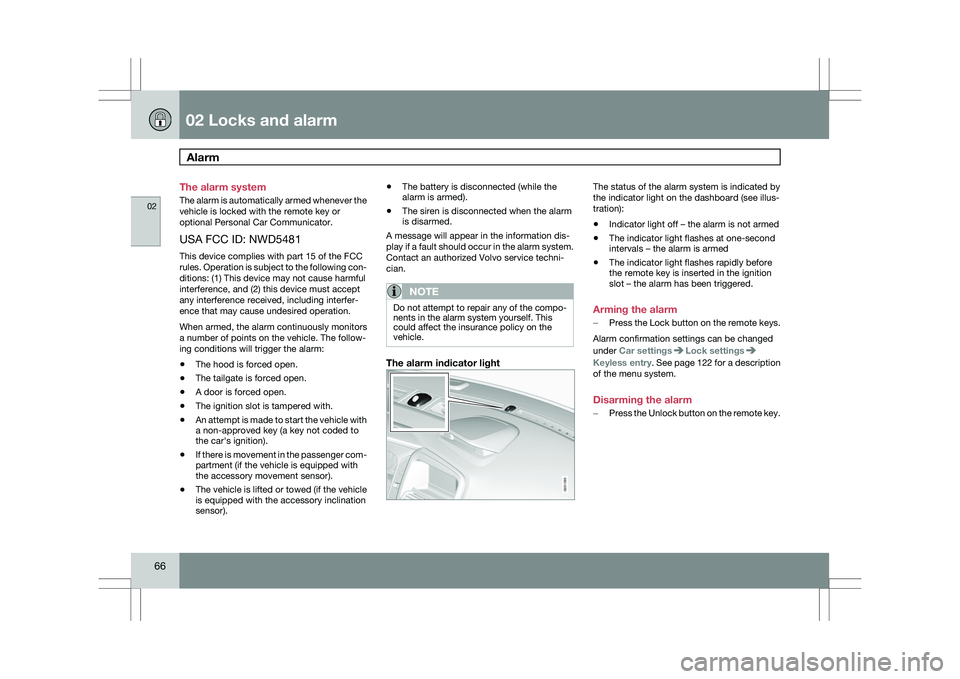
The alarm indicator light The status of the alarm system is indicated by
the indicator light on the dashboard (see illus-
tration):
\b
Indicator light off – the alarm is not armed
\b The indicator light flashes at one-second
intervals – the alarm is armed
\b The indicator light flashes rapidly before
the remote key is inserted in the ignition
slot – the alarm has been triggered.
Arming the alarm
– Press the Lock button on the remote keys.
Alarm confirmation settings can be changed
under Car settings Lock settings
Keyless entry
. See page 122 for a description
of the menu system.
Disarming the alarm
– Press the Unlock button on the remote key. G031385
Page 72 of 297

70
* Option/accessory, for more information, see Introduction. Instruments and controls
........................................................................\
72
Ignition modes ........................................................................\
................ 79
Seats........................................................................\
............................... 81
Steering wheel ........................................................................\
................ 86
Lighting ........................................................................\
........................... 87
Wipers and washers......................................................\
..........................
93
Power windows........................................................................\
............... 96
Mirrors........................................................................\
............................. 98
Power panorama moonroof*................................................................. 100
HomeLink® Wireless Control System* .................................................102
Starting the engine ........................................................................\
........ 105
Transmission ........................................................................\
................. 109
Brakes........................................................................\
........................... 112
Hill Descent Control (HDC).................................................................... 114
Parking brake ........................................................................\
................ 116
G02091
2
Page 75 of 297
03 Your driving environment
Instruments and controls03
}}
* Option/accessory, for more information, see Introduction. 73Function Page
Menus and mes-
sages, turn signals,
high/low beams,
trip computer 122 , 90,
87, 153
Cruise control 158
Horn, airbag 86, 17
Main instrument
panel 73
Menu system,
audio, Bluetooth
hands-free controls 152
START/STOP
ENGINE button 79
Ignition slot 79
Information display 89
Door handle –
In-door control pan-
els (power win-
dows, mirrors,
power child safety
locks, central lock-
ing button) 122 , 96,
98, 65, 61 Function Page
Hazard warning
flashers 122 , 136
Audio system con-
trols 126
Climate system
controls 109
Gear selector 157
Controls for active
chassis (Four-C)* 93
Wipers and washers 86
Steering wheel
adjustment 227
Hood opening con-
trol 116
Parking brake 81
Power seat* adjust-
ment controls 87, 208
Lighting panel, con-
trols for opening
fuel filler door/tail-
gate 87, 208,
see page 62 Information displays
Information displays in the instrument panel
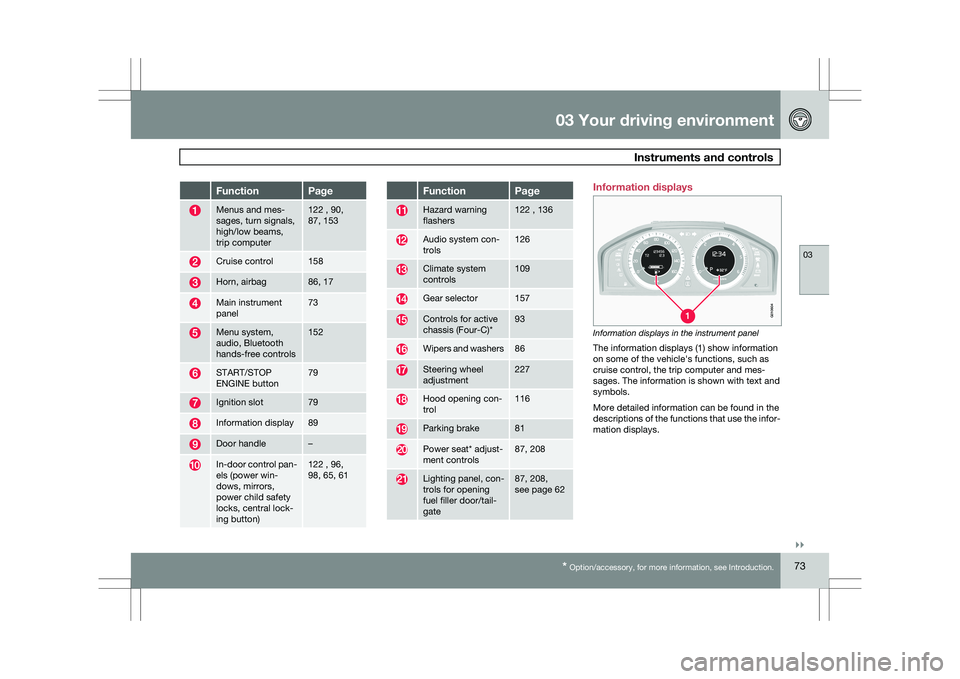
The information displays (1) show information
on some of the vehicle\fs functions, such as
cruise control, the trip computer and mes-
sages. The information is shown with text and
symbols.
More detailed information can be found in the
descriptions of the functions that use the infor-
mation displays. G01060
4
Page 76 of 297
03 Your driving environmentInstruments and controls 03
74 Gauges
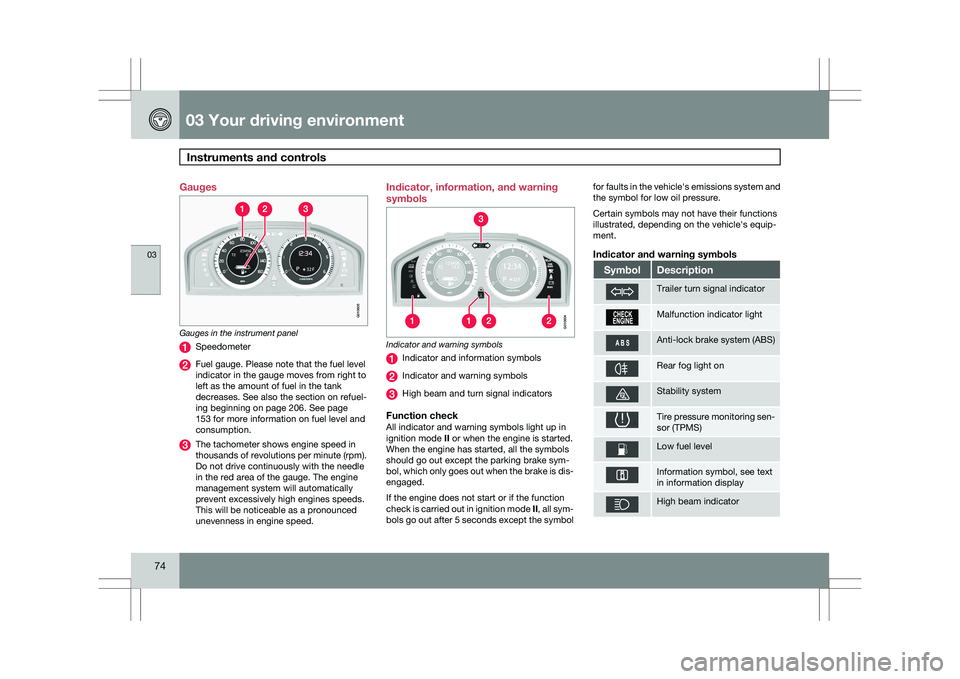
Gauges in the instrument panel
Speedometer
Fuel gauge. Please note that the fuel level
indicator in the gauge moves from right to
left as the amount of fuel in the tank
decreases. See also the section on refuel-
ing beginning on page 206. See page
153 for more information on fuel level and
consumption.
The tachometer shows engine speed in
thousands of revolutions per minute (rpm).
Do not drive continuously with the needle
in the red area of the gauge. The engine
management system will automatically
prevent excessively high engines speeds.
This will be noticeable as a pronounced
unevenness in engine speed. Indicator, information, and warning
symbols
Indicator and warning symbols
Indicator and information symbols
Indicator and warning symbols
High beam and turn signal indicators
Function checkAll indicator and warning symbols light up in
ignition mode
II or when the engine is started.
When the engine has started, all the symbols
should go out except the parking brake sym-
bol, which only goes out when the brake is dis-
engaged.
If the engine does not start or if the function
check is carried out in ignition mode II, all sym-
bols go out after 5 seconds except the symbol for faults in the vehicle\fs emissions system and
the symbol for low oil pressure.
Certain symbols may not have their functions
illustrated, depending on the vehicle\fs equip-
ment.
Indicator and warning symbols
Symbol Description
Trailer turn signal indicator
Malfunction indicator light
Anti-lock brake system (ABS)
Rear fog light on
Stability system
Tire pressure monitoring sen-
sor (TPMS)
Low fuel level
Information symbol, see text
in information display
High beam indicator G010605 G010604
Page 77 of 297
03 Your driving environment
Instruments and controls03
}}
* Option/accessory, for more information, see Introduction. 75Symbol Description
Left turn signal indicator
Right turn signal indicator
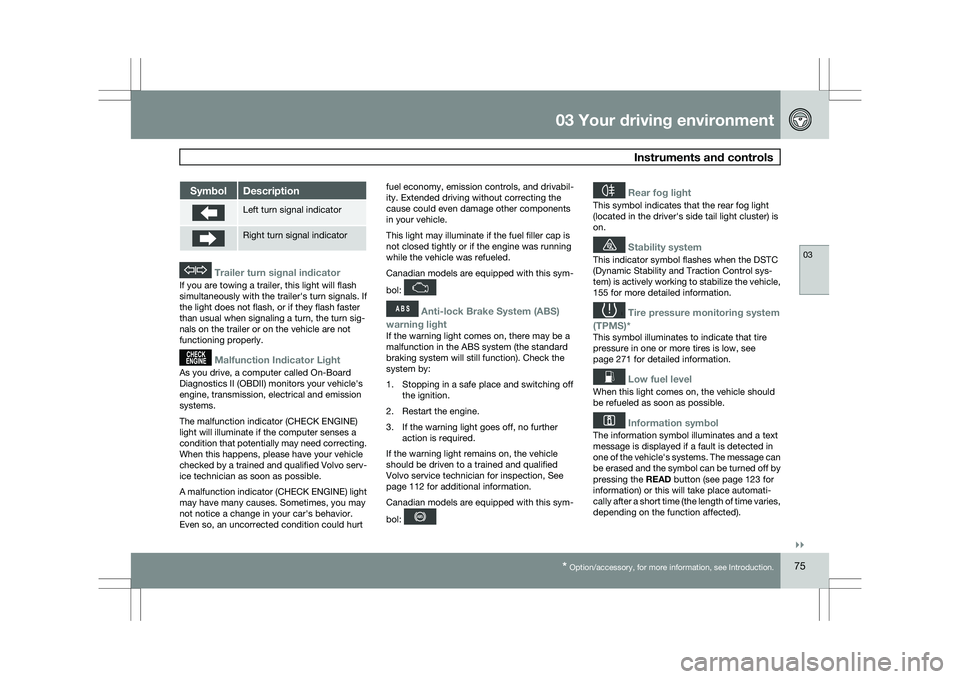
Trailer turn signal indicator
If you are towing a trailer, this light will flash
simultaneously with the trailer\fs turn signals. If
the light does not flash, or if they flash faster
than usual when signaling a turn, the turn sig-
nals on the trailer or on the vehicle are not
functioning properly.
Malfunction Indicator Light
As you drive, a computer called On-Board
Diagnostics II (OBDII) monitors your vehicle\fs
engine, transmission, electrical and emission
systems.
The malfunction indicator (CHECK ENGINE)
light will illuminate if the computer senses a
condition that potentially may need correcting.
When this happens, please have your vehicle
checked by a trained and qualified Volvo serv-
ice technician as soon as possible.
A malfunction indicator (CHECK ENGINE) light
may have many causes. Sometimes, you may
not notice a change in your car\fs behavior.
Even so, an uncorrected condition could hurt
fuel economy, emission controls, and drivabil-
ity. Extended driving without correcting the
cause could even damage other components
in your vehicle.
This light may illuminate if the fuel filler cap is
not closed tightly or if the engine was running
while the vehicle was refueled.
Canadian models are equipped with this sym-
bol:
Anti-lock Brake System (ABS)
warning light
If the warning light comes on, there may be a
malfunction in the ABS system (the standard
braking system will still function). Check the
system by:
1. Stopping in a safe place and switching off the ignition.
2. Restart the engine.
3. If the warning light goes off, no further action is required.
If the warning light remains on, the vehicle
should be driven to a trained and qualified
Volvo service technician for inspection,
See
page 112 for additional information.
Canadian models are equipped with this sym-
bol:
Rear fog light
This symbol indicates that the rear fog light
(located in the driver\fs side tail light cluster) is
on.
Stability system
This indicator symbol flashes when the DSTC
(Dynamic Stability and Traction Control sys-
tem) is actively working to stabilize the vehicle,
155 for more detailed information.
Tire pressure monitoring system
(TPMS)*
This symbol illuminates to indicate that tire
pressure in one or more tires is low, see
page 271 for detailed information.
Low fuel level
When this light comes on, the vehicle should
be refueled as soon as possible.
Information symbol
The information symbol illuminates and a text
message is displayed if a fault is detected in
one of the vehicle\fs systems. The message can
be erased and the symbol can be turned off by
pressing the READ button (see page 123 for
information) or this will take place automati-
cally after a short time (the length of time varies,
depending on the function affected).