maintenance VOLVO XC60 2009 Owner´s Manual
[x] Cancel search | Manufacturer: VOLVO, Model Year: 2009, Model line: XC60, Model: VOLVO XC60 2009Pages: 297, PDF Size: 21.16 MB
Page 206 of 297
05 During your tripDriving recommendations 05
204
Before a long distance tripIt is always worthwhile to have your vehicle
checked by a trained and qualified Volvo serv-
ice technician before driving long distances.
Your retailer will also be able to supply you with
bulbs, fuses, spark plugs and wiper blades for
your use in the event that problems occur.
As a minimum, the following items should be
checked before any long trip:
\b
Check that engine runs smoothly and that
fuel consumption is normal.
\b Check for fuel, oil, and fluid leakage
\b Have the transmission oil level checked.
\b Check condition of drive belts.
\b Check state of the battery\fs charge.
\b Examine tires carefully (the spare tire as
well), and replace those that are worn.
Check tire pressures.
\b The brakes, front wheel alignment, and
steering gear should be checked by a
trained and qualified Volvo service techni-
cian only.
\b Check all lights, including high beams.
\b Reflective warning triangles are legally
required in some states/provinces.
\b Have a word with a trained and qualified
Volvo service technician if you intend to
drive in countries where it may be difficult
to obtain the correct fuel. \b
Consider your destination. If you will be
driving through an area where snow or ice
are likely to occur, consider snow tires.
Cold weather precautionsIf you wish to check your vehicle before the
approach of cold weather, the following advice
is worth noting:
\bMake sure that the engine coolant contains
50 percent antifreeze. Any other mixture
will reduce freeze protection. This gives
protection against freezing down to
–31 °F (–35 °C). The use of "recycled" anti-
freeze is not approved by Volvo. Different
types of antifreeze must not be mixed.
\b Volvo recommends using only genuine
Volvo antifreeze in your vehicle\fs radiator.
\b Try to keep the fuel tank well filled – this
helps prevent the formation of condensa-
tion in the tank. In addition, in extremely
cold weather conditions it is worthwhile to
add fuel line de-icer before refueling.
\b The viscosity of the engine oil is important.
Oil with low viscosity (thinner oil) improves
cold-weather starting as well as decreas-
ing fuel consumption while the engine is
warming up. For winter use, 5W-30 oil, par-
ticularly the synthetic type, is recom-
mended. Be sure to use good quality oil but
do not use cold-weather oil for hard driving
or in warm weather, see page 283 for more
information on engine oil.
NOTE Synthetic oil is not used when the oil is
changed at the normal maintenance inter-
vals except at owner request and at addi-
tional charge.
\b
The load placed on the battery is greater
during the winter since the windshield wip-
ers, lighting, etc. are used more often.
Moreover, the capacity of the battery
decreases as the temperature drops. In
very cold weather, a poorly charged bat-
tery can freeze and be damaged. It is there-
fore advisable to check the state of charge
more frequently and spray an anti-rust oil
on the battery posts.
\b Volvo recommends the use of snow tires
on all four wheels for winter driving, see
page 262.
\b To prevent the washer fluid reservoir from
freezing, add washer solvents containing
antifreeze. This is important since dirt is
often splashed on the windshield during
winter driving, requiring the frequent use of
the washers and wipers. Volvo Washer
Solvent should be diluted as follows: Down
to 14 °F (–10 °C): 1 part washer solvent and
4 parts water Down to 5 °F (–15 °C): 1 part
washer solvent and 3 parts water Down to
0 °F (–18 °C): 1 part washer solvent and
Page 219 of 297
05 During your trip
Towing a trailer05
}}
217
Introduction
Volvo recommends the use of Volvo trailer
hitches that are specially designed for the vehi-
cle.
NOTE
See page 282 for the maximum trailer and
tongue weights recommended by Volvo.
\b
Observe the legal requirements of the
state/province in which the vehicles are
\b All Volvo models are equipped with
energy-absorbing shock-mounted bump-
ers. Trailer hitch installation should not
interfere with the proper operation of this
bumper system.
Trailer towing does not normally present any
particular problems, but take into considera-
tion:
\b Increase tire pressure to recommended
full. See the tire inflation tables beginning
on page 258.
\b When your vehicle is new, avoid towing
heavy trailers during the first 620 miles
(1,000 km).
\b Maximum speed when towing a trailer:
50 mph (80 km/h).
\b Engine and transmission are subject to
increased loads. Therefore, engine coolant
temperature should be closely watched when driving in hot climates or hilly terrain.
Use a lower gear and turn off the air con-
ditioner if the temperature gauge needle
enters the red range.
\b If the automatic transmission begins to
overheat, a message will be displayed in
the text window.
\b Avoid overload and other abusive opera-
tion.
\b Hauling a trailer affects handling, durabil-
ity, and economy.
\b It is necessary to balance trailer brakes
with the towing vehicle brakes to provide a
safe stop (check and observe state/local
regulations).
\b Do not connect the trailer\fs brake system
directly to the vehicle\fs brake system.
\b More frequent vehicle maintenance is
required.
\b Remove the ball and drawbar assembly
when the hitch is not being used.
\b Volvo recommends the use of synthetic
engine oil when towing a trailer over long
distances or in mountainous areas.
WARNING \b
Bumper-attached trailer hitches must
not be used on Volvos, nor should
safety chains be attached to the
bumper.
\b Trailer hitches attaching to the vehicle
rear axle must not be used.
\b Never connect a trailer\fs hydraulic
brake system directly to the vehicle
brake system, nor a trailer\fs lighting
system directly to the vehicle lighting
system. Consult your nearest author-
ized Volvo retailer for correct installa-
tion.
\b When towing a trailer, the trailer\fs safety
wire must be correctly fastened to the
hole or hook provided in the trailer hitch
on the vehicle. The safety wire should
never be fastened to or wound around
the drawbar ball.
Page 224 of 297

222 Volvo maintenance
........................................................................\
........ 224
Maintaining your car ........................................................................\
...... 225
Hood and engine compartment ............................................................ 227
Engine oil........................................................................\
....................... 228
Fluids........................................................................\
............................. 230
Replacing bulbs ........................................................................\
............ 232
Wiper blades and washer fluid .............................................................. 240
Battery........................................................................\
........................... 242
Fuses........................................................................\
............................. 245
Wheels and tires........................................................\
............................ 253
Vehicle care ........................................................................\
................... 274
Label information ........................................................................\
.......... 279
Specifications..........................................................\
.............................. 281
Volvo programs ........................................................................\
............. 287
G02092
2
Page 226 of 297
06 Maintenance and specificationsVolvo maintenance 06
224 Introduction
Volvo advises you to follow the maintenance
program outlined in the Warranty and Service
Records Information booklet. This mainte-
nance program contains inspections and serv-
ices necessary for the proper function of your
vehicle. The maintenance services contain
several checks that require special tools and
training, and therefore must be performed by a
qualified technician. To keep your Volvo in top
condition, specify time-tested and proven
Genuine Volvo Parts and Accessories.
The Federal Clean Air Act – U.SThe Federal Clean Air Act requires vehicle
manufacturers to furnish written instructions to
the ultimate purchaser to assure the proper
servicing and function of the components that
control emissions. These services, which are
listed in the "Warranty and Service Records
Information" booklet, are not covered by the
warranty. You will be required to pay for labor
and material used.
MaintenanceYour Volvo passed several major inspections
before it was delivered to you, in accordance
with Volvo specifications. The maintenance
procedures outlined in the Warranty and Serv-
ice Records Information booklet, many of
which will positively affect your vehicle\fs emis-
sions, should be performed as indicated. It is
recommended that receipts for vehicle emis-
sion maintenance be retained in case ques-
tions arise concerning maintenance. Inspec-
tion and maintenance should also be per-
formed anytime a malfunction is observed or
suspected.
Applicable warranties – U.S/CanadaIn accordance with applicable U.S. and Cana-
dian regulations, the following list of warranties
is provided.
\b
New Vehicle Limited Warranty
\b Parts and Accessories Limited Warranty
\b Corrosion Protection Limited Warranty
\b Seat Belt and Supplemental Restraint Sys-
tems Limited Warranty
\b Emission Design and Defect Warranty
\b Emission Performance Warranty
These are the federal warranties; other warran-
ties are provided as required by state/provin-
cial law. Refer to your separate Warranty and
Service Records Information booklet for
detailed information concerning each of the
warranties.
Periodic maintenance helps minimize
emissions
Periodic maintenance will help keep your vehi-
cle running well. Your Warranty and Service
Records Information booklet provides a com- prehensive periodic maintenance schedule up
to 150,000 miles (240,000 km) of vehicle main-
tenance. The schedule includes components
that affect vehicle emissions. This page
describes some of the emission-related com-
ponents.
Vehicle Event Data (Black Box)Your vehicle\fs driving and safety systems
employ computers that monitor, and share
with each other, information about your vehi-
cle\fs operation. One or more of these comput-
ers may store what they monitor, either during
normal vehicle operation or in a crash or near-
crash event. Stored information may be read
and used by:
\b
Volvo Car Corporation
\b service and repair facilities
\b law enforcement or government agencies
\b others who may assert a legal right to
know, or who obtain your consent to know
such information.
Page 227 of 297
06 Maintenance and specifications
Maintaining your car06
}}
225
Owner maintenance
Periodic maintenance requirements and inter-
vals are described in your vehicle\fs Warranty
and Service Records Information booklet.
The following points can be carried out
between the normally scheduled maintenance
services.
Each time the car is refueled:
\b
Check the engine oil level.
\b Clean the windshield, windshield wipers,
headlights, and tail lights.
Monthly:
\bCheck cold tire pressure in all tires. Inspect
the tires for wear.
\b Check that engine coolant and other fluid
levels are between the indicated "min" and
"max" markings.
\b Clean interior glass surfaces with a glass
cleaner and soft paper towels.
\b Wipe driver information displays with a soft
cloth.
\b Visually inspect battery terminals for cor-
rosion. Corrosion may indicate a loose ter-
minal connector, or a battery near the end
of its useful service life. Consult your Volvo
retailer for additional information.
As needed:Wash the car, including the undercarriage, to
reduce wear that can be caused by a buildup
of dirt, and corrosion that can be caused by salt
residues.
Clean leaves and twigs from air intake vents at
the base of the windshield, and from other pla-
ces where they may collect.
NOTE Complete service information for qualified
technicians is available online for purchase
or subscription at www.volvotechinfo.com.
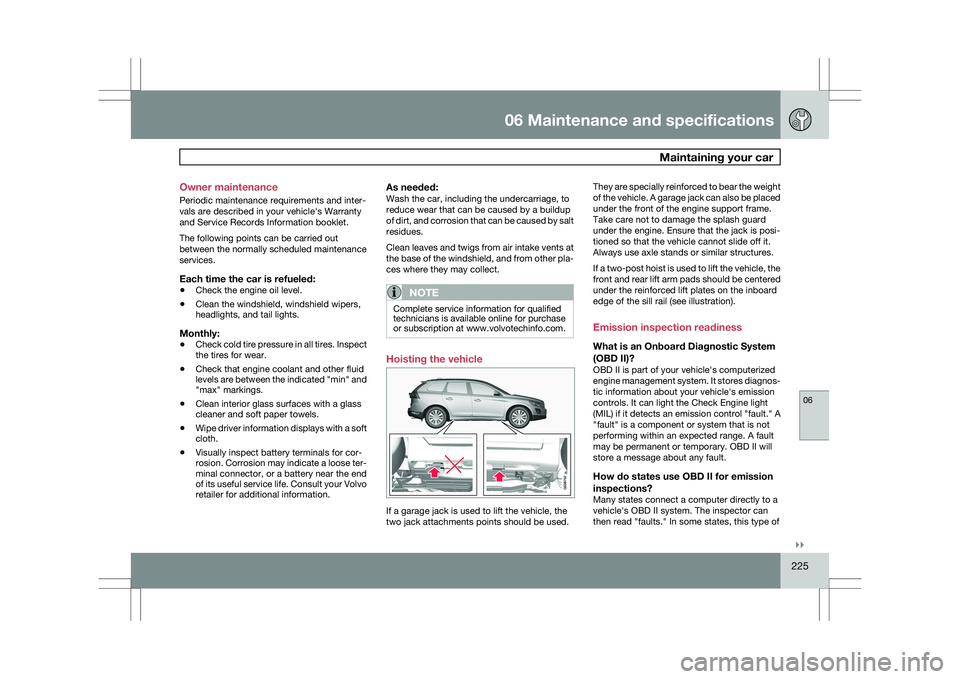
Hoisting the vehicle
If a garage jack is used to lift the vehicle, the
two jack attachments points should be used.They are specially reinforced to bear the weight
of the vehicle. A garage jack can also be placed
under the front of the engine support frame.
Take care not to damage the splash guard
under the engine. Ensure that the jack is posi-
tioned so that the vehicle cannot slide off it.
Always use axle stands or similar structures.
If a two-post hoist is used to lift the vehicle, the
front and rear lift arm pads should be centered
under the reinforced lift plates on the inboard
edge of the sill rail (see illustration).
Emission inspection readiness
What is an Onboard Diagnostic System
(OBD II)?
OBD II is part of your vehicle\fs computerized
engine management system. It stores diagnos-
tic information about your vehicle\fs emission
controls. It can light the Check Engine light
(MIL) if it detects an emission control "fault." A
"fault" is a component or system that is not
performing within an expected range. A fault
may be permanent or temporary. OBD II will
store a message about any fault.
How do states use OBD II for emission
inspections?
Many states connect a computer directly to a
vehicle\fs OBD II system. The inspector can
then read "faults." In some states, this type of
Page 228 of 297
06 Maintenance and specificationsMaintaining your car 06
226 inspection has replaced the tailpipe emission
test.
How can my vehicle fail OBD II emission
inspection?
Your vehicle can fail OBD II emission inspec-
tion for any of the following reasons.
\b
If your Check Engine (MIL) light is lit, your
vehicle may fail inspection.
\b If your vehicle\fs Check Engine light was lit,
but went out without any action on your
part, OBD II will still have a recorded fault.
Your vehicle may pass or fail, depending
on the inspection practices in your area.
\b If you had recent service that required dis-
connecting the battery, OBD II diagnostic
information may be incomplete and "not
ready" for inspection. A vehicle that is not
ready may fail inspection.
How can I prepare for my next OBD II
emission inspection?
\bIf your Check Engine (MIL) light is lit – or
was lit but went out without service, have
your vehicle diagnosed and, if necessary,
serviced by a qualified Volvo technician.
\b If you recently had service for a lit Check
Engine light, or if you had service that
required disconnecting the battery, a
period of driving is necessary to bring the
OBD II system to "ready" for inspection. A
half-hour trip of mixed stop-and-go/high- way driving is typically needed to allow
OBD II to reach readiness. Your Volvo
retailer can provide you with more infor-
mation on planning a trip.
\b Maintain your vehicle in accordance with
your vehicle\fs maintenance schedule.
Page 229 of 297
06 Maintenance and specifications
Hood and engine compartment06
227
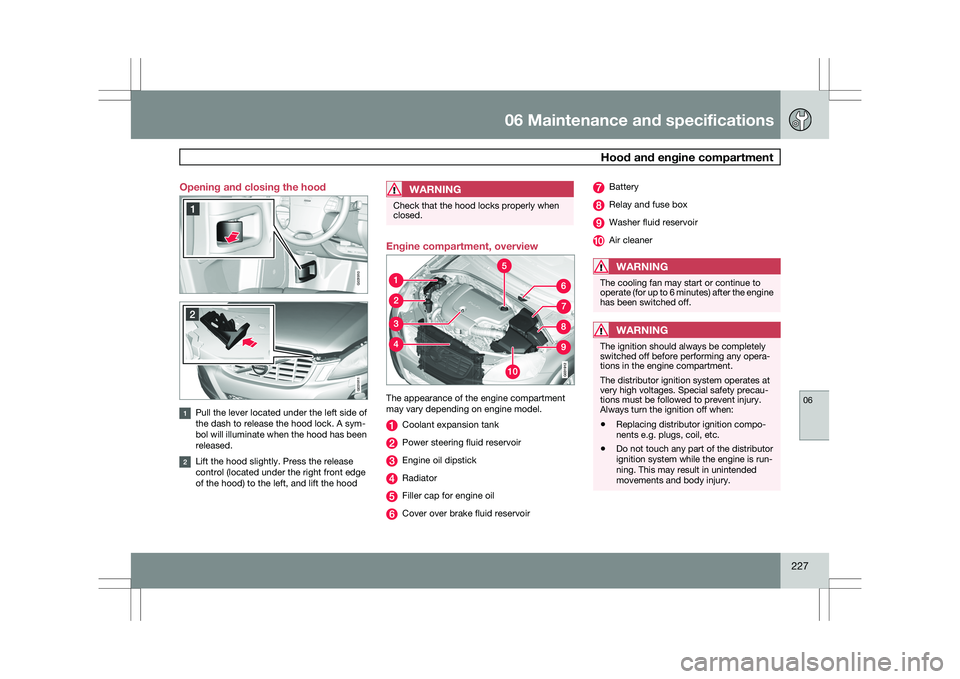
Opening and closing the hood
Pull the lever located under the left side of
the dash to release the hood lock. A sym-
bol will illuminate when the hood has been
released.
Lift the hood slightly. Press the release
control (located under the right front edge
of the hood) to the left, and lift the hood
WARNING Check that the hood locks properly when
closed.
Engine compartment, overview
The appearance of the engine compartment
may vary depending on engine model.
Coolant expansion tank
Power steering fluid reservoir
Engine oil dipstick
Radiator
Filler cap for engine oil
Cover over brake fluid reservoir Battery
Relay and fuse box
Washer fluid reservoir
Air cleaner
WARNING
The cooling fan may start or continue to
operate (for up to 6 minutes) after the engine
has been switched off.
WARNING
The ignition should always be completely
switched off before performing any opera-
tions in the engine compartment.
The distributor ignition system operates at
very high voltages. Special safety precau-
tions must be followed to prevent injury.
Always turn the ignition off when:
\b
Replacing distributor ignition compo-
nents e.g. plugs, coil, etc.
\b Do not touch any part of the distributor
ignition system while the engine is run-
ning. This may result in unintended
movements and body injury. G031910 G031911
Page 230 of 297
06 Maintenance and specificationsEngine oil 06
228 Checking the engine oil
The oil level should be checked every time the
vehicle is refueled. This is especially important
during the period up to the first scheduled
maintenance service.
\b
See page 283 for oil specifications.
\b Refer to the Warranty and Service Records
Information booklet for information on the
oil change intervals.
Volvo recommends Castrol oil products.
CAUTION \b
Not checking the oil level regularly can
result in serious engine damage if the oil
level becomes too low.
\b Oil that is lower than the specified qual-
ity can damage the engine.
\b Volvo does not recommend the use of
oil additives.
\b Always add oil of the same type and
viscosity as already used.
\b Never fill oil above the
MAX mark. This
could cause an increase in oil consump-
tion.
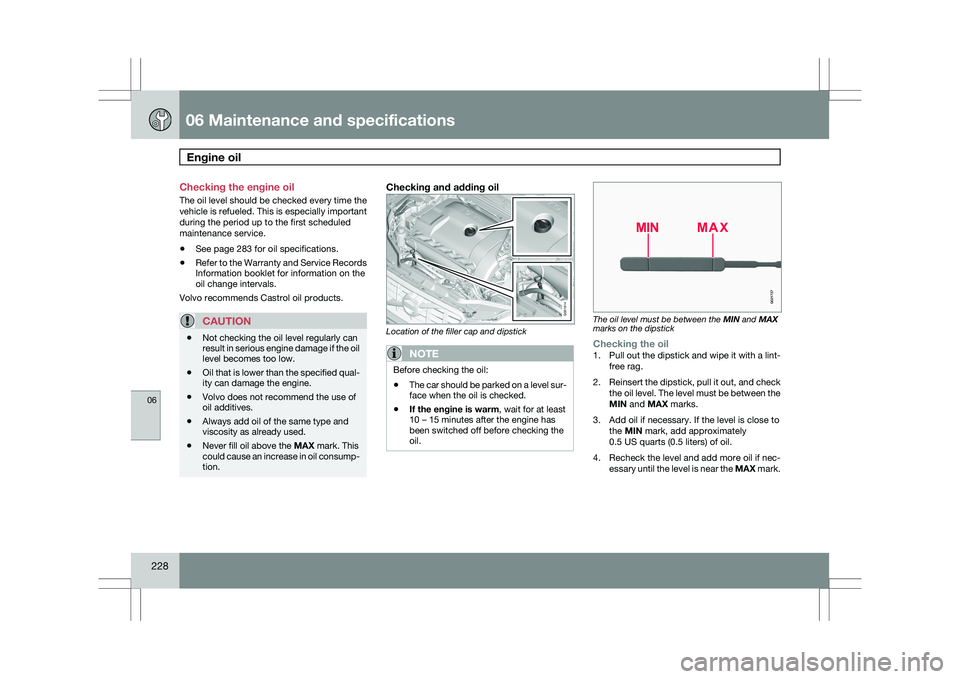
Checking and adding oil Location of the filler cap and dipstick
NOTE
Before checking the oil:
\b
The car should be parked on a level sur-
face when the oil is checked.
\b If the engine is warm, wait for at least
10 – 15 minutes after the engine has
been switched off before checking the
oil. The oil level must be between the MIN and MAX
marks on the dipstickChecking the oil1.
Pull out the dipstick and wipe it with a lint-
free rag.
2. Reinsert the dipstick, pull it out, and check
the oil level. The level must be between the
MIN and MAX marks.
3. Add oil if necessary. If the level is close to the MIN mark, add approximately
0.5 US quarts (0.5 liters) of oil.
4. Recheck the level and add more oil if nec-
essary until the level is near the MAX mark. G031914 G02173
7
Page 231 of 297
06 Maintenance and specifications
Engine oil06
229
WARNINGDo not allow oil to spill onto or come into
contact with hot exhaust pipe surfaces.
NOTE
Synthetic oil is not used when the oil is
changed at the normal maintenance inter-
vals except at owner request and at addi-
tional charge. Please consult your Volvo
retailer.
Page 232 of 297
06 Maintenance and specificationsFluids 06
230 Coolant
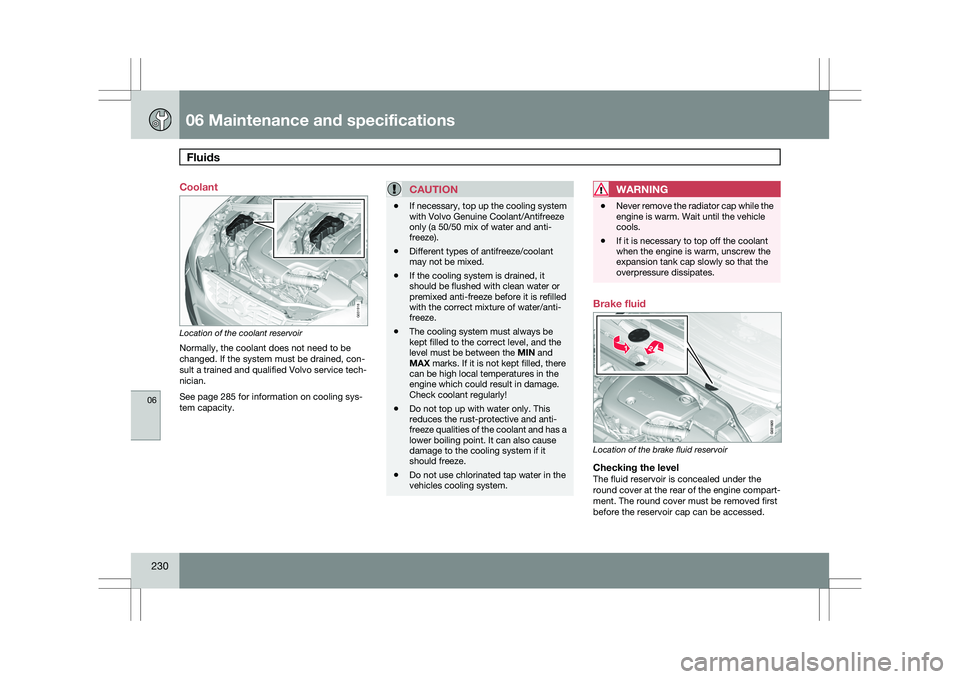
Location of the coolant reservoir
Normally, the coolant does not need to be
changed. If the system must be drained, con-
sult a trained and qualified Volvo service tech-
nician.
See page 285 for information on cooling sys-
tem capacity.
CAUTION \b
If necessary, top up the cooling system
with Volvo Genuine Coolant/Antifreeze
only (a 50/50 mix of water and anti-
freeze).
\b Different types of antifreeze/coolant
may not be mixed.
\b If the cooling system is drained, it
should be flushed with clean water or
premixed anti-freeze before it is refilled
with the correct mixture of water/anti-
freeze.
\b The cooling system must always be
kept filled to the correct level, and the
level must be between the MIN and
MAX marks. If it is not kept filled, there
can be high local temperatures in the
engine which could result in damage.
Check coolant regularly!
\b Do not top up with water only. This
reduces the rust-protective and anti-
freeze qualities of the coolant and has a
lower boiling point. It can also cause
damage to the cooling system if it
should freeze.
\b Do not use chlorinated tap water in the
vehicles cooling system.WARNING \b
Never remove the radiator cap while the
engine is warm. Wait until the vehicle
cools.
\b If it is necessary to top off the coolant
when the engine is warm, unscrew the
expansion tank cap slowly so that the
overpressure dissipates. Brake fluid
Location of the brake fluid reservoir
Checking the levelThe fluid reservoir is concealed under the
round cover at the rear of the engine compart-
ment. The round cover must be removed first
before the reservoir cap can be accessed. G031918