roof VOLVO XC60 2009 Owner´s Manual
[x] Cancel search | Manufacturer: VOLVO, Model Year: 2009, Model line: XC60, Model: VOLVO XC60 2009Pages: 297, PDF Size: 21.16 MB
Page 170 of 297
04 Comfort and driving pleasureCity Safety™ 04
168 1.
Use the thumb wheel to scroll until City
Safety is displayed.
2. Press the RESET button for approximately
1 second until Off is displayed.
WARNINGThe laser sensor emits light when the igni-
tion is in mode II or higher, even if City
Safety™ has been switched off.
To switch City Safety™ on again:
\b
Follow the same procedure as for switch-
ing City Safety™ off but select On by
pressing RESET.
or
\b Vehicles not equipped with keyless
drive: Press lightly on the remote key to
release it partially from the ignition slot.
Press the remote key into the ignition slot
again. Depress the brake pedal and press
the START/STOP ENGINE button to start
the engine. This restarts City Safety™
.
\b Vehicles equipped with the optional
keyless drive: Press the START/STOP
ENGINE button to switch off the engine.
Depress the brake pedal and press the
START/STOP ENGINE button to start the
engine. This restarts City Safety™.
See page 79 for information on ignition modes. City Safety™ will be automatically switched on
the next time the engine is started, even if it was
off when the engine was switched off.
Limitations
The sensor used by City Safety™ is designed
to detect cars and other larger motor vehicles
ahead of your vehicle in both daylight and dark-
ness.
However, there are certain limitations and the
laser sensor’s function may be reduced by, for
example, heavy rain or snowfall, or by dense
fog or thick, blowing dust or snow. Condensa-
tion, dirt, ice or snow on the windshield may
also interfere with the sensor’s function.
Objects such as warning flags hanging from
long objects on the roof or accessories such as
auxiliary lights or protective arches on the front
of the vehicle that are higher than the hood may
also impede the sensor’s function.
Braking distance to the vehicle ahead increa-
ses on slippery road surfaces, which may
reduce City Safety’s capacity to avoid a colli-
sion. In situations like this, the DSTC system
(see page 155) will help provide the best pos-
sible braking capacity and stability.
City Safety™ emits infrared light and measures
the way in which the light is reflected. There-
fore, vehicles or objects with low-reflective sur-faces may not be detected. Normally, the
license plate and taillight reflectors give the
rear section of a vehicle ahead sufficient reflec-
tive surfaces to be detected.
NOTE
\b
Keep the windshield in front of the laser
sensor free of ice, snow, dirt, etc. See
the illustration on page
167
\b Snow or ice on the hood deeper than
2 inches (5 cm) may obstruct the sen-
sor. Keep the hood free of ice and snow.
\b Do not mount or in any way attach any-
thing on the windshield that could
obstruct the laser sensor. Troubleshooting
If Windshield sensors blocked appears in
the information display, this indicates that the
City Safety™ laser sensor is obstructed in
some way and cannot detect vehicles ahead of
you, which means that the system is not func-
tioning.
However, this message will not be displayed in
all situations in which the sensor is obstructed.
For this reason, the driver must ensure that the
area of the windshield in front of the sensor is
always kept clean.
Page 204 of 297
05 During your tripDriving recommendations 05
202 General information
Economical driving conserves natural
resources
Better driving economy may be obtained by
thinking ahead, avoiding rapid starts and stops
and adjusting the speed of your vehicle to
immediate traffic conditions.
Observe the following rules:
\b
Bring the engine to normal operating tem-
perature as soon as possible by driving
with a light foot on the accelerator pedal for
the first few minutes of operation. A cold
engine uses more fuel and is subject to
increased wear.
\b Whenever possible, avoid using the vehicle
for driving short distances. This does not
allow the engine to reach normal operating
temperature.
\b Drive carefully and avoid rapid acceleration
and hard braking.
\b Use the transmission\fs Drive (
D) position
as often as possible and avoid using kick-
down.
\b Do not exceed posted speed limits.
\b Avoid carrying unnecessary items (extra
load) in the vehicle.
\b Maintain correct tire pressure. Check tire
pressure regularly (when tires are cold). \b
Remove snow tires when threat of snow or
ice has ended.
\b Note that roof racks, ski racks, etc,
increase air resistance and also fuel con-
sumption.
\b At highway driving speeds, fuel consump-
tion will be lower with the air conditioning
on and the windows closed than with the
air conditioning off and the windows open.
\b Using the onboard trip computer\fs fuel
consumption modes can help you learn
how to drive more economically.
Other factors that decrease gas mileage
are:
\b Dirty air cleaner
\b Dirty engine oil and clogged oil filter
\b Dragging brakes
\b Incorrect front end alignment
Some of the above mentioned items and others
are checked at the standard maintenance
intervals.
WARNING Driving with the tailgate open: Driving with
the tailgate open could lead to poisonous
exhaust gases entering the passenger com-
partment. If the tailgate must be kept open
for any reason, proceed as follows:
\b
Close the windows
\b Set the ventilation system control to air
flow to floor, windshield and side win-
dows and the blower control to its high-
est setting.
Weight distribution affects handlingAt the specified curb weight your vehicle has a
tendency to understeer, which means that the
steering wheel has to be turned more than
might seem appropriate for the curvature of a
bend. This ensures good stability and reduces
the risk of rear wheel skid. Remember that
these properties can alter with the vehicle load.
The heavier the load in the cargo area, the less
the tendency to understeer.
Handling, roadholdingVehicle load, tire design and inflation pressure
all affect vehicle handling. Therefore, check
that the tires are inflated to the recommended
pressure according to the vehicle load. See the
"Tire pressure" section. Loads should be dis-
tributed so that capacity weight or maximum
permissible axle loads are not exceeded.
Page 213 of 297
05 During your trip
Loading05
}}
211
WARNING\b
Cover sharp edges on long loads to help
prevent injury to occupants. Secure the
load to help prevent shifting during sud-
den stops.
\b Always secure large and heavy objects
with a seat belt or cargo retaining
straps.
\b Always secure the load to help prevent
it from moving in the event of sudden
stops.
\b Switch off the engine, apply the parking
brake and put the gear selector in P
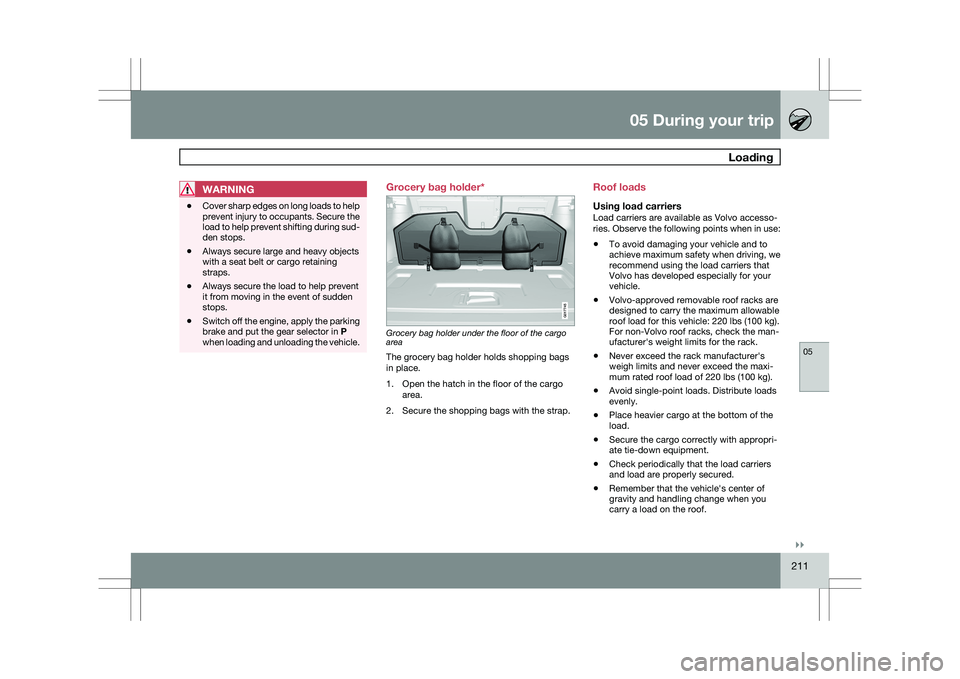
when loading and unloading the vehicle. Grocery bag holder*
Grocery bag holder under the floor of the cargo
area
The grocery bag holder holds shopping bags
in place.
1. Open the hatch in the floor of the cargo
area.
2. Secure the shopping bags with the strap. Roof loads
Using load carriersLoad carriers are available as Volvo accesso-
ries. Observe the following points when in use:
\b
To avoid damaging your vehicle and to
achieve maximum safety when driving, we
recommend using the load carriers that
Volvo has developed especially for your
vehicle.
\b Volvo-approved removable roof racks are
designed to carry the maximum allowable
roof load for this vehicle: 220 lbs (100 kg).
For non-Volvo roof racks, check the man-
ufacturer\fs weight limits for the rack.
\b Never exceed the rack manufacturer\fs
weigh limits and never exceed the maxi-
mum rated roof load of 220 lbs (100 kg).
\b Avoid single-point loads. Distribute loads
evenly.
\b Place heavier cargo at the bottom of the
load.
\b Secure the cargo correctly with appropri-
ate tie-down equipment.
\b Check periodically that the load carriers
and load are properly secured.
\b Remember that the vehicle\fs center of
gravity and handling change when you
carry a load on the roof. G017745
Page 249 of 297
06 Maintenance and specifications
Fuses06
}}
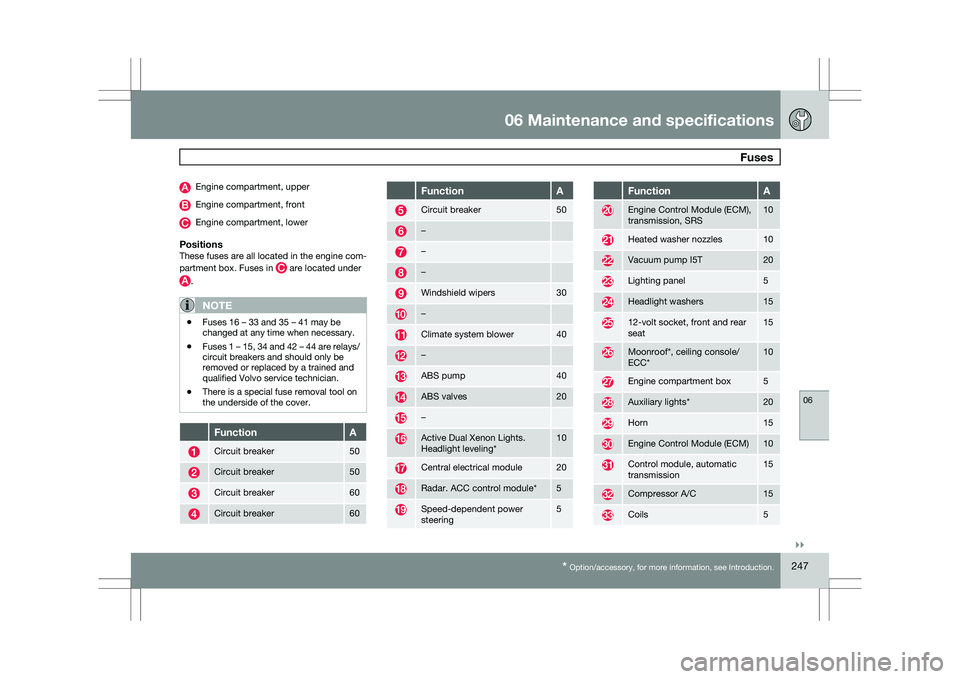
* Option/accessory, for more information, see Introduction. 247Engine compartment, upper
Engine compartment, front
Engine compartment, lower
PositionsThese fuses are all located in the engine com-
partment box. Fuses in
are located under
.
NOTE
\b
Fuses 16 – 33 and 35 – 41 may be
changed at any time when necessary.
\b Fuses 1 – 15, 34 and 42 – 44 are relays/
circuit breakers and should only be
removed or replaced by a trained and
qualified Volvo service technician.
\b There is a special fuse removal tool on
the underside of the cover. Function A
Circuit breaker 50
Circuit breaker 50
Circuit breaker 60
Circuit breaker 60 Function A
Circuit breaker 50
–
–
–
Windshield wipers 30
–
Climate system blower 40
–
ABS pump 40
ABS valves 20
–
Active Dual Xenon Lights.
Headlight leveling
* 10
Central electrical module 20
Radar. ACC control module* 5
Speed-dependent power
steering 5 Function A
Engine Control Module (ECM),
transmission, SRS 10
Heated washer nozzles 10
Vacuum pump I5T 20
Lighting panel 5
Headlight washers 15
12-volt socket, front and rear
seat 15
Moonroof*, ceiling console/
ECC* 10
Engine compartment box 5
Auxiliary lights* 20
Horn 15
Engine Control Module (ECM) 10
Control module, automatic
transmission 15
Compressor A/C 15
Coils 5
Page 251 of 297
06 Maintenance and specifications
Fuses06
}}
* Option/accessory, for more information, see Introduction. 249
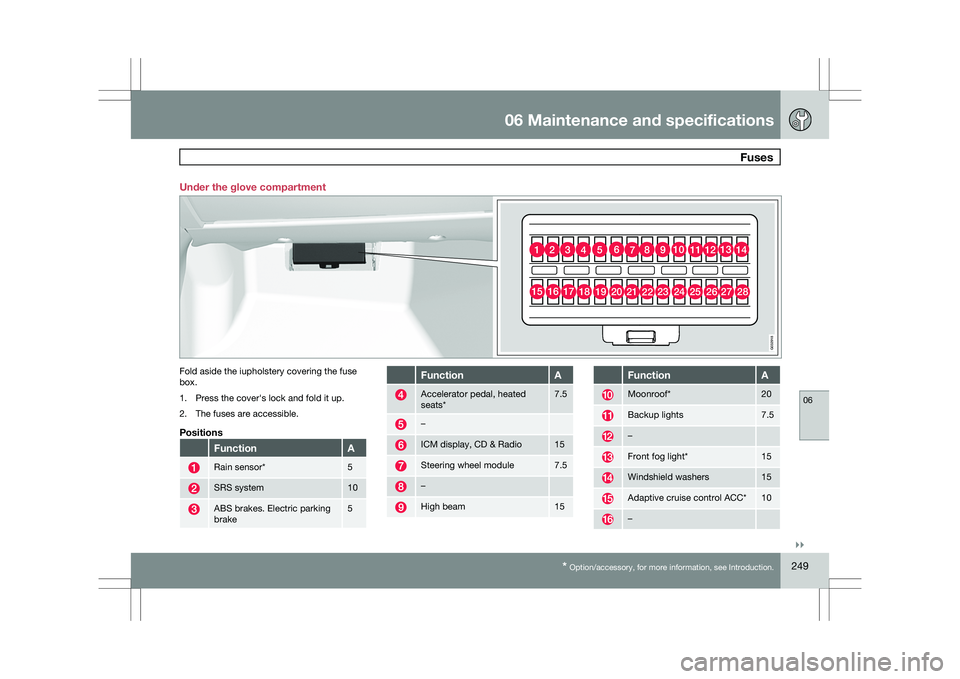
Under the glove compartment
Fold aside the iupholstery covering the fuse
box.
1. Press the cover\fs lock and fold it up.
2. The fuses are accessible.
Positions
Function A
Rain sensor* 5
SRS system 10
ABS brakes. Electric parking
brake 5 Function A
Accelerator pedal, heated
seats* 7.5
–
ICM display, CD & Radio 15
Steering wheel module 7.5
–
High beam 15 Function A
Moonroof* 20
Backup lights 7.5
–
Front fog light* 15
Windshield washers 15
Adaptive cruise control ACC* 10
– 1011121314123456789
2322212019181716152425262728
G032918
Page 276 of 297
06 Maintenance and specificationsVehicle care 06
274 Washing the car
WARNING
Be sure that the compressor is not con-
nected to a 12-volt socket while replacing
the container.
The following points should be kept in mind
when washing and cleaning the car:
\b
The car should be washed at regular inter-
vals since dirt, dust, insects and tar spots
adhere to the paint and may cause dam-
age. To help prevent corrosion, it is partic-
ularly important to wash the car frequently
in the wintertime.
\b Avoid washing your car in direct sunlight.
Doing so may cause detergents and wax
to dry out and become abrasive. To avoid
scratching, use lukewarm water to soften
the dirt before you wash with a soft
sponge, and plenty of sudsy water.
\b Bird droppings: Remove from paintwork
as soon as possible. Otherwise the finish
may be permanently damaged.
\b A detergent can be used to facilitate the
softening of dirt and oil.
\b A water-soluble grease solvent may be
used in cases of sticky dirt. However, use
a wash place equipped with a drainage
separator. \b
Dry the car with a clean chamois and
remember to clean the drain holes in the
doors and rocker panels.
\b Tar spots can be removed with kerosene
or tar remover after the car has been
washed.
\b A stiff-bristle brush and lukewarm soapy
water can be used to clean the wiper
blades. Frequent cleaning of the wind-
shield and wiper blades improves visibility
considerably and also helps prolong the
service life of the wiper blades.
\b Wash off the dirt from the underside (wheel
housings, fenders, etc).
\b In areas of high industrial fallout, more fre-
quent washing is recommended.
\b After cleaning the engine, the spark plug
wells should be inspected for water and
blown dry if necessary.
NOTE When washing the car, remember to remove
dirt from the drain holes in the doors and
sills.
CAUTION \b
During high pressure washing, the
spray mouthpiece must never be closer
to the vehicle than 13" (30 cm). Do not
spray into the locks.
\b Dirt, snow, etc., on the headlights can
reduce lighting capacity considerably.
Clean the headlights regularly, for
example when refueling.
\b When washing or steam cleaning the
engine, avoid spraying water or steam
directly on the electrical components or
toward the rear side of the engine. Spe-
cial moonroof cautions:
\b Always close the moonroof and sun
shade before washing your vehicle.
\b Never use abrasive cleaning agents on
the moonroof.
\b Never use wax on the rubber seals
around the moonroof.
Exterior componentsVolvo recommends the use of special cleaning
products, available at your Volvo retailer, for
cleaning colored plastic, rubber, or ornamental
components such as chromed strips on the
exterior of your vehicle. The instructions for
using these products should be followed care-
Page 284 of 297
06 Maintenance and specificationsSpecifications 06
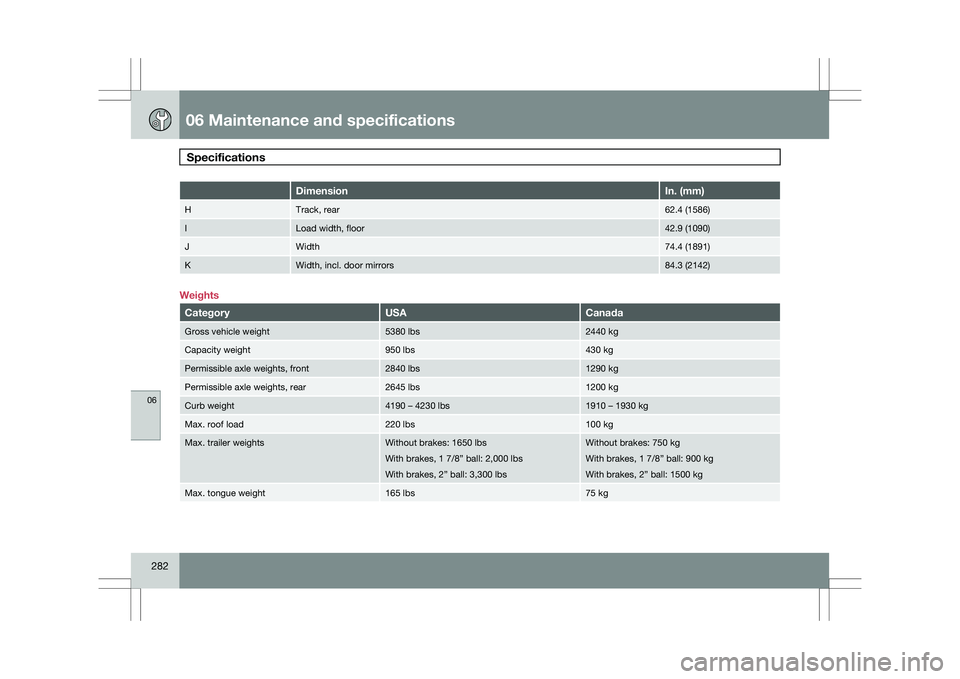
282 Dimension In. (mm)
H Track, rear 62.4 (1586)
I Load width, floor 42.9 (1090)
J Width 74.4 (1891)
K Width, incl. door mirrors 84.3 (2142)
Weights
Category USA Canada
Gross vehicle weight 5380 lbs 2440 kg
Capacity weight 950 lbs 430 kg
Permissible axle weights, front 2840 lbs 1290 kg
Permissible axle weights, rear 2645 lbs 1200 kg
Curb weight 4190 – 4230 lbs 1910 – 1930 kg
Max. roof load 220 lbs 100 kg
Max. trailer weights Without brakes: 1650 lbs
With brakes, 1 7/8” ball: 2,000 lbs
With brakes, 2” ball: 3,300 lbs Without brakes: 750 kg
With brakes, 1 7/8” ball: 900 kg
With brakes, 2” ball: 1500 kg
Max. tongue weight 165 lbs 75 kg
Page 293 of 297
07 Index07
291
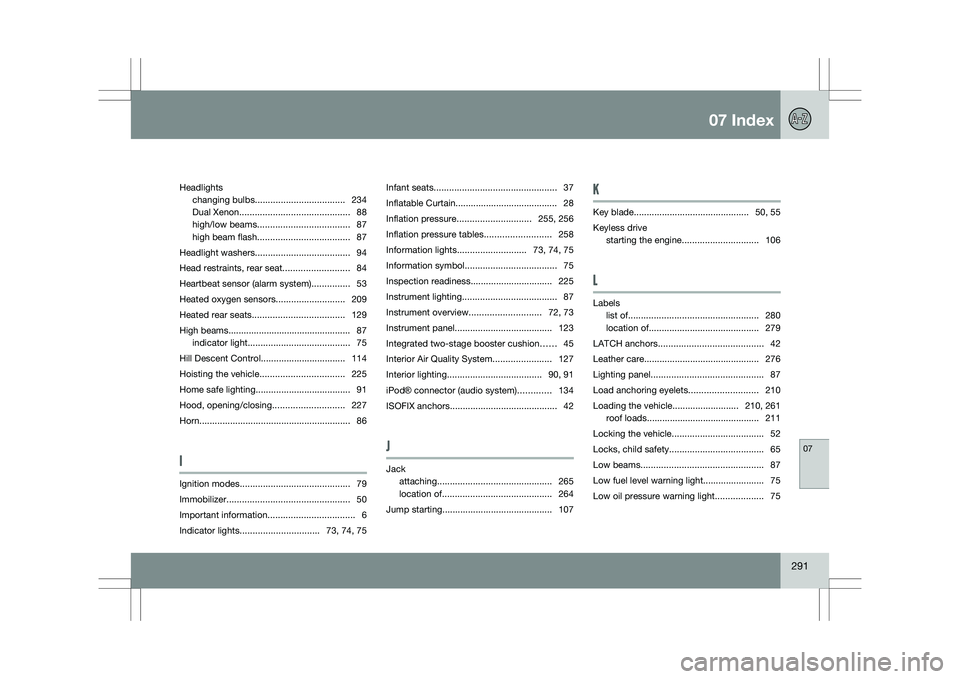
Headlights
changing bulbs ................................... 234
Dual Xenon ........................................... 88
high/low beams .................................... 87
high beam flash .................................... 87
Headlight washers ..................................... 94
Head restraints, rear seat.......................... 84
Heartbeat sensor (alarm system)............... 53
Heated oxygen sensors ...........................209
Heated rear seats.................................... 129
High beams................................................
87
indicator light ........................................ 75
Hill Descent Control ................................. 114
Hoisting the vehicle ................................. 225
Home safe lighting ..................................... 91
Hood, opening/closing ............................227
Horn ........................................................... 86
I Ignition modes
........................................... 79
Immobilizer................................................ 50
Important information .................................. 6
Indicator lights ............................... 73, 74, 75Infant seats................................................
37
Inflatable Curtain........................................ 28
Inflation pressure ............................. 255, 256
Inflation pressure tables ..........................258
Information lights ........................... 73, 74, 75
Information symbol .................................... 75
Inspection readiness ................................ 225
Instrument lighting ..................................... 87
Instrument overview ............................72, 73
Instrument panel...................................... 123
Integrated two-stage booster cushion ......45
Interior Air Quality System....................... 127
Interior lighting ..................................... 90, 91
iPod® connector (audio system) .............134
ISOFIX anchors.......................................... 42
J Jack
attaching ............................................. 265
location of ........................................... 264
Jump starting........................................... 107K Key blade.............................................
50, 55
Keyless drive starting the engine .............................. 106
L Labels
list of................................................... 280
location of ........................................... 279
LATCH anchors ......................................... 42
Leather care ............................................. 276
Lighting panel ............................................ 87
Load anchoring eyelets ...........................210
Loading the vehicle ..........................210, 261
roof loads............................................ 211
Locking the vehicle .................................... 52
Locks, child safety..................................... 65
Low beams................................................ 87
Low fuel level warning light
........................ 75
Low oil pressure warning light ...................75
Page 294 of 297
07 Index07
292 M
Main instrument panel
.............................123
Maintenance ............................................ 224
hoisting the vehicle ............................. 225
performed by the owner..................... 225
Malfunction indicator light .........................74
Menu system........................................... 122
overview..............................................
122
Messages in the instrument panel ...........123
Mirrors defroster............................................... 99
power door........................................... 98
rearview, auto-dim function ..................99
retractable............................................. 98
vanity.................................................. 199
Moonroof ................................................. 100
Motor oil checking ............................................. 228
specifications ...................................... 283
volumes .............................................. 284
N Net in cargo area
..................................... 214O Occupant safety........................................
12
Occupant weight sensor ......................22, 23
Octane recommendations .......................207
Odometer, trip........................................... 78
Oil specifications ...................................... 283
volumes .............................................. 284
On Call Roadside Assistance ..................287
Overhead courtesy lighting ..................90, 91
Overheating, engine ................................... 77
Oxygen sensors, heated.......................... 209
P Paint, touching up.................................... 277
Panorama moonroof
................................ 100
Park assist....................................... 187, 189
Park Assist Camera................................. 190
Parking brake electric, applying/releasing .................116
warning light ......................................... 75Parking lights
............................................. 88
changing bulbs ................................... 234
Personal Car Communicator, unique func-
tions........................................................... 53
Polishing .................................................. 276
Power front seat memory function ................................... 81
with keyless drive................................. 82
Power mirrors............................................ 98
defroster............................................... 99
Power moonroof ...................................... 100
Power steering speed-dependent............................... 157
Power steering fluid .........................230, 285
Power tailgate ............................................ 63
Power windows................................... 96, 97
laminated glass ..................................... 97
Pregnancy, using seat belts during ...........16
PROPOSITION 65 WARN-
ING....................................... 9, 107, 243, 286
Page 295 of 297
07 Index07
293
R
Radio
Sirius satellite radio ............141, 143, 144
Radio functions ........................................ 138
Digital Audio Broadcasting (DAB) .......140
HD digital radio ................................... 139
Rain sensor ................................................ 93
READ button............................................ 123
Rear fog light ..................................... 89, 236
Rear park assist............................... 187, 189
Rear seats center head restraint.............................
84
folding ................................................... 83
heated................................................. 129
Rearview mirror auto-dim function ................................. 99
compass............................................. 154
Rear window defroster.............................. 99
Recalls, child restraints ..............................44
Refrigerant ............................................... 285
Refueling .......................................... 206, 207
fuel filler cap....................................... 208
fuel filler door ...................................... 208
fuel tank volume ................................. 285Registering child restraints
........................44
Remote control .......................................... 50
approach lighting .................................. 52
common functions ................................ 52
immobilizer ........................................... 50
key blade........................................ 50, 55
key memory.......................................... 50
locking the vehicle ................................ 52
Personal Car Communicator ..........52, 53
replacing the battery .............................56
unlocking the vehicle ............................52
Reporting safety defects............................
13
Roadside Assistance ............................... 287
Rollover Protection System (ROPS) ..........31
Roll Stability Control (RSC) ........................31
Roof loads................................................ 211
S Safety, occupant........................................ 12
Safety defects, reporting...........................
13
Seat belt reminder................................................
15Seat belts
Automatic locking retractor/Emergency
locking retractor
.................................... 34
buckling ................................................ 14
maintenance ......................................... 14
pretensioners ........................................ 14
reminder................................................ 14
reminder warning light ..........................76
securing child restraint sys-
tems.......................................... 37, 39, 41
unbuckling ............................................ 14
use during pregnancy ...........................16
using ..................................................... 14
Seats, front................................................ 81
Side door mirrors....................................... 98
Side impact airbags................................... 26
Side marker lights, changing bulbs .........235
Sirius satellite radio.................. 141, 143, 144
Snow chains ............................................ 262
Snow tires................................................ 262
Sound settings, audio system .................136
Spare tire................................................. 264
Speed-dependent steering...................... 157
Spin control ............................................. 155
SRS............................................................ 17