brake light VOLVO XC60 2009 Owner´s Manual
[x] Cancel search | Manufacturer: VOLVO, Model Year: 2009, Model line: XC60, Model: VOLVO XC60 2009Pages: 297, PDF Size: 21.16 MB
Page 206 of 297
05 During your tripDriving recommendations 05
204
Before a long distance tripIt is always worthwhile to have your vehicle
checked by a trained and qualified Volvo serv-
ice technician before driving long distances.
Your retailer will also be able to supply you with
bulbs, fuses, spark plugs and wiper blades for
your use in the event that problems occur.
As a minimum, the following items should be
checked before any long trip:
\b
Check that engine runs smoothly and that
fuel consumption is normal.
\b Check for fuel, oil, and fluid leakage
\b Have the transmission oil level checked.
\b Check condition of drive belts.
\b Check state of the battery\fs charge.
\b Examine tires carefully (the spare tire as
well), and replace those that are worn.
Check tire pressures.
\b The brakes, front wheel alignment, and
steering gear should be checked by a
trained and qualified Volvo service techni-
cian only.
\b Check all lights, including high beams.
\b Reflective warning triangles are legally
required in some states/provinces.
\b Have a word with a trained and qualified
Volvo service technician if you intend to
drive in countries where it may be difficult
to obtain the correct fuel. \b
Consider your destination. If you will be
driving through an area where snow or ice
are likely to occur, consider snow tires.
Cold weather precautionsIf you wish to check your vehicle before the
approach of cold weather, the following advice
is worth noting:
\bMake sure that the engine coolant contains
50 percent antifreeze. Any other mixture
will reduce freeze protection. This gives
protection against freezing down to
–31 °F (–35 °C). The use of "recycled" anti-
freeze is not approved by Volvo. Different
types of antifreeze must not be mixed.
\b Volvo recommends using only genuine
Volvo antifreeze in your vehicle\fs radiator.
\b Try to keep the fuel tank well filled – this
helps prevent the formation of condensa-
tion in the tank. In addition, in extremely
cold weather conditions it is worthwhile to
add fuel line de-icer before refueling.
\b The viscosity of the engine oil is important.
Oil with low viscosity (thinner oil) improves
cold-weather starting as well as decreas-
ing fuel consumption while the engine is
warming up. For winter use, 5W-30 oil, par-
ticularly the synthetic type, is recom-
mended. Be sure to use good quality oil but
do not use cold-weather oil for hard driving
or in warm weather, see page 283 for more
information on engine oil.
NOTE Synthetic oil is not used when the oil is
changed at the normal maintenance inter-
vals except at owner request and at addi-
tional charge.
\b
The load placed on the battery is greater
during the winter since the windshield wip-
ers, lighting, etc. are used more often.
Moreover, the capacity of the battery
decreases as the temperature drops. In
very cold weather, a poorly charged bat-
tery can freeze and be damaged. It is there-
fore advisable to check the state of charge
more frequently and spray an anti-rust oil
on the battery posts.
\b Volvo recommends the use of snow tires
on all four wheels for winter driving, see
page 262.
\b To prevent the washer fluid reservoir from
freezing, add washer solvents containing
antifreeze. This is important since dirt is
often splashed on the windshield during
winter driving, requiring the frequent use of
the washers and wipers. Volvo Washer
Solvent should be diluted as follows: Down
to 14 °F (–10 °C): 1 part washer solvent and
4 parts water Down to 5 °F (–15 °C): 1 part
washer solvent and 3 parts water Down to
0 °F (–18 °C): 1 part washer solvent and
Page 219 of 297
05 During your trip
Towing a trailer05
}}
217
Introduction
Volvo recommends the use of Volvo trailer
hitches that are specially designed for the vehi-
cle.
NOTE
See page 282 for the maximum trailer and
tongue weights recommended by Volvo.
\b
Observe the legal requirements of the
state/province in which the vehicles are
\b All Volvo models are equipped with
energy-absorbing shock-mounted bump-
ers. Trailer hitch installation should not
interfere with the proper operation of this
bumper system.
Trailer towing does not normally present any
particular problems, but take into considera-
tion:
\b Increase tire pressure to recommended
full. See the tire inflation tables beginning
on page 258.
\b When your vehicle is new, avoid towing
heavy trailers during the first 620 miles
(1,000 km).
\b Maximum speed when towing a trailer:
50 mph (80 km/h).
\b Engine and transmission are subject to
increased loads. Therefore, engine coolant
temperature should be closely watched when driving in hot climates or hilly terrain.
Use a lower gear and turn off the air con-
ditioner if the temperature gauge needle
enters the red range.
\b If the automatic transmission begins to
overheat, a message will be displayed in
the text window.
\b Avoid overload and other abusive opera-
tion.
\b Hauling a trailer affects handling, durabil-
ity, and economy.
\b It is necessary to balance trailer brakes
with the towing vehicle brakes to provide a
safe stop (check and observe state/local
regulations).
\b Do not connect the trailer\fs brake system
directly to the vehicle\fs brake system.
\b More frequent vehicle maintenance is
required.
\b Remove the ball and drawbar assembly
when the hitch is not being used.
\b Volvo recommends the use of synthetic
engine oil when towing a trailer over long
distances or in mountainous areas.
WARNING \b
Bumper-attached trailer hitches must
not be used on Volvos, nor should
safety chains be attached to the
bumper.
\b Trailer hitches attaching to the vehicle
rear axle must not be used.
\b Never connect a trailer\fs hydraulic
brake system directly to the vehicle
brake system, nor a trailer\fs lighting
system directly to the vehicle lighting
system. Consult your nearest author-
ized Volvo retailer for correct installa-
tion.
\b When towing a trailer, the trailer\fs safety
wire must be correctly fastened to the
hole or hook provided in the trailer hitch
on the vehicle. The safety wire should
never be fastened to or wound around
the drawbar ball.
Page 229 of 297
06 Maintenance and specifications
Hood and engine compartment06
227
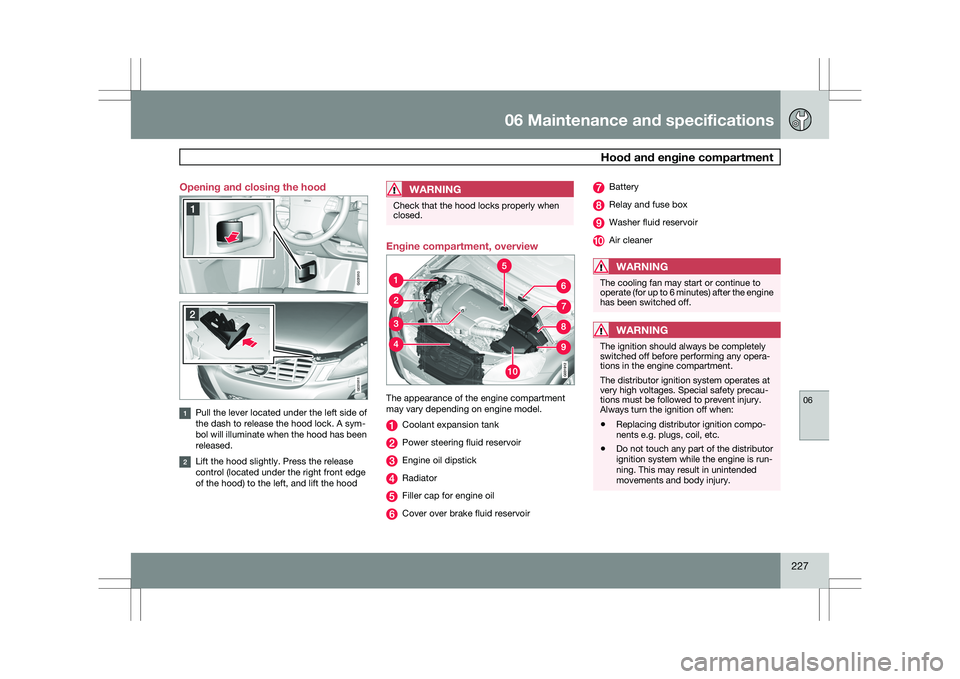
Opening and closing the hood
Pull the lever located under the left side of
the dash to release the hood lock. A sym-
bol will illuminate when the hood has been
released.
Lift the hood slightly. Press the release
control (located under the right front edge
of the hood) to the left, and lift the hood
WARNING Check that the hood locks properly when
closed.
Engine compartment, overview
The appearance of the engine compartment
may vary depending on engine model.
Coolant expansion tank
Power steering fluid reservoir
Engine oil dipstick
Radiator
Filler cap for engine oil
Cover over brake fluid reservoir Battery
Relay and fuse box
Washer fluid reservoir
Air cleaner
WARNING
The cooling fan may start or continue to
operate (for up to 6 minutes) after the engine
has been switched off.
WARNING
The ignition should always be completely
switched off before performing any opera-
tions in the engine compartment.
The distributor ignition system operates at
very high voltages. Special safety precau-
tions must be followed to prevent injury.
Always turn the ignition off when:
\b
Replacing distributor ignition compo-
nents e.g. plugs, coil, etc.
\b Do not touch any part of the distributor
ignition system while the engine is run-
ning. This may result in unintended
movements and body injury. G031910 G031911
Page 239 of 297

06 Maintenance and specifications
Replacing bulbs06
}}
237Brake light
Backup light
Turn signal
Brake lights (LED)
NOTE
If an error message remains in the display
after a faulty bulb has been replaced, con-
tact an authorized Volvo workshop.
Brake lights and Taillights
The brake lights and taillights are replaced from
inside the cargo area.
NOTE Before starting to replace a bulb, see the
general information on page 232.
1. Open the panel.
2.
Remove the bulb holder by turning it coun-
terclockwise.
3. Remove the burned out bulb by pressing it
in and turning it counterclockwise.
4. Insert a new bulb, press it in and turn it clockwise.
5. Reinsert the bulb holder and turn it clock- wise.
License plate lighting 1. Remove the screws with a screwdriver.2. Carefully detach the entire bulb housing
and pull it out.
3. Replace the bulb.
4. Reinsert the entire bulb housing and screw
it into place.
Footwell lighting 1.
Insert a screwdriver at the short end of the
lens closest to the tunnel console (the cen-
ter of the vehicle) and turn gently so that
the lens comes loose. (Applies to both
lights).
2. Turn carefully until the lens comes loose.
3. Replace the bulb.
4. Press the lens back into place. G032485 G031940 G031941
Page 251 of 297
06 Maintenance and specifications
Fuses06
}}
* Option/accessory, for more information, see Introduction. 249
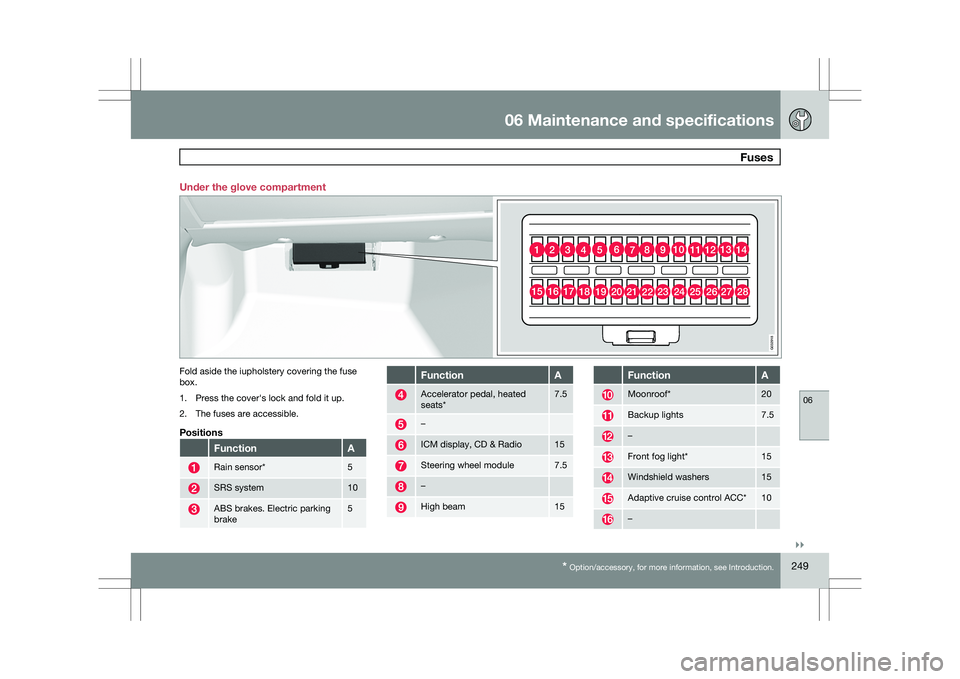
Under the glove compartment
Fold aside the iupholstery covering the fuse
box.
1. Press the cover\fs lock and fold it up.
2. The fuses are accessible.
Positions
Function A
Rain sensor* 5
SRS system 10
ABS brakes. Electric parking
brake 5 Function A
Accelerator pedal, heated
seats* 7.5
–
ICM display, CD & Radio 15
Steering wheel module 7.5
–
High beam 15 Function A
Moonroof* 20
Backup lights 7.5
–
Front fog light* 15
Windshield washers 15
Adaptive cruise control ACC* 10
– 1011121314123456789
2322212019181716152425262728
G032918
Page 252 of 297
06 Maintenance and specificationsFuses 06
250
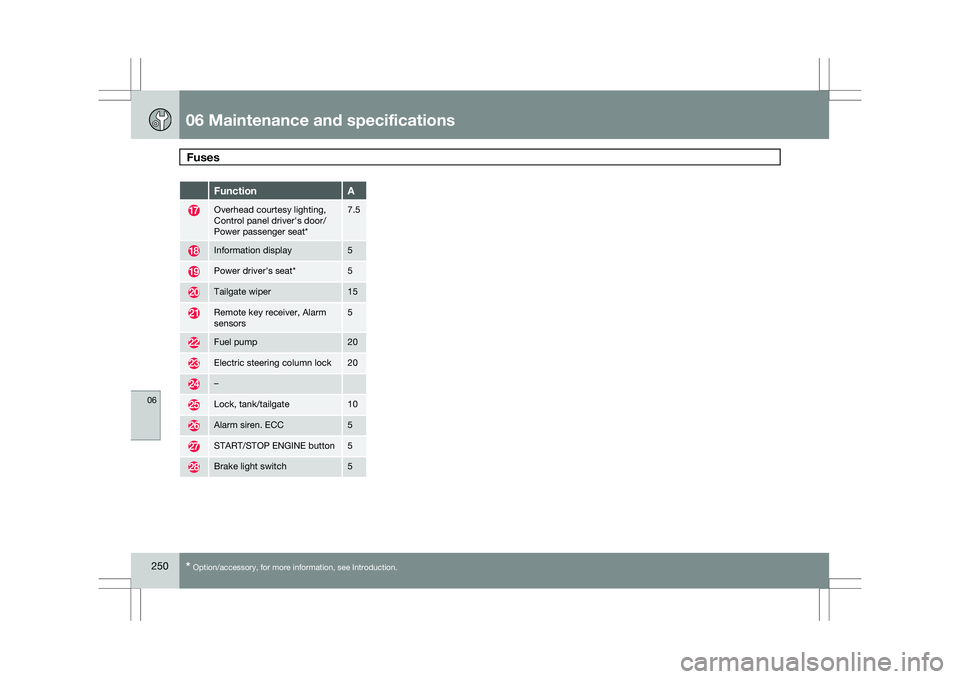
* Option/accessory, for more information, see Introduction. Function A
Overhead courtesy lighting,
Control panel driver\fs door/
Power passenger seat* 7.5
Information display 5
Power driver\fs seat* 5
Tailgate wiper 15
Remote key receiver, Alarm
sensors 5
Fuel pump 20
Electric steering column lock 20
–
Lock, tank/tailgate 10
Alarm siren. ECC 5
START/STOP ENGINE button 5
Brake light switch 5
Page 277 of 297
06 Maintenance and specifications
Vehicle care06
}}
275
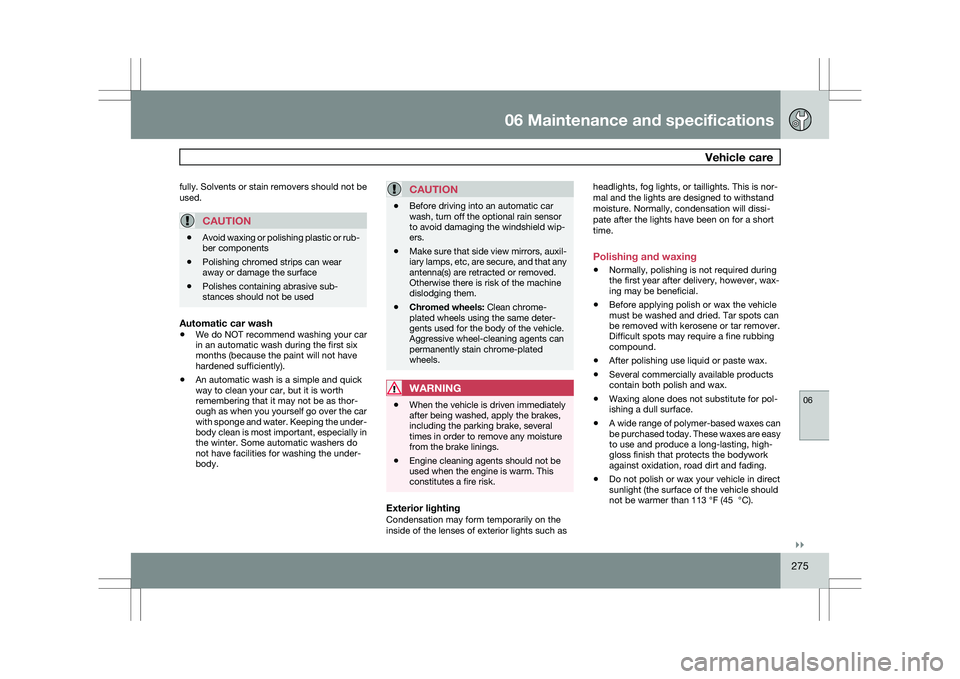
fully. Solvents or stain removers should not be
used.
CAUTION
\b
Avoid waxing or polishing plastic or rub-
ber components
\b Polishing chromed strips can wear
away or damage the surface
\b Polishes containing abrasive sub-
stances should not be used
Automatic car wash
\b
We do NOT recommend washing your car
in an automatic wash during the first six
months (because the paint will not have
hardened sufficiently).
\b An automatic wash is a simple and quick
way to clean your car, but it is worth
remembering that it may not be as thor-
ough as when you yourself go over the car
with sponge and water. Keeping the under-
body clean is most important, especially in
the winter. Some automatic washers do
not have facilities for washing the under-
body.
CAUTION \b
Before driving into an automatic car
wash, turn off the optional rain sensor
to avoid damaging the windshield wip-
ers.
\b Make sure that side view mirrors, auxil-
iary lamps, etc, are secure, and that any
antenna(s) are retracted or removed.
Otherwise there is risk of the machine
dislodging them.
\b Chromed wheels: Clean chrome-
plated wheels using the same deter-
gents used for the body of the vehicle.
Aggressive wheel-cleaning agents can
permanently stain chrome-plated
wheels.
WARNING \b
When the vehicle is driven immediately
after being washed, apply the brakes,
including the parking brake, several
times in order to remove any moisture
from the brake linings.
\b Engine cleaning agents should not be
used when the engine is warm. This
constitutes a fire risk.
Exterior lightingCondensation may form temporarily on the
inside of the lenses of exterior lights such as headlights, fog lights, or taillights. This is nor-
mal and the lights are designed to withstand
moisture. Normally, condensation will dissi-
pate after the lights have been on for a short
time.
Polishing and waxing
\b
Normally, polishing is not required during
the first year after delivery, however, wax-
ing may be beneficial.
\b Before applying polish or wax the vehicle
must be washed and dried. Tar spots can
be removed with kerosene or tar remover.
Difficult spots may require a fine rubbing
compound.
\b After polishing use liquid or paste wax.
\b Several commercially available products
contain both polish and wax.
\b Waxing alone does not substitute for pol-
ishing a dull surface.
\b A wide range of polymer-based waxes can
be purchased today. These waxes are easy
to use and produce a long-lasting, high-
gloss finish that protects the bodywork
against oxidation, road dirt and fading.
\b Do not polish or wax your vehicle in direct
sunlight (the surface of the vehicle should
not be warmer than 113 °F (45 °C).
Page 287 of 297
06 Maintenance and specifications
Specifications06
}}
285
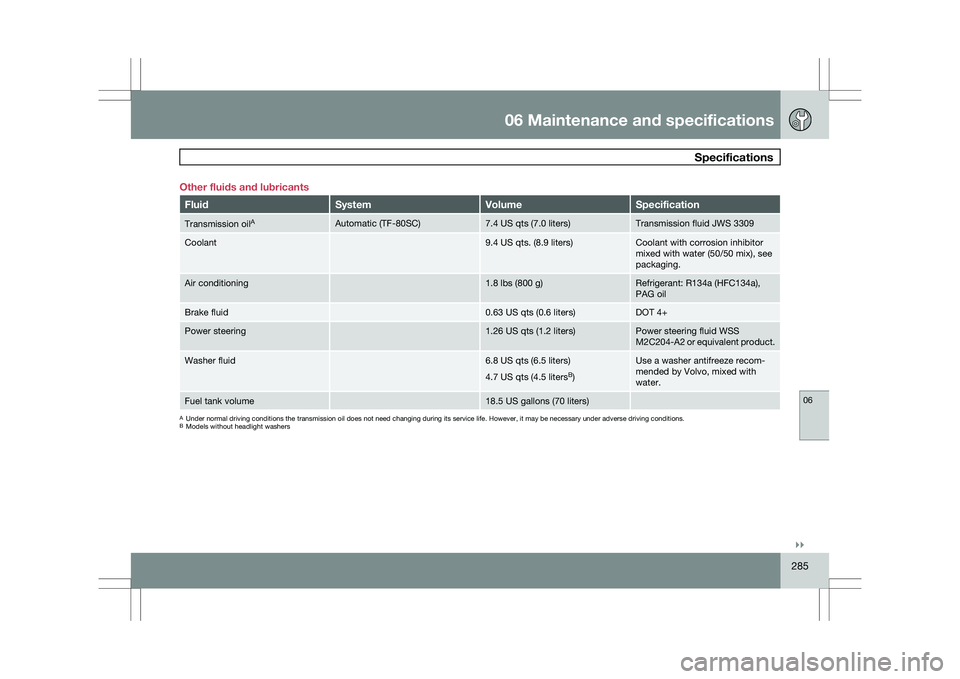
Other fluids and lubricants
Fluid System Volume Specification
Transmission oil
A Automatic (TF-80SC) 7.4 US qts (7.0 liters) Transmission fluid JWS 3309
Coolant 9.4 US qts. (8.9 liters) Coolant with corrosion inhibitor
mixed with water (50/50 mix), see
packaging.
Air conditioning 1.8 lbs (800 g) Refrigerant: R134a (HFC134a),
PAG oil
Brake fluid 0.63 US qts (0.6 liters) DOT 4+
Power steering 1.26 US qts (1.2 liters) Power steering fluid WSS
M2C204-A2 or equivalent product.
Washer fluid 6.8 US qts (6.5 liters)
4.7 US qts (4.5 liters
B
) Use a washer antifreeze recom-
mended by Volvo, mixed with
water.
Fuel tank volume 18.5 US gallons (70 liters)
A
Under normal driving conditions the transmission oil does not need chang\
ing during its service life. However, it may be necessary under adverse \
driving conditions.
B Models without headlight washers
Page 290 of 297
07 Index07
288 1, 2, 3 ...
12-volt sockets
........................................ 199
A Accessory installation warning
.................... 8
Active chassis system .............................157
Active yaw control ................................... 155
Adaptive cruise control ....172, 173, 174, 175
Airbags disconnecting the front passenger’s
side................................................. 22, 23
front.......................................... 18, 19, 20
inflatable curtain ................................... 28
side impact........................................... 26
Air conditioning ........................................ 129
Air distribution..........................................
127
Air distribution table................................. 131
Air vents................................................... 127
All Wheel Drive ......................................... 111
Anti-freeze ....................................... 204, 230
Anti-lock brake system ............................112
warning light ......................................... 74Approach lighting................................. 52, 92
Audio system
audio functions ................................... 136
CD player/changer
...................... 144, 145
Digital Audio Broadcasting (DAB) .......140
HD digital radio ................................... 139
menu control....................................... 135
overview.............................................. 133
radio functions .................................... 138
Sirius satellite radio ............141, 143, 144
sound settings .................................... 136
steering wheel keypad ........................133
USB/iPod® connector ........................134
Auto-dim rearview mirror ...........................99
Automatic locking retractor .......................34
Automatic transmission Geartronic ................................... 109, 110
general description .....................109, 110
oil ........................................................ 285
shiftlock override ................................ 110
Axle weight .............................................. 261B Battery
changing ..................................... 242, 243
maintenance ....................................... 242
remote control, replacing .....................56
specifications ...................................... 286
warning symbols.................................
242
Black box............................................. 7, 224
Blind Spot Information System
(BLIS)....................................... 193, 194, 195
Booster cushion, integrated ......................45
Booster cushions ....................................... 41
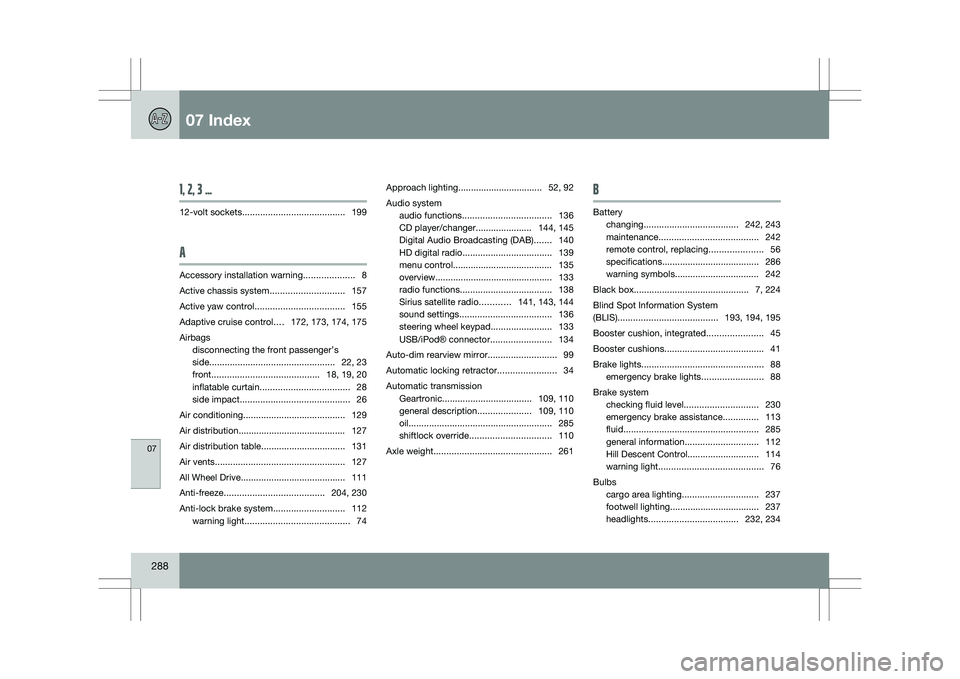
Brake lights ................................................ 88
emergency brake lights ........................88
Brake system checking fluid level ............................. 230
emergency brake assistance ..............113
fluid..................................................... 285
general information ............................. 112
Hill Descent Control ............................114
warning light ......................................... 76
Bulbs cargo area lighting .............................. 237
footwell lighting................................... 237
headlights ................................... 232, 234
Page 292 of 297
07 Index07
290 Dual Xenon headlights
...............................88
E ECC.................................................. 129, 130
Economical driving
.................................. 202
Electric parking brake ..............................116
Electronic Climate Control .......128, 129, 130
air distribution table ............................131
Interior Air Quality System.................. 130
Emergency brake lights .............................88
Emergency locking retractor
...................... 34
Emergency starting .................................. 107
Emergency towing ........................... 220, 221
Emission inspection readiness ................225
Engine overheating ........................................... 77
specifications ...................................... 283
starting ................................................ 105
starting with keyless drive ..................106
Engine compartment overview ................227
Engine oil checking ............................................. 228
low pressure warning light ....................75specifications
...................................... 283
volumes .............................................. 284
Environment ................................................. 9
Eyelets for anchoring loads .....................210
F Federal Clean Air Act
...............................224
Fluid specifications .................................. 285
Fog lights front...................................................... 75
front, changing bulbs ..........................236
front/rear............................................... 89
rear......................................................
236
Four C (active chassis system) ................157
Front airbags.................................. 18, 19, 20 disconnecting passenger’s side air-
bag.................................................. 22, 23
Front fog lights ..................................... 75, 89
changing bulbs ................................... 236
Front park assist.............................. 187, 189
Front seats ........................................... 81, 82
Fuel filler cap............................................ 208
Fuel filler door, opening ...........................208Fuel level warning light
..............................75
Fuel requirements ............................ 206, 207
Fuel tank volume
...................................... 285
Fuses............................... 245, 246, 249, 251
G Gasoline requirements
.............................207
Gas tank volume...................................... 285
Gauges...................................................... 73
Geartronic ................................................ 110
Geartronic automatic transmission
.. 109, 110
Generator warning light .............................76
Glossary of tire terminology .....................260
Grocery bag holder.................................. 211
Gross vehicle weight ............................... 261
H Hazard warning flashers
............................89
HD digital radio ........................................ 139