lock VOLVO XC60 2009 Owner´s Manual
[x] Cancel search | Manufacturer: VOLVO, Model Year: 2009, Model line: XC60, Model: VOLVO XC60 2009Pages: 297, PDF Size: 21.16 MB
Page 4 of 297
Contents2
00
00
Introduction
Important information ................................. 6
Important warnings..................................... 8
Environment ................................................ 9
01
01Safety
Occupant safety........................................ 12
Reporting safety defects........................... 13
Seat belts ................................................. 14
Supplemental Restraint System (SRS) .... 17
Occupant Weight Sensor ......................... 22
Side impact protection (SIPS) airbags ..... 26
Volvo Inflatable Curtain (VIC) ................... 28
Whiplash Protection System – WHIPS..... 29
Rollover Protection System (ROPS) ......... 31
Crash mode.............................................. 32
Child safety............................................... 33
Child restraint systems .............................35
Infant seats............................................... 37
Convertible seats ...................................... 39
Booster cushions ...................................... 41
ISOFIX lower anchors............................... 42
Top tether anchors.................................... 43
Child restraint registration and recalls ......44
Integrated booster cushion .......................45
02
02Locks and alarm
Remote key and key blade....................... 50
Keyless drive............................................. 58
Locks ........................................................ 61
Child safety locks ...................................... 65
Alarm......................................................... 66
Page 16 of 297
01 SafetySeat belts 01
14 General information
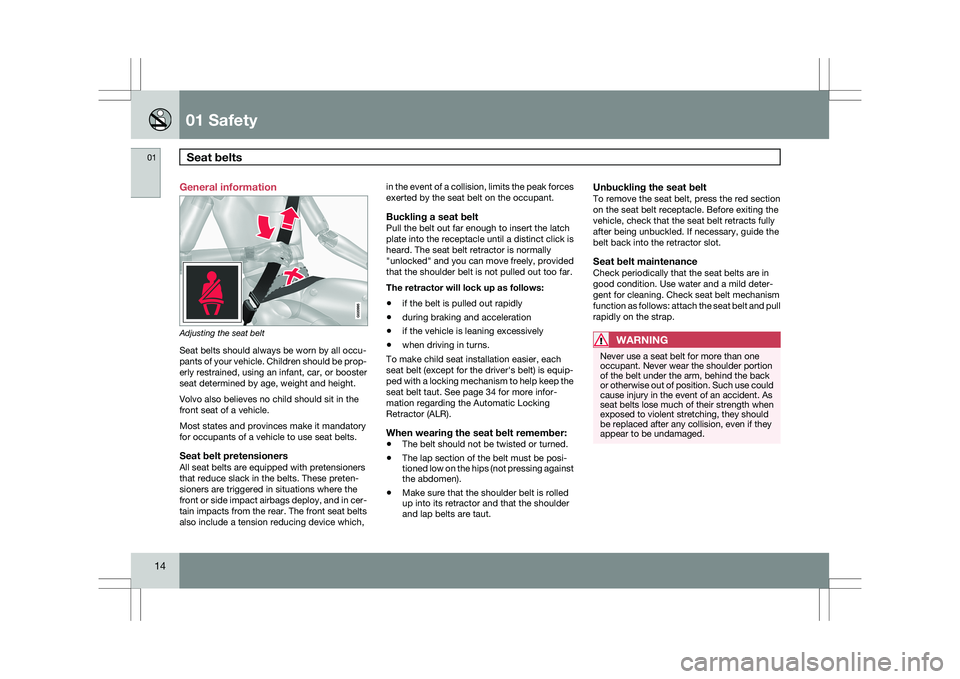
Adjusting the seat belt
Seat belts should always be worn by all occu-
pants of your vehicle. Children should be prop-
erly restrained, using an infant, car, or booster
seat determined by age, weight and height.
Volvo also believes no child should sit in the
front seat of a vehicle.
Most states and provinces make it mandatory
for occupants of a vehicle to use seat belts.
Seat belt pretensionersAll seat belts are equipped with pretensioners
that reduce slack in the belts. These preten-
sioners are triggered in situations where the
front or side impact airbags deploy, and in cer-
tain impacts from the rear. The front seat belts
also include a tension reducing device which, in the event of a collision, limits the peak forces
exerted by the seat belt on the occupant.
Buckling a seat beltPull the belt out far enough to insert the latch
plate into the receptacle until a distinct click is
heard. The seat belt retractor is normally
"unlocked" and you can move freely, provided
that the shoulder belt is not pulled out too far.
The retractor will lock up as follows:
\b
if the belt is pulled out rapidly
\b during braking and acceleration
\b if the vehicle is leaning excessively
\b when driving in turns.
To make child seat installation easier, each
seat belt (except for the driver\fs belt) is equip-
ped with a locking mechanism to help keep the
seat belt taut. See page 34 for more infor-
mation regarding the Automatic Locking
Retractor (ALR).
When wearing the seat belt remember:
\b The belt should not be twisted or turned.
\b The lap section of the belt must be posi-
tioned low on the hips (not pressing against
the abdomen).
\b Make sure that the shoulder belt is rolled
up into its retractor and that the shoulder
and lap belts are taut.
Unbuckling the seat beltTo remove the seat belt, press the red section
on the seat belt receptacle. Before exiting the
vehicle, check that the seat belt retracts fully
after being unbuckled. If necessary, guide the
belt back into the retractor slot.
Seat belt maintenanceCheck periodically that the seat belts are in
good condition. Use water and a mild deter-
gent for cleaning. Check seat belt mechanism
function as follows: attach the seat belt and pull
rapidly on the strap.
WARNING Never use a seat belt for more than one
occupant. Never wear the shoulder portion
of the belt under the arm, behind the back
or otherwise out of position. Such use could
cause injury in the event of an accident. As
seat belts lose much of their strength when
exposed to violent stretching, they should
be replaced after any collision, even if they
appear to be undamaged.
Page 19 of 297
01 Safety
Supplemental Restraint System (SRS)01
}}
17
General information
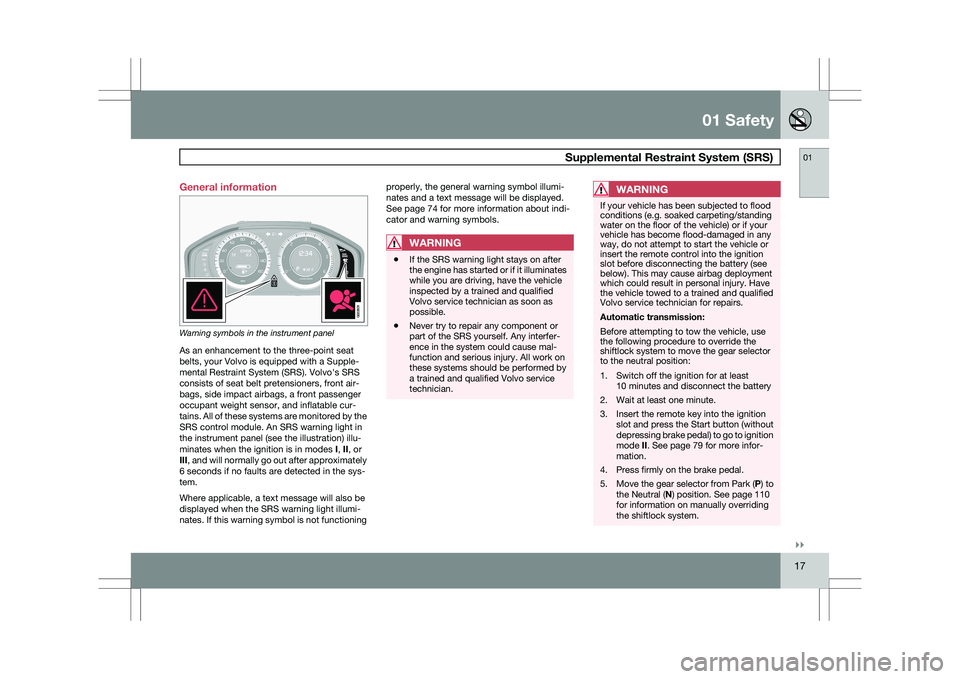
Warning symbols in the instrument panel
As an enhancement to the three-point seat
belts, your Volvo is equipped with a Supple-
mental Restraint System (SRS). Volvo\fs SRS
consists of seat belt pretensioners, front air-
bags, side impact airbags, a front passenger
occupant weight sensor, and inflatable cur-
tains. All of these systems are monitored by the
SRS control module. An SRS warning light in
the instrument panel (see the illustration) illu-
minates when the ignition is in modes
I, II, or
III, and will normally go out after approximately
6 seconds if no faults are detected in the sys-
tem.
Where applicable, a text message will also be
displayed when the SRS warning light illumi-
nates. If this warning symbol is not functioning properly, the general warning symbol illumi-
nates and a text message will be displayed.
See page 74 for more information about indi-
cator and warning symbols.
WARNING
\b
If the SRS warning light stays on after
the engine has started or if it illuminates
while you are driving, have the vehicle
inspected by a trained and qualified
Volvo service technician as soon as
possible.
\b Never try to repair any component or
part of the SRS yourself. Any interfer-
ence in the system could cause mal-
function and serious injury. All work on
these systems should be performed by
a trained and qualified Volvo service
technician.
WARNING If your vehicle has been subjected to flood
conditions (e.g. soaked carpeting/standing
water on the floor of the vehicle) or if your
vehicle has become flood-damaged in any
way, do not attempt to start the vehicle or
insert the remote control into the ignition
slot before disconnecting the battery (see
below). This may cause airbag deployment
which could result in personal injury. Have
the vehicle towed to a trained and qualified
Volvo service technician for repairs.
Automatic transmission:
Before attempting to tow the vehicle, use
the following procedure to override the
shiftlock system to move the gear selector
to the neutral position:
1. Switch off the ignition for at least
10 minutes and disconnect the battery
2. Wait at least one minute.
3. Insert the remote key into the ignition slot and press the Start button (without
depressing brake pedal) to go to ignition
mode II. See page 79 for more infor-
mation.
4. Press firmly on the brake pedal.
5. Move the gear selector from Park ( P) to
the Neutral (N) position. See page 110
for information on manually overriding
the shiftlock system. G022831
Page 27 of 297
01 Safety
Occupant Weight Sensor01
25
WARNING\b
Do not place any type of object on the
front passenger\fs seat in such a way
that jamming, pressing, or squeezing
occurs between the object and the front
seat, other than as a direct result of the
correct use of the Automatic Locking
Retractor/Emergency Locking Retrac-
tor (ALR/ELR) seat belt (see page 34).
\b No objects should be placed under the
front passenger\fs seat. This could inter-
fere with the OWS system\fs function.
Page 34 of 297
01 SafetyCrash mode 01
32
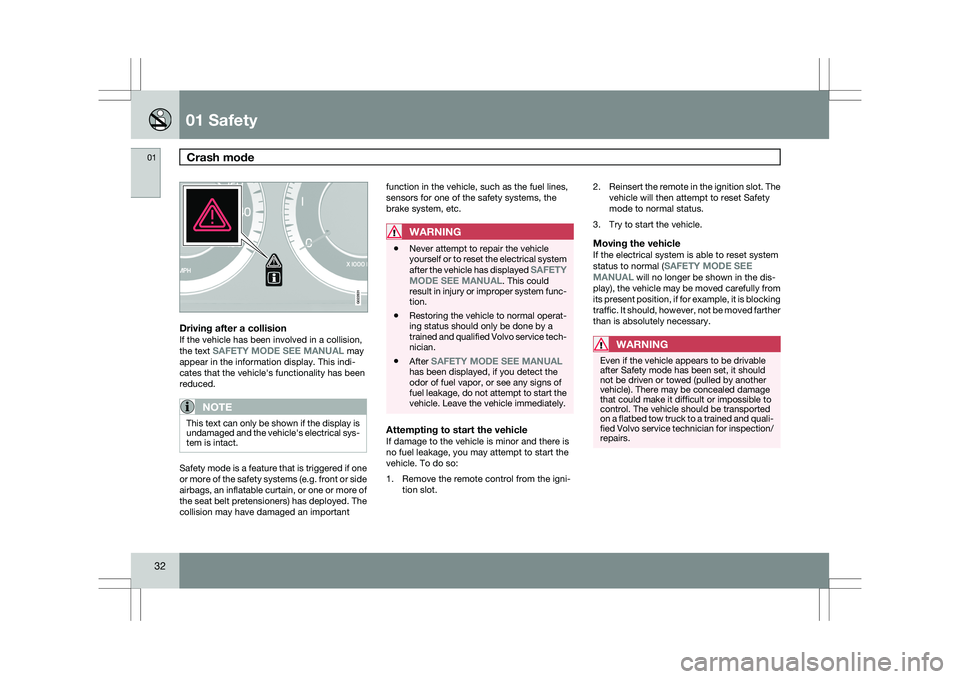
Driving after a collisionIf the vehicle has been involved in a collision,
the text SAFETY MODE SEE MANUAL may
appear in the information display. This indi-
cates that the vehicle\fs functionality has been
reduced.
NOTE This text can only be shown if the display is
undamaged and the vehicle\fs electrical sys-
tem is intact.
Safety mode is a feature that is triggered if one
or more of the safety systems (e.g. front or side
airbags, an inflatable curtain, or one or more of
the seat belt pretensioners) has deployed. The
collision may have damaged an important function in the vehicle, such as the fuel lines,
sensors for one of the safety systems, the
brake system, etc.
WARNING \b
Never attempt to repair the vehicle
yourself or to reset the electrical system
after the vehicle has displayed SAFETY
MODE SEE MANUAL. This could
result in injury or improper system func-
tion.
\b Restoring the vehicle to normal operat-
ing status should only be done by a
trained and qualified Volvo service tech-
nician.
\b After SAFETY MODE SEE MANUAL
has been displayed, if you detect the
odor of fuel vapor, or see any signs of
fuel leakage, do not attempt to start the
vehicle. Leave the vehicle immediately.
Attempting to start the vehicleIf damage to the vehicle is minor and there is
no fuel leakage, you may attempt to start the
vehicle. To do so:
1. Remove the remote control from the igni-
tion slot. 2.
Reinsert the remote in the ignition slot. The
vehicle will then attempt to reset Safety
mode to normal status.
3. Try to start the vehicle.
Moving the vehicleIf the electrical system is able to reset system
status to normal (SAFETY MODE SEE
MANUAL will no longer be shown in the dis-
play), the vehicle may be moved carefully from
its present position, if for example, it is blocking
traffic. It should, however, not be moved farther
than is absolutely necessary.
WARNING Even if the vehicle appears to be drivable
after Safety mode has been set, it should
not be driven or towed (pulled by another
vehicle). There may be concealed damage
that could make it difficult or impossible to
control. The vehicle should be transported
on a flatbed tow truck to a trained and quali-
fied Volvo service technician for inspection/
repairs. G022831
Page 36 of 297
01 SafetyChild safety 01
34
WARNING \b
Do not use child safety seats or child
booster cushions/backrests in the front
passenger\fs seat. We also recommend
that children under 4 feet 7 inches
(140 cm) in height who have outgrown
these devices sit in the rear seat with the
seat belt fastened.
\b On hot days, the temperature in the
vehicle interior can rise very quickly.
Exposure to these high temperatures
for even a short period of time can
cause heat-related injury or death.
Small children are particularly at risk. Automatic Locking Retractor/
Emergency Locking Retractor (ALR/
ELR)
To make child seat installation easier, each
seat belt (except for the driver\fs belt) is equip-
ped with a locking mechanism to help keep the
seat belt taut.
When attaching the seat belt to a child
seat:
1. Attach the seat belt to the child seat
according to the child seat manufacturer\fs
instructions.
2. Pull the seat belt out as far as possible. 3. Insert the seat belt latch plate into the
buckle (lock) in the usual way.
4. Release the seat belt and pull it taut around
the child seat.
A sound from the seat belt retractor will be
audible at this time and is normal. The belt will
now be locked in place. This function is auto-
matically disabled when the seat belt is
unlocked and the belt is fully retracted.
WARNING Do not use child safety seats or child
booster cushions/backrests in the front
passenger\fs seat. We also recommend that
children who have outgrown these devices
sit in the rear seat with the seat belt properly
fastened.
Volvo\fs recommendationsWhy does Volvo believe that no child should sit
in the front seat of a vehicle? It\fs quite simple
really. A front airbag is a very powerful device
designed, by law, to help protect an adult.
Because of the size of the airbag and its speed
of inflation, a child should never be placed in
the front seat, even if he or she is properly bel-
ted or strapped into a child safety seat. Volvo
has been an innovator in safety for over sev-
enty-five years, and we\fll continue to do our
part. But we need your help. Please rememberto put your children in the back seat, and
buckle them up.
Volvo has some very specific
recommendations:
\b
Always wear your seat belt.
\b Airbags are a SUPPLEMENTAL safety
device which, when used with a three-
point seat belt can help reduce serious
injuries during certain types of accidents.
Volvo recommends that you do not dis-
connect the airbag system in your vehicle.
\b Volvo strongly recommends that everyone
in the vehicle be properly restrained.
\b Volvo recommends that ALL occupants
(adults and children) shorter than 4 feet
7 inches (140 cm) be seated in the back
seat of any vehicle with a front passenger
side airbag.
Drive safely!
Page 39 of 297
01 Safety
Infant seats01
}}
37
Securing an infant seat with a seat belt
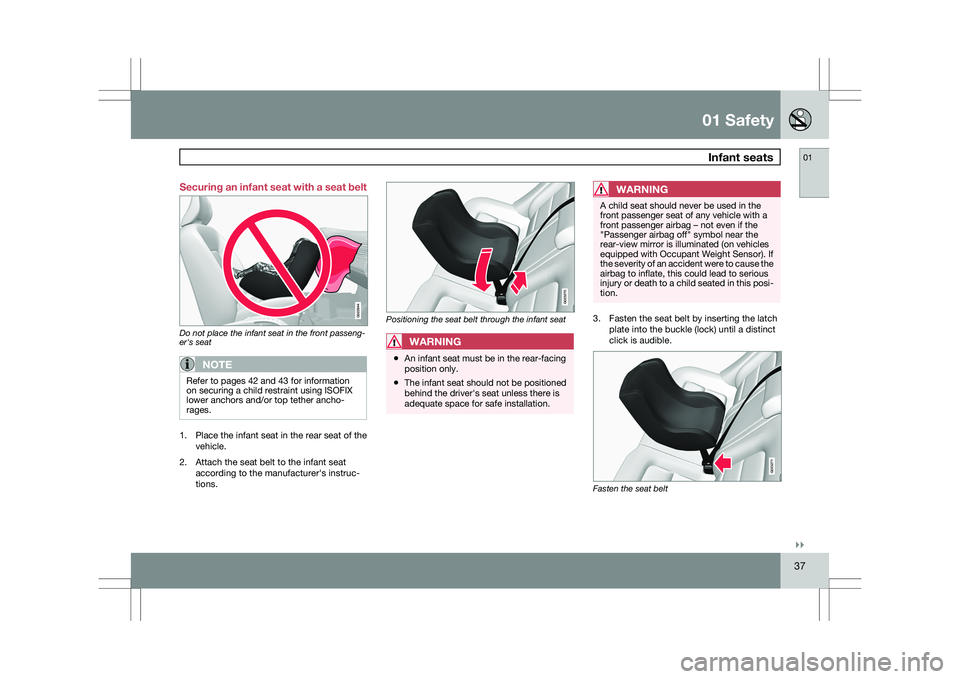
Do not place the infant seat in the front passeng-
er's seat
NOTE
Refer to pages 42 and 43 for information
on securing a child restraint using ISOFIX
lower anchors and/or top tether ancho-
rages.
1.
Place the infant seat in the rear seat of the
vehicle.
2. Attach the seat belt to the infant seat according to the manufacturer\fs instruc-
tions. Positioning the seat belt through the infant seat
WARNING
\b
An infant seat must be in the rear-facing
position only.
\b The infant seat should not be positioned
behind the driver\fs seat unless there is
adequate space for safe installation.
WARNING A child seat should never be used in the
front passenger seat of any vehicle with a
front passenger airbag – not even if the
"Passenger airbag off" symbol near the
rear-view mirror is illuminated (on vehicles
equipped with Occupant Weight Sensor). If
the severity of an accident were to cause the
airbag to inflate, this could lead to serious
injury or death to a child seated in this posi-
tion.
3. Fasten the seat belt by inserting the latch
plate into the buckle (lock) until a distinct
click is audible. Fasten the seat belt G022844 G023270 G023271
Page 40 of 297
01 SafetyInfant seats 01
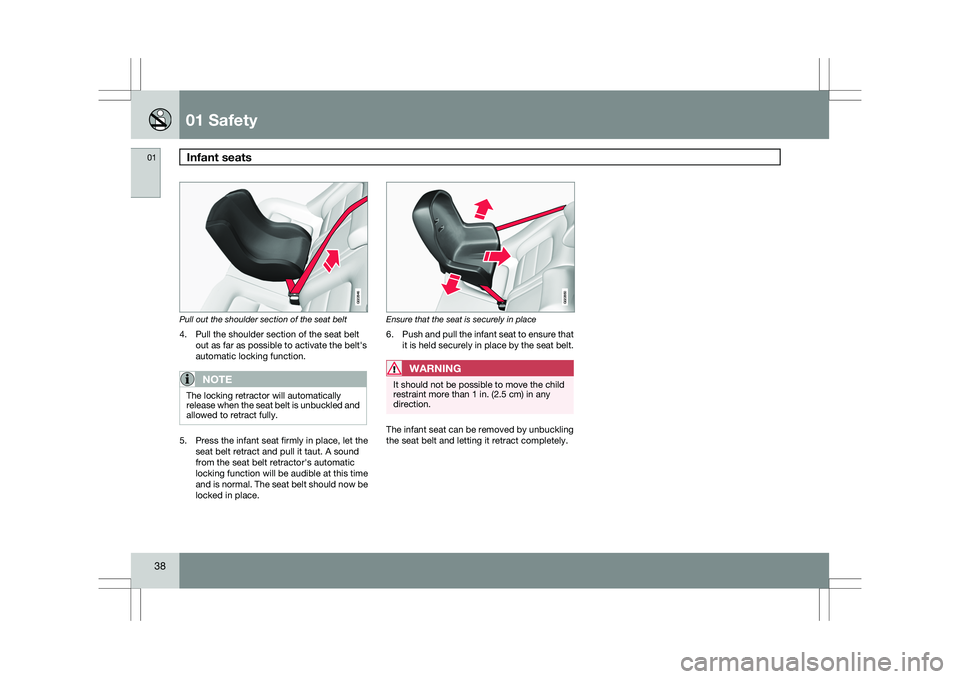
38 Pull out the shoulder section of the seat belt
4. Pull the shoulder section of the seat belt
out as far as possible to activate the belt\fs
automatic locking function.
NOTE The locking retractor will automatically
release when the seat belt is unbuckled and
allowed to retract fully.
5. Press the infant seat firmly in place, let the
seat belt retract and pull it taut. A sound
from the seat belt retractor\fs automatic
locking function will be audible at this time
and is normal. The seat belt should now be
locked in place. Ensure that the seat is securely in place
6.
Push and pull the infant seat to ensure that
it is held securely in place by the seat belt.WARNING It should not be possible to move the child
restraint more than 1 in. (2.5 cm) in any
direction.
The infant seat can be removed by unbuckling
the seat belt and letting it retract completely. G022846 G022850
Page 42 of 297
01 SafetyConvertible seats 01
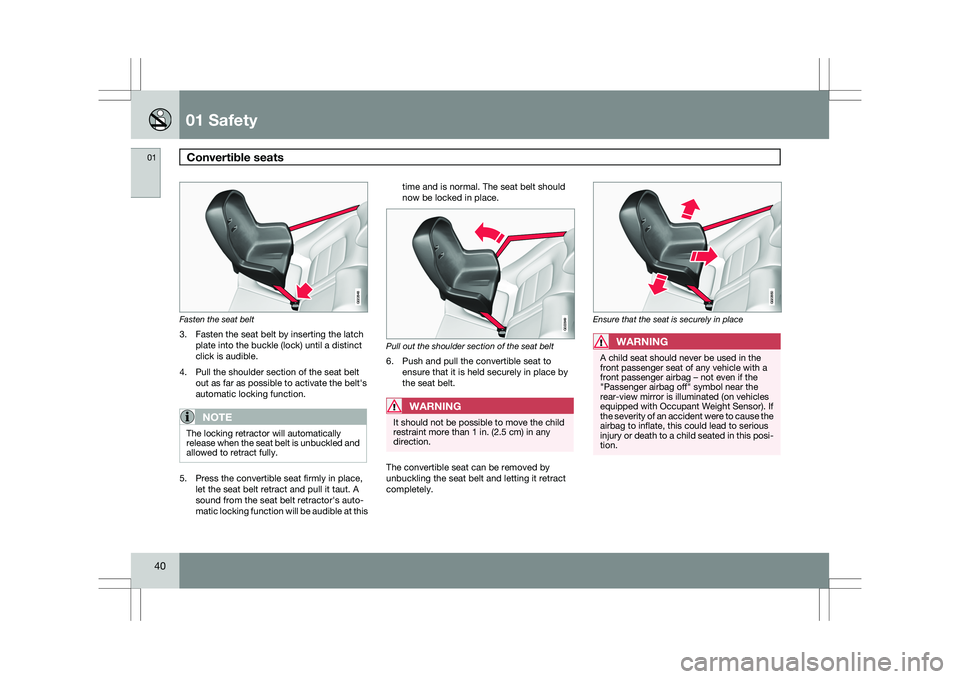
40 Fasten the seat belt
3. Fasten the seat belt by inserting the latch
plate into the buckle (lock) until a distinct
click is audible.
4. Pull the shoulder section of the seat belt out as far as possible to activate the belt\fs
automatic locking function.
NOTE The locking retractor will automatically
release when the seat belt is unbuckled and
allowed to retract fully.
5. Press the convertible seat firmly in place,
let the seat belt retract and pull it taut. A
sound from the seat belt retractor\fs auto-
matic locking function will be audible at this time and is normal. The seat belt should
now be locked in place.
Pull out the shoulder section of the seat belt
6. Push and pull the convertible seat to
ensure that it is held securely in place by
the seat belt.WARNING It should not be possible to move the child
restraint more than 1 in. (2.5 cm) in any
direction.
The convertible seat can be removed by
unbuckling the seat belt and letting it retract
completely. Ensure that the seat is securely in place
WARNING
A child seat should never be used in the
front passenger seat of any vehicle with a
front passenger airbag – not even if the
"Passenger airbag off" symbol near the
rear-view mirror is illuminated (on vehicles
equipped with Occupant Weight Sensor). If
the severity of an accident were to cause the
airbag to inflate, this could lead to serious
injury or death to a child seated in this posi-
tion. G022848 G022849 G022850
Page 43 of 297
01 Safety
Booster cushions01
41
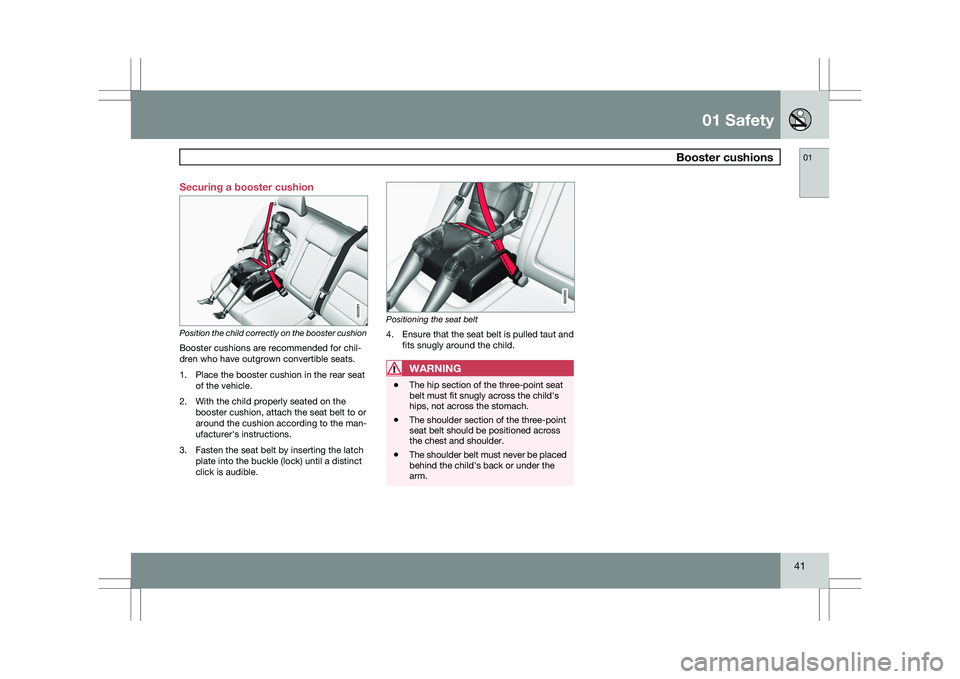
Securing a booster cushion
Position the child correctly on the booster cushion
Booster cushions are recommended for chil-
dren who have outgrown convertible seats.
1. Place the booster cushion in the rear seat
of the vehicle.
2. With the child properly seated on the booster cushion, attach the seat belt to or
around the cushion according to the man-
ufacturer\fs instructions.
3. Fasten the seat belt by inserting the latch plate into the buckle (lock) until a distinct
click is audible. Positioning the seat belt
4.
Ensure that the seat belt is pulled taut and
fits snugly around the child.
WARNING \b
The hip section of the three-point seat
belt must fit snugly across the child\fs
hips, not across the stomach.
\b The shoulder section of the three-point
seat belt should be positioned across
the chest and shoulder.
\b The shoulder belt must never be placed
behind the child\fs back or under the
arm. G022851 G022852