engine VOLVO XC60 2017 Owner´s Manual
[x] Cancel search | Manufacturer: VOLVO, Model Year: 2017, Model line: XC60, Model: VOLVO XC60 2017Pages: 398, PDF Size: 9.17 MB
Page 358 of 398
MAINTENANCE AND SERVICING
* Option/accessory, for more information, see Introduction.
356
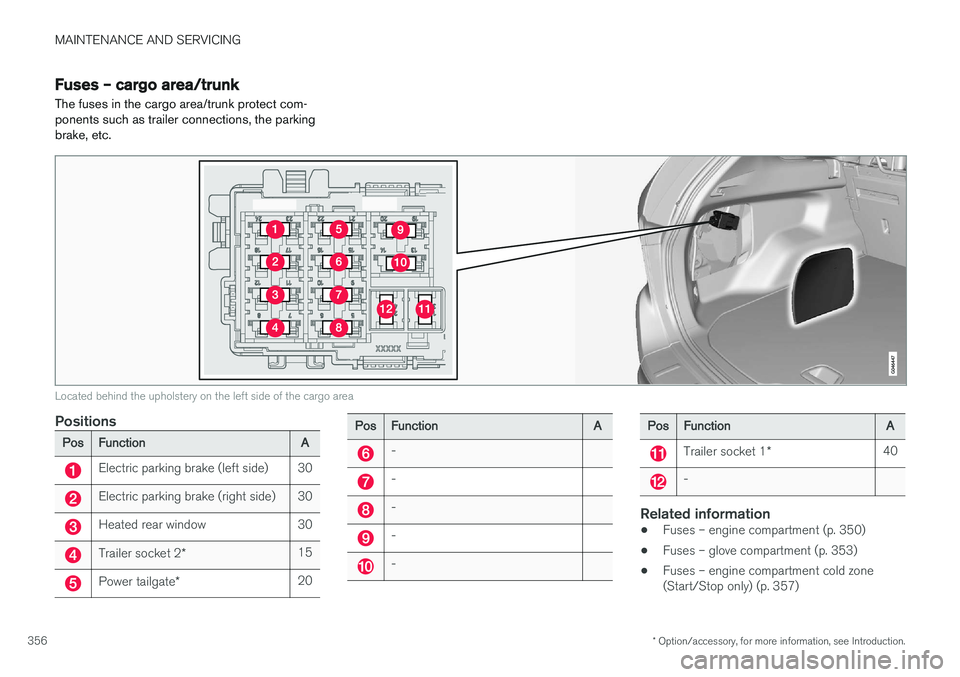
Fuses – cargo area/trunk The fuses in the cargo area/trunk protect com- ponents such as trailer connections, the parkingbrake, etc.
Located behind the upholstery on the left side of the cargo area
Positions
PosFunctionA
Electric parking brake (left side)30
Electric parking brake (right side)30
Heated rear window30
Trailer socket 2 *15
Power tailgate*20
PosFunctionA
-
-
-
-
-
PosFunctionA
Trailer socket 1 *40
-
Related information
•Fuses – engine compartment (p. 350)
• Fuses – glove compartment (p. 353)
• Fuses – engine compartment cold zone (Start/Stop only) (p. 357)
Page 359 of 398

MAINTENANCE AND SERVICING
}}
357
Fuses – engine compartment cold zone (Start/Stop only)7
There are fuses in the engine compartment cold zone on models with the Start/Stop function.
Location of Start/Stop fuses
Positions
• Fuses A1, A2 and 1–11 are relays/circuit breakers and should only be removed orreplaced by a trained and qualified Volvoservice technician.
• Fuse 12 may be changed at any time whennecessary.PosFunctionA
Circuit breaker: central electrical module in the engine compart-ment175
Circuit breaker: fuseboxes under the glove compartment, centralelectrical module in the cargoarea175
PosFunctionA
-
Circuit breaker: fusebox
B under
the glove compartment (see Fuses – glove compartment(p. 353))50
7 Option on 4-cyl. engines
Page 360 of 398

||
MAINTENANCE AND SERVICING
358
PosFunctionA
Circuit breaker: fusebox A under
the glove compartment (see Fuses – glove compartment(p. 353))60
Circuit breaker: fusebox A under
the glove compartment (see Fuses – glove compartment(p. 353))60
Circuit breaker: central electrical module in the cargo area60
Climate system blower40
––
––
Starter motor relay30
Internal diode50
Auxiliary battery70
Central electrical module: auxili- ary battery reference voltage,auxiliary battery charging point15
Related information
• Fuses – engine compartment (p. 350)
• Fuses – glove compartment (p. 353) •
Fuses – cargo area/trunk (p. 356)
• Start/Stop – introduction (p. 258)
Page 362 of 398
||
MAINTENANCE AND SERVICING
360
CAUTION
•Avoid waxing or polishing plastic or rub- ber components
• Polishing chromed strips can wear awayor damage the surface
• Polishes containing abrasive substancesshould not be used
Related information
• Polishing and waxing (p. 361)
• Cleaning the interior (p. 361)
Automatic car wash
The vehicle should be washed at regular inter- vals since dirt, dust, insects and tar spotsadhere to the paint and may cause damage. Tohelp prevent corrosion, it is particularly importantto wash the car frequently in the wintertime.
• We do NOT recommend washing your car in an automatic wash during the first fewmonths (because the paint will not havehardened sufficiently).
• An automatic wash is a simple and quick wayto clean your car, but it is worth rememberingthat it may not be as thorough as when youyourself go over the car with sponge andwater. Keeping the underbody clean is mostimportant, especially in the winter. Someautomatic washers do not have facilities forwashing the underbody.
NOTE
Condensation may form temporarily on the inside of the lenses of exterior lights such asheadlights, fog lights, or taillights. This is nor-mal and the lights are designed to withstandmoisture. Normally, condensation will dissi-pate after the lights have been on for a shorttime.
CAUTION
•
Before driving into an automatic car wash, turn off the optional rain sensor toavoid damaging the windshield wipers.
• Make sure that side view mirrors, auxiliarylamps, etc, are secure, and that anyantenna(s) are retracted or removed. Oth-erwise there is risk of the machine dis-lodging them.
• Chromed wheels:
Clean chrome-plated
wheels using the same detergents usedfor the body of the vehicle. Aggressivewheel-cleaning agents can permanentlystain chrome-plated wheels.
WARNING
• When the vehicle is driven immediately after being washed, apply the brakes,including the parking brake, several timesin order to remove any moisture from thebrake linings.
• Engine cleaning agents should not beused when the engine is warm. This con-stitutes a fire risk.
Related information
•
Polishing and waxing (p. 361)
• Cleaning the interior (p. 361)
• Washing the car (p. 359)
Page 370 of 398
||
SPECIFICATIONS
368
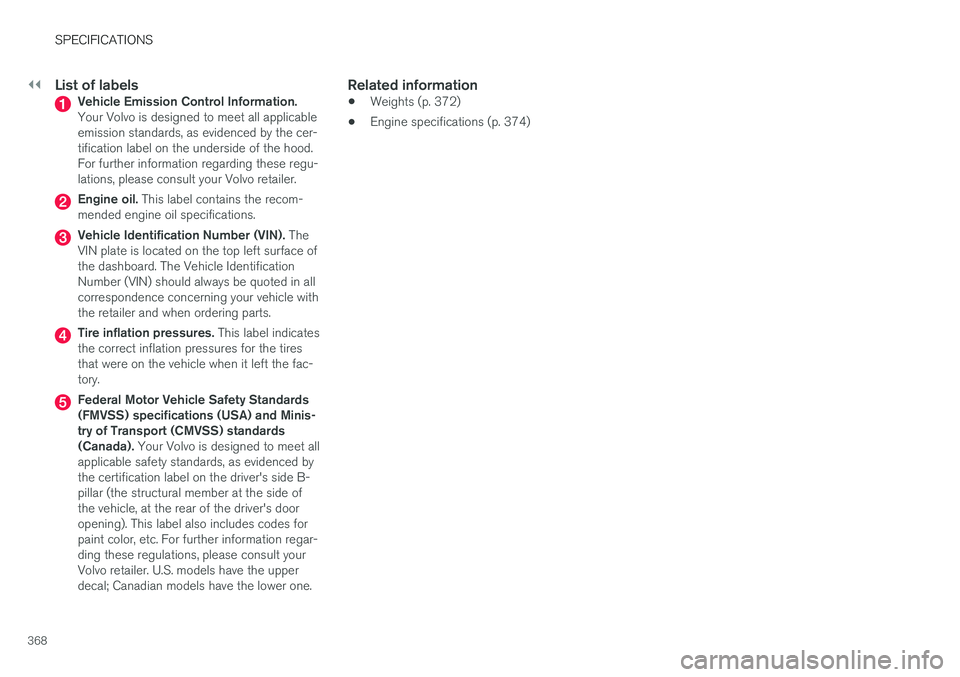
List of labelsVehicle Emission Control Information. Your Volvo is designed to meet all applicable emission standards, as evidenced by the cer-tification label on the underside of the hood.For further information regarding these regu-lations, please consult your Volvo retailer.
Engine oil. This label contains the recom-
mended engine oil specifications.
Vehicle Identification Number (VIN). The
VIN plate is located on the top left surface of the dashboard. The Vehicle IdentificationNumber (VIN) should always be quoted in allcorrespondence concerning your vehicle withthe retailer and when ordering parts.
Tire inflation pressures. This label indicates
the correct inflation pressures for the tires that were on the vehicle when it left the fac-tory.
Federal Motor Vehicle Safety Standards (FMVSS) specifications (USA) and Minis-try of Transport (CMVSS) standards(Canada). Your Volvo is designed to meet all
applicable safety standards, as evidenced bythe certification label on the driver's side B-pillar (the structural member at the side ofthe vehicle, at the rear of the driver's dooropening). This label also includes codes forpaint color, etc. For further information regar-ding these regulations, please consult yourVolvo retailer. U.S. models have the upperdecal; Canadian models have the lower one.
Related information
• Weights (p. 372)
• Engine specifications (p. 374)
Page 376 of 398
SPECIFICATIONS
374
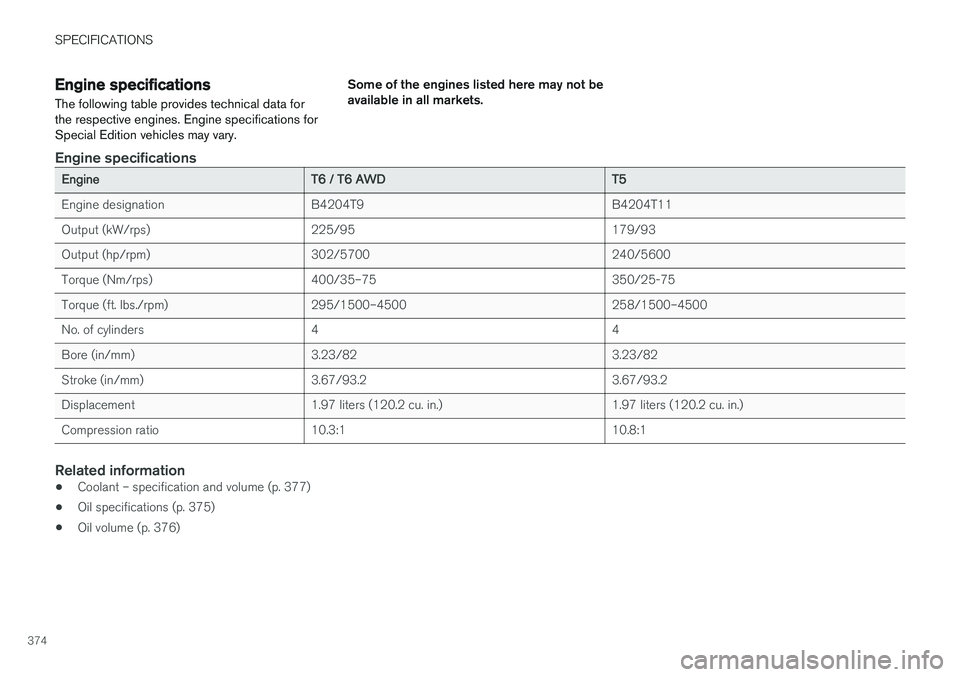
Engine specificationsThe following table provides technical data for the respective engines. Engine specifications forSpecial Edition vehicles may vary. Some of the engines listed here may not beavailable in all markets.
Engine specifications
EngineT6 / T6 AWDT5
Engine designationB4204T9B4204T11
Output (kW/rps)225/95179/93
Output (hp/rpm)302/5700240/5600
Torque (Nm/rps)400/35–75350/25-75
Torque (ft. lbs./rpm)295/1500–4500258/1500–4500
No. of cylinders44
Bore (in/mm)3.23/823.23/82
Stroke (in/mm)3.67/93.23.67/93.2
Displacement1.97 liters (120.2 cu. in.)1.97 liters (120.2 cu. in.)
Compression ratio10.3:110.8:1
Related information
•
Coolant – specification and volume (p. 377)
• Oil specifications (p. 375)
• Oil volume (p. 376)
Page 377 of 398
SPECIFICATIONS
375
Oil specifications
Full synthetic engine oil meeting the minimum
ACEA A5/B5 must be used. Lower quality oils may not offer the same fuel economy, engineperformance, or engine protection.
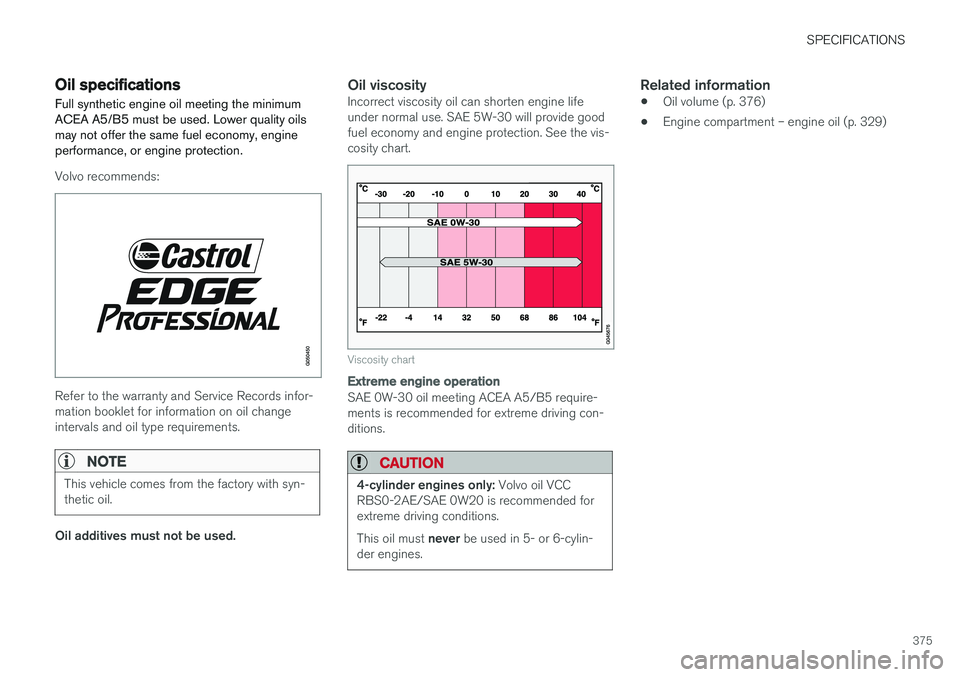
Volvo recommends:
Refer to the warranty and Service Records infor- mation booklet for information on oil changeintervals and oil type requirements.
NOTE
This vehicle comes from the factory with syn- thetic oil.
Oil additives must not be used.
Oil viscosityIncorrect viscosity oil can shorten engine life under normal use. SAE 5W-30 will provide goodfuel economy and engine protection. See the vis-cosity chart.
Viscosity chart
Extreme engine operation
SAE 0W-30 oil meeting ACEA A5/B5 require- ments is recommended for extreme driving con-ditions.
CAUTION
4-cylinder engines only: Volvo oil VCC
RBS0-2AE/SAE 0W20 is recommended for extreme driving conditions. This oil must never be used in 5- or 6-cylin-
der engines.
Related information
• Oil volume (p. 376)
• Engine compartment – engine oil (p. 329)
Page 378 of 398
SPECIFICATIONS
376
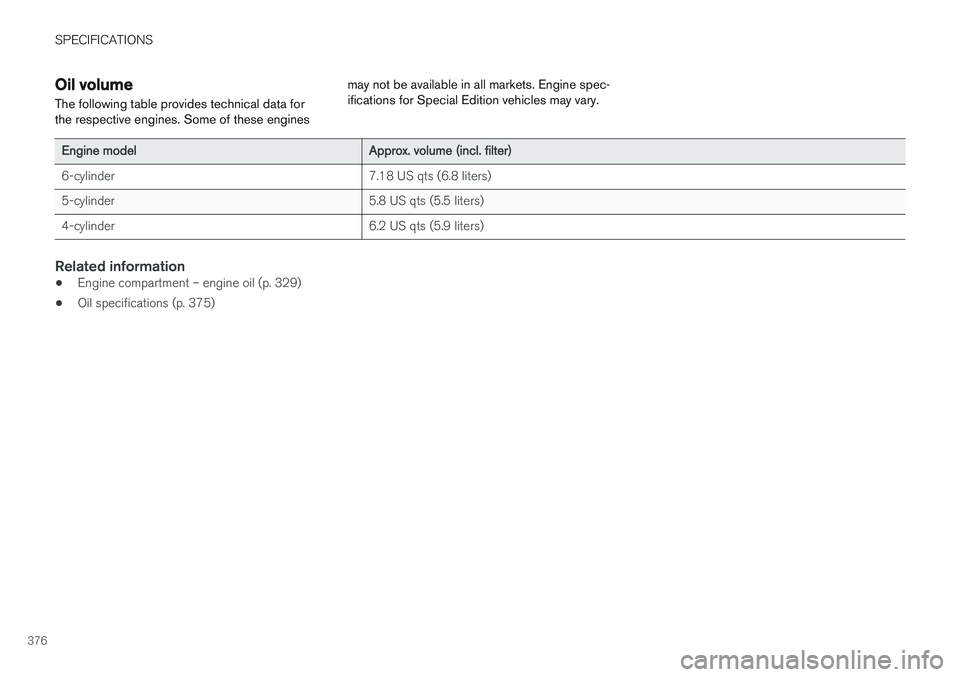
Oil volume
The following table provides technical data for the respective engines. Some of these engines may not be available in all markets. Engine spec-ifications for Special Edition vehicles may vary.
Engine modelApprox. volume (incl. filter)
6-cylinder7.18 US qts (6.8 liters)
5-cylinder5.8 US qts (5.5 liters)
4-cylinder6.2 US qts (5.9 liters)
Related information
•
Engine compartment – engine oil (p. 329)
• Oil specifications (p. 375)
Page 379 of 398
SPECIFICATIONS
377
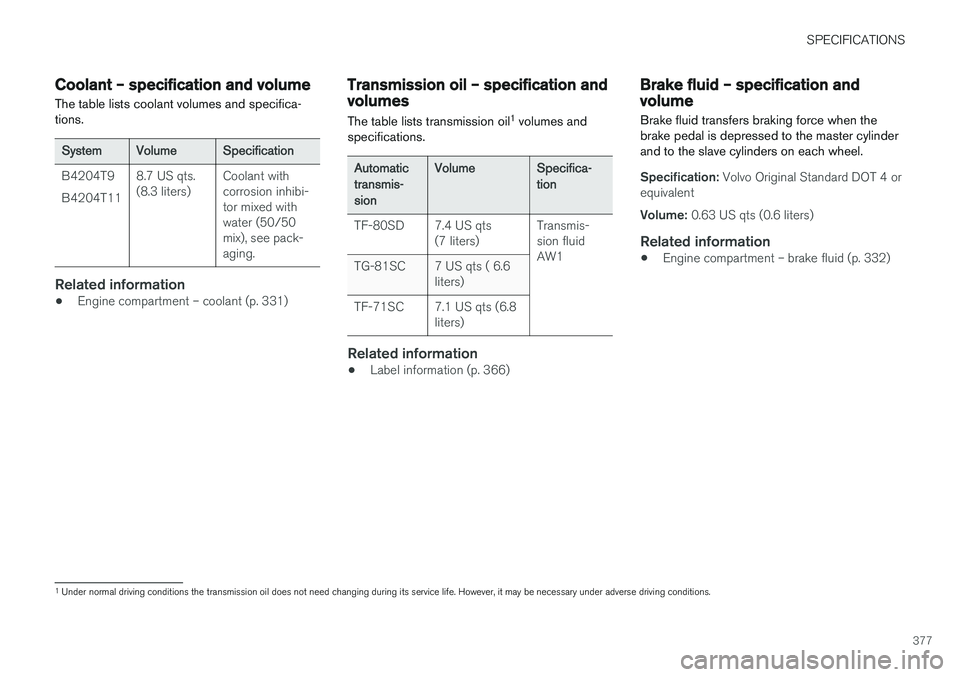
Coolant – specification and volume The table lists coolant volumes and specifica- tions.
SystemVolumeSpecification
B4204T9 B4204T118.7 US qts. (8.3 liters)Coolant with corrosion inhibi-tor mixed withwater (50/50mix), see pack-aging.
Related information
•Engine compartment – coolant (p. 331)
Transmission oil – specification and volumes The table lists transmission oil 1
volumes and
specifications.
Automatic transmis-sionVolumeSpecifica- tion
TF-80SD7.4 US qts (7 liters)Transmis- sion fluidAW1
TG-81SC7 US qts ( 6.6 liters)
TF-71SC7.1 US qts (6.8 liters)
Related information
• Label information (p. 366)
Brake fluid – specification and volume
Brake fluid transfers braking force when the brake pedal is depressed to the master cylinderand to the slave cylinders on each wheel.
Specification: Volvo Original Standard DOT 4 or
equivalent Volume: 0.63 US qts (0.6 liters)
Related information
•Engine compartment – brake fluid (p. 332)
1
Under normal driving conditions the transmission oil does not need changing during its service life. However, it may be necessary under adverse driving conditions.
Page 380 of 398
SPECIFICATIONS
378
Power steering – specification
This fluid is used to help reduce and regulate steering force.
Specification: Power steering fluid recom-
mended by Volvo.
Related information
• Engine compartment – power steering fluid (p. 333)
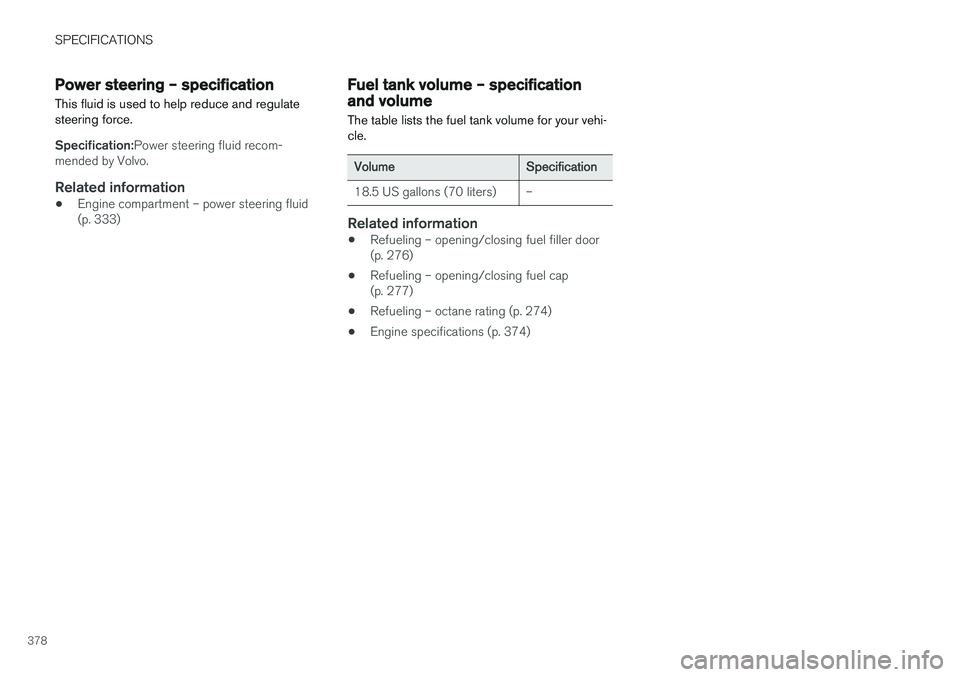
Fuel tank volume – specification and volume The table lists the fuel tank volume for your vehi- cle.
VolumeSpecification
18.5 US gallons (70 liters)–
Related information
•Refueling – opening/closing fuel filler door (p. 276)
• Refueling – opening/closing fuel cap(p. 277)
• Refueling – octane rating (p. 274)
• Engine specifications (p. 374)