battery VOLVO XC60 2017 Owner´s Manual
[x] Cancel search | Manufacturer: VOLVO, Model Year: 2017, Model line: XC60, Model: VOLVO XC60 2017Pages: 398, PDF Size: 9.17 MB
Page 325 of 398
MAINTENANCE AND SERVICING
323
Maintenance – owner maintenance
Periodic maintenance requirements and intervals are described in your vehicle's Warranty andService Records Information booklet. The following points can be carried out between the normally scheduled maintenance services.
Owner maintenance
Each time the car is refueled:
• Check the engine oil level.
• Clean the windshield, windshield wipers, headlights, and taillights.
Monthly:
• Check cold tire pressure in all tires. Inspect the tires for wear.
• Check that engine coolant and other fluidlevels are between the indicated "min" and"max" markings.
• Clean interior glass surfaces with a glasscleaner and soft paper towels.
• Wipe driver information displays with a softcloth.
• Visually inspect battery terminals for corro-sion. Corrosion may indicate a loose terminalconnector, or a battery near the end of itsuseful service life. Consult your Volvo retailerfor additional information.
As needed:
Wash the car, including the undercarriage, to reduce wear that can be caused by a buildup of dirt, and corrosion that can be caused by salt res-idues. Clean leaves and twigs from air intake vents at the base of the windshield, and from other placeswhere they may collect.
NOTE
Complete service information for qualified technicians is available online for purchase orsubscription at www.volvotechinfo.com.
Related information
•
Maintenance – opening/closing hood (p. 327)
• Engine compartment – overview (p. 328)
• Engine compartment – coolant (p. 331)
• Engine compartment – engine oil (p. 329)
• Engine compartment – power steering fluid(p. 333)
• Engine compartment – washer fluid (p. 344)
• Cleaning the interior (p. 361)
• Washing the car (p. 359)
• Tire inflation – checking pressure (p. 297)
• Tires – tread wear indicator (p. 290)
Page 327 of 398
MAINTENANCE AND SERVICING
}}
* Option/accessory, for more information, see Introduction.325
Onboard Diagnostic System OBD II is part of your vehicle's computerized engine management system. It stores diagnosticinformation about your vehicle's emission con-trols. It can light the Check Engine light (MIL) if itdetects an emission control "fault." A "fault" is acomponent or system that is not performingwithin an expected range. A fault may be perma-nent or temporary. OBD II will store a messageabout any fault.
Emission inspection readiness
How do states use OBD II for emission inspections?
Many states connect a computer directly to a vehicle's OBD II system. The inspector can thenread "faults." In some states, this type of inspec-tion has replaced the tailpipe emission test.
How can my vehicle fail OBD II emission inspection?
Your vehicle can fail OBD II emission inspection for any of the following reasons.
• If your Check Engine (MIL) light is lit, yourvehicle may fail inspection.
• If your vehicle's Check Engine light was lit,but went out without any action on your part,OBD II will still have a recorded fault. Yourvehicle may pass or fail, depending on theinspection practices in your area.
• If you had recent service that required dis-connecting the battery, OBD II diagnostic information may be incomplete and "notready" for inspection. A vehicle that is notready may fail inspection.
How can I prepare for my next OBD II
emission inspection?
• If your Check Engine (MIL) light is lit – or was lit but went out without service, have yourvehicle diagnosed and, if necessary, servicedby a qualified Volvo technician.
• If you recently had service for a lit CheckEngine light, or if you had service thatrequired disconnecting the battery, a periodof driving is necessary to bring the OBD IIsystem to "ready" for inspection. Two half-hour trips of mixed stop-and-go/highwaydriving are typically needed to allow OBD II toreach readiness. Your Volvo retailer can pro-vide you with more information on planning atrip.
• Maintain your vehicle in accordance with yourvehicle's maintenance schedule.
Booking service and repairs
Connected Service Booking (CSB) makes set- ting up a time for service, maintenance and/orrepairs directly from the vehicle quick and con-venient.
Prerequisites
• The owner (primary driver) must have a valid Volvo ID. See Volvo ID (p. 22) for additionalinformation.
• The vehicle must be connected to the Inter- net using a paired Bluetooth ®
cell phone.
See your Sensus Infotainment supplement for information on pairing a cell phone. On models equipped with Volvo On Call (VOC) *,
you can connect to the Internet using your separate VOC data plan. Refer to your sepa-rate Volvo On Call manual.
• By default, the retailer where you purchasedyour vehicle will be your preferred (primary)retailer/Volvo authorized workshop who willperform service and repairs on your vehicle.To change the preferred retailer, go to DealerLocator at volvocars.com and select aretailer, click on Service Scheduler and bookan appointment at the new preferred retailer.
• In order to be guided through the on-screen steps, the menu alternative
Display
notifications must be activated.
Page 330 of 398

MAINTENANCE AND SERVICING
328
Engine compartment – overviewThe overview shows the main inspection points in the engine compartment.
Coolant expansion tank
Power steering fluid reservoir
Dipstick-engine oil
Filler cap-engine oil
Cover over brake fluid reservoir
Battery
Relay/fuse box
Washer fluid reservoir
Engine compartment - 4-cylinder engines only
Filler cap-engine oil
Coolant expansion tank
Power steering fluid reservoir
Radiator
Brake fluid reservoir
Battery
Relay/fuse box
Washer fluid reservoir
Air cleaner
The appearance of the engine compartment may vary depending on engine model.
WARNING
The cooling fan (located at the front of the engine compartment, behind the radiator) maystart or continue to operate (for up to6 minutes) after the engine has beenswitched off.
WARNING
Before performing any operations in the engine compartment, the ignition should always be completely switched off (in mode 0,
see Ignition modes (p. 80)) and there should be no remote keys in the passenger compart- ment. The gear selector should be in the P
(park) position. If the engine has been run- ning, wait until it has cooled before touchingany components in the engine compartment. The distributor ignition system operates at very high voltages. Special safety precautionsmust be followed to prevent injury. Alwaysturn the ignition off when:
• Replacing distributor ignition componentse.g. plugs, coil, etc.
• Do not touch any part of the distributorignition system while the engine is run-ning. This may result in unintended move-ments and body injury.
Related information
•Maintenance – opening/closing hood (p. 327)
• Maintenance – owner maintenance (p. 323)
Page 347 of 398
MAINTENANCE AND SERVICING
}}
345
Battery – symbols
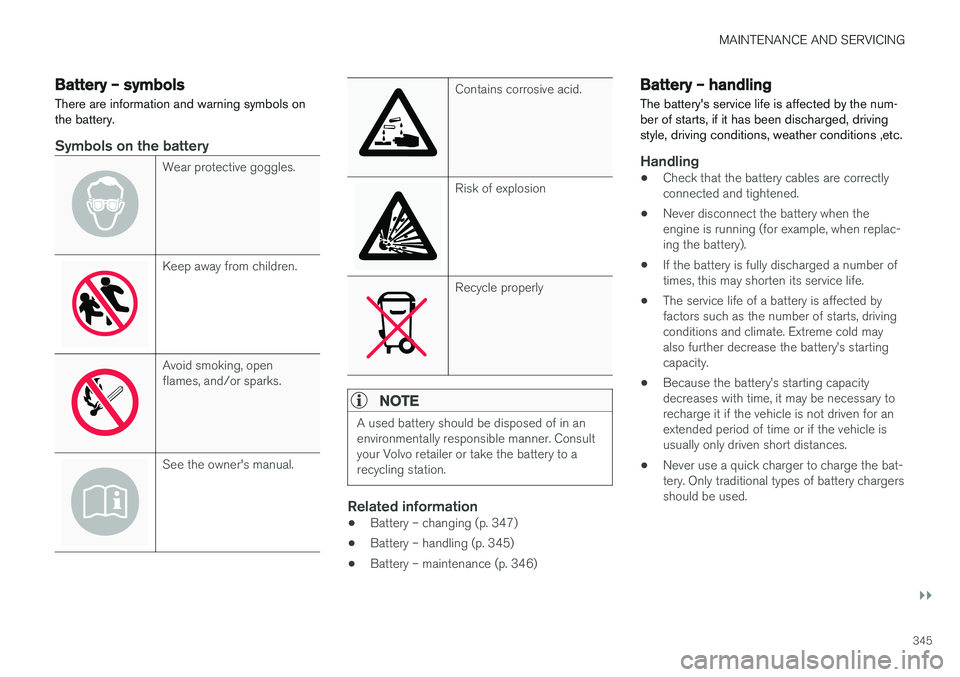
There are information and warning symbols on the battery.
Symbols on the battery
Wear protective goggles.
Keep away from children.
Avoid smoking, open flames, and/or sparks.
See the owner's manual.
Contains corrosive acid.
Risk of explosion
Recycle properly
NOTE
A used battery should be disposed of in an environmentally responsible manner. Consultyour Volvo retailer or take the battery to arecycling station.
Related information
• Battery – changing (p. 347)
• Battery – handling (p. 345)
• Battery – maintenance (p. 346)
Battery – handling
The battery's service life is affected by the num- ber of starts, if it has been discharged, drivingstyle, driving conditions, weather conditions ,etc.
Handling
• Check that the battery cables are correctly connected and tightened.
• Never disconnect the battery when theengine is running (for example, when replac-ing the battery).
• If the battery is fully discharged a number oftimes, this may shorten its service life.
• The service life of a battery is affected byfactors such as the number of starts, drivingconditions and climate. Extreme cold mayalso further decrease the battery
Page 348 of 398
||
MAINTENANCE AND SERVICING
346
CAUTION
The infotainment system's energy-saving fea- ture may not function correctly or at all,and/or a message may be displayed if a bat-tery charger or jumper cables are not con-nected properly. •The negative terminal on the battery must never
be used to connect a jumper cable
or a battery charger. Only the ground point on the chassis may be used.
See Jump starting (p. 251) for an illustrationand additional information.
WARNING
• Never expose the battery to open flame or electric spark.
• Do not smoke near the battery.
• Battery fluid contains sulfuric acid. Do notallow battery fluid to contact eyes, skin,fabrics or painted surfaces. If contactoccurs, flush the affected area immedi-ately with water. Obtain medical helpimmediately if eyes are affected.
NOTE
The life of the battery is shortened if it becomes discharged repeatedly.
Related information
•Battery – changing (p. 347)
• Battery – maintenance (p. 346)
• Battery – symbols (p. 345)
Battery – maintenance
Proper battery maintenance can help prolong its service life.
Maintenance
• Use a screw driver to open the caps or cover and a flashlight to inspect the level.
• If necessary, add distilled water. The levelshould never be above the indicator.
• The fluid level should be checked if the bat-tery has been recharged.
• After inspection, be sure the cap over eachbattery cell or the cover is securely in place.
• Check that the battery cables are correctlyconnected and properly tightened.
• Never disconnect the battery when theengine is running, or when the key is in theignition. This could damage the vehicle'selectrical system.
• The battery should be disconnected from thevehicle when a battery charger is useddirectly on the battery.
• To help keep the battery in good condition,the vehicle should be driven for at least 15minutes a week or connected to a chargerwith an automatic charging function.
• If the battery is fully discharged a number oftimes, this may shorten its service life. Keep-ing the battery fully charged helps prolong itsservice life.
Page 349 of 398
MAINTENANCE AND SERVICING
}}
347
•
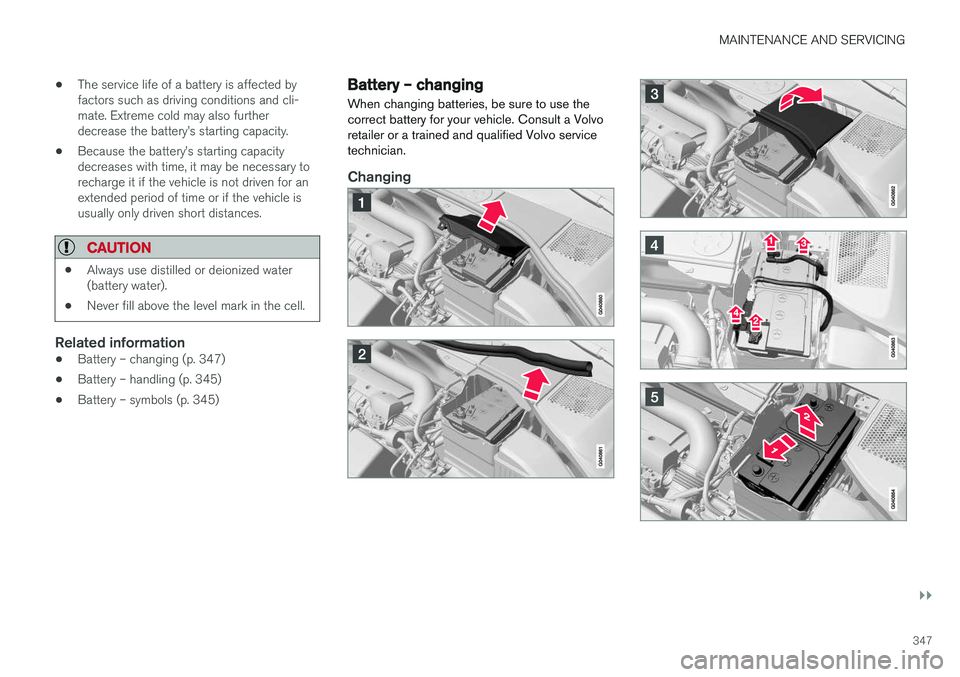
The service life of a battery is affected by factors such as driving conditions and cli-mate. Extreme cold may also furtherdecrease the battery
Page 350 of 398
||
MAINTENANCE AND SERVICING
348
WARNING
Connect and disconnect the positive and neg- ative cables in the correct sequence.
Removal
Switch off the ignition, remove the remote key from the ignition slot and wait at least 5 minutesbefore disconnecting the battery so that all infor-mation in the vehicle's electrical system can bestored in the control modules.
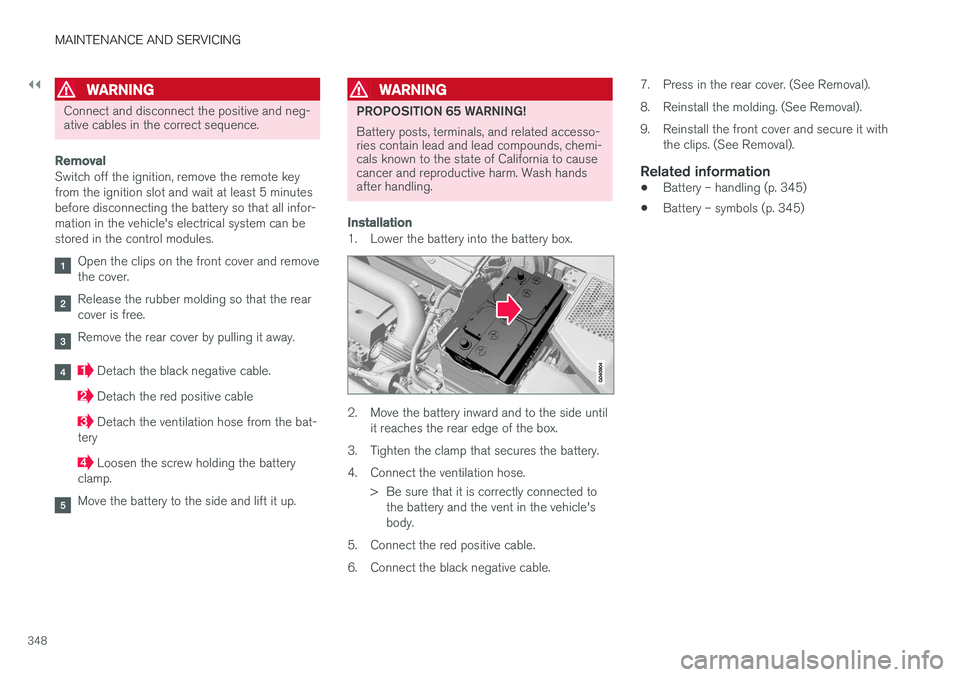
Open the clips on the front cover and remove the cover.
Release the rubber molding so that the rear cover is free.
Remove the rear cover by pulling it away.
Detach the black negative cable.
Detach the red positive cable
Detach the ventilation hose from the bat-
tery
Loosen the screw holding the battery
clamp.
Move the battery to the side and lift it up.
WARNING
PROPOSITION 65 WARNING! Battery posts, terminals, and related accesso- ries contain lead and lead compounds, chemi-cals known to the state of California to causecancer and reproductive harm. Wash handsafter handling.
Installation
1. Lower the battery into the battery box.
2. Move the battery inward and to the side until it reaches the rear edge of the box.
3. Tighten the clamp that secures the battery.
4. Connect the ventilation hose. > Be sure that it is correctly connected tothe battery and the vent in the vehicle's body.
5. Connect the red positive cable.
6. Connect the black negative cable. 7. Press in the rear cover. (See Removal).
8. Reinstall the molding. (See Removal).
9. Reinstall the front cover and secure it with
the clips. (See Removal).
Related information
• Battery – handling (p. 345)
• Battery – symbols (p. 345)
Page 360 of 398

||
MAINTENANCE AND SERVICING
358
PosFunctionA
Circuit breaker: fusebox A under
the glove compartment (see Fuses – glove compartment(p. 353))60
Circuit breaker: fusebox A under
the glove compartment (see Fuses – glove compartment(p. 353))60
Circuit breaker: central electrical module in the cargo area60
Climate system blower40
––
––
Starter motor relay30
Internal diode50
Auxiliary battery70
Central electrical module: auxili- ary battery reference voltage,auxiliary battery charging point15
Related information
• Fuses – engine compartment (p. 350)
• Fuses – glove compartment (p. 353) •
Fuses – cargo area/trunk (p. 356)
• Start/Stop – introduction (p. 258)
Page 383 of 398
SPECIFICATIONS
* Option/accessory, for more information, see Introduction.381
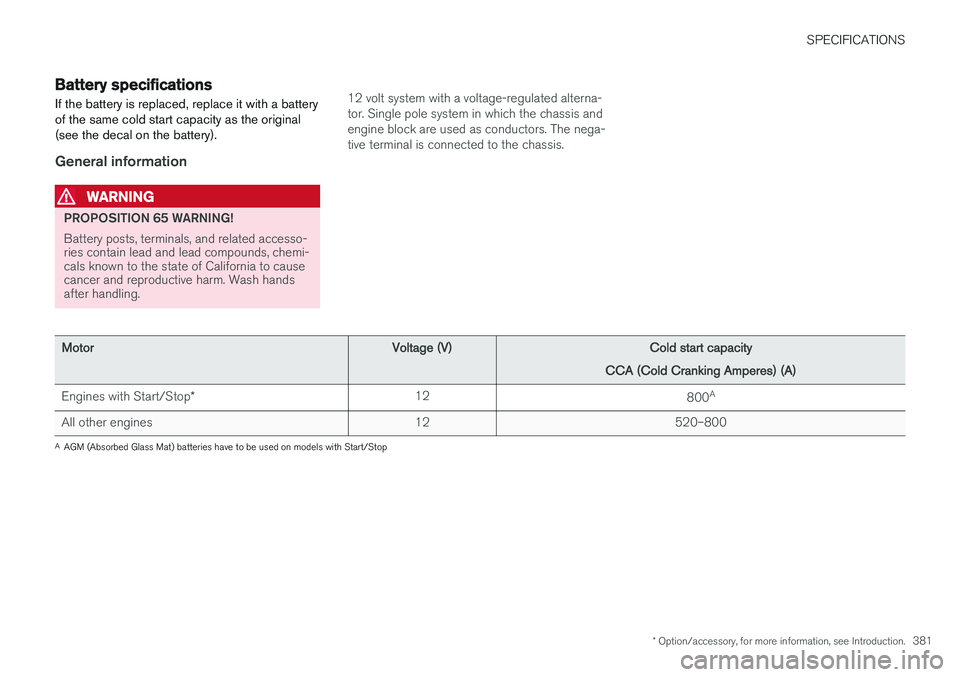
Battery specifications If the battery is replaced, replace it with a battery of the same cold start capacity as the original(see the decal on the battery).
General information
WARNING
PROPOSITION 65 WARNING! Battery posts, terminals, and related accesso- ries contain lead and lead compounds, chemi-cals known to the state of California to causecancer and reproductive harm. Wash handsafter handling. 12 volt system with a voltage-regulated alterna- tor. Single pole system in which the chassis andengine block are used as conductors. The nega-tive terminal is connected to the chassis.
MotorVoltage (V)Cold start capacity
CCA (Cold Cranking Amperes) (A)
Engines with Start/Stop *12800A
All other engines12520–800
A
AGM (Absorbed Glass Mat) batteries have to be used on models with Start/Stop
Page 394 of 398
INDEX
392fuel filler door 276, 277
fuel tank volume 378
Registering child restraints 49 Remote control private locking 156
Remote key 150, 151, 152, 154, 157 approach lighting 153
immobilizer 152
key blade 150, 151, 152, 154, 155,156 , 157
locking the vehicle 153
replacing the battery 158
unlocking the vehicle 153
Reporting safety defects 29
Roadside Assistance 25
Road sign information (RSI) 179
Rollover Protection System (ROPS) 45
Roll Stability Control (RSC) 45
Roof loads 144
S
Safety, occupant 28
Safety defects, reporting 29
Safety mode 45
Seat belt reminder 32
Seat belts Automatic locking retractor/Emergency
locking retractor 49
buckling 31
maintenance 31
pretensioners 30
reminder 32
reminder warning light 75
securing child restraint systems 51, 53, 55
unbuckling 31
use during pregnancy 32
using 30
Seats, front 81, 82
Sensus 114Service connected service booking 325
Shiftlock 15 override 257
Side door mirrors 104, 105
Side impact airbags 41
Sign information (RSI) 179
Snow chains 303
Snow tires 303
Spare tire 294
Spin control 174, 175SRS 33
Stability system 174, 175, 177 Corner Traction Control (CTC) 175
Engine Drag Control (EDC) 175
indicator light 74
Start/Stop (engine function) 257, 258, 259, 260, 261
Starting the engine 248 remote start 250
with keyless drive 248
Starting the vehicle after a crash (crash mode) 45, 46, 47
Start inhibitor (immobilizer) 152
Steel grid in cargo area 148Steering wheel adjusting 89
heated 90
horn 89
keypad 89
Steering wheel paddles 89
Stone chips, touching up 363
Storage spaces 140
Studded tires 303Sunroof laminated panoramic roof 108, 109
Sun shade 102