fuel VOLVO XC60 2018 Owner´s Manual
[x] Cancel search | Manufacturer: VOLVO, Model Year: 2018, Model line: XC60, Model: VOLVO XC60 2018Pages: 660, PDF Size: 11.77 MB
Page 586 of 660
||
MAINTENANCE AND SERVICE
584If the engine oil is not checked regularly and the level becomes low, this could cause seriousengine damage.
CAUTION
To satisfy the requirements for the engine's service intervals, all engines are factory-filledwith a specially adapted synthetic engine oil.Great care has been put into the choice of oil,with consideration given to service life, starta-bility, fuel consumption and environmentalimpact. For the recommended service intervals to apply, an approved engine oil must be used.Only use the prescribed oil grade to top off orchange the oil. Otherwise, there is a risk ofthe vehicle's service life, startability, fuel con-sumption and environmental impact beingaffected. Failure to use engine oil of the prescribed grade and viscosity could cause damage toengine-related components. Volvo Car Corpo-ration disclaims warranty liability for such typeof damage. Volvo recommends entrusting oil changes to an authorized Volvo workshop.
Volvo uses different systems to warn if the oil level is too low/high or the oil pressure is low. Onengine variants with an oil pressure sensor, a
warning symbol is displayed in the instrument panel when oil pressure is low
. On engine
variants with an oil level sensor, the
warn-
ing symbol in the instrument panel and display messages are used to alert the driver. Someengine variants have both systems. Contact aVolvo retailer for more information. Change the engine oil and oil filter according to the schedule specified in the Warranty and Main-tenance Records Information booklet. Oils of ahigher grade than that specified may be used. Ifthe vehicle is driven in adverse conditions, Volvorecommends using an oil with a higher gradethan that specified.
Related information
• Checking and filling engine oil (p. 584)
• Engine oil specifications (p. 638)
Checking and filling engine oil
The engine oil level is monitored by an electronic oil level sensor.
Page 594 of 660
MAINTENANCE AND SERVICE
592
Start battery
The vehicle has a single-pole electrical system that uses the chassis and engine mount as con-ductors. The start battery is used to start the electrical system and power the starter motor and otherelectrical equipment in the vehicle. The start battery should only be replaced by a workshop 17
.
The vehicle has a voltage-regulated alternating current generator. The starter battery is a 12 V battery, designed for the carbon dioxide reducing functions Start/Stopand regenerative charging, and to support thefunctionality of the car's different systems. The service life and performance of the start bat- tery are affected by factors such as driving style,driving conditions, climate, battery discharges,number of starts, etc.
• Never disconnect the start battery while theengine is running.
• Make sure the cables to the start battery arecorrectly connected and the clamps aresecurely tightened.
WARNING
•Batteries generate hydrogen gas, which is flammable and explosive.
• Do not connect the jumper cable to anypart of the fuel system or to any movingparts. Avoid touching hot manifolds.
• Battery fluid contains sulfuric acid. Do notallow battery fluid to contact eyes, skin,fabrics or painted surfaces.
• If contact occurs, flush the affected areaimmediately with water. Obtain medicalhelp immediately if eyes are affected.
• Never expose the battery to open flameor electric spark. Do not smoke near thebattery. Failure to follow the instructionsfor jump starting can lead to injury.
Connection points
WARNING
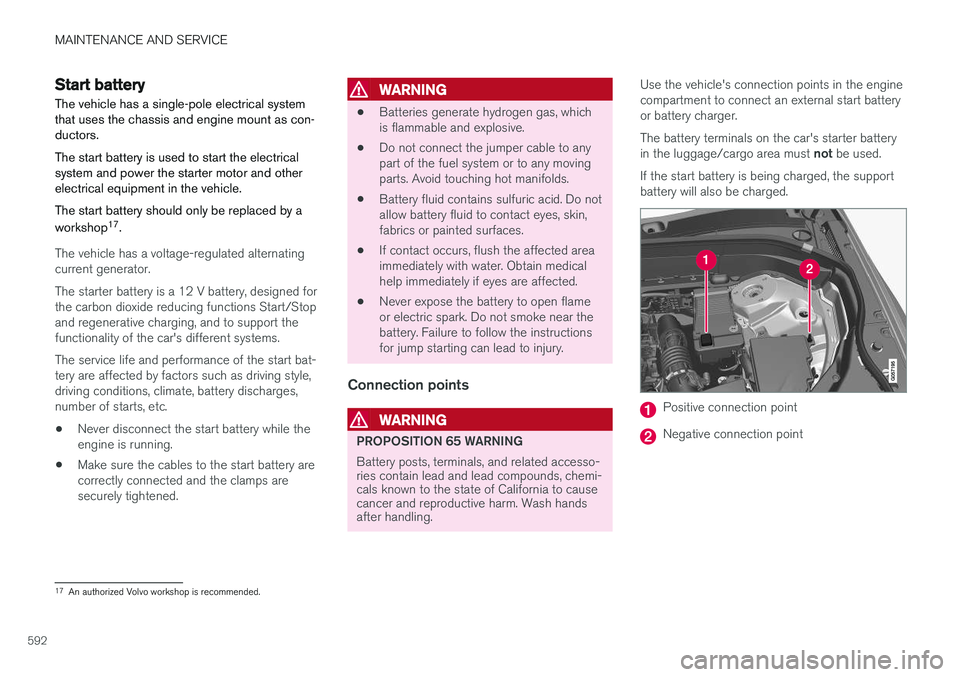
PROPOSITION 65 WARNING Battery posts, terminals, and related accesso- ries contain lead and lead compounds, chemi-cals known to the state of California to causecancer and reproductive harm. Wash handsafter handling. Use the vehicle's connection points in the engine compartment to connect an external start batteryor battery charger. The battery terminals on the car's starter battery in the luggage/cargo area must
not be used.
If the start battery is being charged, the support battery will also be charged.
Positive connection point
Negative connection point
17 An authorized Volvo workshop is recommended.
Page 597 of 660
MAINTENANCE AND SERVICE
}}
595
Support battery In addition to the start battery, vehicles equipped with the Start/Stop function also have a supportbattery.
Vehicles with the Start/Stop function are equip- ped with two 12-volt batteries ‒ a heavy-duty
start battery and a support battery that provides extra current during the Start/Stop function'sstart sequence.
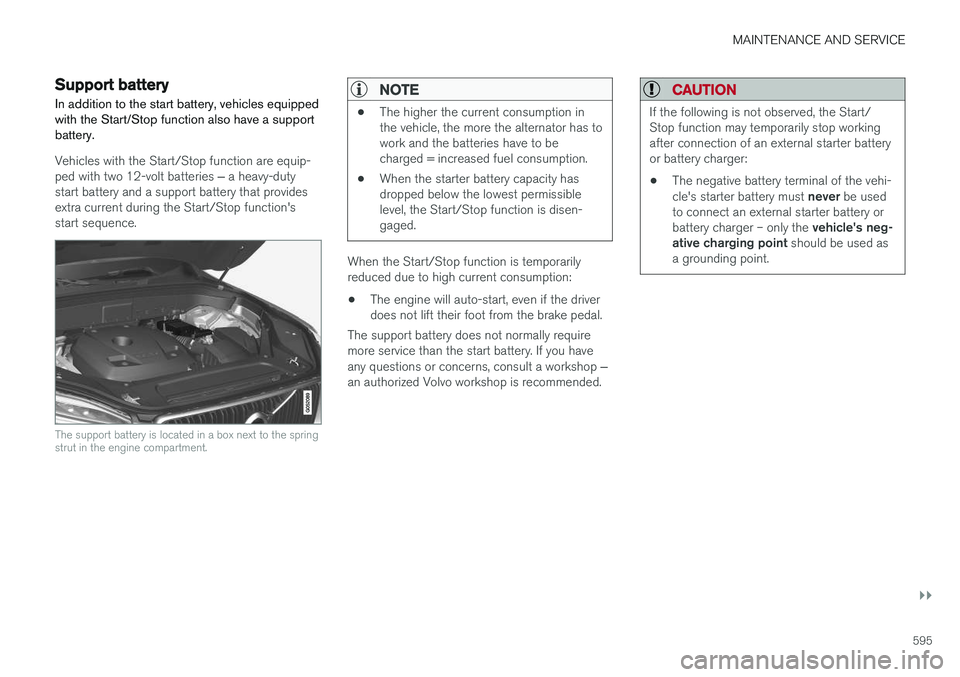
The support battery is located in a box next to the spring strut in the engine compartment.
NOTE
• The higher the current consumption in the vehicle, the more the alternator has towork and the batteries have to becharged = increased fuel consumption.
• When the starter battery capacity hasdropped below the lowest permissiblelevel, the Start/Stop function is disen-gaged.
When the Start/Stop function is temporarily reduced due to high current consumption:
• The engine will auto-start, even if the driverdoes not lift their foot from the brake pedal.
The support battery does not normally requiremore service than the start battery. If you have any questions or concerns, consult a workshop ‒
an authorized Volvo workshop is recommended.
CAUTION
If the following is not observed, the Start/ Stop function may temporarily stop workingafter connection of an external starter batteryor battery charger: • The negative battery terminal of the vehi- cle's starter battery must
never be used
to connect an external starter battery orbattery charger – only the vehicle's neg-
ative charging point should be used as
a grounding point.
Page 602 of 660
||
MAINTENANCE AND SERVICE
* Option/accessory.
600 Fuse pliers are provided on the inside of the fuse box cover to assist in removing and insertingfuses. There are also spaces for several extra fuses in the fusebox.
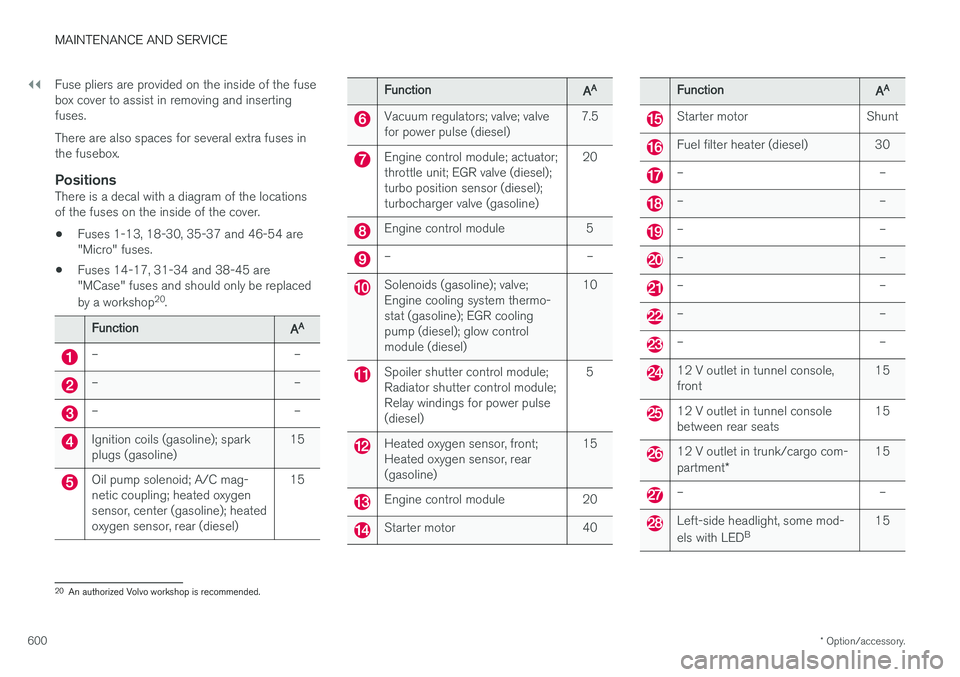
PositionsThere is a decal with a diagram of the locationsof the fuses on the inside of the cover.
• Fuses 1-13, 18-30, 35-37 and 46-54 are"Micro" fuses.
• Fuses 14-17, 31-34 and 38-45 are"MCase" fuses and should only be replaced by a workshop 20
.
FunctionAA
– –
– –
– –
Ignition coils (gasoline); spark plugs (gasoline) 15
Oil pump solenoid; A/C mag- netic coupling; heated oxygensensor, center (gasoline); heatedoxygen sensor, rear (diesel)15
FunctionAA
Vacuum regulators; valve; valve for power pulse (diesel)
7.5
Engine control module; actuator; throttle unit; EGR valve (diesel);turbo position sensor (diesel);turbocharger valve (gasoline) 20
Engine control module 5
– –
Solenoids (gasoline); valve; Engine cooling system thermo-stat (gasoline); EGR coolingpump (diesel); glow controlmodule (diesel)10
Spoiler shutter control module; Radiator shutter control module;Relay windings for power pulse(diesel)
5
Heated oxygen sensor, front; Heated oxygen sensor, rear(gasoline)
15
Engine control module 20
Starter motor 40
FunctionAA
Starter motor Shunt
Fuel filter heater (diesel) 30
– –
– –
– –
– –
– –
– –
– –
12 V outlet in tunnel console, front
15
12 V outlet in tunnel console between rear seats15
12 V outlet in trunk/cargo com- partment
* 15
– –
Left-side headlight, some mod- els with LED
B 15
20
An authorized Volvo workshop is recommended.
Page 606 of 660
||
MAINTENANCE AND SERVICE
* Option/accessory.
604
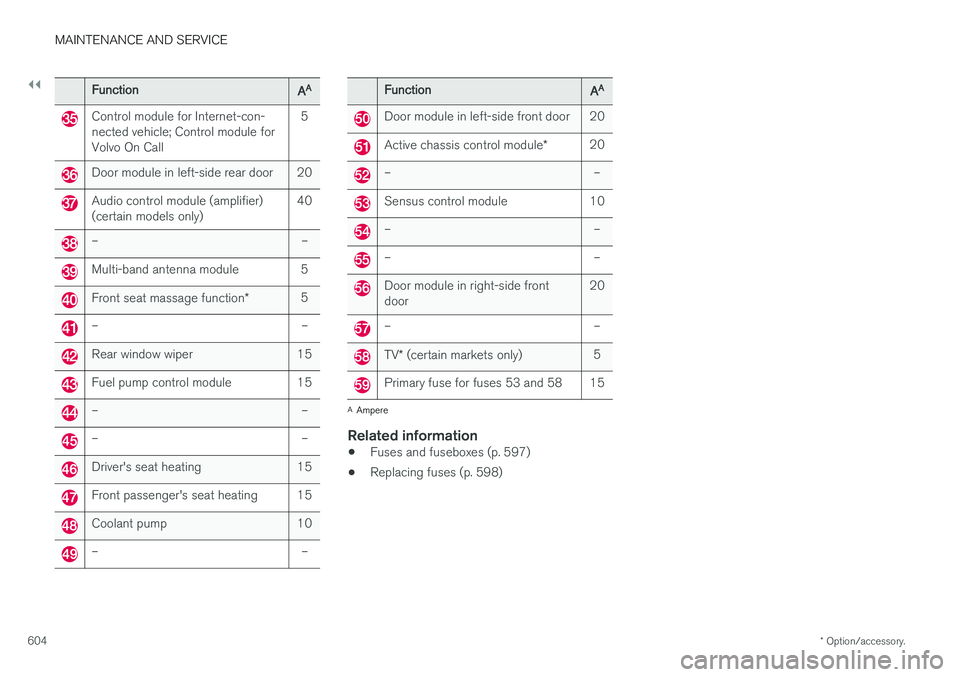
FunctionAA
Control module for Internet-con- nected vehicle; Control module forVolvo On Call 5
Door module in left-side rear door 20
Audio control module (amplifier) (certain models only)
40
– –
Multi-band antenna module 5
Front seat massage function
*5
– –
Rear window wiper 15
Fuel pump control module 15
– –
– –
Driver's seat heating 15
Front passenger's seat heating 15
Coolant pump 10
– –
FunctionAA
Door module in left-side front door 20
Active chassis control module
*20
– –
Sensus control module 10
– –
– –
Door module in right-side front door 20
– –
TV
* (certain markets only) 5
Primary fuse for fuses 53 and 58 15
A
Ampere
Related information
• Fuses and fuseboxes (p. 597)
• Replacing fuses (p. 598)
Page 618 of 660
||
MAINTENANCE AND SERVICE
616•
Wash using a sponge, car washing detergent and plenty of lukewarm water.
• Clean the wiper blades with lukewarm soapsolution or car washing detergent.
• Dry the vehicle using a clean, soft chamois ora squeegee. Try not to let drops of water dryin strong sunlight. This could cause waterdrying stains that may need to be polishedout.
• In areas with heavy industrial emissions,more frequent washing of the vehicle's exte-rior is recommended.
• Tar spots from asphalt may remain even afterwashing. Use a tar remover to remove thesespots after washing the vehicle.
WARNING
Always entrust engine washing to a workshop. If the engine is hot, there is a risk of fire.
CAUTION
Dirty headlights do not work as well. Clean them regularly, e.g. when refueling. Do not use corrosive cleaners. Use water and a non-abrasive sponge.
NOTE
Exterior lighting such as headlights and tail- lights may develop temporary condensationon the inside of the lens. This is normal. Allexterior lighting is designed to resist this.Condensation is normally vented out of thelamp housing once the light has been lit forsome period of time.
CAUTION
• Make sure that the panoramic roof and sun shade are closed before washing thevehicle.
• Never use abrasive polishing agents onthe panoramic roof.
• Never use wax on the rubber sealsaround the panoramic roof.
CAUTION
Remember to remove dirt from the drain holes in the doors and sills after washing thevehicle.
Related information
• Cleaning the exterior (p. 614)
• Polishing and waxing (p. 615)
• Automatic car washes (p. 617)
• High-pressure washing (p. 618) •
Cleaning the wiper blades (p. 618)
• Cleaning exterior plastic, rubber and trim components (p. 619)
• Cleaning rims (p. 620)
• Corrosion protection (p. 620)
Page 640 of 660
SPECIFICATIONS
638
Engine oil specificationsFully synthetic engine oil of at least ACEA A5/B5 must be used. Lower oil gradesmay not offer the same fuel economy, engineperformance or engine protection.
Volvo recommends:
GeneralSee the Service and warranty booklet for infor- mation about oil change intervals.
NOTE
This vehicle is delivered from the factory with synthetic oil.
Do not use oil additives.
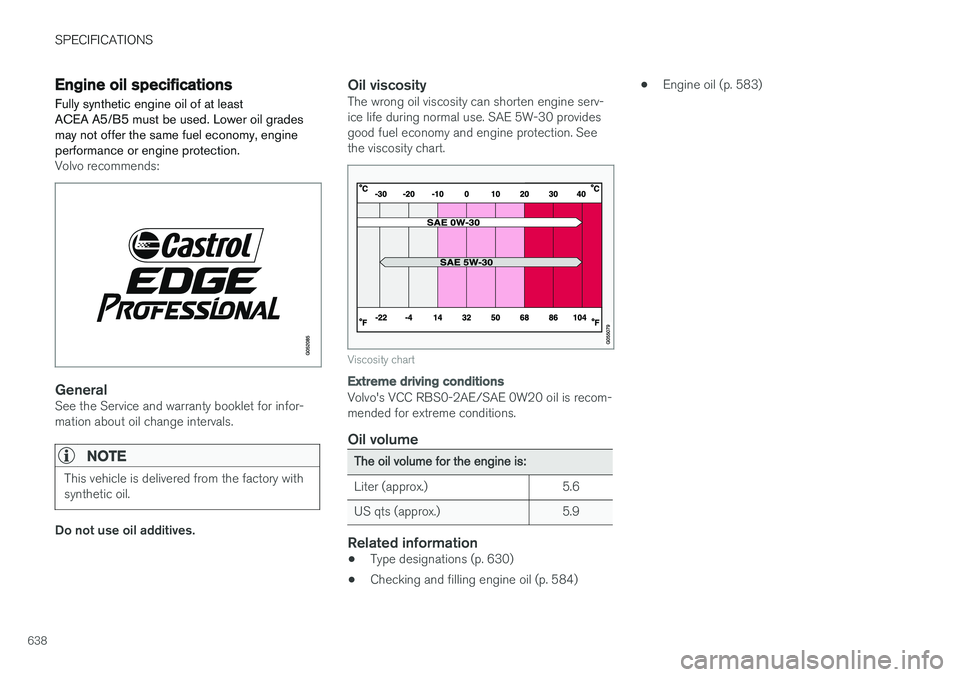
Oil viscosityThe wrong oil viscosity can shorten engine serv- ice life during normal use. SAE 5W-30 providesgood fuel economy and engine protection. Seethe viscosity chart.
Viscosity chart
Extreme driving conditions
Volvo's VCC RBS0-2AE/SAE 0W20 oil is recom- mended for extreme conditions.
Oil volume
The oil volume for the engine is:
Liter (approx.) 5.6
US qts (approx.) 5.9
Related information
• Type designations (p. 630)
• Checking and filling engine oil (p. 584) •
Engine oil (p. 583)
Page 642 of 660
SPECIFICATIONS
640
Fuel tank volumeThe fuel tank's refillable volume is shown in the table below.
All models
Liter (approx.) 71
US gallons (approx.) 18.8
Related information
• Refueling (p. 436)
• Octane rating (p. 437)
Air conditioning specifications
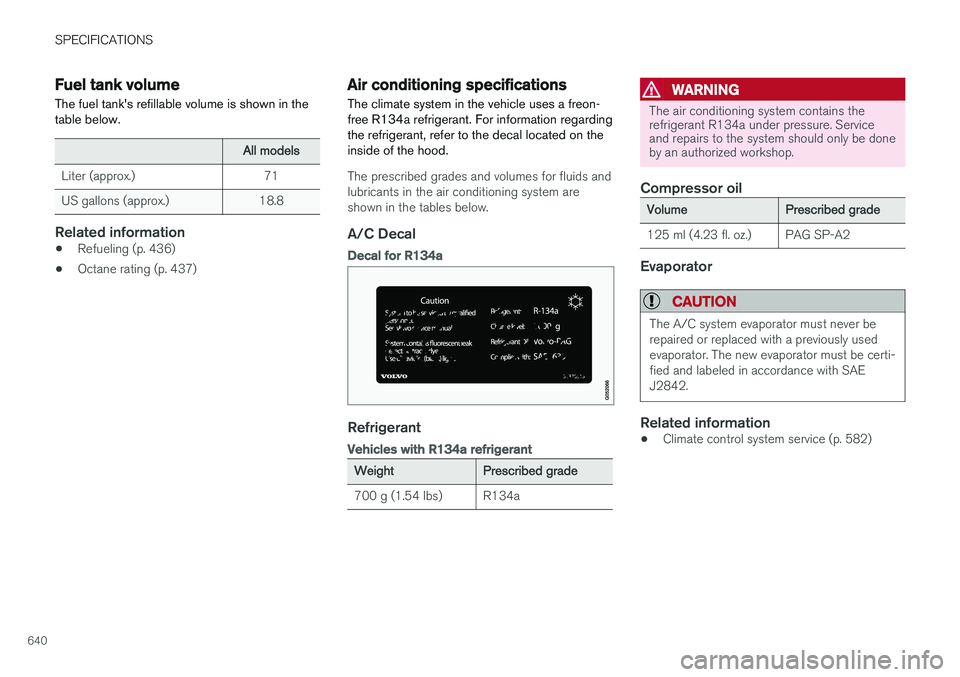
The climate system in the vehicle uses a freon- free R134a refrigerant. For information regardingthe refrigerant, refer to the decal located on theinside of the hood.
The prescribed grades and volumes for fluids and lubricants in the air conditioning system areshown in the tables below.
A/C Decal
Decal for R134a
Refrigerant
Vehicles with R134a refrigerant
WeightPrescribed grade
700 g (1.54 lbs) R134a
WARNING
The air conditioning system contains the refrigerant R134a under pressure. Serviceand repairs to the system should only be doneby an authorized workshop.
Compressor oil
VolumePrescribed grade
125 ml (4.23 fl. oz.) PAG SP-A2
Evaporator
CAUTION
The A/C system evaporator must never be repaired or replaced with a previously usedevaporator. The new evaporator must be certi-fied and labeled in accordance with SAEJ2842.
Related information
• Climate control system service (p. 582)
Page 649 of 660
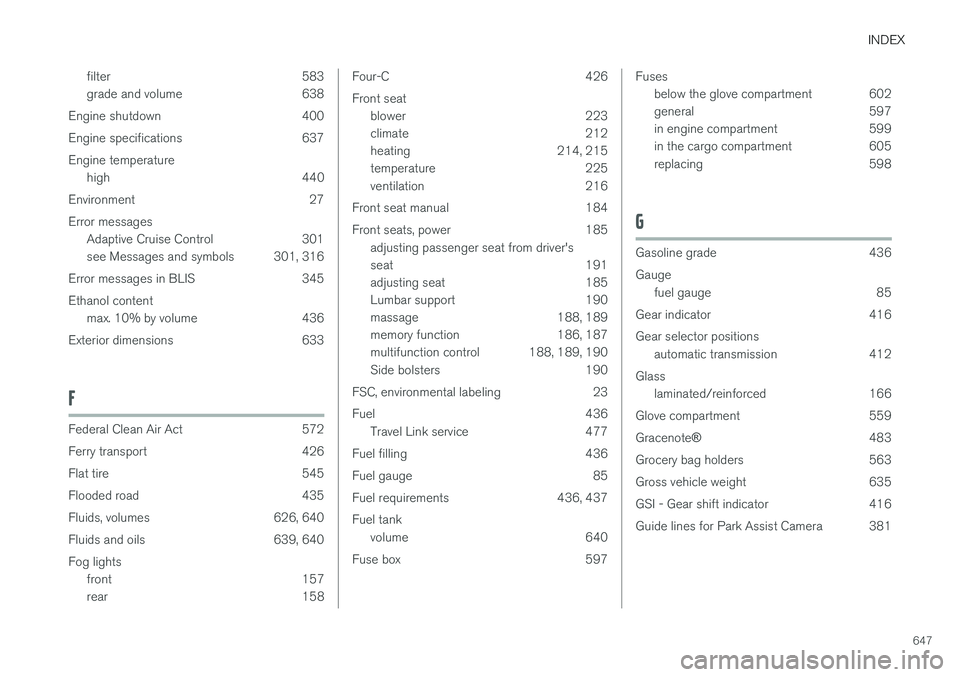
INDEX
647
filter 583
grade and volume 638
Engine shutdown 400
Engine specifications 637Engine temperature high 440
Environment 27Error messages Adaptive Cruise Control 301
see Messages and symbols 301, 316
Error messages in BLIS 345 Ethanol content max. 10% by volume 436
Exterior dimensions 633
F
Federal Clean Air Act 572
Ferry transport 426
Flat tire 545
Flooded road 435
Fluids, volumes 626, 640
Fluids and oils 639, 640 Fog lights front 157
rear 158
Four-C 426 Front seatblower 223
climate 212
heating 214, 215
temperature 225
ventilation 216
Front seat manual 184
Front seats, power 185 adjusting passenger seat from driver's
seat 191
adjusting seat 185
Lumbar support 190
massage 188, 189
memory function 186, 187
multifunction control 188, 189, 190
Side bolsters 190
FSC, environmental labeling 23
Fuel 436 Travel Link service 477
Fuel filling 436
Fuel gauge 85
Fuel requirements 436, 437 Fuel tank volume 640
Fuse box 597Fuses below the glove compartment 602
general 597
in engine compartment 599
in the cargo compartment 605
replacing 598
G
Gasoline grade 436 Gaugefuel gauge 85
Gear indicator 416Gear selector positions automatic transmission 412
Glass laminated/reinforced 166
Glove compartment 559 Gracenote ®
483
Grocery bag holders 563
Gross vehicle weight 635
GSI - Gear shift indicator 416
Guide lines for Park Assist Camera 381
Page 654 of 660

INDEX
652Rain sensor 177, 178
Rain sensor's memory function 178
Raise the rear end 562
Rear camera 379, 380, 381, 383, 384,
386, 387
Rear seat blower 224
climate 212
folding backrest 192
head restraint 195
heating 215
temperature 226
Rear sensors 374, 375, 376, 377, 378 Rearview/door mirrors dimming 170
heating 222
interior 169
Rearview mirror 169 dimming 170
Rear window heating 222
washers 180
wipers 180
Recalls 45
Recommendations when driving 433
Recommendations when loading 561
Recovery 450
Red Key 240 settings 241
Refrigerant 582 climate system 640
Refueling filling 436
fuel filler door, fuel flap 435
Remote immobilizer 244
Remote key 231 battery replacement 236
connecting to driver profile 137
detachable key blade 242
loss 240
Range 235
Remote updates 575
Reporting safety defects 44
Resetting door mirrors 170
Resetting settings 133 change of owner 132
Driver profile 137
Resetting trip odometer 88
Road Sign Information 350, 351, 352 limitations 354
operation 351, 352, 353, 354
Road trip 433
Roll Stability Control 265
Roof load, max. weight 635RSC (Roll Stability Control) 265
Run-off Mitigation 366, 367
S
Safety 42 pregnancy 43
Safety belt, see Seat belt 47
Safety defects, reporting 44
Safety mode 61 starting/moving 62
Sealing compound 545
Seat, see Seats 184
Seat belt reminder 51
Seat belts 47 Automatic locking retractor/Emergency
locking retractor 65
buckling/unbuckling 48
pregnancy 43
seat belt reminder 51
seat belt tensioner 50
securing child restraint systems 67, 69, 71
Seat belt tensioner 50 resetting 51
Seats heating 214, 215
manual front seat 184