overheating VOLVO XC60 T8 2018 Owner´s Manual
[x] Cancel search | Manufacturer: VOLVO, Model Year: 2018, Model line: XC60 T8, Model: VOLVO XC60 T8 2018Pages: 674, PDF Size: 11.93 MB
Page 460 of 674
STARTING AND DRIVING
* Option/accessory.
458
Overheating of engine andtransmission
In demanding driving conditions, such as driving in mountainous areas or hot weather, there is arisk of the engine or transmission overheating,especially when carrying heavy loads.
• Engine power may be temporarily limited.
• Remove any auxiliary lights mounted in front of the grille when driving in hot weather.
• If the temperature in the engine's coolingsystem becomes too high, a warning symbolwill appear in the instrument panel along with the message
Engine temperature High
temperature Stop safely. Pull over to a
safe location and let the engine idle for a few minutes to cool down.
• If the message
Engine temperature High
temperature Turn off engine or Engine
coolant Level low, turn off engine is dis-
played, stop the vehicle and turn off the engine.
• If the transmission begins to overheat, analternative gear shifting program will beselected. An integrated protective functionwill also be activated, the warning symbol will illuminate and the message
Transmission
warm Reduce speed to lower
temperature or Transmission hot Stop
safely, wait for cooling will be displayed in
the instrument panel. Follow the recommen- dations given by reducing speed or stopping the vehicle safely and letting the engine idle for a few minutes to let the transmissioncool.
• If the vehicle begins to overheat, the air con-ditioning may be temporarily switched off.
• After a prolonged period of driving indemanding conditions, do not turn off theengine immediately after stopping.
NOTE
It is normal for the engine's cooling fan to operate for a short time after the engine isswitched off.
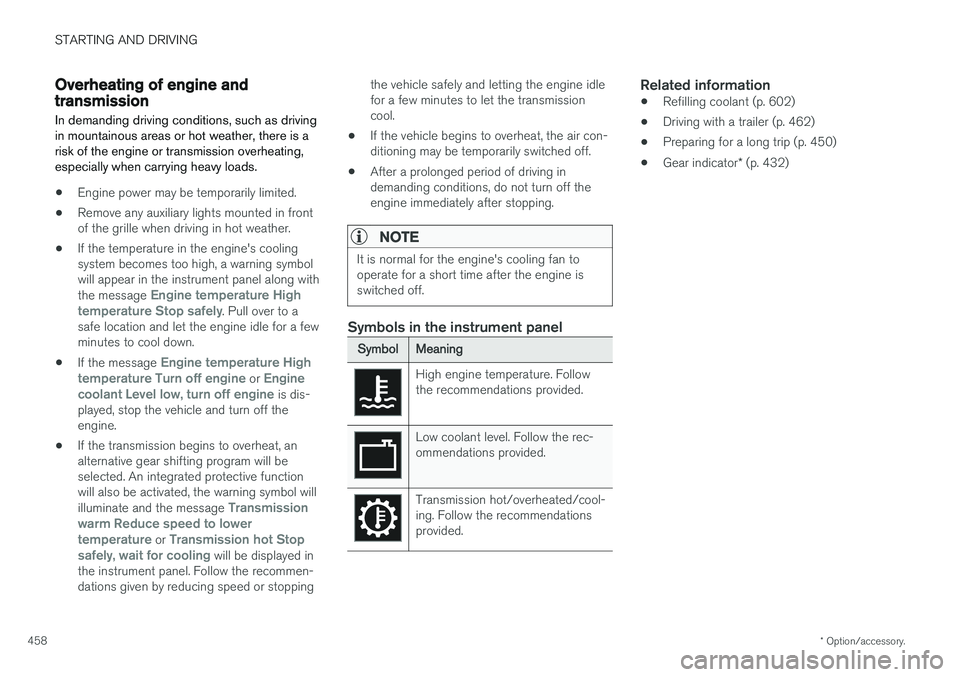
Symbols in the instrument panel
SymbolMeaning
High engine temperature. Follow the recommendations provided.
Low coolant level. Follow the rec- ommendations provided.
Transmission hot/overheated/cool- ing. Follow the recommendationsprovided.
Related information
• Refilling coolant (p. 602)
• Driving with a trailer (p. 462)
• Preparing for a long trip (p. 450)
• Gear indicator
* (p. 432)
Page 465 of 674
STARTING AND DRIVING
* Option/accessory.463
CAUTION
•Bumper-attached trailer hitches must not be used on Volvos, nor should safetychains be attached to the bumper.
• Trailer hitches attaching to the vehiclerear axle must not be used.
• Never connect a trailer's hydraulic brakesystem directly to the vehicle brake sys-tem, nor a trailer's lighting system directlyto the vehicle lighting system. Consultyour nearest authorized Volvo retailer forcorrect installation.
• When towing a trailer, the trailer's safetychains or wire must be correctly fastenedto the attachment points provided in thetrailer hitch on the vehicle. The safetychain or wire must never be fastened toor wound around the towing ball.
NOTE
The optional detachable trailer hitch may not be available in all markets or on all models.Consult your Volvo retailer.
NOTE
Extreme weather conditions, towing a trailer, driving at high altitudes and fuel quality arefactors that significantly increase a vehicle'sfuel consumption.
Trailer weights
WARNING
Please adhere to the recommendations provi- ded for trailer weight. If the recommendationsare not followed, the vehicle and trailer maybe difficult to control during evasive maneu-vers and braking.
NOTE
The specified maximum trailer weights are those permitted by Volvo. National vehicleregulations may set additional restrictions ontrailer weight and speed. The trailer hitchesmay be certified for higher towing weightsthan the vehicle is permitted to tow.
Self-leveling suspension
*The vehicle's self-leveling system attempts to keep the vehicle at a constant level, regardless ofload (up to the maximum permitted weight).When the vehicle is stationary, the rear end of thevehicle will be slightly lowered, which is normal.
Driving in hilly terrain or hot weatherIn certain conditions, there is a risk of overheat-ing when driving with a trailer. If overheating ofthe engine and drive system is detected, a warn-ing symbol will illuminate in the instrument panelalong with a message. The automatic transmission selects the optimalgear for the current load and engine speed.
Steep inclines
Do not lock the automatic transmission into a higher gear than what the engine can handle
‒ it
is not always preferable to drive in high gears at low rpm.
Parking on a hill
1. Depress the brake pedal.
2. Apply the parking brake.3. Put the gear selector in P.
4. Release the brake pedal.Put chocks behind the wheels when the vehicle is parked on a hill with a trailer attached.
Starting on a hill
1. Depress the brake pedal. 2. Put the gear selector in D.
3. Release the parking brake.
4. Release the brake pedal and start driving.
Related information
• Trailer Stability Assist
* (p. 464)
• Checking trailer lights (p. 465)
• Towing capacity and tongue weight (p. 650)
• Overheating of engine and transmission (p. 458)
Page 567 of 674
WHEELS AND TIRES
}}
565
7. Connect the electrical cable to the nearest
12 V outlet and start the vehicle.
NOTE
Make sure that none of the vehicle's other 12 V sockets are used while the compressoris running.
WARNING
Never leave children unattended in the vehicle while the engine is running. 8. Start the compressor by moving the switch to
the I (On) position.
WARNING
Never stand next to a tire being inflated with the compressor. If cracks, bulges, etc. form onthe tire, switch off the compressor immedi-ately. The vehicle should not be driven. Callroadside assistance to have the vehicle towedto a workshop for inspection/replacement ofthe tire. Volvo recommends an authorizedworkshop.
NOTE
When the compressor first starts, air pressure may temporarily increase up to 6 bar (88 psi)but should decrease again after approxi-mately 30 seconds.
9. Inflate the tire for 7 minutes.
CAUTION
To help avoid overheating, the compressor should never be used for more than10 minutes at a time.
10. Switch off the compressor and check the
inflation pressure using the air pressure gauge. The inflation pressure should bebetween 1.8 bar (22 psi) and 3.5 bar(51 psi). If the inflation pressure is too high,use the air release valve to release air.
WARNING
If the bottle is not removed in the correct order, sealant could spill out.
WARNING
If pressure falls below 1.8 bar (22 psi), the hole in the tire may be too large. The vehicleshould not be driven. Call roadside assistanceto have the vehicle towed to a workshop forinspection/replacement of the tire. Volvo rec-ommends an authorized workshop.
11. Switch off the compressor and remove the electrical cable.
12. Unscrew the hose from the tire's valve and screw the valve cap back on.
13. Put the protective hose cover onto the hose to help prevent leakage of any residual seal- ing compound. Return the equipment to thecargo compartment.
Page 569 of 674
WHEELS AND TIRES
567
Inflate tires with the compressorincluded in the tire sealing system The vehicle's original tires can be inflated using the compressor in the tire sealing system.
1. The compressor must be switched off. Makesure that the switch is in the 0 (Off) position
and take out the electrical cable and the hose.
2. Unscrew the tire's valve cap and screw the hose's valve connector as far as possibleonto the valve. Be sure the air release valve on the com- pressor's hose is completely closed.
3. Connect the electrical cable to the nearest 12 V outlet and start the vehicle.
WARNING
Inhaling exhaust fumes could lead to serious injury. Never leave the engine running in anenclosed space or a space without sufficientventilation.
WARNING
Never leave children unattended in the vehicle while the engine is running.
4. Start the compressor by moving the switch to the I (On) position.
CAUTION
Risk of overheating. The compressor should not be running for longer than 10 minutes ata time.
5. Inflate the tire to the pressure specified on
the tire pressure decal on the driver's side door pillar. If the inflation pressure is toohigh, use the air release valve to release air.
6. Switch off the compressor. Remove the hose and the electrical cable.
7. Screw the valve cap back onto the tire.
NOTE
• After inflating a tire, always replace the valve cap to help prevent valve damagecaused by gravel, dirt, etc.
• Use plastic valve caps only. Metal capscould corrode and become difficult toremove.
NOTE
The compressor is an electric device. Follow local regulations for disposal.
Related information
• Recommended tire pressure (p. 549)
• Using the tire sealing system (p. 563)
• Tire sealing system (p. 562)
Page 570 of 674
WHEELS AND TIRES
568
Determining the vehicle's permittedweight
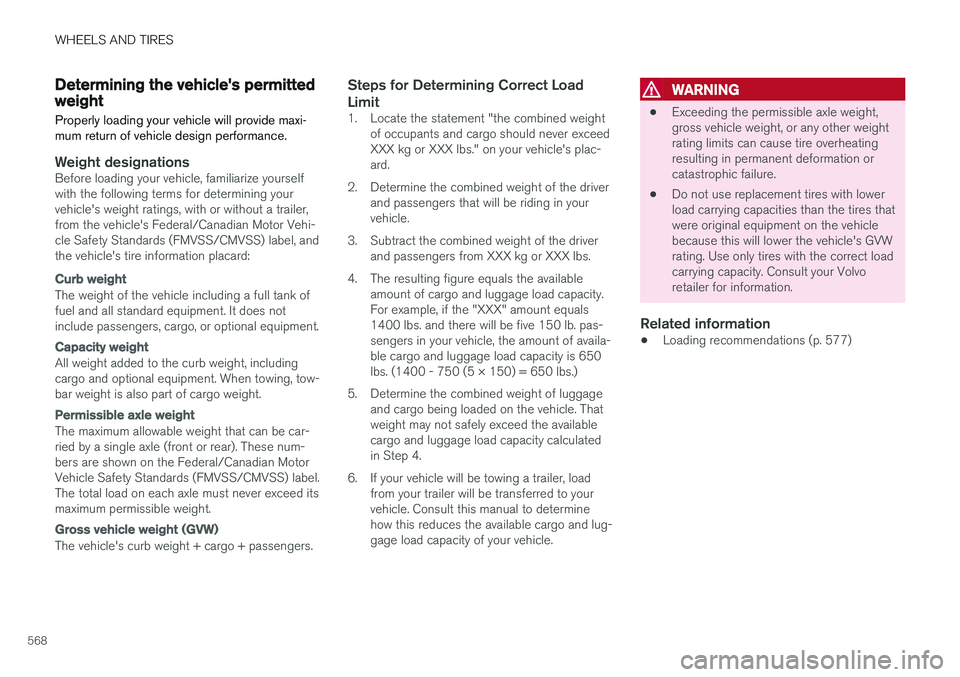
Properly loading your vehicle will provide maxi- mum return of vehicle design performance.
Weight designationsBefore loading your vehicle, familiarize yourself with the following terms for determining yourvehicle's weight ratings, with or without a trailer,from the vehicle's Federal/Canadian Motor Vehi-cle Safety Standards (FMVSS/CMVSS) label, andthe vehicle's tire information placard:
Curb weight
The weight of the vehicle including a full tank of fuel and all standard equipment. It does notinclude passengers, cargo, or optional equipment.
Capacity weight
All weight added to the curb weight, including cargo and optional equipment. When towing, tow-bar weight is also part of cargo weight.
Permissible axle weight
The maximum allowable weight that can be car- ried by a single axle (front or rear). These num-bers are shown on the Federal/Canadian MotorVehicle Safety Standards (FMVSS/CMVSS) label.The total load on each axle must never exceed itsmaximum permissible weight.
Gross vehicle weight (GVW)
The vehicle's curb weight + cargo + passengers.
Steps for Determining Correct Load Limit
1. Locate the statement "the combined weight of occupants and cargo should never exceed XXX kg or XXX lbs." on your vehicle's plac-ard.
2. Determine the combined weight of the driver and passengers that will be riding in yourvehicle.
3. Subtract the combined weight of the driver and passengers from XXX kg or XXX lbs.
4. The resulting figure equals the available amount of cargo and luggage load capacity.For example, if the "XXX" amount equals1400 lbs. and there will be five 150 lb. pas-sengers in your vehicle, the amount of availa-ble cargo and luggage load capacity is 650lbs. (1400 - 750 (5 × 150) = 650 lbs.)
5. Determine the combined weight of luggage and cargo being loaded on the vehicle. Thatweight may not safely exceed the availablecargo and luggage load capacity calculatedin Step 4.
6. If your vehicle will be towing a trailer, load from your trailer will be transferred to yourvehicle. Consult this manual to determinehow this reduces the available cargo and lug-gage load capacity of your vehicle.
WARNING
• Exceeding the permissible axle weight, gross vehicle weight, or any other weightrating limits can cause tire overheatingresulting in permanent deformation orcatastrophic failure.
• Do not use replacement tires with lowerload carrying capacities than the tires thatwere original equipment on the vehiclebecause this will lower the vehicle's GVWrating. Use only tires with the correct loadcarrying capacity. Consult your Volvoretailer for information.
Related information
• Loading recommendations (p. 577)
Page 662 of 674
INDEX
660Cooling system
overheating 458
Corner Traction Control 264
Corrosion protection 634Covering cargo compartment 582
Crash, see Collision 42
Crash event data 33
Cross Traffic Alert – CTA 344, 345, 346, 347
Cruise control 276, 277 manage speed 277, 278
temporary deactivation 279, 280
turn off 280
CTA – Cross Traffic Alert 344, 345, 346, 347
Curb weight 649
CZIP (Clean Zone Interior Package) 200
D
Data recording 33 transferring between vehicle and work-
shop 590
Data sharing 526
Daytime running lights 150
Decals location of 644
Defrosting 214
Detection of cyclist 329
Dimensions 647
Dipstick, electronic 601
Direction of rotation 542
Display lighting 159
Distance Alert 281, 282, 283 limitations 284
DivX ®
502
Door mirrors 165, 166 compass 471, 472
dimming 166
outer 165, 166
power folding 166
resetting 166
Driveline transmission 428
Drive mode 435 changing 439
Driver Alert Control 353 operation 354, 355
Driver Alert Control limitations 355
Driver performance 88Driver profile 133 edit 135
select 134
Driver support system 262
Drive systems 433Driving cooling system 458
with a trailer 462
Driving economy 446
Driving through standing water 452 driving with a trailer towball load 650
towing capacity 650
E
Economical driving 446
Electrical outlet 572
use 574
Electrical system 605 Electric drive motor specifications 651
electric motor 433 Driving 447
Range 448
Electric parking brake 422
Page 663 of 674
INDEX
661
Electronic immobilizer 242
emergency brake lights 156
Emission inspection readiness 588Engine
automatic start and stop of combustion
engine 434
overheating 458
start 414
turn off 416
Engine braking, automatic 444 Engine compartment coolant 602
engine oil 600
overview 599
Engine drag control 264
Engine oil 600 filling 601
filter 600
grade and volume 652
Engine shutdown 416
Engine specifications 651Engine temperature high 458
Environment 27 Error messages Adaptive Cruise Control 299
see Messages and symbols 299, 314
Error messages in BLIS 343 Ethanol content
max. 10% by volume 454
Exterior dimensions 647
F
Federal Clean Air Act 588
Ferry transport 440
Flat tire 562
Flooded road 452
Fluids, volumes 640, 654
Fluids and oils 653, 654Fog lights rear 155
Four-C 440 Front seat blower 218
climate 208
heating 209, 210
temperature 218
ventilation 211
Front seat manual 180
Front seats, power 181 adjusting passenger seat from driver's
seat 187
adjusting seat 181
Lumbar support 186
massage 184, 185
memory function 182, 183
multifunction control 184, 185, 186
Side bolsters 186
FSC, environmental labeling 23
Fuel 454 Travel Link service 495
Fuel filling 453
Fuel gauge 82
Fuel requirements 454, 455 Fuel tank volume 654
Fuse box 611Fuses below the glove compartment 616
general 610
in engine compartment 612
in the cargo compartment 619
replacing 611
G
Gasoline grade 454 Gauge
fuel gauge 82
Page 666 of 674
INDEX
664instrument lighting 159
light bulbs, specifications 604
low beams 151
position lights 150
rear fog light 155
settings 149
Turn signals 154
Lighting, replacing bulbs 603
Limp home 428Load anchoring eyelets cargo compartment 579
Load anchoring hooks 579
Load carriers 578
Load index 544 Loading general 577
load anchoring eyelets 579
long load 578
Lock indication 228 setting 229
Locking/unlocking Tailgate 233, 246
Locking wheel bolts 555 Locks Locking 231
unlocking 231
Long-term storage 411
Low battery charge level start battery 459
Low beams 151
Lower the rear end 578
Low oil level 601
Low-speed driving 443 activate with function button 444
M
Maintained climate comfort 225
start/stop 225
Maintenance 588 corrosion protection 634
Max. axle weight 649
Max. roof load 649
Media player 497, 498, 499 compatible file formats 526, 527
voice control 144
Messages and symbols Adaptive Cruise Control 299
Collision warner with auto-brake 337
Messages in BLIS 343
Messages in display 101, 136 handling 102, 137
saved 103, 138
Mileage 85electric motor 448
Misting condensation in headlights 628, 631
Mood lighting 159
N
Net cargo compartment 584
O
Occupant safety 43
Occupant weight sensor 56
Octane rating 455
Oil, see also Engine oil 652
On-board diagnostics 588
On-board Diagnostic socket 36
Option/accessory 21
Outside temperature gauge 90
Overheating 458, 462
Owner's information 16
OWNER'S MANUAL 21environmental labeling 23