ABS VOLVO XC60 TWIN ENGINE 2020 User Guide
[x] Cancel search | Manufacturer: VOLVO, Model Year: 2020, Model line: XC60 TWIN ENGINE, Model: VOLVO XC60 TWIN ENGINE 2020Pages: 687, PDF Size: 14.65 MB
Page 410 of 687

||
STARTING AND DRIVING
408be felt from the brake pedal when ABS is operating, which is normal. After the vehicle is started, a brief test of the ABS system is automatically performed whenthe driver releases the brake pedal. An addi-tional automatic test of the system may beperformed when the vehicle is traveling at alow speed. During the test, the brake pedalmay feel as though it is pulsating.
Light braking charges the hybrid
battery
When the brakes are applied lightly, the elec-tric motor braking function is used. This con-verts the vehicle's kinetic energy into electricalenergy, which is used to charge the hybridbattery. When the battery is being chargedwith the electric motor braking function, thiswill be indicated in the instrument panel.When the battery is being charged with the electric motor braking function, this will be indicated in theinstrument panel.
This function is active at speeds in the range of 150-5 km/h (93-3 mph). When braking atspeeds outside of this range, or during harderbraking, the hydraulic braking system is usedto augment braking. This is indicated in theinstrument panel with the pointer down in thered area.
Symbols in the instrument panel
Symbol Meaning
A
B Check the brake fluid level. If the level is low, fill brake fluid andcheck to determine the reasonfor the loss of brake fluid.
A
BFault in pedal sensor.
2
Anti-lock Braking System
Page 411 of 687

STARTING AND DRIVING
409
Symbol Meaning
A
BSteady glow for 2 seconds after the engine is started: Automaticfunction check. Steady glow for more than 2 seconds: Fault in the ABS sys-tem. The vehicle's regular brakesystem is still working, but with-out the ABS function.
If the message Brake pedal
Characteristics changed Serv- ice required
is displayed, the
"Brake-by-wire" system is not functioning properly. Greaterpressure will be required to brakethe vehicle.
A In Canada.
B In the US.
WARNING
If the warning symbols for both brake fault and ABS fault are lit simultaneously, theremay be a fault in the brake system.
If the brake fluid reservoir level is nor- mal when this occurs, drive carefully tothe nearest workshop to have thebrake system checked - an authorizedVolvo workshop is recommended.
If the brake fluid has fallen below theMIN
level in the brake fluid reservoir,
the vehicle should not be driven untilthe brake fluid has been filled. The rea-son for the brake fluid loss must bechecked.
Related information
Brake Assist System (p. 409)
Auto-hold brakes (p. 414)
Hill Start Assist (p. 416)
Braking on wet roads (p. 410)
Braking on salted roads (p. 410)
Maintenance of the brake system(p. 410)
Brake lights (p. 164)
Brake Assist System The brake enhancing system, (BAS 3
), helps
increase braking force and can thereby reduce braking distance.
The system monitors the driver's braking hab- its and increases braking force when neces-sary. Braking force can be increased up to thepoint at which the ABS intervenes. The func-tion is deactivated when pressure on the brakepedal is decreased.
Related information
Brakes (p. 407)
3
Brake Assist System
Page 425 of 687

STARTING AND DRIVING
}}
* Option/accessory.423
Starting and stopping the combustion engine in Twin Enginevehicles An advanced control system determines the distance that the vehicle can be driven on thecombustion engine, electric motor, or both atthe same time. When driving on only theelectric motor, the vehicle may automaticallystart the combustion engine due to outsidecircumstances, e.g. low ambient tempera-tures. This is completely normal. The com-bustion engine will also always start whenthe hybrid battery is nearly fully discharged.
Climate settings at low temperaturesAt low ambient temperatures, the combustion engine will sometimes start automatically tohelp achieve the desired passenger compart-ment temperature and air quality. The amountof time the combustion engine is running canbe affected by lowering the temperature
reducing blower speed
activating
Pure drive mode.
Using the electric motor in hot or cold
weather
At very low or high ambient temperatures, the electric motor's driving range and power maybe reduced and affect how often the combus-tion engine automatically starts.
Emission control systemTo help ensure that the emission control sys-tem is as energy-efficient as possible, thecombustion engine will run for several minutesafter it is started. The amount of time the com-bustion engine needs to be used variesdepending on the temperature of the three-way catalytic converter.
WARNING
California Proposition 65 Operating, servicing and maintaining a pas- senger vehicle can expose you to chemi-cals including engine exhaust, carbon mon-oxide, phthalates, and lead, which areknown to the State of California to causecancer and birth defects or other reproduc-tive harm. To minimize exposure, avoidbreathing exhaust, do not idle the engineexcept as necessary, service your vehicle ina well ventilated area and wear gloves orwash your hands frequently when servicingyour vehicle. For more information go towww.P65Warnings.ca.gov/passenger-vehicle.
Related information
Drive systems (p. 422)
Economical driving (p. 438)
Drive modes (p. 423)
Drive modes
Drive modes affect the vehicle's driving cha- racteristics in different ways to enhance andsimplify the driving experience in certaintypes of situations.
Drive modes enable easy access to the vehi- cle's many functions and settings in differentdriving situations. Each drive mode is adaptedto help optimize driving characteristics. Steering
Engine/transmission/all-wheel drive
Brakes
Pneumatic suspension
* and shock absorb-
ers
Instrument panel
Climate control settings
Select the drive mode that is adapted to the current driving conditions. Keep in mind thatnot all drive modes are available in all situa-tions.
Page 432 of 687
STARTING AND DRIVING
* Option/accessory.
430
Leveling control * and suspension
The vehicle's leveling control system adjusts the suspension and shock absorbers auto-matically to help optimize comfort and con-trol while driving. Leveling can also be con-trolled manually to facilitate loading or get-ting in and out of the vehicle.
Manually adjustable shock absorbers *The suspension on Polestar Engineered* vehi-
cles can be manually adjusted. There are three recommended modes: Performance,engineered and Comfort.
Performance mode
In Performance mode, the vehicle's suspen- sion feels stiffer.
Engineered, factory setting
Engineered is designed for daily driving.
Comfort mode
In Comfort mode, the vehicle's suspension feels softer.
Pneumatic suspension and shock
absorbers
The system is adapted to the selected drivemode and vehicle speed. The pneumatic sus- pension reduces the vehicle's ground clear-ance at higher speeds to reduce air resistanceand increase stability. The shock absorbers arenormally set to help optimize comfort and areadjusted continuously according to the roadsurface and the vehicle's acceleration, brakingand cornering.
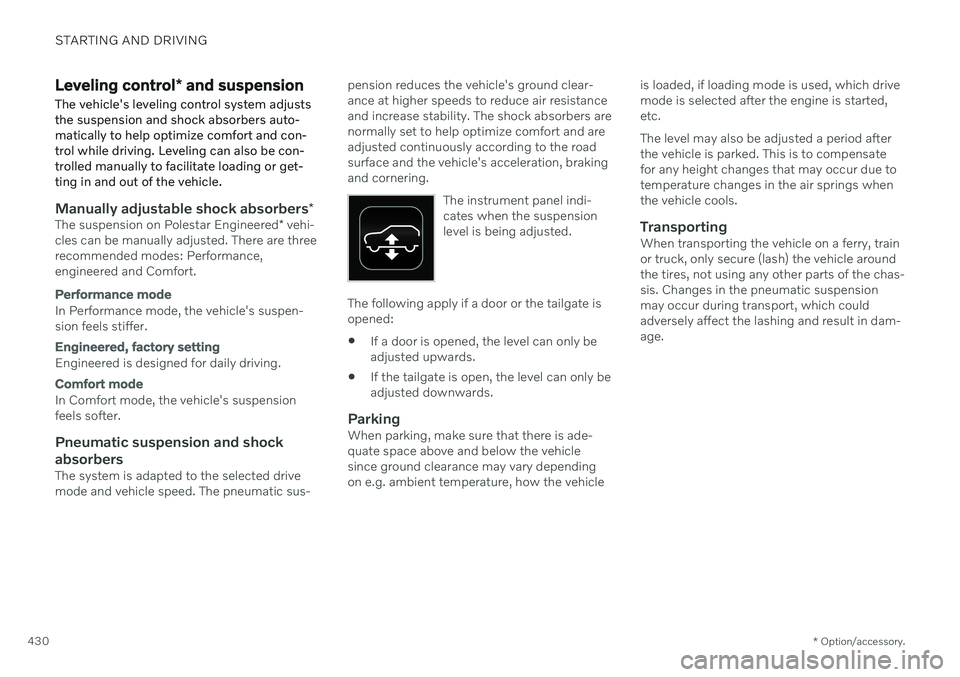
The instrument panel indi-cates when the suspensionlevel is being adjusted.
The following apply if a door or the tailgate is opened: If a door is opened, the level can only be adjusted upwards.
If the tailgate is open, the level can only beadjusted downwards.
ParkingWhen parking, make sure that there is ade-quate space above and below the vehiclesince ground clearance may vary dependingon e.g. ambient temperature, how the vehicle is loaded, if loading mode is used, which drivemode is selected after the engine is started,etc. The level may also be adjusted a period after the vehicle is parked. This is to compensatefor any height changes that may occur due totemperature changes in the air springs whenthe vehicle cools.
TransportingWhen transporting the vehicle on a ferry, trainor truck, only secure (lash) the vehicle aroundthe tires, not using any other parts of the chas-sis. Changes in the pneumatic suspensionmay occur during transport, which couldadversely affect the lashing and result in dam-age.
Page 435 of 687
STARTING AND DRIVING
}}
* Option/accessory.433
Leveling control settings *
Turn off leveling control before lifting the vehicle with a jack to help avoid problemswith the pneumatic suspension. The vehicle can be lowered or raised to make it easier to load or for passengers to get inand out.
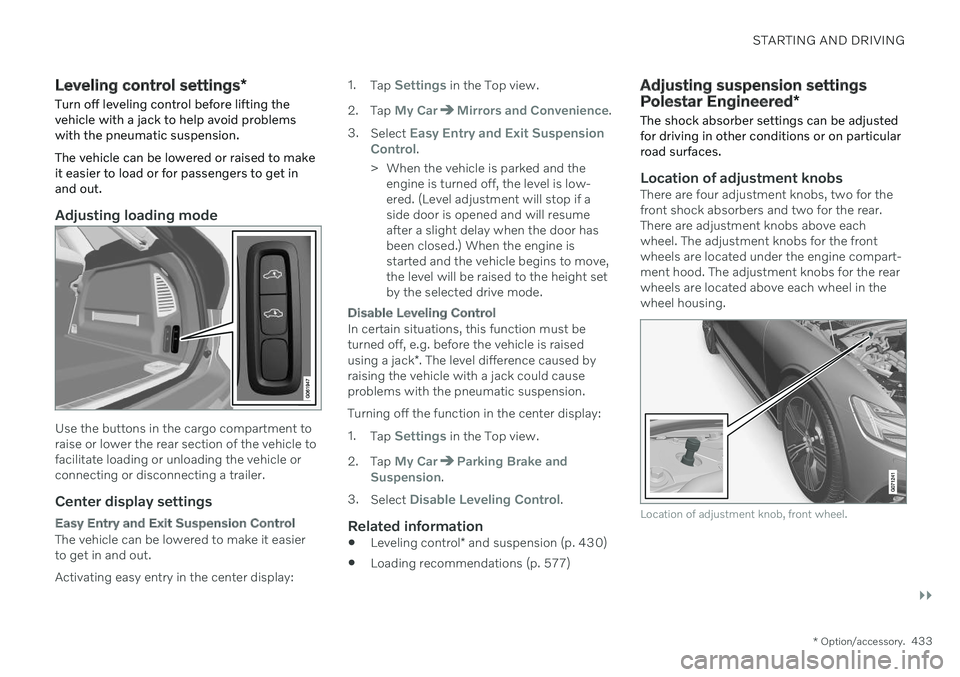
Adjusting loading mode
Use the buttons in the cargo compartment to raise or lower the rear section of the vehicle tofacilitate loading or unloading the vehicle orconnecting or disconnecting a trailer.
Center display settings
Easy Entry and Exit Suspension Control
The vehicle can be lowered to make it easier to get in and out. Activating easy entry in the center display: 1.
Tap
Settings in the Top view.
2. Tap
My CarMirrors and Convenience.
3. Select
Easy Entry and Exit Suspension
Control.
> When the vehicle is parked and the engine is turned off, the level is low- ered. (Level adjustment will stop if aside door is opened and will resumeafter a slight delay when the door hasbeen closed.) When the engine isstarted and the vehicle begins to move,the level will be raised to the height setby the selected drive mode.
Disable Leveling Control
In certain situations, this function must be turned off, e.g. before the vehicle is raised using a jack *. The level difference caused by
raising the vehicle with a jack could cause problems with the pneumatic suspension. Turning off the function in the center display:1. Tap
Settings in the Top view.
2. Tap
My CarParking Brake and
Suspension.
3. Select
Disable Leveling Control.
Related information
Leveling control
* and suspension (p. 430)
Loading recommendations (p. 577)
Adjusting suspension settings Polestar Engineered
*
The shock absorber settings can be adjusted for driving in other conditions or on particularroad surfaces.
Location of adjustment knobsThere are four adjustment knobs, two for the front shock absorbers and two for the rear.There are adjustment knobs above eachwheel. The adjustment knobs for the frontwheels are located under the engine compart-ment hood. The adjustment knobs for the rearwheels are located above each wheel in thewheel housing.
Location of adjustment knob, front wheel.
Page 442 of 687
||
STARTING AND DRIVING
440
Factors the driver cannot control
There are several outside conditions that affect range to varying degrees: the current traffic situation
driving short distances
topography
ambient temperature and headwinds
road conditions and road surface.
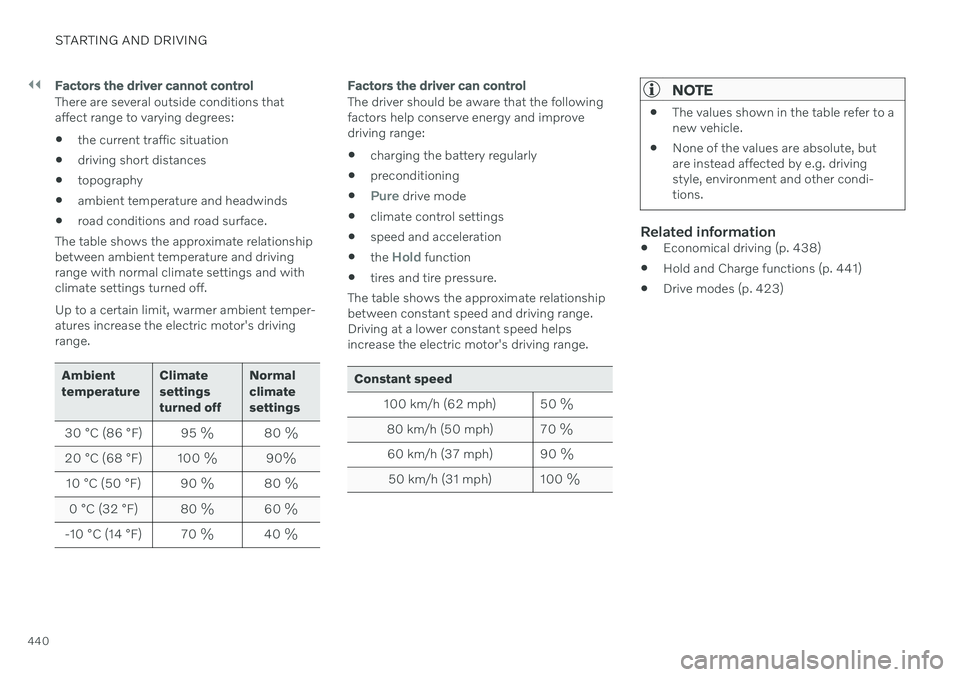
The table shows the approximate relationshipbetween ambient temperature and drivingrange with normal climate settings and withclimate settings turned off. Up to a certain limit, warmer ambient temper- atures increase the electric motor's drivingrange.
Ambient temperature Climatesettingsturned offNormalclimatesettings
30 °C (86 °F) 95 % 80 %
20 °C (68 °F) 100 % 90%
10 °C (50 °F) 90 % 80 %
0 °C (32 °F) 80 % 60 %
-10 °C (14 °F) 70 % 40 %
Factors the driver can control
The driver should be aware that the following factors help conserve energy and improvedriving range: charging the battery regularly
preconditioning
Pure drive mode
climate control settings
speed and acceleration
the
Hold function
tires and tire pressure.
The table shows the approximate relationship between constant speed and driving range.Driving at a lower constant speed helpsincrease the electric motor's driving range.
Constant speed
100 km/h (62 mph) 50 %80 km/h (50 mph) 70 %60 km/h (37 mph) 90 %
50 km/h (31 mph) 100 %
NOTE
The values shown in the table refer to a new vehicle.
None of the values are absolute, butare instead affected by e.g. drivingstyle, environment and other condi-tions.
Related information
Economical driving (p. 438)
Hold and Charge functions (p. 441)
Drive modes (p. 423)
Page 549 of 687
WHEELS AND TIRES
}}
* Option/accessory.547
Recommended tire pressure
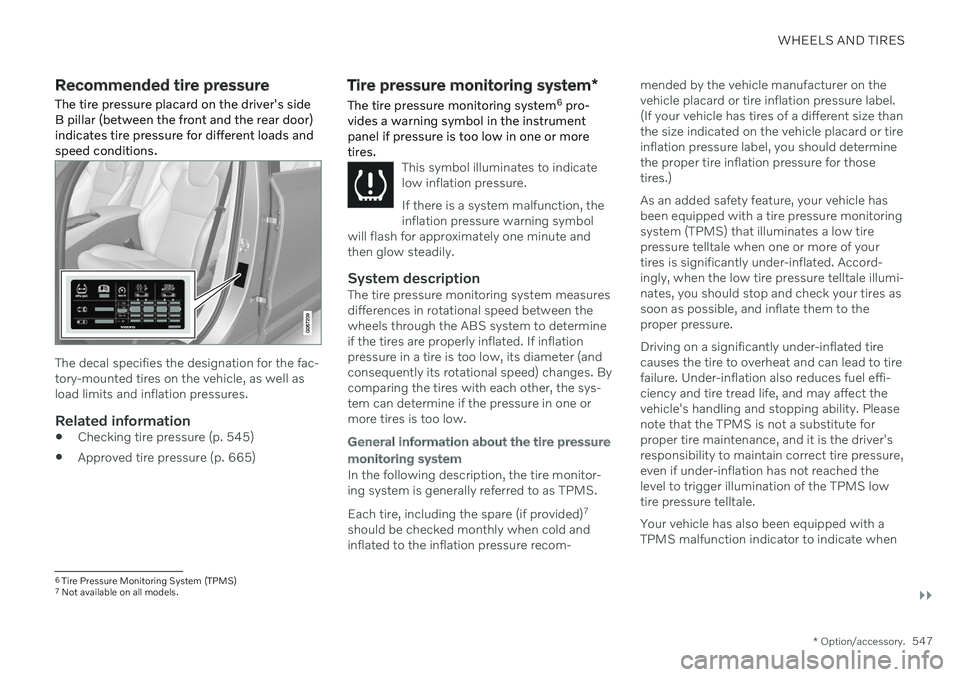
The tire pressure placard on the driver's side B pillar (between the front and the rear door)indicates tire pressure for different loads andspeed conditions.
The decal specifies the designation for the fac- tory-mounted tires on the vehicle, as well asload limits and inflation pressures.
Related information
Checking tire pressure (p. 545)
Approved tire pressure (p. 665)
Tire pressure monitoring system
*
The tire pressure monitoring system 6
pro-
vides a warning symbol in the instrument panel if pressure is too low in one or moretires.
This symbol illuminates to indicate low inflation pressure. If there is a system malfunction, the inflation pressure warning symbol
will flash for approximately one minute andthen glow steadily.
System descriptionThe tire pressure monitoring system measures differences in rotational speed between thewheels through the ABS system to determineif the tires are properly inflated. If inflationpressure in a tire is too low, its diameter (andconsequently its rotational speed) changes. Bycomparing the tires with each other, the sys-tem can determine if the pressure in one ormore tires is too low.
General information about the tire pressure monitoring system
In the following description, the tire monitor- ing system is generally referred to as TPMS. Each tire, including the spare (if provided) 7
should be checked monthly when cold and inflated to the inflation pressure recom- mended by the vehicle manufacturer on thevehicle placard or tire inflation pressure label.(If your vehicle has tires of a different size thanthe size indicated on the vehicle placard or tireinflation pressure label, you should determinethe proper tire inflation pressure for thosetires.) As an added safety feature, your vehicle has been equipped with a tire pressure monitoringsystem (TPMS) that illuminates a low tirepressure telltale when one or more of yourtires is significantly under-inflated. Accord-ingly, when the low tire pressure telltale illumi-nates, you should stop and check your tires assoon as possible, and inflate them to theproper pressure. Driving on a significantly under-inflated tire causes the tire to overheat and can lead to tirefailure. Under-inflation also reduces fuel effi-ciency and tire tread life, and may affect thevehicle's handling and stopping ability. Pleasenote that the TPMS is not a substitute forproper tire maintenance, and it is the driver'sresponsibility to maintain correct tire pressure,even if under-inflation has not reached thelevel to trigger illumination of the TPMS lowtire pressure telltale. Your vehicle has also been equipped with a TPMS malfunction indicator to indicate when
6
Tire Pressure Monitoring System (TPMS)
7 Not available on all models.
Page 597 of 687
MAINTENANCE AND SERVICE
}}
* Option/accessory.595
Vehicle status The vehicle's general status can be displayed in the center display along with the option to schedule service3
.
The Car Status app is started
from the center display's App view and has four tabs:
Messages - status messages
Status – checking engine oil level and
AdBlue level 4
TPMS - tire inflation pressure check
Appointments - appointment information
and vehicle information 3
.
Related information
Handling messages saved from the instru- ment panel (p. 111)
Checking and filling engine oil (p. 603)
Tire pressure monitoring system
* (p. 547)
Scheduling service and repairs (p. 595)
Sending vehicle information to the work-shop (p. 596)
Navigating in the center display's views(p. 118)
Scheduling service and repairs 5
This service offers a way to send a booking request for service and workshop appoint-ments directly from the vehicle.
When it is time for service, and in certain cases if the vehicle requires repairs, a mes-sage will be displayed in the instrument paneland at the top of the center display. The timefor service is determined by how much timehas elapsed, the number of hours the enginehas run, or the distance driven since the lastservice.
To use the service
Create a Volvo ID and register it to thevehicle.
To send and receive appointment informa-tion, the vehicle must be connected to the Internet 6
.
Book serviceBook a service request when desired or when a message is displayed indicating that serviceor repairs are needed. 1. Open the
Car Status app from App view
in the center display.
2. Tap
Appointments. 3.
Tap
Request appointment.
4. Check that your
Volvo ID is correct.
5. Make sure your preferred
Workshop is
correct.
6. In the
Tap to write information to the
workshop field, you can provide details
on what you would like performed during the visit or other important information toyour workshop.
7. Tap
Send appointment request.
> You will receive an appointment sug- gestion by email within a couple of days 7
.
On some markets, the message in the instrument panel indicating that thevehicle requires service will go out oncethe appointment request has been sent.
8. Tap
Cancel request if you would like to
cancel your request.
The appointment request contains information about your vehicle that helps the workshopplan for your visit. The retailer will send you a digital appointment suggestion. You also have information aboutyour retailer available in the vehicle so that youcan contact your workshop.
3 Certain markets only.
4 AdBlue Diesel models only.
5 Certain markets only.
Page 609 of 687

MAINTENANCE AND SERVICE
}}
607
Start battery
The vehicle has a single-pole electrical sys- tem that uses the chassis and engine mountas conductors. The start battery is used to start the electrical system and power electrical equipment in thevehicle. The hybrid battery is used to start thecombustion engine. The start battery should only be replaced by a workshop 17
.
The start battery is a 12 V AGM (Absorbed Glass Mat) battery, dimensioned for regenera-tive charging and to support the function ofthe vehicle's various systems. The service life and performance of the start battery are affected by factors such as drivingstyle, driving conditions, climate, battery dis-charges, number of starts, etc. Never disconnect the start battery while the engine is running.
Make sure the cables to the start batteryare correctly connected and the clampsare securely tightened.
WARNING
Batteries generate hydrogen gas, which is flammable and explosive.
Do not connect the jumper cable toany part of the fuel system or to anymoving parts. Avoid touching hotmanifolds.
Battery fluid contains sulfuric acid. Donot allow battery fluid to contact eyes,skin, fabrics or painted surfaces.
If contact occurs, flush the affectedarea immediately with water. Obtainmedical help immediately if eyes areaffected.
Never expose the battery to open flameor electric spark. Do not smoke nearthe battery. Failure to follow theinstructions for jump starting can leadto injury.
Connection points
WARNING
California Proposition 65 Operating, servicing and maintaining a pas- senger vehicle can expose you to chemi-cals including engine exhaust, carbon mon-oxide, phthalates, and lead, which areknown to the State of California to causecancer and birth defects or other reproduc-tive harm. To minimize exposure, avoidbreathing exhaust, do not idle the engineexcept as necessary, service your vehicle ina well ventilated area and wear gloves orwash your hands frequently when servicingyour vehicle. For more information go towww.P65Warnings.ca.gov/passenger-vehicle.
Use the vehicle's connection points in the engine compartment to connect an externalstart battery or battery charger. The battery terminals on the car's start battery in the luggage/cargo area must not be used.
17
An authorized Volvo workshop is recommended.
Page 620 of 687
||
MAINTENANCE AND SERVICE
* Option/accessory.
618
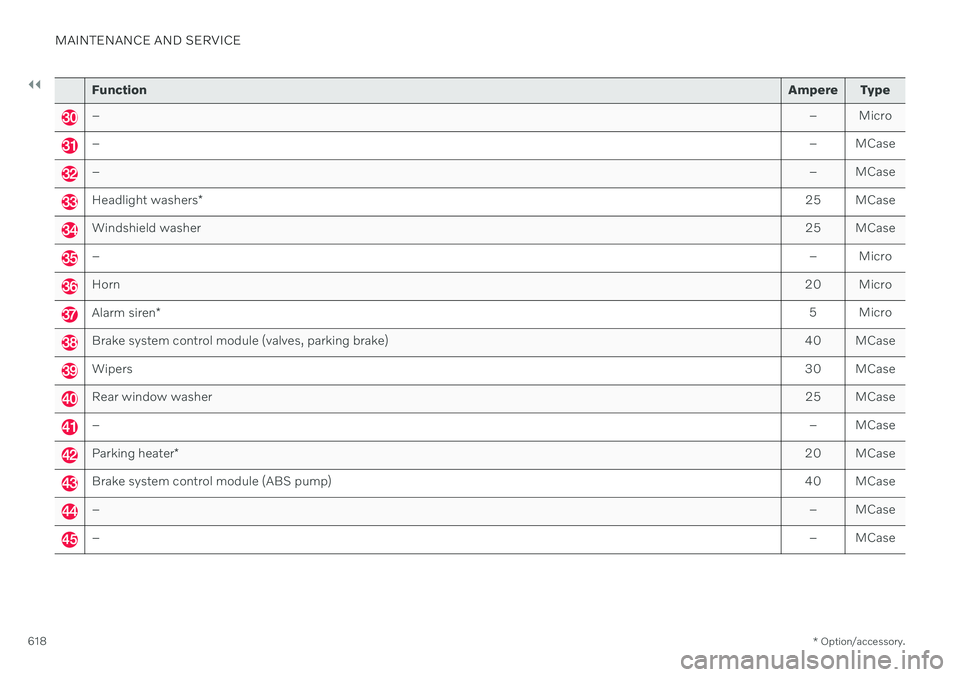
Function Ampere Type
– – Micro
–– MCase
–– MCase
Headlight washers* 25 MCase
Windshield washer
25 MCase
– – Micro
Horn20 Micro
Alarm siren* 5 Micro
Brake system control module (valves, parking brake)
40 MCase
Wipers30 MCase
Rear window washer 25 MCase
– – MCase
Parking heater* 20 MCase
Brake system control module (ABS pump)
40 MCase
– – MCase
–– MCase