oil VOLVO XC60 TWIN ENGINE 2020 Owner's Manual
[x] Cancel search | Manufacturer: VOLVO, Model Year: 2020, Model line: XC60 TWIN ENGINE, Model: VOLVO XC60 TWIN ENGINE 2020Pages: 687, PDF Size: 14.65 MB
Page 644 of 687

MAINTENANCE AND SERVICE
* Option/accessory.
642
Settings for automatically activating the parking brake (p. 413)
Keyless and touch-sensitive surfaces
*
(p. 253)
High-pressure washing The vehicle should be washed as soon as it becomes dirty. The longer the dirt remains,the more difficult it will be to keep the vehicleclean. It could also lead to paint damage.Wash the vehicle in a car wash or garagewith an oil separator. Use a car washingdetergent.
If washing the vehicle with a high-pressure wash, use sweeping movements and keep thenozzle at least 30 cm (13 in.) from the vehicle.Do not spray directly onto locks.
Related information
Cleaning the exterior (p. 638)
Polishing and waxing (p. 638)
Hand washing (p. 639)
Automatic car washes (p. 641)
Cleaning the wiper blades (p. 642)
Cleaning exterior plastic, rubber and trimcomponents (p. 643)
Cleaning rims (p. 644)
Corrosion protection (p. 644)
Cleaning the wiper blades The vehicle should be washed as soon as it becomes dirty. The longer the dirt remains,the more difficult it will be to keep the vehicleclean. It could also lead to paint damage.Wash the vehicle in a car wash or garagewith an oil separator. Use a car washingdetergent.
Asphalt, dust and salt residue on wiper blades, as well as insects, ice etc. on the windshield,shorten the service life of wiper blades. When cleaning, put the wiper blades in the service position.
NOTE
Wash the wiper blades and windshield regularly with a lukewarm soap solution orvehicle shampoo. Do not use strong sol-vents.
Related information
Cleaning the exterior (p. 638)
Polishing and waxing (p. 638)
Hand washing (p. 639)
Automatic car washes (p. 641)
High-pressure washing (p. 642)
Cleaning exterior plastic, rubber and trim components (p. 643)
Page 645 of 687
MAINTENANCE AND SERVICE
}}
* Option/accessory.643
Cleaning rims (p. 644)
Corrosion protection (p. 644)
Cleaning exterior plastic, rubber and trim components The vehicle should be washed as soon as it becomes dirty. The longer the dirt remains,the more difficult it will be to keep the vehicleclean. It could also lead to paint damage.Wash the vehicle in a car wash or garagewith an oil separator and use car washingdetergent.
A special cleaning agent available from Volvo retailers is recommended for the cleaning andcare of colored plastic parts, rubber and trimcomponents, e.g. glossy trim. Follow theusage instructions for the cleaning agent care-fully. Avoid using car washing detergents with a pH value lower than 3.5 or higher than 11.5. Doingso could result in the discoloring of anodized aluminum surfaces
* (as shown in the illustra-
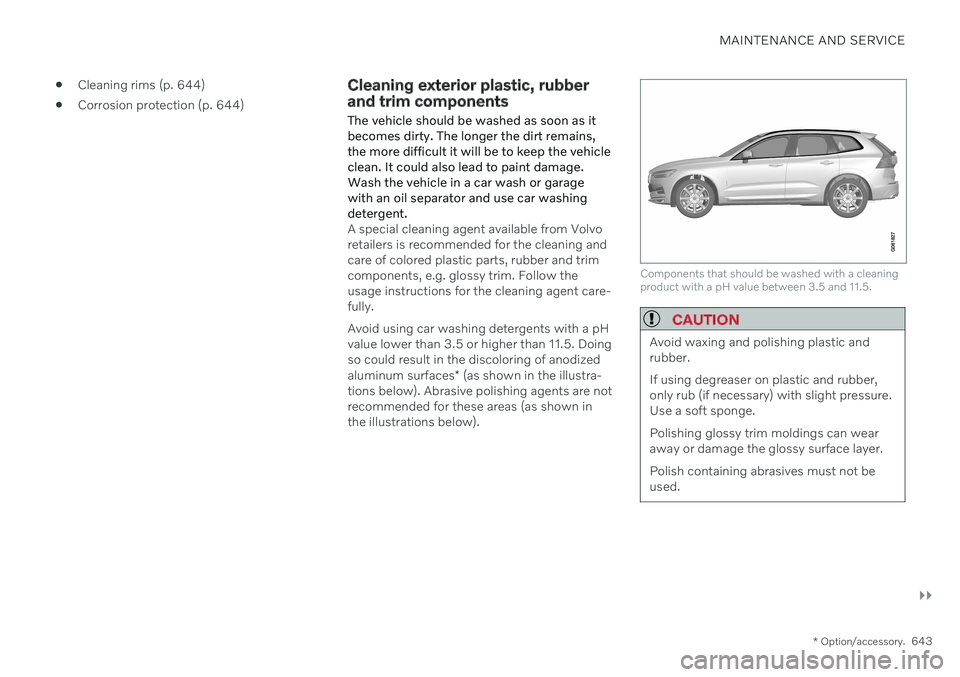
tions below). Abrasive polishing agents are not recommended for these areas (as shown in the illustrations below).
Components that should be washed with a cleaning product with a pH value between 3.5 and 11.5.
CAUTION
Avoid waxing and polishing plastic and rubber. If using degreaser on plastic and rubber, only rub (if necessary) with slight pressure.Use a soft sponge. Polishing glossy trim moldings can wear away or damage the glossy surface layer. Polish containing abrasives must not be used.
Page 646 of 687
||
MAINTENANCE AND SERVICE
644
CAUTION
Avoid washing the vehicle with cleaner with a pH value below 3.5 or above 11.5.This could cause discoloration of anodizedaluminum components like the roof rail andaround the side windows. Never use metal polishing agent on ano- dized aluminum components. This couldcause discoloration and destroy the sur-face treatment.
Related information
Cleaning the exterior (p. 638)
Polishing and waxing (p. 638)
Hand washing (p. 639)
Automatic car washes (p. 641)
High-pressure washing (p. 642)
Cleaning the wiper blades (p. 642)
Cleaning rims (p. 644)
Corrosion protection (p. 644)
Cleaning rims
The vehicle should be washed as soon as it becomes dirty. The longer the dirt remains,the more difficult it will be to keep the vehicleclean. It could also lead to paint damage.Wash the vehicle in a car wash or garagewith an oil separator and use car washingdetergent.
Only use rim cleaning products recommended by Volvo. Strong rim cleaning agents could damage the surface and stain the chromed aluminum rims.
Related information
Cleaning the exterior (p. 638)
Polishing and waxing (p. 638)
Hand washing (p. 639)
Automatic car washes (p. 641)
High-pressure washing (p. 642)
Cleaning exterior plastic, rubber and trimcomponents (p. 643)
Cleaning rims (p. 644)
Corrosion protection (p. 644)
Corrosion protection Your vehicle is constructed with protection against corrosion.
Corrosion protection for the body consists of modern metallic protective coatings on thesheet metal, a high-quality painting process,corrosion-protected and minimized metaloverlap, and shielding plastic components,abrasion protection and supplemental rustinhibitor in exposed areas. In the chassis,exposed components of the wheel suspensionare made of corrosion-resistant cast alumi-num.
Inspection and maintenanceThe corrosion protection does not normallyrequire maintenance, but keeping the vehicleclean helps reduce the risk of corrosion. Theuse of strong alkaline or acidic cleaning fluidsshould be avoided on shiny body components.Any stone chips in the paint should betouched up as soon as they are discovered.
Related information
Cleaning the exterior (p. 638)
Polishing and waxing (p. 638)
Hand washing (p. 639)
Automatic car washes (p. 641)
High-pressure washing (p. 642)
Cleaning the wiper blades (p. 642)
Page 658 of 687

||
SPECIFICATIONS
656
Federal Motor Vehicle Safety Standards
(FMVSS) specifications (USA) and Ministry of Transport (CMVSS) standards (Canada).Your Volvo is designed to meet all applicablesafety standards, as evidenced by the certifi-cation label on the driver's side B-pillar (thestructural member at the side of the vehicle, atthe rear of the driver's door opening). Thislabel also includes codes for paint color, etc.For further information regarding these regula-tions, please consult your Volvo retailer. U.S.models have the upper decal; Canadian mod-els have the lower one. Engine oil. This label contains the recom-
mended engine oil specifications.
Decal A/C. Refrigerant R134a.
NOTE
The decals shown in the Owner's Manual do not claim to be exact reproductions ofthose found in the vehicle. The purpose isto show approximately how they look andabout where they are located on the vehi-cle. The information that applies for yourvehicle in particular is found on the decalon the vehicle.
Related information
Air conditioning specifications (p. 664)
Page 663 of 687

SPECIFICATIONS
661
Engine specifications Engine specifications (output, etc.) for each engine variant are shown in the table below.The specifications for Special Edition vehiclesmay vary.Twin Engine vehicles are powered by both agasoline engine and an electric motor (ERAD– Electric Rear Axle Drive).NOTE
Not all engines are available on all markets.
Engine
Engine codeA
Output
(kW/rps) Output
(hp/rpm) Torque
(Nm/rps) Torque
(ft. lbs./rpm) Number of cylinders
T8 Twin Engine B4204T28 233/100 313/6000 400/37–90 295/2200–5400 4
T8 Twin Engine Polestar B4204T39 245/100 328/6000 430/75 317/4500 4
A The engine code, component and manufacturer serial numbers can be found on the engine.
Electric motorMax. output: 65 kW (87 hp).
Torque: 240 Nm.
Related information
Type designations (p. 654)
Engine oil specifications (p. 662)
Coolant specifications (p. 663)
Page 664 of 687
SPECIFICATIONS
662
Engine oil specifications Fully synthetic engine oil of at least ACEA A5/B5 must be used. Lower oil gradesmay not offer the same fuel economy, engineperformance or engine protection.
Volvo recommends:
GeneralSee the Service and warranty booklet for infor- mation about oil change intervals.
NOTE
This vehicle is delivered from the factory with synthetic oil.
Do not use oil additives.
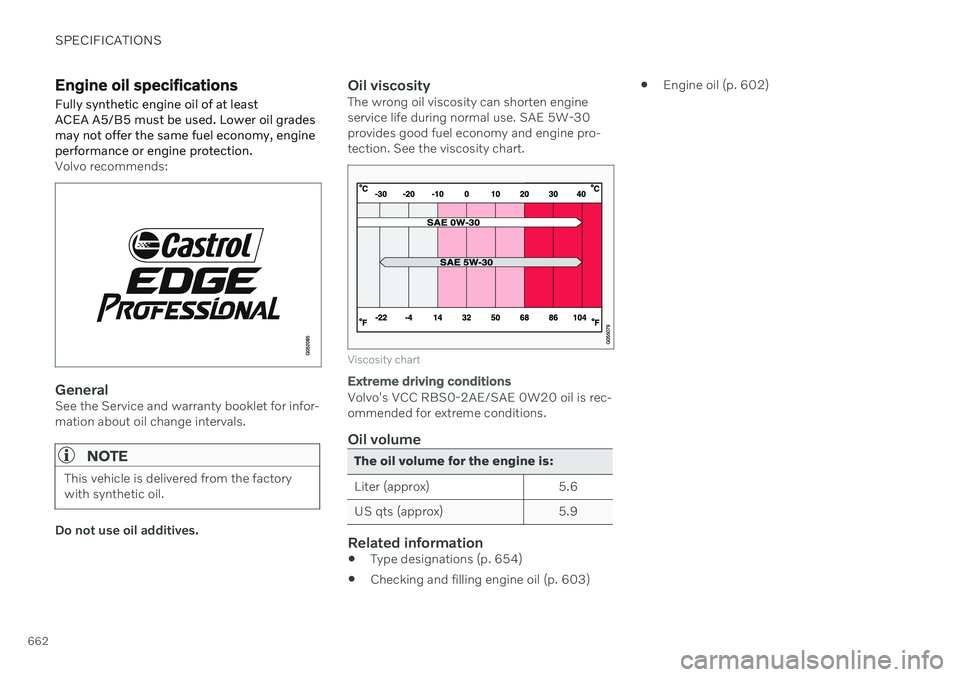
Oil viscosityThe wrong oil viscosity can shorten engine service life during normal use. SAE 5W-30provides good fuel economy and engine pro-tection. See the viscosity chart.
Viscosity chart
Extreme driving conditions
Volvo's VCC RBS0-2AE/SAE 0W20 oil is rec- ommended for extreme conditions.
Oil volume
The oil volume for the engine is:
Liter (approx) 5.6
US qts (approx) 5.9
Related information
Type designations (p. 654)
Checking and filling engine oil (p. 603)
Engine oil (p. 602)
Page 666 of 687
SPECIFICATIONS
664
Fuel tank volume
The fuel tank's refillable volume is shown in the table below.
All models
Liter (approx) 70
US gallons (approx) 18.5
Related information
Refueling (p. 445)
Octane rating (p. 447)
Air conditioning specifications
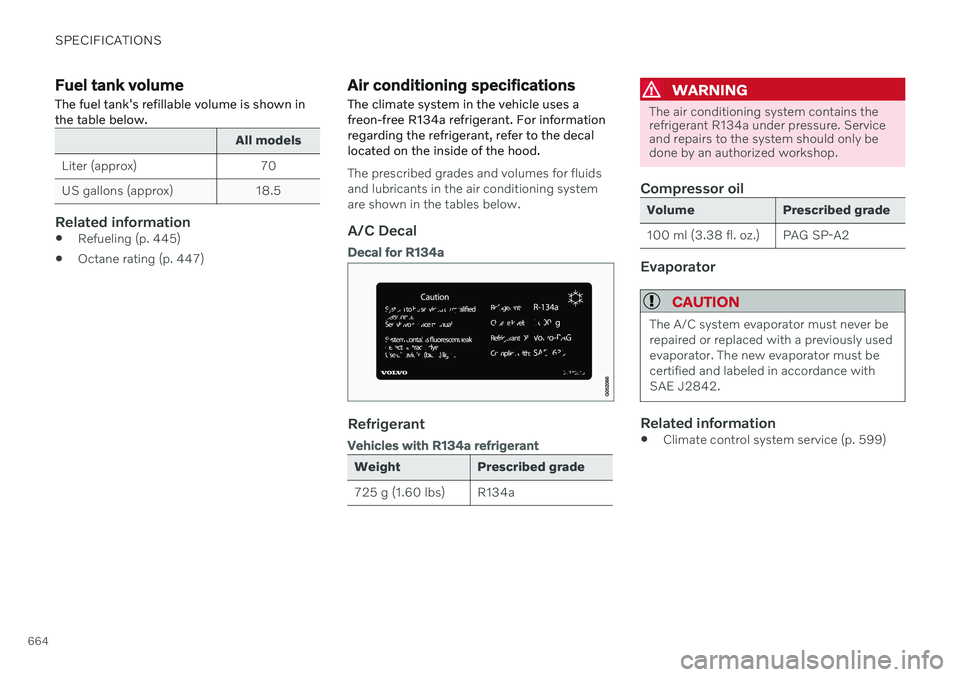
The climate system in the vehicle uses a freon-free R134a refrigerant. For informationregarding the refrigerant, refer to the decallocated on the inside of the hood.
The prescribed grades and volumes for fluids and lubricants in the air conditioning systemare shown in the tables below.
A/C Decal
Decal for R134a
Refrigerant
Vehicles with R134a refrigerant
Weight Prescribed grade
725 g (1.60 lbs) R134a
WARNING
The air conditioning system contains the refrigerant R134a under pressure. Serviceand repairs to the system should only bedone by an authorized workshop.
Compressor oil
Volume Prescribed grade
100 ml (3.38 fl. oz.) PAG SP-A2
Evaporator
CAUTION
The A/C system evaporator must never be repaired or replaced with a previously usedevaporator. The new evaporator must becertified and labeled in accordance withSAE J2842.
Related information
Climate control system service (p. 599)
Page 670 of 687
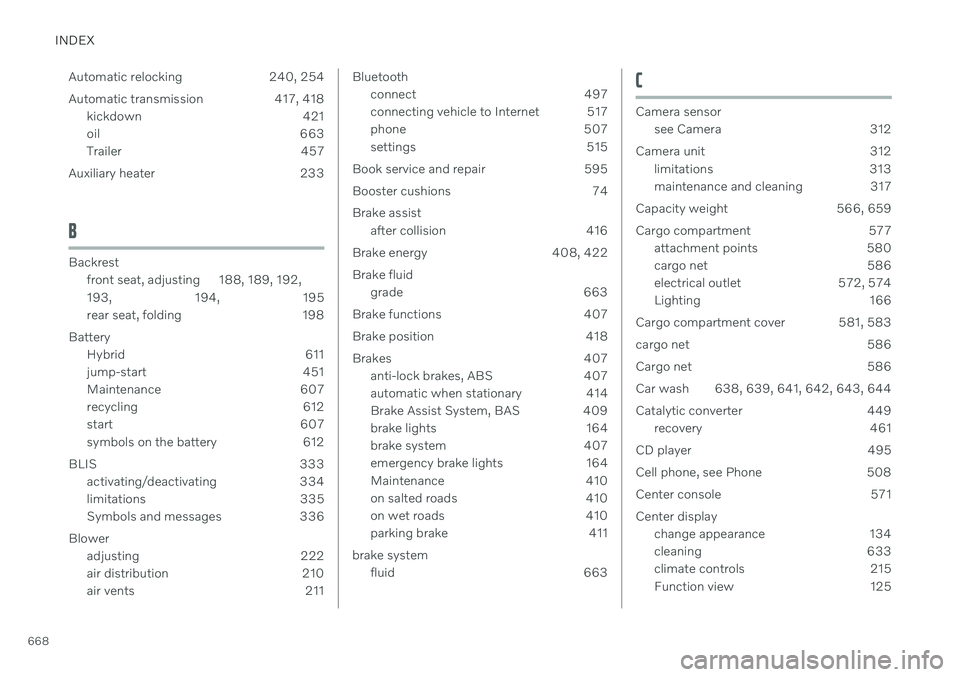
INDEX
668Automatic relocking 240, 254
Automatic transmission 417, 418
kickdown 421
oil 663
Trailer 457
Auxiliary heater 233
B
Backrest front seat, adjusting 188, 189, 192, 193 , 194, 195
rear seat, folding 198
Battery Hybrid 611
jump-start 451
Maintenance 607
recycling 612
start 607
symbols on the battery 612
BLIS 333 activating/deactivating 334
limitations 335
Symbols and messages 336
Blower adjusting 222
air distribution 210
air vents 211
Bluetooth
connect 497
connecting vehicle to Internet 517
phone 507
settings 515
Book service and repair 595
Booster cushions 74Brake assist after collision 416
Brake energy 408, 422Brake fluid grade 663
Brake functions 407
Brake position 418
Brakes 407 anti-lock brakes, ABS 407
automatic when stationary 414
Brake Assist System, BAS 409
brake lights 164
brake system 407
emergency brake lights 164
Maintenance 410
on salted roads 410
on wet roads 410
parking brake 411
brake system fluid 663C
Camera sensorsee Camera 312
Camera unit 312 limitations 313
maintenance and cleaning 317
Capacity weight 566, 659
Cargo compartment 577 attachment points 580
cargo net 586
electrical outlet 572, 574
Lighting 166
Cargo compartment cover 581, 583
cargo net 586
Cargo net 586
Car wash 638, 639, 641, 642, 643, 644
Catalytic converter 449 recovery 461
CD player 495
Cell phone, see Phone 508
Center console 571Center display change appearance 134
cleaning 633
climate controls 215
Function view 125
Page 671 of 687

INDEX
669
keyboard 129
messages 143, 144
operation 115, 118, 122, 127
overview 113
settings 135, 136
switch off and change volume 134
symbols in status bar 127
views 118
Central locking 257
Change of owner 137
Changing a wheel 552 Charge vehicle function 441
Charge level vehicle function 441
Charging hybrid battery 385 opening and closing the charging
door 390
start charging 390
Status 392, 393, 394
stop charging 396
Charging cable 387
Charging current 387
Checking engine oil level 603
Child restraints 65, 67 booster cushions 74
convertible seats 71
infant seats 69
integrated booster cushion 78
ISOFIX/LATCH anchors 77
lower attachment points 76
recalls and registration 67
top tether anchors 75
Child safety 65
Child safety locks 259
Circuit breaker 389
City Safety 318 braking for oncoming vehicles 327
crossing traffic 324
delayed evasive maneuver 327
detecting obstacles 322
evasive maneuver 326
limitations 328
limitations for evasive maneuvers 326
limitations in crossing traffic 325
setting warning distance 321
sub-functions 319
Symbols and messages 331
Cleaning 635, 637 automatic car wash 641
car wash 638, 639, 641, 642, 643, 644
center display 633
Seat belts 635
textile upholstery 633, 635, 636upholstery 633, 635, 636, 637
wheels 644
Cleaning wheels 644
Cleaning wiper blades 642
Clean Zone 207
Clean Zone Interior Package 208
Climate 204 auto-regulation 219
blower control 222
parking 225
perceived temperature 205
Sensors 204
temperature control 223, 224
voice control 205
zones 204
Climate controls 215 center display 215
rear seat 215
Climate system 204, 215 Refrigerant 664
repairs 599
Clock, setting 96
Collision 44, 49, 54, 63 Collision warner crossing traffic rear 337
see City Safety 318
Page 673 of 687

INDEX
671
Driver Alert Control 346
activating/deactivating 347
limitations 348
rest stop guidance 347
Driver performance 94 settings 95
Driver profile 139 edit 140, 141, 143
select 140
Driver support system 272 Drive mode 305
Drive systems 422 Driving cooling system 450
with a trailer 457
Driving economy 438
Driving through standing water 443 driving with a trailer towball load 660
towing capacity 660
E
Economical driving 438
Electrical outlet 572use 574
Electrical system 607
Electric drive motor specifications 661
electric motor 422 Range 439
Electric parking brake 411
Electronic immobilizer 251
emergency brake lights 164
Emission inspection readiness 590Energy distribution using map data 429
Engine automatic start and stop of combus-
tion engine 423
overheating 450
start 402
turn off 404
Engine braking 407, 418, 436 Engine compartment coolant 604
engine oil 602
overview 601
Engine drag control 273
Engine oil 602 filling 603
filter 602
grade and volume 662
Engine shutdown 404Engine specifications 661 Engine temperature high 450
Environment 30Ethanol content max. 10% by volume 446
Exterior dimensions 657
Extra heater (Auxiliary heater) 233
F
Federal Clean Air Act 590
Ferry transport 430
Flooded road 443
Fluids, volumes 650, 664
Fluids and oils 663, 664 Fog lights rear 163
Four-C 430 Front seat blower 222
climate 215
heating 216, 217
temperature 223
ventilation 217
Front seat manual 188