air condition VOLVO XC70 2003 User Guide
[x] Cancel search | Manufacturer: VOLVO, Model Year: 2003, Model line: XC70, Model: VOLVO XC70 2003Pages: 257, PDF Size: 5.33 MB
Page 79 of 257

2003 VOLVO XC70
l Press for more that 3 seconds. the LED flashes for 5 seconds. the air recircu\
lates in the car
for 3-12 minutes depending on the outside temperature.
l The timer function is activated each time you press .
To switch off the timer function :
l Press again for more than 3 seconds. The LED lights for 5 seconds to confirm \
your selection.
Recirculation is always disconnected when you select Defroster
.
Blower
Blower speed can be increases or decreased by turning the knob. If the k\
nob is set to 0, the air
conditioning function is automatically disengaged.
Temperature
Turn the control to set the temperature for the driver's and passenger's\
sides of the car. For cooler air, the
air conditioning function must be engaged.
Air distribution
Use the air distribution control positions (marked with dots) between \
the different symbols to fine-tune
air distribution for the maximum comfort.
pg. 54 Manual climate control with air conditioning, A/C
Air distribution
file:///K|/ownersdocs/2003/2003_XC70/03xc70_03.htm (11 of 12)12/30/200\
6 4:17:55 PM
Page 139 of 257

2003 VOLVO XC70
pattern, load-, speed-, traction-, temperature-, and treadwear rating. N\
ever drive on mixed tires, except
for brief periods when the temporary spare tire is in use.
Always use properly inflated tires of correct dimensions. Tire size and \
inflation pressures are shown on
the tire pressure label located inside the fuel filler door.
Tire Rotation
Volvo recommends rotating the tires every 7,500 miles (12,000 km). Tir\
es should be rotated front-to-
back/back-to-front only. Tires must maintain the same direction of rotat\
ion throughout their lifetime, and
should never be rotated from one side of the vehicle to the other.
Temporary Spare
The temporary spare tire is for temporary, low-speed, short-distance use\
only. Replace it with a full-
sized tire as soon as possible, in accordance with "Tire Rotation" above\
. Do not drive on the temporary
spare at speeds above 50 m.p.h. (80km/h) or for distances greater than\
50 miles (80 km).
Never install snow chains on a temporary spare.
pg. 95 Driving economy
Economical driving conserves natural resources
Better driving economy may be obtained by thinking ahead, avoiding rapid\
starts and stops and
adjusting the speed of your vehicle to immediate traffic conditions. Obs\
erve the following rules:
l Bring the engine to normal operating temperature as soon as possible by \
driving with a light foot on
the accelerator pedal for the first few minutes of operation. A cold eng\
ine uses more fuel and is subject
to increased wear.
l Whenever possible, avoid using the car for driving short distances. This\
does not allow the engine to
reach normal operating temperature.
l Drive carefully and avoid rapid acceleration and hard braking.
l Do not exceed posted speed limits.
l Avoid carrying unnecessary items (extra load) in the car.
l Maintain correct tire pressure. Check tire pressure regularly (when tir\
es are cold).
l Remove snow tires when threat of snow or ice has ended.
l Note that roof racks, ski racks, etc., increase air resistance and also \
fuel consumption.
l Avoid using automatic transmission kickdown feature unless necessary.
l Avoid using the air conditioning when it is not required. When engaged, \
the conditioner's compressor
places an additional load on the engine. However, at higher driving spee\
ds, fuel consumption will be
file:///K|/ownersdocs/2003/2003_XC70/03xc70_06a.htm (16 of 22)12/30/20\
06 4:18:00 PM
Page 140 of 257

2003 VOLVO XC70
lower with the air conditioning on and the windows closed than with the \
air conditioning off and the
windows open.
l Using the onboard trip computer's fuel consumption modes can help you le\
arn how to drive more
economically.
Other factors that decrease gas mileage are:
l Dirty air cleaner
l Dirty engine oil and clogged oil filter
l Dragging brakes
l Incorrect front end alignment Some of the above mentioned items and othe\
rs are checked at the
standard Maintenance Service intervals.
NOTE: Vehicles equipped with automatic transmissions should use (D)rive as o\
ften as possible and
avoid using "kick-down" to help improve fuel economy. Vehicles equipped \
with manual transmissions
should use fifth gear at highway speeds. At other times, choose the high\
est gear that still allows smooth
acceleration.
Weight distribution affects handling
At the specified curb weight your car has a tendency to understeer, whic\
h means that the steering wheel
has to be turned more than might seem appropriate for the curvature of a\
bend. This ensures good
stability and reduces the risk of rear wheel skid. Remember that these p\
roperties can alter with the
vehicle load. The heavier the load on the rear of the vehicle (e.g., he\
avily loaded (max. 220 lbs, 100 kg)
cargo area or when towing a trailer, the less the tendency to understeer\
.
Handling, roadholding
Vehicle load, tire design and inflation pressure all affect vehicle hand\
ling. Therefore, check that the tires
are inflated to the recommended pressure according to the vehicle load. \
See "Tire pressure" section.
Loads should be distributed so that capacity weight or maximum permissib\
le axle loads are not
exceeded.
pg. 96 Points to remember
Cooling system
The risk for engine overheating is greatest, especially in hot weather, \
when:
l Towing a trailer up steep inclines for prolonged periods at wide open th\
rottle and low engine rpm.
l Stopping the engine suddenly after high speed driving (so-called "after\
-boiling" can occur).
l To avoid overheating, the following rules should be followed: Do not dri\
ve for prolonged periods at
file:///K|/ownersdocs/2003/2003_XC70/03xc70_06a.htm (17 of 22)12/30/20\
06 4:18:00 PM
Page 141 of 257

2003 VOLVO XC70
engine speeds above 4500 rpm if you are towing a trailer in hilly terrai\
n.
Reduce speed when towing a trailer up long, steep inclines. The risk of \
overheating can be reduced by
switching off the air conditioning system for a short time.
Do not let the engine idle unnecessarily for prolonged periods.
Do not mount auxiliary lamps in front of the grill.
When the risk of overheating is imminent, or in the event of overheating\
(the temperature gauge goes
repeatedly into, or stays continually in, the red section), the followi\
ng precautions should be taken:
l Switch off the air conditioning system.
l Pull off the road, away from traffic, stop the car and put the gear sele\
ctor into neutral.
l Switch the heater to full (maximum) position. Increase the engine spee\
d to approx. 2000 rpm (twice
idling speed) until the temperature begins to drop.
WARNING!
Do not remove coolant expansion tank cap. The coolant will be extremely \
hot.
If necessary, see
page 129 and 132 for information on checking and topping-up the coolant
level.
CAUTION: Drive slowly and carefully if going through standing water (i.e. flood\
ed roadways, etc.).
Damage to the engine could result if excess water is drawn in through th\
e air intake system. Never drive
the vehicle in water deeper than 1 foot (300 mm). See the flood warnin\
g on
page 7.
WARNING!
l Driving with the tailgate open: Driving with the tailgate open could mean that poisonous exhaust
gases enter the passenger compartment.
If the tailgate must be kept open for any reason, proceed as follows:
- Close the windows.
- Set the ventilation system control to air flow to floor, windshield an\
d side windows and blower
control to its highest setting.
l Floor mats: An extra mat on the driver's floor can cause the accelerator pedal to \
catch. Check that
the movement of the accelerator pedal is not impeded. Not more than one \
protective floor covering
may be used at one time.
file:///K|/ownersdocs/2003/2003_XC70/03xc70_06a.htm (18 of 22)12/30/20\
06 4:18:00 PM
Page 149 of 257

2003 VOLVO XC70
pg. 101 Towing a trailer
When preparing for trailer towing, observe the following:
Volvo recommends the use of Volvo trailer hitches which are specially de\
signed for the car.
l Maximum trailer weight recommended by Volvo is:
Trailers without brakes: 1100 lbs (500 kg)
Trailers with brakes: 3300 lbs* (1,500 kg),
Observe the legal requirements of the state/province in which the vehicl\
es are registered.
l All Volvo models are equipped with energy-absorbing shock-mounted bumper\
s. Trailer hitch
installation should not interfere with the proper operation of this bump\
er system.
Trailer towing does not normally present any particular problems, but ta\
ke into consideration:
l Increase tire pressure to recommended full. See section "Wheels and tire\
s".
l When your car is new, avoid towing heavy trailers during the first 620 m\
iles (1000 km).
l Recommended hitch tongue load is:
Trailer weights below 2,650 lbs (1,200 kg) - 110 lbs (50 kg)
Trailer weights above 2,650 lbs (1,200 kg) - 165 lbs (75 kg)
l Maximum speed when towing a trailer: 50 mph (80 km/h).
l Engine and transmission are subject to increased loads. Therefore, engin\
e coolant temperature should
be closely watched when driving in hot climates or hilly terrain. Use a \
lower gear and turn off the air
conditioner if the temperature gauge needle enters the red range.
l If the automatic transmission begins to overheat, a message will be disp\
layed in the text window.
l Avoid overload and other abusive operation.
l Hauling a trailer affects handling, durability, and economy.
l It is necessary to balance trailer brakes with the towing vehicle brakes\
to provide a safe stop (check
and observe state/local regulations).
l Do not connect the trailer's brake system directly to the vehicle's brak\
e system.
l More frequent vehicle maintenance is required.
l Remove the ball and drawbar assembly when the hitch is not being used.
l Volvo recommends the use of synthetic engine oil when towing a trailer o\
ver long distances or in
mountainous areas.
file:///K|/ownersdocs/2003/2003_XC70/03xc70_06b.htm (4 of 10)12/30/200\
6 4:18:00 PM
Page 185 of 257
.
Cleaning the upholstery
l The fabric can be cleaned")
2003 VOLVO XC70
l Do not polish or wax your car in direct sunlight (the surface of the ca\
r should not be warmer than
113° F (45° C).
Cleaning the upholstery
l The fabric can be cleaned with soapy water or a detergent. For more difficult spot\
s caused by oil, ice
cream, shoe polish, grease, etc., use a clothing/fabric stain remover.
l The plastic in the upholstery can be cleaned with a soft cloth and mild soap soluti\
on.
l Leather upholstery/suede-like upholstery (alcanteraTM) can be cleaned with a soft cloth and mild
soap solution. For more difficult spots, Volvo offers a leather care kit\
.
l Under no circumstances should gasoline, naphtha or similar cleaning agen\
ts be used on the
plastic or the leather since these can cause damage.
Cleaning the seat belts
Clean only with lukewarm water and mild soap solution.
Cleaning floor mats
The floor mats should be vacuumed or brushed clean regularly, especially\
during winter, when they
should be taken out for drying. Spots on textile mats can be removed wit\
h a mild detergent.
Stain removal
l Take extra care when removing stains such as ink or lipstick since the c\
oloring can spread.
l Use solvents sparingly. Too much solvent can damage the seat padding.
l Start from the outside of the stain and work toward the center.
pg. 129 Maintenance service, Warranty
Maintenance service
Volvo advises you to follow the service program outlined in the Warranty\
and Service Records
Information booklet. This maintenance program contains inspections and s\
ervices necessary for the
proper function of your car. The maintenance services contain several ch\
ecks which require special
instruments and tools and therefore must be performed by a qualified tec\
hnician. To keep your Volvo in
top condition, specify time-tested and proven Genuine Volvo Parts and Ac\
cessories.
The Federal Clean Air Act - U.S.
file:///K|/ownersdocs/2003/2003_XC70/03xc70_08a.htm (20 of 21)12/30/20\
06 4:18:03 PM
Page 188 of 257

2003 VOLVO XC70
charcoal canister to the engine's air intake system and into the combust\
ion process.
NOTE:
l Overfilling the fuel tank can cause damage to the evaporative control sy\
stem.
l If the fuel filler cap is not closed tightly or if the engine is running\
when the car is refueled, the
Malfunction Indicator Lamp may indicate a fault.
l During a transitional period, a small number of service stations may sti\
ll have fuel nozzles that are not
compatible with the fuel filler neck on cars equipped with the evaporati\
ve emission control system
mandated by the U.S. Environmental Protection Agency and the California \
Air Resources Board. If you
experience difficulties in refueling your vehicle, please ask the gas st\
ation attendant for assistance.
CAUTION:
Fuel must not be siphoned from the fuel tank. This will damage the evapo\
rative control system.
pg. 131 Drive belt, Coolant
Belt check
Check the belt regularly to make sure it is in good condition and is cle\
an. A worn or dirty belt can cause
poor cooling and low alternator output as well as impair the operation o\
f the power steering and the air
conditioning unit.
NOTE: The drive belt is equipped with a self-tensioning mechanism and requires\
no adjustment
between changes.
WARNING!
The engine must not be running when this check is
performed.
Check coolant level
The cooling system must be filled with coolant and not leak to operate a\
t maximum efficiency. Check
the coolant level regularly. The level should be between the "MAX" and "\
MIN" marks on the expansion
tank. The check should be made with particular thoroughness when the eng\
ine is new or when the
cooling system has been drained. Do not remove the filler cap other than\
for topping up with coolant.
Frequent removal may prevent coolant circulation between the engine and \
the expansion tank during
file:///K|/ownersdocs/2003/2003_XC70/03xc70_08b.htm (2 of 16)12/30/200\
6 4:18:04 PM
Page 190 of 257

2003 VOLVO XC70
more often when the vehicle is driven under dirty and dusty conditions. \
The cartridge cannot be cleaned,
and should always be replaced with a new one.
Fuel filter
The fuel filter should be replaced at 105,000 miles (168,000 km) or at\
120,000 miles (193,000 km) for
the 2.5T engine on AWD models. The filter is replaced as a complete unit\
. Replace more frequently if
contaminated fuel is introduced into the tank, or if there is reason to \
suspect that this has occurred.
Fuel system, including filler cap, tank and lines and
connections
The ability of the fuel system to contain hydrocarbons depends upon a le\
ak-free system. Inspect fuel
lines every 30,000 miles (48,000 km).Check for proper sealing of the f\
uel filler cap which contains "O"
ring seals.
NOTE: If the fuel filler cap is not closed tightly or if the engine is running\
when the car is refueled, the
Check Engine light (Malfunction indicator) may indicate a fault. Howev\
er, your vehicle's performance
will not be affected. Use only Volvo original or approved fuel filler ca\
ps.
Timing belt
For proper functioning of the vehicle and its emission control systems, \
the timing belt and belt tensioner
must be replaced every 105,000 miles (168,000 km) or at 120,000 miles \
(193,000 km) for the 2.5T
engine on AWD models. Engine damage will occur if the belt fails.
PCV system
(on turbocharged models)
The nipple in the intake manifold and the filter at the end of the PCV h\
ose in the air cleaner should be
inspected and cleaned at 105,000 miles (168,000 km) and thereafter, ag\
ain at 150,000 mile (240,000 km)
intervals.
Spark plugs
The spark plugs should be replaced every 60,000 miles (96,000 km) unde\
r normal driving conditions.
City driving or fast highway driving may necessitate replacement sooner.\
Under normal driving conditions, spark plugs require no maintenance betw\
een replacement intervals.
file:///K|/ownersdocs/2003/2003_XC70/03xc70_08b.htm (4 of 16)12/30/200\
6 4:18:04 PM
Page 242 of 257
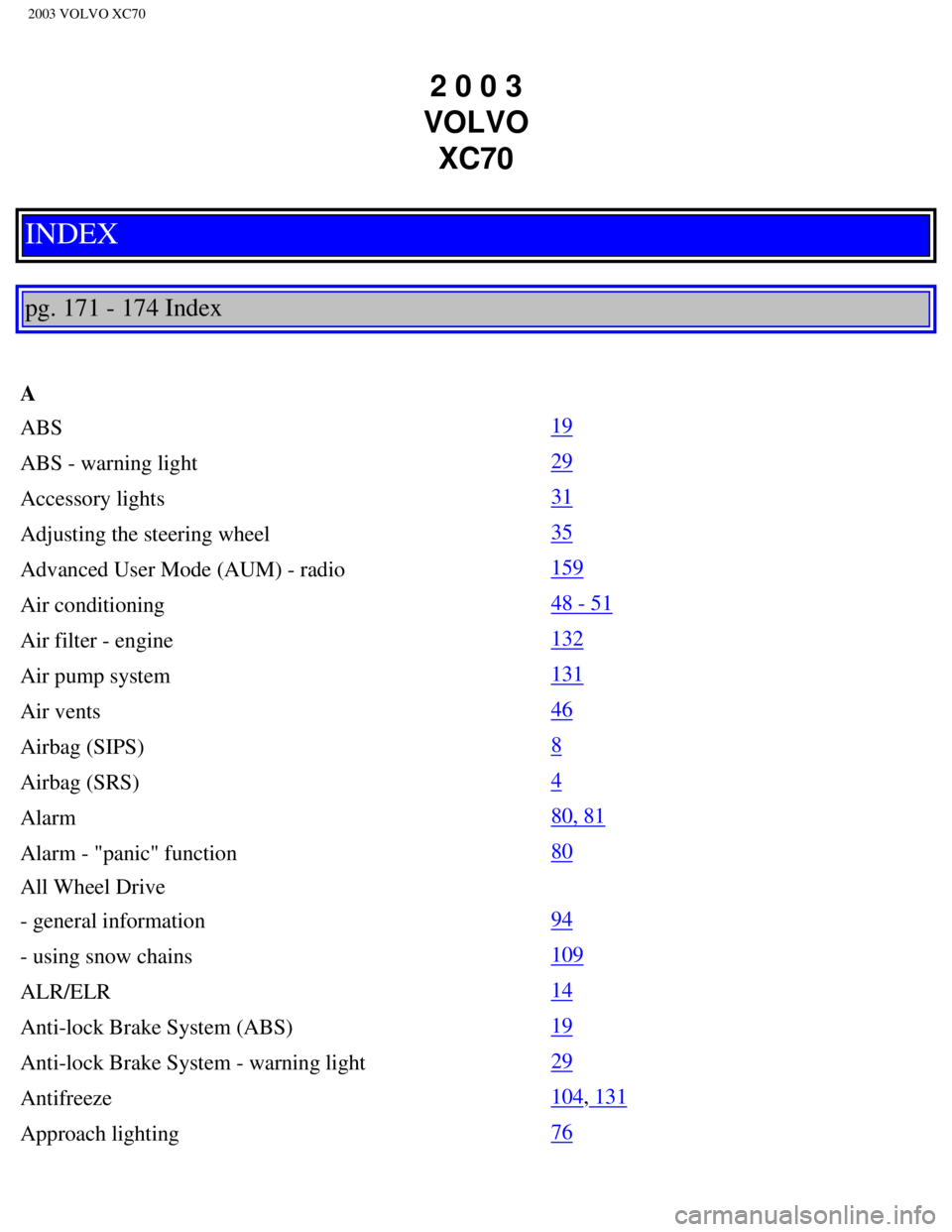
2003 VOLVO XC70
2 0 0 3
VOLVO XC70
INDEX
pg. 171 - 174 Index
A
ABS
19
ABS - warning light
29
Accessory lights
31
Adjusting the steering wheel
35
Advanced User Mode (AUM) - radio
159
Air conditioning
48 - 51
Air filter - engine
132
Air pump system
131
Air vents
46
Airbag (SIPS)
8
Airbag (SRS)
4
Alarm
80, 81
Alarm - "panic" function
80
All Wheel Drive
- general information
94
- using snow chains
109
ALR/ELR
14
Anti-lock Brake System (ABS)
19
Anti-lock Brake System - warning light
29
Antifreeze
104, 131
Approach lighting
76
file:///K|/ownersdocs/2003/2003_XC70/03xc70_12.htm (1 of 12)12/30/2006\
4:18:08 PM
Page 248 of 257

2003 VOLVO XC70
Instrument panel 27
Instruments
26
Integrated booster cushion
12
Interior Air Quality system
51
Interior features - overview
24
Interior lighting
74
J
Jack
72, 112
Jump starting
103
K
Key - removing from ignition switch
87
Keyless entry system
77, 78
Keyless entry system - replacing batteries
78
Keylock
87
Keys
76
Kickdown
91, 92
L
Label information
142
License plate lights - replacing
124
Lifting the car
133
Lights - accessory
31
Load carriers
97
Locking and unlocking the car
76
Locking steering wheel
35
Long distance trip
105
Long loads
57
M
Maintenance schedule
129
Malfunction indicator lamp
29
Manual climate control with air conditioning
52-54
Manual transmission
89, 145
Memory function - front seats
56
file:///K|/ownersdocs/2003/2003_XC70/03xc70_12.htm (7 of 12)12/30/2006\
4:18:08 PM